The late ’90s were home to extreme sports on consoles. There was a huge boom in this genre, and it led to many great games. Sled Storm is kind of an oddball, as snowmobile racing isn’t a huge hit in the US. However, EA managed to pull off a responsive and fun little racing title.
Sled Storm is similar to most arcade racing games from its time. There are several modes such as championship, single race, and multiplayer. Championship has two different modes. One mode is an open circuit with natural courses and you can upgrade your ride. The second one is a snocross closed-circuit event in which you just need to win. Sounds simple enough right?
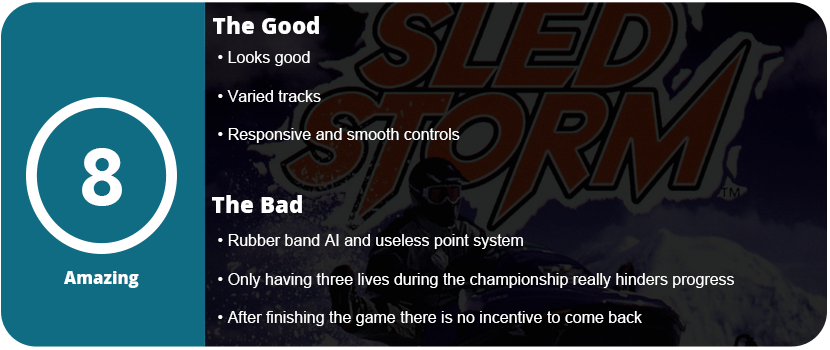
Wrong. You need to get first place in every race to advance. There are four other racers on the track, and the game is subject to frustrating rubber band AI. You can be ahead all through the race, and on the final lap, everyone seems to zoom ahead of you. One crash, and it’s restart time. The other annoying thing is that you only get three restarts and then have to restart the entire championship.
It’s rather annoying but tolerable. The crafts handle really well and the visuals are great. Powder flies up behind the vehicle into the camera every time you bounce or take a turn. There’s snow blowing toward you and the track is nicely detailed. The controls are what steal the show here. They feel smooth and very responsive and make you want to keep playing.
There is no fancy trick system here, but a point system is used for knocking down objects on the track and other reasons I couldn’t figure out. That’s about all there is to this game. The tracks actually vary, but after beating the championship there’s really no reason to come back. Think of this as a quick little 2-3 hour racing game and back on the shelf it goes.
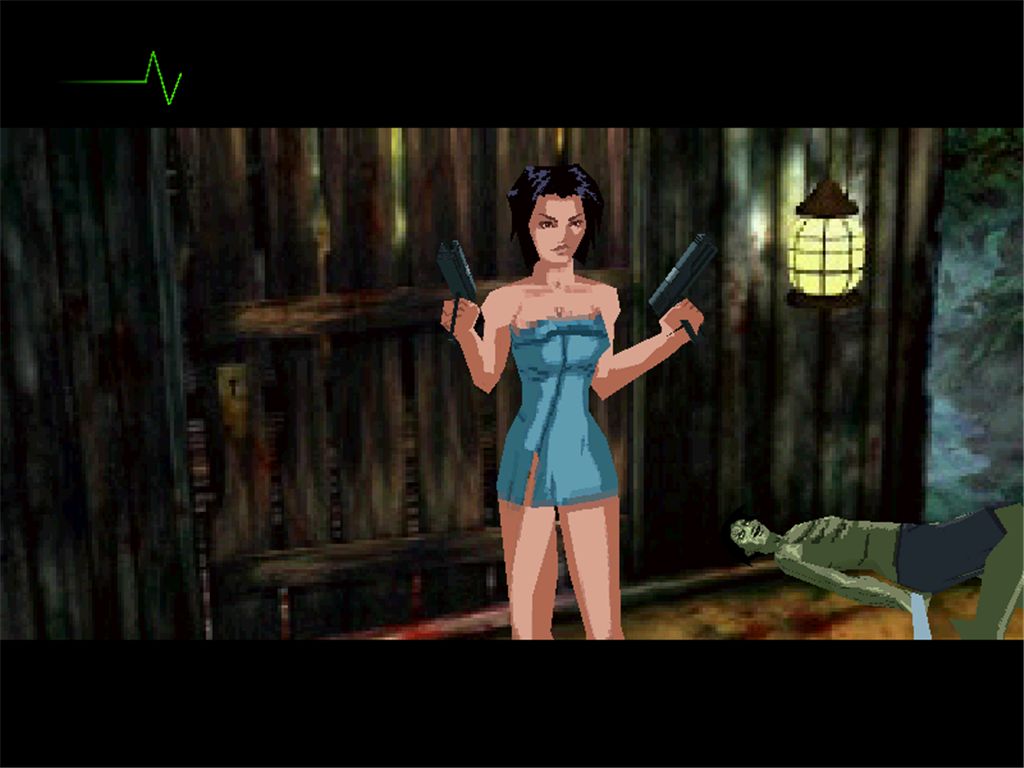
Fear Effect is actually a game that goes way back for me. I remember the summer of 2000 and was shopping around in a local game store, Game Doctor, back in Casper, Wyoming. There weren’t really any databases to look up reviews in back then, outside of magazines, so I would always pick a game based on its cover. I saw Fear Effect, $30, used in the display case. I used trade-in credit (back when it was all written down on carbon paper) and took the game home. Seeing it had four discs, I thought I was in for one hell of a ride.
I was actually dead wrong and returned the game the following day. It was frustrating, hard, and too mature for my age at the time. It’s so strange finishing this game almost 20 years later and realizing that it was actually harder than I thought. This game is downright unfair and frustrating around every corner.
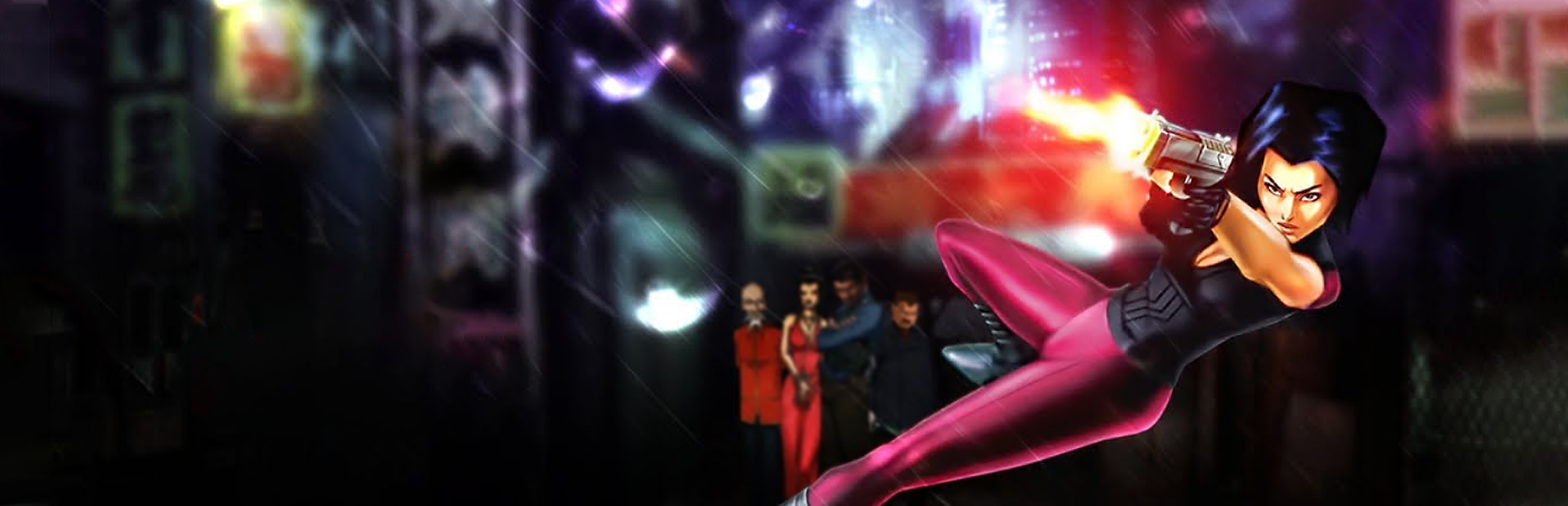
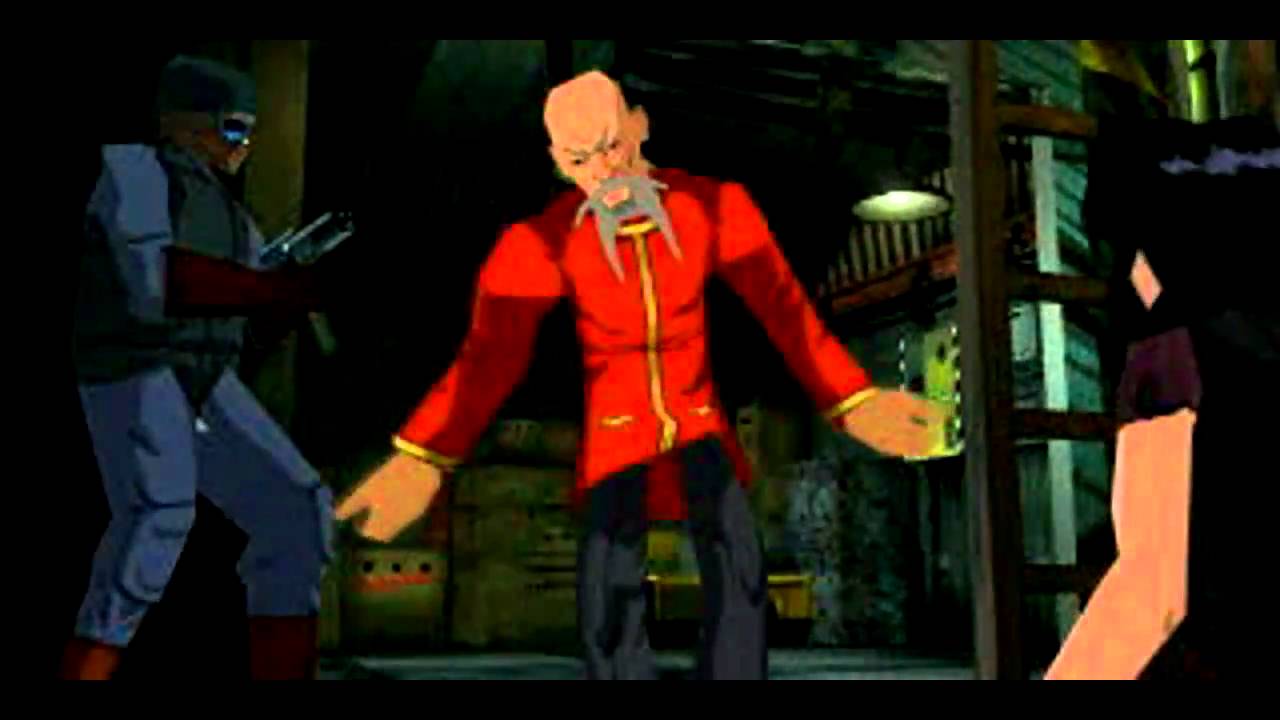
You play three different characters throughout the game: Hana, Deke, and Glas. All three are mercenaries hired by a Chinese mobster who wants his kidnapped daughter back. It starts out as a spy-style action game and then quickly turns into something supernatural. It’s the strangest thing and is such a jarring change of pace for this type of game. That will be the least of your worries, however.
The game has beautifully pre-rendered backgrounds that you run around in Resident Evil style. These “tank” controls are just awful, and there’s a reason why they don’t exist anymore. You can sneak around, shoot, and use items, but it’s how those are executed that makes the game so hard and unfair. Stealth is actually out of the question; no matter how slowly I snuck up, guards would hear me and kill me. I just had to blast my way through everything, and therein lies another issue: ammo. You will have many enemies thrown at you with little ammo, and the supernatural enemies don’t drop ammo. They even get clever towards the end and make them drop paper ammo that you need to backtrack to a fire and burn to get the real ammo.
It doesn’t end there; you will be reloading save after save and dying over and over again. Most of the puzzles and traps will trigger an FMV, and usually a death FMV, meaning game over. Just the slightest pixel of your character touches the trap, and you’re dead. It’s back to reloading the save, which is rather long, by the way. The backtracking is the final killer here, especially on the final level, with items gathering on either end of the level just to unlock the door on the opposite end. It’s silly, archaic, even for the time, and didn’t need to be in this game.
I will admit that the puzzles are rather clever. You actually get clues that are organically placed in the environment, and you need to write them down to solve the puzzle, which is neat. Back in the day, walkthroughs were scarce, so all you had was a guide or writing things down. The puzzles aren’t serious brain-scratchers, but they are tough and fun.
The combat itself is awful and is the main cause for reloads. You get a dodge button, but with awful tank controls, you just stand there blasting everything. There’s no cover, no armor, nothing like that. You also have to flip through your inventory with squares and circles while you’re getting blown away, which can cause problems. Why not pause the action with a radial menu? That’s not too hard.
Is the game even worth trudging through for the story? Not really. The mix between Chinese mafia antics and the undead is weird and forgettable here. The characters have no depth, and the story is slow to move forward. It’s entertaining enough to push you through the game, but nothing you would replay, even for the multiple endings. With that said, I only recommend playing this if you want a beautiful-looking PS1 game to play or a decent adventure. Just get the cheat codes handy, or expect to spend more time reloading than playing.
It took many years to acquire, but the PSOne with a screen attachment has been one of my top must-have consoles since it came out. Growing up as a kid, my parents didn’t have the $100 for the console and the $130 for the screen add-on. The Combo Pack was released for $200 and seemed insane, but the PS2 was out and cost $300 at the time of release. $130 for a 5″ TFT LCD screen might seem like a lot, but this did more than just display games. It had an amazing brightness range and clear stereo speakers that could be quite loud when turned up all the way. It also easily screwed onto the back of the unit and had a headphone jack, AV in, and even AV out, so you could just plug it up to your TV without taking the screen off. The power cable also plugs directly into the screen, so there was a lot of foresight on Sony’s part.
What makes the screen so awesome compared to any other console out there is that you can take it with you. Using a 7.5-volt car adapter and bringing it into your bedroom or on the go allows you to make playing the PS1 a more immersive and personal experience. The LCD screen makes the games look better than they do on current or older TVs. It’s like Sony found a perfect balance and knew how the PS1 would render and output, so they made the perfect screen for it. All the games display clearly and sharply, and the screen is quite vivid, so I can easily see the $130 price point during release.
As for the system itself, what can I say? It’s the PlayStation 1! While the system’s first iterations had many flaws, such as overheating, cheap laser assemblies, and various other issues, the PSOne is sleek, slim, and just the basic unit, which is all we need. Sony went for a rounded style with this system, and it looks great. The only downside is that you can’t use most wireless controllers because the receivers are too large and can’t fit a memory card on top. The system is lightweight, even with the screen attached, and would easily fit into a backpack. The PS1 has an amazing library—probably some of the best out there. The PS1 wiped the floor with the Nintendo 64 due to a more diverse and massive library. The Nintendo 64 has some memorable games, but the overall experience just couldn’t top the PS1. With pre-rendered and live-action cutscenes, thanks to the CD format, it was a whole new experience. From the classic start-up jingle to the amazing feeling of the DualShock controller, and even down to the black underside of the discs, the PS1 was a behemoth and was unstoppable.
Would I recommend the current going price for a full PSOne combo pack at $100? Yes, go out and get it now. If you’re a PlayStation fan or just want to check out the classic library, this is the perfect unit to pick up. For some advice, make sure when you buy the unit that the power and tray buttons work. These are large buttons and can easily be stuck or get grimed down inside. Also, make sure the hinges on the screen aren’t loose. Many units have cracked hinges with screens that won’t stay up, and most importantly, make sure the LCD backlight isn’t dead. I bought a unit from a local store only to have the backlight die on me the second I turned it on when I got home. Of course, make sure both speakers are working and that there isn’t any rattling or distortion. Make sure to ask the sellers these questions, or look for this if you find one in person.
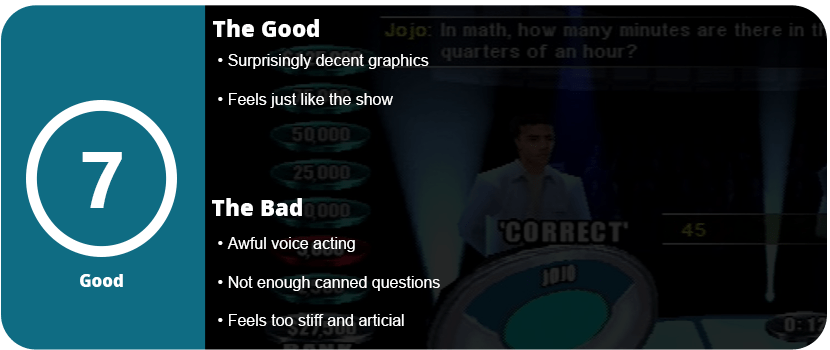
The Weakest Link brings back memories from my childhood. I remember the show being the next Jeopardy or Who Wants to Be a Millionaire. I remember the sound bites, that sassy British host, and the fast-paced and addictive play style. Surprisingly, the video game is an exact copy of the game show but is held back by set content.
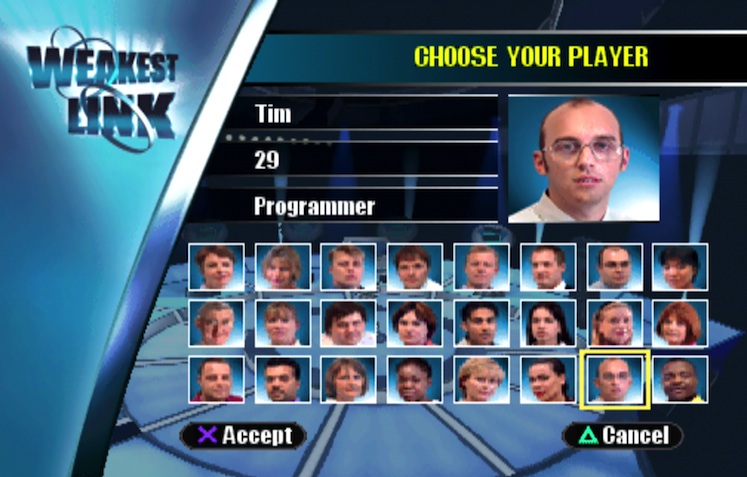
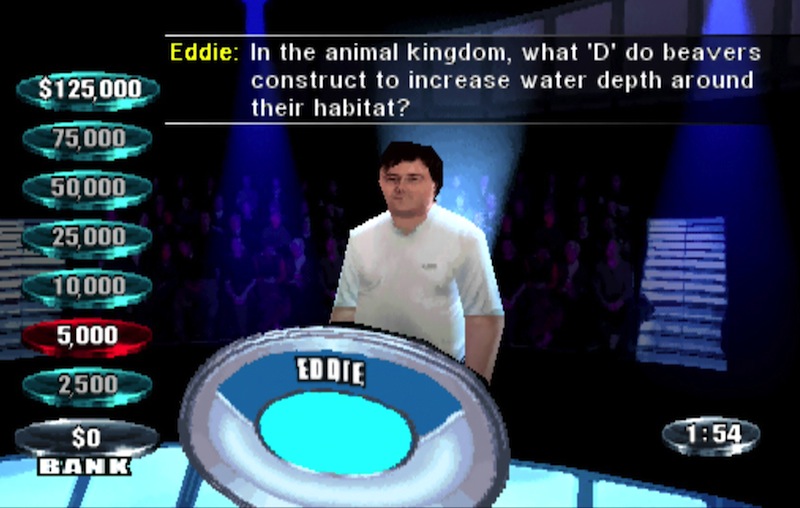
There are about two dozen contestants you can choose from, who are all poorly voiced and have canned sayings that get old quick during the games. The Weakest Link is an elimination-style game that is made up of six rounds. The first round starts out at 2 minutes and 30 seconds, with each round taking 15 seconds off the clock. The host goes around in a randomly chosen order, asking trivia questions, and you can either bank the amount of cash totaled so far or answer the question. If you’re wrong or pass, you lose the total amount of money queued.
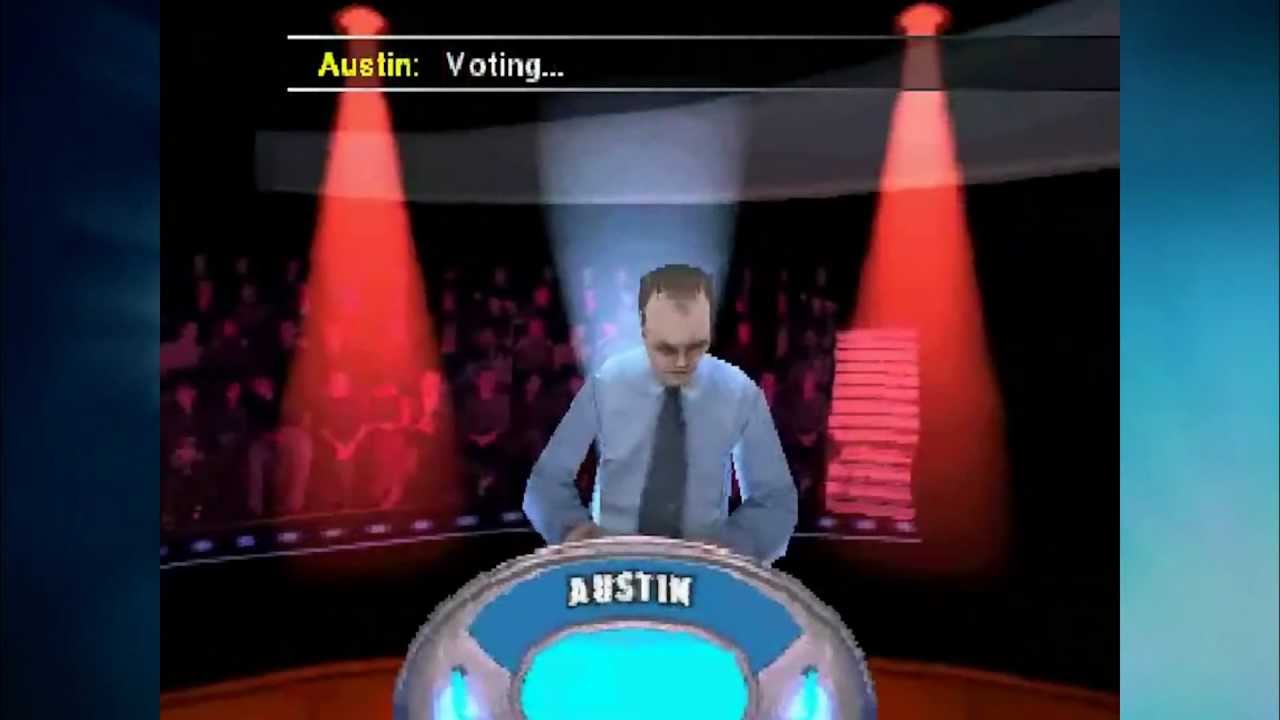
For the video game, the answers start out with one letter, and as the timer goes down, more letters are revealed. This is obviously easier and faster than typing in a full answer, as that wouldn’t be any fun. The trivia questions can be rather hard and range from science to sports, so having multiple people in the room helps a lot. When the round is over, each contestant votes off another, and here’s where the game becomes a little stale. The AI will automatically vote off the weakest link for the round, which is annoying if it’s you. This is the furthest from the game, as the contestants don’t know who’s the strongest or weakest link for the round, but somehow the AI knows.
The game continues in this fashion with live-action clips of the host rambling on pre-scripted sayings and jokes from the show. It’s nice to see, but after about an hour, you start to see some repeats. Honestly, the only way to play this is with other people, and the way too smart AI kind of ruins the game-show feeling of the entire experience. It nails down the feeling of The Weakest Link perfectly, but you also have awful voice acting and a limited amount of content.
I would recommend anyone who is a fan of the show or wants a fun new trivia game to play. Even for the PS1, the graphics are quite nice, and they capture the effects of the show. If you can look past the stiffness of it being a pre-set video game and the awful voice acting, then give it a go.
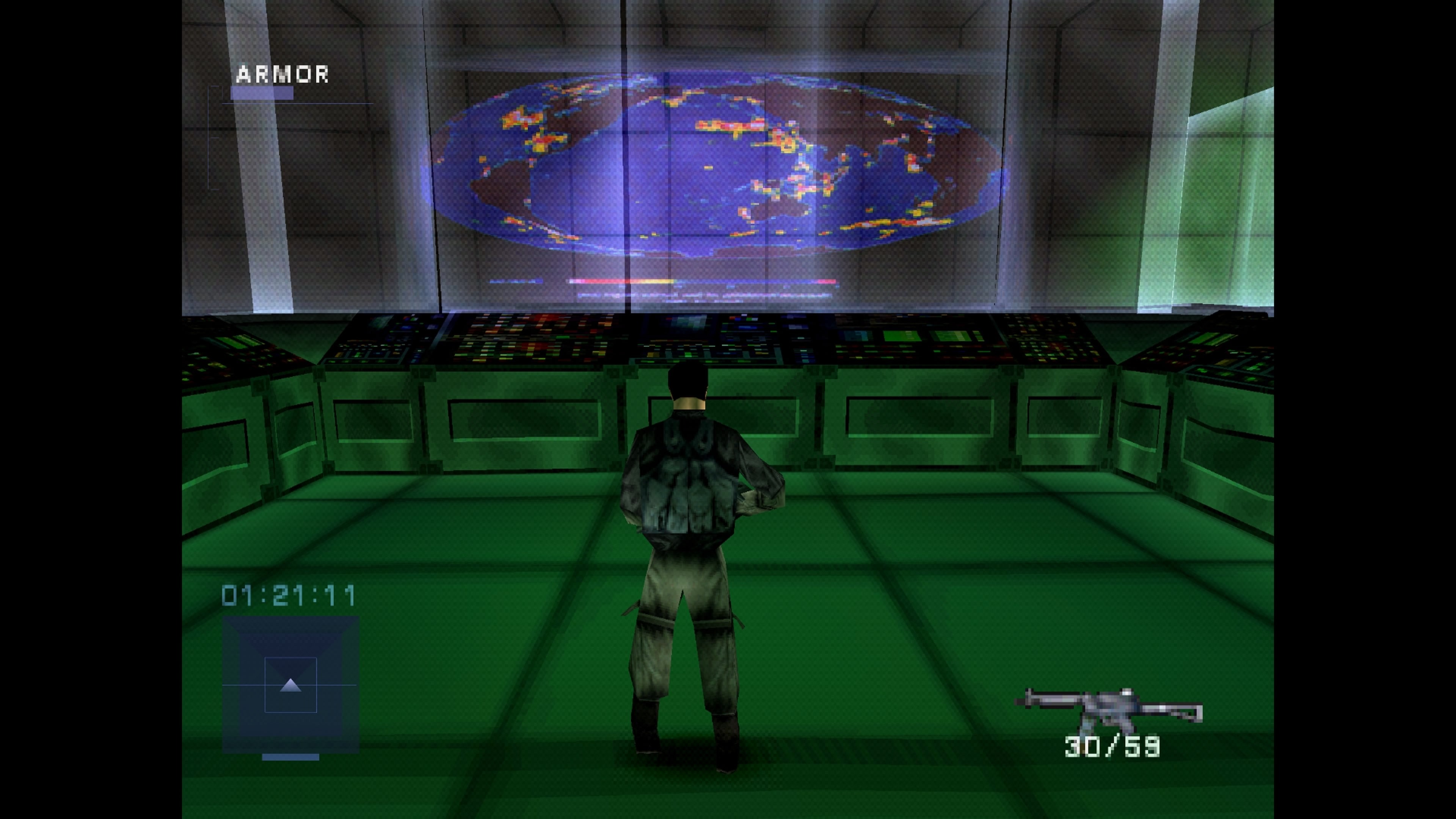
Third-person shooters weren’t very frequent on PS1, and when they did come by, they were usually pretty bad. Syphon Filter proved that you can make this genre work on the PS1. The game is still really fun today and was way ahead of its time. A well-done camera, a great lock-on system, a decent story with memorable characters, a kick-ass arsenal of guns, and genius-level design. Who would have thought a third-person shooter would be this good in the late 1990s? Eidetic and 989 Studios did.
You play super spy Gabriel Logan, who is a CIA agent trying to stop a dangerous terrorist named Eric Rhoemer. A Syphon Filter virus that targets specific DNA demographics has been created by a man named Phagan, and it is up to you to shut down their operations and stop them from spreading the virus. You start out in New York with the streets being shot up by Rhoemer’s thugs. There are objectives in each level to complete, but it is way beyond throwing this switch, pulling this lever, or shooting this amount of bad guys. You usually have to kill a certain number of scientists, administer vaccines to victims, disarm bombs, and turn off power grids. The objectives vary, but what is fun is figuring out how to get there.
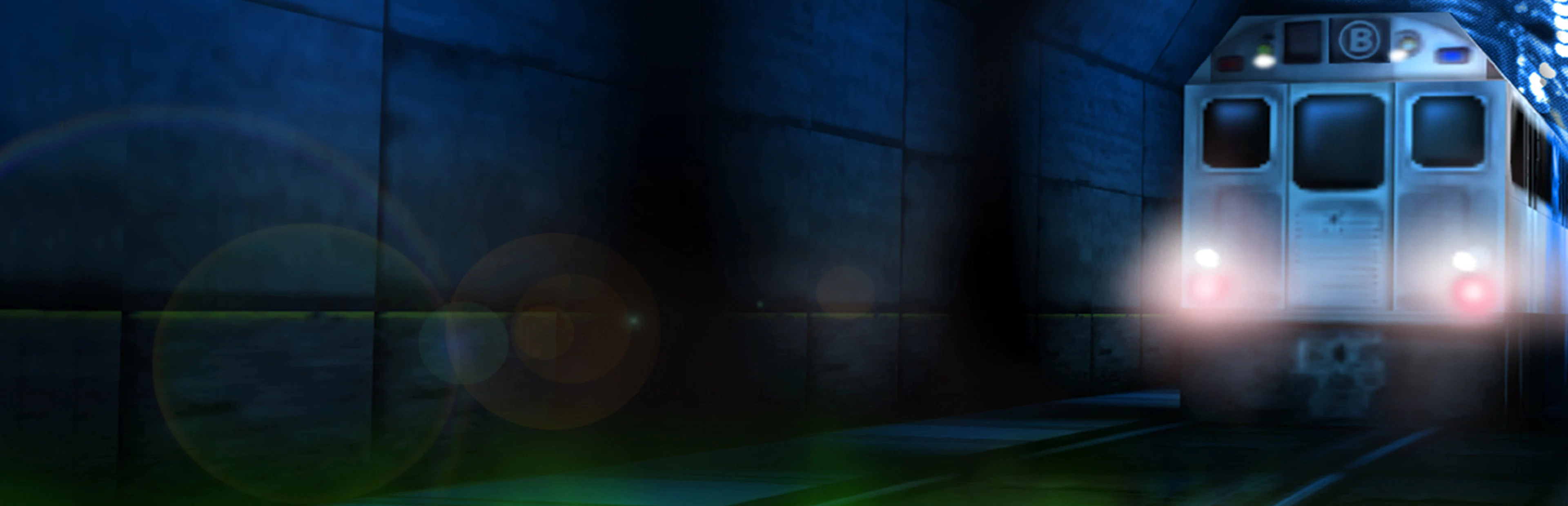
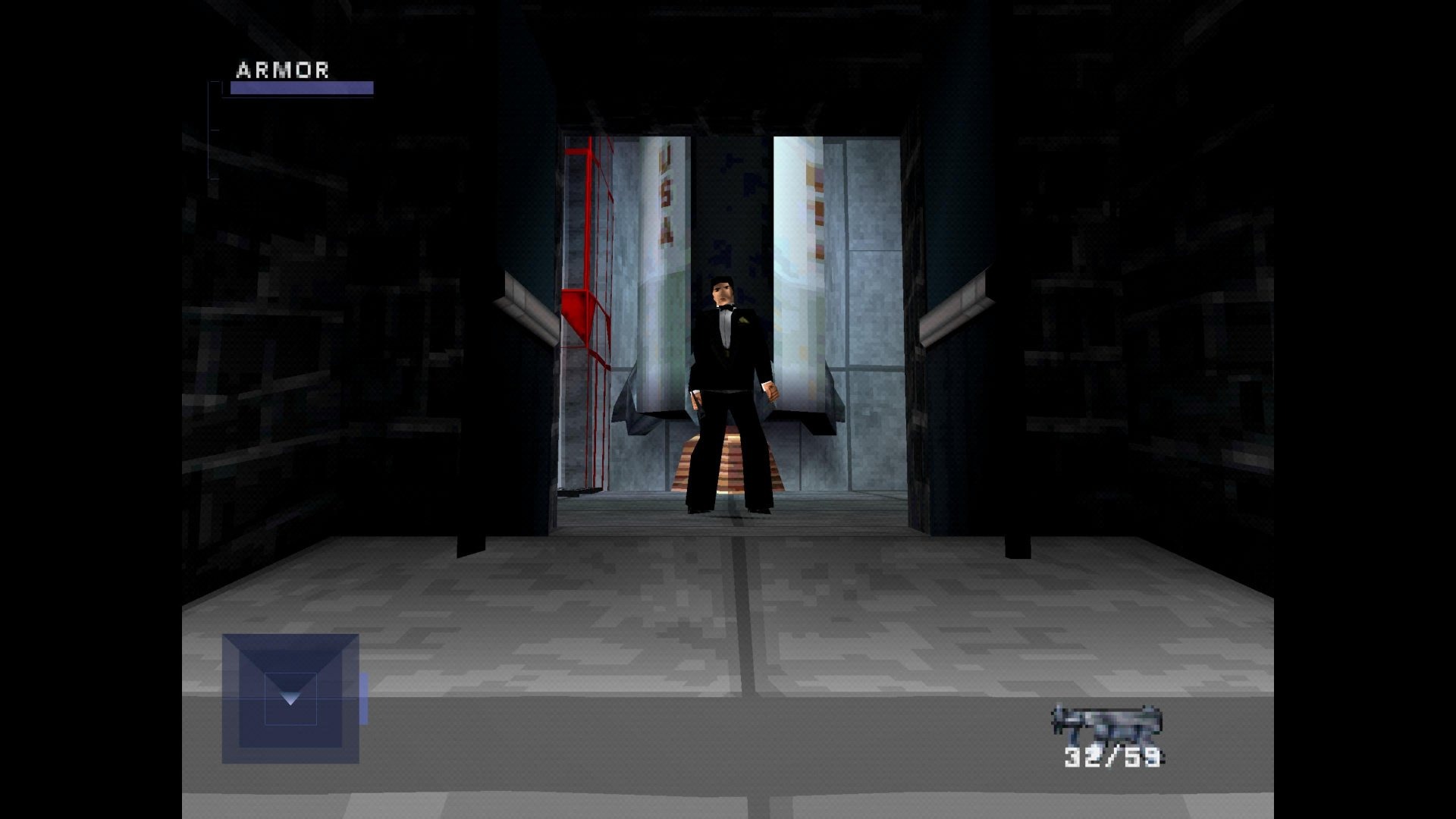
Syphon Filter has some of the most memorable levels I can remember. This is a game you play several times and remember where every enemy is, every castle location, and even how to kill each enemy. The levels vary with stealth sections, climbing, and timed areas. The game features a smart lock-on system because there is no camera control. It is surprisingly smart and follows you wherever you go. Enemies wearing flak jackets can only be taken out with headshots or very powerful weapons. This requires aiming in first-person mode and taking them out. This flak jacket element is a staple of the series and will go on to be in every game. It is actually an element all on its own and not just body armor for you or the enemy. You can die very easily, and if you don’t stop and aim for headshots, you will waste ammo and/or die very quickly.
There are a couple of boss fights thrown in, such as a helicopter midway and Rhoemer himself at the end. I found all gameplay elements to be evenly tossed up, so you are never bored. The stealth elements need a bit of work and are probably the worst thing about the game, but they are very minor. Crouching and sneaking around work fine, but enemies tend to see you at unknown distances. Maybe a line-of-sight cone on the radar would help with this. You also have to get in headshots; otherwise, they won’t die right away and alert other guards.
Weapon selection is also a bit flimsy because you have to hold down select and use L2 and R2 (strafe buttons) to select the weapon. I would have preferred a radial menu instead. Some levels can be a bit hard to navigate and are too dark to see. Thankfully, you get a flashlight you can equip because some levels are nearly pitch black. I found myself lost a few times because, even though the level design is fantastic, some levels can look the same with confusing hallways and misplaced crates and boxes.
I actually learned about weapons as a kid from this game. Real-world weapons are in here, some of which I have never seen in any other game before. The weapons are almost a character all on their own because they feel so good to shoot in the game. The K3G4 will cut through flak jackets easily and is probably the only weapon that will do this. The G18 is a super-fast sub-machine pistol, while the silenced 9mm is a staple of the series. The shotgun, combat shotgun, PK-102, BIZ-2, Nightvision Rifle,.45, HK5, and a few more are all excellent weapons. It was also the distinct sounds the developers used that made these guns so memorable. The game has a great sniper scope that was unseen in games back then. There are grenades and gas grenades, which are great for taking out a group of enemies stealthily. There are a lot of great weapons in the game, and they are very memorable, unlike most shooters.
While the game itself is amazing, the graphics were pretty good at the time. Looking pretty realistic art-wise, the game had some good lighting effects and a lot of detail everywhere. I also have many fond memories of this game from when I was a kid. I actually accidentally rented Silent Hill because I forgot the name of this game. I got all the way to the Pharcom Warehouse levels and had to turn the game in. I rented this game many times over and played it to death as a kid. I purchased it a few times here and there, and every time I play it, it brings back fond memories. Syphon Filter is one of the greatest games ever made, and every gamer should play this masterpiece.
Mortal Kombat 4 was probably the most carefully watched game in the series due to abandoning the 2D root and going for 3D. No one knew what was going to happen to the series, and a lot of fans lost hope, thinking the silky smooth controls and excellent digitized graphics would go by the wayside in 3D. However, the game featured excellent visuals (for the time), and the silky smooth controls stayed despite some slippery and awkward animations. The fourth game also introduced some new characters who I thought were some of the weakest in the series. So despite the weaker roster, we got some pretty good fatalities and excellent stages to fight in.
The new characters like Kai, Jarek, Fujin (a weak attempt at making another Raiden), and Tanya were pretty “blah.” They didn’t have the same impact as the classic characters, but some returned, like Scorpion and Sub-Zero, Sonya, and Johnny Cage, who came back for the first time since MK2. The run button and combos were carried over into 3D, which were smooth as well as a first stab at moving in a 3D environment. You would hit a button to kind of strafe to the side to avoid attacks, and this added a whole new level of strategy. Weapons were introduced in free form now, and every character had one. Get hit, though, and you lose the weapon until you can pick it back up.
The fatalities were extremely brutal, some of the best the series has seen, and they looked even better in 3D. This leads to a new level of detail and creativity that can’t be done in 2D. This was also a slow departure from other “alities,” and the series stuck with just fatalities. A new boss was introduced as Shinnok, and Goro returned as the mini-boss. The game carries over a lot of elements that make it still feel classic, but then injects some new stuff as well. I really felt the game was well balanced and was exactly what the first MK in 3D should be. Overall, MK4 is a classic and did an amazing job of transferring over to 3D, which was very difficult. This, of course, paved the way for all future MK games, but we can always look back on MK4 as children.
What better way to end an era for a fighting genre than to throw it all into one big game? MKT does just this, so for people only familiar with the 3D era, this is what Armageddon was based on. Every MK character up to Ultimate Mortal Kombat 3 is in here, plus all the mechanics from UMK3 that everyone loved. The game introduces a new aggressor meter, which is the predecessor of the power meter in the new MK. Getting attacked will increase it (which is just text at the bottom that fills up, which I really hate), and then you do extra damage while in aggressor mode. The combo system is still intact, as are the weapons from UMK3.
The 2D games were silky smooth, and the graphics look great in Trilogy. Every level, as well as a lot of fan-favorite music, is in the game (you can pull the soundtrack right off the disc). Using the run button, pulling off a 5-hit combo, and then blocking, jumping around, and using all the signature moves brings back a great feeling of nostalgia. There are some secrets hidden here, such as a special code screen (1-button Fatalities are awesome), plus some original outfits like Raiden and Kano’s original outfit, which also unlocks their original Fatality. Of course, the game is best played with two people, but a single player is also a lot of fun.
There are a few minor problems, like Shang Tsung’s morphs requiring loading, loading times between menus and fights, and the game freezing sometimes, which is no good. I also wish maybe Test Your Might would have come back, but this really just feels like Mortal Kombat: The Greatest Hits. I also hate how cheap the computer can be on even normal difficulties, plus Shao Kahn is one of the cheapest bosses in gaming history, so good luck beating him. Overall, this is the ultimate MK experience for the 16-bit era that made history. If you loved the older MK games, then Trilogy is exactly what you need, plus this is probably the last time you’ll see Animalities and Brutalities.
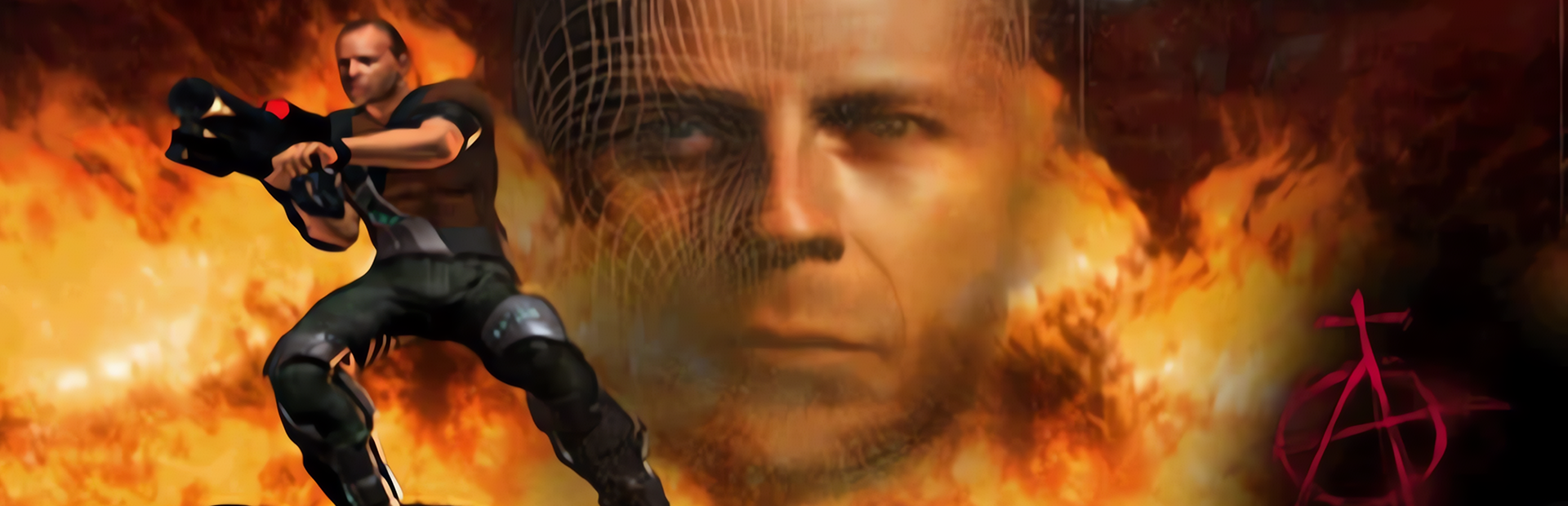
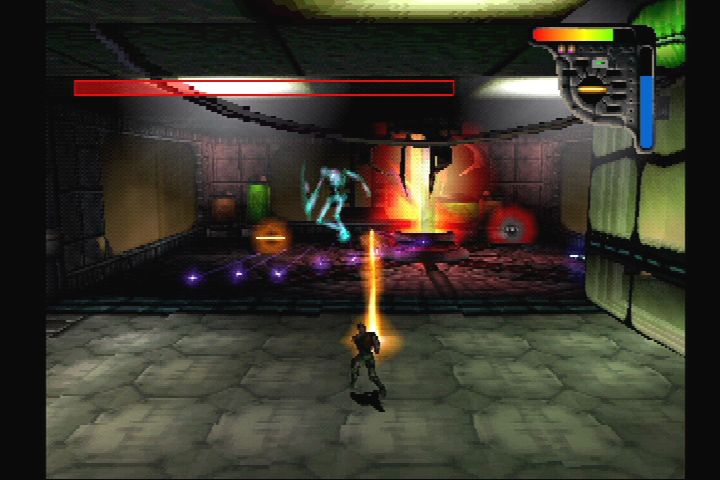
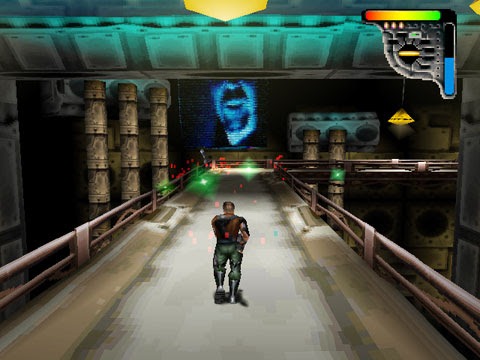
Back in the old 64-bit era, famous actors were just starting to feature in video games, but many blew it off as child’s play. Bruce Willis is one of the first actors to have a game built with him as the main protagonist that is not based on a movie. The game features a very detailed Bruce for the time, with some solid pre-rendered FMVs thrown in the mix as well. The game features a noncoherent story that makes no sense, but when Bruce is involved, it’s all about the action, right?
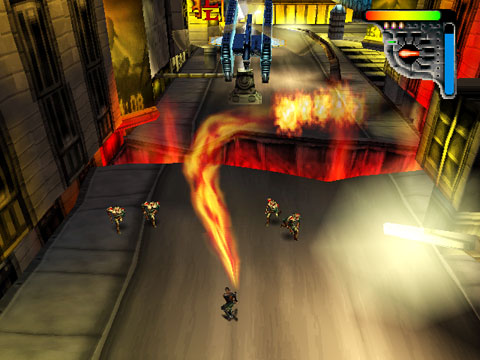
The game has an over-the-top view, and you shoot all around you using the face buttons. You can jump, but as the camera goes, jumping can be a bitch and is probably the hardest part of the game. Not being able to move the camera in his environment is very frustrating and almost ruins the game. You can pick up different limited weapons such as homing missiles, plasma guns, electro bolts, etc.—nothing special. Each level, however, is very well laid out, and the enemies have nice designs. The game is hectic, fast-paced, and pretty immersive.
At the end of every level is a boss fight, and these can be easy or hard, and they vary throughout the game. A problem I ran into is that instead of using the second analog stick, using the face buttons makes shooting diagonally hard, which leads me to mention that the difficulty is very unbalanced. Some levels are easy, some are hard throughout the game, and that’s a bad thing.
Bruce Willis lends his voice, and there are maybe 20 or so lines. Yeah, that’s it. Cliche stuff such as “Ohhh, you want some too?!” “Kill ’em all, it’s time to jam!” and various groans and grunts. In my mind, that isn’t using Bruce Willis to his fullest potential. This game could have been cooler and more than just a name tie-in. I also feel a co-op mode would have been good here as well.
All in all, Apocalypse is a fun weekend shooter, but nothing more. Bruce Willis’ talent was wasted, but if you can get over the annoying camera, controls, and lack of an interesting story, then Apocalypse is just for you.













![37653-Syphon_Filter_[NTSC-U]-6](https://thebinarymessiah.com/wp-content/uploads/2013/01/37653-syphon_filter_ntsc-u-6.jpg)












 thebinarymessiah.com
Try multiplayer. A lot of fun !