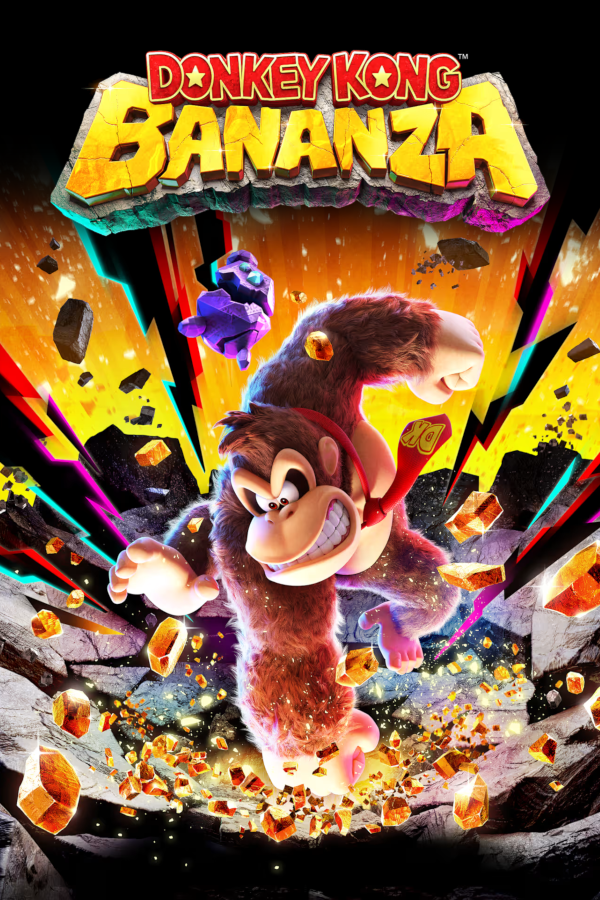
Publisher: Nintendo
Developer: Nintendo
Release Date: 07/17/2025
Available Exclusively On


Super Mario Odyssey was one of the best games released this last generation. It was imaginative, never got old, and was just the right length, but I also didn’t want it to end. There was something insanely addictive about Odyssey that the mainline Mario games always got right. I hadn’t felt that way since Galaxy. Bananza is made by the Odyssey team, but can they catch lightning in a bottle twice? As with all other Mario games, the story is minimal and lacks uniqueness. It’s barely there to keep the player threading through a series of levels. Essentially you play as the titular ape who wants nothing but banana gems. He works for a mining company (or so it’s implied) on Ingot Isle and ends up coming across a mysterious talking rock and Void from Void Co., an evil ape hellbent on stealing the Banana Core to make his wish come true. It’s fine. For the most part, I have no interest in Mario stories, but they are at least entertaining.
That’s not why you’re here, though. Bananza has a similar gameplay loop to Odyssey in the sense that you can just follow the main story thread and do only the main objectives, or you can venture off and discover a new challenge somewhere or how to get a hidden Banana Gem. In this game, there are 777 Banana Gems in total, while Odyssey features 880 Power Moons. Although there are fewer Banana Gems, the overall size of Bananza is significantly larger than that of Odyssey. The main gameplay element in Bananza is the terrain deformation and total destruction of entire levels. The experience is incredibly satisfying all the way to the end of the game. The game has many layers, but you start at the planet’s outer core and work your way to the center. Naturally, layers will get tougher as you dig deeper, and each level has a layer hardness rating. This means that the primary terrain you are walking on will require more hits to break through. You also have a slap power that produces waves that penetrate the ground, showing you what’s hidden underneath. This ability is essential to finding hidden items spread out everywhere.

This ability is what made this game confusing at first to me. I’m used to most Nintendo games having everything you need to find visible. You just have to figure out how to get there. This adds an entirely new element to the way you think about navigating levels. You can dig through nearly every object in the game. Of course, there are layers and material you cannot dig through to stop you from cheating. However, some Banana Gems have more than one way to get there. You can either dig straight through or find a clue on the surface to get there. These may be obvious dig spots on walls, gold veins leading to hidden items, or places where you need to use one of your five abilities to get to it. There’s a lot to this game, and it can be very overwhelming at first. The completionist within you will be utterly enthralled by the sheer size of some levels and the sheer difficulty of locating their hidden treasures. That’s also the fun of it. You feel like an excavator, an explorer, and someone on a hunt for treasure.
Your main objective will always be highlighted with a yellow exclamation. You need to talk to characters who will constantly extend the breadcrumb trail to get you to the level’s main boss. There are many different ways this can happen. You will encounter a mix of platforming and combat trials, which require you to use your abilities while navigating the current state of the world’s terrain. For instance, you can dissolve the poisonous slime in the Festive layer by grabbing and melting salt chunks. One example is Switcharoo Goo, which consists of two different colors. Hitting one color will fill the other in the opposite X and Y axis. Later levels will throw multiple things at you, such as the Switcharoo Goo, but you need to have an enemy eat it while you run around one color to climb to the next. You must constantly stay alert and respond swiftly. The game’s level design and pace are impeccable. I always eagerly anticipated the next move or the challenges the game would present.
That’s where combat and platforming challenges come in. There are multiple types, and all award Banana Gems. The Combat challenges are single banana platforms that are covered by purple Void Co tape that you need to have Pauline sing to get rid of. When you drop down, you must defeat a specific number of enemies within a time limit, and these enemies are typically of the same type found in the current level, which also includes terrain that you need to utilize. Another terrain example is in the Radiance Layer: there is light that turns certain terrain soft, and in shadow it will turn hard. Enemies can be covered in this terrain, and you must find a way to break through a wall to get the light to shine on them or cover them in shadow. Platforming challenges offer three banana gems, with one hidden somewhere on the level, but they are not timed. Each layer has a2D level in the style of Donkey Kong Country as well, usually named something clever after the SNES series.
Other challenges include Swifty challenges, which are white triangles that require you to destroy all the white wall pieces in that small area in less than 20 seconds. Usually you need to use an ability or manipulate the terrain around you in some way. There are quizzes from the Quiztone (characters in this game are called Tones); some will place a spot on your map for a hidden banana gem, and some challenges are just seeing one through a wall that you can’t get to, and you need to figure out a way around. You’re always thinking and solving puzzles when exploring. They are also incredibly clever, allowing you to solve them instantly and experience a satisfying “Aha!” moment each time. There are a few other challenges I haven’t covered, but suffice it to say despite all of the variety there are a lot of the same type, and they do eventually wear thin after 30 hours of doing them. I will delve deeper into this issue at a later time.
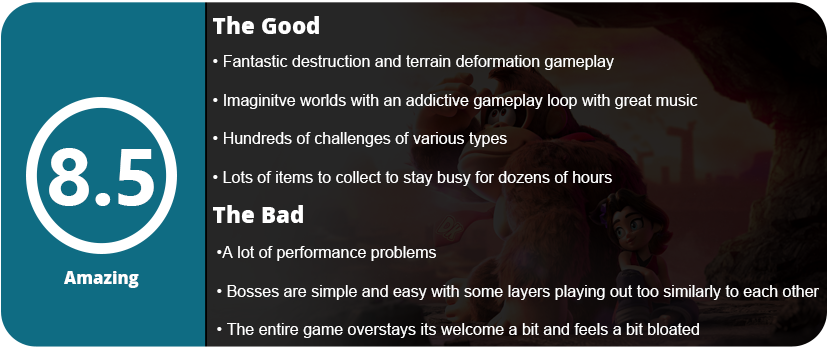
Bosses themselves, while designed cleverly, are effortless and barely offer any challenge. The RPG aspects of Bananza, along with the option to purchase health-restoring items from the shop, contribute significantly to this. You can breeze through bosses pretty quickly. The only real challenge was the final couple of boss fights that seemed to last forever. The situation is pretty typical with most Mario games. Boss fights in Mario games are usually not that hard despite being clever and fun. I just wish there was more of a challenge here. At least the game doesn’t go the route of a boss rush at the end or anything like that. I only fought two bosses again later in the game, so it wasn’t that bad.

As I stated earlier, there are RPG elements in this game. Those gold nuggets you acquire in the game are actual currency to buy things in the shops, construct shortcuts and gateways (rest spots), and unlock challenges. Some main objectives require gold as well. Another currency is banana chips, which are used to exchange banana gems. The third currency is fossils. Each layer has its own type of fossils. Common, uncommon, and rare fossils. These are used at the clothes shop to dress up DK and Pauline. Clothes add defense against the main element in the layer that can harm you, such as burning, poison, shock, etc. You can also change DK’s fur (no added bonus) for some fun. You can then upgrade those clothes up to level 3 with more fossils. Banana Gems are used to gain skill points (five get you a skill), which unlock things like more hearts, making it easier to break through tougher layers, and adding bonuses to your ability powers as well. DK can do a couple of interesting things with terrain, such as using it to “terrain surf” and knock into enemies to travel long distances. Softer terrain deteriorates at a fast rate, so it’s not advised to surf over terrain that can hurt you, as it will disappear quickly from under your feet. There’s an ability for DK to surf over water, allowing you to skate over hazardous surfaces like the aforementioned hot grease in the Festive layer, but this is an unlock in the skill tree.
Pauline herself is an assist character similar to Mario’s hat in Odyssey. She doesn’t get in the way and never leaves your shoulder. You use her voice to change into forms and get rid of purple tape on certain objects. That’s it. She’s a wonderful character to see that’s not shoved off to the side in a Mario Kart or Mario Party game. She has character and spunk, and her relationship with DK over time is charming, albeit nothing more than what you would see in a Pixar movie. It’s not very deep or memorable, but it’s enjoyable to see. I wish her singing was put to more use. While I appreciate the melody she employs when you unlock the purple tape and the catchy songs she sings in each ability form, they quickly lose their appeal. Hearing the same song on repeat every time you transform gets old. The songs also flip when you switch abilities quickly (you don’t need to go back to normal form and re-form into another ability), so it’s like skipping tracks on a CD back and forth constantly. The music isn’t particularly pleasant to listen to.
That’s my biggest issue with this entire game. The gameplay becomes monotonous after a while. I loved seeing all the new layers. The first time you drop into the Lagoon layer and see the sky swirling out of the hole like water into this bright, colorful world, it’s fascinating. That never got old, but as you get deeper, those bright and colorful layers are less frequent and give way to drab dark worlds with many browns, blacks, and little light. I feel the game overstayed its welcome, with too many later levels feeling too similar, and many challenges towards the end of the game felt like they were put in to extend the game time. It’s not a good thing that the final level stretches endlessly. There are 17 freaking levels in this game. It could have easily been cut in half with just the best ones, and it would have been fine. I enjoyed having a few “break” levels, such as the Racing layer, which did not include many challenges or require collecting Banana Gems. Occasionally I just wanted a cool new thing to do that didn’t require dozens of hours of exploring.
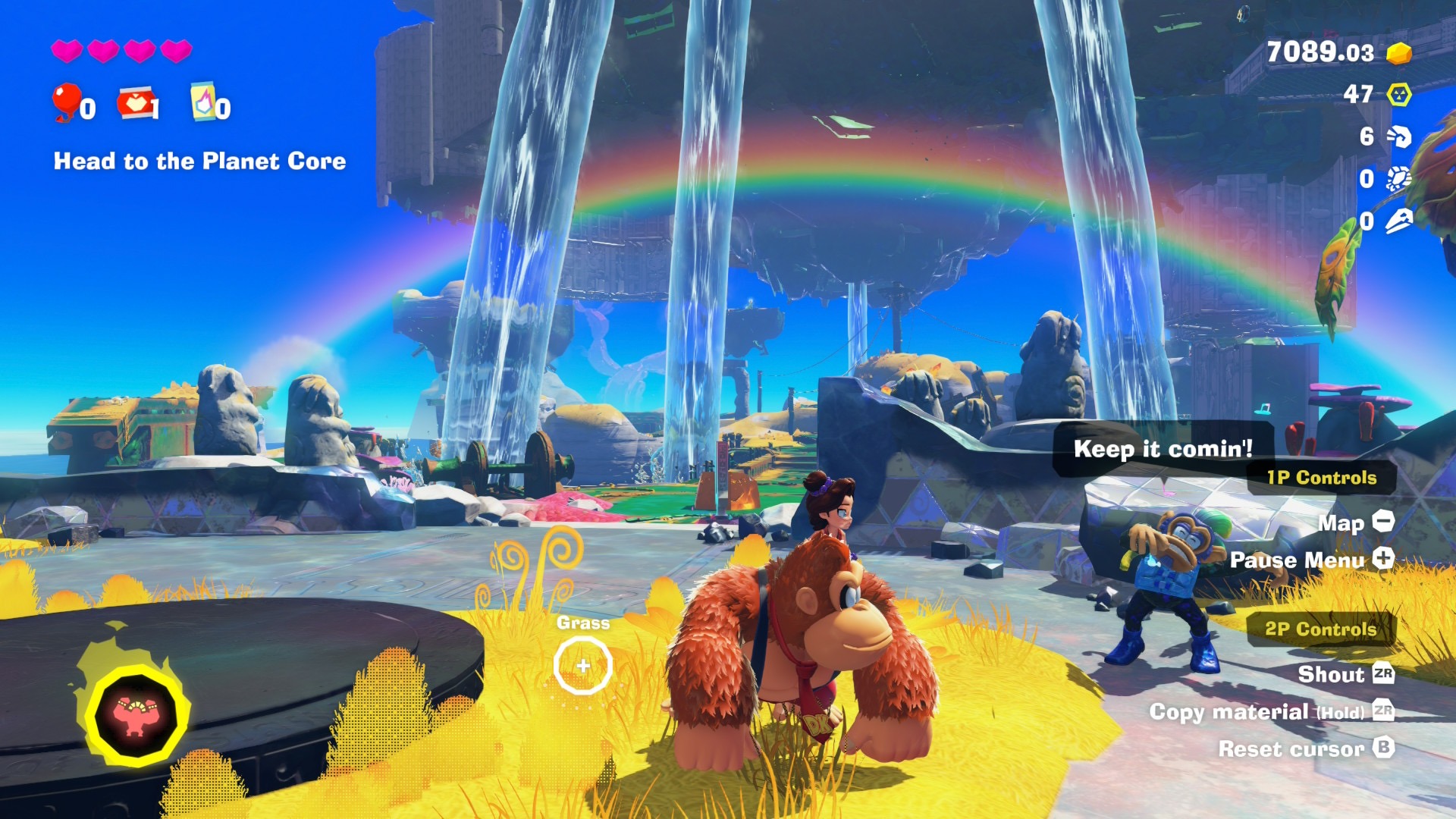
The visuals and audio are top-notch here. While the game doesn’t quite look like a full-blown Switch 2 game (it was started on Switch 1 anyway), the impressive deformation and destruction and textures that you can almost swear you know what it tastes or feels like are something Nintendo does well. The ice cubes look and sound like real ice. The burger mountain looked so good I wanted to go and get a burger. I wanted to know what the Switcharoo Goo tasted and felt like to squish. The physics and textures are so well done here. However, the game has some terrible performance issues with frames dropping into single digits when hundreds of objects are flying around or when the camera zooms away to show the entire level for a few seconds. It’s noticeable all the time, not just once in a while. I feel like Nintendo not utilizing the power of the Switch 2 is a real problem. No VRR, no DLSS, and the game doesn’t look too hot in handheld mode either. It doesn’t ruin the game, but it could have been better.
Overall, Donkey Kong Bananza is one of the best games this year. The biggest issue with this game, in my opinion, stems from its overstaying welcome, the similarity of many later levels, and the overwhelming number of challenges that eventually become monotonous. The final level could have been shortened, and while 17 levels is a significant undertaking with something new to offer in each one, the novelty does not resonate as strongly as it did in the earlier levels. Nintendo created an experience that is not easily replicated, featuring incredibly fun destruction (such as destroying a building-sized racing cup full of gold, which is one of the most memorable moments in this game), great level design, and making Donkey Kong a fun character for a new generation to play as. From the fun DK Country references (find Cranky Kong in every level for a Banana Gem!) to the fantastic and occasionally otherworldly and surreal feeling and scope of the music, there’s something here for everyone.


 thebinarymessiah.com
Try multiplayer. A lot of fun !