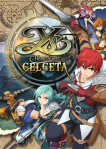
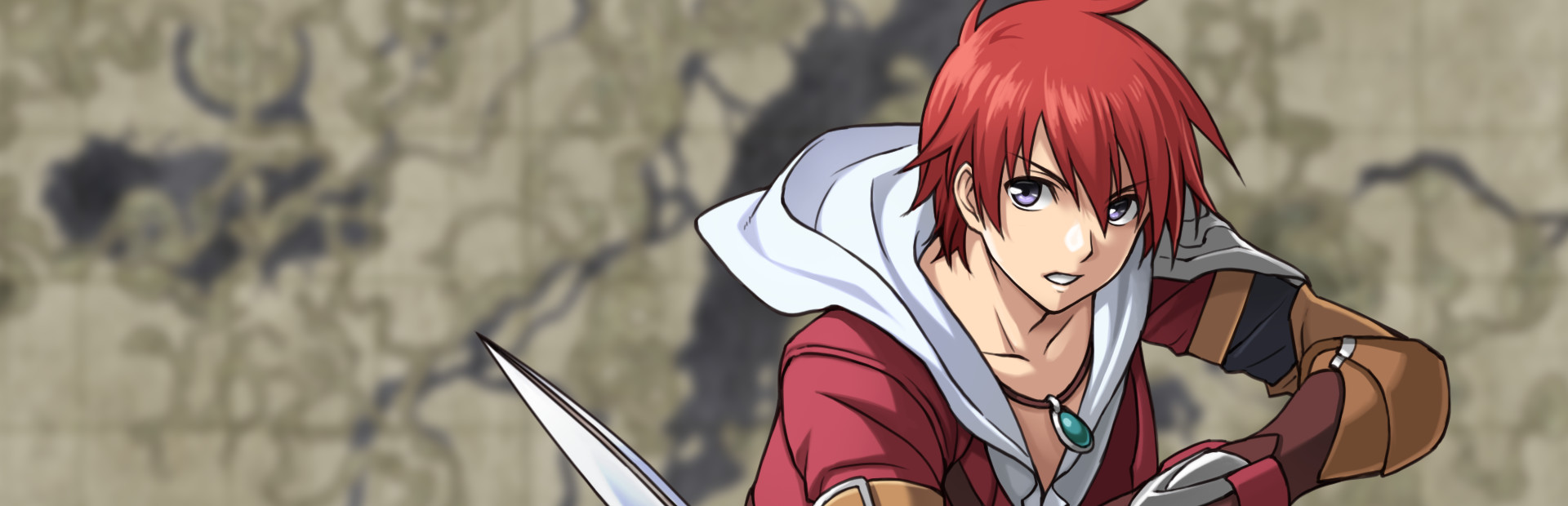
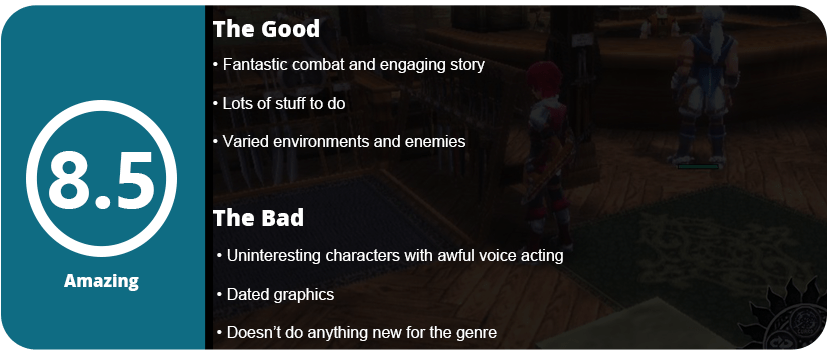
I have never been much into Ys, but I have played past games. Memories of Celceta is the biggest Ys yet and the best traditional JRPG available on Vita right now. You play as Adol Christin, a red-haired boy who loses all his memories and must find them again. Of course, the story is much deeper than that. A god named Eldeel ends up creating a mask called the Mask of the Sun, and other people want it for its powers. The story gets pretty deep, yet the characters are completely uninteresting. They all have generic dialogue, and their personalities all feel stereotypical for JRPGs. While the game isn’t anything new, it does what has been done before really well.
The combat in Ys has always been real-time, and this helps alleviate the boredom that has come in JRPGs over the decades from random battles. The combat is fast-paced and fun, with skills you can use; guarding, dodging, and switching between three characters on the fly add a bit of strategy and depth. Each character has a weakness it can deliver to enemies, so you will always change who you put in your party. Aside from fighting regular monsters, the bosses are a lot of fun and quite challenging, but not so hard that you can’t beat them. Honestly, the game is perfectly balanced in that you will acquire the strongest weapons and armor by the end of the game, so you’re always one step ahead of your enemies.
The whole point of Celceta is exploration. Your main secondary goal is to discover the entire area and complete the map 100%. The sense of exploration is one of the greatest assets of Celceta, and you have a hard time putting the game down just to explore one more dungeon. When you’re in towns, you can buy items and exchange stuff you find in the wild. Minerals, beasts, and plant materials can be exchanged for larger and higher-quality items to reinforce armor and weapons. You can also craft items out of these materials as well. There are quite a few towns in this game, and each one has three quests you can complete. Some are hard, some aren’t, but they aren’t hard to figure out. In fact, I never really got lost that much in this game, which is normally common in a JRPG. There was a sense of direction without having to hold your hand, which is wonderful.
On another note, there are a few puzzles thrown in, but nothing that really takes advantage of the Vita’s features, which aren’t expected in a JRPG. I do wish the game had local or online co-op for up to 3 people, but that’s all right. The graphics look detailed but are dated, even for the Vita. It looks like a decent PS2 game at best and could have used some more detail. The textures can look really muddy and grainy, which is unacceptable on the Vita. At the end of the day, you will just love Celceta for the engaging story, fun gameplay, and combat. There are a good 20 hours just in the story alone, and another dozen if you want to get 100%.
Overall, Memories of Celceta isn’t perfect, but it has some great combat, bosses, and a sense of exploration that will keep you glued to your system. The graphics are dated, the voice acting is awful, and the characters are uninteresting, but that’s expected from a JRPG. Could Celceta have broken this trend? It may have been one of the best JRPGs in a long time. What’s here is solid and well worth a purchase for any JRPG fan.
Before you continue reading, this review is coming from someone who has grown to hate JRPGs over the past ten years. I rarely play them, and if I do, I never finish them. The story ends up falling flat; there are too many random battles; the characters are boring; or it’s just too damn hard. Ni no Kuni caught my attention due to the fact that Studio Ghibli was involved, and Level 5 is a master at JRPGs. While I didn’t finish Dragon Quest VIII, I did enjoy its story and art immensely.
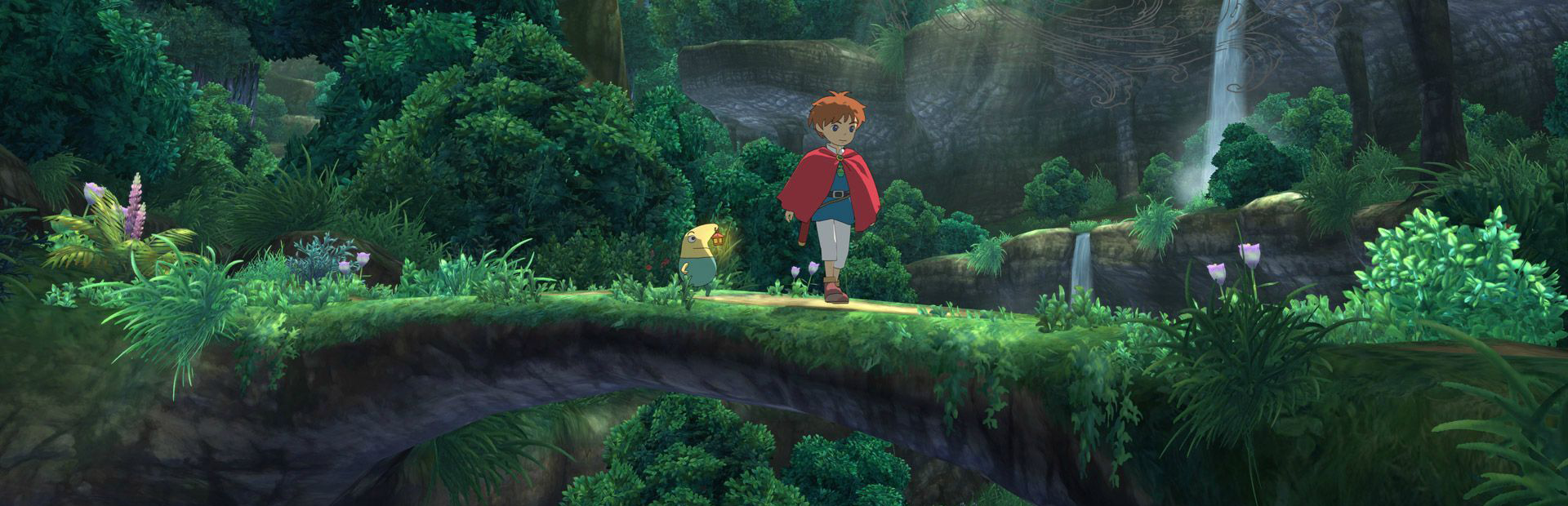
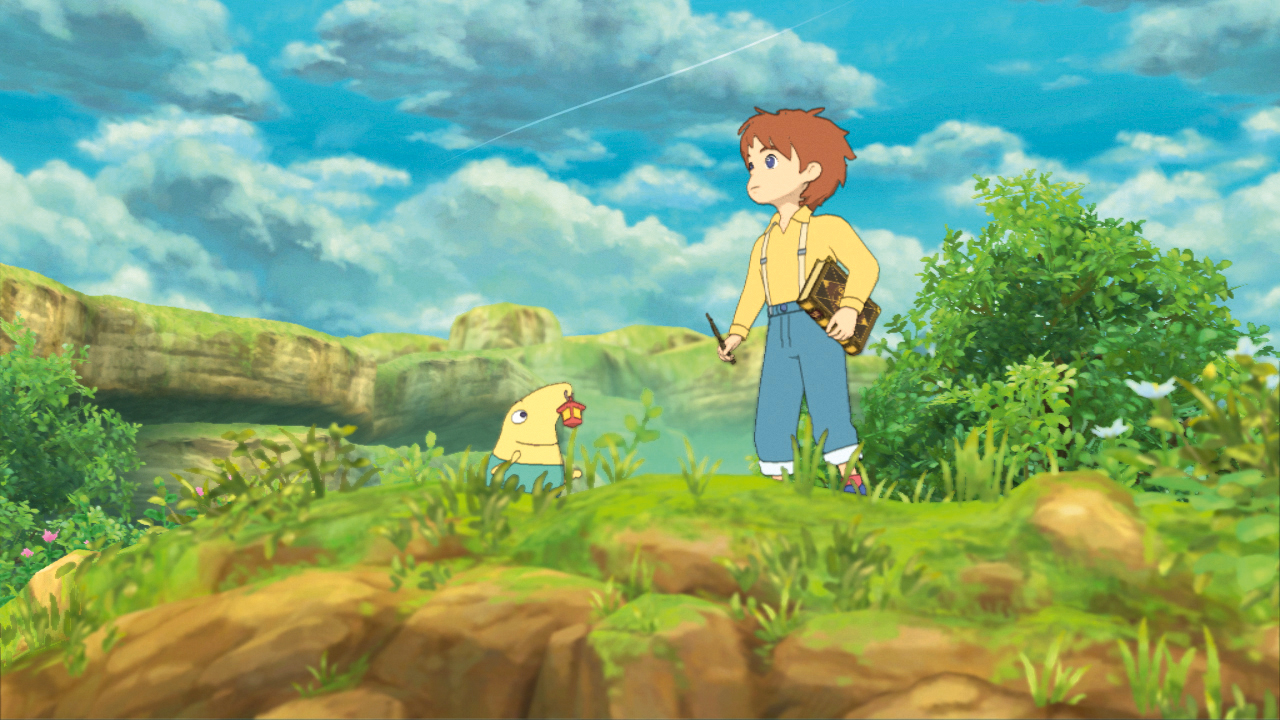
Ni no Kuni is all about magic. A boy named Oliver’s mother dies after saving him from drowning. A fairy named Mr. Drippy comes to visit him, and he’s off to another world. It turns out that an evil witch wants to destroy the world. It sounds pretty simple, but there are a lot of plot twists, and the ending will have you going, “No way!” during each cutscene. The game holds a lot of secrets, the characters are engaging, and you will get very attached. However, the story is only half of what makes a good JRPG.
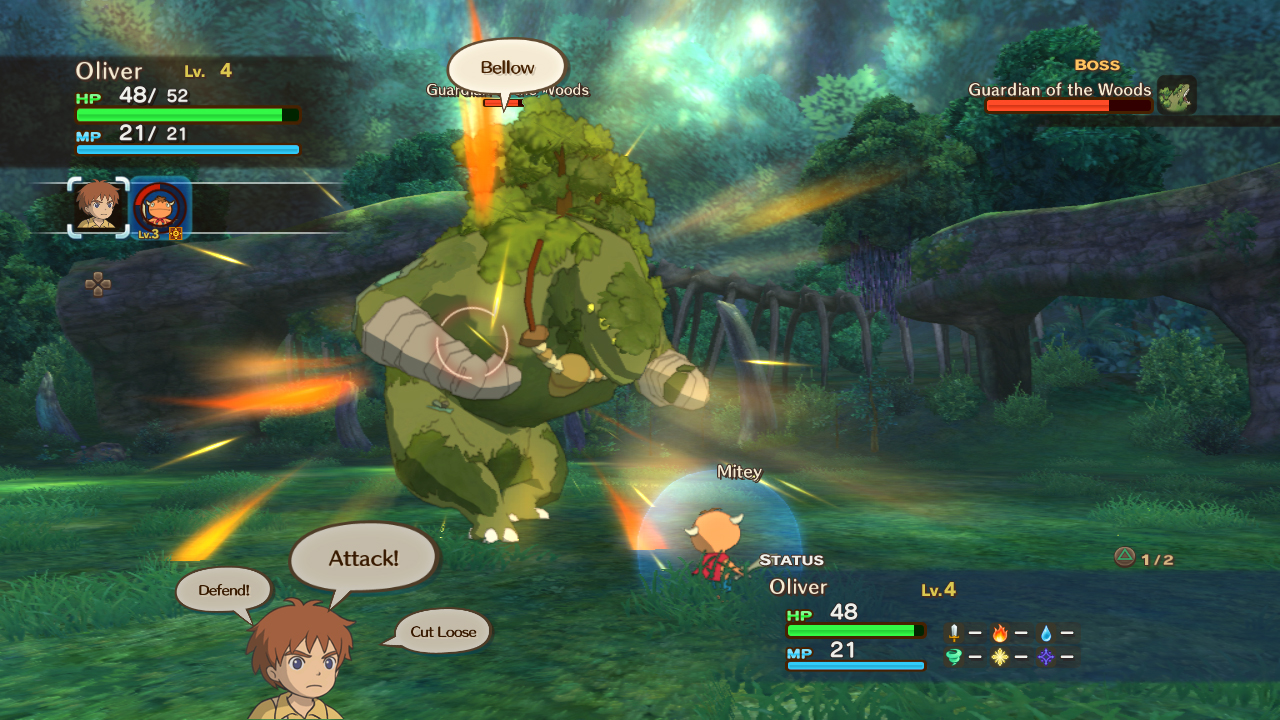
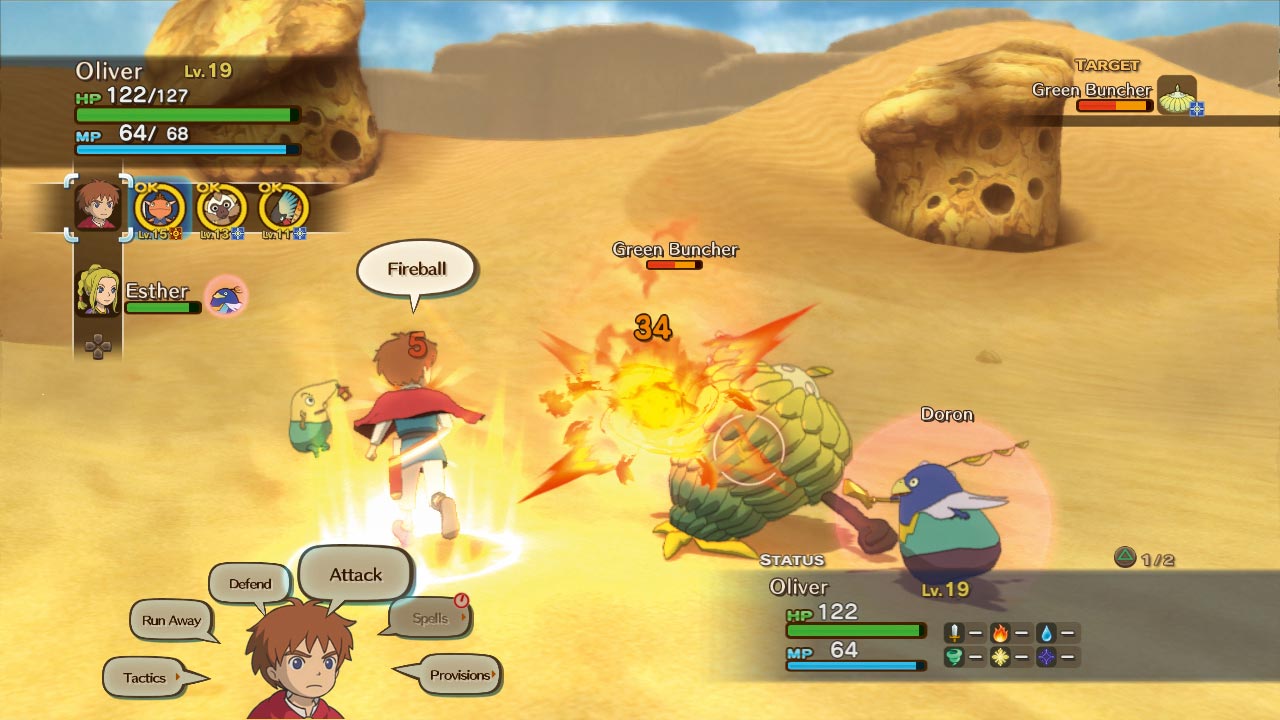
The combat is in real-time, not turn-based. It’s all about reaction time and strategy. All three of your characters run around the battlefield. The enemy can strike at any time, but so can you. Each character can cast spells and send out one of three familiars to cast various other spells and do physical damage. There are dozens of them throughout the game that you can capture and train. Oliver is the most powerful mage, and by the end of the game, you will be casting room-clearing magic. The biggest issue with this is that the game is solely focused on magic. Physical damage, no matter how high of a level you are, never does the same amount of damage as magic. You will be guzzling MP potions like crazy; always make sure you have a ton stocked up. Enemies will sometimes cast spells themselves or charge physical attacks. You can order your team to defend or attack, and then you have to attack yourself. This requires quick thinking and timing, as well as actual gaming skills. It’s also important to exploit the elemental weakness of each enemy, if there is one. During the battle, enemies will drop HP and MP glims to help you out, and rarely the gold glim will supercharge you or you’re familiar with an ultra-powerful attack or defensive move.
Boss battles are the toughest in the game, and towards the end, they will come with 2 and 3 different phases. This game gets extremely tough after the first few chapters, so tough that it will require a lot of level grinding during the last half. I actually played the last half on easy and still died quite often. This game is extremely hard; be warned. There are other things you can do outside of battles, like side quests. Oliver can go around collecting pieces of heart from people and giving them to other people who need them. He can cast spells to help advance his way through the world, like making bridges, talking to ghosts and animals, rejuvenating broken objects, etc. There are 150 side quests, and you get gold and items for them as well as stamps. 10 stamps get you a card, and these cards can be redeemed for permanent effects like extra XP during battle, enemies dropping more loot, and even giving Oliver 100 extra max HP and MP. These side quests, including bounty hunts, can be fun and can add 15-20 hours of gameplay themselves.
After so long, you will be able to sail and fly around the entire world, allowing you to avoid overworld battles. The game has no random battles, but some enemies are so hard to avoid that they might as well be. If you get to a high enough level, enemies will run away, and you won’t have to deal with them. The game is also full of dangerous dungeons full of chests of loot. Now, what about these familiars? Think of them like Pokemon. You can feed them treats to advance various attributes, and then feed them gemstones to advance them to their third and most powerful stage. As they level up, they acquire new spells and techniques. You can swap out different familiars and hold up to 500 in your familiar retreat.
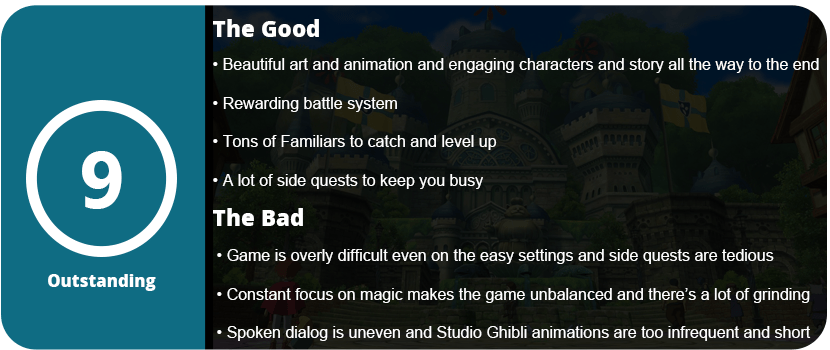
The game’s art is fantastic and gorgeous, along with the music. Studio Ghibli created the animated cutscenes, but there aren’t many of them. There are less than 10 minutes of animation throughout the whole game, and that’s very disappointing. I felt they shouldn’t have bothered at that point. There’s also a lot of unspoken dialogue, and it just seems random when it happens. Towards the end, there are hardly any cut scenes, and it drove me nuts. Why waste the great voice acting and animation only to spread it randomly and unevenly throughout the game? Other than that, colors pop on a 1080p HDTV with bright, vibrant colors thanks to Studio Ghibli’s art style, which everyone has grown to love and appreciate.
In the end, Ni no Kuni has a very engaging story that will keep you hooked for dozens of hours. The combat tries to change things from the typical JRPG format, but there are a few flaws in it. Your spells can be interrupted often, and when you defend, sometimes they won’t register or you don’t get enough time before the enemy attacks. You get about a second before the enemy attacks. During that time, you need to order your team to defend themselves. It can be tough during boss fights. I also hated the focus on magic, and the game was overly difficult during the last 3/4. Other than that, the combat was fine. The game suffers from tedium towards the end, and the side quests start feeling the same, and you just want the game to end. There is some post-end content, but most people might skip this. Ni no Kuni is a perfect game for JRPG fans, but non-fans won’t find enough here to change their minds.
Shadow Hearts is a JRPG that is all about politics and religion. Of course, what is a JRPG? Covenant has a very interesting story with memorable characters; however, the pacing is a bit off. You play as Yuri, a young man stricken with a curse called the Mistletoe. This locks out his inner powers inside his heart, and you are trying to find a cure for it. Along the way, you meet many people with various abilities for combat. The story is a bit involved and complicated, but it is interesting. I could try to explain it, but it would take nearly 3–4 paragraphs just to do that.
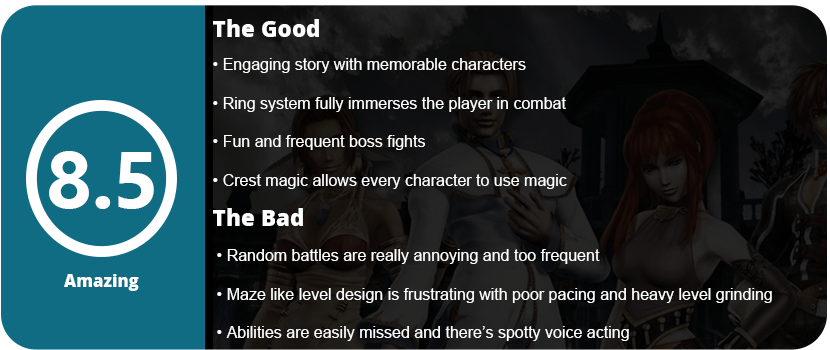
Let’s start with the combat. Shadow Hearts uses a ring system where a needle spins around a ring, and you press X when it falls in the yellow and red areas. Each character has different-sized hit areas and different amounts. You want to try to get it in the red zone, which is a strike zone that does extra damage, but it can be hard because some characters’ strike zones are small 2 pixel slivers. You can acquire expansions for these areas, and you can customize your ring. Once you get good, you can increase the number of hit areas, but they become smaller. This ring is used for everything from items to special attacks to magic. In Shadow Hearts, you can do combos with characters by watching your battle turns at the top. Use a four-player combo, and you can do massive damage and special combo magic attacks. One thing I really like about this game is that you aren’t stuck with specific characters that only do magic. Everyone can do it because you use magic crests, which have different magic attacks that are both offensive and defensive. Some characters just have more MP than others. This means your heavy hitter can also cast Raise Up without compromising anything.
Covenant is mainly comprised of boss battles. They are very frequent but are the most fun in the game. Each is different; some are weak to combos and special attacks only, and some are just weak to physical damage. However, the ring system makes you solely responsible for whether or not attacks hit or miss. If you don’t focus and miss part of the ring, you don’t attack. This also makes the combat more engaging because you aren’t just flipping through menus. Yuri has the ability to switch between fusion forms, which are elementals. This allows you to target a weakness on the fly. However, everybody has SP, which are sanity points and deplete with each turn. When you run out, characters go berserk, and JRPG players know that is not a good thing. You have to use pure items to restore these points, but this only becomes an issue early in the game. Once you level up enough, you get enough SP that it won’t run out before a boss battle is over.
The amount of grinding in the game is minimal. Since you mostly fight bosses, you get globs of XP all the time, so just from bosses alone, you can get to level 40. There are random battles, but they aren’t as frequent as most JRPGs, but they still exist. Random battles are the single thing that keeps me away from these games. It is a lazy game design that just needs to end. There are puzzles in the game that can be kind of challenging, but the mazes are frustrating. Running around and trying different combos on different floors is just a nightmare. Partner this with random battles, and you are bound to toss your controller a few times.
There are side quests, but they are pretty weak and not really worth it. You usually just get items for it or armor, but these armors can be bought later on, usually just after the next boss fight or two. A lot of the character’s abilities have to be learned from fighting people in the game or finding them, which I found irritating. I’d rather just learn them by leveling up. Karin’s sword arts are found by talking to certain people, so if you miss them, then your special attacks will always be weak and not fun. Besides all that, this is a more tolerable JRPG, and even people like me who hate them will enjoy this game.
The graphics at the time were good, and there is a nice art style here. The CGI cutscenes are nice, but there aren’t enough of them. The voice acting is spotty; a couple of characters sound good, but the rest sound like cheesy high school students in a play. That is usually expected in English versions of JRPGs, especially back then. I would play this game for the story and the fun boss fights. Skip all the side quest crap and just finish the story. There’s nothing worthwhile about spending 20 extra hours on some items.
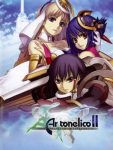
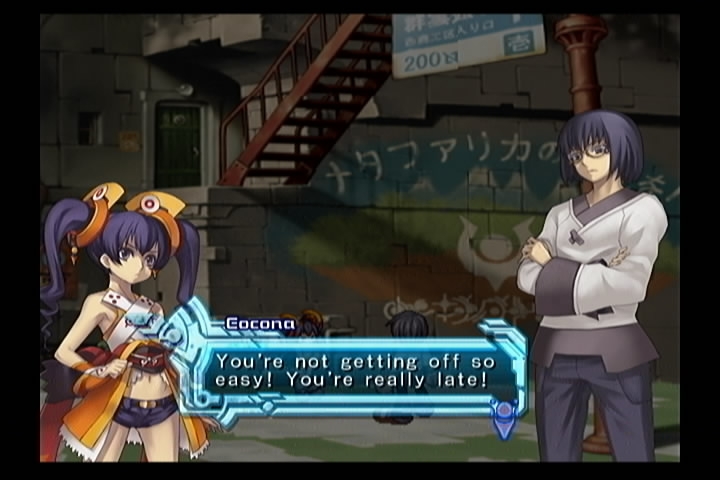
I first have to say that this is a review coming from someone who particularly doesn’t care for or can stand JRPGs. I forced myself to play this, and I am very glad I did. Ar Tonelico II strays from the typical JRPG battle system and story with a little sexually confused boy trying to save some generic fantasy world with generic fantasy characters. You play as an entire team of people whose balance of Ar Tonelico (the world they live in) rests on two Song Maidens. The game is full of political schemes, betrayals, and deception. These two maidens must also get to know each other more before they can sing Metafalica and bring about the paradise of Metafalss. The characters are very well designed, and because of how the story is developed, you get to love these characters more than you probably would in any JRPG.
The main design behind the characters and story is getting to know their deep, dark secrets. This is done by diving into Reyvateil’s minds at a dive shop. There are different levels of their cosmosphere that you must explore, and these are played through dialog. You need dive points to trigger certain events, but this is where you really get to know the characters. After completing each level, you will unlock new song magic, which is essential for battle. Without song magic, you will not get anywhere in the game. You can also unlock new costumes for the three Reyvateils that will increase their stats. The diving gets really deep into the characters’s minds and is actually quite interesting. These are some very deep and well-developed characters with some serious issues that make you even question your own. There is also the Infelsphere, where two of the three Reyvateils need to learn to understand each other and get out their deepest, darkest secrets and thoughts about each other (the two depending on how you play the story).
The main protagonist, Croix, is caught in a love triangle between these two Song Maidens and the third Reyvateil. There’s sexual tension between them, which can be awkward in the game, but by the end, there are some pretty good scenes that will tug at your heartstrings. Overall, the story is well-developed, deep, intelligent, and very self-aware. When you rest at saves, you can talk to the Reyvateils and bring your relationship closer, which will unlock different levels of their cosmosphere that you can dive into. Of course, the game can’t just wing it on the story, so let’s get to combat.
The game uses mini-games during battle. There are two phases: attack and defense. When you attack, you have to use the D-pad along with each of the two characters’ assigned attack buttons. This will help your Reyvateils sing better, depending on what directional attack you’re using. There’s a meter that will show their desires for the direction they want. You’re banking on your Reyvateils song magic to do the most damage. You are just whittling down their health and protecting them while they charge. There are different phases of each song tree that do different attacks. Thankfully, there are also healing songs that you can use as many times as you want, but when you switch to another song in the same attack phase, the points will carry over, so you don’t have to charge again. I found myself charging a song tree as far as I could go, unleashing the attack, and then using a healing song. This also reduces the number of potions and healing items you need to use, which removes the headache that most JRPGs have. This makes combat exciting because you aren’t just mashing X until the enemy dies. Those attack buttons have meters on them, and you have to press the button when the green line goes by; otherwise, you won’t defend your Reyvateil, and they will take damage. They are fragile and can’t take much, so you must be on your guard and press that attack button quickly. If you get a perfect rating, you won’t do any damage! But this is hard and requires precise timing. Depending on which two Reyvateils got along and went through the Infelsphere, they can synch during combat and bring out devastatingly powerful dual song magic. This can only be done towards the end of the game, but it also requires doing the same attacks with your Vanguards so the girls synch.
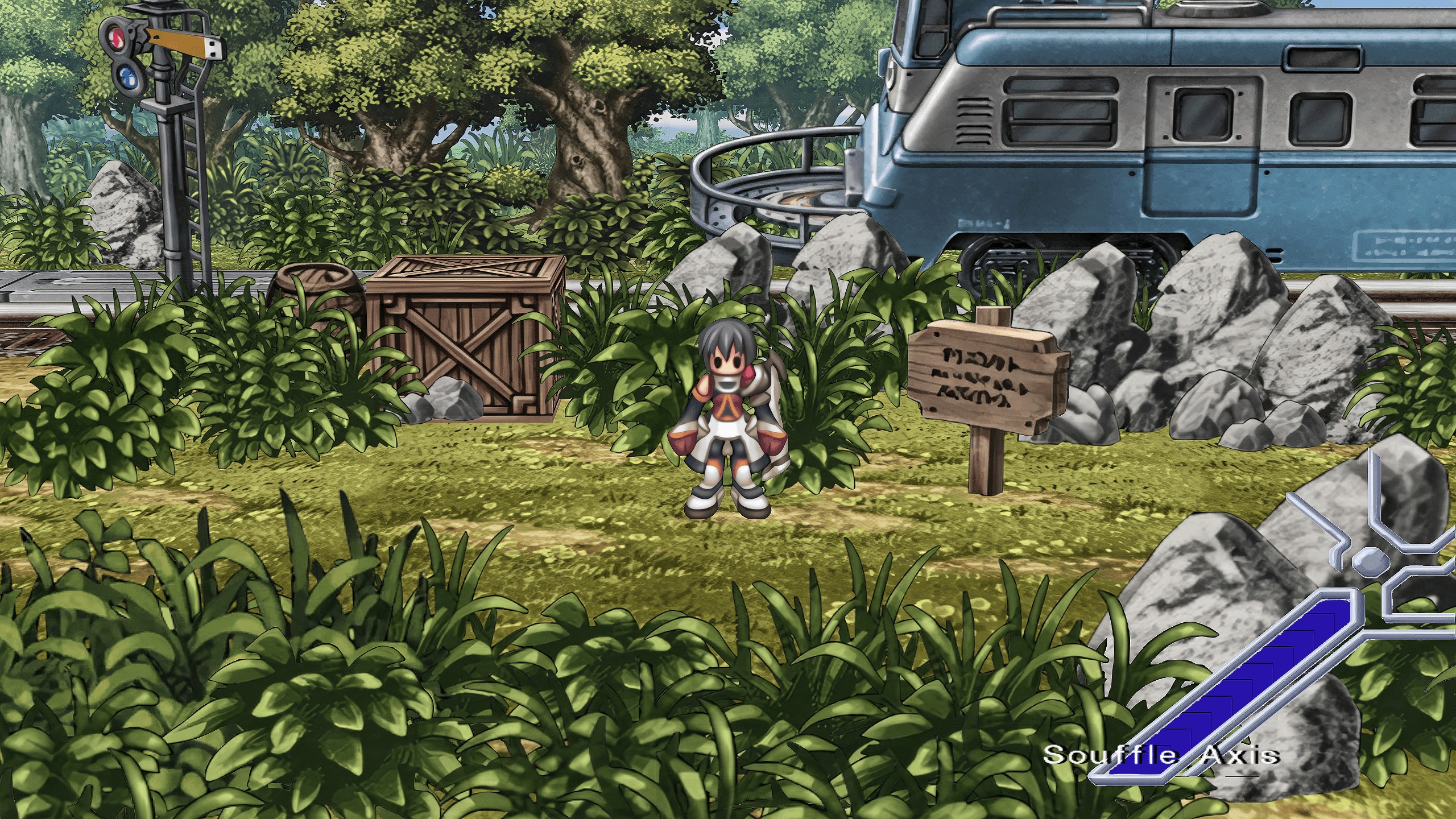
Other than that, the combat is pretty straightforward. Each Vanguard’s attacks will increase in level during fights, so you can do more deadly attacks. The main issue I have with JRPGs is random battles. These usually keep me from completing them, but Ar Tonelico II skirts this by making random battles limited. There is a meter that goes down as you do each battle. Each dungeon only has about 10 (until the last dungeon, which is infinite), but it also turns from blue to flashing red, which will indicate you are about to get into a fight. This lets you explore dungeons freely without getting frustrated. Once that meter runs down, there are no more battles until you leave the dungeon. Even the map system is very useful when most JRPGs don’t even have one.
Of course, there are some side things you can do, like synthesizing items with shop owners. As you advance through the story, you will get new recipe cards from them, but unlike most games, this isn’t just menu-driven. When you synthesize, it brings the characters together more, and dialog plays through. Sometimes the item may not even be what was on the recipe! After a while, you can go back and try again to improve on it. Lastly, you will run into I.P.D. victims in dungeons, which are high-level Reyvateils that you have to battle. If you can beat them, you can do dive therapy on them, which will give you girl power that can raise your stats quite a bit. You can even dualstall during saves and level up your Reyvateils by doing onsen baths! You find dualithnode crystals and put them in this bath, and the girls will absorb them. It is not recommended to do solo baths because the effects aren’t that strong.
The game isn’t perfect, though. The very last dungeon (Sol Morta) is a long, frustrating nightmare with endless random battles and too much backtracking. The visuals are disapprovingly 2D and not very good-looking. During the dialog, characters pop up with different facial expressions, but there are some anime cutscenes, but not nearly enough. There’s even a lack of spoken dialog, but at least the game includes the Japanese tracks. The English voices are hilariously bad and make you want to tear your ears off. There are also a few game-breaking glitches as well as typos. The last 20% of the game is just really tough, and the game stops giving you a sense of direction. This last 20% really disappointed me and was kind of drawn out and long-winded. If it weren’t for these issues, I would give this game a higher score. One plus for me is the amazingly beautiful music in this game. The Hymnos are beautiful, and I loved them so much that I downloaded the songs and listened to them often.
Overall, Ar Tonelico II breaks the JRPG mold with unique gameplay elements, from combat to leveling up Reyvateils via baths and synthesizing. The music is beautiful, and the story is deep with political intrigue and reveals the deepest, darkest secrets a person can hold. However, there are some issues that hold this otherwise wonderful game back. If you hate JRPGs, I recommend giving this one a shot.
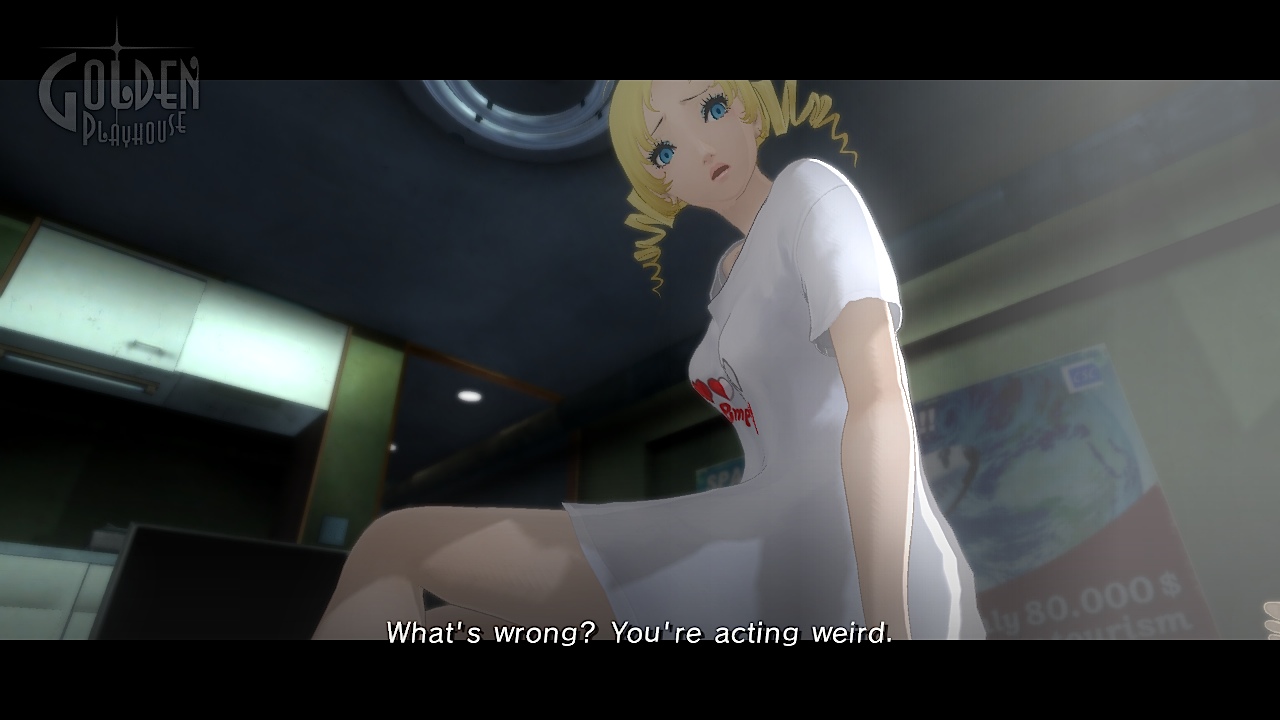
I usually regret playing Atlus games because they are frustrating and difficult experiences. The games are usually excellent, but the difficulty always leaves a bitter taste in my mouth. I have only been able to complete a couple of Atlus games due to this. Catherine is no different, but she shouldn’t be taken lightly. RPG fans should stay away. If you just want to experience the story, go on YouTube. This is for hard-core puzzle fans only. I mean the hardest of core puzzle gamers. This game will leave you infuriated, angry, full of rage, and probably with a few smashed controllers. The game is plagued with issues, but for some reason, there’s a story that makes you want to see the end. Thankfully, the game isn’t very long. Just prepare the video walkthroughs because you will need them.
This experience is coming from someone who hates these kinds of puzzles. This game is complete to taste. I hate block-pushing puzzles, but here we are with a very deep game that includes these. The first three stages aren’t that bad. Starting at stage 4, things get frustrating, and forget about progressive difficulty. First off, the story is very engaging, and it’s a love story. A man named Vincent Brooks is in love with a girl named Katherine, and she wants him to marry her. Suddenly, a sultry seductress named Catherine comes along, and somehow Vincent wakes up with her naked next to him. The rest of the game is him trying to hide each Katherine from the other.
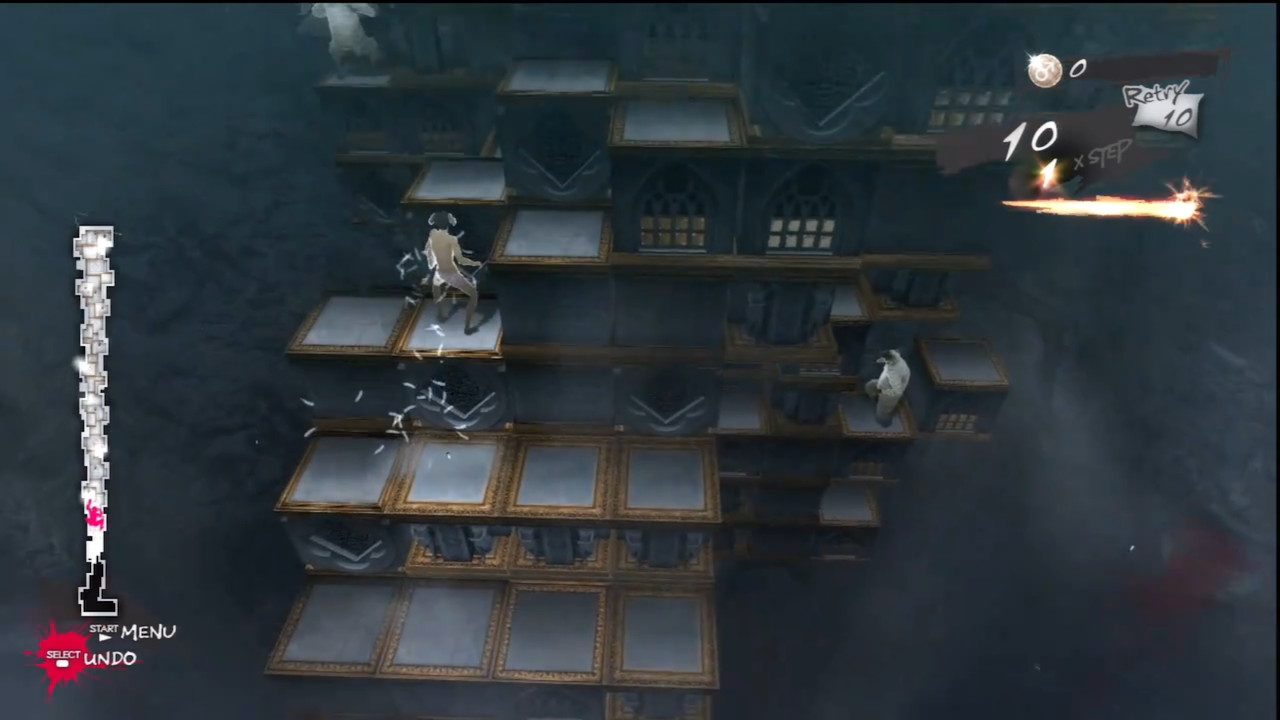
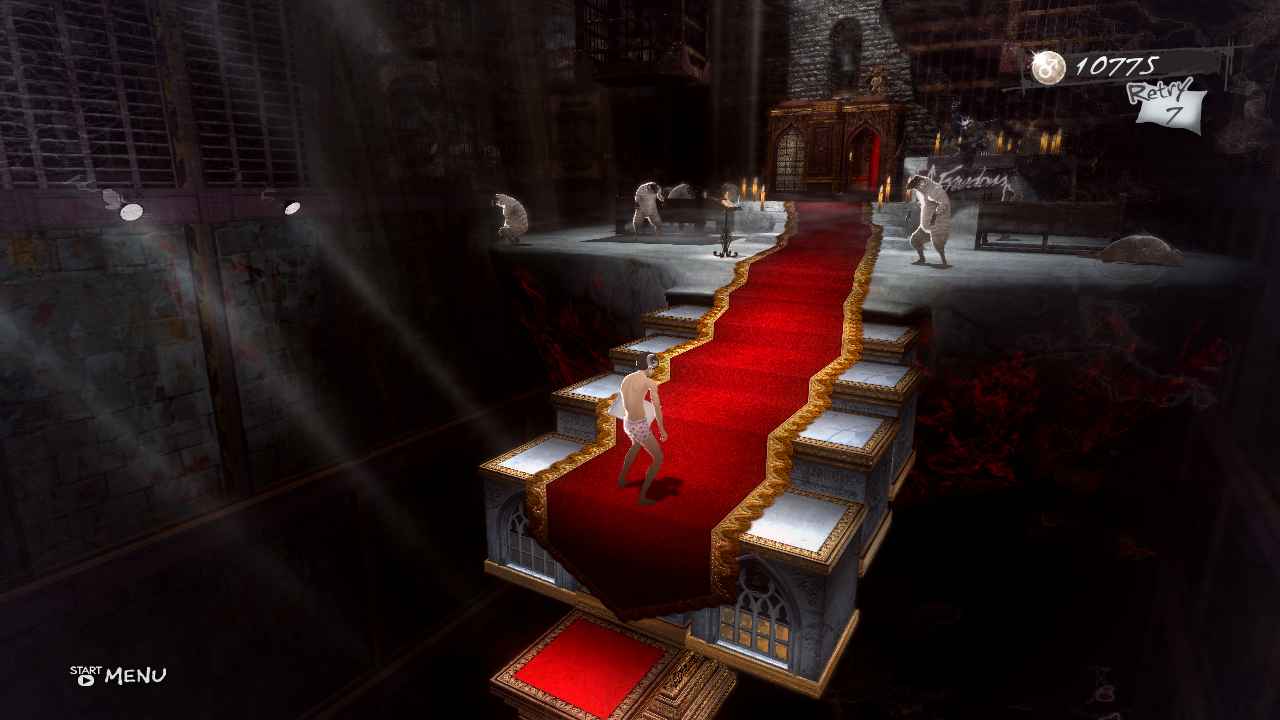
The story gets tense in spots, like any well-written drama. When you are in the Stray Sheep bar, you will receive text messages on your phone that you can reply to. Be careful because this will affect your morality meter, which will impact the way Vincent handles inner conflict. I had a lot of fun replying to these texts because it’s almost like you are actually doing it and in this relationship yourself. Atlus did a great job bringing you into this problem. Of course, every night when Vincent dreams, you are brought to an area where you climb an endless tower of blocks with other sheep, and that’s where you start to hate or love the game.
I can’t really explain the methods of all the block-pushing because there are over a dozen that you learn throughout the game. You can push blocks horizontally, but it’s not so simple. There are other types of blocks, like heavy ones, ice, traps, randomly changing blocks, and others, that will make your life hell. It was nigh impossible to figure most of these out without a video walkthrough, because otherwise, you will be restarting dozens of times due to trial and error. To make things harder, the stage is crumbling underneath you. To make things even tougher, you are awarded medals at the end. The only way to get gold is to keep your step multiplier up throughout the whole level and never mess up. Sure, there are checkpoints every so often, but I had such a tough time that even the video walkthroughs didn’t help sometimes.
There are items you can pick up that help create one extra block, allow you to jump two blocks, kill enemies, and turn all blocks to normal. You can pick up coins along the way to increase your score as well. At the end of each stage, there is a boss that you must run from and who tries to kill you. These changed the pace, but they just made things even more frustrating. You just can’t catch a break during these puzzle levels. Even the controls are terrible, with reversed control when crawling around behind the blocks, delays, and strange quirks that will make you die just because of control problems.
I really felt like this was a puzzle game with a love story wrapped around it. The game is tough, and I highly suggest renting it first because most people won’t even finish it. Don’t think this is something like Pushmo with a reset button. Some levels take over ten minutes to complete. There is a co-op mode you can unlock, but all you will do is lose friendships. The best parts are the story in between and the questions that you answer that even make you question the way you view romanticism and maybe even your own relationship. I even liked how you could see how other people answered. Besides these puzzles and answering text messages, there is no other gameplay apart from talking to people.
Overall, Catherine is a love-hate thing. Puzzle fans will fall in love with this, but RPG and other genre fans will hate it. I only hated the puzzle stages, but I loved the story. With the puzzle levels being 90% of the game, I can’t really give this a higher score, even if I wanted to. It is gripping, exciting, steamy, and can go any way. The anime cutscenes are beautifully done, and even the English voice acting is tolerable, but I would have preferred the Japanese voices with English subtitles. If you insist on wanting to know the story and characters, rent this and keep a video walkthrough handy, and maybe a spare controller or three.
The mash-up of Disney and Final Fantasy set fanboys squealing and shook the gaming world. It was like a huge tsunami of awesomeness that no one could have predicted. Thus, the first Kingdom Hearts was born with lots of charm and character but had a lot of problems with combat and one confusing story. The second game came out and really added depth to the game and was fan-freaking-tastic. Birth by Sleep is a prequel to the first game, and you really get a lot of stuff that was answerless in the last two games. You play as Terra, Ventus, and Aqua, who are three key blade wielders trying to stop the darkness from spreading through the world and within themselves. While the story works and is a lot simpler than in past games, it never feels like it really goes anywhere and isn’t as emotional as in other games.
With that aside, the next biggest thing is combat. While it’s a lot deeper, it’s also a lot more confusing and can be daunting to understand, especially for newcomers and younger players. You have a command deck that allows you to swap out abilities, and there are a lot of them. You can eventually equip up to nine commands, but flipping through them is tedious and not so combat-friendly. Using the D-pad to flip through commands can really kill you, especially during tough boss fights. Having to move from the analog nub to the D-pad means you stand still while switching. This leaves you vulnerable and can mean life or death if you have one hit left.
You can use the shot lock command, which is like a special attack that requires focus. You go into first-person mode and lock on the target for a few seconds, and it unleashes a pretty devastating attack. Summons are no longer available; instead, they are replaced with the less spectacular D-links. As you beat worlds, Disney characters can be selected, and basically, you just have a different set of commands to choose from. Your health replenishes, but this doesn’t seem as exciting as seeing the character fight with you.
You can meld commands together and add boosts to create new commands. This can be really interesting, and you can make commands you can’t normally buy or find. Other than this, the menus are usual with character bios, documents, and whatnot, but once you get used to the menu, you will have no problems. The biggest issue with combat is the stupid camera. Relying on a camera is critical with PSP games due to the lack of a second analog nub, but this camera is stupid. Locking on seems like a good idea until the lock-on breaks for some unknown reason and you lose sight of the enemy. This is really irritating during highly intense boss fights because you lose sight of them and can walk right into their traps. The camera likes to flip-flop around constantly, and fighting enemies above you is like going down into a swirling toilet with needles stabbing your eyes. It jitters and jitters and spasms, and it feels like the game is having an epileptic fit.
Despite this, it’s manageable, and you get so used to it that you just deal with it. Exploration is still the same yawn fest, but even more so since most of the environments aren’t as active or lush as KH2. The worlds are super short, and you can get to each boss without even fighting a single enemy, but if you return, they respawn, and this is only because of the irritating amount of level grinding. No matter what you do or what level you are at, bosses can kill you in just a few hits. At level 25, I was still getting my butt kicked by a boss late into the game. This leads to each character’s story completion time of about 10 hours. The words just don’t feel as alive and exciting as in KH2, and they just seem like bite-sized samples of what they should be. There are a few original worlds that are a nice touch, but they could have made the game so much better.
There is a command-board game that is so complicated and boring that you may not even care about it. You move around a board trying to collect new commands, and it’s overly complicated, as all Square mini-games are. This is more like a mini-mind meltdown than anything else, and co-op doesn’t make it any more fun. The game’s best feature is its technical achievement, being one of the very few games that pushes the PSP to the max. You could easily mistake this game for a PS2 game, but there are some frame rate issues, and if you don’t install your data on your memory stick, you are most likely going to experience horrendous load times. The voice acting is a bit iffy, but the game looks amazing. The enemies are pretty boring and generic, and they could have been a lot better.
Overall, Birth by Sleep is a great start, and I hope this isn’t the last KH on the PSP. If they improve the game’s many flaws, we are looking at the best portable game ever made. What the game really needs is a reboot because this formula is tasting a bit stale in 2010.
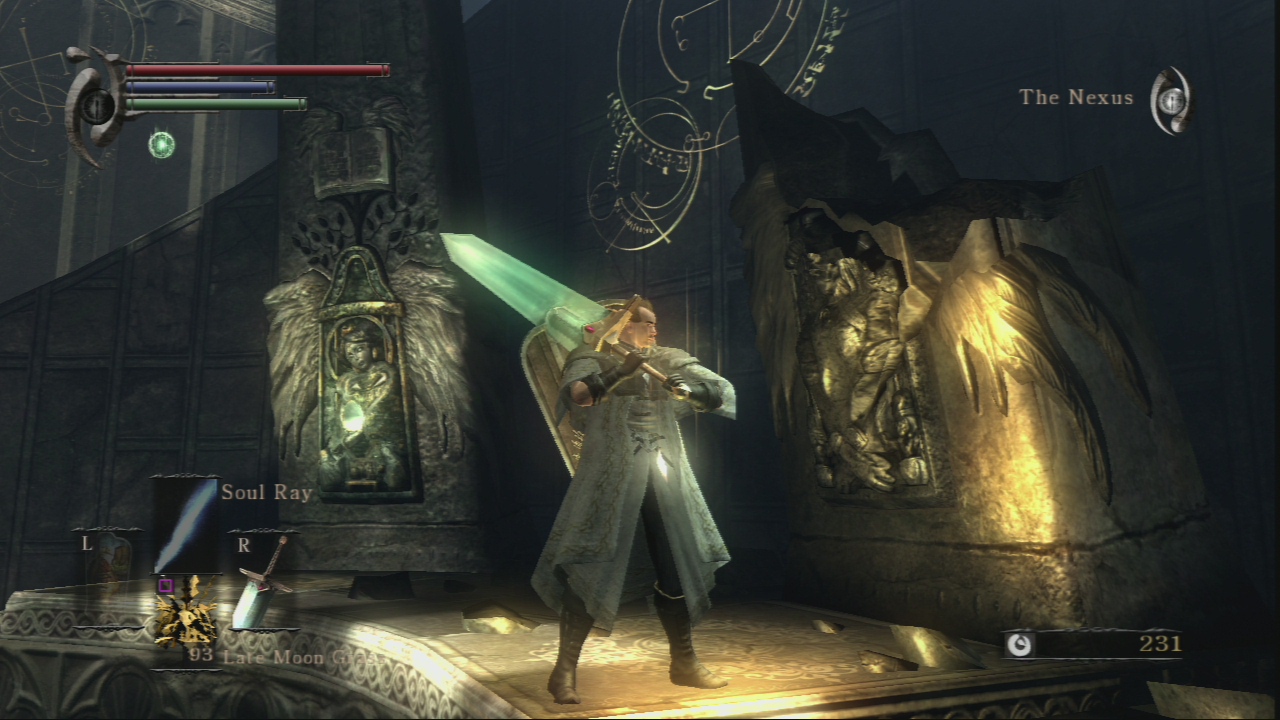
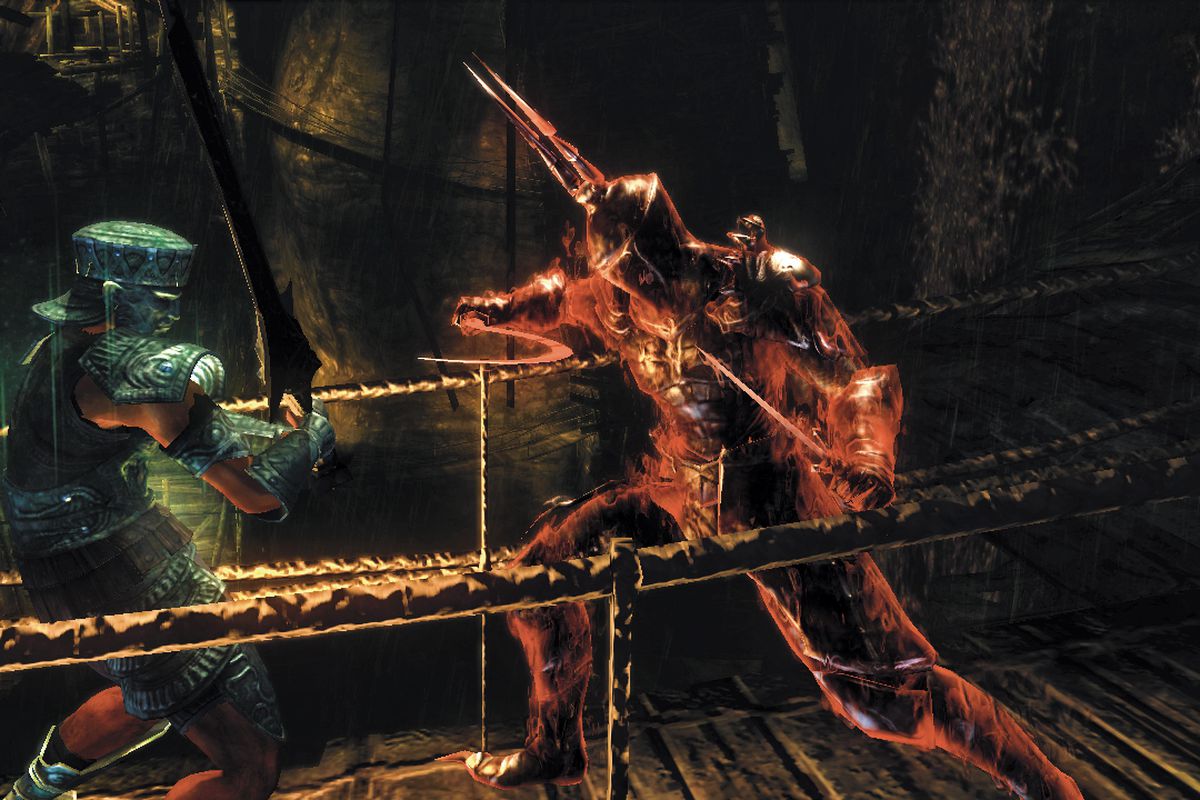
Brutal. That is the first word that will come out of your mouth when playing this game. This is for the hardcore only, and I strictly warn you before plunking down $40 for this game and regretting the purchase like I did. This isn’t your straight-up hack-and-slash game. Oh no, not by any means. This game is all about level grinding and repetition. You will be punished for even trying to take that last-minute hit. What’s the punishment? Going back to the last save. Ha, if only that were true here. You have to restart the entire level every time you die, and you lose all your souls (XP). Yeah, I screamed as well when I found this out.
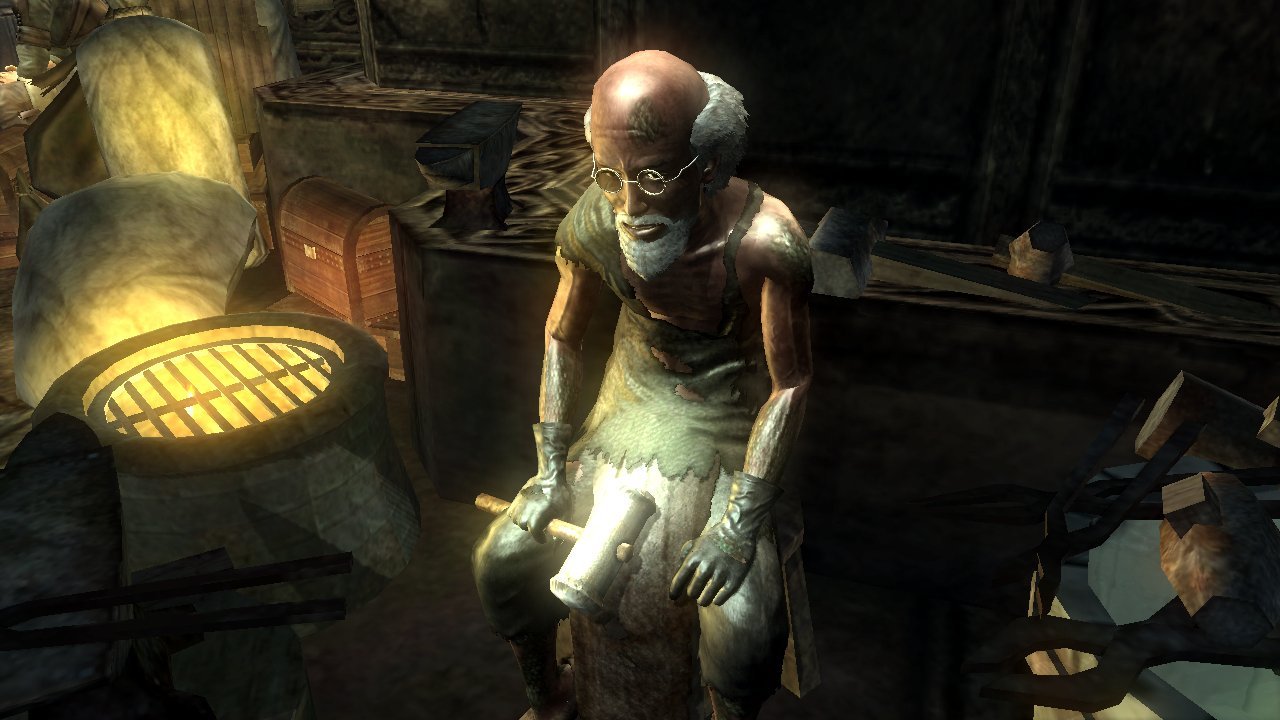
The game is also hard to figure out. I had to do some research online to figure out how to play Demon’s Souls because most RPGs aren’t like this. Instead of a story that you follow through and advance through a game, you get stuck in a central hub and have five connecting levels. You have to repeat these levels dozens of times to level up. You can go to any level whenever you want, and each level has four sections with a boss at the end of each section. Just getting through stages 1–1 was a pain in the ass. I died about 20 times before beating that section.
Another thing you will never know how to do is level up. It doesn’t just happen like in most RPGs. You have to get all your souls back to the Nexus (hub) without dying and talk to the Maiden in Black to level up. There are 999 levels, and each time you upgrade an attribute, it bumps you up one level. So if you upgrade strength, vitality, and dexterity, that bumps you up to three levels. So once you figure this out, you have to start soul grinding until you get to a high enough level that you won’t die with every swing.
Don’t panic when you die, though. If you manage to get back to the spot where you died without dying again, you can reclaim all your lost souls, and they will be added to what you currently have. Die before you reach there, and the count is reset. This makes the game so frustrating, and I even almost got an aneurysm from the frustration. A lot of enemies are tough, and the fighting mechanics aren’t all that smooth, so you have to learn them and execute them well. It’s all about skill.
The fighting mechanics are pretty decent. You have a light and heavy attack as well as a block and parry button. All these are mapped to the shoulder buttons. You can switch weapons out with the left and right D-pads (assign them in your menu). Another flaw the game has that doesn’t make any sense is that you can’t sell items but only drop them. You think selling these would make getting souls easier, but From Software just had to make things that much more difficult. On top of this, you have a burden count (think Oblivion), and getting new armor and weapons isn’t easy. You can upgrade weapons and armor by finding stones. These can only be upgraded at the Nexus (as far as I know).
Another flaw this game has is that there’s no pause button. Yeah, what? I couldn’t believe you can’t pause the game; it’s that hardcore. You just have to stand in a safe spot. This game goes out of its way to make you hate it to death. Yet there’s something that makes you keep playing. You just want to keep leveling up, getting the next boss, and fighting your way through the game. This is probably because you get so angry that you just won’t let the game win. This also means you need hours of your day to play this game since this is by no means a pickup-and-play game.
I was so angry about the game that I didn’t even mention the story. The story goes along the lines of a deep fog that has taken over the land of Boletaria, and you must defeat the demons holding it there. It’s not really much to ponder, but it’s enough to keep you going. The voice acting is iffy, and you will spend so much time leveling up that you will probably forget all about the story.
The game does do something unique, and this is its online mode. Instead of having a co-op or anything like that, other people can help everyone else through hidden messages or bloodstains. If you come across a message, you can read it, and it will give you hints to help you through the level. These are pre-made messages that people can enter to help others out. Most of the time, these are helpful, but a lot are tricks. Bloodstains are a player that most recently died in that spot, and you can watch their “ghost” to avoid getting killed yourself. Sometimes you will see white ghosts floating around in real-time, and there are other players that you can watch to give you a hint. This is very unique and innovative, but the frustration of the game makes you quickly forget about it all.
The game looks pretty decent. The graphics are a bit bland in some areas, but they’re technically sound. There are some glitches, like collision detection issues and wonky physics. Overall, Demon’s Souls is for the hardcore only. If you want a hack and slash that’s simple and fun, don’t get this game; stay far away. So why did I give this such a high score if I hate it so much? Because the game is good itself, and I just don’t have the patience for this type of game. I’m not going to punish the game for my inability to play it, so the people who can play it will enjoy it. It’ll take you a good 10-15 hours just to figure out all the stats and how the game is played, another 10-15 to get your bearings and level up enough to attempt the game, and about 50+ just to get through the game. Each boss feels like a triumph and is very rewarding, but this game only rewards the patient.
I don’t know how else to put this, but Eternal Sonata is probably one of the best (if not THE best) RPGs of this generation (yes, next-gen is now this gen; it’s been almost four years now, C’mon). The best part about Eternal Sonata is the graphics, story, music, and unique battle system.
To make this as easy as possible to understand, I’ll start with the story. ES does something different that I’ve never seen in a game before, and that uses a fictitious story with something that’s nonfiction. ES is about the famous pianist Chopin from the early 1800s. ES follows the life of Chopin when he was struck with tuberculosis and left Warsaw, Poland, due to the war with Austria at the time. While the real Chopin is sick in bed, you enter into his mind and into the world that he created while trying to recover. Chopin is now Frederic, and you run into several unique and lovable characters while trying to defeat the evil Count Waltz. Forte Castle (where Waltz lies) is supposed to represent Austria, and Chopin wants to go back and defeat the evil leader so he can go home. The reason why Chopin runs into these colorful characters is that they all have separate reasons to see the count (I won’t explain why due to spoilers). After you beat each chapter, stills of Europe will play, as well as a piece of Chopin’s music and pieces of his life will be told. Everything flows and ties in perfectly, and it makes it one of my favorite RPG stories of all time.
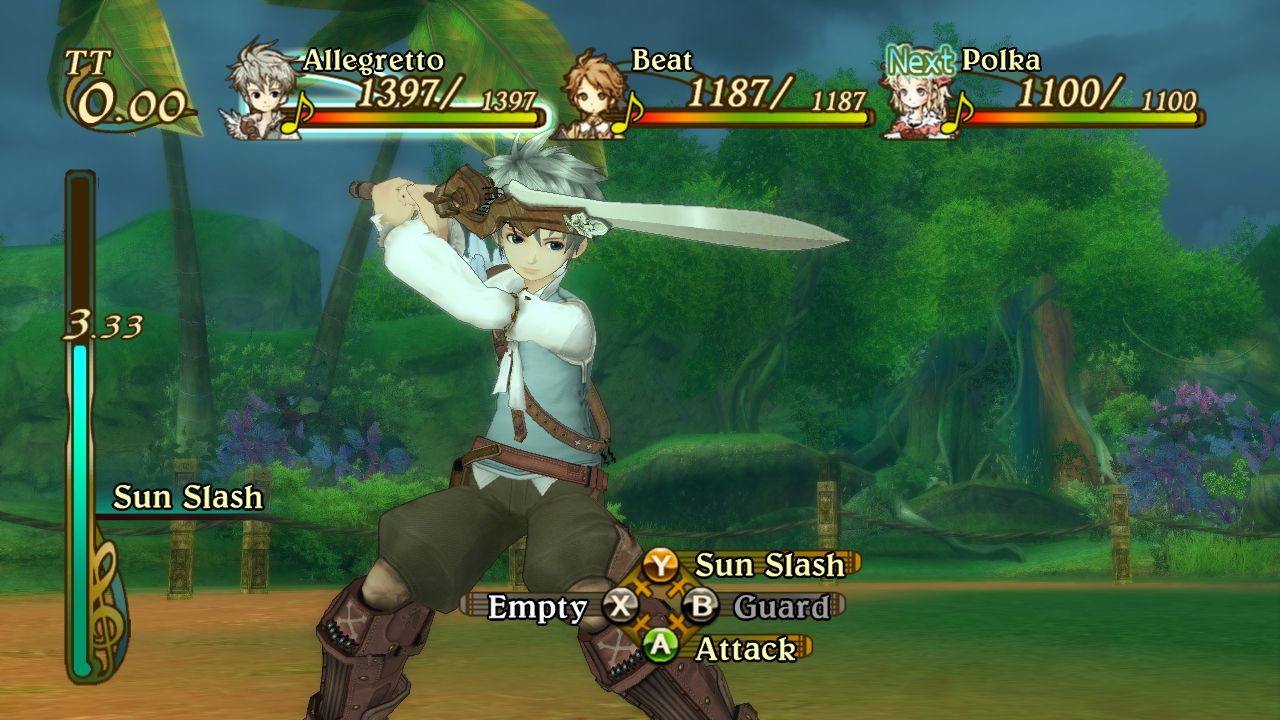
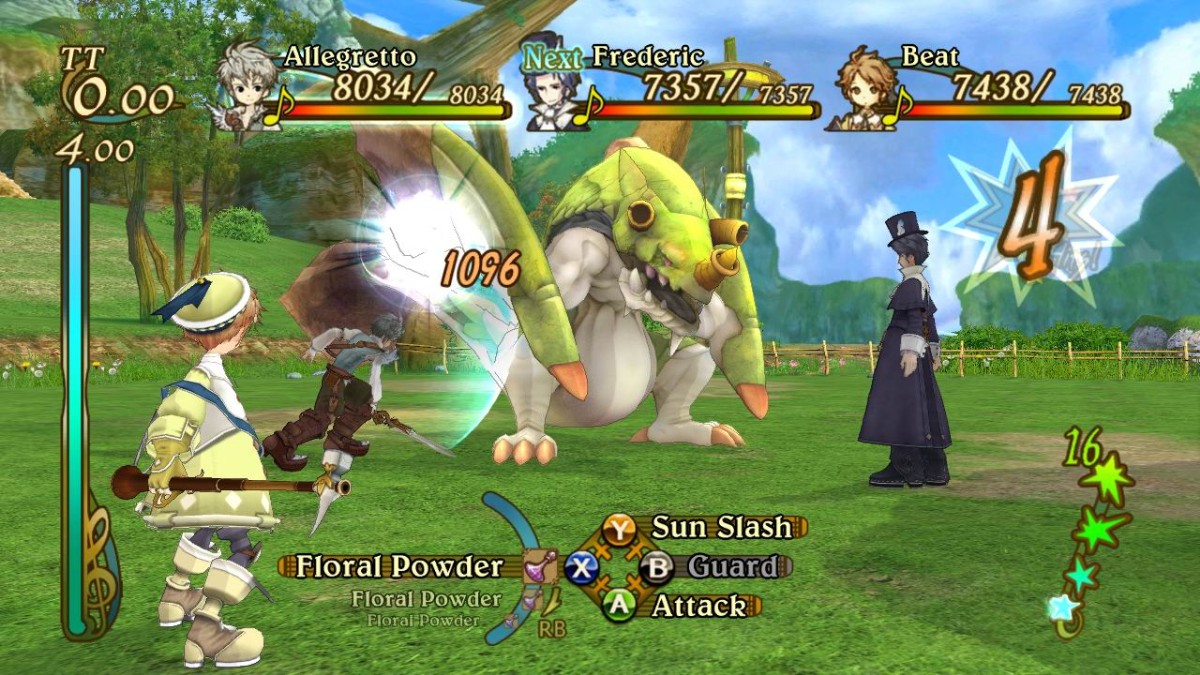
Now I’m going to go right into the battle system, with this being the meat of the game. ES doesn’t have a random battle system (thank God!) since I think we’re finally beyond that. Every enemy you see is in real-time, and you can avoid them if you want (like in numerous other RPGs). Instead of having magic, ability points, and some sort of super attack, ES does away with all that. You have a battle counter that lets you decide what you need to do. After this runs out, your action counter (about 5 seconds) counts down when you start moving, and you use the A button to attack with your main weapon. Magic, Special Abilities, or whatever you want to call them, are on your Y button, and you can use them as many times as you want throughout your turn. So, if you attack until your turn is just about up and then hit the Y button, you can do some devastating damage. Of course, you have items that heal, poison, and revive KOs, and there are tons of them, but there’s nothing special about these that you haven’t seen before. When it comes to guarding, you have a “chance” button (B), and if you hit the button when it appears on screen, you will block the enemy’s attack, greatly reducing the damage by about 90%. Sometimes the button will stay longer than other times, but it’s all about timing, and this helps keep the action up.
When you get your party leveled up, battle rules change from losing time on your counters to being able to chain special attacks to moving faster in battle. Every time you hit an enemy, you “queue” up power, and then when you use your special attack, it’s that much more powerful. Every character gets two abilities: light and dark. On the battlefield, you’ll see shadows and light areas; when you are in a dark area, you’ll use a dark attack, and when you are in a light area, you’ll use a light attack. This is really great and can help keep things mixed up. Watch out, though some enemies transform into stronger monsters when they are in the dark. The level design in this game can vary sometimes since some of it has labyrinthine dungeons that require a FAQ to even remotely understand how to navigate. A lot of these are partly due to puzzles that require a lot of backtracking that really gets under your skin. Now that the battle system is out of the way, let’s talk about production values.
Eternal Sonata uses some outstanding music, especially when Chopin’s pieces are used. The graphics are just absolutely gorgeous, with bright color palettes and unique architecture I’ve never seen in a game before. Eternal Sonata is also one of the JRPGs that also includes Japanese voice acting, and I highly recommend this over the American voice actors. Just turn the English subtitles on, and you’re good to go since the Japanese voice actors fit the characters better and are just superb. The game is easier than most JRPGs, but maybe this is a good thing. Everyone wants a stupidly hard RPG that takes over 100 hours to beat, and that’s not always necessary.
Eternal Sonata will take you 20–30 hours to beat, depending on your play style, and even has a “game finished” save so you can go back from the beginning at whatever level you finished. It’s sad to know Eternal Sonata got great reviews but had poor sales, so I hope you pick this up and experience the best RPGs of all time.
I heard all the hoopla about Persona 3, but the next-gen craze sidetracked me from it. I finally rented the game, and I have to say I am very impressed. I’m tired of the same old random battle JRPG with cliché stories, characters, and battle systems. P3 tries to do something different with practically every element. When you start the game, you’ll notice the game has beautifully drawn anime cutscenes. The story doesn’t become very clear until after you start playing, but this is OK.
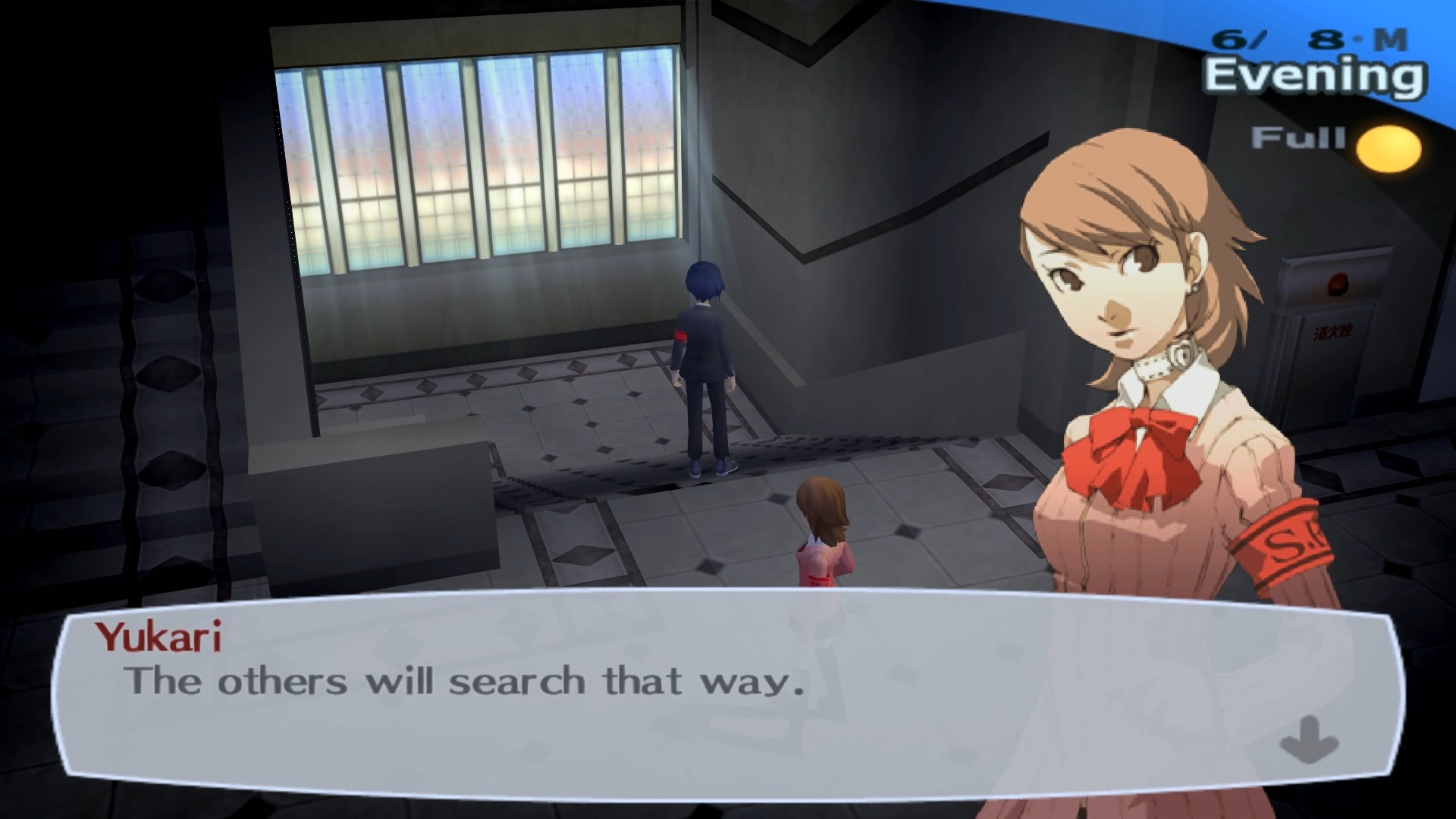
The first thing I have to say is that the game takes forever to get going. Maybe 5–6 hours into the game, you’ll really start getting interesting, and most of the play mechanics will be taught. When you’re not fighting, you’ll be living your regular school life by studying hard and preparing for exams. The game has a calendar event set up, and you go to school, talk to some people, and you can choose to stay awake in class and listen to the lecture to increase your academic skills. Sometimes you’ll have to answer questions (it’s mostly guessing), and maybe your charm will increase. After school, you can meet up with your friends to strengthen your social link (more on that later). Depending on the responses you choose, they will affect your relationships. You can also go shopping at the mall for items, weapons, armor, etc. Another thing I have to mention is that there isn’t enough to buy before the next moon phase (more on that later). So there is one new thing for each member, and that’s it. This can make traveling to the upper levels of Tarturus even harder (more on that later).
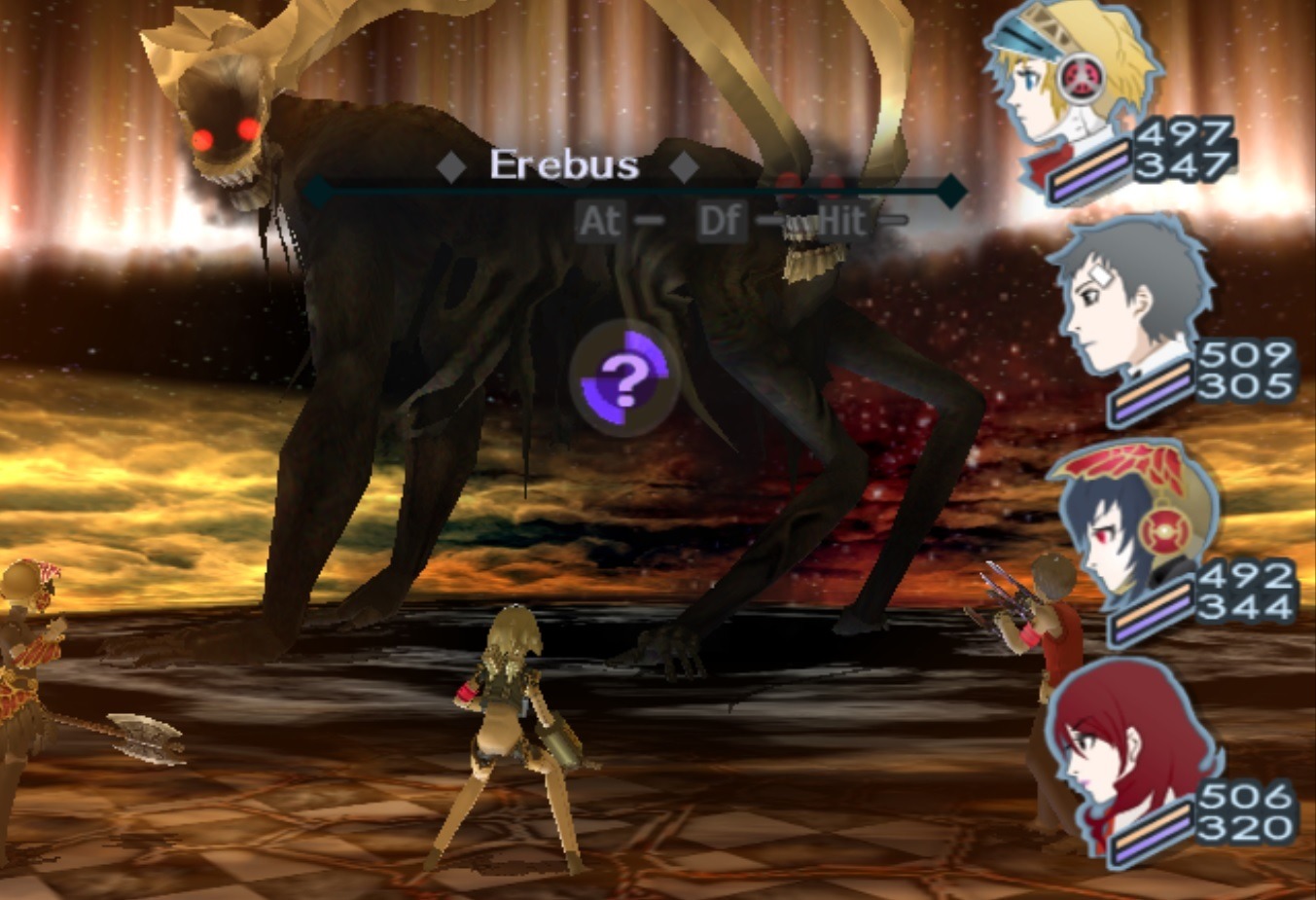
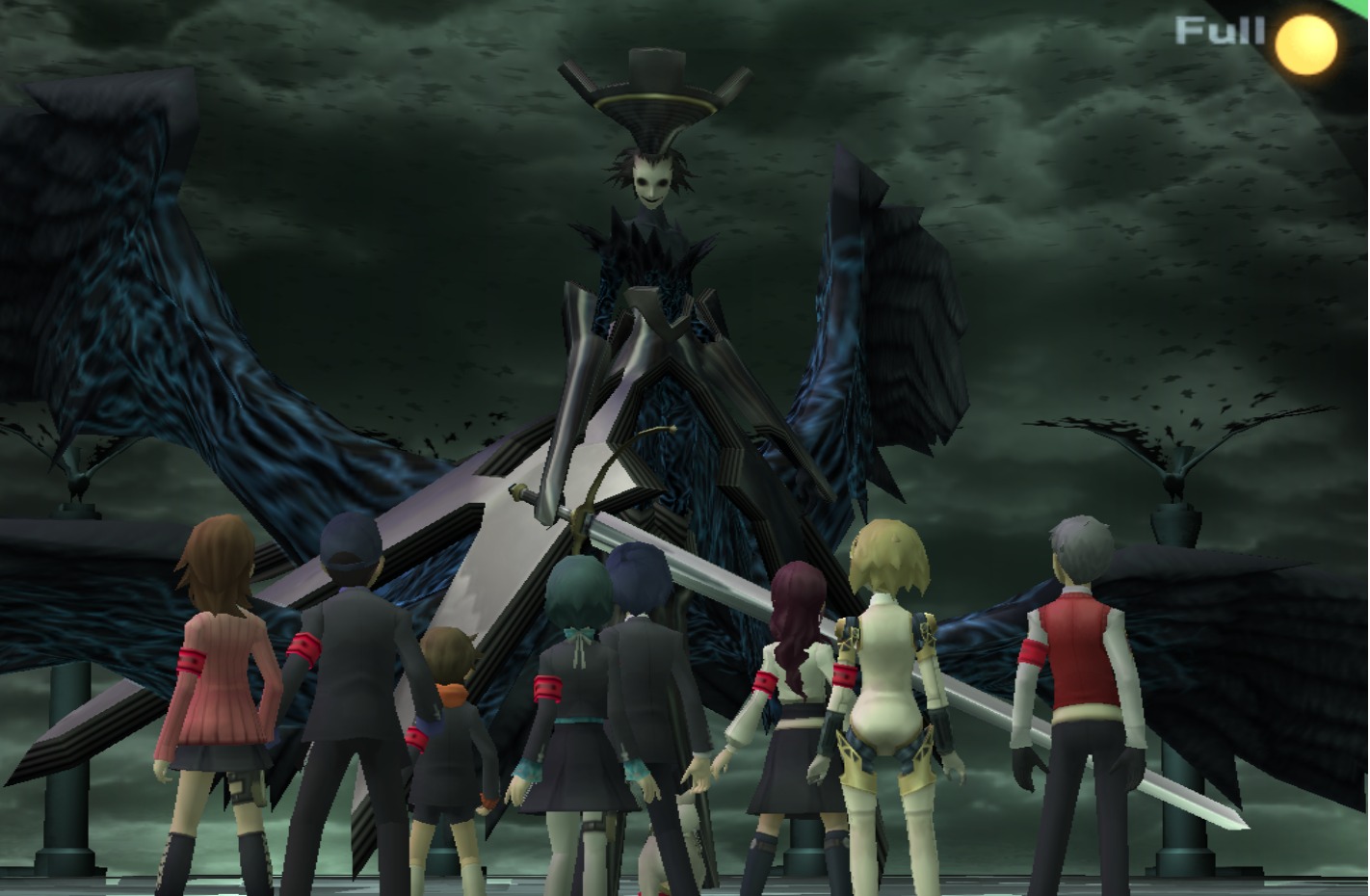
The game’s story is about shadows that try to wreak havoc during the Dark Hour, which is midnight. During this hour, the dorm you stay at turns into a mysterious tower known as Tartarus, and you must climb the tower, fighting stronger and stronger enemies. Every 30 days, you fight a boss, and some events happen that evolve the story. During those 30 days, you have to increase your social links, level up, and acquire all that you can before the big boss. When you fight in battle, you use your personas, which are like Aeons (think Final Fantasy), and they are your strongest attacks. You’ll rarely attack yourself, so you always concentrate on your personas. Some personas have different magic abilities, etc. The battles are won by determining the enemy’s weaknesses and exploiting them. When you hit their weakness, you get one more turn, and the enemies fall down. If you get all the enemies to fall down, you can do an all-out attack where all the players will maul the enemies for extra damage. This is key to mastering because you can die very easily early in the game because leveling up takes longer than it should. Luckily, you can switch personas in mid-battle, so you can exploit accordingly.
One irritating thing about this game is that they changed the elements’ names. Instead of Fire, Ice, Wind, and Fire, it’s Zio, Bufu, and Garu (light), and it’s really stupid. Why did they do this? Probably just to be cute, but it confuses you, and you have to know what these names mean. Once you win a battle, you may get Shuffle Time, which lets you see the faces of a card and shuffles them around. Some may give you bonus experience, some may be a new persona, and some may be weapons. While you run around through Tarturus, you can see the shadows, so this game isn’t random. If you hit them first, you get an advantage, but if you let them hit you, it’s not so good.
The game mainly revolves around personas, so, of course, you can make your own. Take your cards to the Velvet Room, and you can combine them to make better personas. Now there are attributes and rules, but these are confusing and pointless, so you just add a few up and see what it makes. It’s really simple and easy to use, but you can’t do this for a while because you can only create a persona that is at your level. Also in the VR, you can take requests from Elizabeth by bringing her certain items at certain dates for rewards. I found this very hard because you never really know what she’s talking about half the time. I think it’s mainly there for completionists.
Social links affect your persona because if you have a friend who is a Magician SL, all your Magician personas will level up faster. Of course, there are events every day that always change. Sometimes you can’t go to Tartarus at night because your members are too tired, some may get sick, some may be busy studying for exams, etc. This changes things up all the time, so not one day is the same. When it all boils down, the game is generally the same. Go to school; go to Tarturus over and over. There are no worlds or levels to actually explore, so this may disappoint some people. When in doubt, pick up Persona 3 because you are going to have a blast, and there are dozens of hours of RPG goodness here. With decent voice acting, memorable characters, and a great battle system, you will truly love this game.
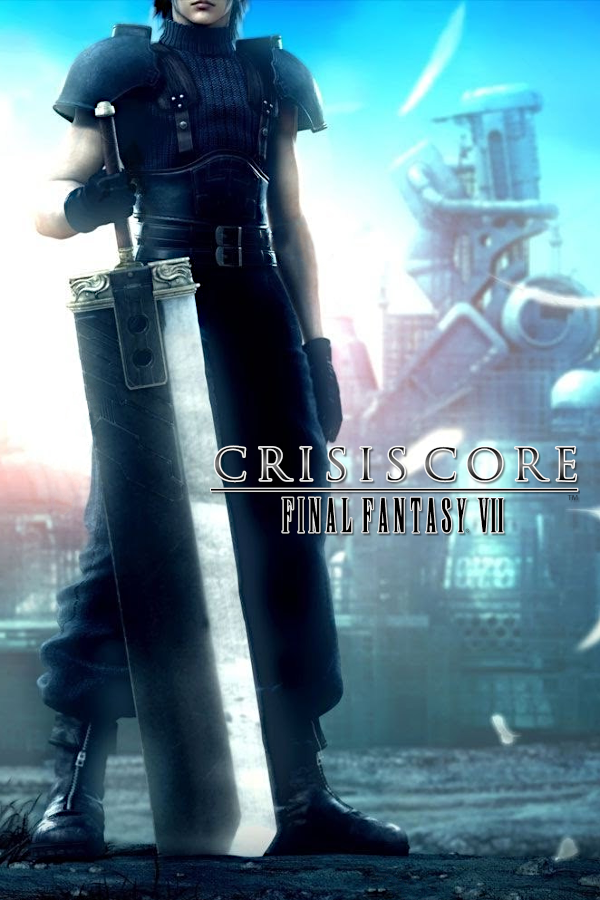
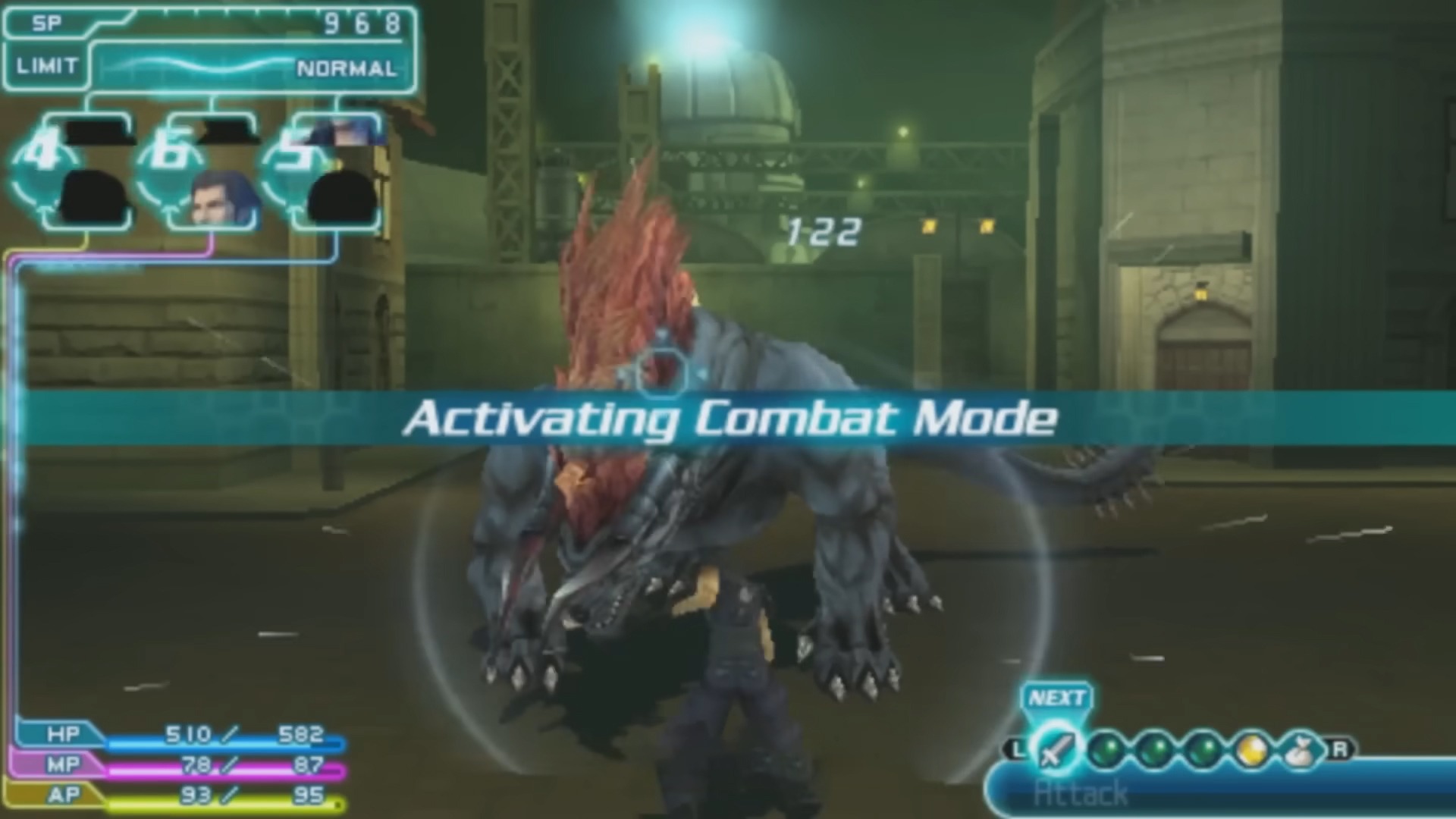
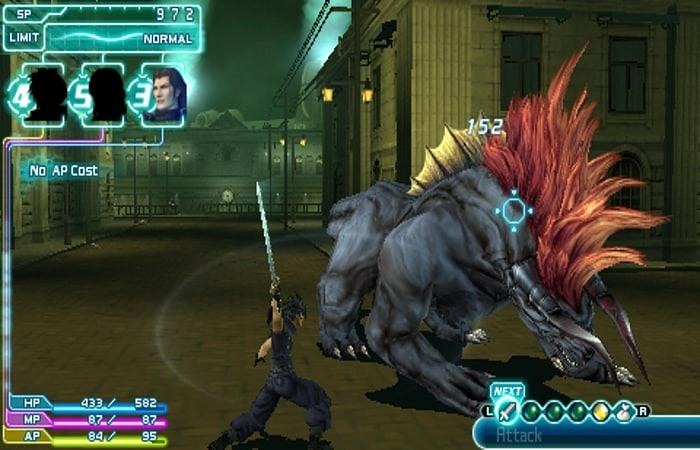
If you’ve been holding out on a PSP (I don’t know why you have), here is another reason to buy one. CC offers an original game experience, and, well, here’s how. First off, people who hate turn-based RPGs can relax. We get a whole new real-time combat engine, and no, it’s not like FF12’s. When you engage in combat, you can select attack, your materia (more on that later), and your items with the L or R buttons. You attack with X (combat is very simple and pretty easy). Now for the new original hate-it-or-like-it idea: the DMW. It looks like a slot machine up in the corner, and this is how you choose your power attacks (overdrives), level up, and your Aeon. This is also random, so it mixes up gameplay, yet for micro-managing freaks, they will hate this. Each character’s face is on the wheel, and as you meet them, they are unlocked. Each character has a special move, either offensive or defensive, and they are pretty neat. You also have numbers, and for example, if you get three 7’s, you level up. If you get two of the same number, you level up your materia. Another thing is that you don’t have magic and all that anymore.
Materia is things like fire, thunder, vital slash, and even graviga. You also have AP now, which is for materia like Vital Slash, Jump Attack, etc. You can also fuse materia together to make different materia. This is really fun to do, and there are tons of combos and different materia to collect. There are plenty of enemy types, so don’t worry.
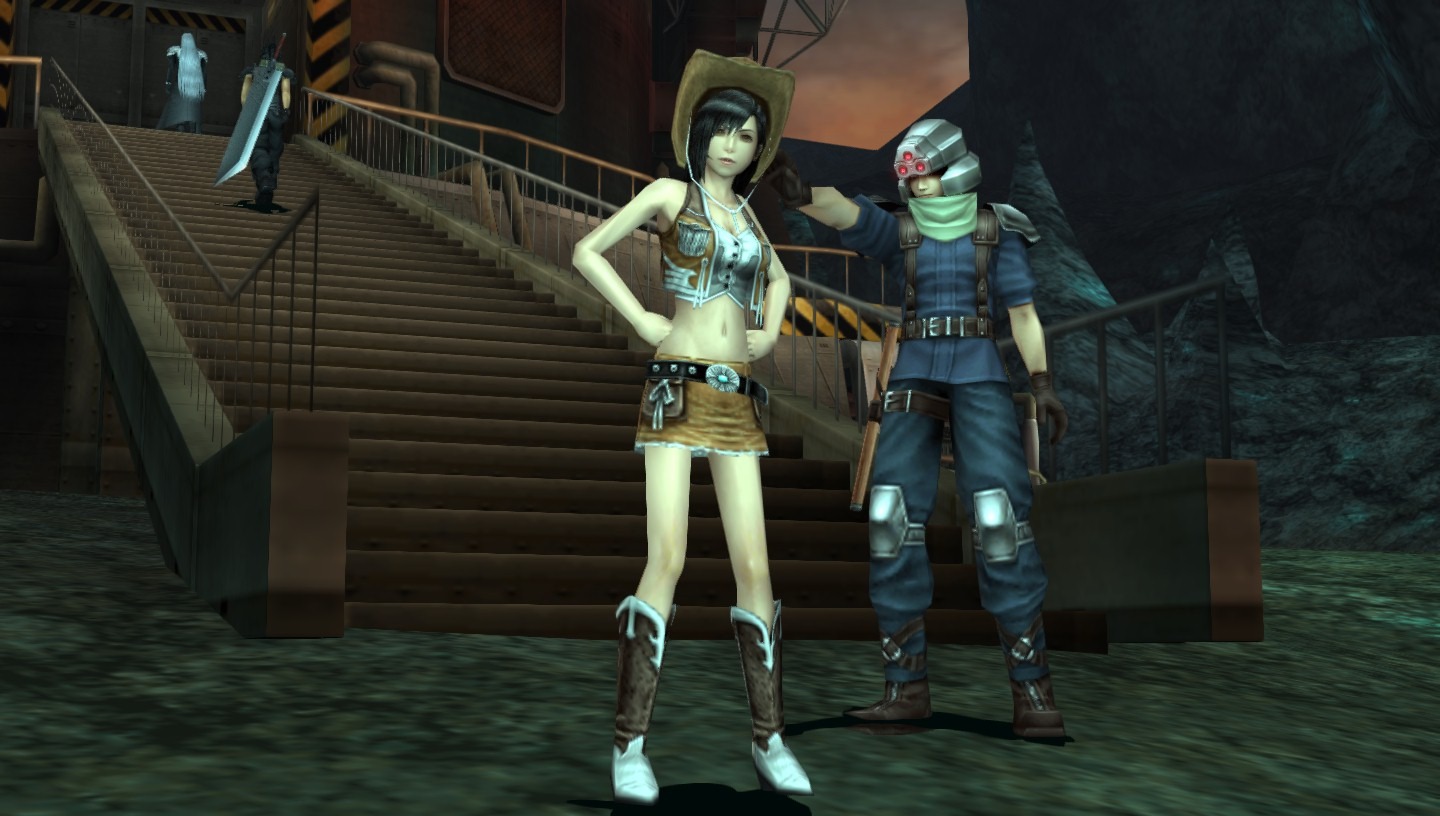
Now for the story, it picks up after the movie where you play as Zack (yes, just one character through the whole game, yeah, so…deal with it). You have to save the world from the evil projects that people are doing and stop Genesis from taking over the world. While the graphics are amazing and the voice acting (for the first time in an FF game) is great, you also get beautiful pre-rendered FMVs. Now for the issues. The DMW wheel is great, and it’s very fair on leveling you up (I finished at level 38) and balances your character very well for you.
The combat is very simple, with just one button: hit, block, and dodge. This could have been revamped more. The game is pretty short by FF standards. I beat the game in 17 hours, and I did 15% of the side missions as well. Speaking of that, the side missions get dull real fast. You access them through save points, and it’s just a “kill every enemy in the room” type thing, and it’s for getting more items. You can’t get new weapons either; you’re stuck with what you have. You can also access shops through the menu at any time, which is convenient but makes the game even easier. Overall, if you love FF, you’ll absolutely love this. If you hate FF, then try the game, and I’m sure you’ll like it now.








































 thebinarymessiah.com
Yeah, it's pretty damn awful. Notoriously one of the worst games on the PSP. A 4 was actually being generous.…