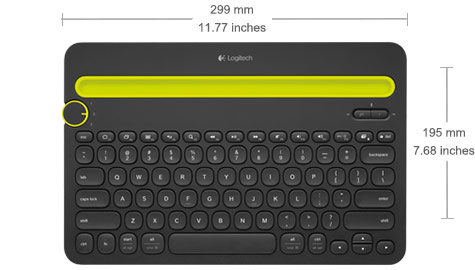
Logitech makes some pretty fantastic products, and it doesn’t surprise me that they make the first Bluetooth keyboard that actually interests me or seems useful. Most are too small, too big, or just don’t feel right. The K480 is perfect for anyone with big hands or multiple devices.
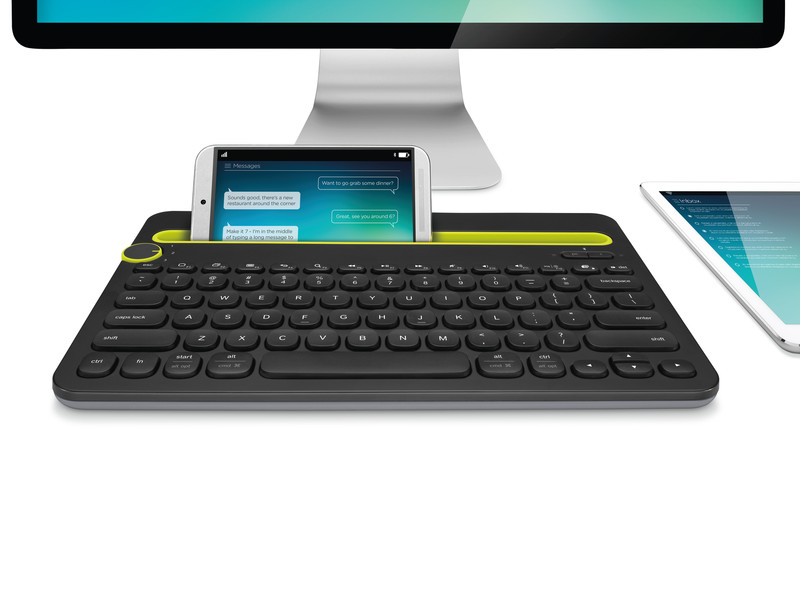
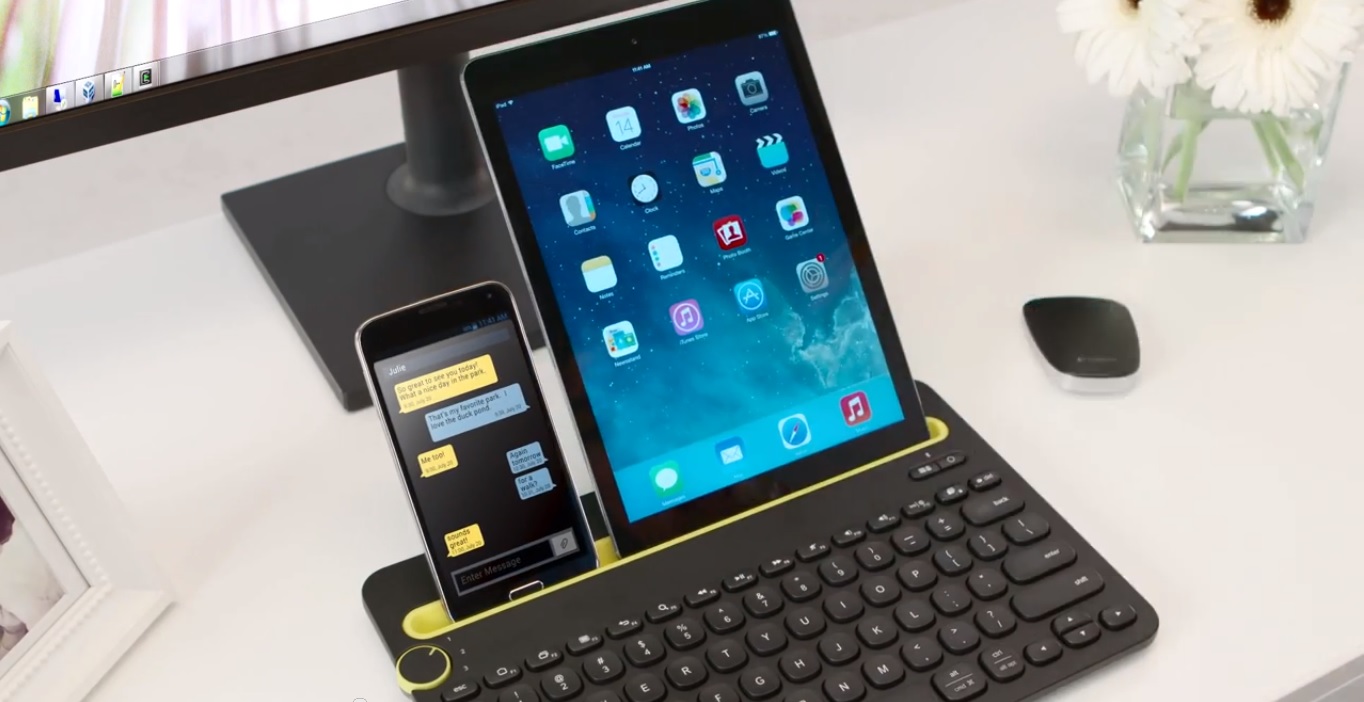
While the keyboard isn’t exactly portable and won’t fit into any small carry-on bags, it doesn’t need to. What got my attention right away was being able to switch between three devices on the fly. The turn dial on the left allows switching between a tablet, phone, and computer all at the same time. Why would you need to do this, you ask? Well, you may be using your computer like normal while texting a friend or typing up a report on your tablet, or vice versa. You can do your research on your computer while you type on the tablet and still chat with a friend. Some people may not need to multitask like this, so having three channels is great to have without having to re-sync your keyboard with every device you use every time.
With that said, you can fit a 7″ tablet laying sideways with a 4″ wide phone next to it, or a 10″ tablet by itself. You can also have the 7″ tablet standing up with a 6″ phone laying sideways. It’s up to you. The keys feel great and click just right. The keyboard looks “bubbly” and sleek, with the keys concaved just right. The actual layout makes sense and works with Macs, iOS devices, and Android. With the FN key, you can use the top row as F keys on a PC, and without it, they are your regular functions on a touch device, such as a menu, home screen, recent apps, media keys, screenshot, volume, etc. It’s a smart layout and one of the best I’ve ever seen on a compact keyboard.
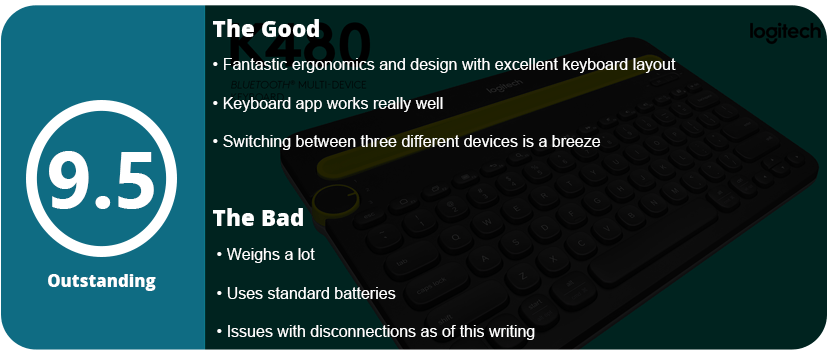
Actually, getting this thing to function with a device isn’t that hard, but Android users may find switching between devices a little annoying when having to select the default keyboard. Using the Logitech app to allow you to type without touching the keyboard is needed. This is actually an issue with the Android OS and not the keyboard itself.
The PC and Mac have their own software that allows you to use the shortcuts on the desktop. It’s fairly easy to connect and use without much hassle. Now the biggest issue with this keyboard is that it uses standard AAA batteries, which blows my mind. In this day and age, most of these gadgets should have internal batteries, but maybe this will cut the price down? I don’t know. Just make sure you have rechargeable AAA batteries handy. The other downside was the weight. This thing is pretty heavy by itself, and even more so if you have a tablet and phone on it. It’s meant to sit on a desk or table, so don’t expect it to be comfortable on your lap.
Developer: Crystal Dynamics/Nixxes Software/United Front Games
Release Date: 1/28/2014
Available On
This is exactly how you do a game series reboot, right? I wish I could end my review with that, but I need to tell you why. Tomb Raider suffered through a few mediocre games during the first run of the series during the late 90’s and early 2000s. The first reboot did well for the series by maturing Lara and giving us better controls and a more cinematic experience. Now comes Tomb Raider (2013), a fantastic game that shows the more human side of Lara. The game starts out with you and a science crew on a ship on the way to an archeological site, but things go awry when Lara decides to head to the Dragon’s Triangle off the coast of Japan. A mysterious storm destroys the boat, and Lara and the team are stranded on this island. There is a mysterious cult trying to sacrifice people to a sun goddess to end these storms. Lara has to deal with this if she wants, of course.
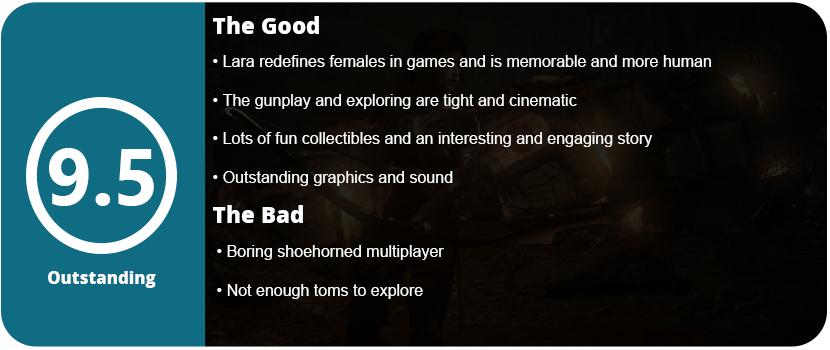
What makes Tomb Raider so memorable is the struggle she goes through while surviving. She is nearly raped, suffers tremendous injuries, and has to cope with herself, dealing with the fact that she has to kill to survive. She is not comfortable with this at first and really struggles to pull the trigger. This adds layers of depth to her character that weren’t seen before. Not only is her personality more memorable, but her looks have changed. No longer is Lara wearing the short shorts and tight shirt with her huge bust. She has been knocked down a few cup sizes and is much younger, straight out of college, in fact. It’s hard to really describe her more than this; you have to play the game to really connect.
The gameplay in Tomb Raider has completely changed, but yes, there is platforming and gunplay. Both are tight and very well crafted. Gunplay consists of using scraps to create a pistol, bow, machine gun, and shotgun. That’s it. As you progress and find salvage in crates and dead bodies, you can upgrade these to look and feel like better weapons. There are many upgrades that increase damage and accuracy, as well as adding new ammo types. Lara’s animations are very well done and realistic, and this falls into combat. She scrambles around and ducks behind cover; the guns feel great to shoot, and you can see how inexperienced Lara is; she’s not a Navy SEAL or commando. Unlike other games like this, her stumbling animations don’t interfere with the game at all. You can still move around, you can dodge, and there’s even some melee thrown in. As you upgrade your skills (done at various campfires throughout the game), you can dodge, and through quick-time events, you can do some pretty gruesome kills.
While gunplay is tight and fun, exploring is just as important. This island is massive, and you can go anywhere; there are no limits. Fast travel via camps really helps, but there’s a reason for moving around everywhere: collecting hidden items. These range from relics, GPS caches, documents, etc. There are hidden tombs found throughout the game that hold area maps for these items. These tombs consist of cleverly made physics puzzles that are really fun to complete. You get rewards like art and 3D models to view. The whole game just has an amazing atmosphere and is so much fun to explore.
On top of all the climbing around, you get a climbing axe, which is an important tool for climbing and combat. Your bow is used for shooting ropes across valleys and canyons to pull items to solve puzzles, break doors, and access new areas. The whole exploring ideal in this game is just fantastic and really fun. I did have to think about how to get to new areas and actually try to navigate and experiment; that’s good game design. There is a Survival Instinct ability that highlights map markers and objectives, and when you unlock the skill, you can see items through walls.
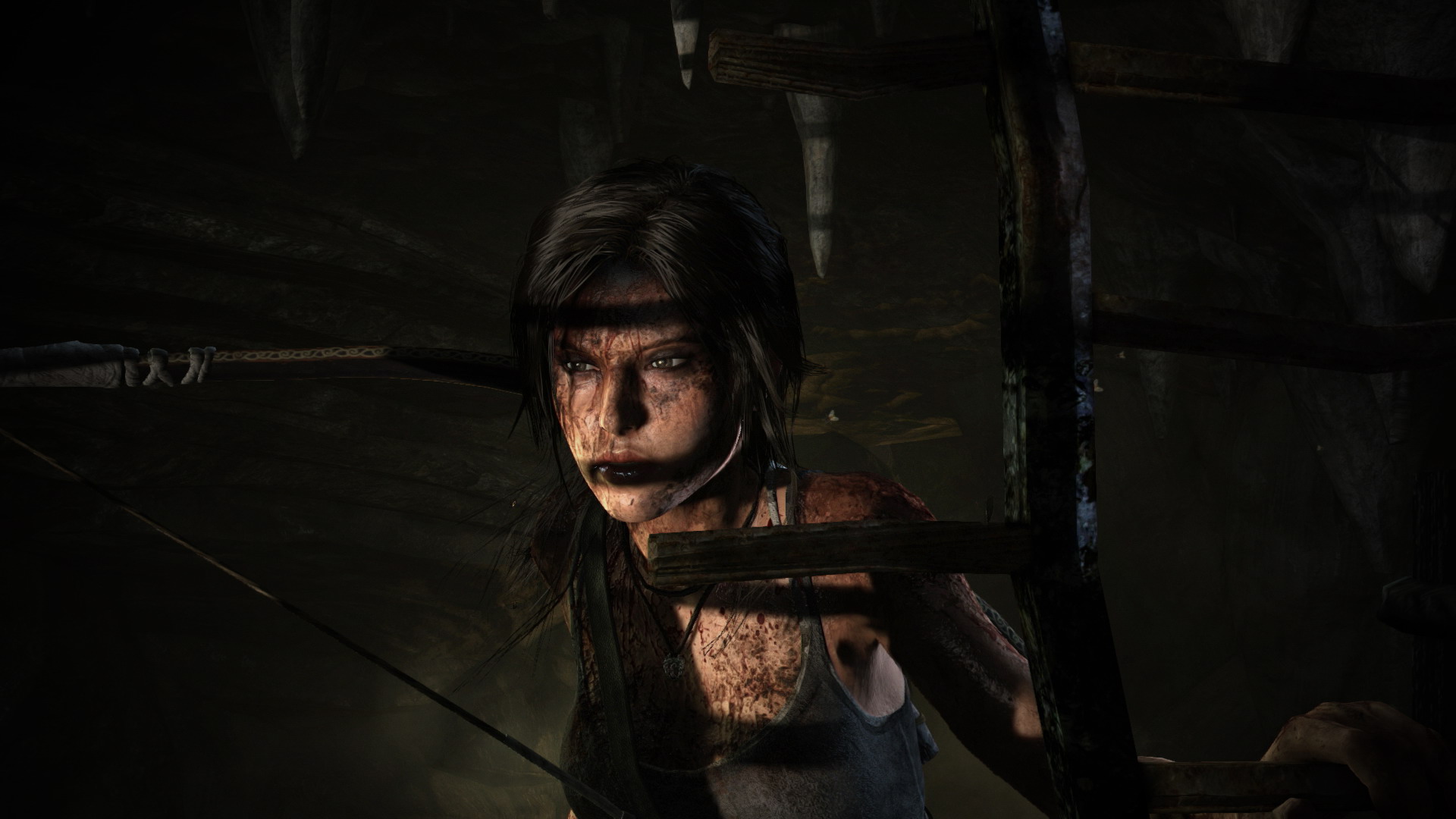
The story itself is a bit confusing; the whole spiritual thing is a bit unbelievable in such a realistic world like this, but that is what Tomb Raider is known for. Lara is the main character here, and what she goes through was the main story for me. I loved every second of the story. The voice acting is awesome, and the graphics look amazing.
The multiplayer was tacked on late in development and is pretty boring. The combat was designed for cinematic gameplay, not multiplayer. It feels just like it does in the story, but it just doesn’t suit multiplayer well. I played all three rounds and got bored of the game. Some people may like it, but there are better multiplayer shooters out there.
Overall, Tomb Raider is one of my favorite games of all time and is really memorable. The voice acting is solid, and Lara’s new personality makes her more human and more relatable. The graphics are outstanding, and the gunplay and exploring mechanics are fun and very cinematic.
Definitive Edition
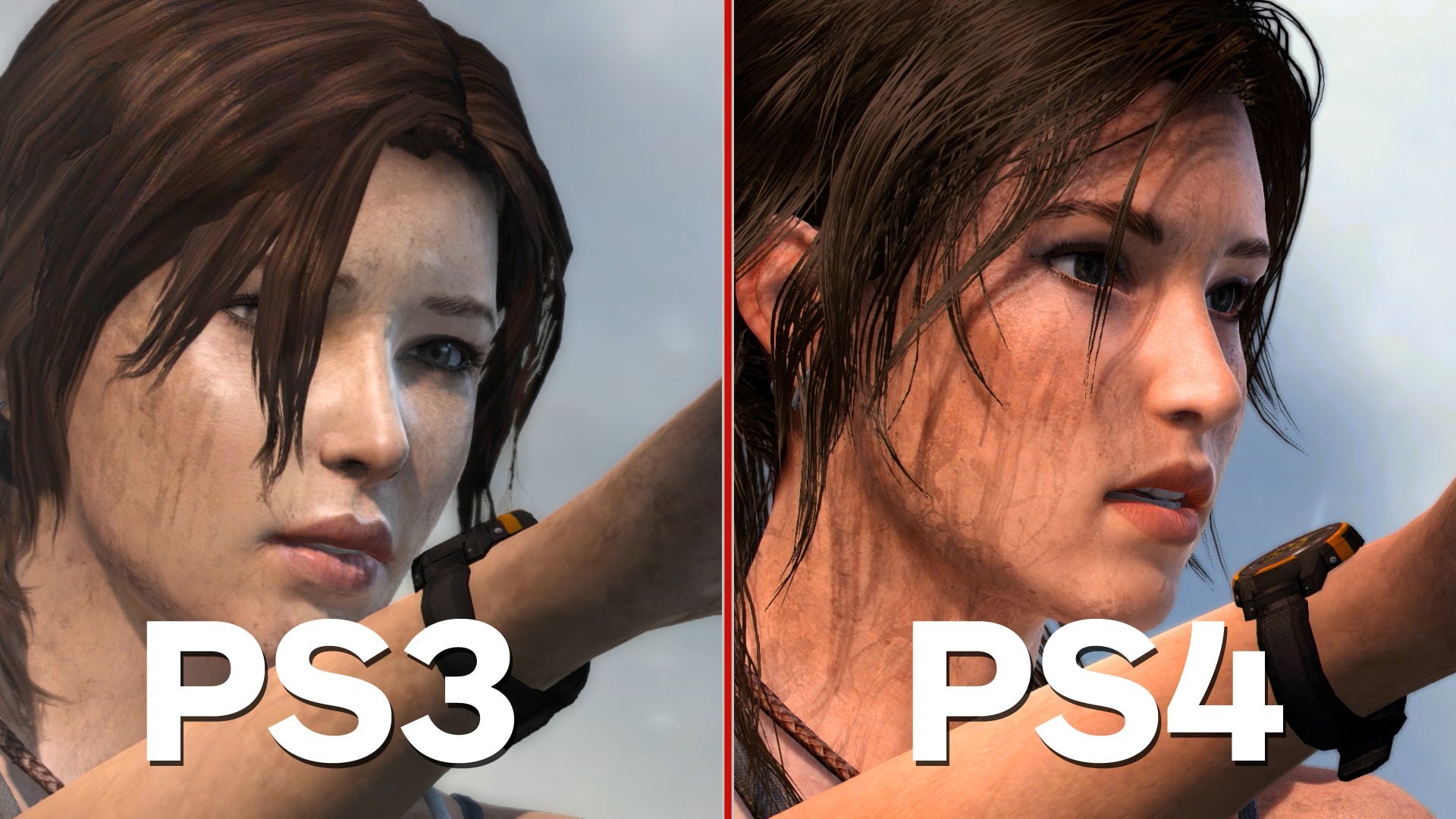
I have to say that the graphics upgrade alone is worth a re-buy. The game looks even better than the best settings on PC. Lara’s newly remodeled look is fantastic, and TressFX on her hair has finally been fixed to the point where there isn’t any slowdown from it. All textures and lighting have been slightly bumped up, and the smooth 60FPS in 1080p on next-gen consoles just looks gorgeous. This game still holds up well to this day, and I played the game all the way through with the same excitement and rush that I did the first time. The PS4 version has been specifically tailored to the controller and headset. You can now play most of the game with voice commands; however, there are quite a few, and it takes a while to remember them all. The PS4 speaker is used through most of the game as ambiance, but I found some narrative bits going through both the controller and TV to sound strange. The Definitive Edition is well worth the buy and is the best version yet.
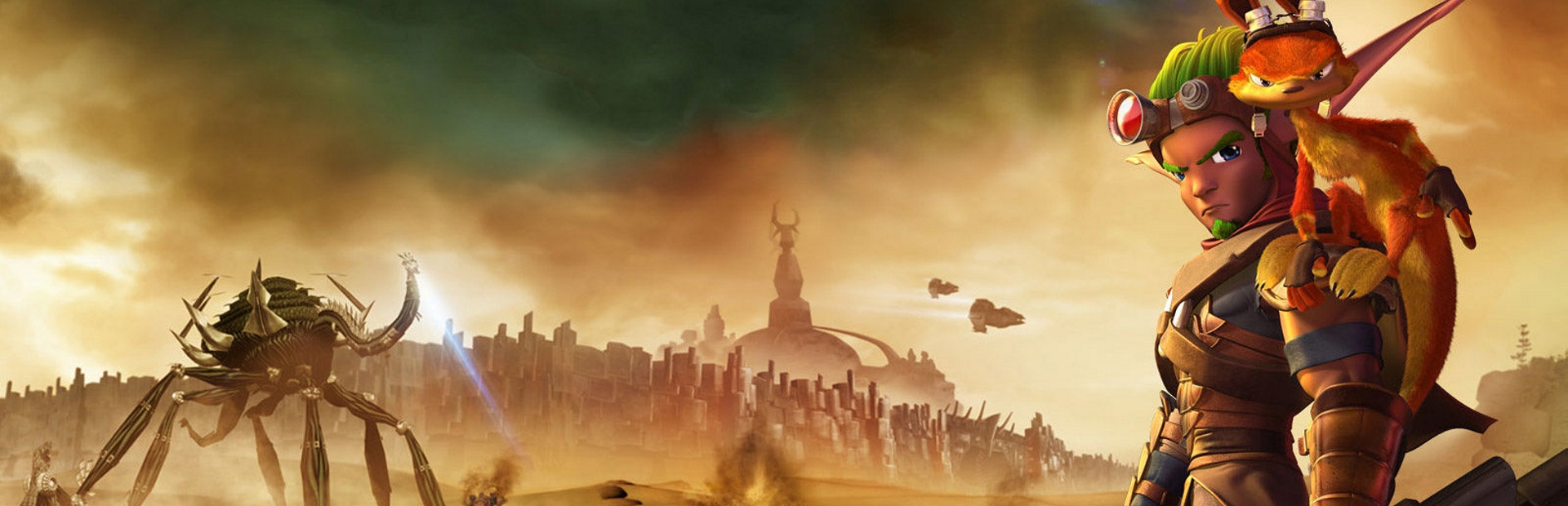
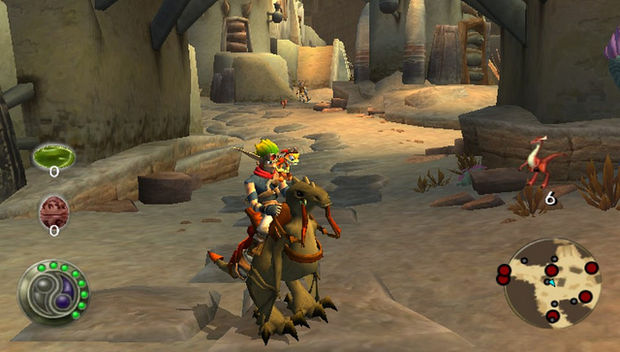
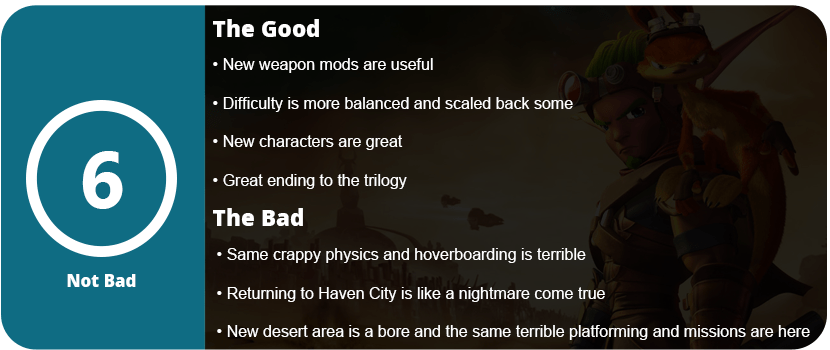
Well, I finally did it. I have played the entire Jak and Daxter trilogy, and I have to say it is one of the most overhyped and overrated game series ever made. While the characters and charm are memorable, everything else is sub-par and less than mediocre. I thought that three times in Naughty Dog would have nailed the gameplay and fixed everything from Jak II, but I was wrong. Instead, we get to revisit that crap fest with just some updated areas of Haven City and an entirely new, boring open desert we can drive cars in that has awful physics.
Jak and Daxter must stop Errol, who is a half-cyborg, from getting to the Death Star. The only worthwhile part of the game is at the very end, when we finally get to know what the precursors are, and I was very satisfied when I found out. Everything else is slightly smelly crap, but complete crap nonetheless. We’re stuck with the same linear level design, repeated mission areas, hard as hell difficulty, wonky platforming, extremely wacky physics, and too much traveling between missions. I loved the new characters, but that’s all this game really had to go for it.
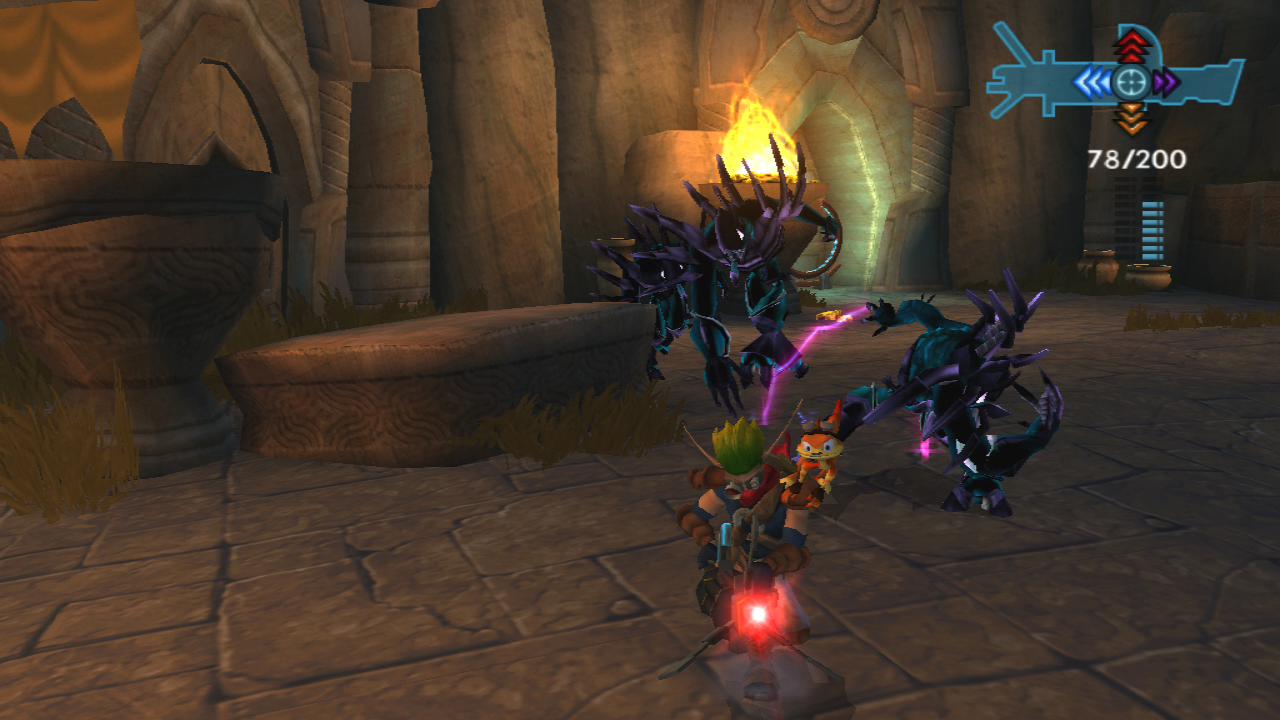
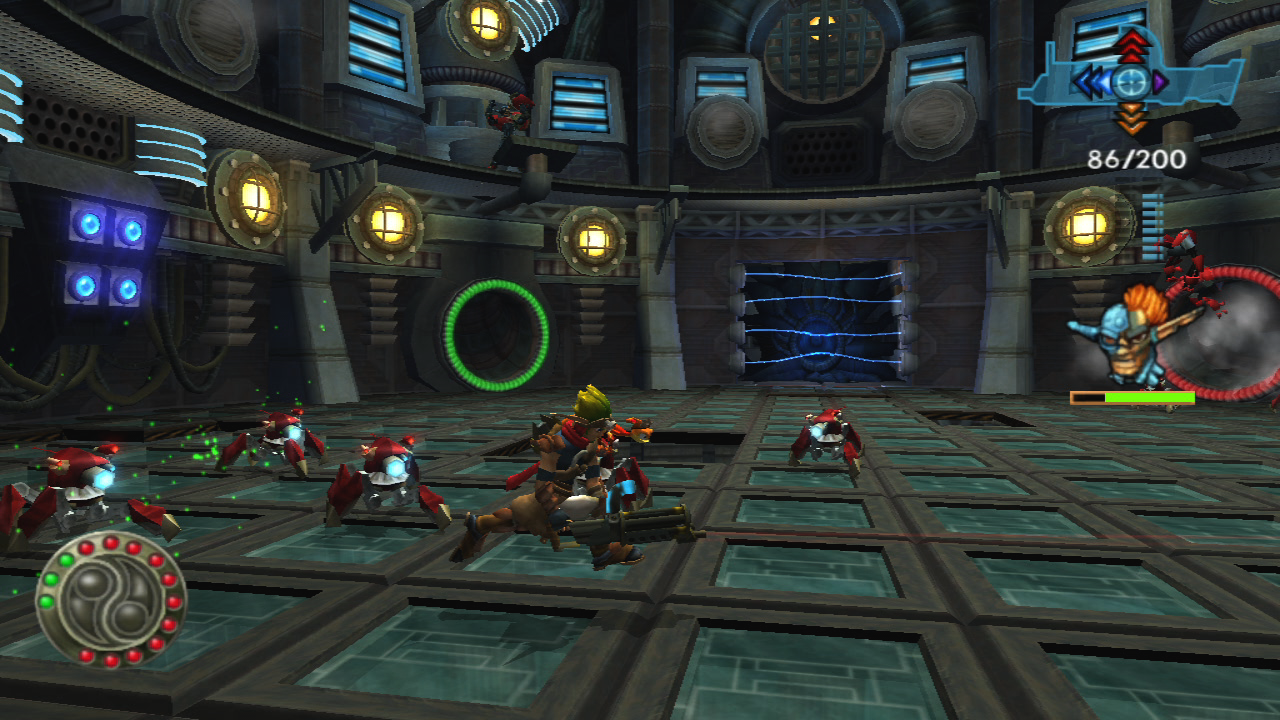
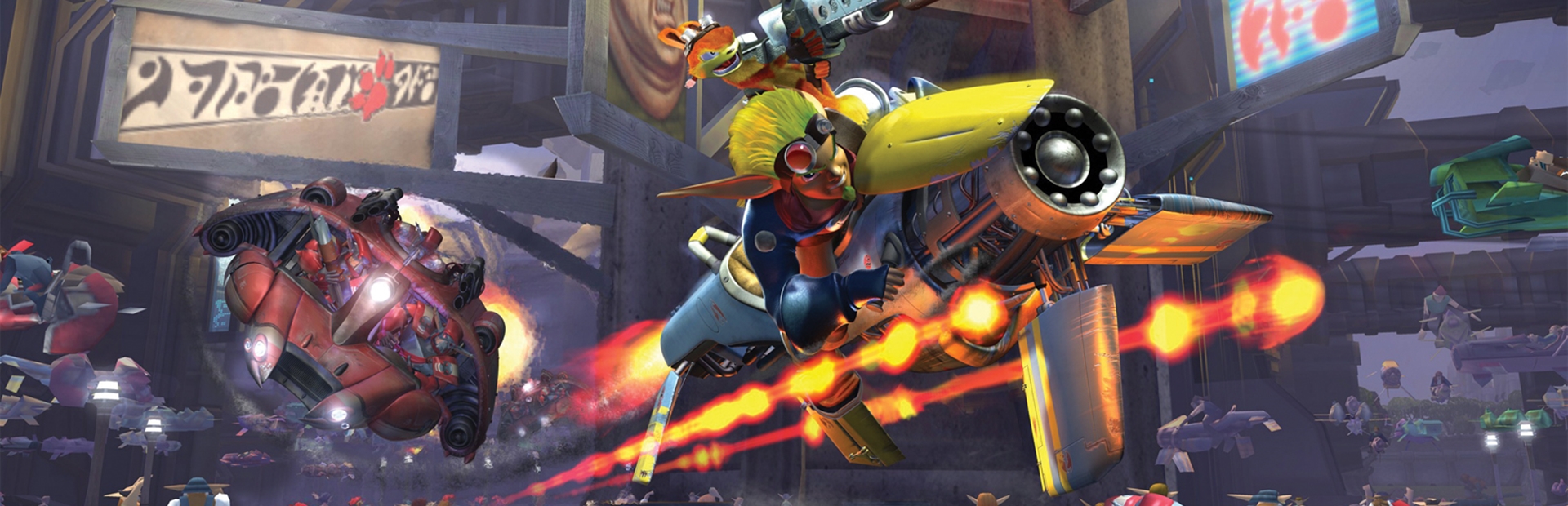
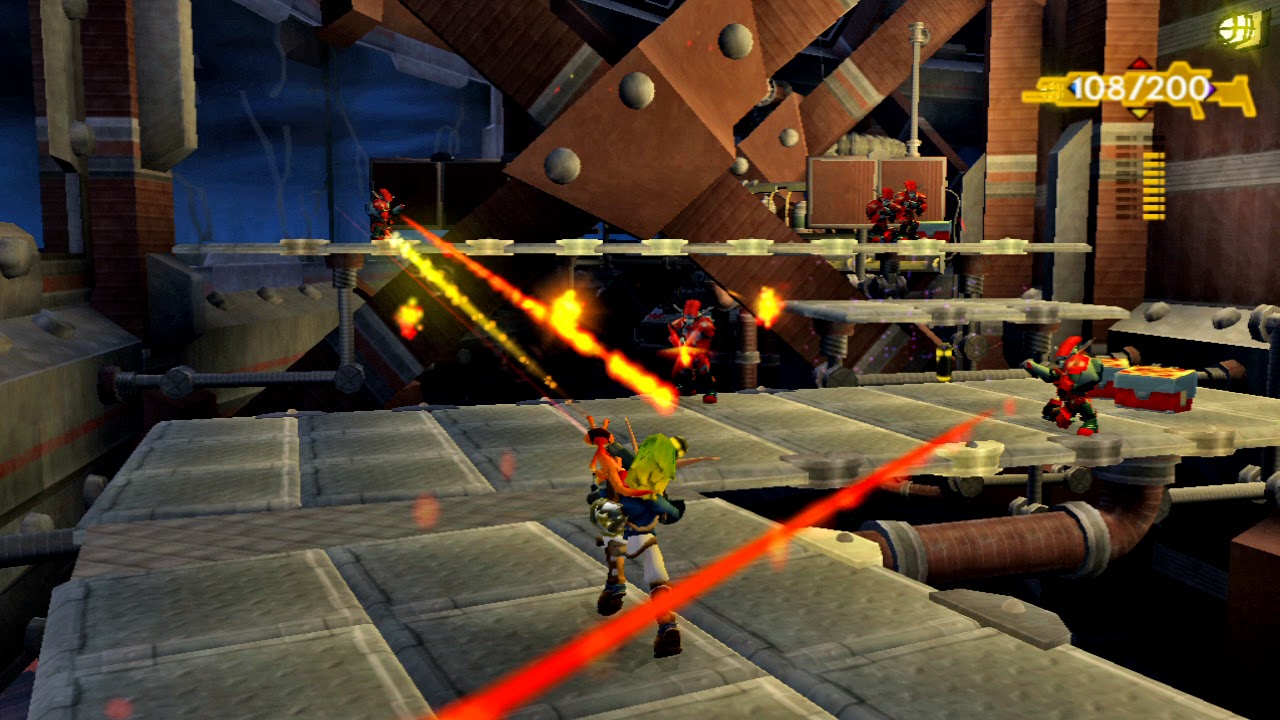
All the new content doesn’t really feel new. Sure, the missions weren’t as difficult as in Jak II, but they were still annoying and boring. This felt like Jak 2.5 rather than a true sequel. The new open desert area is a complete bore to drive in, and bandits will constantly spawn to attack you relentlessly. You are given several buggies, but they all drive like crap. The only helpful addition were the new weapon mods. There are three for each weapon we had in the last game, but they are all really useful, and I relied on them a lot throughout the game. However, the auto lock-on system is still just as crappy, and you waste a lot of ammo just trying to aim in the general direction of the enemy.
Let’s talk about Haven City. I thought I would never have to see that awful city again, but here we are. Each section has been more…updated due to the ongoing war with the Metal Heads and Krimson Guard. The areas are a tad more wide open, and the same vehicles drive a tiny bit better, but not much. There is a new camera angle that puts you right behind Jak, but it just made me noxious due to the awful physics. I really just wanted the game to end, and it felt like a chore, just like the last two games.
With that said, if you played Jak II, you won’t need to expect much from Jak 3. I’m not sure if I’m more disappointed with Jak II than this game, but I honestly can’t recommend this one either. The entire series feels like a complete bust to me, and that’s a crying shame.
This review has actually been a long time coming. I never really liked or got into Jak and Daxter. I gave Jak II a shot back when I was about 13 and, for some reason, liked it, but I also remember being extremely frustrated and hating it too. The game was a complete redesign of the series. Gone is the aimless platforming and collect-a-thon stuff. Here we have an open-world GTA: Vice City clone with attitude. Jak II received a lot of criticism for steering away from the cheery tone of the first game. Jak now talks but has a bad attitude; he shoots guns; and the game has more spunk and adult content. It was a great step for the series, but it created more problems than the first game had.
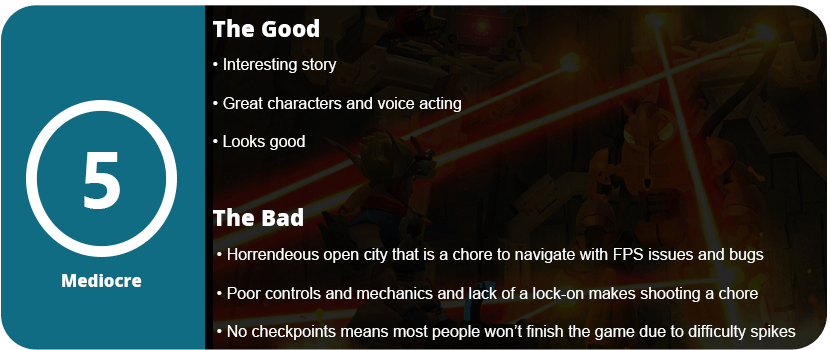
The first thing is the crappy open world. I can’t tell you how tedious and frustrating it is to move around in this damn city. It’s a maze for one with tight linear areas to move around and the vehicles controlled like complete garbage. You bump into everything as you’re driving around, and if the game itself isn’t hard enough, I died multiple times just trying to get to a mission. I have never seen such a poorly built open city before; this takes the cake. If the vehicles aren’t enough, the difficulty of the game is by far the hardest. I guarantee 95% of players will quit before they even get five missions in. You will die time and time again, but not only because it’s hard. The game is just poorly designed.
Take into account no lock-on for aiming whatsoever. You’re left with poor auto-aim, which doesn’t work half the time. Add on glitches, sloppy platforming, and a crappy hoverboard, and you have a craptastic game. Now, that’s not to say Jak II didn’t have potential. It has an AAA budget written all over it. Excellent voice acting, great graphics—the works. It just seems the development team wasn’t up to speed on how smoothly a game needs to play.
Even with the poor gameplay elements aside, the game seems like it wasn’t playtested. Some areas are so difficult to get through; this usually includes the mass amounts of enemies you have to shoot, and you literally need to rely on luck that the AI will miss more than hit just so you can pass on. But the one ultimate reason that this game cannot be forgiven is the lack of checkpoints. I don’t just mean there’s one or two poorly placed. I mean, there are none, zero. You will get halfway through a mission, die, and restart over and over again at the beginning. This is just absurd and completely unfair. If the game had fair checkpoints, I could overlook everything else, but that one major issue nearly ruins the game.
I also don’t like how long this game is. With the difficulty and poor mechanics in place, you just want it to end. Be it the hair-tearing racing missions, hoverboard missions, or the nearly unbeatable timed missions, I don’t think I can remember a game harder than maybe Demons’ Souls, but that game was at least understandable as to why it was hard. It was meant to be that way. Jak II is not.
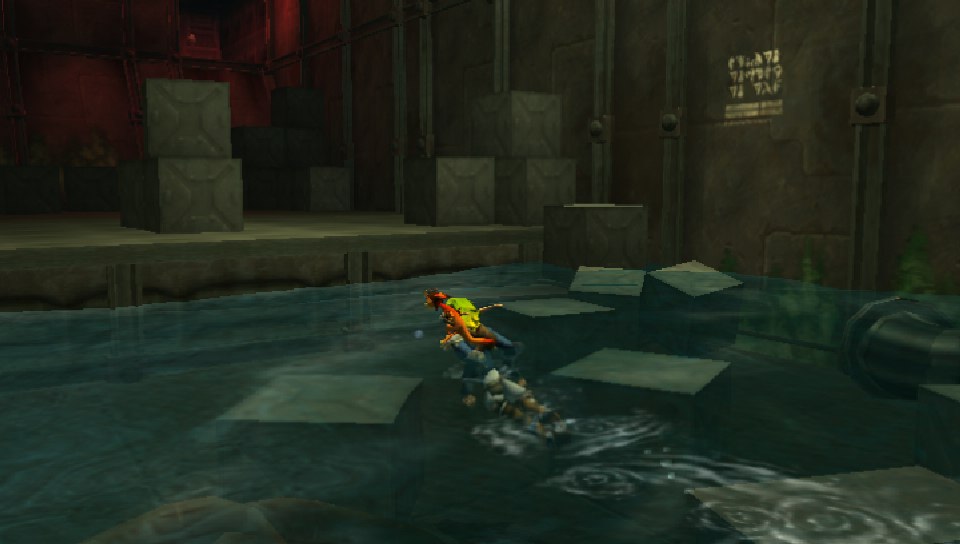
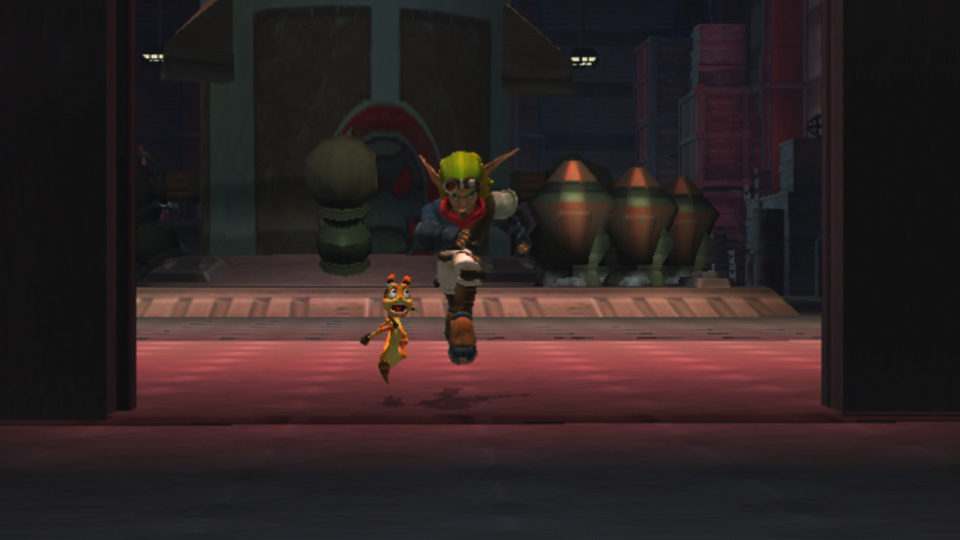
I really wanted to love this game, but I just can’t. Even with the somewhat interesting Saturday morning cartoon-type story, I just hated this game. I will never play it again and wouldn’t wish for my worst enemy to sit through this. Jak II has a great AAA feel but a low-budget, bargain bin gameplay aesthetic. The game also looks good on the Vita, but like Jak and Daxter, the frame rate drops to single digits quite often and chugs. Either the game is pushing the Vita too hard or it’s just poorly optimized. Even without that issue, the game is just terrible.
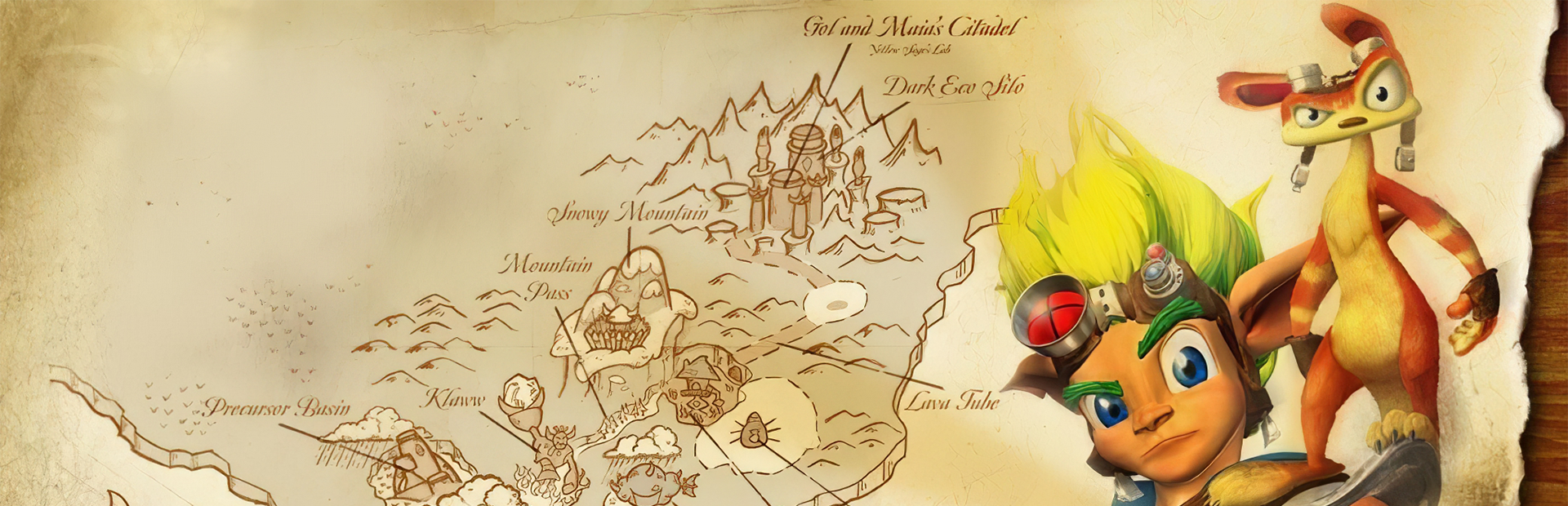
I can’t begin to tell you how many chances I have given this game throughout my childhood. When I first tried the game back in 2002, I had no idea what to even do. The game does not give you any hints, there’s no map, and there certainly aren’t any traditional objectives. The story is somewhat entertaining, but it’s cut short due to the short length of the game.
You play Jak, who is just an average dude who gets stuck trying to do something. Well, eventually you find out you’re trying to find all the mages to open their portals and find out why they are missing. Then Daxter gets himself mixed up in Dark Eco and becomes an otter. He’s your sarcastic yet slightly annoying sidekick through the entire game.
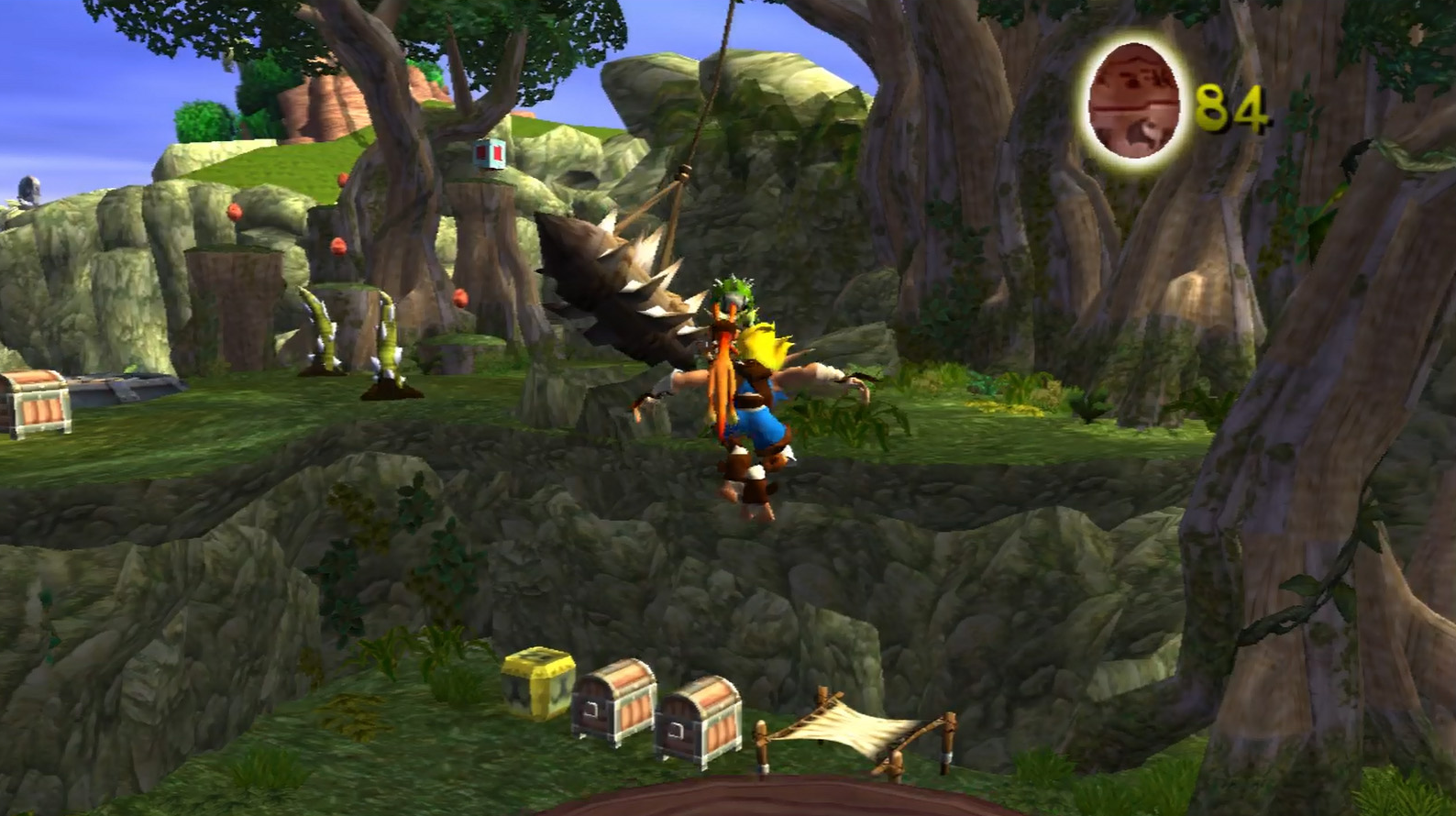
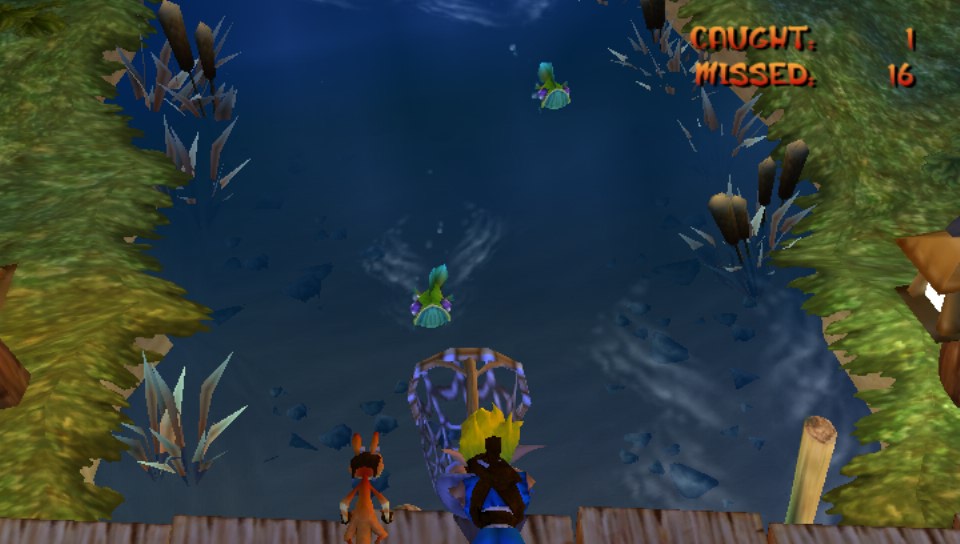
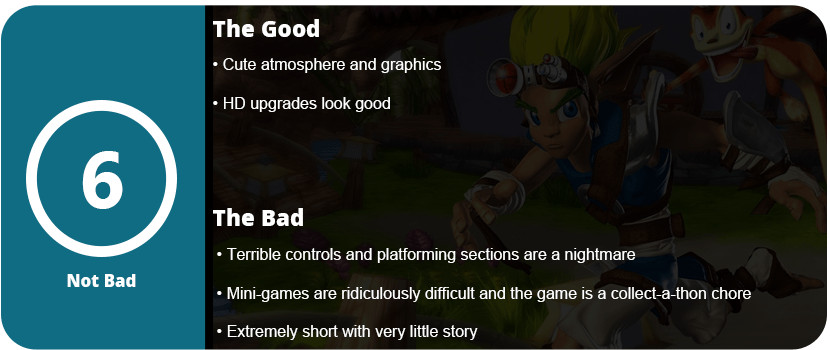
The main issue with Jak and Daxter isn’t the story or the fact that you have no idea where to go or what to do. It’s the platforming mechanics. They are sluggish, slippery, and just awful. In fact, I have played worse platformers with better controls. Just simply jumping from platform to platform can be a chore that causes multiple deaths. It also doesn’t help that the platforming segments are excruciatingly difficult. I went from area to area, tearing my hair out because the game is so frustrating. Even the mini-games are ridiculously hard and require meticulous memorization and reflexes. Now I don’t want my handheld to go through the whole thing, but I want to make it fun while also being challenging. The entire game felt like a huge chore.
The whole point of going through these areas is to collect power cells. These are needed to progress through the three areas of the game. In the third section, you need 73, and there’s 101 in the whole game. That’s a lot of frustrating platforming. To acquire these power cells, you need to complete one of the eight objectives in each area. Some require fighting certain enemies, while others require finding items or going through a platforming segment. The biggest problem with this is that the levels are so poorly designed. I got lost all the time, not knowing where to go or even an indication of where I’m going or what I was doing, which is part of the objective.
Here’s another big problem with the game. It was one of the last “collect-a-thon” games similar to Donkey Kong 64 and various other 3D platformers of the time. Collecting Precursor Orbs to buy power cells is just a chore. I despise collecting like this in a game because, to me, it feels like an excuse for filler content.
I seriously could not take it anymore after almost getting to the final boss. I spent hours in frustration and anger and probably died over 100 times. Dying wouldn’t be so bad if you had more than three hits before you died and it didn’t take 50 green eco-orbs to get a health piece back.
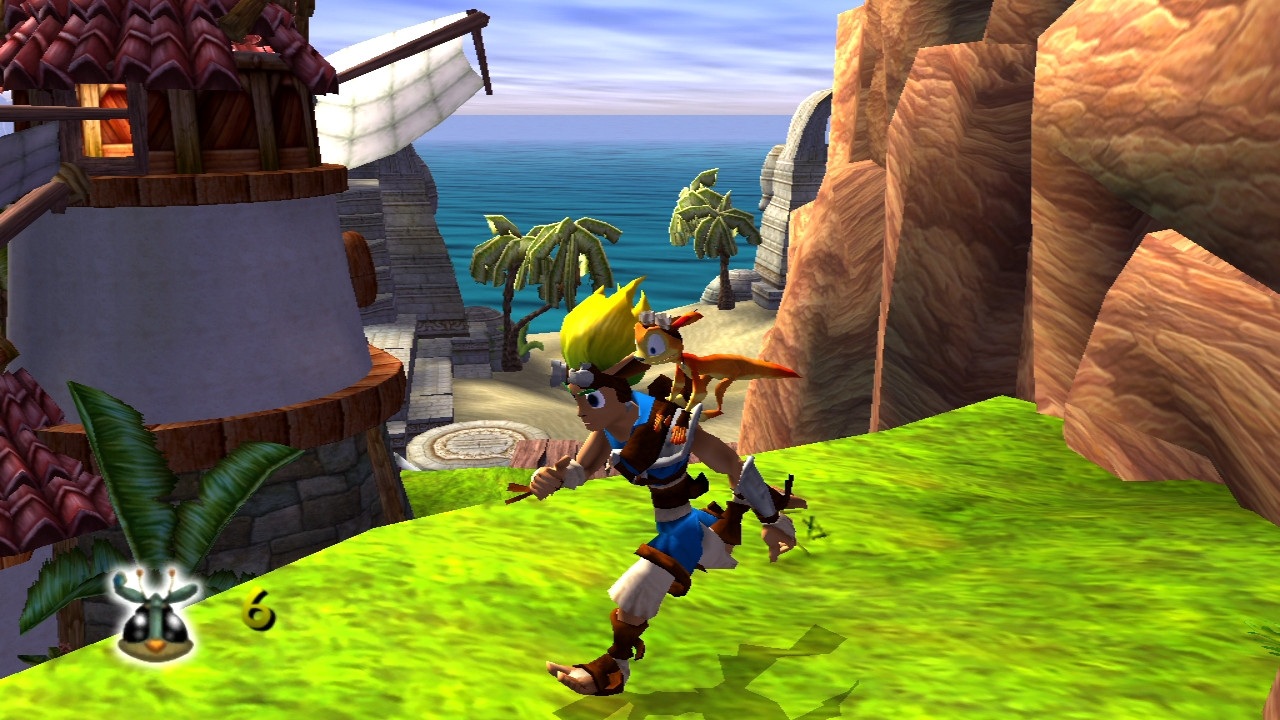
At least the graphics are nice, and the game has a nice atmosphere and charm about it. The Vita and PS3 versions have upgraded lighting effects, some texture filtering, and anti-aliasing thrown in for good measure. The game looks pretty decent, even for a 12-year-old game.
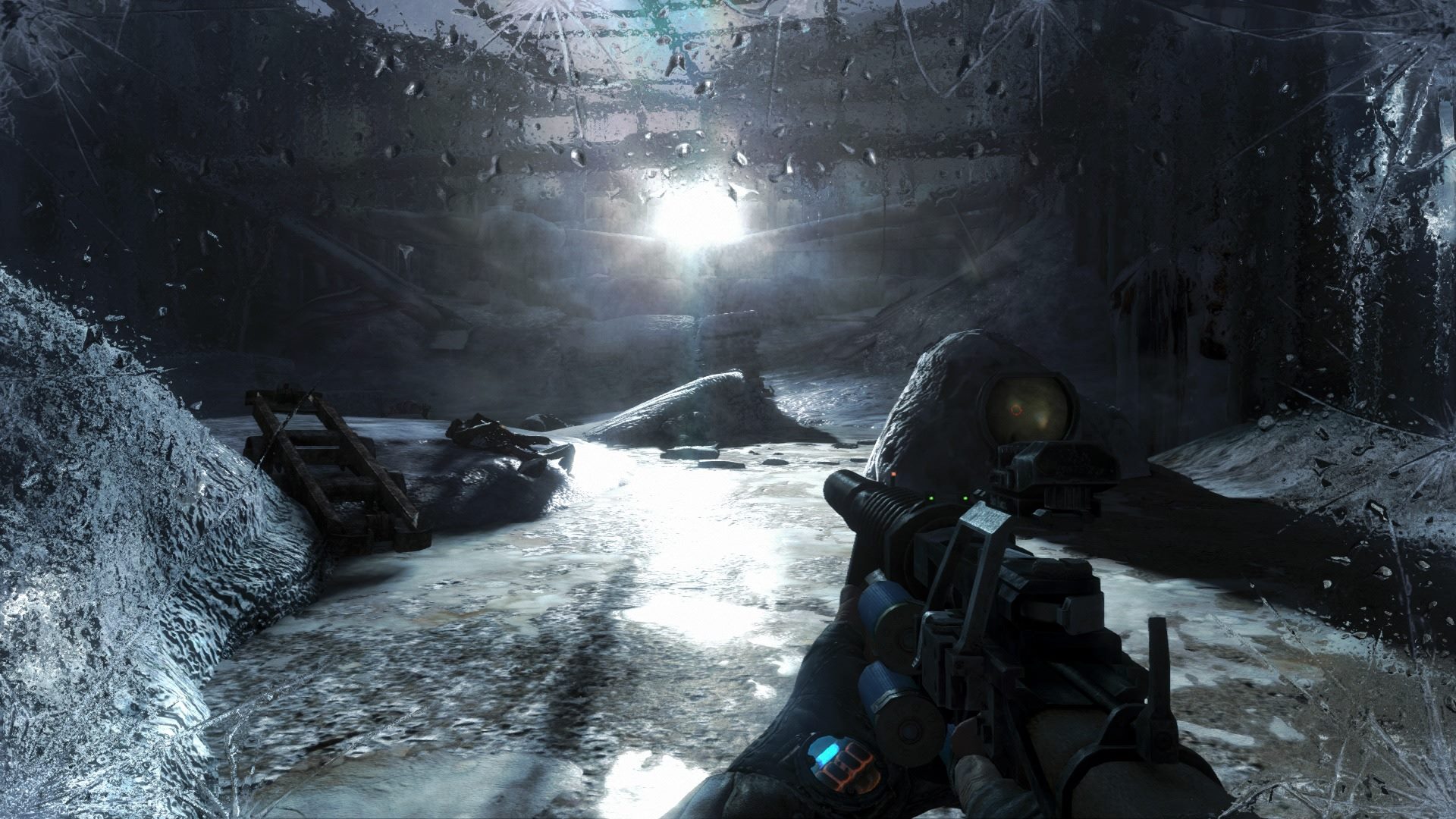
If you haven’t already read the novel, Metro 2033 is probably one of the best post-apocalyptic novels ever written. The novel really gets into your head and takes the whole post-apocalyptic Russian lore and myths and brings them to life. Metro 2033 was ahead of its time in 2010. While the game looked decent on Xbox 360, it really pushed systems on PC. The game was one of the first to fully utilize DirectX 11. As a game itself, it had many issues, such as huge AI problems and a somewhat incoherent story, but underneath it all, it oozed an atmosphere that no other game could provide at the time. This is all tidied up and wrapped up in one big next-gen ribbon. The game is worth a replay for vets and well worth any newcomers’ time.
You play as Artyom, a “chosen one” who must stop the Dark Ones that have invaded his home station in the underground Moscow metro. While his station was overrun, he was trying to make his way to Polis to get help fighting off the Dark Ones. Instead, he must find a mysterious and once-forgotten nuclear missile silo called D6. His journey is terrifying; even humans can be as horrible as mutated beasts.
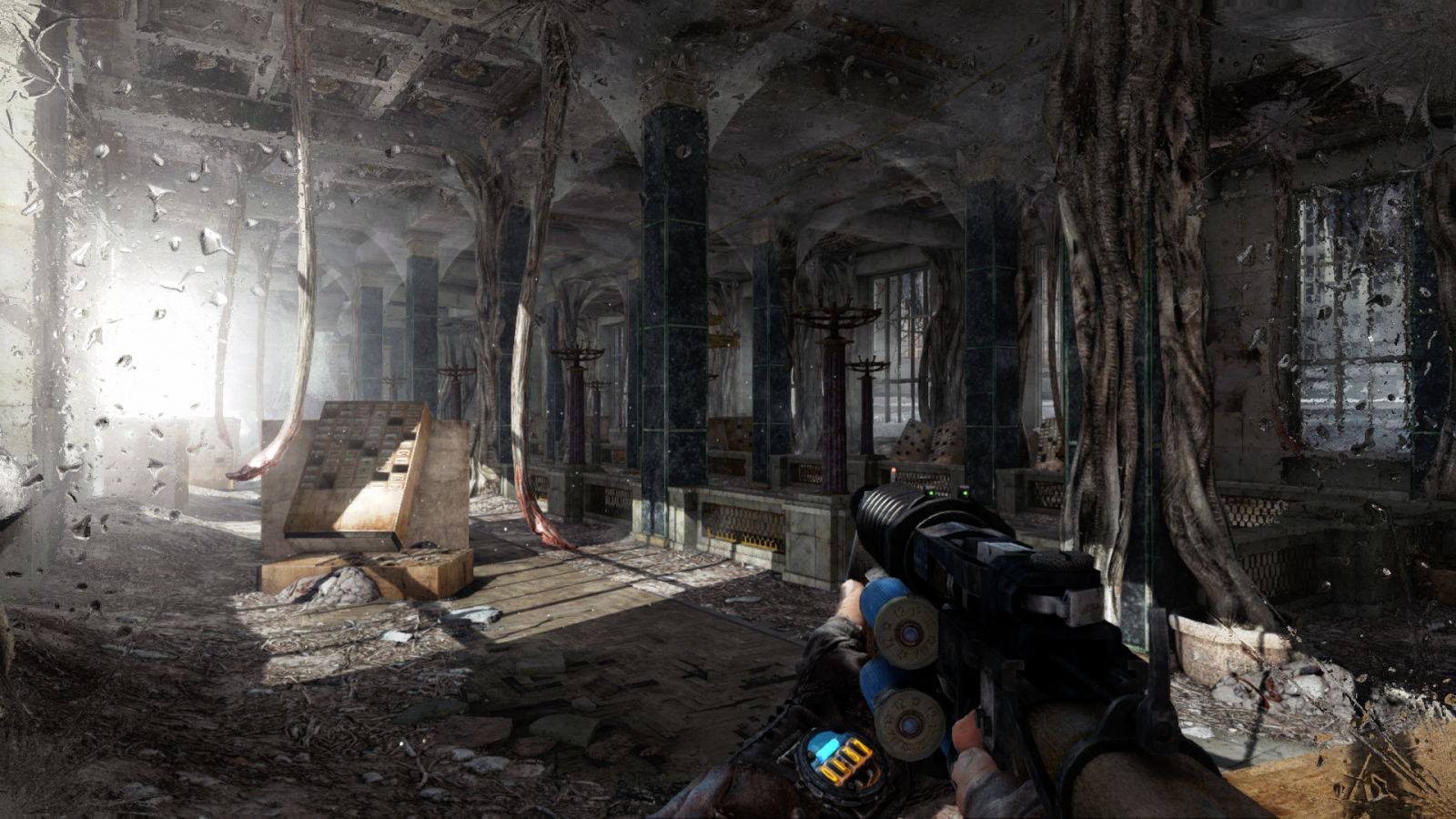
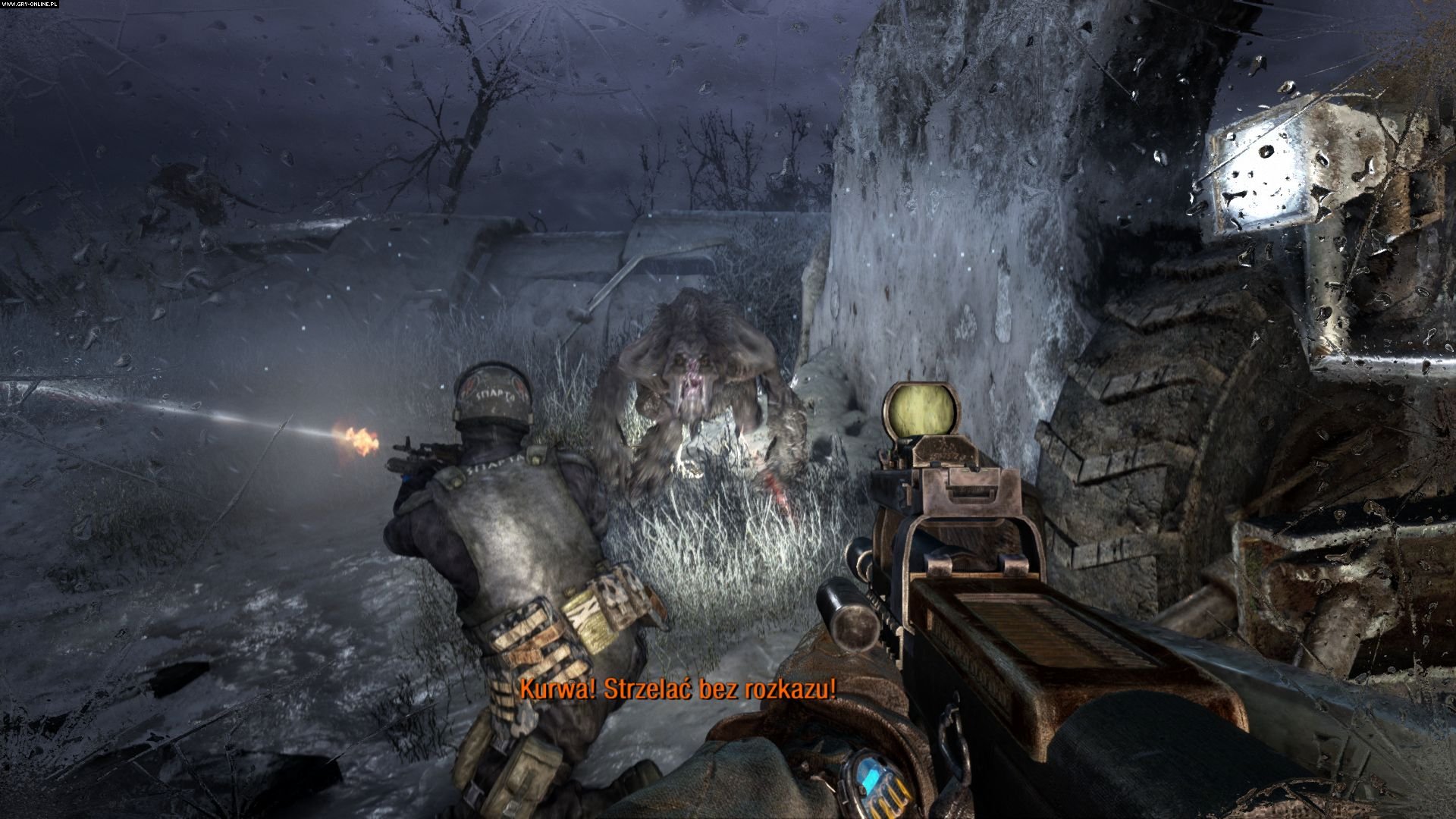
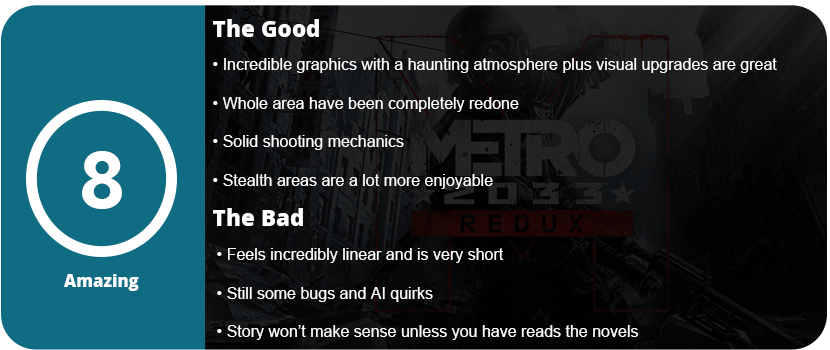
Most of the game sees you either fight your way through monsters or stealthily push through Communist or Nazi frontlines. Back when the game was originally released, these stealth sections were nearly broken due to the AI being able to detect them in the oddest circumstances. The AI has been tweaked but can sometimes still show a bit of awkwardness. While some areas have been completely reworked with even new enemy placement, I still found myself confused as to whether I could sneak through the area or shoot the place up. The stealth path would be too well hidden or in an odd place. However, this was pretty rare, and I really love how these areas were given attention. The atmosphere is just so incredible. When you get into populated areas, you actually feel “safe” and enjoy every minute of light and peace. One area that became extremely scary was the library. Mutated gorillas called Librarians that stalk are just downright scary.
The shooting mechanics themselves are fantastic. Each gun has its own personality, and you will easily find your favorite three or experiment. There is a wide variety of gun types, ranging from revolvers, assault rifles, bolt guns, pneumatic guns, and even shotguns. However, they all feel unique to the setting. Each gun looks beat up and worn and somehow piecemealed together to just kind of work. There are also a variable number of throwables, such as knives, firebombs, shrapnel grenades, and various others.
It wasn’t just the gameplay parts that were reworked. Entire outdoor areas were rebuilt to look more next-gen. Compared to the original Xbox 360 version, Metro 2033 Redux looks like a whole new game. Incredible attention to detail was taken when combing back over this game. Thankfully, due to the power of next-gen consoles, we get all the fancy DirectX 11 graphics that the PC version got, plus some. Despite being a remade game, Metro 2033 Redux is one of the best-looking games out on consoles right now.
With that said, the game is a little on the short side, and it feels a little too linear for its own good. Yes, you are in a cramped metro, but I feel like it would have been a good idea to explore this place more. The game is extremely scary, the monsters are freaky but awesome, and there are some pretty fun scripted events. For a 4-year-old game, it has held up so well to recent games and just shows how far ahead the game was back in the day. If you are a fan of Fallout, STALKER, or any other post-apocalyptic game, you should give this a spin.
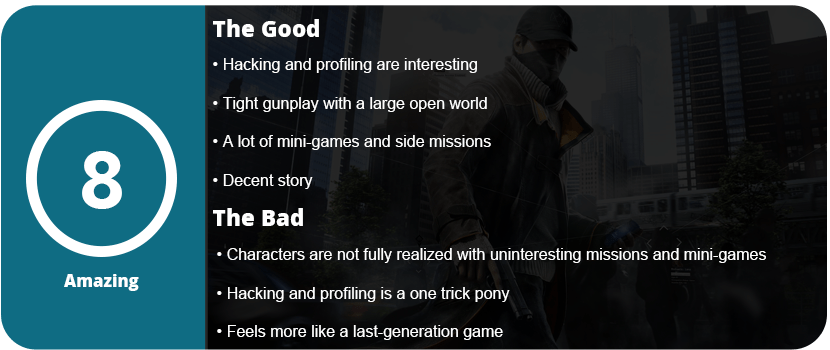
Watch Dogs is supposed to be the next Grand Theft Auto III! The next-gen revolutionary open-world game! Well, there’s one big flaw in all that hype. Watch Dogs was developed for last-gen consoles. We will never get a truly next-gen experience until a game is made specifically for next-gen consoles, is no longer ported to last-gen consoles, or has those consoles in mind. With that said, Watch Dogs is a solid open-world game, but it feels limited due to the scope that it tries to create.
You are Aiden Pearce. A vigilante hacker is trying to exact revenge on his niece’s death. You get involved in a huge blackmail hacking/drug ring while operating Chicago’s own connected grid. This online grid is called CTOS, or Citizen Operating System. Chicago has cameras everywhere (even in places they aren’t supposed to) and is storing all the data on servers. Hacker groups are battling for the data, while some have blackmailed city officials. It makes for a pretty twisty story, but that falls flat due to the story being dragged out for too long. One thing that an open world needs are strong characters, and Watch Dogs is lacking that. Each character has potential, but they are missing that certain something to make them more than generic, or they don’t get enough screen time.
Outside of the so-so story is the so-so gameplay. Now the gunplay is solid, with a great cover mechanic and a weapon wheel. You also get the electronics on your side, such as the gimmicky “camera hopping” ability. You can hack cameras around an area to stealthily blow up stuff and distract enemies. It kind of felt like something similar to the Batman Arkham games. Some enemies have grenades that you can explode remotely that are on them, disrupt their communications, disable reinforcements, etc. This stealthy way of combat is actually pretty fun but gets old in the end because it becomes predictable and almost too easy. Gunning it all the way is tough because you die so quickly. A few shots, and you’re dead.
Most GTA-like games have wanted levels and cops that come after you. Watch Dogs does something rather unique in the sense that you can use the city against the cops. With the push of a button, you can raise bridges, activate blockers, blow up underground pipes, change traffic lights to block intersections, etc. I just found that the cops can find you way too easily. You are able to craft gadgets to stop enemies. One such item is the JamComms. This is used when the police are trying to find you. When this happens, yellow circles will appear on your map, and you should avoid them until the search is called off. I only ever avoided this once in the whole game. My only option was to be found and then escape the police.
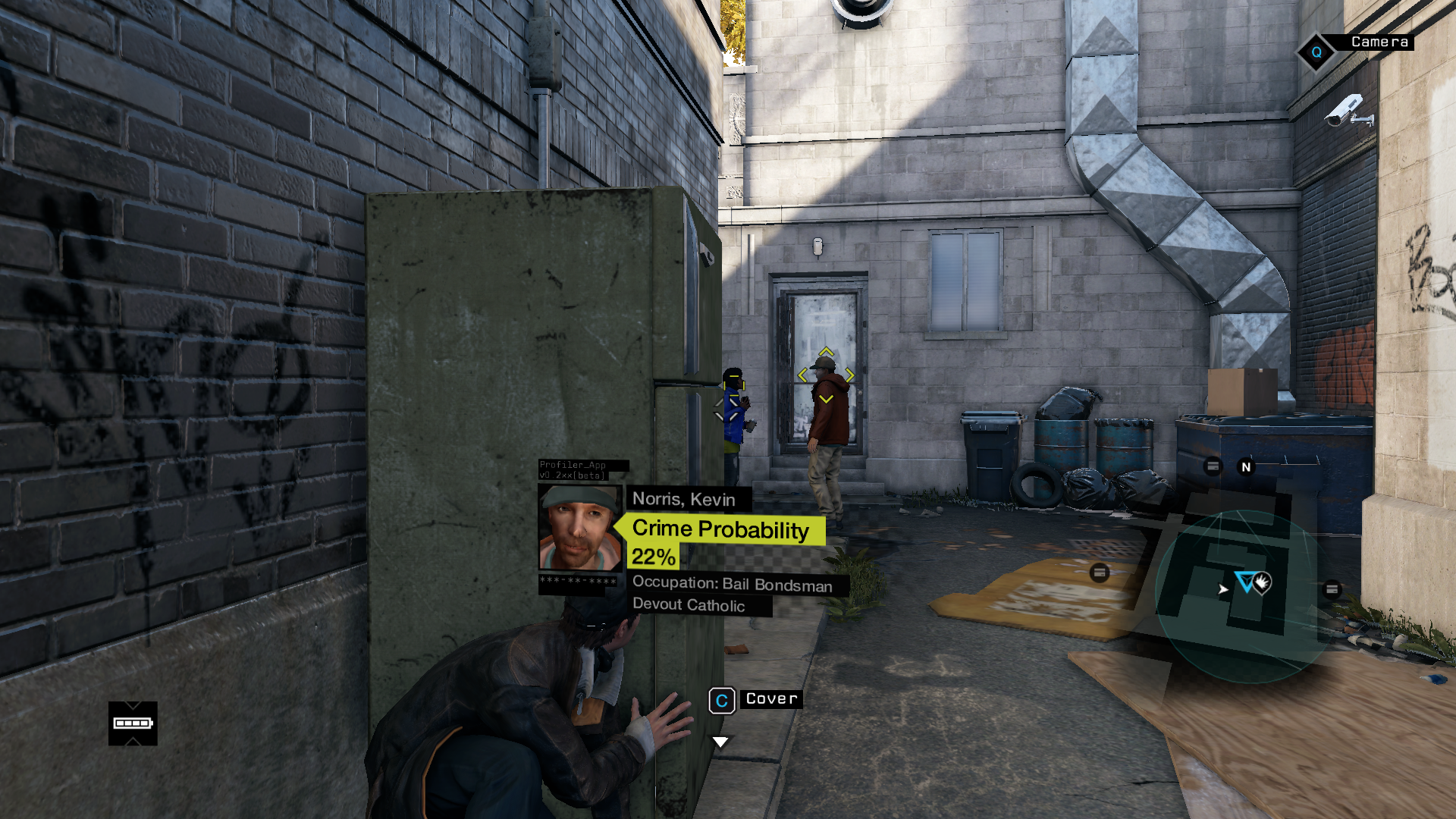
Another gameplay element that open-world games have are mini-games. Watch Dogs is full of them, but neither of them is interesting, including the side missions. Being able to prevent crimes, AR time trials, online contract hunts, etc. These were all interesting the first time, but after that, I lost interest. I have yet to talk about what caused Watch Dogs to get such hype, and that is the profiler. When you pull out your phone, every citizen’s information is displayed. Their job, income, and what they currently do are dark secrets, and sometimes you can hack their phone conversations or steal money from them. Now, this may seem like a big deal, but it’s all randomized, and after a few minutes of exploring it, you just won’t care anymore.
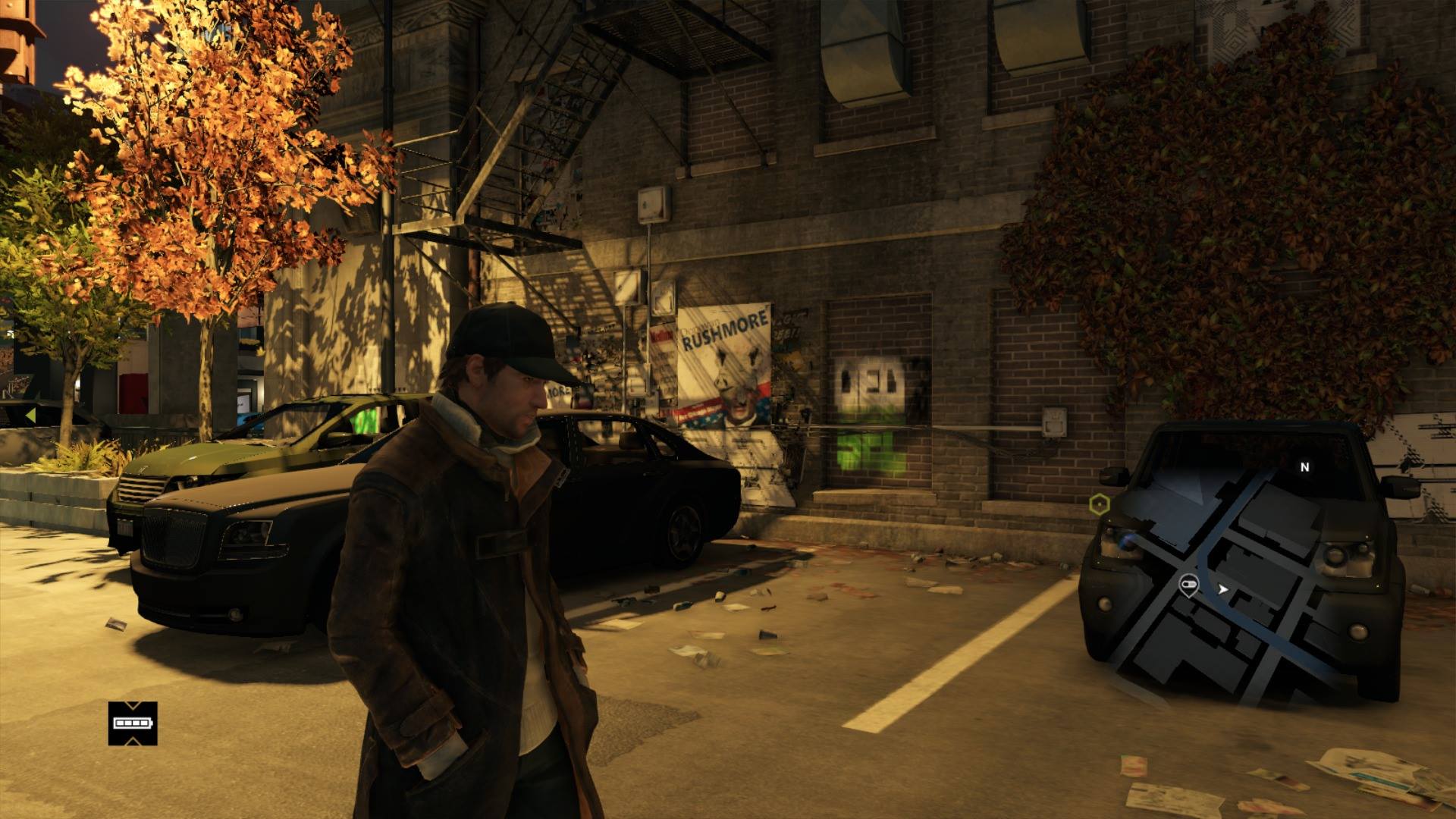
That’s the main problem with Watch Dogs at the end of the day. You just stop caring about more and more things as you play. When you start off, you’re completely confused about how to use this new hacking and profiling ability. It all seems overwhelming. Once you play for a few hours, you start checking off what’s interesting and what’s not in your head. That’s usually not a good thing for a game. Watch Dogs brings a lot to the table, but none of it is outstanding or memorable. The graphics are also decent, but even for PC and next-gen consoles, there are some ugly spots, the character models are dated, and it all just feels like a last-gen game with a next-gen coating of polish slapped on top.
Sony’s little FPS could have become a console seller. Back in 2004, Killzone was deemed a “Halo Killer” by Sony but was met with unexpectedly low fanfare due to pushing the PS2 too far and feeling too heavy and sluggish to play. The fourth installment in the main console franchise has perfected itself in some ways and has taken steps back in others.
The story takes place years after Killzone 3, with Helghan finally destroying itself due to the constant mining of the unstable element Peru. Vekta formed a peace treaty with Helghan to share their planet. This obviously never worked out because now Vekta wants every last Helghan destroyed, so this causes a civil war. You play as a shadow marshal who is working for both sides in some way. You must find Stahl and kill him, as he is making a massive weapon that will wipe out the entire planet.
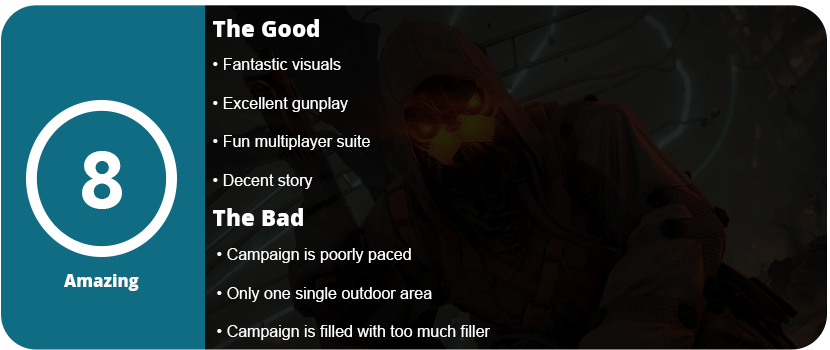
The story is fairly decent compared to past Killzone games, but the actual campaign is poorly paced. Not only does it drag on for far too long, but the same type of “arena”-type bursts of gameplay are repeated. Stealth sections are also compromised due to poor enemy placement and, overall, poor stealth mechanics. At least the shooting part is fun and feels like the most balanced of all the Killzone games. The enemy types are still not very varied, which is a real shame. There are your usual grunts, but some have shields or energy fields surrounding them, which gets boring after a while. Every once in a while, you will find an automaton enemy that will be a pain to take down.
Shadow Fall tries throwing in little things here and there to make it feel different from past games, but it doesn’t really work. Things like anti-gravity movement, space battles, large open environments, and “choose your own objective”. These things are just sprinkled in to stretch the already-long campaign. That’s not to say it isn’t enjoyable, but there are obvious splinters in this hand of a campaign that you can just tell were put there to lengthen it. I really loved the opening, as it was cinematic and unlike anything done in a previous Killzone game, but they let the ball drop with only that one segment.
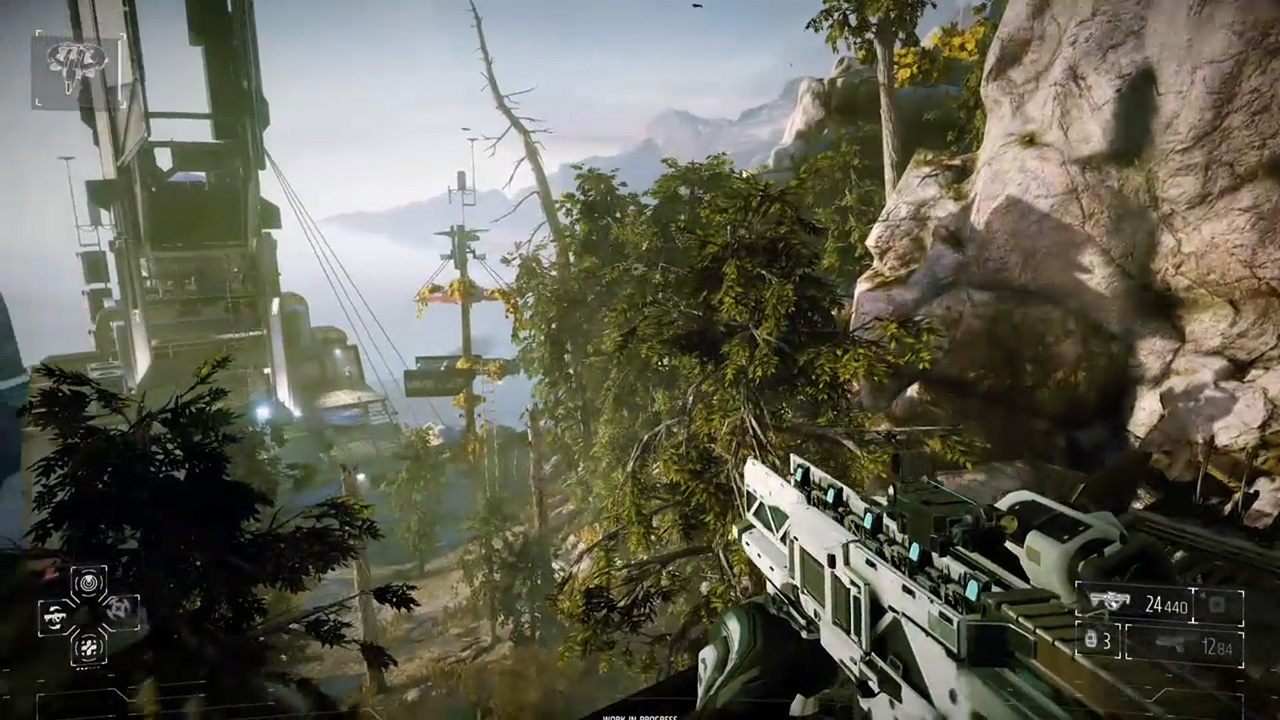
You get a personal drone, which is kind of borrowed from the PS Vita game Killzone Mercenary. Using the touchpad, you can select a grapple line, attack mode, defense, or an EMP burst. This all really comes in handy and changes the way you play the game. I also like the adrenaline shots you can get to revive yourself after dying. I also loved the open forest environment at the beginning of the game. I felt this was the strongest bit, but after that, you’re stuck in cramped corridors and boring spaceships. I feel this was just to show off the power of the PS4 and then quickly move you along.
The multiplayer suite of Killzone is fun and some of the best on PS4. Upgrading your soldier and weapon layouts is a standard for FPS games these days, but it’s nice to see it again in a Killzone game. The game is well balanced, and the maps are a lot of fun to play with, so you won’t be disappointed.
Let’s talk graphics. Shadow Fall is probably one of the best-looking console games ever made, but it’s still not pushing the PS4 to its limits. There are some ugly textures up close, and the closed-off, cramped areas of the last half of the game don’t look very impressive. The outdoor areas are beautiful, with fantastic lighting effects that would cripple the PS3.
As it is, Shadow Fall is a must-have in any PS4 owner’s collection, but don’t expect a revolutionary or even memorable campaign or Killzone game.
The biggest competitor to Call of Duty has always been Battlefield. While both games have drastically changed over the years, they both still compete for the most action-packed single-player campaign and an addictive multiplayer suite. Battlefield has been the superior game for the past few years for many reasons. Not only does the game look better, but the campaign actually has a decent story and feels more organic and well-paced. The multiplayer is actually challenging and requires a lot of skill, rather than who can quickly scope the fastest.
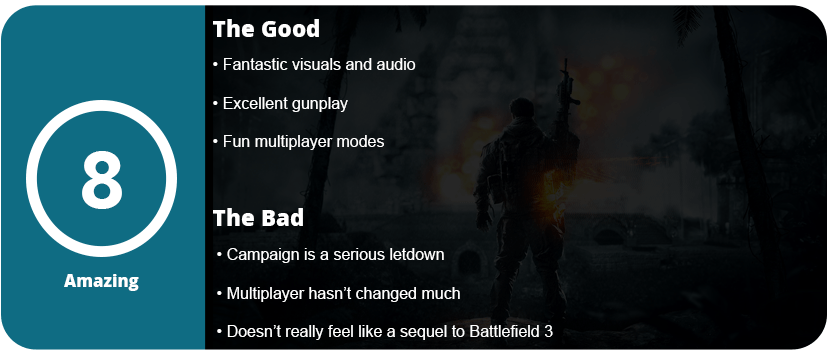
While many fanboys may disagree and send me angry emails about that statement, one thing is certain: Battlefield is a huge game, but did anyone even want BF4? BF3 was a fantastic game and was well-balanced. BF4 feels very similar to the last game without many changes, besides a new campaign and maps. The campaign is actually rather disappointing and not nearly as fun as BF3‘s campaign. It’s short, typical, and feels very generic. The story is forgettable despite having some ground. A civil war in China has broken out, and the US government is involved, but you never really know why. There are a lot of loose ends and loopholes, and by the time the credits roll, you just won’t care.
Multiplayer is as fun as ever but doesn’t have as memorable maps as BF3. I loved having all the same modes and an easy-to-navigate server browser on the console. The game feels just as balanced as BF3, but there’s just a little bit of that magic missing. I didn’t have the same long play sessions I used to have with BF3.
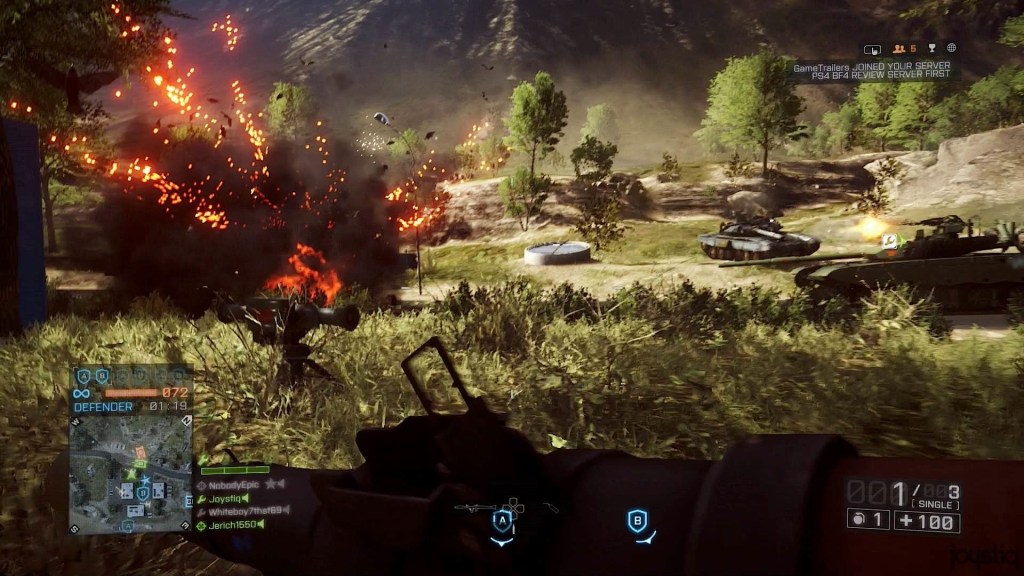
The graphics are fantastic, and they make BF4 one of the best-looking next-gen games out right now. The textures are superb, the lighting is gorgeous, and the sound and physics are top-notch. I’m not kidding about the sound. Battlefield has had some of the best-sounding guns and explosions since Bad Company, and that still hasn’t changed. Overall, Battlefield 4 just doesn’t do enough; that’s new, like BF3 did. I honestly felt the game could never have been released, and fans would still be happy with an HD upgrade of BF3 for consoles. As it is, if you can find it cheap enough, BF4 is well worth the purchase and playthrough. Just don’t expect anything as groundbreaking as BF3.
Overall, Battlefield 4 just doesn’t do enough; that’s new, like BF3 did. I honestly felt the game could never have been released, and fans would still be happy with an HD upgrade of BF3 for consoles. As it is, if you can find it cheap enough, BF4 is well worth the purchase and playthrough. Just don’t expect anything as groundbreaking as BF3.
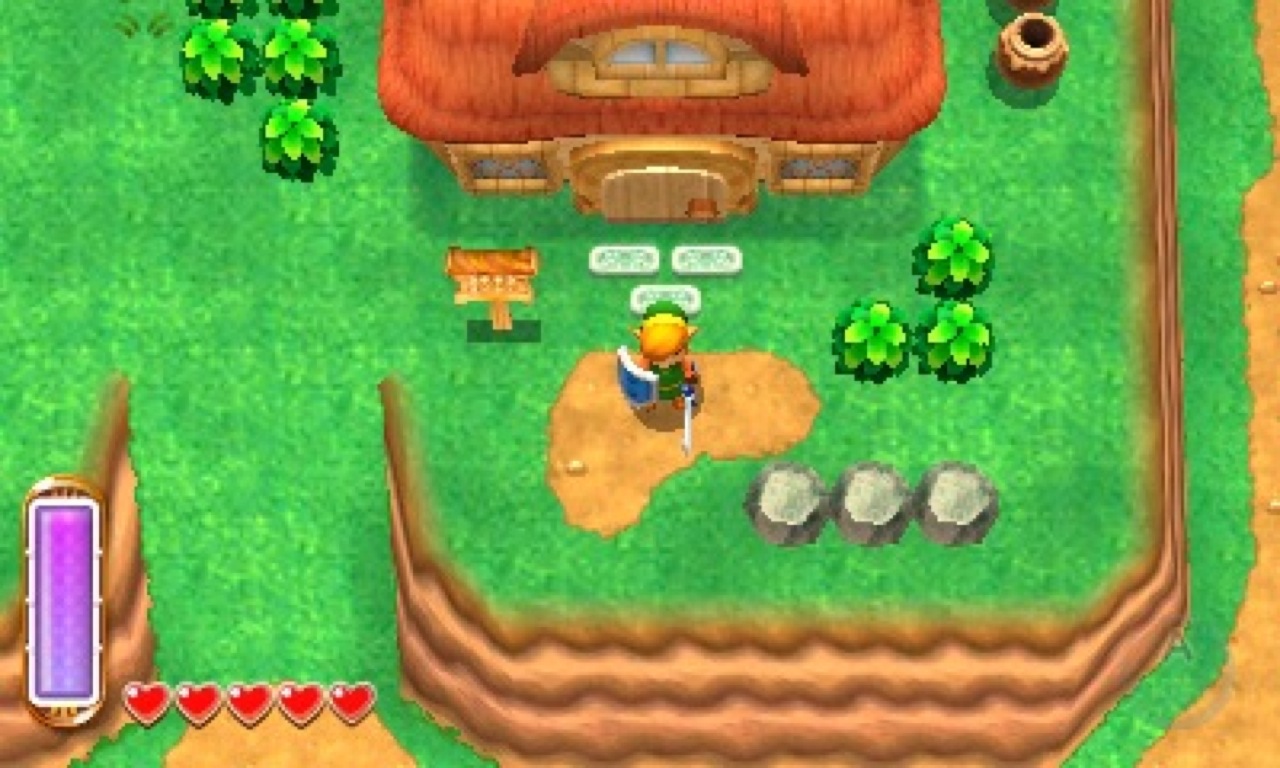
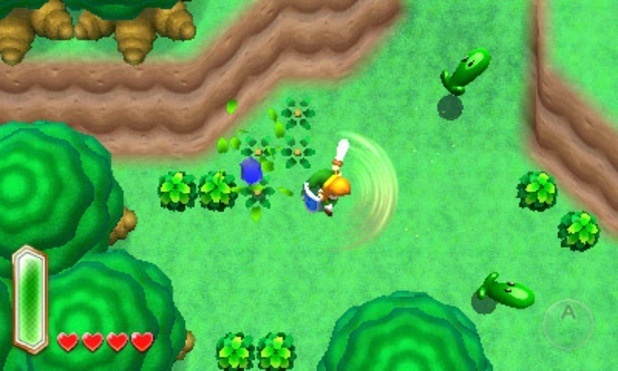
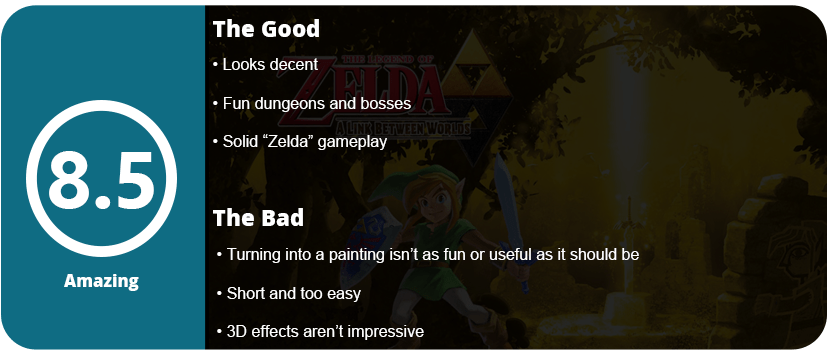
So here I was thinking this game was going to be something completely new and exciting when I realized it was pretty much a port of A Link to the Past. That’s not really a bad thing, since many younger gamers have never played that game before. What I also didn’t like was just how easy and short the game was. The dungeons themselves aren’t really all that hard, but they are more confusing, and some puzzles are really hard to figure out. With that said, the game is enjoyable, but some may not like it.
It all comes down to feeling like every other Zelda game out there. There’s not much to set this apart, and when you’re done with it, you will just shrug and move on to the next game. The dungeon layout and the bosses are clever and fun, but I just wish there was more to this game. One thing I also didn’t like was having to buy the equipment to keep it. If you rent equipment and die, it will be sent back to Rovio’s shop, where you have to go back to your house, rent it again, and return to the dungeon you were in. At least there are warp spots, which are a serious lifesaver. In all honesty, if these weren’t here, I doubt most people would be able to stomach getting around.
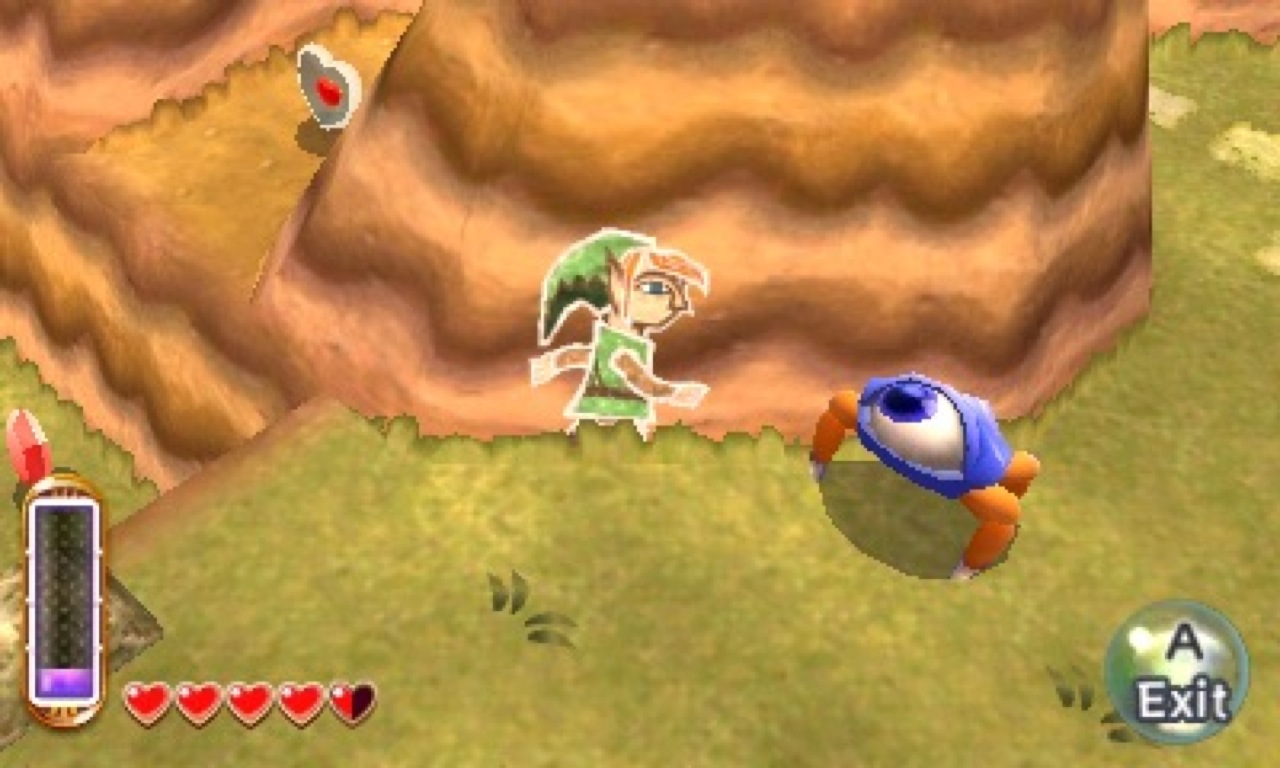
Most dungeons involve a certain element or weapon. The boss in each dungeon also requires this weapon to defeat it. The sand rod, fire rod, ice rod, bomb, and various other weapons from past Zelda games make an appearance. However, the story involves sages being turned into paintings, and that’s where the whole “Link Between Worlds” thing comes in. This feature is actually quite gimmicky, and the game would have been fine without it. It’s used as a segue between puzzles or just briefly to get around. Flattening against a wall and shuffling side to side isn’t exactly a game-selling feature, and I felt it was poorly used here.
The game’s 8 dungeons may actually be enough for most people, especially Zelda fans. The most frustrating part was how to get to each dungeon since you can easily get lost or spend hours just wandering around aimlessly. The lack of direction has been abundant in the Zelda series, and I feel it needs to change. However, once again, some fans may be happy with this, and that’s fine.
Overall, A Link Between Worlds is one of the best games available on 3DS and a fine Zelda game. It’s the only issue that it’s the same type of Zelda we have played numerous times, not the revolutionary Zelda we have come to expect from games like Phantom Hourglass. The 3D effects don’t really do much for the overall experience (like 99% of 3DS games) and can be just as enjoyable with the 3D turned off.








































 thebinarymessiah.com
Try multiplayer. A lot of fun !