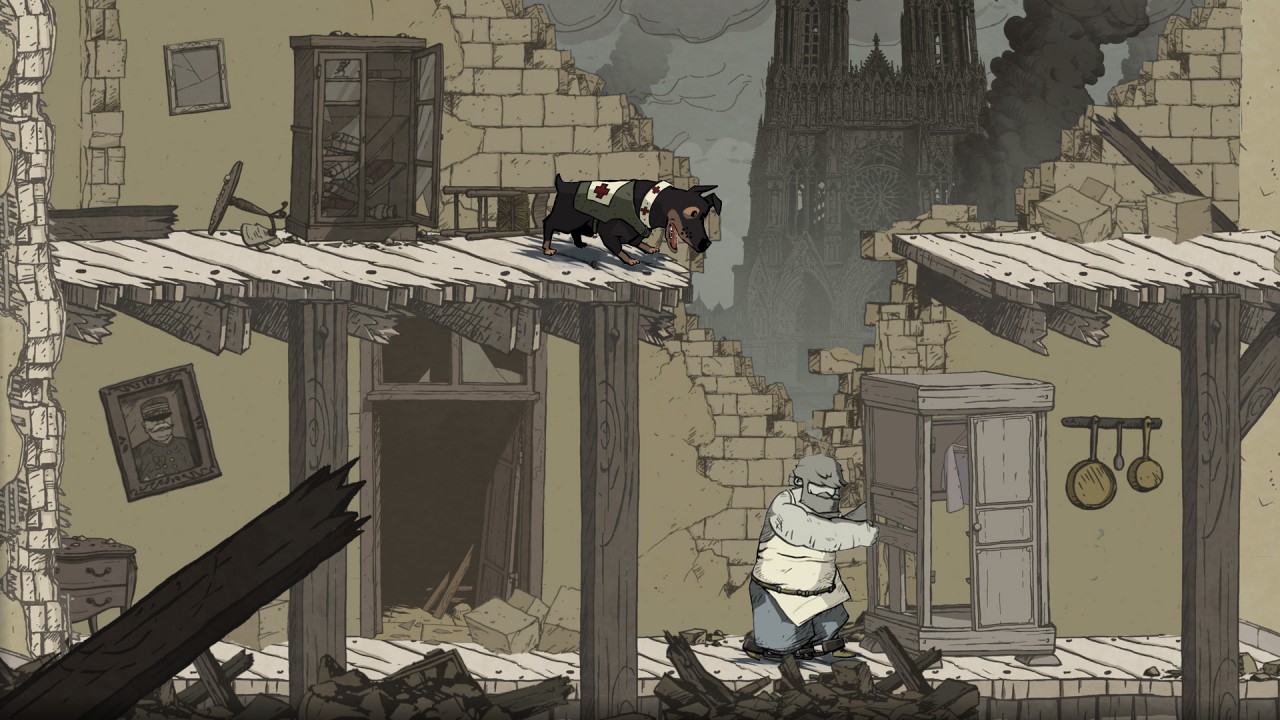
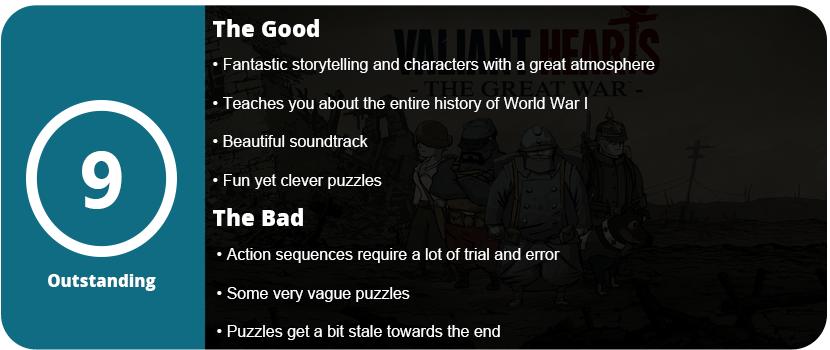
It’s been a long time since I played a game through an entire day and couldn’t put it down. Valiant Hearts will keep you instantly glued to the screen thanks to its rich history, characters, and story. Valiant Hearts is probably the only WW1 game I can remember playing. There is a huge lack of WW1 games, and I’m glad Ubisoft decided to make it a 2D platformer rather than an FPS. The game is brilliant on many levels, and fans of these types of games will not be disappointed.
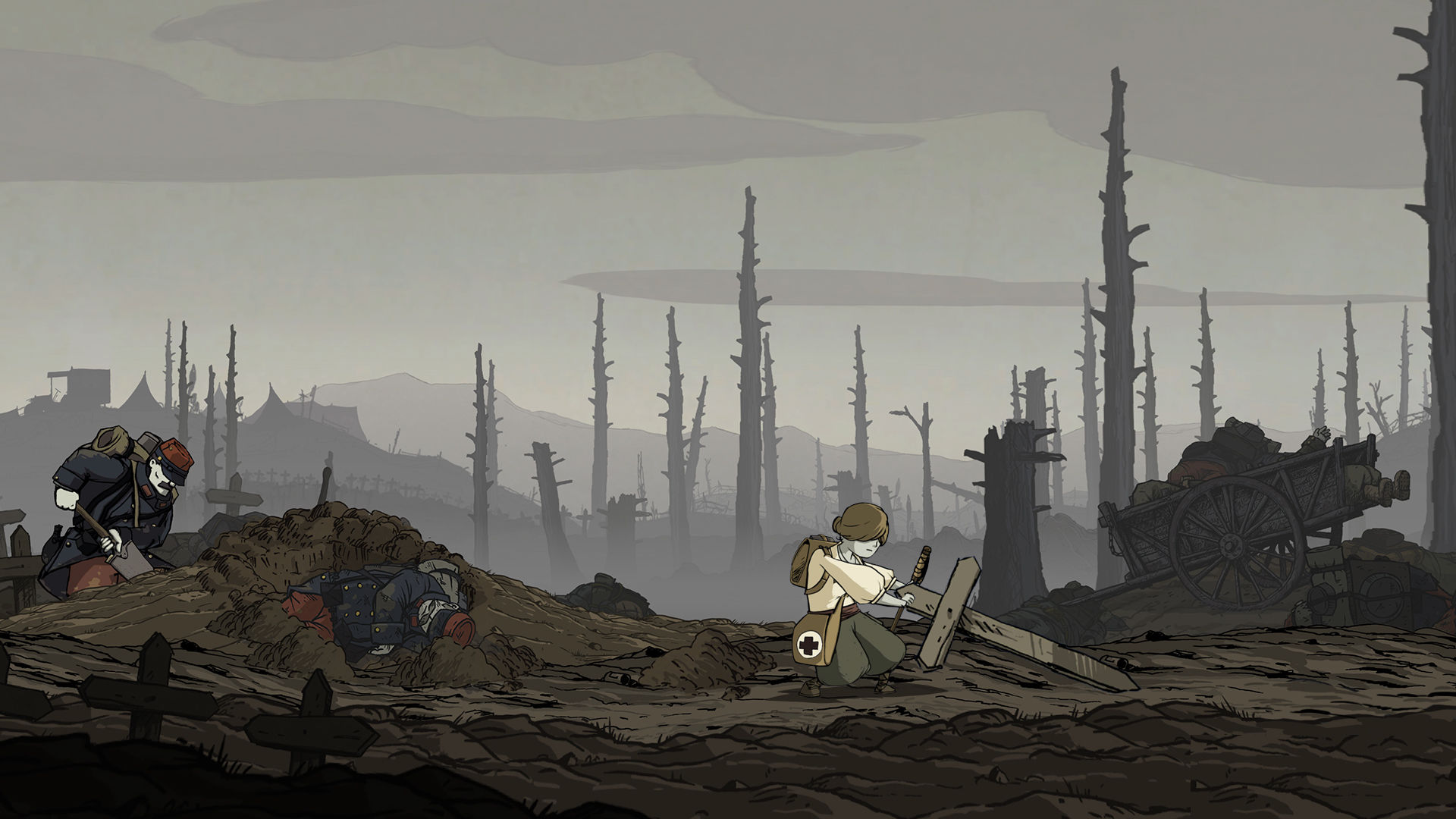
You play four different characters, all fighting the tragic war in France. A German, an American, a French woman, and a Frenchman. The game reenacts major battles from World War I and also gives you a history of what really happened during that time period. You can also go around collecting trinkets that are from the war. It’s great for history buffs or anyone who’s curious about what really happened during WW1, since WWII is all anyone talks about.
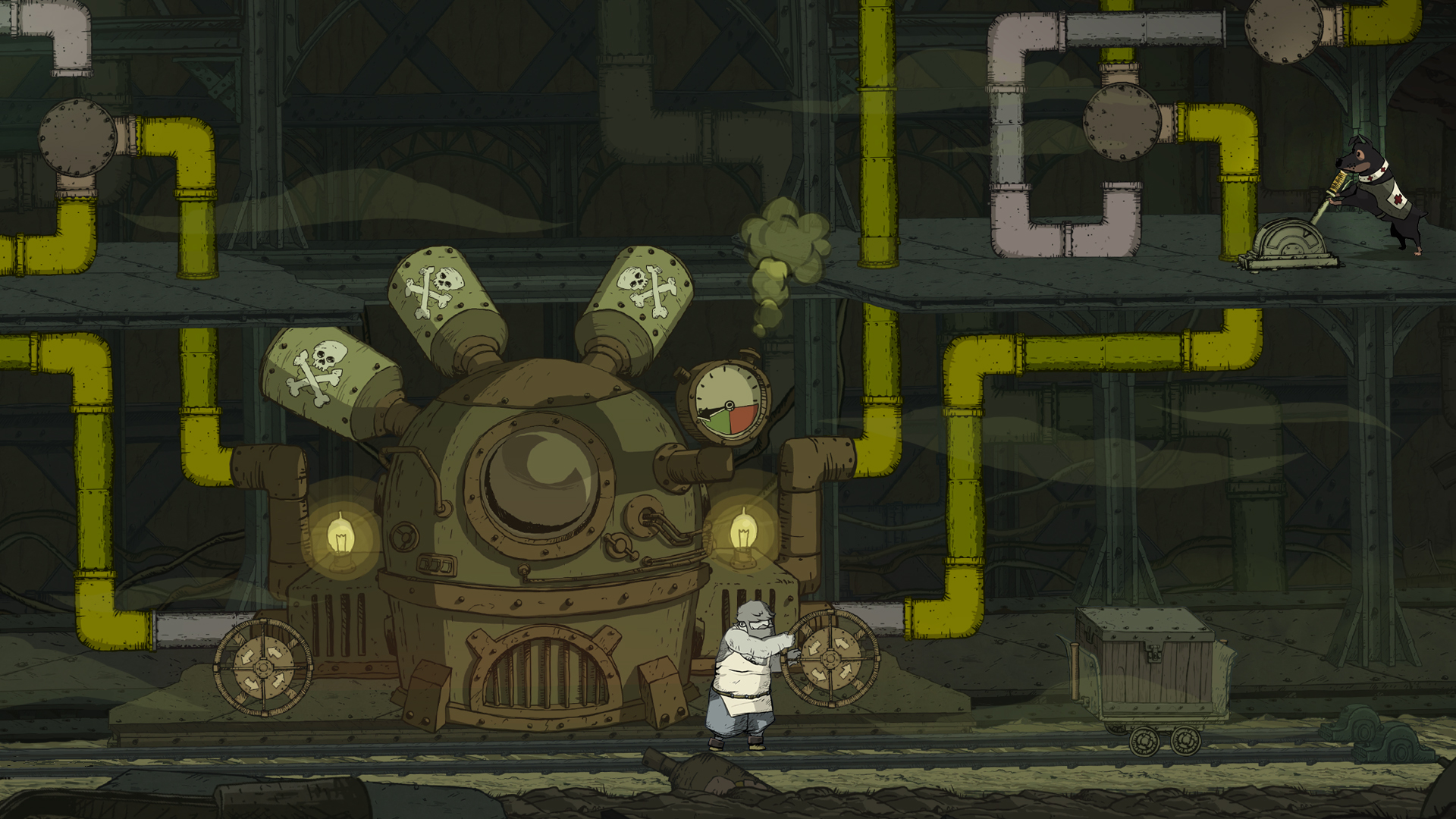
With that said, the game mixes up stealth, action, and puzzle solving, all of which are excellent. There’s no real fighting in the game; you don’t get a gun. You are mainly just trying to survive this tragic war while you watch everyone around you die. It gives you a sense of helplessness and makes you realize just how terrible and brutal World War I was. The game is played on several 2D planes. Using the background and foreground to solve puzzles, all of which are completely different, but the mechanics tend to be the same, and it gets a bit old towards the end. However, many sequences are cinematic and scripted, which keeps you glued. I can honestly say the game is well-paced and perfect for a one-day gaming spree.
I did find some issues here and there, such as a few puzzles being extremely vague, but it’s nothing that some trial and error and exploration won’t solve. There is a hint system for people who aren’t very good at puzzles, but it can also be turned off. Some of the more frustrating areas were the action sequences in which bombs drop and you have to dodge enemy fire. A lot of it is trial-and-error because the game rushes you through it. Expect to restart and die several times throughout this game.
The graphics alone are just gorgeous, and the colors pop on PS4 and Xbox One. The sound is excellent, and the music is wonderful. Many pieces are classical symphonies from the time period, so it adds even more authenticity to the game.
With that said, Valiant Hearts is probably a hidden gem that many people will pass up. It’s tragic; it really teaches and shows you every step of WWI and enlightens you on just how terrible the human race can be. From mustard gas bombings to the creation of tanks and aircraft, World War I was just a stepping stone for WWII.
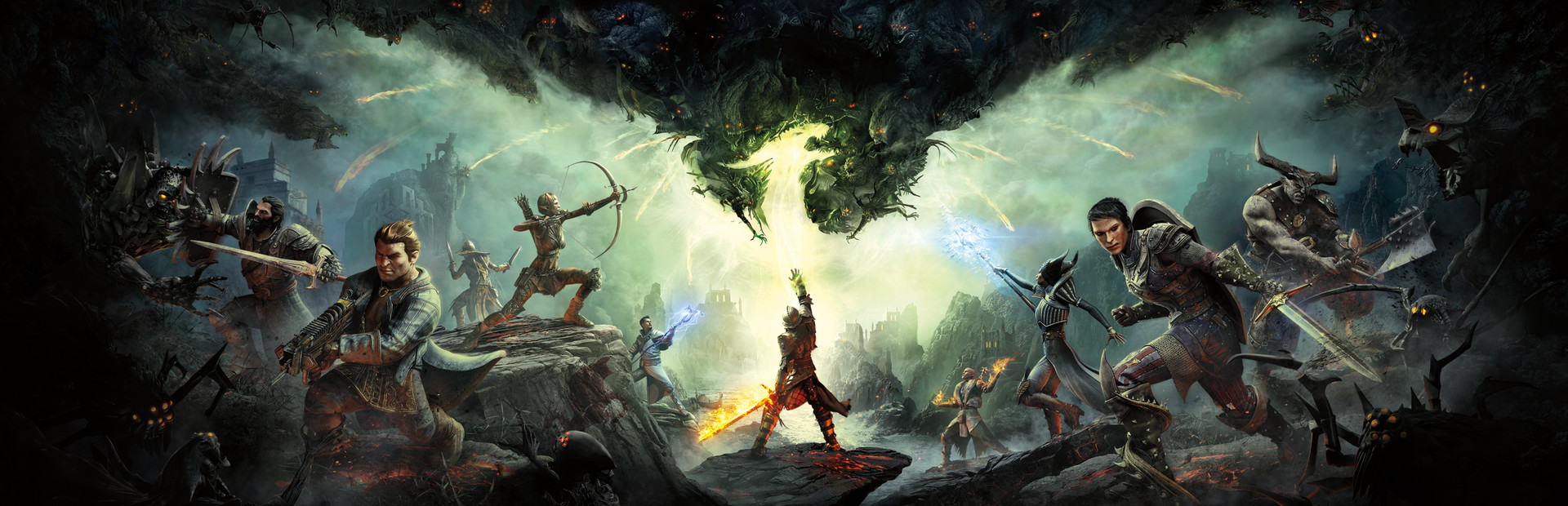
Bioware has a knack for creating D&D-style games that are memorable years down the road. Dragon Age is one such series. Origins helped push forward the way stories are told in Western RPGs. This was with dialog choices that would impact your relationship with fellow party members and the overall story. The game was also well known for its huge amount of lore that filled hundreds of Wiki pages online. Inquisition helps to mainly wash the sour taste of Dragon Age II out of our mouths by bringing back the original feeling of Origins.
The Inquisition has a lot of politics involved in its story, more so than the previous two. I say this because the entirety of Thedas is on the brink of being wiped out due to a powerful ancient being ripping a hole in the fade and unleashing chaos. You play as a brand new character (your choices don’t carry over here from DA2; it’s set several years into the future). You play as a nobody, just some guard serving Divine Justinia, when all of a sudden you walk into this ancient being, Corypheus, attacking the Divine. You try to help stop him, but something terrible happens to you. You take on some of the powers he is trying to acquire. This foils his plans and also weakens him, leaving the entire land accusing you of killing the Divine.
This is where the story starts off with several of your companions. Many dialog choices are brought to you to ease you into how this is done. It’s actually quite easier to understand over the last two games. Symbols will easily tell you what your choice will do. A heart will advance a romance, branching arrows could lead to anything, a question mark is an investigation, etc. While dialog and story are huge parts of Dragon Age, so are combat and exploration.
The inquiry is huge. Twice the size of Origins and DA2 combined. There are several areas you can explore, but these are large maps that take hours to completely explore. There are hundreds of side quests on top of the dozen story missions. The meat of the game is actually the side quests. If you skip these, you are missing 80% of the game. Of course, not all side missions can be blown through. Some require accessing new areas, which require being cleared or accessed through the War Table missions. The War Table allows you to send either Josyphene, Cullen, or Liliana on missions to open up new areas on maps or acquire items.
There are two major hub areas you will have, with Skyhold being the main one. Here, you advance relationships with a character through dialog, upgrade your castle, and try to capture prisoners that you captured throughout the game. Inquisition has so much going on that it will take you a good 100 hours to complete every mission and see everything. I can’t do this game’s sheer size justice just by explaining it. Outside of exploration, there is combat. It is a mix of DA1 and 2, with more control over companions by freezing time like DA1, but it’s completely optional. You can also just wail on people like DA2, but this time you aren’t just standing in one spot while fighting. However, despite this change, I felt something was missing from combat. There wasn’t much strategy to it, and it was just a button-mashing fest outside of learning what each skill’s cooldown times are and planning accordingly.
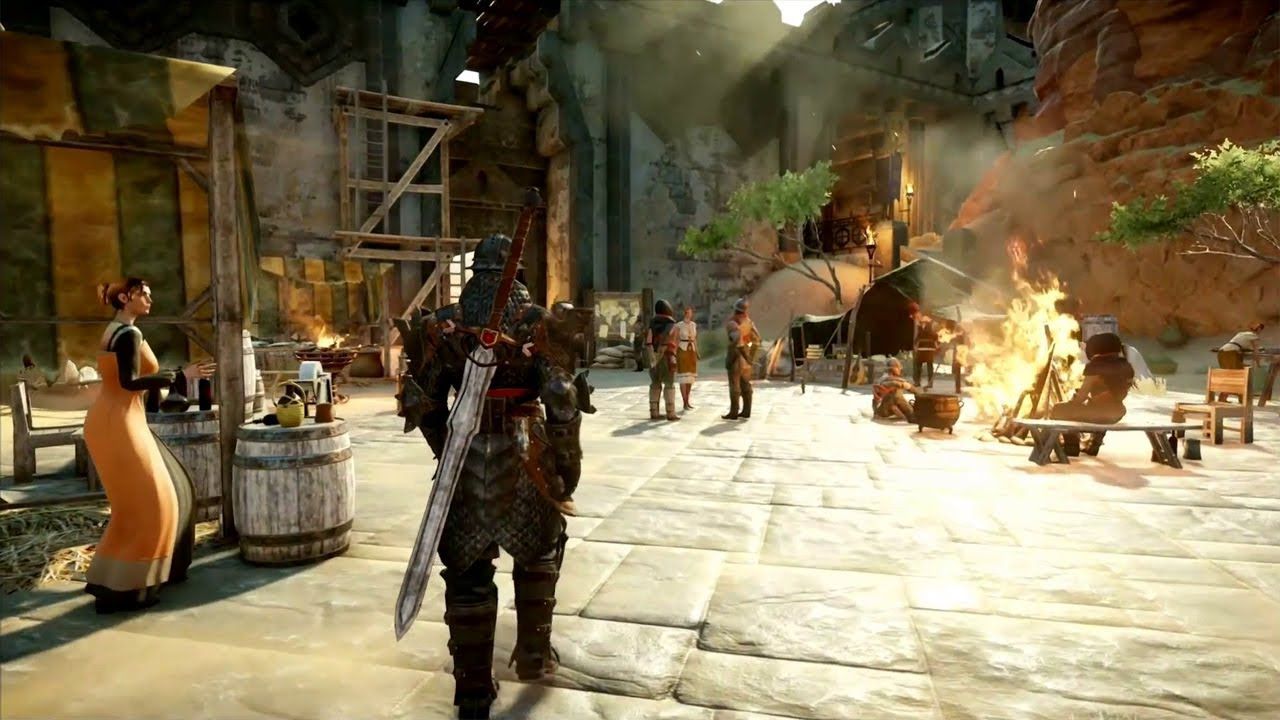
I do commend BioWare for the interesting enemy designs and wildlife. The game just has so much detail and is one of the best-looking games available right now. I mainly love the lighting in this game and the foliage placement; it’s just so beautiful. However, there are issues with pathfinding. Many missions are hard to get to, and some maps are just poorly laid out. The Forbidden Oasis is the worst offender, with huge cliffs, gaps, and hidden caves in everything on the map. It’s a chore to navigate, and most maps are pretty barren, with not much to do besides these fetch quests.
And that’s where I will wrap this up. Inquisition is a fine game; it looks amazing, has extremely deep dialog choices, and there’s so much to do here, from creating armor and weapons from blueprints to deciding what kind of drapes you want in your castle. However, it is all filler content. By hour 80, I really started getting annoyed with the game and bored. I said screw it to the rest of the romance options and any companion quests that were becoming a chore to complete and just did the final story mission. Will I come back to Inquisition to complete it 100%? Sure, but not for a while. Inquisition overstays its welcome by about 30 hours with fetch quests and item gathering. If you loved the previous games, you will love Inquisition, but haters from the past will find even more to hate here.
Call of Duty has had a steady downfall since Modern Warfare 3. Ghosts was a great change for the series, but it just wasn’t enough. Advanced Warfare is the first CoD game to be developed outside of Treyarch and Infinity Ward, and this is probably one of the best things for the series. The fact that Advanced Warfare is completely fictional and original is a good change as well.
You play Mitchell, a soldier who is working for a private military company called Atlas. Atlas is bigger and better funded than the entire US military, so they also have more power. I love the way the pace of the story is, and the characters are actually pretty likable and memorable. Gideon is a tough Brit who you grow to like, and he is actually my favorite of all the characters. The story is all about stopping a bad guy named Hades, who nuked parts of the world years ago. However, the good part is that the story takes a huge turn when you go after Atlas’ founder, for reasons I won’t say to avoid spoilers.
With the story being solid (probably the only good story in the CoD series), the gameplay holds up well. Yes, it still feels like CoD, but it’s a bit different. The guns have more weight and feel better, despite being completely fictional and futuristic. The weapons are based on real-world weapons, but with a twist. There are some really awesome new attachments and features. The new grenade feature is amazing. Your tactical grenade allows you to switch between EMP, Threat, and various other types. The threat grenade is my favorite, as it lights all the enemies up red for a short time. There’s also a threat detector attachment for guns that lights enemies up red when you have your reticle over them. The lethal grenade can switch between Frag, Smart, and various others. The smart grenade is my favorite, as it shoots into the air and homes in on the closest enemy. These features may seem subtle, but they fit the futuristic universe and advance the traditional CoD gameplay quite a bit.
A second major feature is the ExoSuit. There are three abilities that you can have, such as a jump pack, stim pack, a temporary shield, grapple, and various other features. Rolling this over into multiplayer is a blast and really changes things up, forcing you to forgo your CoD multiplayer routine and traditions.
The multiplayer suite is great, and the customization is even deeper than Ghosts. Choosing your gender, clothing, and even a different face is a step up for the series. The weapon customization is extremely in-depth, allowing you to hand-tailor your perfect CoD loadouts with various attachments, perks, weapons, and weapon paint. While the basic CoD suite is still here and hasn’t changed much, the added features of Advanced Warfare pretty much change the entire thing for the better.
Lastly, the graphics are absolutely fantastic on next-gen systems and PCs. The character models are gorgeous, the animations are beautiful, and the lighting is some of the best you will see this year. High-res textures and amazing sound keep you engulfed and trekking on. CoD had always been something to laugh at graphically due to the previous console’s aging, but now the series has one of the most advanced graphics engines available.
With all that said, Advanced Warfare is a great departure from the tired formula, and anyone who has been holding out should jump in now. It washes out the foul taste of the stigma that the series has created for itself and the FPS genre as a whole.
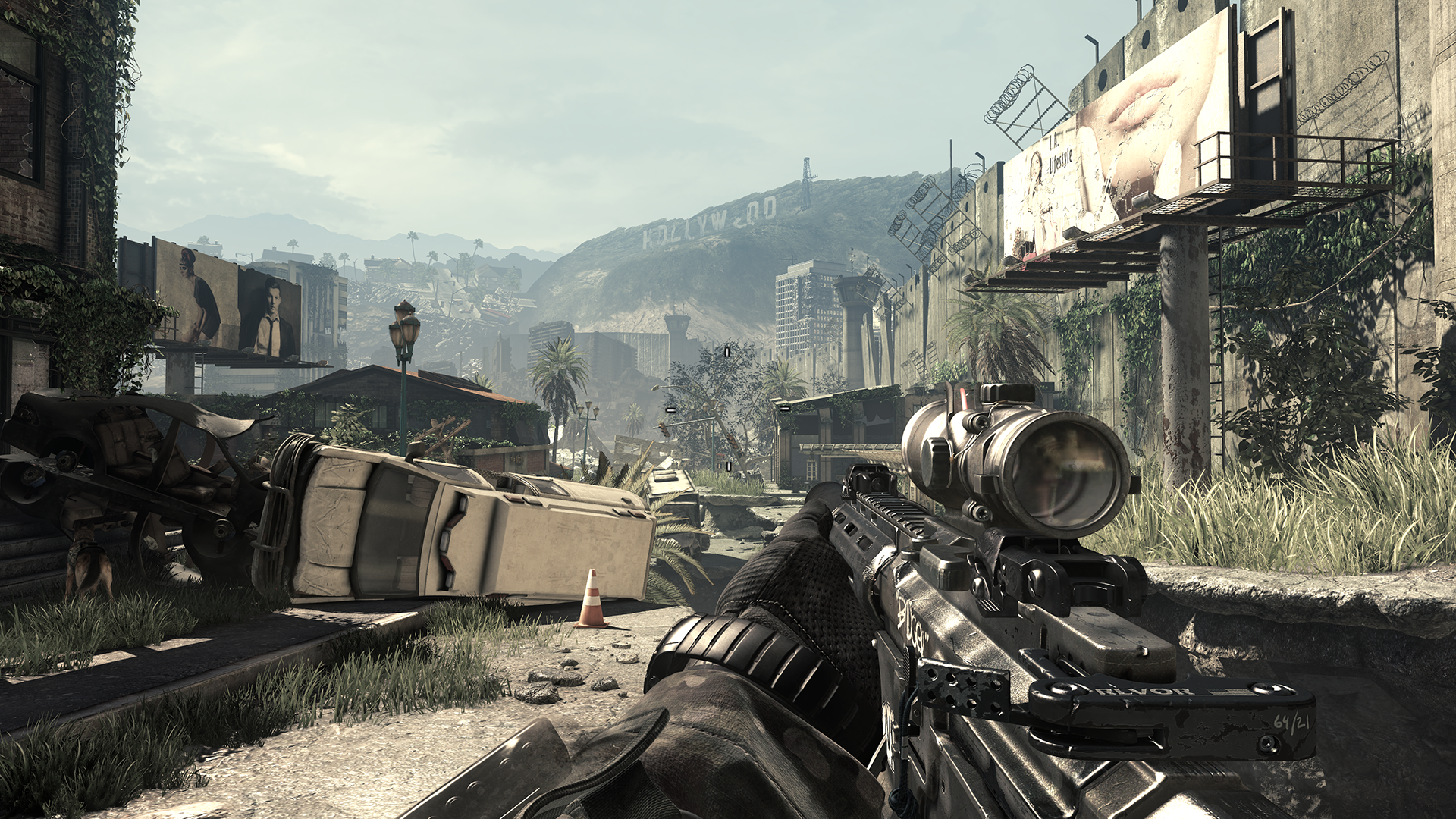
Call of Duty has come a long way since 2003. From World War II to the Afghan War, there’s a lot going on with this series. While it has had its ups and many downs, Ghosts seems to have picked the series up a little bit, and the transition to next-gen consoles may have helped that.
The story in Ghosts is actually quite interesting and probably the only story in the series that’s even somewhat memorable. This is a huge feat for the series in itself. You play as a ghost named Logan, who is following his brother Hesh around trying to stop a global crisis. I think the reason the story is so great is because it’s fictional. This is a made-up apocalyptic scenario that seems too close to being real. A former ghost named Rorke is using a satellite weapon that can destroy entire continents in minutes. The game starts out with Logan and Hesh talking with their father when these missiles start hitting. Later on, you learn more about ghosts in flashback missions and then eventually become one yourself. The voice acting and character modeling are fantastic and help hold the story together and keep you interested.
One of the many reasons why Ghosts‘ campaign is so interesting is that each mission is completely different. Sure, you are always shooting bad guys, but the entire campaign is constantly turned up, whether you’re driving a tank, mounting a mini-gun in a helo, or fighting underwater. New ideas and better pacing are brought to Ghosts, which is exactly what this series needed. One addition is the dog, Riley. You would think this would get overused, but he’s used it just right. He’s only available for maybe 5 missions through the whole game, but that’s the way he’s used. New gameplay elements are introduced to Riley with each mission, and after the first third of the game, he’s mostly absent, which is a good thing. This makes you care for Riley and really appreciate his role as a soldier.
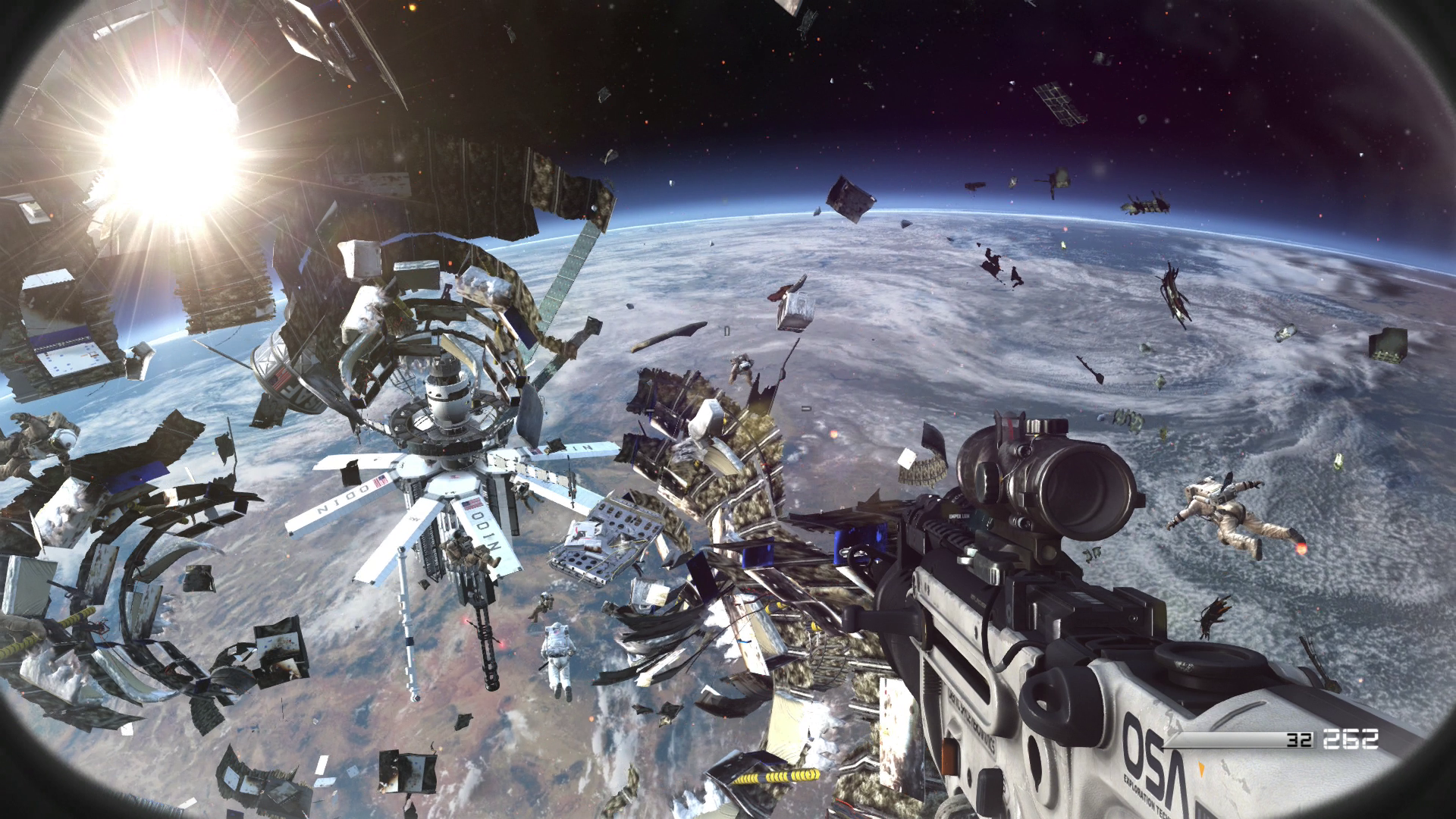
With that said, the shooting itself is solid, which is expected from any Call of Duty. The guns feel heavy and have weight to them, and the sound and action on-screen are crisp and really pull you into the drama going on. There’s a good mix of stealth and action as a whole, along with the other change-ups the game throws at you. There are quite a few memorable scenes, such as the firefight in outer space towards the end and the underwater level as well. However, we are still missing an organic feel that a slower, more deliberate pace would bring out. The game is still the same at its core. There still isn’t any gore, the enemy AI is still off, and everything still feels rushed and too in your face. Call of Duty can be more intellectual and less ham-fisted with macho violence and action.
With that said, multiplayer is nothing short of fun and has the same core suite as Modern Warfare. The biggest addition is being able to play a female character and customize the clothing. Of course, the customization for weapons is even deeper than before with balance tweaks and menu changes, but if you have played Call of Duty in the last 5 years, you know what to expect. I feel that the maps are a little better than past CoD games, but I have yet to play any that are as great as Modern Warfare 2.
With all that said, Ghosts is a fine shooter and was given a little too much harsh criticism. The visuals are fantastic, and the campaign is a huge step in the right direction toward pulling the series out of the stereotypical rut that it has been in for years.
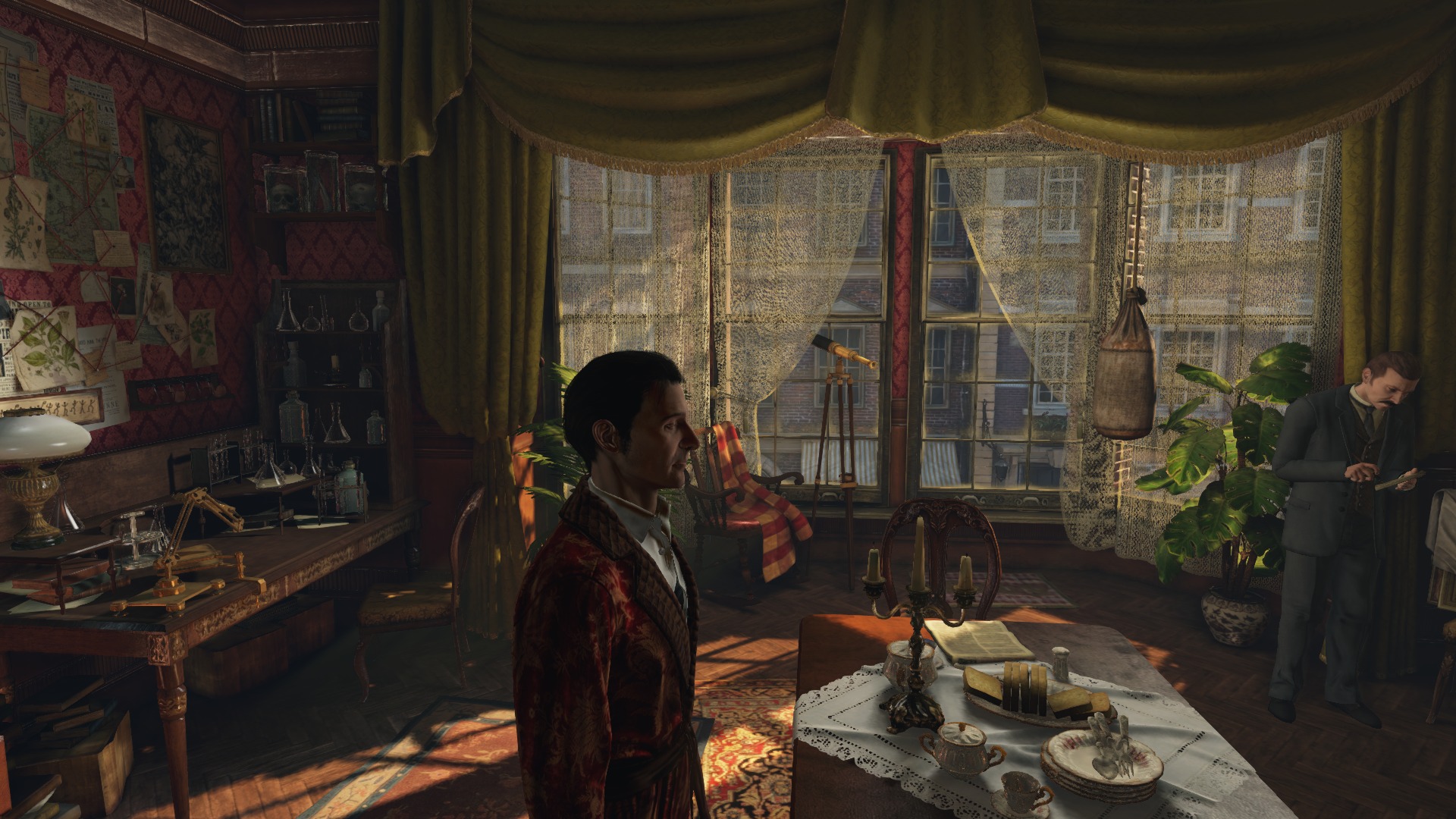
The Sherlock Holmes adventure series has had its ups and downs. If the story isn’t up to par with the show or books, it’s clunky controls or poor gameplay. Crimes and Punishments sound darker than they really are. Honestly, the game is more about the characters shining through and less about the crimes or gameplay.
The game starts out surprisingly cinematic for a point-and-click. Watson is dodging Holmes gunfire in his study as he ducks and weaves between pieces of furniture. It shows just how more nuanced the series is and just how much it has grown. Among the four cases you solve, neither of them is all that interesting. The game tries to get you thinking about big mysteries, but honestly, the dull way of going about the cases keeps you from really caring.
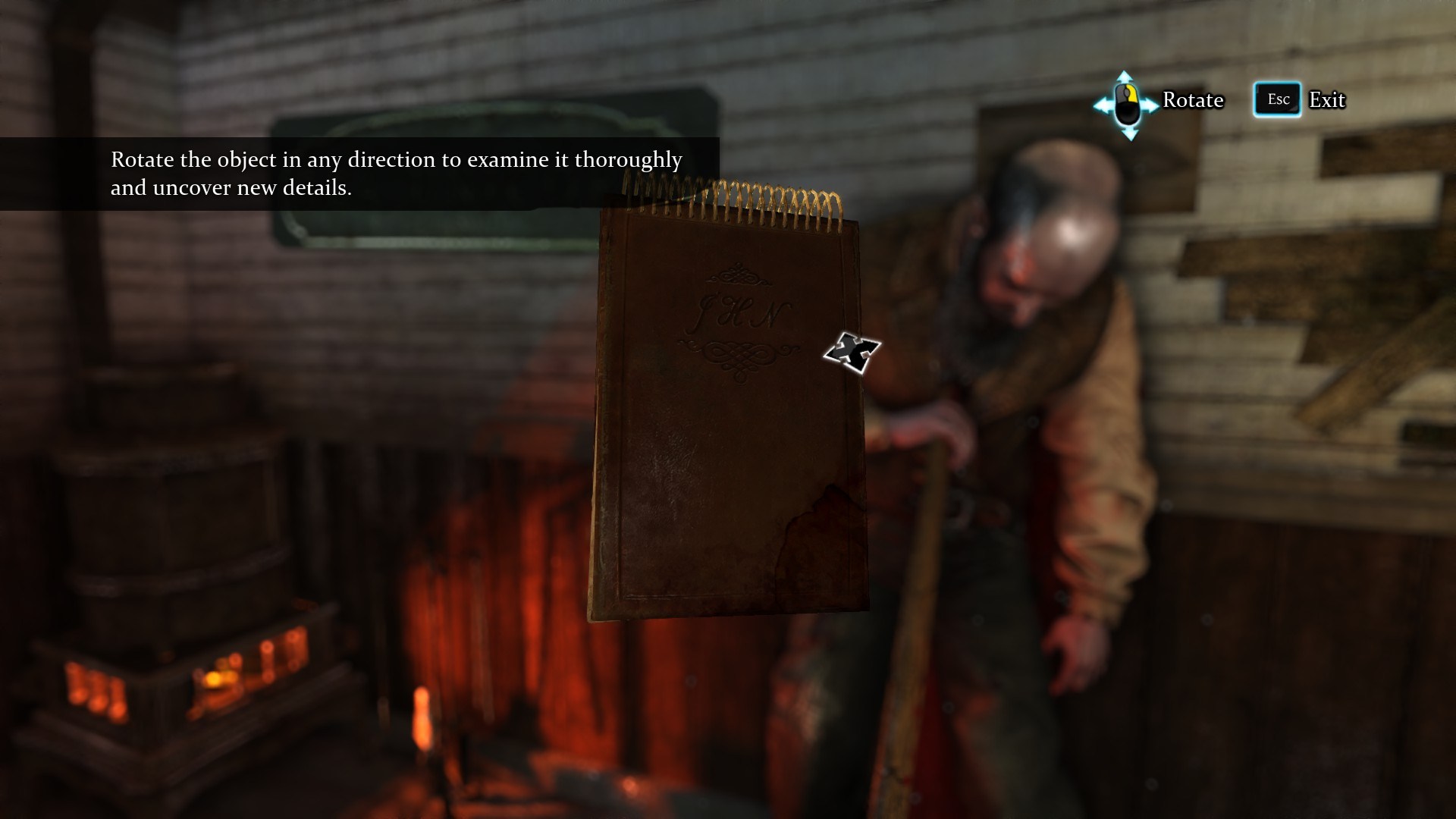
The gameplay consists of walking around areas and finding anything you can click on. Some items can be examined, and certain characters can be profiled, where you scan the character in slow motion to find interesting points. There are various puzzles as well, but these seem to be half-broken since pieces won’t snap in place and various objects won’t register. Surrounding is figuring out where to go and then solving clues to bring the whole thing together. Hopping back and forth between areas gets old, especially with the long load times. The character interactions are somewhat interesting, and I couldn’t help but smile at Holmes’ sarcastic way of going about things. Other than this, the game offers a dull experience of the detective mystery of old.
I played through the first two cases and, honestly, started losing interest. Each case has the same exact way of being solved. Wander around an area and pixel hunt, interview characters, run back and forth between areas, and rinse and repeat. The game looks really good, and the facial animations are surprisingly well done. Adventure game fanatics may love this game, but anyone else wanting a bit of action or suspense like in the Telltale adventure games won’t find it here.
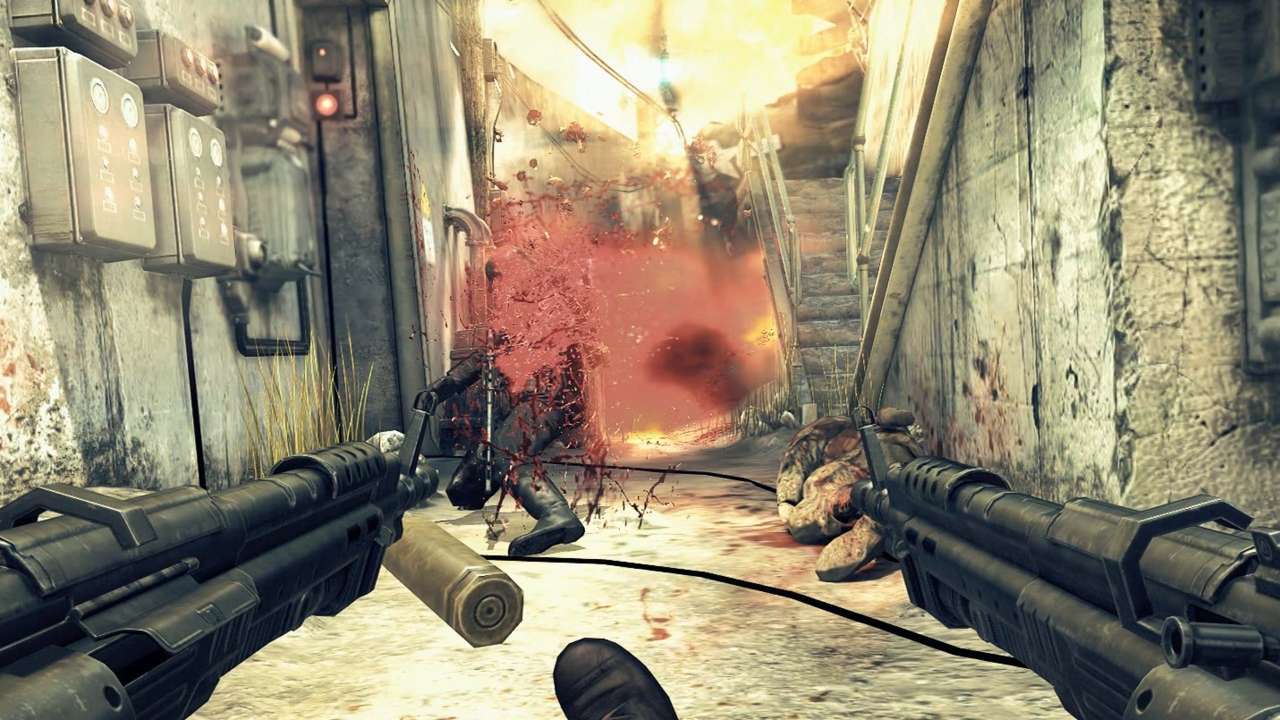
The fear of Nazi Germany taking over the world was probably quite believable about 60 years ago. Nowadays, it’s a fascinating “what if” scenario that authors love to toy with. While it’s never usually anything good or nice, it usually shows how nations can come together and fight a larger enemy. The New Order does exactly this with a tight narrative and some pretty solid shooting.
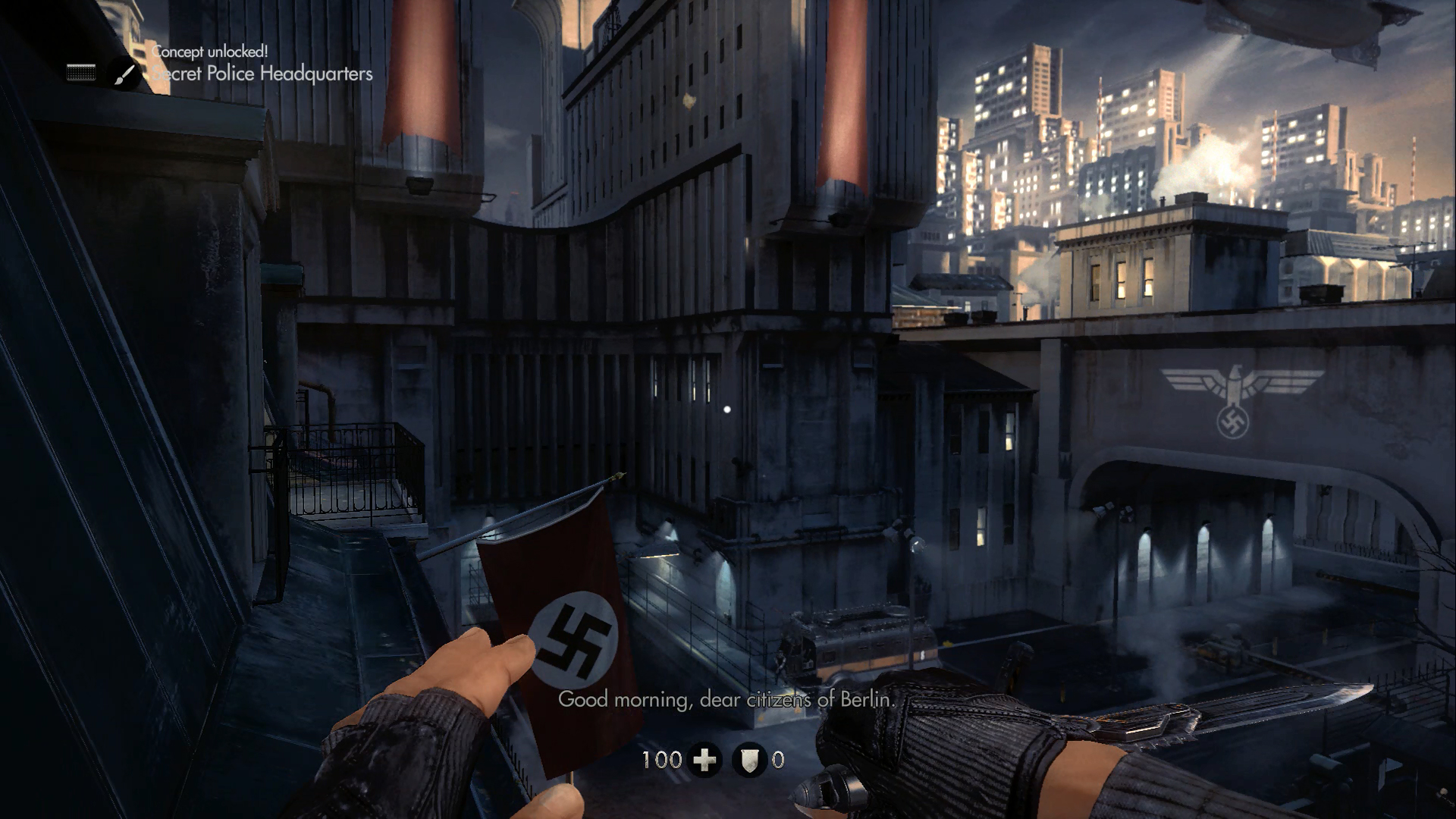
Now, let’s just put all this aside right now. Wolfenstein has its nostalgic moments that feel archaic and ancient compared to modern shooters, but for some reason it will always be there. This includes health packs, ammo pickups, and level design. The narrative is actually a huge step up for the series. William J. Blazkowicz is an American captain helping fight the ever-losing war with Germany. Wolfenstein was popular for delving into the arcane and supernatural that was part of rumored goings-on by Hitler’s elite group. Weapons use ancient technology to have an advantage over the rest of the world. In Wolfenstein, Hitler succeeds, but it’s not Hitler here, but Deathshead, a Nazi general who is doing terrible and evil things to the world.
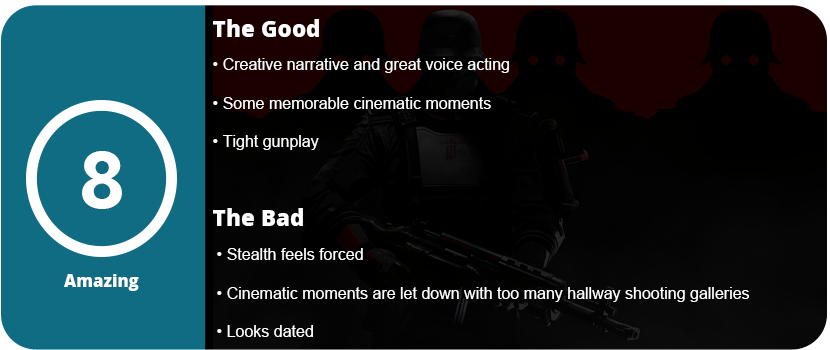
The New Order captures this cry for help from the rest of the world with torture and a small rebel group working together to bring down the New World Order. While the atmosphere is captured quite well, the game does dive into some past Wolfenstein stuff that accidentally brings you out of this modern take on the series. Things like linear-level design and enemy AI. Sneaking on an enemy and killing everyone in the room doesn’t alert other enemies. They will walk right past dead bodies and not bat an eye. There are also too few cinematic cutscenes with long, dragged-out battles that are extremely difficult and require multiple attempts. This type of poor pacing leads to a constant reminder of past games in the series and just how old the series is.
The actual gunplay is solid, with great-feeling weapons—not just any weapons, but weapons that you have to switch between as the situation calls. I used every single weapon, along with the multiple modes they have. I did feel the stealth areas were a little unnecessary and slowed the pace down too much. This is forced by lieutenants with headsets that will call in backup if they aren’t taken care of quietly. Outside of those series-specific issues, it just felt too much like the same ‘ol FPS to really be anything revolutionary or truly memorable.
Multiplayer is also nonexistent, so the team could focus on a great single-player experience, which is rare for shooters these days. Does the campaign feel like it was worth cutting a multiplayer mode? That’s hard to say. I just can’t help but recall so many good moments that lost momentum due to tried and tired FPS issues that Wolfenstein kept getting lost in. Sure, the shooting was solid, but those moments of torture and the uniqueness of Wolfenstein were just kind of let down.
With all that aside, the game doesn’t look as good as everyone was claiming. ID Tech 5 isn’t all impressive. The textures are really low resolution, and the lighting effects seem fairly dated. I looked at some textures that looked like they were pulled from a PS2 game. The facial animations were awkward, and the water effects did not look next-gen. Maybe my expectations were too high, but right away I noticed all these flaws within the first 5 minutes of the game.
In the end, The New Order is a solid shooter and one of the best on next-gen consoles; just don’t expect anything revolutionary for the genre—just for the series. This is a great step in a new direction for the aged Wolfenstein series, but it still needs a little more to be anything memorable.
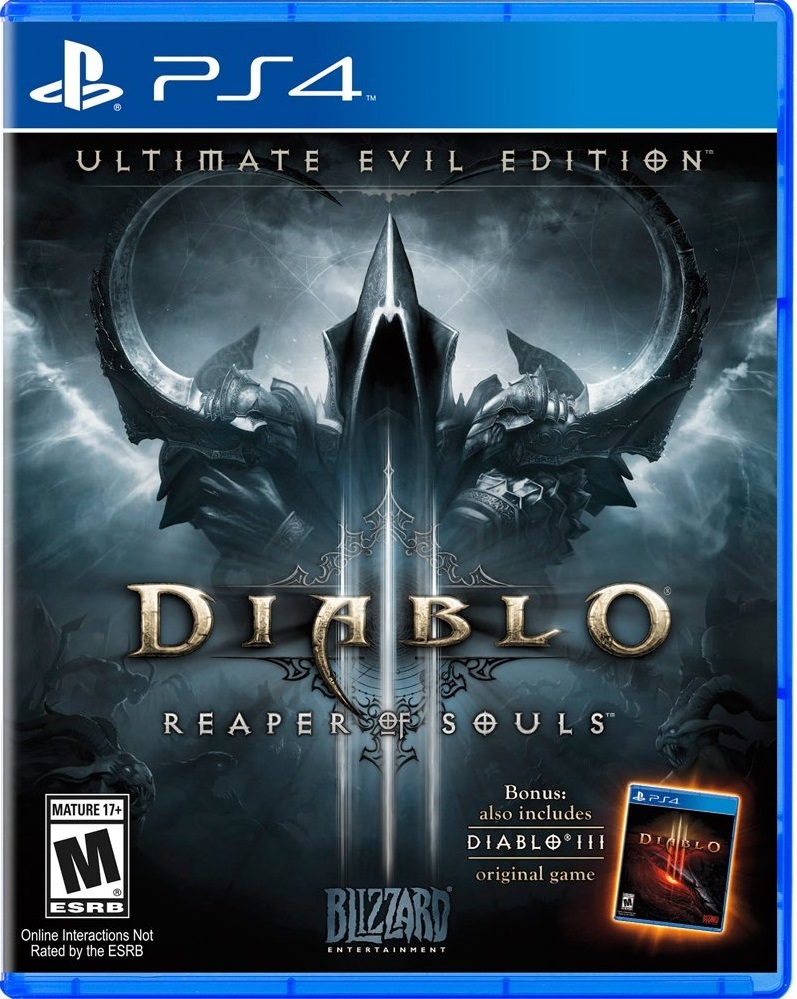
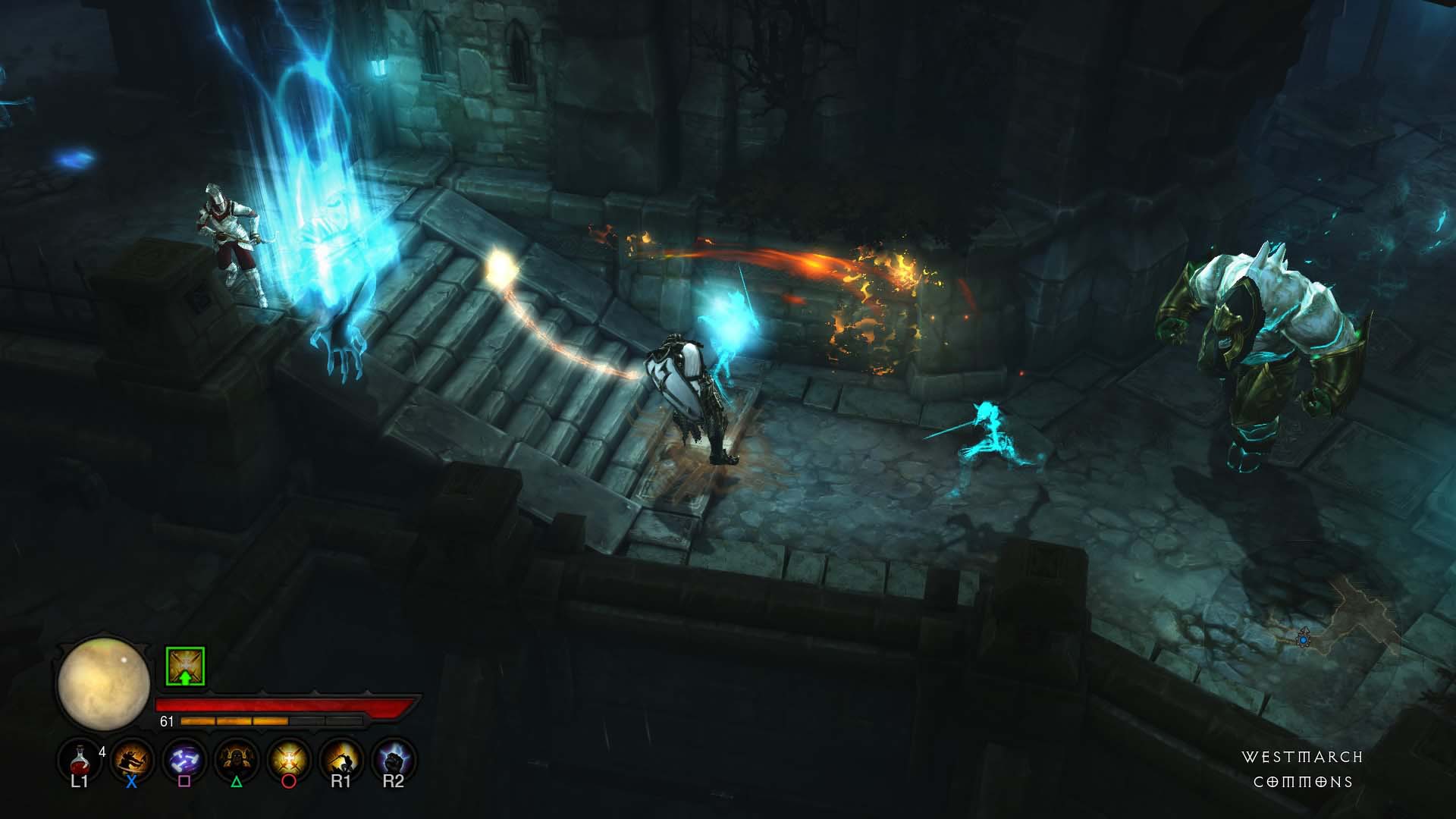
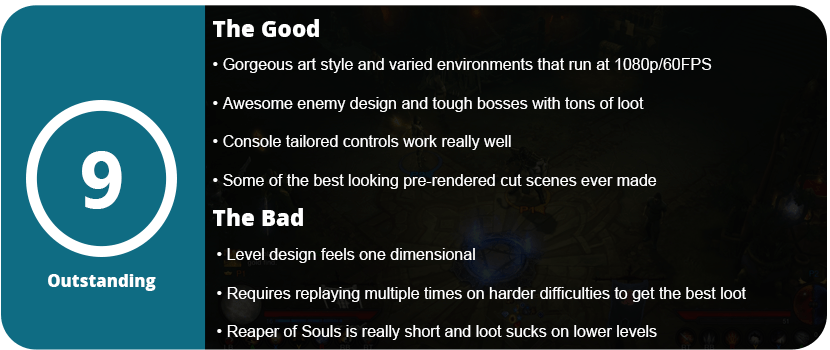
This is my review for Diablo III when it first came out. You can read it to get an overview of the original game, but here I will focus on what’s new. While the console versions are still pretty much the same, a lot has been balanced, and the game is overall more comfortable on consoles. The UI and controls have been tailored for controllers, and they work very well. Each button is mapped to an attack or a shortcut. Outside of this, the difficulty has been better balanced than normal and is actually quite easy. The game runs at a smooth 60FPS at 1080p on the PS4, and it looks gorgeous. There is so much content here that you will have dozens of hours to play.
Now for the Reaper of Souls expansion. My biggest complaint is going to be that it’s quite short (can be beaten in less than 5 hours) but is a lot of fun. All new enemies, bosses, and a continued story that was so great in Diablo III. New armor and loot are also welcome, but overall, it’s still the same game behind it all. I wouldn’t drop $40 on this by itself, but the inclusion in the $60 package is a fantastic deal.
Diablo III on consoles is worth every penny. You get the fantastic Diablo III, along with its expansion and all the other fixes and balances from the PC version. The hand-tailored controls and console experience are done very well. This is by far the best RPG and/or dungeon crawler you will find on next-gen consoles.
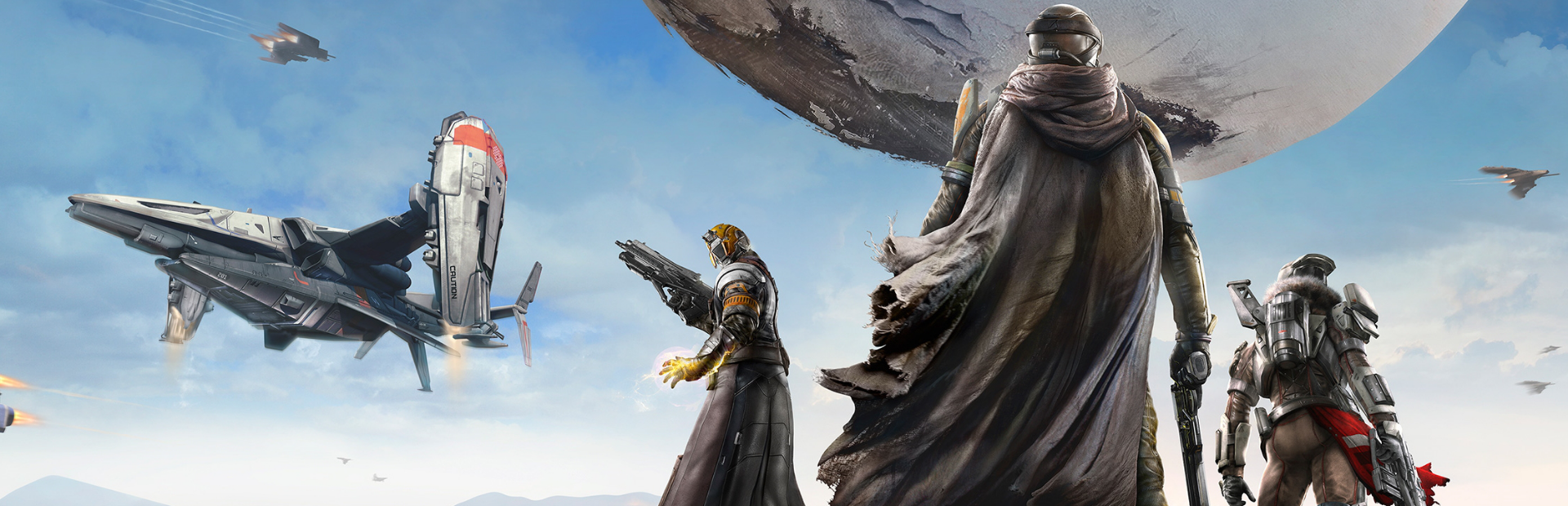
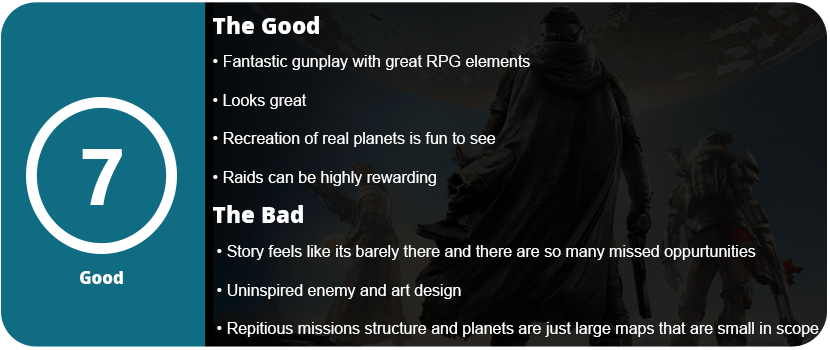
Destiny has been a long-awaited next-gen shooter. With one of the biggest hype trains in existence known as Bungie, Destiny had a lot of push behind it. It was dubbed the next-generation social interaction shooter. Destiny is also the most expensive game ever made, coming in at around $250,000,000. Sure, they made that back already and then some, but was the cost worth it? I sadly have to say it wasn’t. Destiny is probably the best, slightly above-average shooter you will ever play. While I was continuously disappointed, the further I got into the game, I just couldn’t put it down. Destiny is a strange dance of mediocre story and atmosphere mixed with fantastic gunplay and challenging gameplay. So just how does a game split like this?
First off, the story feels nonexistent. There aren’t many cutscenes, and all we are really given is a synapse and a crisis to dwell on. There’s a story about a Traveler, which is a giant alien-looking moon/ship hybrid that appeared above Earth one day. With all the alien fighting, there is a last-standing faction of humanity called the Guardians. You just so happen to be the only one who can make it through all these alien strongholds to finally bring light back to the traveler. It honestly never really makes sense, and towards the end of the game, you forget what happened in the beginning. Once you get down to the shooting, you forgive the paper-thin story a little.
The shooting mechanics are solid and extremely fun. Each sci-fi gun has its own personality, and you actually learn to like a certain class of weapons or switch between them when the situation calls. There are a lot of RPG elements mixed in that feel similar to Mass Effect. Take into account your class leveling; the cap is at a weak 20; and the unlocking of attributes with various armor you pick up. You will use everything at your disposal to kill the hordes of aliens you encounter, because this game is extremely tough. There were sections I had to retry over and over again to get the strategy down right. Now the game is built around a light MMO play model. There are open “maps,” and within these maps are non-respawnable areas filled with “darkness” with little to no checkpoints. Of course, the game was designed for co-op, but I played through it just fine by myself.
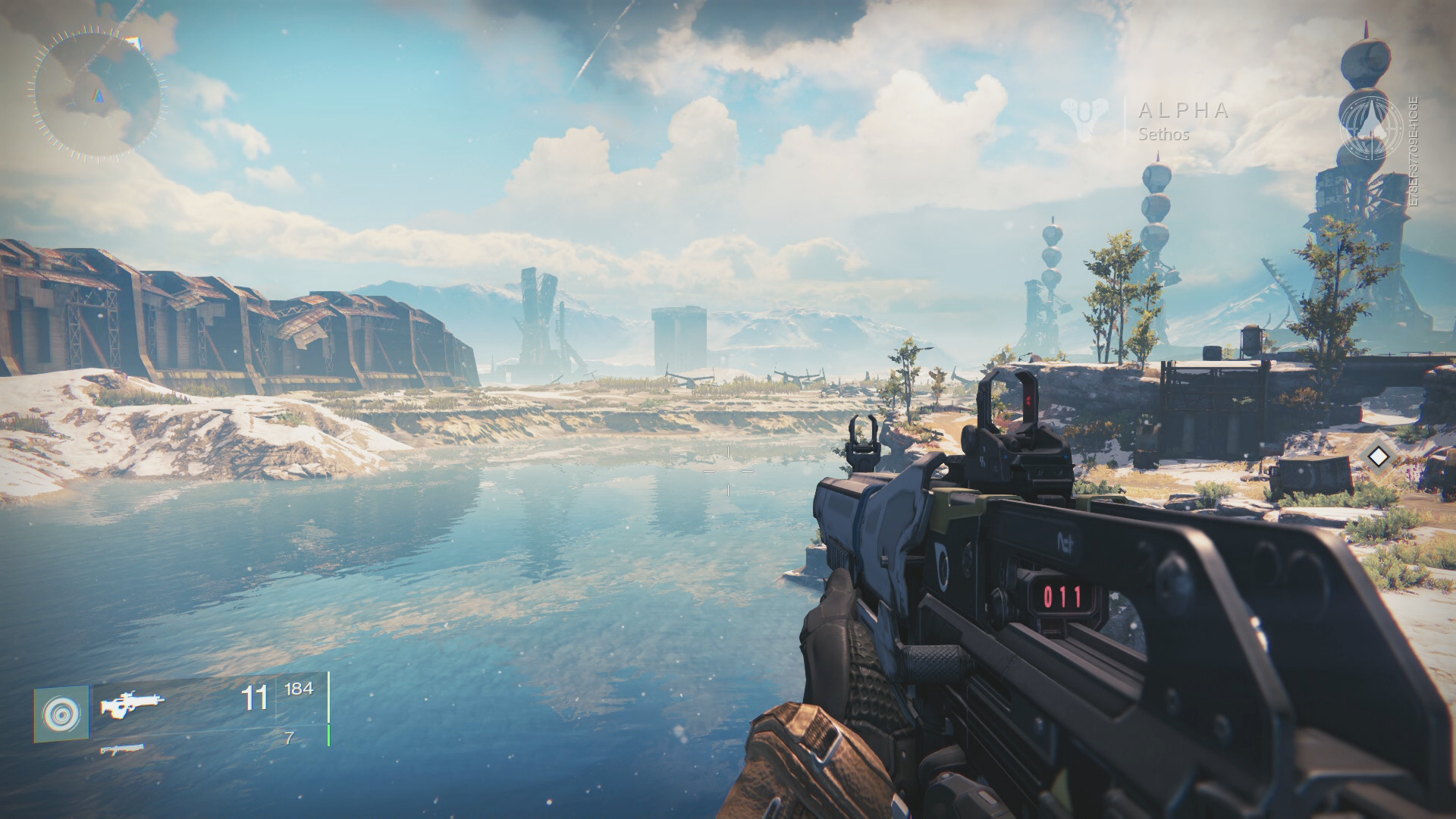
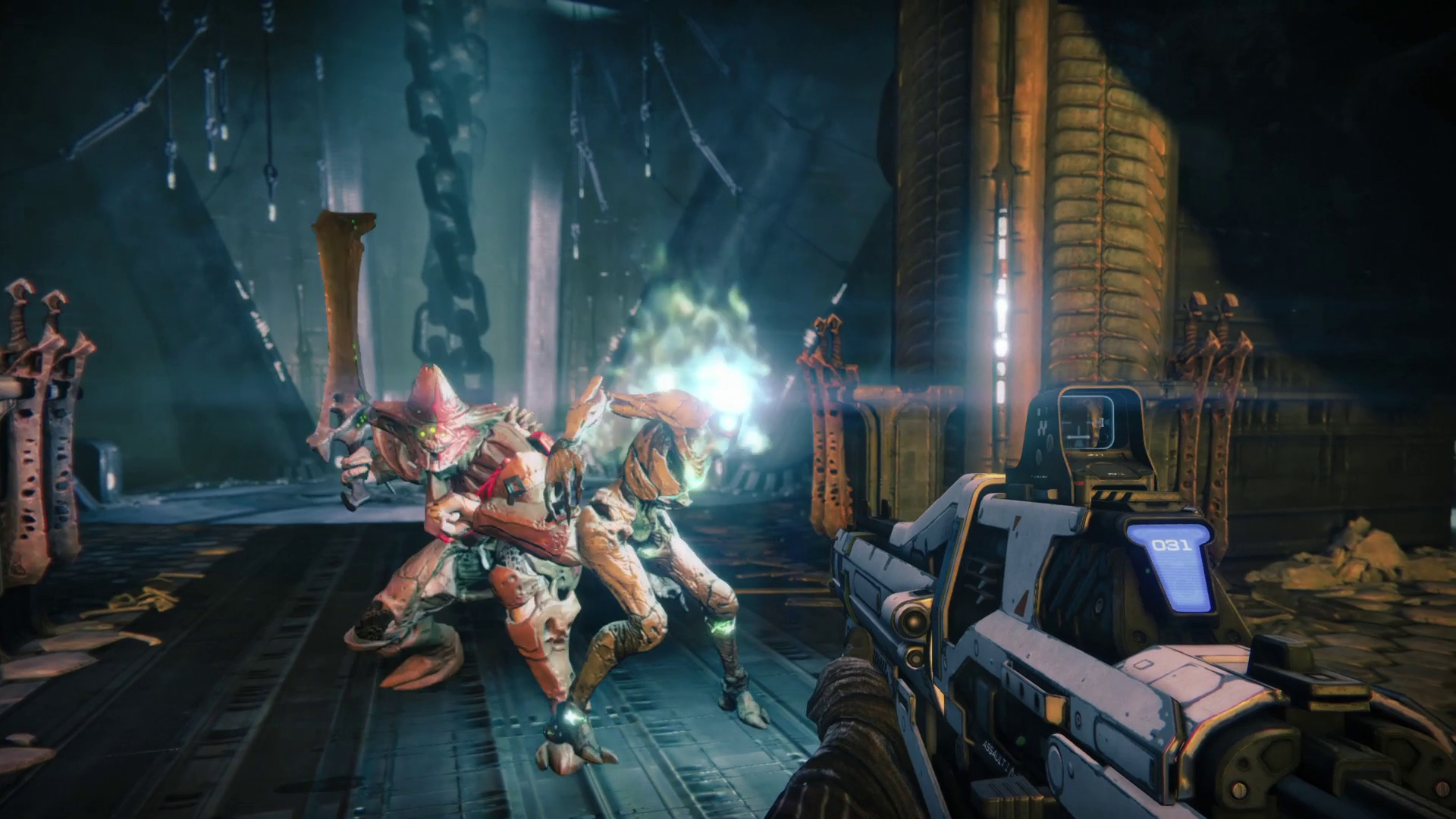
With all the grenade tossing, super-charged stomping, shotgun blasting, and class powers getting thrown around, you start to realize something. The game is pretty much the same everywhere you go. There are only a few select enemy types, and you will be killing them thousands of times before the end. It honestly gets quite old. Instead of the large planets, you thought you could wander; there are just large maps for each of the four planets. Yes, just a mere four. Old Russia is on Earth, the Moon, Mars, and Venus. While it’s pretty awesome to see these planets being recreated, I really felt cramped. This game is so small for such a large scope of design. With the level cap at 20, you can blow through the entire game with three other people in less than 20 hours. This could have been remedied with varied objectives or even scripted events, but instead, it’s nearly the same mission over and over. You have a companion called Ghost (voiced by the bored-sounding Peter Dinklage) who you must protect, and that’s nearly all you do. Scan this area. Cover me while I scan this area.
Destiny really had a lot of potential but seemed to have shrunk in scope during development. The best moments I had were the raids in which you could compete with players online. Each planet had one to two raids, and it was extremely satisfying when you finally killed the end boss after chipping away at him for over 30 minutes. However, there are a few moments like this in Destiny. I honestly can’t really recommend this game to the average gamer wanting to just pick up the latest shooter. Avid FPS players will find all the little flaws and weak spots in the game. When it comes to visuals and audio, Destiny really delivers. The game looks fantastic, despite areas like the Moon and Mars looking overly bland and boring. While it looks good on a technical scale, it feels like it lacks any type of artistic flair. I honestly kept thinking back to Halo too much. You can see the obvious inspiration from that series bleed into Destiny a little.
With all that said, Destiny has tight gunplay and some fun moments during raids, but that’s really it. It feels underwhelming in scope, is extremely repetitious, and will bore most players. However, there is some sort of spark that sticks in the game that keeps you going and racking up your kill count. The gunplay is rock solid, and I honestly have to say this is the best slightly above-average shooter you will have played in a long time.
Developer: Crystal Dynamics/Nixxes Software/United Front Games
Release Date: 1/28/2014
Available On
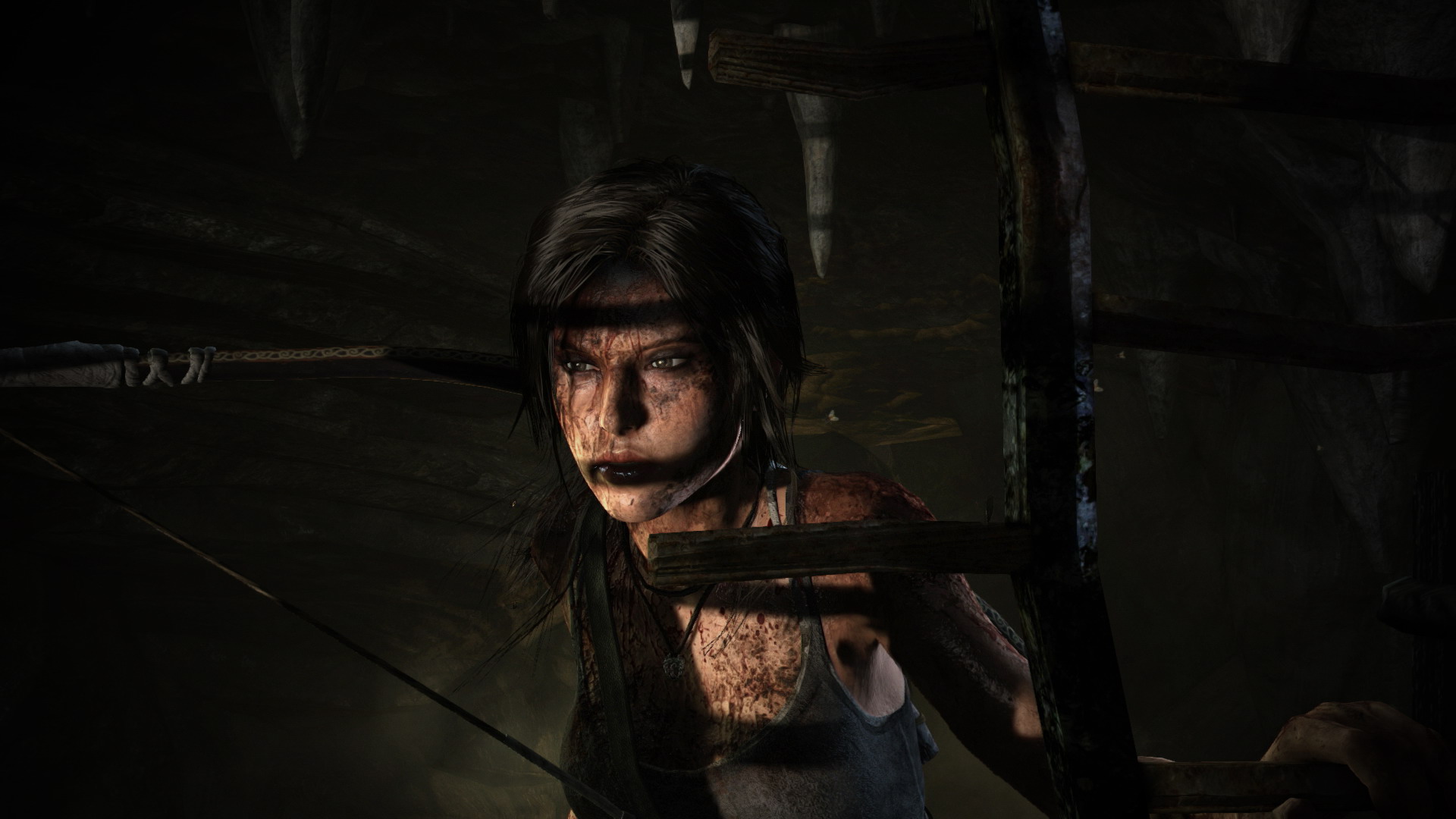
This is exactly how you do a game series reboot, right? I wish I could end my review with that, but I need to tell you why. Tomb Raider suffered through a few mediocre games during the first run of the series during the late 90’s and early 2000s. The first reboot did well for the series by maturing Lara and giving us better controls and a more cinematic experience. Now comes Tomb Raider (2013), a fantastic game that shows the more human side of Lara. The game starts out with you and a science crew on a ship on the way to an archeological site, but things go awry when Lara decides to head to the Dragon’s Triangle off the coast of Japan. A mysterious storm destroys the boat, and Lara and the team are stranded on this island. There is a mysterious cult trying to sacrifice people to a sun goddess to end these storms. Lara has to deal with this if she wants, of course.
What makes Tomb Raider so memorable is the struggle she goes through while surviving. She is nearly raped, suffers tremendous injuries, and has to cope with herself, dealing with the fact that she has to kill to survive. She is not comfortable with this at first and really struggles to pull the trigger. This adds layers of depth to her character that weren’t seen before. Not only is her personality more memorable, but her looks have changed. No longer is Lara wearing the short shorts and tight shirt with her huge bust. She has been knocked down a few cup sizes and is much younger, straight out of college, in fact. It’s hard to really describe her more than this; you have to play the game to really connect.
The gameplay in Tomb Raider has completely changed, but yes, there is platforming and gunplay. Both are tight and very well crafted. Gunplay consists of using scraps to create a pistol, bow, machine gun, and shotgun. That’s it. As you progress and find salvage in crates and dead bodies, you can upgrade these to look and feel like better weapons. There are many upgrades that increase damage and accuracy, as well as adding new ammo types. Lara’s animations are very well done and realistic, and this falls into combat. She scrambles around and ducks behind cover; the guns feel great to shoot, and you can see how inexperienced Lara is; she’s not a Navy SEAL or commando. Unlike other games like this, her stumbling animations don’t interfere with the game at all. You can still move around, you can dodge, and there’s even some melee thrown in. As you upgrade your skills (done at various campfires throughout the game), you can dodge, and through quick-time events, you can do some pretty gruesome kills.
While gunplay is tight and fun, exploring is just as important. This island is massive, and you can go anywhere; there are no limits. Fast travel via camps really helps, but there’s a reason for moving around everywhere: collecting hidden items. These range from relics, GPS caches, documents, etc. There are hidden tombs found throughout the game that hold area maps for these items. These tombs consist of cleverly made physics puzzles that are really fun to complete. You get rewards like art and 3D models to view. The whole game just has an amazing atmosphere and is so much fun to explore.
On top of all the climbing around, you get a climbing axe, which is an important tool for climbing and combat. Your bow is used for shooting ropes across valleys and canyons to pull items to solve puzzles, break doors, and access new areas. The whole exploring ideal in this game is just fantastic and really fun. I did have to think about how to get to new areas and actually try to navigate and experiment; that’s good game design. There is a Survival Instinct ability that highlights map markers and objectives, and when you unlock the skill, you can see items through walls.
The story itself is a bit confusing; the whole spiritual thing is a bit unbelievable in such a realistic world like this, but that is what Tomb Raider is known for. Lara is the main character here, and what she goes through was the main story for me. I loved every second of the story. The voice acting is awesome, and the graphics look amazing.
The multiplayer was tacked on late in development and is pretty boring. The combat was designed for cinematic gameplay, not multiplayer. It feels just like it does in the story, but it just doesn’t suit multiplayer well. I played all three rounds and got bored of the game. Some people may like it, but there are better multiplayer shooters out there.
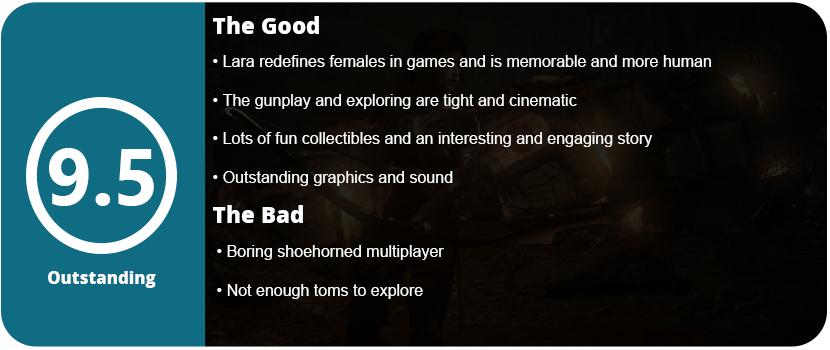
Overall, Tomb Raider is one of my favorite games of all time and is really memorable. The voice acting is solid, and Lara’s new personality makes her more human and more relatable. The graphics are outstanding, and the gunplay and exploring mechanics are fun and very cinematic.
Definitive Edition
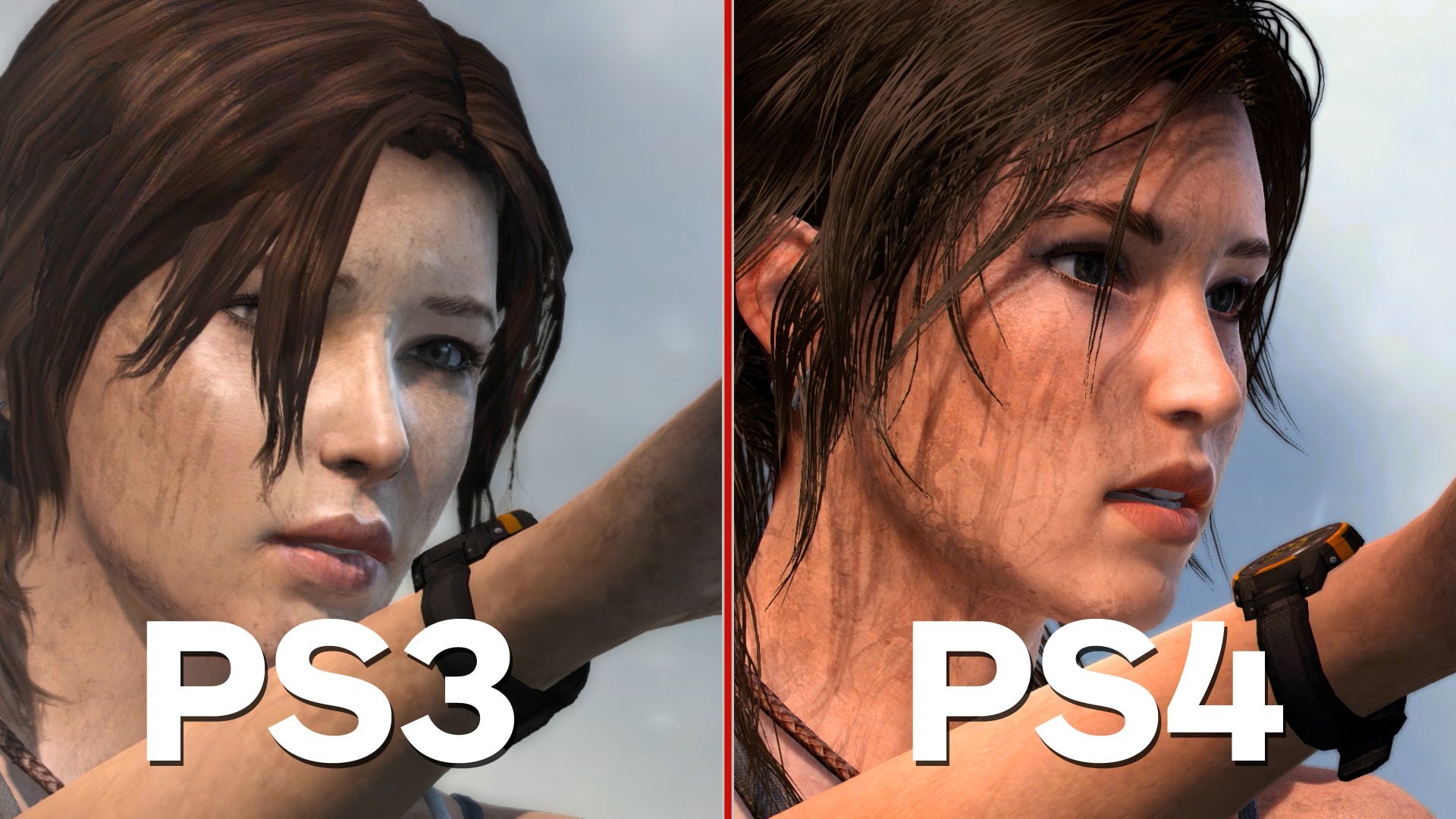
I have to say that the graphics upgrade alone is worth a re-buy. The game looks even better than the best settings on PC. Lara’s newly remodeled look is fantastic, and TressFX on her hair has finally been fixed to the point where there isn’t any slowdown from it. All textures and lighting have been slightly bumped up, and the smooth 60FPS in 1080p on next-gen consoles just looks gorgeous. This game still holds up well to this day, and I played the game all the way through with the same excitement and rush that I did the first time. The PS4 version has been specifically tailored to the controller and headset. You can now play most of the game with voice commands; however, there are quite a few, and it takes a while to remember them all. The PS4 speaker is used through most of the game as ambiance, but I found some narrative bits going through both the controller and TV to sound strange. The Definitive Edition is well worth the buy and is the best version yet.
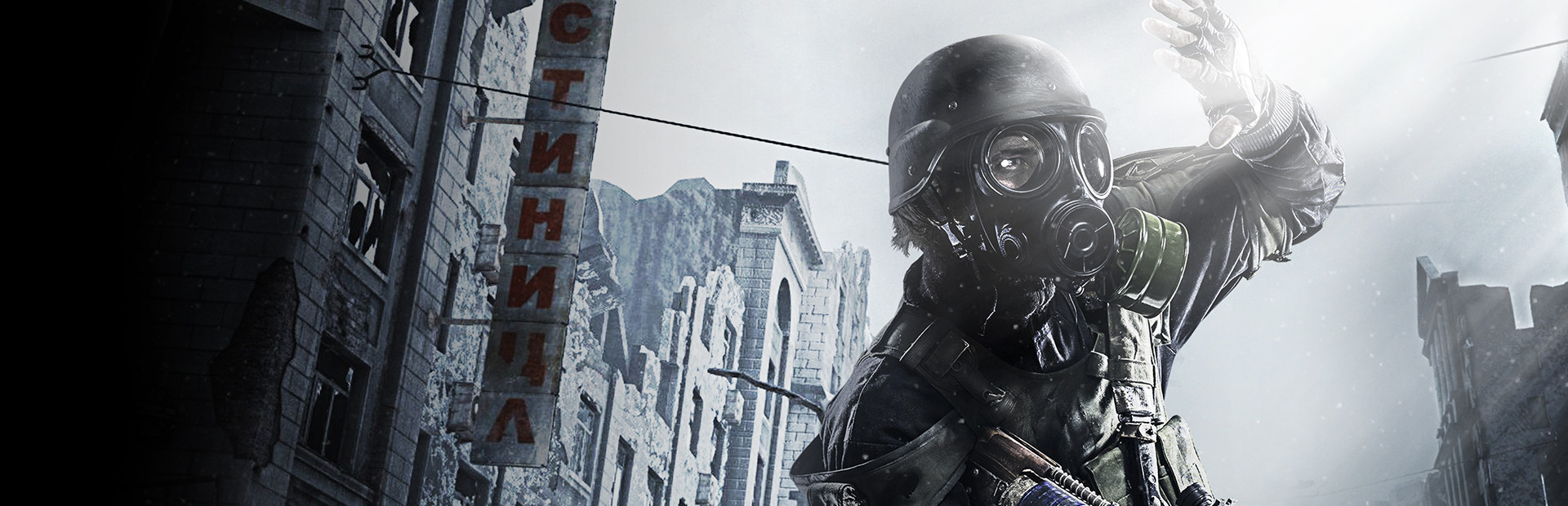
If you haven’t already read the novel, Metro 2033 is probably one of the best post-apocalyptic novels ever written. The novel really gets into your head and takes the whole post-apocalyptic Russian lore and myths and brings them to life. Metro 2033 was ahead of its time in 2010. While the game looked decent on Xbox 360, it really pushed systems on PC. The game was one of the first to fully utilize DirectX 11. As a game itself, it had many issues, such as huge AI problems and a somewhat incoherent story, but underneath it all, it oozed an atmosphere that no other game could provide at the time. This is all tidied up and wrapped up in one big next-gen ribbon. The game is worth a replay for vets and well worth any newcomers’ time.
You play as Artyom, a “chosen one” who must stop the Dark Ones that have invaded his home station in the underground Moscow metro. While his station was overrun, he was trying to make his way to Polis to get help fighting off the Dark Ones. Instead, he must find a mysterious and once-forgotten nuclear missile silo called D6. His journey is terrifying; even humans can be as horrible as mutated beasts.
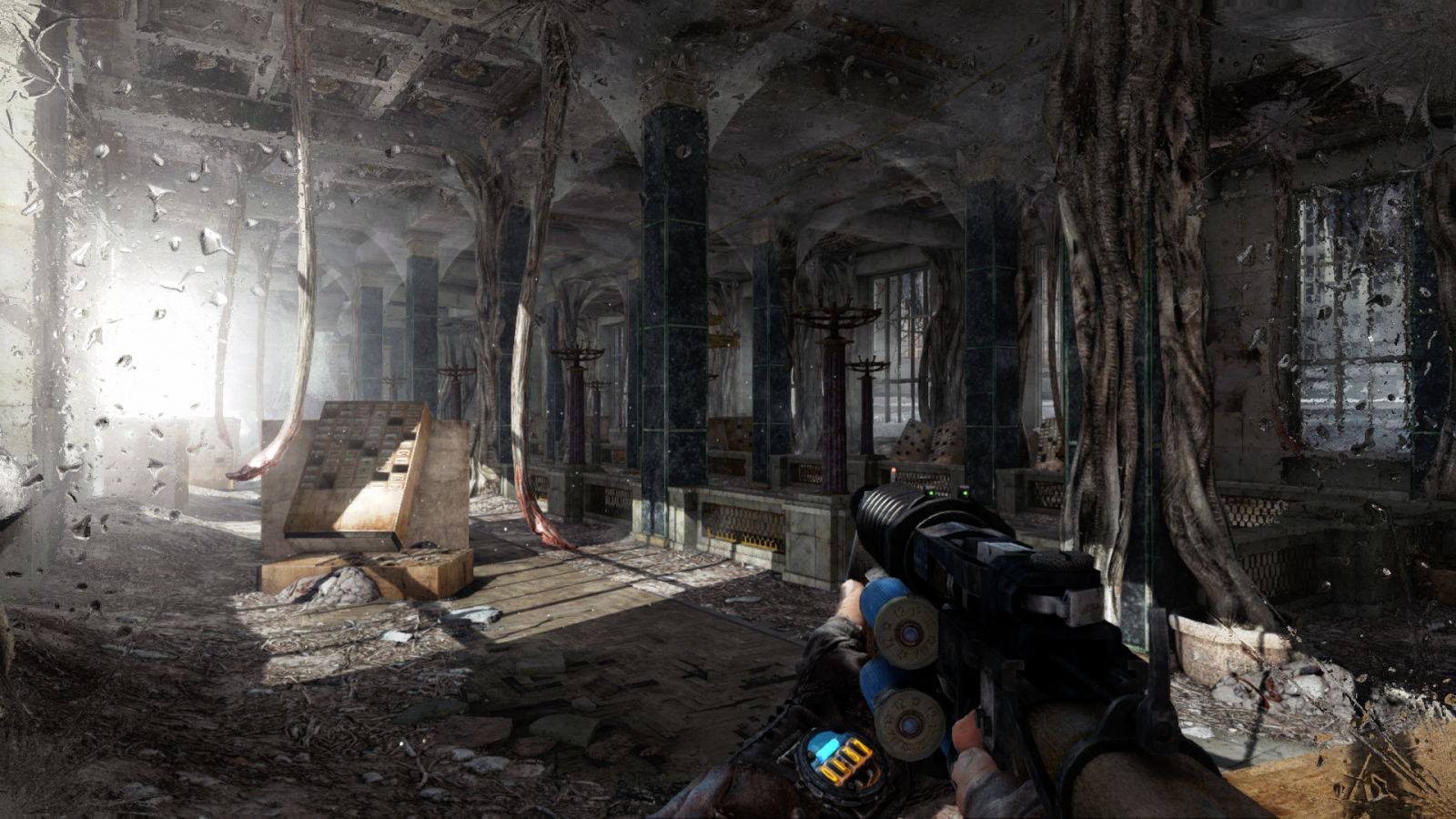
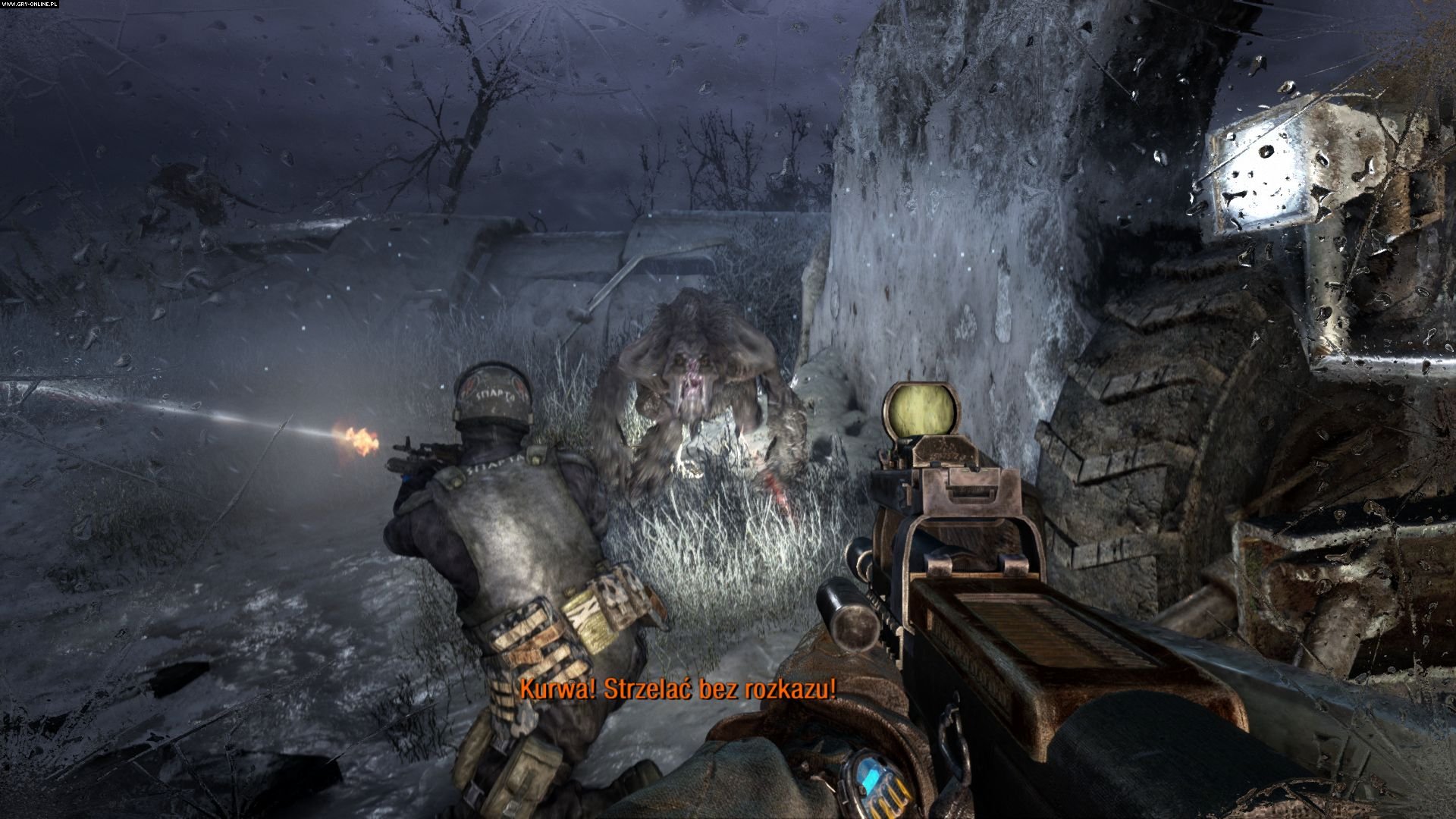
Most of the game sees you either fight your way through monsters or stealthily push through Communist or Nazi frontlines. Back when the game was originally released, these stealth sections were nearly broken due to the AI being able to detect them in the oddest circumstances. The AI has been tweaked but can sometimes still show a bit of awkwardness. While some areas have been completely reworked with even new enemy placement, I still found myself confused as to whether I could sneak through the area or shoot the place up. The stealth path would be too well hidden or in an odd place. However, this was pretty rare, and I really love how these areas were given attention. The atmosphere is just so incredible. When you get into populated areas, you actually feel “safe” and enjoy every minute of light and peace. One area that became extremely scary was the library. Mutated gorillas called Librarians that stalk are just downright scary.
The shooting mechanics themselves are fantastic. Each gun has its own personality, and you will easily find your favorite three or experiment. There is a wide variety of gun types, ranging from revolvers, assault rifles, bolt guns, pneumatic guns, and even shotguns. However, they all feel unique to the setting. Each gun looks beat up and worn and somehow piecemealed together to just kind of work. There are also a variable number of throwables, such as knives, firebombs, shrapnel grenades, and various others.
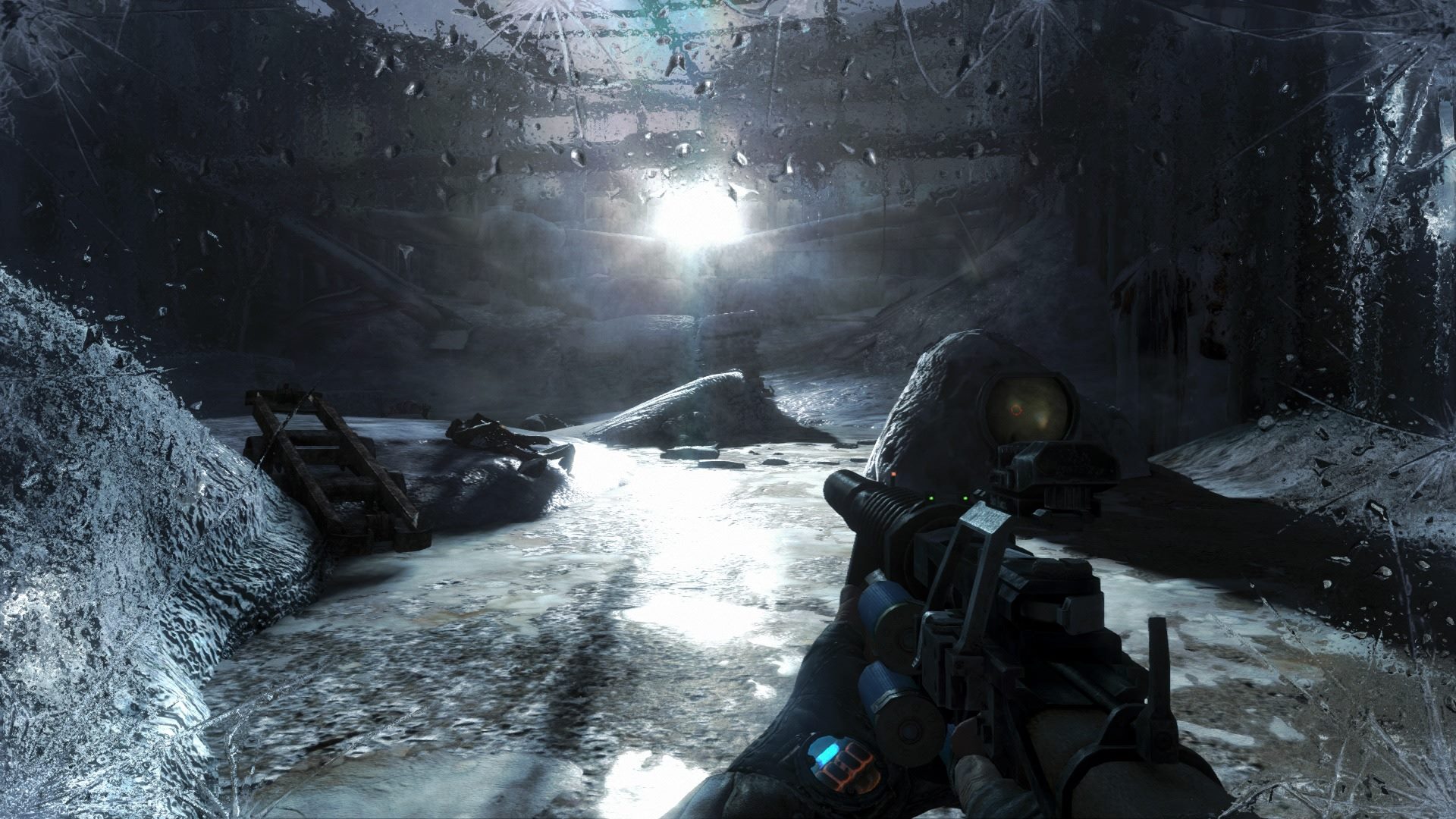
It wasn’t just the gameplay parts that were reworked. Entire outdoor areas were rebuilt to look more next-gen. Compared to the original Xbox 360 version, Metro 2033 Redux looks like a whole new game. Incredible attention to detail was taken when combing back over this game. Thankfully, due to the power of next-gen consoles, we get all the fancy DirectX 11 graphics that the PC version got, plus some. Despite being a remade game, Metro 2033 Redux is one of the best-looking games out on consoles right now.
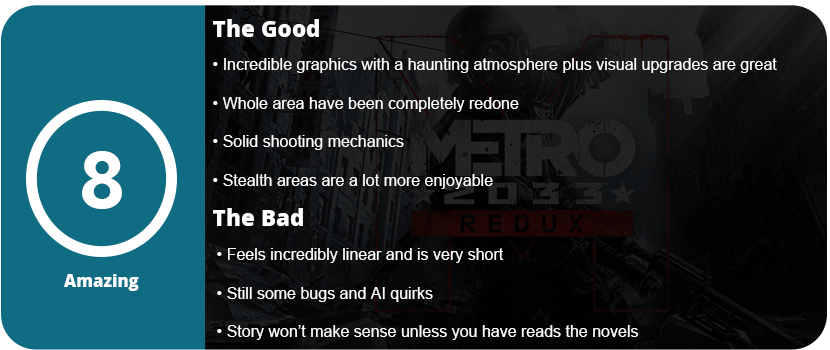
With that said, the game is a little on the short side, and it feels a little too linear for its own good. Yes, you are in a cramped metro, but I feel like it would have been a good idea to explore this place more. The game is extremely scary, the monsters are freaky but awesome, and there are some pretty fun scripted events. For a 4-year-old game, it has held up so well to recent games and just shows how far ahead the game was back in the day. If you are a fan of Fallout, STALKER, or any other post-apocalyptic game, you should give this a spin.










































 thebinarymessiah.com
ORC is probably the worst game in the entire series. It's objectively awful. Being bad isn't different. Different is Outbreak…