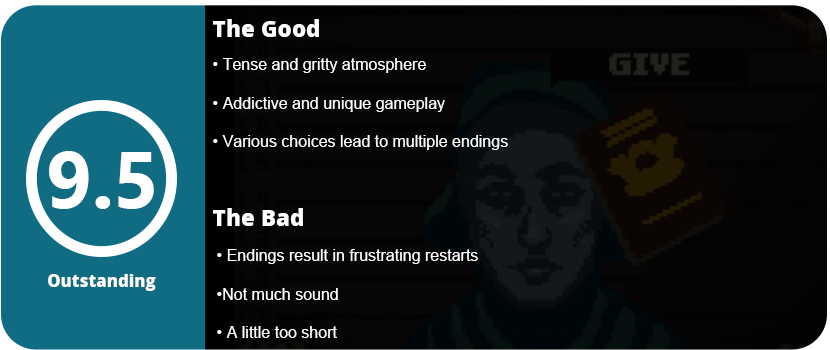
I honestly went into this game not expecting much. It is an 8-bit-style game where you stamp papers for people. Sounds boring, right? Far from it, and I mean very far. This is one of the most addictive and fun indie games I have ever played. This game kept me away from Skyrim, Splinter Cell Blacklist, and Saints Row IV. How can a $10 game keep me away from such high-budget splendor? It’s unique and so much fun. I honestly don’t even know if it’s a puzzle game, an adventure game, or something. It’s something, but so original that it creates a new category all on its own. You play as a Russian citizen who gets his name drawn in a labor lottery to work the customs booth at a border check. The story isn’t exactly deep, but the atmosphere is tense and gritty.
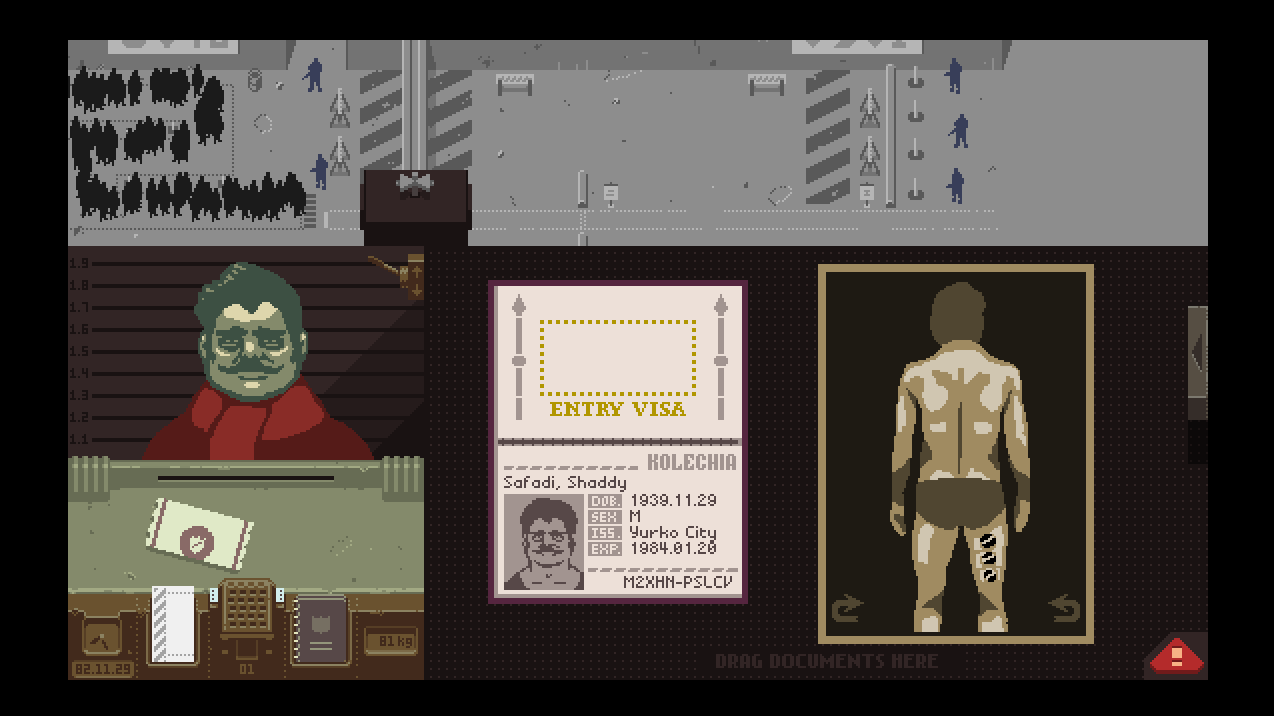
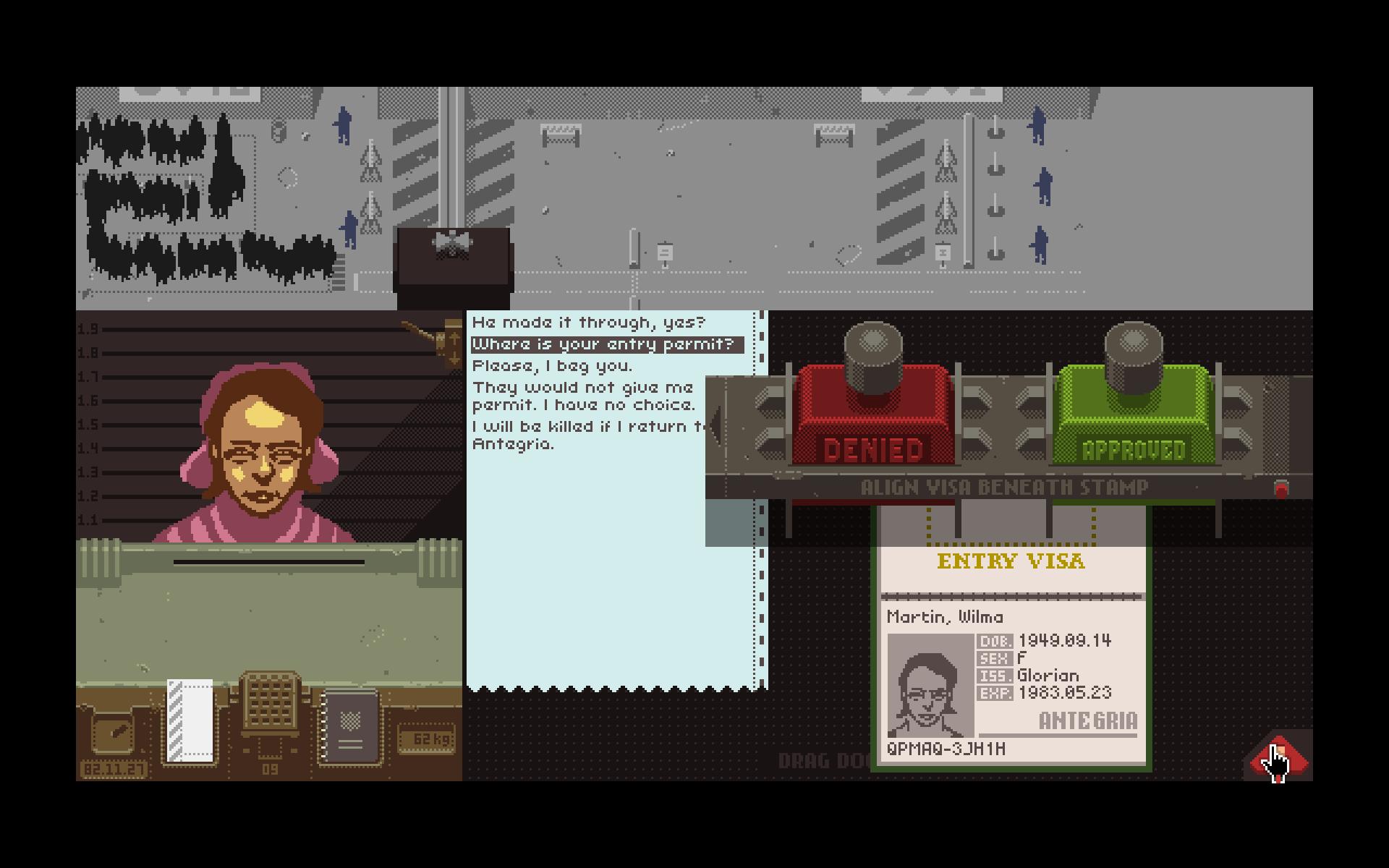
You start out every day by reading the headlines in the paper and walking to work (you don’t actually do the walking). The top half of the screen is the line at the border, and everything is going on. Guards are patrolling, cars are passing by, and you will occasionally witness terrorist attacks. The bottom part of the screen is split into two parts. On the left side are your counter and window. This is where you receive everyone’s passports and various papers, as well as your rule book and bulletin for the day. You must make sure everyone’s credentials match before you stamp their approval. You start out with the simple task of just making sure the issuing city matches the right province. You check this in your rule book. If this doesn’t match up, you go into inspection mode and click on the information you see wrong with the corresponding contradictory information. This gives you a personal touch to the game and makes you feel like you are in control of these people’s lives.
Before you roll your eyes, this isn’t some sort of Burger Builder or any other type of mobile game. You get more and more papers to check as the game progresses. You get special assignments such as confiscating certain citizens’ passports, stamping the reason for denial, cross-checking shot records, matching up ID numbers, height, weight, birthday, and expiration date, and you need to do all this fairly quickly. You’re not in real time, but the more you process, the more you get paid. This just gets so fun and addictive because of all the hands-on stuff you get to do. Sometimes people will try to bribe you or ask you to deny or pass certain people, and guards will bribe you if you detain more people. Later on, you get to even scan them for contraband and fingerprint them. There’s a lot involved, but it’s doled out slowly so you aren’t overwhelmed.
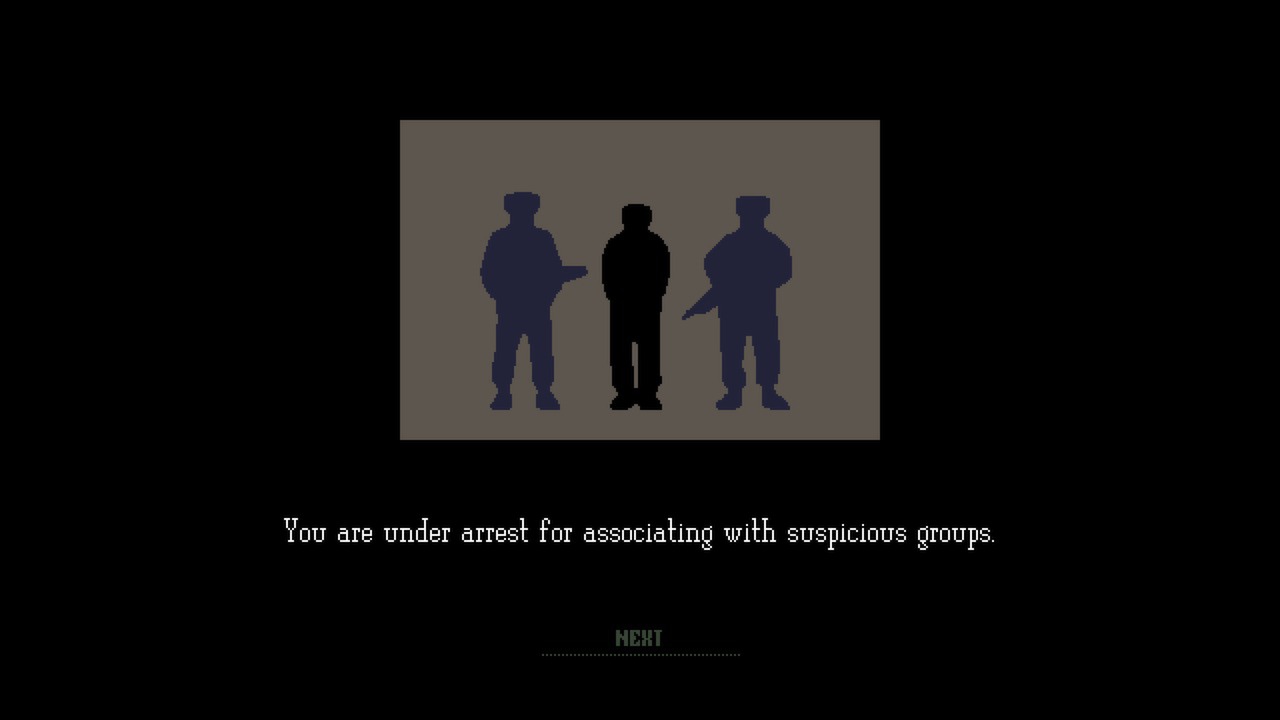
If you mess up, you get penalized; this goes against your 10-day inspection. You get plaques you can hang on the wall, but if you are caught with anything else on the wall, you get docked pay. If you are involved with the terrorist group EZIC, you get fired. It’s up to you to be loyal to your country or betray them behind your back. There are 20 different endings to get for different choices. Thankfully, the game saves before the start of each day, so you can change your choice. Things, like accepting certain bribes and spending that money, will trigger an audit, leading to an ending. You can burn the money and continue to save, but it’s all up to you. By the end of the day, you need to help your family with food, heat, and various other things using your pay. You need to be very careful and only get them what they need, or you will end up with a game over and your family dying.
The constant lash and tension between countries are tense, and you get the full brunt if you let known murderers in. Sometimes being the good guy will get you lots of penalties. Too many will lead to a game-overcoming inspection every 10 days. The game is just so much fun with a lot of replay value, and there’s a lot of content here. I honestly don’t have too much to say that’s bad except I wish the game was longer and you didn’t get all these endings and have to restart whole levels as a result.
Papers, Please is one of the most unique games ever made, period. I normally don’t care for these indie games since they are a dime a dozen, but when games like Fez, Braid, Limbo, and Papers, Please come up, they get my attention. Any gamer can play this since it really isn’t designed for a set crowd. This will be the best $10 you will spend on a game.
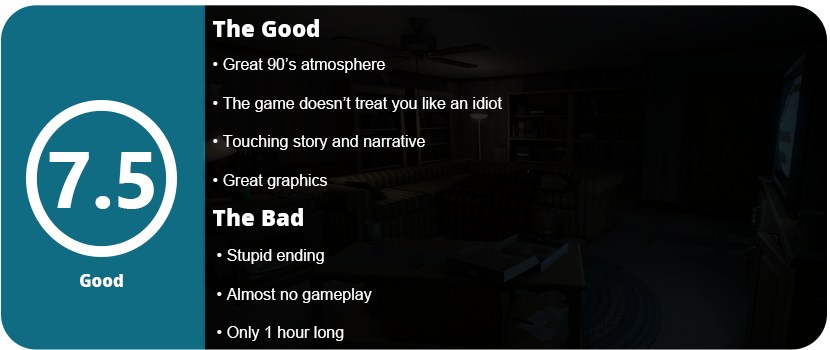
It goes to show that a smaller focus can create a great story and atmosphere. You don’t need a multi-million-dollar budget to create something great. Gone Home starts out oddly because you are given no direction, but after about 15 minutes, you realize what you are supposed to do. You arrive home from a school trip, and no one is home. You find a note on the front door from your little sister, Sam, that says she’s gone and won’t come back. With the dark atmosphere of lightning and rain, you expect this to be a murder mystery. In fact, that feeling changes throughout the game.
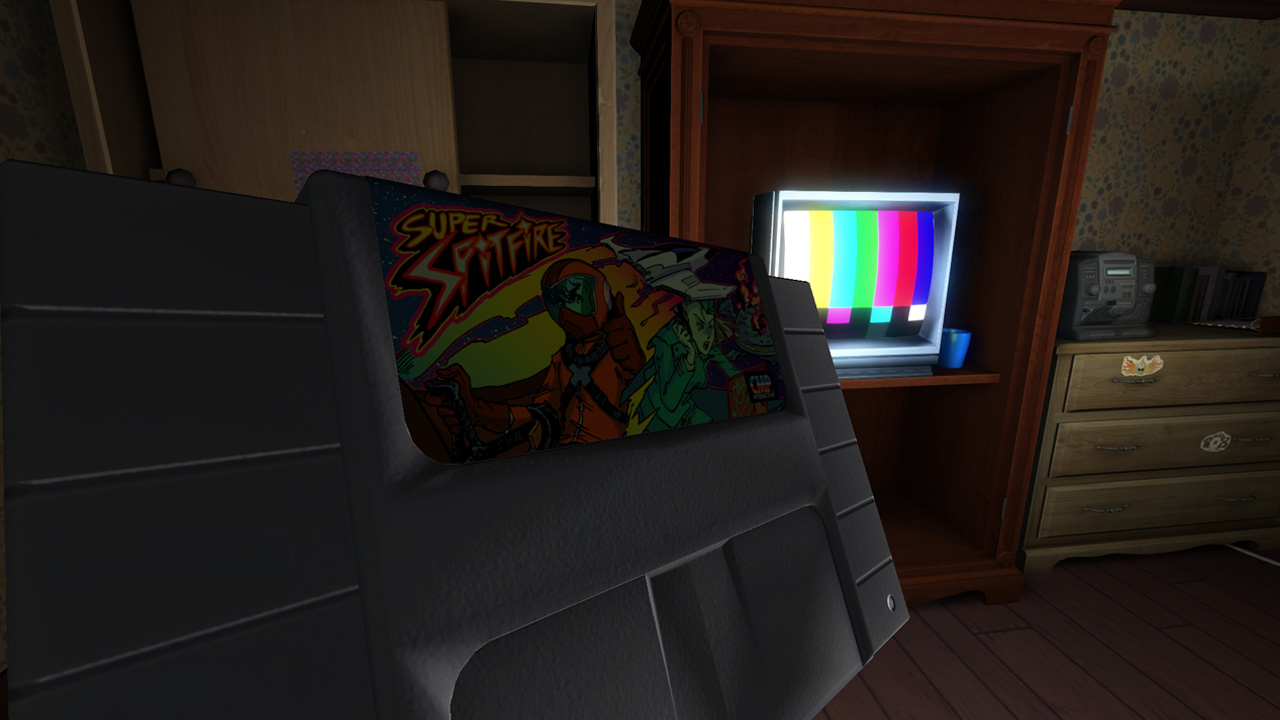
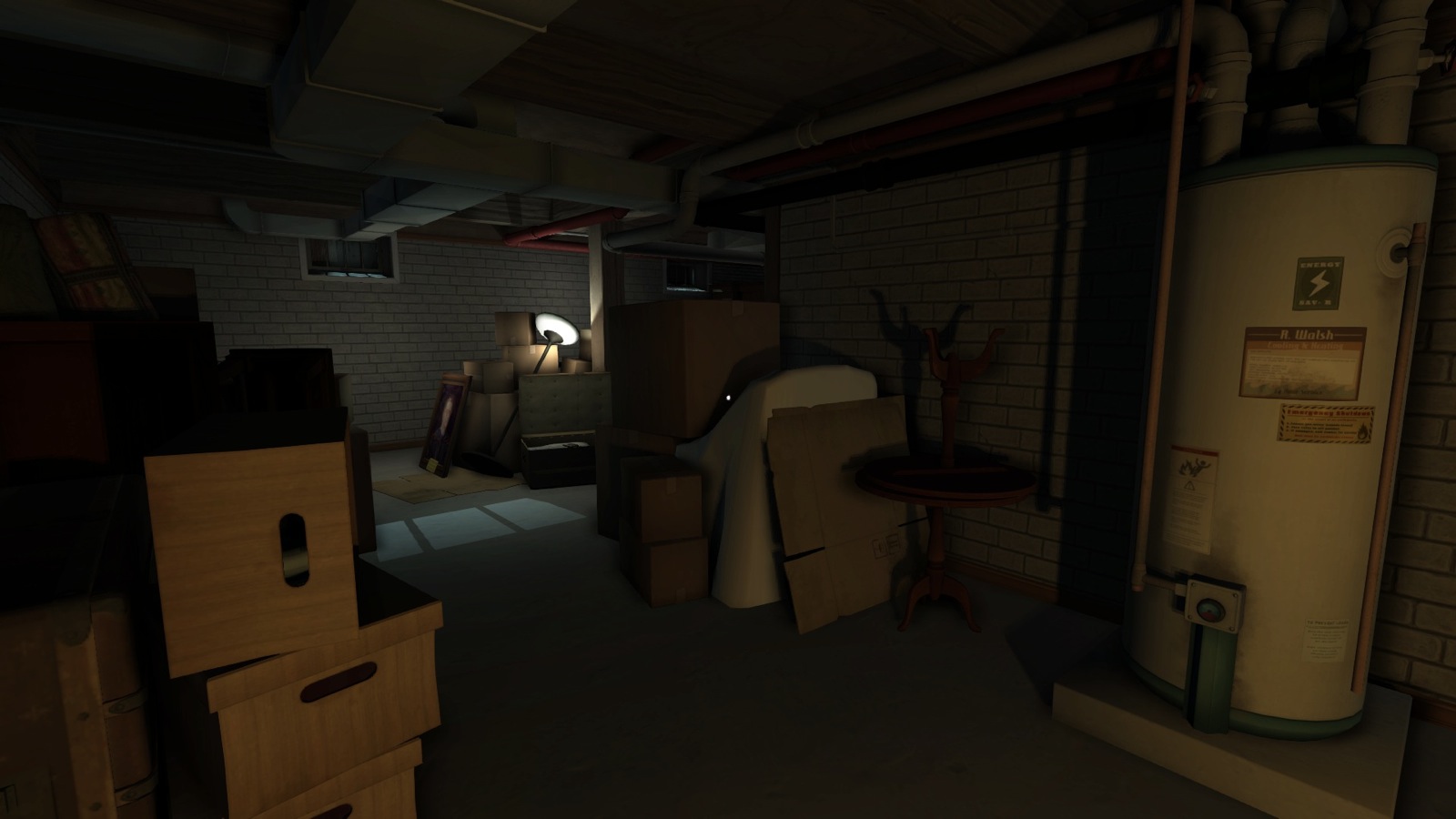
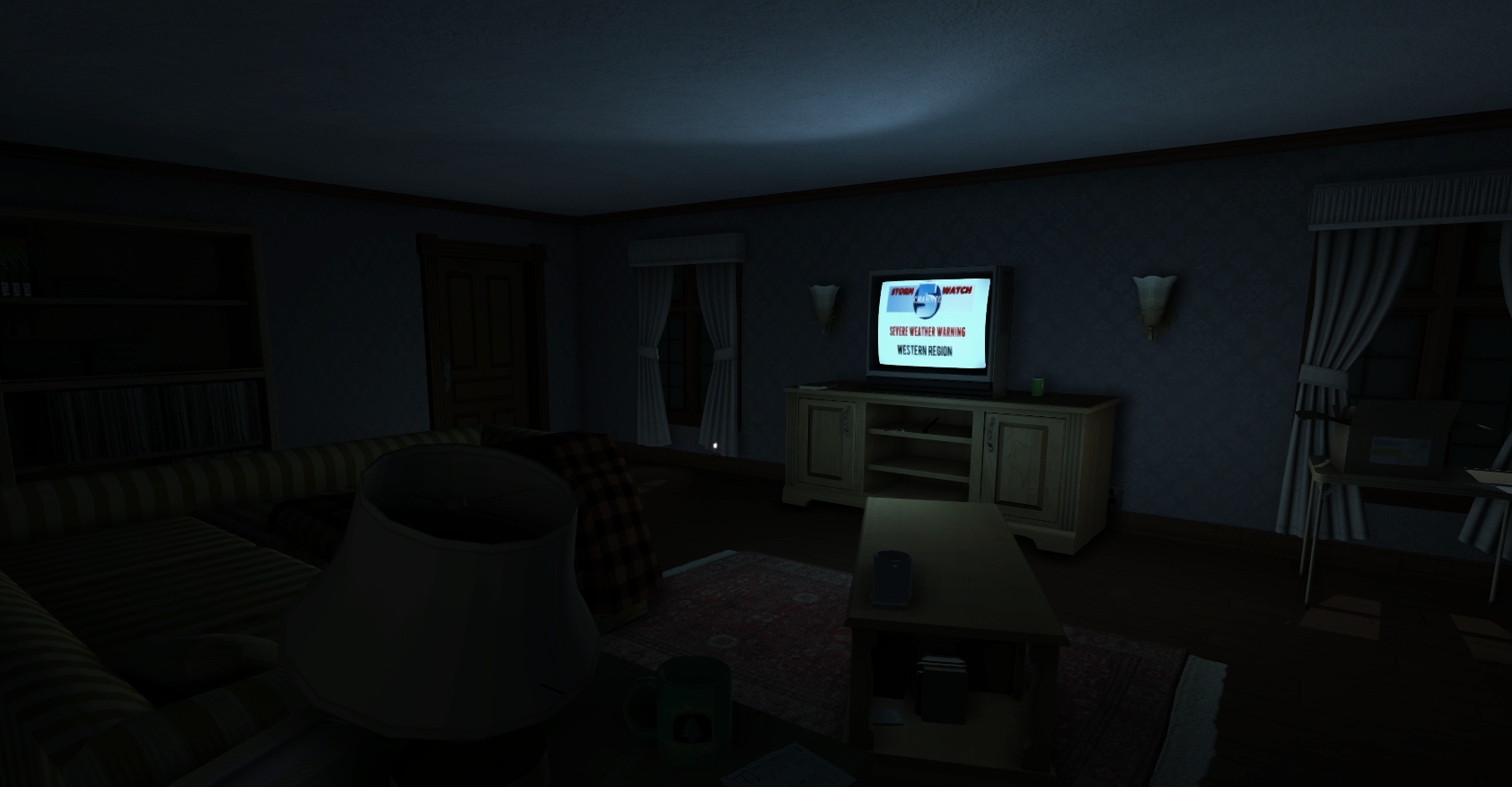
Once you find the key and go inside, you just wander around, examining everything. There are letters to read and interesting objects to look at. After a while, you start finding key items that activate journals narrated by your sister. The home itself is a great recreation of a ’90s home. It actually brought back a lot of childhood memories with CRT TVs, cassettes, VHS tapes, and various items from the 90s. It gave me a warm feeling, and I felt at home in this house, but I wasn’t sure what was going to happen. Was it haunted? Was there a murderer in the house? I went on to read more letters and items to see that the mom was a park ranger and the dad was a tried and failed author and magazine writer. I later discovered a few locked areas and three different cabinets that had lock combos on them.
Honestly, you don’t need a walkthrough for this game. It’s all pretty easy to figure out. I just went from room to room looking at everything and realizing that this lesbian relationship with Sam and her friend Lonnie is actually pretty heartbreaking. You see signs throughout the house that it’s a bit of a broken home, and Sam is a problem child. Little things like good report cards from you and then disciplinary notices from the school for Sam. It all brought back memories for me from my school days and my childhood. Anyone who grew up in the 90s will feel the same way. As I reached the end of the game, I was pretty emotionally stirred up. I couldn’t wait for the end.
Once I got to the final room and saw the ending, I was really disappointed. I felt the entire 1-hour journey was for nothing. Sure, the story was sad and will tug at your heartstrings, but the ending was predictable and lame. There are signs everywhere of Sam studying the occult and various things about the house being haunted, but nothing ever happened. I was never spooked; there was no murder; it was just a few journals narrated by a gay sister, and that’s it. 90% of gamers will find this game extremely boring, and even if you don’t, it’s not worth $20. You get about an hour of gameplay with a lame ending. I expected the sister to have committed suicide and you would find her body upstairs, something like that, but no, just a lame ending.
The game has decent graphics, but nothing too impressive. There’s a lot of attention to detail everywhere to create this great 90’s atmosphere, but you still need a pretty powerful rig to run it due to the complex lighting effects. As it is, Gone Home is a great narrative and a trip down memory lane, but the ending and lack of gameplay are disappointing.
Forget about the last Shadowrun FPS. That game was a disaster. This HD remake of Shadowrun Returns with a great story, but the combat is lacking just a bit. You are basically a runner who watches a tape of your best friend before he dies. You suddenly become his insurance collector, and you need to find his killer. The story is pretty engaging, and I was sucked in from the beginning. You basically just follow mission after mission, unraveling this mystery.
Of course, you get to pick your class at the beginning. Go from ranged weapons to melee to magic. There’s also a fourth decking ability that makes you stronger during hacking battles. Once you complete some missions, you get to The Union, which is your underground hideout. You can buy weapons, cybernetic enhancements, magic, first aid, weapons, and various other things. Make sure you take plenty of health with you and stock up on the latest before the next mission. Usually, you have to hire out mercenaries to help you in a fight. I found the majority of the story fairly challenging, but later on, it got downright unfair. The biggest issue is the unfair savings system. The game is autosave only. The game will only save at the beginning of each level, so if you die, it’s game over. This is so infuriating towards the end when you have really long and tough fights.
The combat is fairly decent. You can select between ammo types (or magic types), special powers, and items. With this variety, you are sure to win battles. I was just so upset at how often I missed. I could be at point-blank range, and I would miss three times in a row. The accuracy and rate at which you hit enemies seem completely random, and I hated that. Decking battles are interesting but boring because they aren’t as deep as regular combat and there are only a few types of enemies. Once you complete the mission in the hacking area, you have to run all the way back to the opening. If no one’s out there defending you, the enemies shoot up your body, and you can die. That’s really frustrating, and it drove me nuts.
I also wish there was more exploration, but you’re stuck where the missions take you. Sure, there are a couple of side missions, but you can’t explore anywhere. This is a really interesting world with interesting characters, but you’re limited to where the story takes you. That will turn a lot of RPG fans away, but the entertaining combat and story should keep you for a while. I also wish there were more powerful weapons and armor in the game. Even when I was almost done, the same armor from 10 missions ago was still the best. The game is pretty unbalanced, but some may overlook it. The graphics are decent, but nothing special. They won’t make your system sweat.
In the end, Shadowrun is a fun RPG for fans of Fallout and earlier top-down RPGs. The story is great and is a fun murder mystery, but the combat feels too thin, and decking just isn’t fun. The real deal-breaker here is the unfair and punishing save system, and some may quite early on because of it. If you can stomach the unbalanced gameplay and save system, you will be in for a great story.
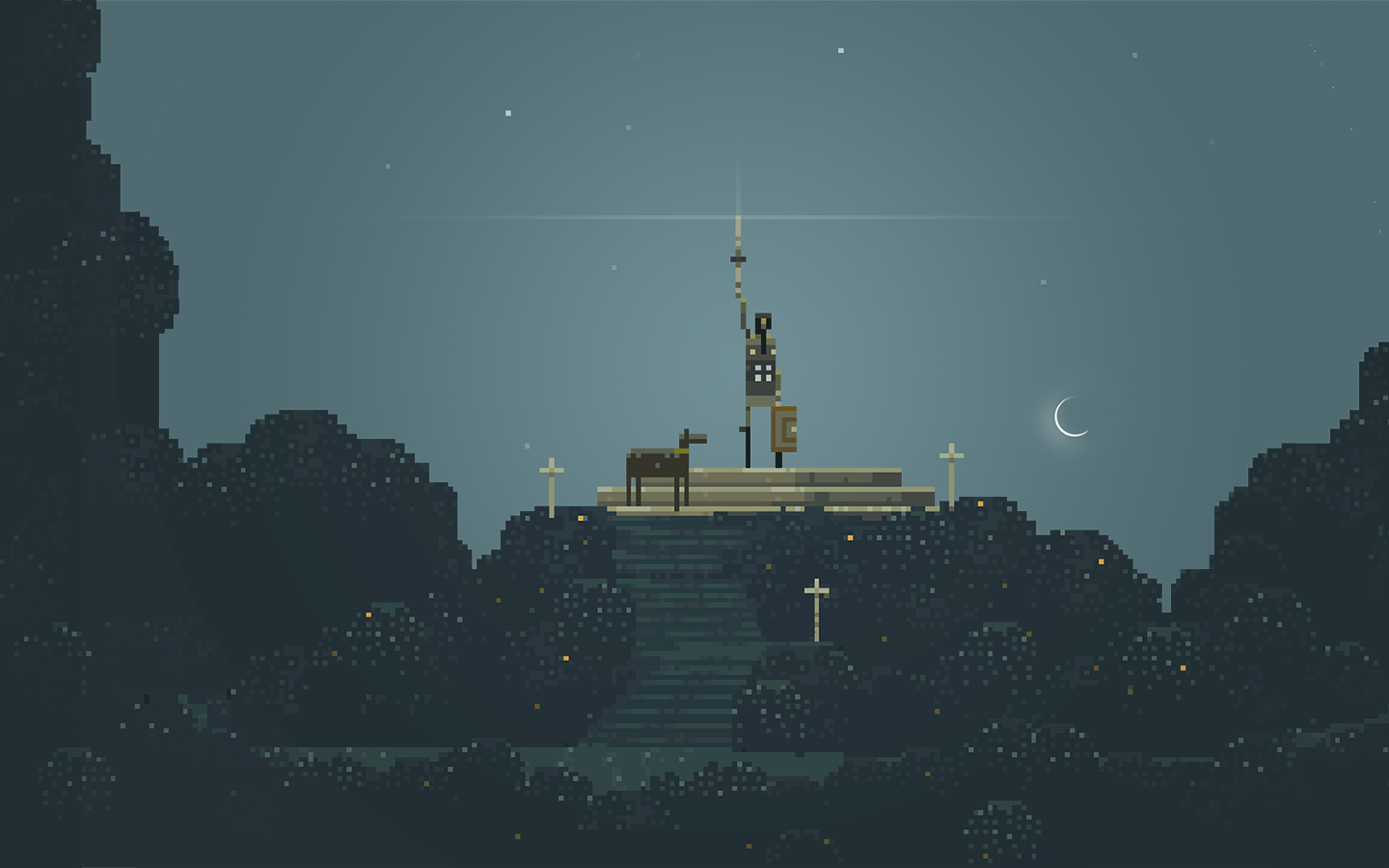
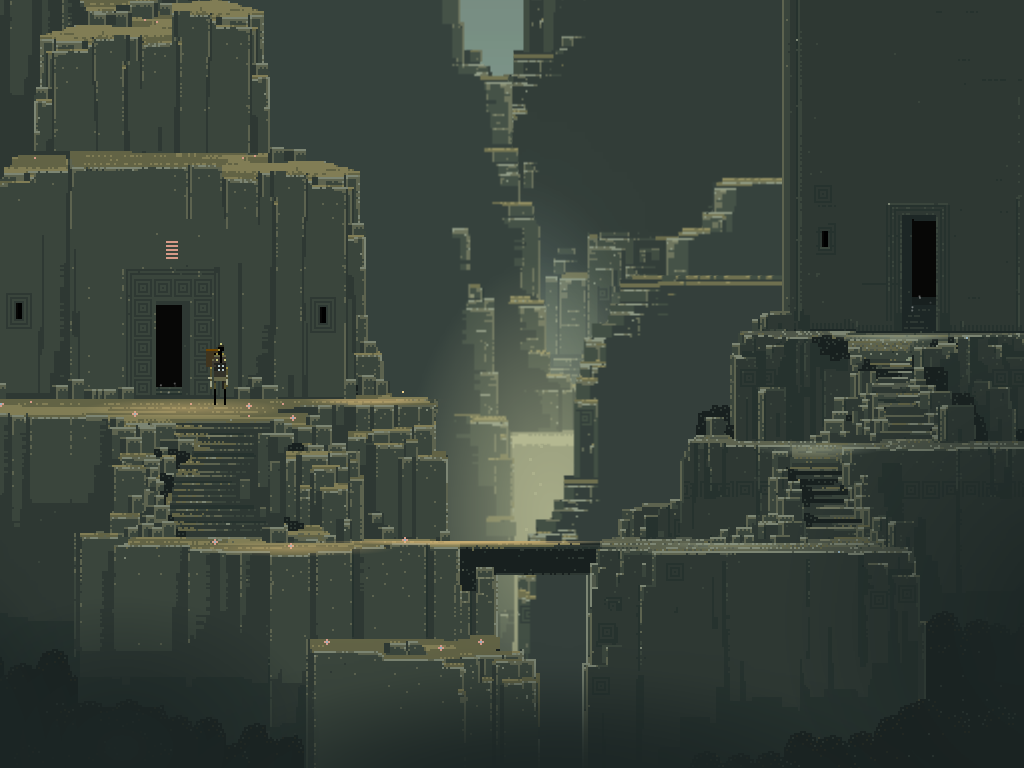
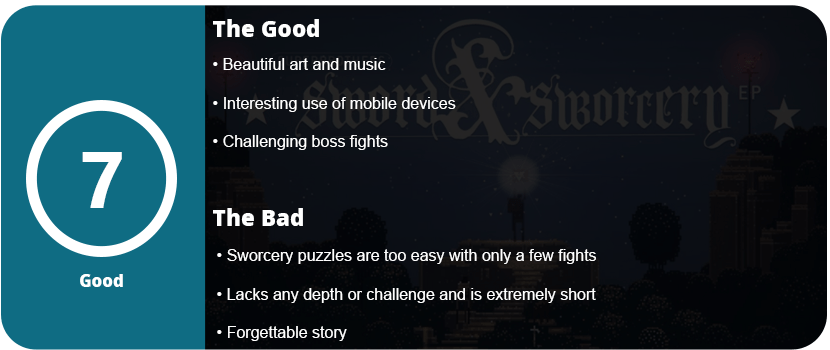
This game made a huge splash in the indie scene thanks to its rocking soundtrack and unique take on mobile games. I have to say that Superbrothers uses tablets and phones unlike any other mobile game out there. It is a breath of fresh air, but in the end, it is way too short and just leaves a feeling of emptiness, like there is no point in playing it.
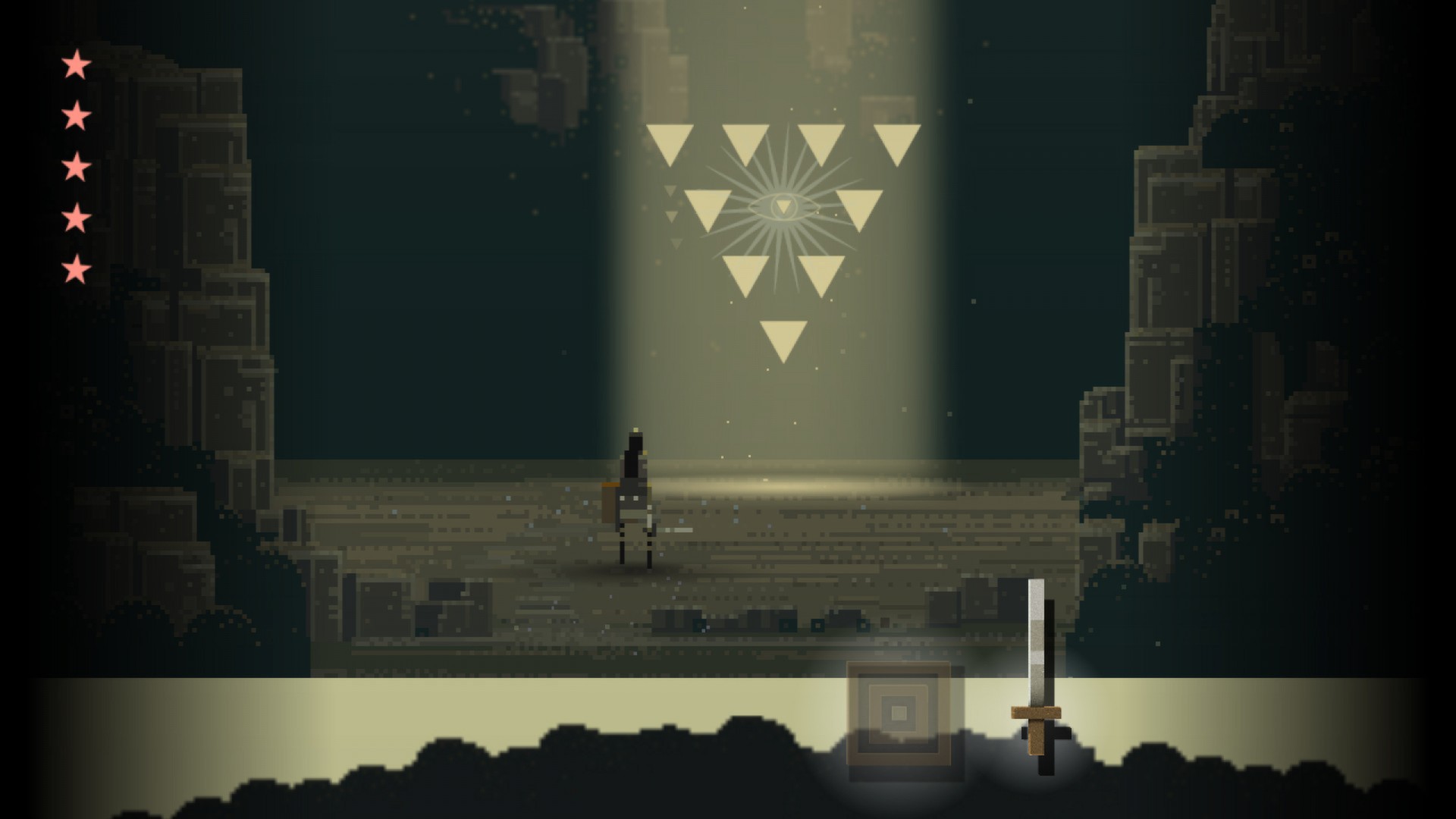
You play as a man or boy who is on a quest to destroy an evil being at the top of a mountain called Mingi Taw. You come across a magic tome and must find three triangles to make a trifecta. The story is pretty thin, and there really isn’t much of one there. It’s all about adventure, music, and unique art styles. You tap along this countryside during the first half, trying to find your way to a cliffside. After you play for a bit, you get a sword and shield and fight your first monster. If you turn your phone or tablet sideways to fight, you can block an attack, but it’s very simple and not very complicated. There are only a few fights in the entire game. The bulk of the game is made up of using your swoony powers to solve little puzzles, but these feel easy and slightly uninspired.
You hold down on your character to enter this mode. You then have to figure out what to tap in order to get the little sprite out of the ground. You need these to advance to the next stage. Sometimes things have to be tapped in order, but it’s not all that hard to figure out. One interesting concept is that you need to find two of these triangles during the bright and dark phases of the moon—in real-time. You will have to come back when the phases of the moon are just right, and the game will tell you when. Or you can just cheat and advance your calendar on your device. If you do this, the developers are on to you, and they only give you a 99% completion rating for cheating. This is a pretty interesting idea, as no other mobile game has done this, but it’s not very significant and feels like a cheap way to extend the game’s length.
The only challenging part of the game was the three major boss fights and figuring out where to go. There are almost no hints; sometimes I wandered around forever, not knowing what to do. The boss fights require precise reaction times for dodging and attacking and can get pretty tough. You can beat the game in a few short hours if you cheat, but when I finished the game, there was no attachment. The characters are just there, and there’s not much of a story to get attached to. The music is great, but only during certain scenes or events. I honestly just feel this game is really overrated; it’s good, but not that good. I personally loved the 8-bit retro art style, and it’s beautifully done. I just wish there was better gameplay to go with it.
In the end, this is just an odd game that you play for the hell of it. It’s a unique mobile game, yet everything in it feels unnecessary, and in the end, you wonder why you played it. There’s nothing here that will keep you talking about it years later; it’s really short and lacks any challenge or depth. I just like that it took a different approach to game design, and that is greatly respected.
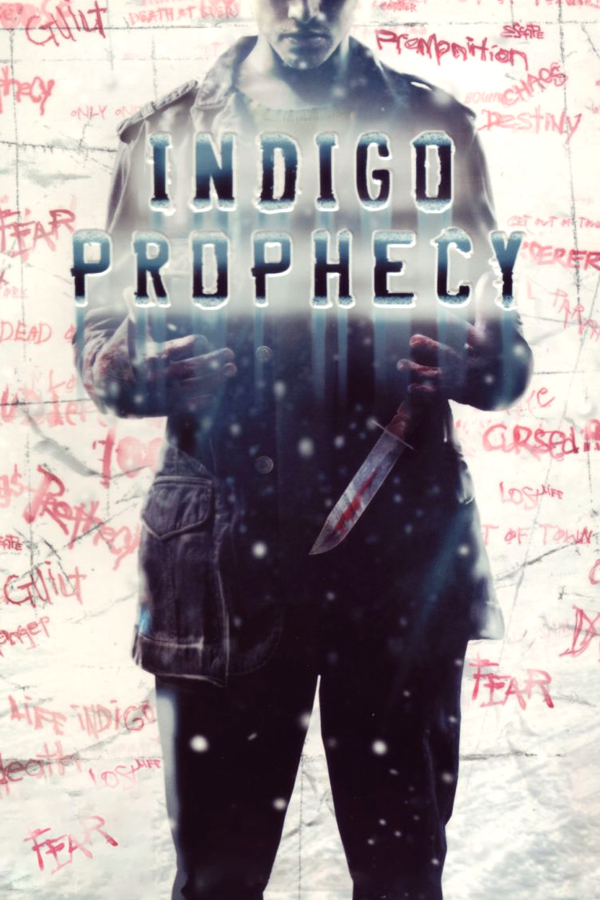
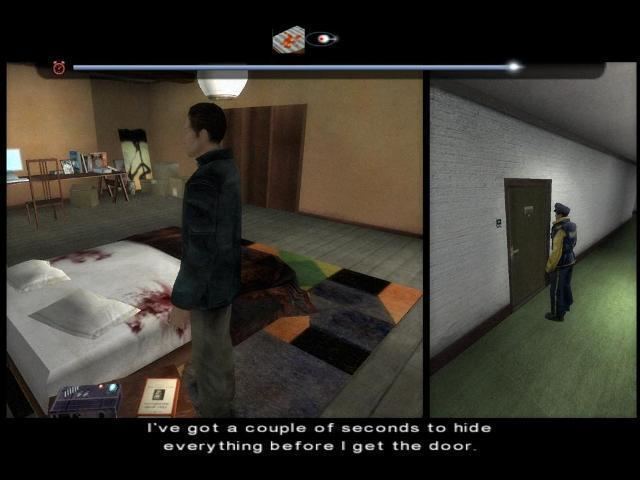
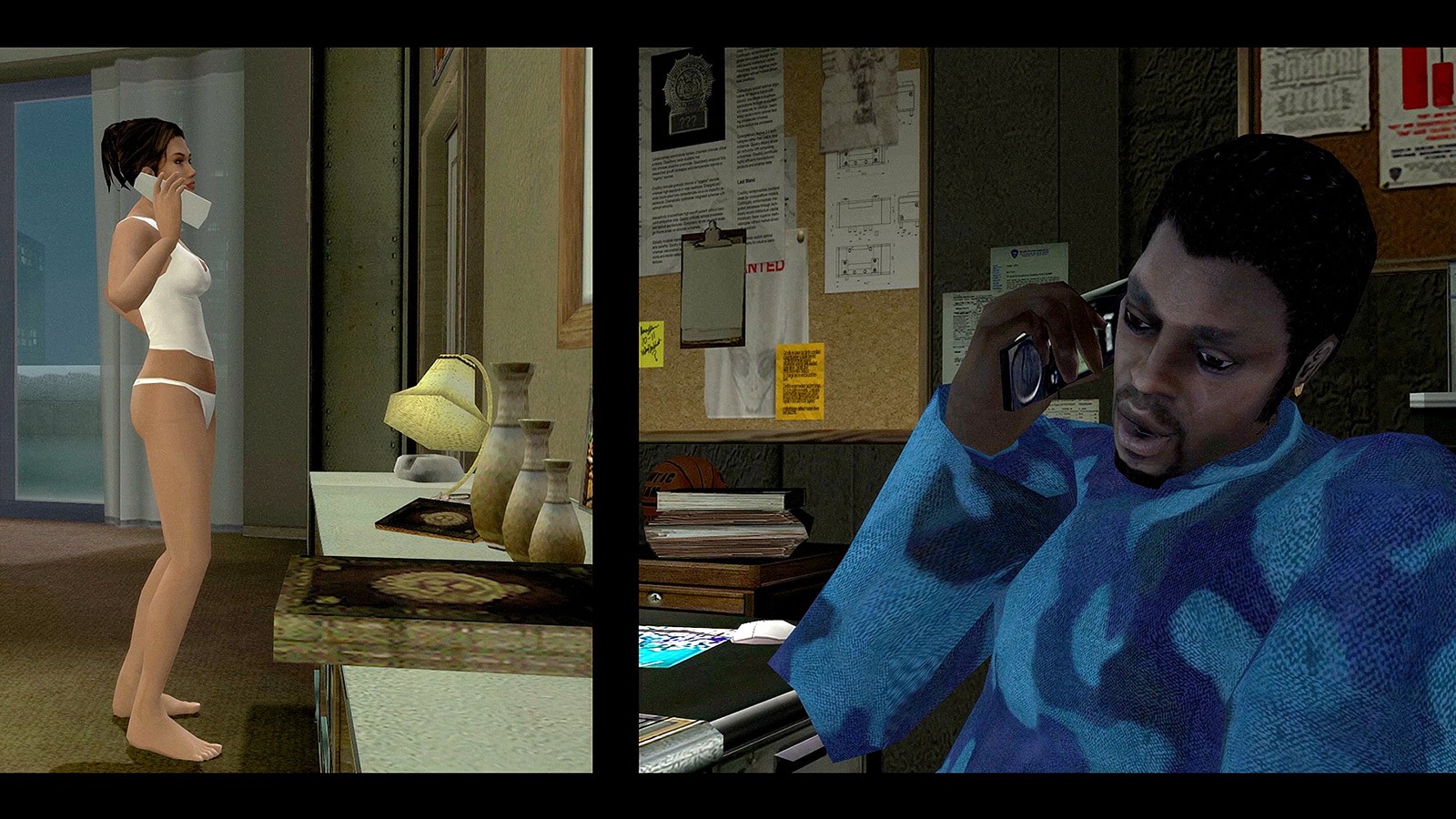
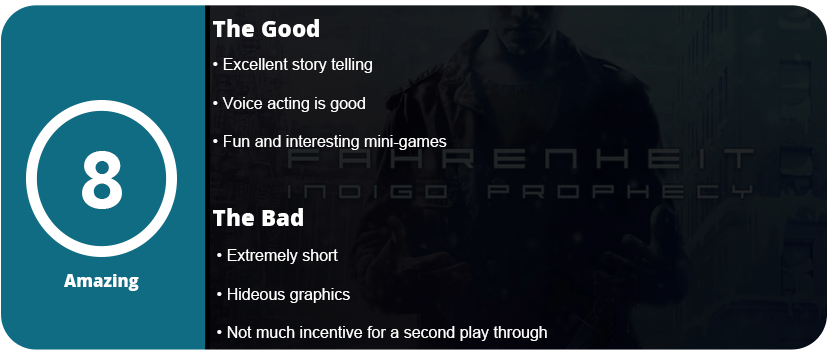
Games these days lack much of a story, and thankfully Indigo Prophecy takes up some of that slack. About 80% of Indigo Prophecy is just storytelling with excellent voice acting. The majority of the game has you walking around places looking for clues to solve simple puzzles. This is done with the thumbstick moving, so it makes you feel like you’re “really picking objects up.” A good example is when you have to sit down: you just push the right thumbstick down (an icon will appear on the top of the screen to show what you are going to do and what move to make). The other half of the game is made up of mini-games with the timed thumb stick moving (think of Simon Says) and L+R alternations. Yeah, it doesn’t sound exciting, but it really works, and these ideas are implemented well with the ideas attached to them.
On the story side, it’s very complex and well-executed. You play Lucas Kane, who is convicted of a murder he didn’t commit. You play as the two cops investigating the crime as well. The whole purpose of the game is the idea of playing chess against yourself. You can decide how the game is played out, and actions you take early on will affect things later on. You really notice this too, because later on, you’ll say, “Oh man, I shouldn’t have done that earlier!” The game’s pace flows smoothly, and everything eventually comes together.
Between each scene in the game, you can choose which character you’ll play next, and this also determines the outcome. Some parts are also timed, so you have a certain amount of time to hide, collect, and hide evidence. If you miss one piece of evidence and someone comes to ask you questions, they’ll see it and get suspicious. This, in turn, raises their suspicion meter, and you must make the right choices so you don’t get busted. You also have a mental health gauge that lets you know how your character is feeling. Your choices will determine whether or not they become happier or more and more depressed, leaning toward suicide. You can do things like go to the bathroom, drink something, or even just make the right choice in a conversation to raise or lower this gauge. This plays a key role in certain scenes because some choices will completely drain your meter, so you end up turning yourself in. The game is constantly changing from Lucas’ childhood flashbacks, and the three separate characters keep things interesting.
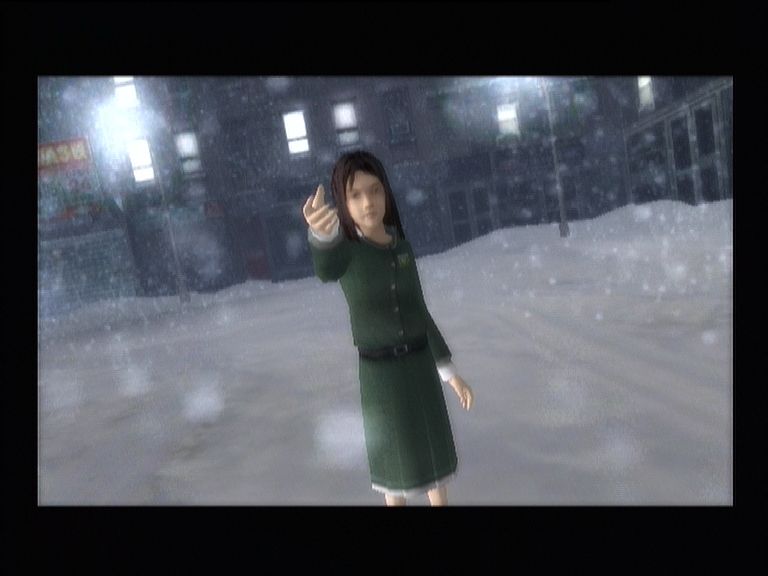
Thankfully, you can beat the game in about 6–8 hours, so you won’t get too bored with these concepts. For a short time, they work well and will keep you hooked until the very end. The great storytelling and excellent voice acting keep you hooked. Now, a huge downside is that the game is hideous. The animations are stiff, and the textures are flat, dull, muddy, and just downright ugly. The game looks like a PS2 launch title; that’s how bad it looks. I played the PS2 version back when it came out, and that version had some slowdown, but the Xbox version is just as ugly. There are some extras here, such as making videos, galleries, and a soundtrack (which is really good). You can unlock these by finding bonus cards in the game, but don’t worry—one playthrough and you’ll get more points than you need to unlock everything. I highly suggest IP if you really want a good story. I also suggest picking this up at a game store because you can get it for less than $10 now!!! Xbox Originals charges you $15, so be warned!!
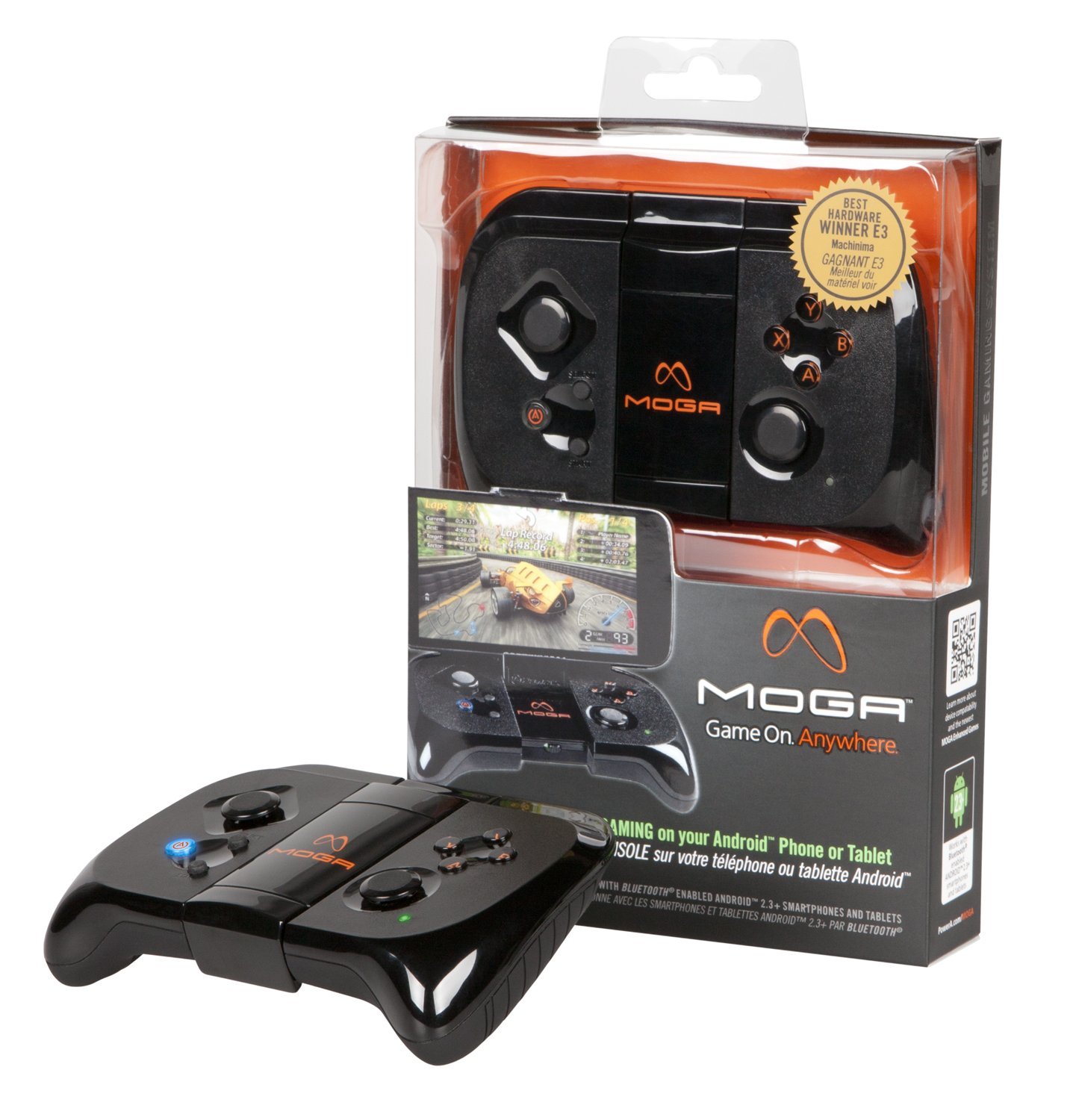
Now that gaming on tablets and phones is becoming more serious and popular, companies are coming out with dedicated controllers for your devices. PowerA was one of the first ones out of the gate with their Moga series of controllers. This is the mobile version that holds your phone while you play. It’s Bluetooth, so there are no cords tethered to your device. The controller is very well designed and sturdy; it doesn’t feel cheap at all.
I love the ergonomics of this controller. The middle of the controller has a flip-up phone holder. It can hold up to 6″ phones, so everything up to the Samsung Note II. The top and bottom of the clip have rubber grips so your phone doesn’t slip out, and it keeps it from getting scratched. Getting the controller to connect is a breeze. The initial setup is done with the Moga Pivot app, which also scans your device for games that can be played with the controller. You can also navigate and launch these apps with the controller. The controller sits well in your hands and is powered by 2 AA batteries, each housed on either side of the controller. PowerA went for minimalism with this controller, and they nailed it.
The only issue with the controller is that it feels too rigid. The buttons aren’t very soft and make a loud clicking sound. The thumbstick nubs are a bit stiff, and there’s no D-pad. I like the L and R triggers, which feel great for shooting games and racing. I wish the controller had analog sticks rather than nubs. It’s really hard to adjust to these in a shooter; I had to turn the sensitivity way down in the game to make it feel somewhat normal. The controller is also lacking bumpers, which could have fit just fine. So there’s a bit of a learning curve with this controller.
At least it comes with two free games: Pac-Man and Sonic CD. It also includes a really nice leather case to hold your controller in. The biggest issue of all is that there aren’t many games that support this thing. There is a free universal driver app to use in emulators, which is probably the main reason why someone would buy this. I was able to play a GBA, SNES, PS1, and Genesis emulator with no issues. Other than this, this is well worth the $40 for anyone looking for a controller without having to buy special cables, root, or buy expensive apps.
The Android family is growing exponentially and feels like a train hurtling down the track at 200 MPH with no stop in sight. The whole platform has grown in just a couple of short years with a quality market (and market storefront), more quality apps, and games, and now the addition of books and movies just makes the Android market feel like something to compete with the App Store. The devices are also really utilizing the system, and thanks to Google allowing open resource development of the platform, we get some really great apps and features on the phone that the iPhone, Blackberry, and other phones just can’t do.
Out of the Box
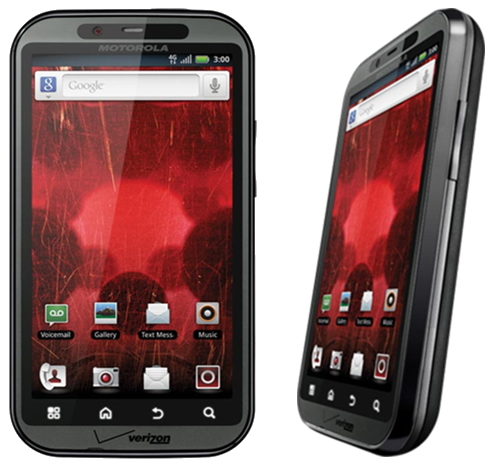
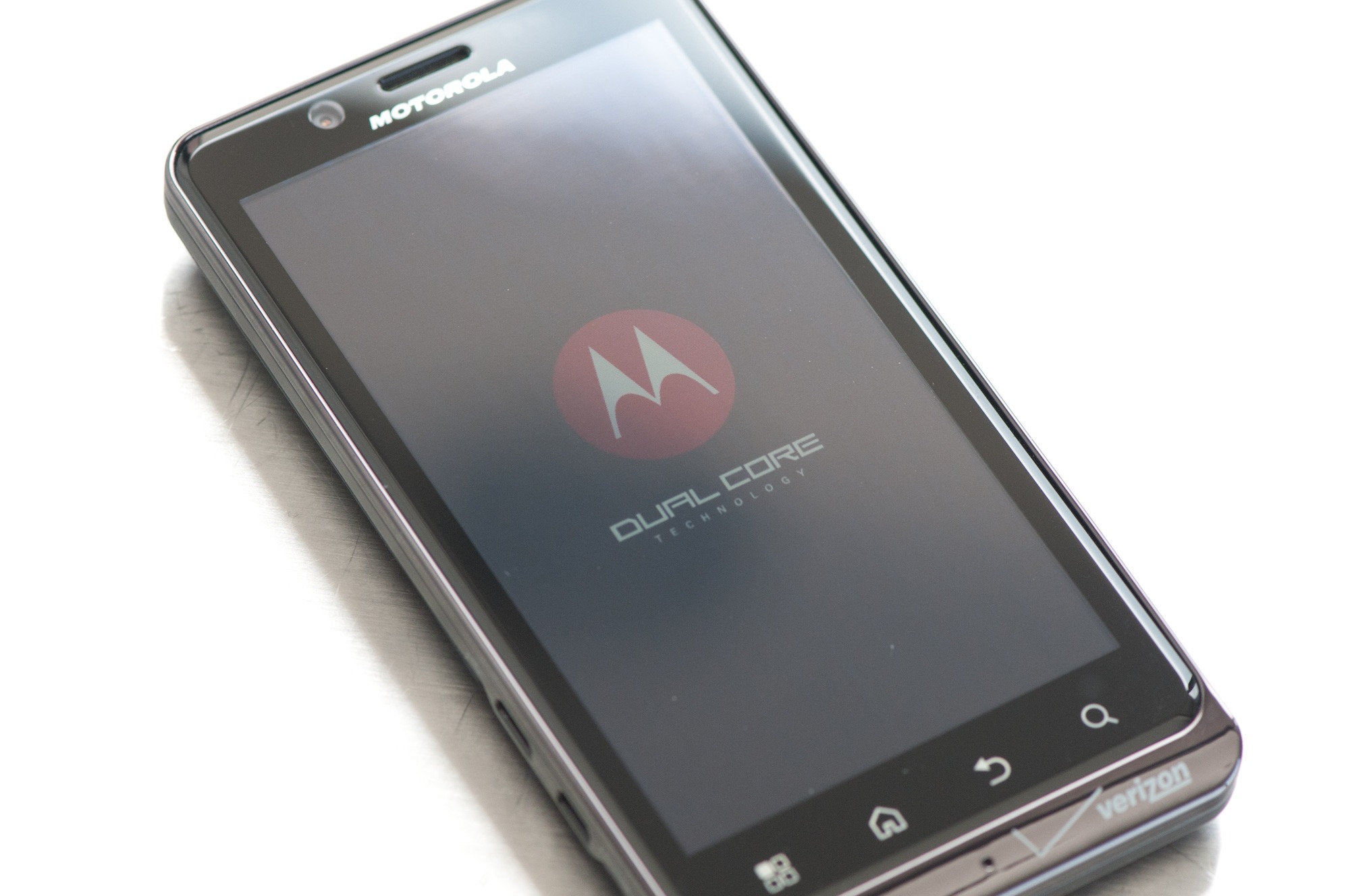
The Bionic has a great-looking box, but there’s not much beyond that. It comes with the standard battery, charger, USB cable, and 16GB micro SD card (cha-ching!) (I’ll cry if a phone comes with a car charger.) The phone came with a SIM card, which is new to Verizon and Droid phones. This is a 4G SIM card and is needed to activate 4G. When you boot it up, you can act like normal, but there’s one feature that was enabled on my phone that kept me on the phone with Verizon for over an hour until I scoured the internet myself. A certain little voice privacy feature was enabled that keeps your 3/4G off and, for some reason, was also enabled on my old Droid. Thankfully, disabling this turned my 3G back on, but that wasn’t really a problem with the phone itself. Once that’s all done, you’ll notice how fast the phone boots up (there’s even a neat Droid Bionic logo animation and sound!). Transformers anyone?) So let’s go over some of the hardware features.
Hardware Features
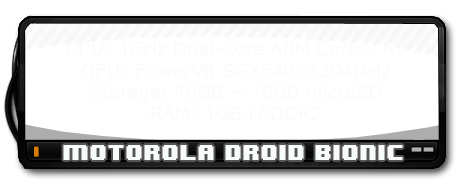
The first thing you’ll notice is that the speed of the phone is as fast as a computer. That’s the 1 GHz dual-core processor running everything for you at lightning speed. Why dual-core? Everything is just twice as fast and lets you multitask like never before without any type of slowdown or lag that you might even get on single-core 1Ghz phones. Compared to the iPhone 4S, it’s actually faster with an ARM Cortex-A9 processor. Yes, the iPhone 4S does have the same processor type, but it’s under-clocked at 800 MHz per core, so you’re losing about 25% speed over the Bionic unless you jailbreak your iPhone and overclock the processor.
The GPU is also slightly faster than both the iPhone 4 and 4S (they both have the same GPU) with a PowerVR SGX540 at 304 MHz, while the new iPhones both have an SGX535 model. The Bionic has faster and more memory with 1 GHz DDR2 memory, which is as fast as a computer, while both iPhones still use eDRAM and only have 512 MB. This means extra speed, faster app switching, and the ability to have more apps open without suffering from slowdown, lag, or crashes.
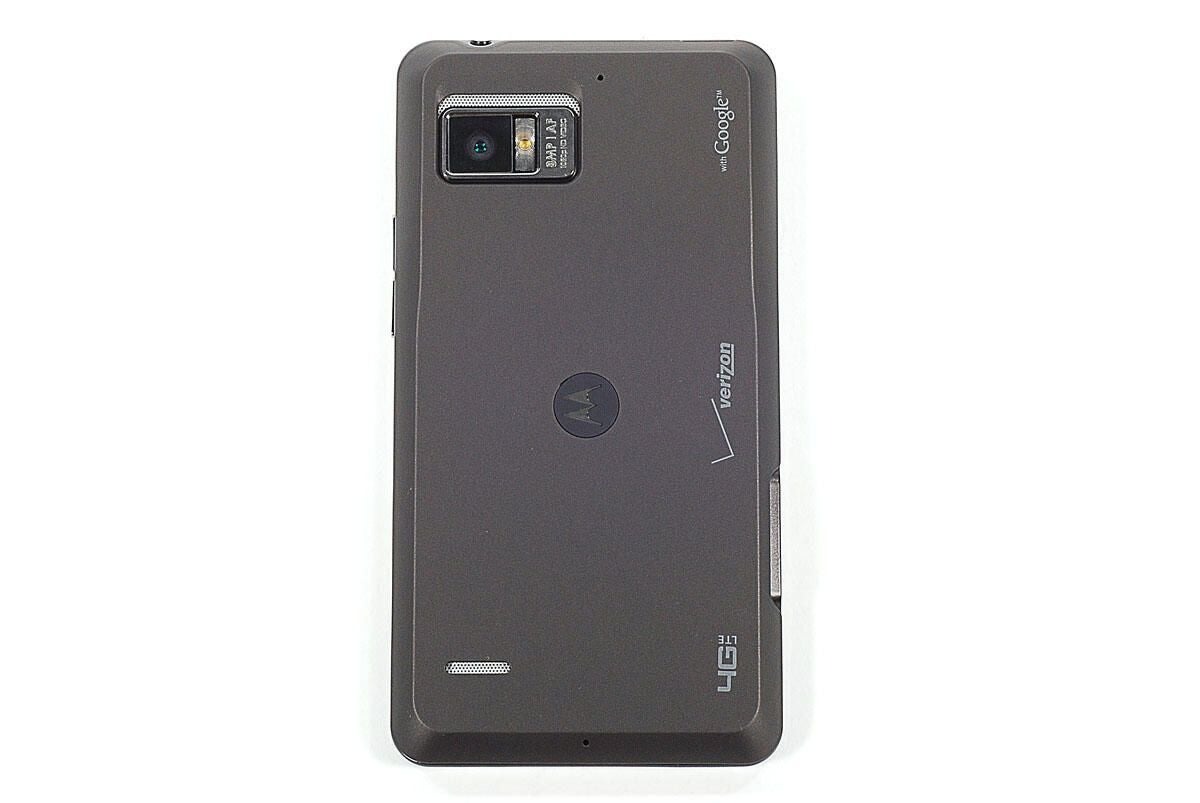
The Bionic also has 8GB of internal memory with the option of SD cards (up to 32GB), so with the standard model, you get 22GB of memory (maximum 40GB), while the iPhones are stuck with just the internal memory and you have to pay huge dollars for more space. The camera is about on par with the 4S with 8MP and 1080p support that lets you take panoramic photos, super high-quality video, and photos, and has an excellent flash. The front-facing camera is just 1.3 MP for video calling.
The only thing that the iPhone really trumps the Bionic on are the displays. The iPhones have 960×640 resolutions with 326 ppi, and the Bionic has 960×540 resolutions with 266 ppi. It’s not much, but it does make a difference when you compare the two. The Bionic does have a huge 4.3″ screen, which stomps on the iPhone’s 3.5″ screen, and is a true qHD screen (true 16:9 ratio), which is perfect for watching movies. The Bionic also has a mini-HDMI port for connecting to your TV, and even other high-end phones don’t have this yet. The Bionic has a higher contrast ratio of 800:1, while the iPhones have 800:1. This means it can display more colors and resemble more of an HDTV than a phone display.
Software Features
When you start using the phone, you will see it has so many great features over old Android phones, the iPhone, and Blackberry. First off, let’s talk about data management and sharing. The phone now comes with a file manager, so you can transfer files from your internal storage to your SD card as well as connect to your computer wirelessly and share files. The phone also supports DLNA, which can sync your media via Wi-Fi and upload media to your computer. The phone also gives a few options when you connect to your computer via USB. Instead of just the mass storage device option, you get a PC Mode that allows you to connect via a Motorola laptop or installs the MotoHelper driver on your PC and lets you access the SD card and internal storage. The software will also show any missed calls, texts, etc., which is a nice touch.
There are some nice pre-installed apps, such as the built-in camera apps, which give you a good range of options for video and photos; you now have a download manager; and MotoPrint, which allows you to connect to a wireless printer via W-Fi. There’s also a task manager, which is very useful to kill stubborn (read: poorly programmed) apps that won’t close. It also has an auto-kill list for when the screen goes out for 2 minutes. This helps preserve battery life (you’ll need it), but the phone does a good job of doing this on its own. You can turn the phone into a mobile hotspot (remember, it’s extra per month for this feature), plus all the standard apps like the task scheduler, calculator, and alarm are nice.
The market has a great storefront and has tons of quality games, apps, books, and movies now. The market just allows you to really make the phone your own, reflects your personality, and gives you so many options. The phone really has just so many great features built-in that make things so much easier for transferring data and media, as well as using the cameras and all the nifty hardware.
One thing I have to mention is that the games run smoothly on this phone. Using the PlayStation and SNES emulators, I can get games to run at 400 FPS with all the quality options enabled. All the high-end 3D games run without a hitch, and you will be unstoppable game-wise, especially if you can switch from a hardware-hungry emulator to the browser to check an FAQ, switch back, answer a call, or text someone, all without any slowdown and with all those running in the background.
When it comes to the basic phone features, it sounds great; the speakers sound sweet; calls are clear; and typing on the keyboard is easy with the huge screen. You won’t miss a pull-out keyboard with this phone.
It’s Not Perfect
The phone isn’t perfect; however, the battery is probably the biggest issue with this monster sucking it dry within a few hours. Sure, you can use battery-saving apps, and the phone has a built-in battery saver, but if you surf the net a lot or play games all the time, have a charger with you at all times. There also seems to be an issue with mobile networking, because it fades in and out a lot. I’m not sure if that’s my area or the phone itself. While 4G LTE is lightning fast (there’s a world of difference in speed), it’s only available in a few areas (mainly big cities), so I don’t even get it in my area. By 2013, Verizon said the whole country would get it, so we’ll have to see. There also isn’t a camera button on the phone, and a lot of people are used to this. The volume and power buttons are also really small and sometimes hard to press when you’re not looking. Other than that, this is an amazing phone and should be bought by every Android lover!
Update (6/17/13)
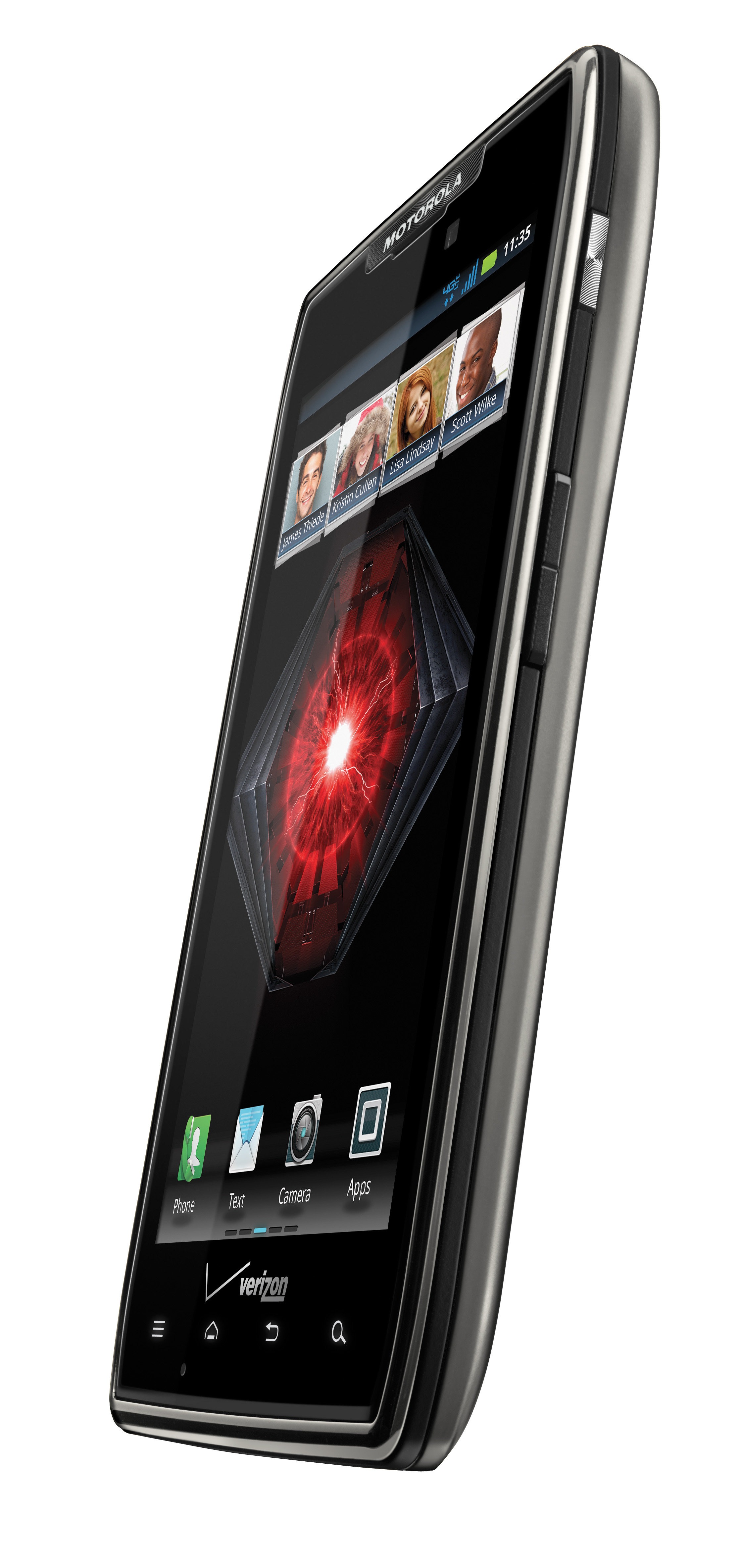
Now that I have had this phone for a full 2 years, I hate the thing. I have the same problem I did with the original Droid. I went through two years of crappy firmware updates, 4G constantly dropping out, sluggish, unresponsive everything, but at least the battery issue got fixed, but it took an entire year. I don’t know what happens with Motorola phones, but after 6 months, they just tank on you. I tried resetting the phone to factory defaults and replacing the phone, but neither worked. It would sometimes take minutes for a browser to load, and typing would be delayed up to 10 seconds, and it was frustrating and annoying. It also doesn’t help that the phone is huge and heavy compared to phones that are out now. It finally got the 4.2.2 Jellybean update about 3 months ago, but it runs worse on that OS than the 2.3 it came with. I will never buy a Motorola phone again. Sometimes the language would change randomly, but at least it didn’t reboot on its own like my last phone. While the Bionic is discontinued now and has been replaced by the Droid Razer and Razer Maxx, I feel mad about Motorola abandoning their Bionic users. The phone was the last to get the 4.0 ICS update, and even that had bugs of its own. Just don’t ever buy a Motorola phone; they are all the same.
Apple finally met its match; the Samsung Galaxy S III has sold more units than the iPhone 4 and 4S combined. That’s a serious feat. Why do you ask? Because Android OS gives you complete freedom to do what you want, not what Samsung wants. There is no iTunes that you are tethered to; you can put what you want on your phone; you can buy expandable media; the choice is yours. People loved that, and the S3 took off due to the form factor and Samsung’s smart marketing ideas. With the S4, Samsung has created the most powerful smartphone on the planet. Honestly, I won’t even compare the S4 to the iPhone 5 much because it is more powerful than that phone and the iPad 3.
Out of the Box
The box itself is actually pretty nice. It has a wood texture on it, letting you know you bought something classy, something with character—not a robot clone like the iPhone 5. Like wood, you can shape it and do what you want with it—make furniture, do some wood burning, or break it into pieces. Like wood, the S4 has endless customization options. The S4 comes with earbuds that are better than the iPhone earbuds, as well as three different earpieces for different size preferences. You will also have to put the battery in yourself, the back cover, and for some carriers, the 4G SIM card. Assembling your phone also lets you know that it’s yours; it’s not assembled in the box like an iPhone, and it gives you a bit more attachment to your phone. This sounds weird to some people, but it’s true; there’s a reason for all this.
Welcome to Android
For people who have used Android for a while (like me since 2.2), you will love the 4.2.2 Jellybean OS. Samsung’s personal touch is amazing, with many power-saving options, a great shutter menu, and the speed and precision of a high-end PC. Think I’m kidding? There is virtually zero lag even with multiple apps open, but that’s not the first thing you will notice.
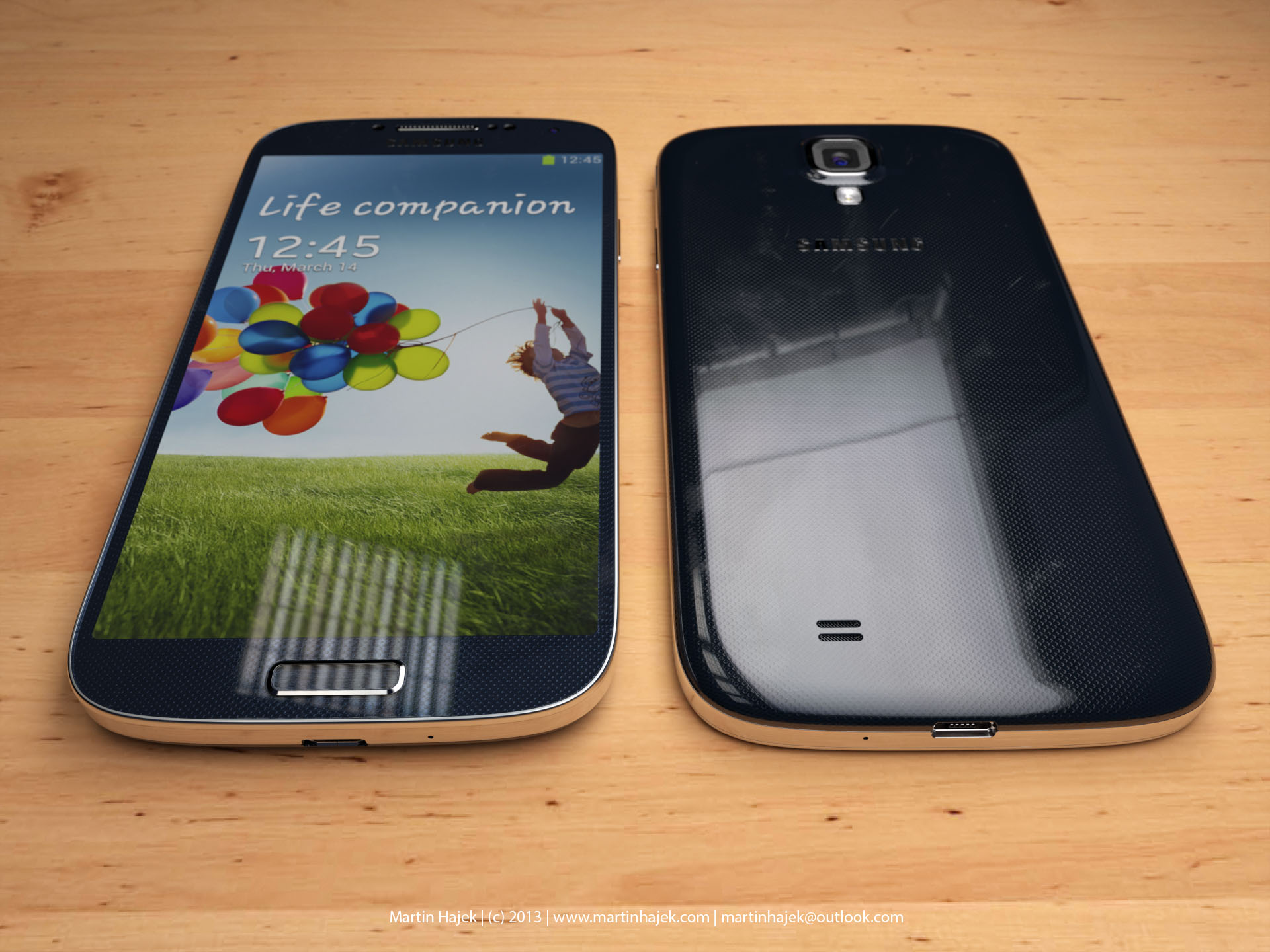
The phone itself is the thinnest and sleekest phone around. Especially for the power under the hood. The 5″ Super AMOLED display is gorgeous and rivals that of high-end HDTVs. It has a 1920×1080 resolution; that’s a full 1080p resolution, which is the same quality as a TV. The screen is also 441 PPI, which is twice that of most other high-end phones. You are looking at pure, eye-catching, crisp visuals for movies, games, and photos. Nothing out there beats it. It also feels great; it’s a perfect rectangle with rounded edges. It has aluminum sides to make it look modern, and it also comes in black and white. I prefer the black because it looks sleeker, and the white makes it look like a stretched-out iPhone 4S. The volume rocker is very thin and blends in with the phone, and the same goes with the power button. The S4 has a home button like the iPhone and is unlike most other Android phones. It has a menu and back soft key, but no search soft key like other phones. I found this simple, and honestly, it looks like a better iPhone.
Under the Hood
For people who care or don’t care, the S4 is one of the most powerful phones on the market. It has a 1.9 GHz (there are 1.6 and 1.4 GHz models available) quad-core Krait 300 CPU. That is damn fast, even faster than most high-end tablets. It sports an SGX PowerVR 544 GPU, which will let you play the best games out there but is also extremely fast, and current games don’t quite push it to its limits; it’s a tri-core GPU to boot. In fact, it’s just one up from the PlayStation Vita GPU, and everyone knows it can produce near-PS3-quality graphics. The S4 has 2GB of LPDDR3 RAM, which means tons of room for app switching, and you won’t have any slowdowns. You also get a 13 MP camera, yeah. It’s the same quality as a high-end point-and-shoot, and the quality is amazing. There is also a 2 MP front-facing camera, which is better than most phones’ 1.3 or 0.3 MP FFC. This allows extra precision when using the smart gestures later. The battery also has a Near Field Communications chip, which allows for NFC to beam to other devices. You can also mirror your screen on another device to show them something. The S4 also features DLNA file sharing for computers and other devices.
Air Gestures
With the combination of the gyroscope, front-facing camera, and smart screen, you can do things on your phone without even touching it. One feature lets you wave your hand in front of the screen to answer a call, hold the screen with two thumbs and use the gyroscope to look around your pictures, wave your hand in front of the screen to scroll pictures, and various other features. One other feature lets you hover your finger above an image to preview it before pressing it. Honestly, these features are gimmicks and nothing more than something to show off to the public. The biggest issue is that there is a serious battery drain. Keeping the FFC and smart screen features on just sucks your battery dry in a few short hours.
Smart Screen
A few features are here, including scrolling pages with the tilt of your head or tilting your screen. It doesn’t respond as well as you think and sucks your battery down. You can also use Smart Stay, which will turn the screen off when you look away, and Smart Pause, which will pause the video when you look away. This all keeps your FFC on and will drain your battery in no time as well.
The Little Things That Matter
In the end, there are little things that are there for customization. Multi-Window allows you to quickly switch apps with a drawer at the side of your screen. There’s a great power-saving mode that underclocks the CPU and can turn off haptic feedback as well as dial back the color resolution on the screen. You will need these because the battery does not last long in the S4 with everything turned on. There’s also a little feature that lets you make your own vibration patterns, which are really interesting. You can have widgets and shortcuts on your lock screen, which most phones need third-party apps for; you can control the phone with your voice; and you can unlock the screen with your voice. This may seem pointless to some people, but the fact that Samsung put it in here means they care about the consumer. They give you all these tools, and you can decide if you want them or not; they are not forced on you. One thing that I do need to mention is that there is a lot of bloatware on the phone that needs to be disabled. I disabled nearly 30 apps that I would never use and just used up space and resources.
In the end, the Galaxy S4 is one of the most customizable and powerful smartphones on the market, and I would go as far as to say THE most. I have never had a phone that gave me so much freedom, so much power, and such great picture quality. The biggest problems are with the battery and the gimmicky features that help drain that battery. The air gestures and smart screen are for lazy people or people who like to show off; it actually takes more effort to use these than to just use the screen. Despite this, the S4 gives you endless possibilities with the most powerful and efficient mobile OS on the market. You are a fool not to own this phone.
Marvel vs. Capcom is considered the official fighting game among Marvel fans. What about DC comics? There really hasn’t been a full-on fighting game except for the lukewarm Mortal Kombat vs. DC Universe. It felt a bit stiff; Mortal Kombat fans felt the violence was too watered down, and it just lacked some polish. The MK team has come back, minus Mortal Kombat, and created a very solid, full-on DC fighting game.
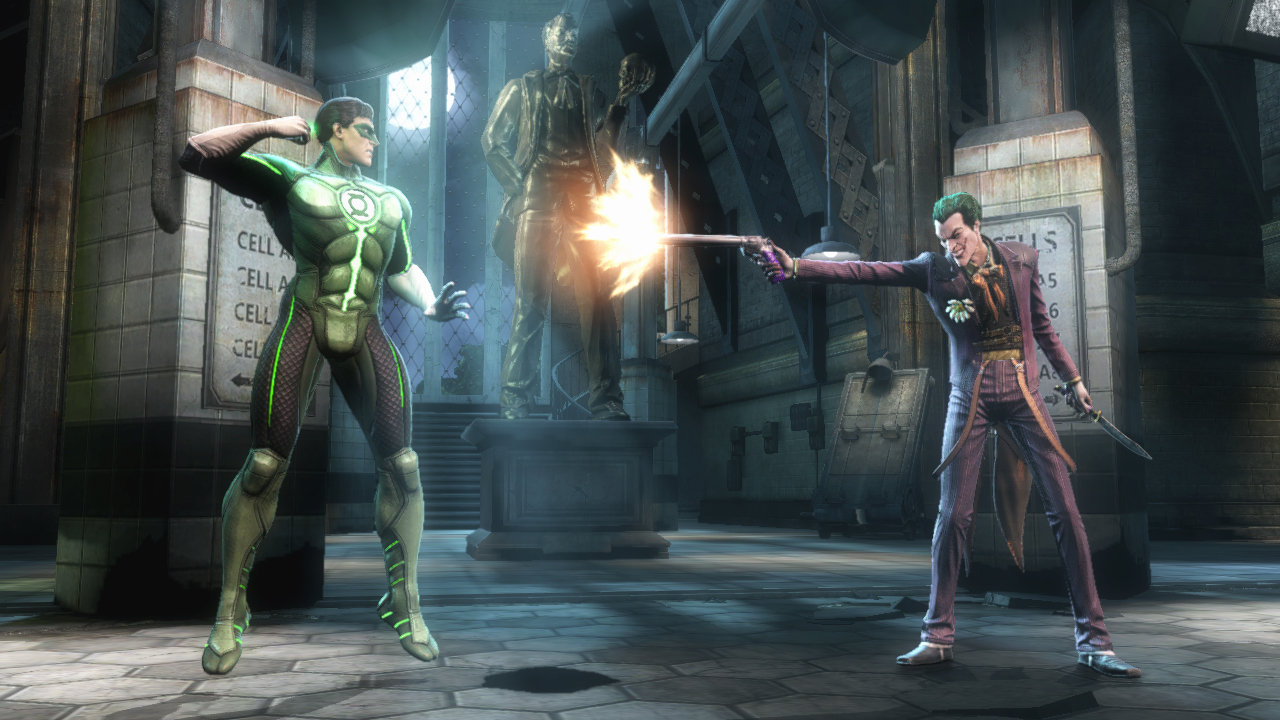
If you have played 2011’s Mortal Kombat reboot, you will be very familiar with this game. The 2D fighting plane remains with interactive environments, special moves, and various other things. The game plays a lot like Mortal Kombat, with several special moves and small combos at your disposal. You must combine all these to create larger combos; it’s tough and really takes some practice. Some characters are harder to play than others, but they are all fun to play in their own way. The interactive environments are very neat, and I hope more fighting games pick up on them. You can press R near different objects, and some are on offense while others are on defense. In Batman’s Bat Cave, you can press a giant red button to ignite the batmobile’s thrusters and burn your opponent. Some items can be picked up and thrown. Some levels have items at the very edges to help you escape and keep you from getting cornered.
The fighting engine is solid and responsive. Each character looks great and has an awesome arsenal of moves that are faithful to their comic origins. Each character has a special power-up they have that is executed with A. No longer are there four attack buttons, but three. Wonder Woman can use her power-up to switch between her sword and whip. Batman can shoot three batarangs, while some characters have defensive and passive power-ups. These have to recharge, of course, so they can’t be spammed. They are helpful and can give you a slight edge over your opponent. The power meter returns, like in Mortal Kombat, but is used for different things. Instead of the gory X-ray moves, you can unleash super-special attacks that look awesome. Some are a little less awesome than others, but they all take advantage of the power that each character wields. You can also use the Clash system, which allows you to wager part of your special meter once per battle for extra health. These are all tactical additions that can give you an edge and turn the tide of the battle, which a lot of fighting games don’t have.
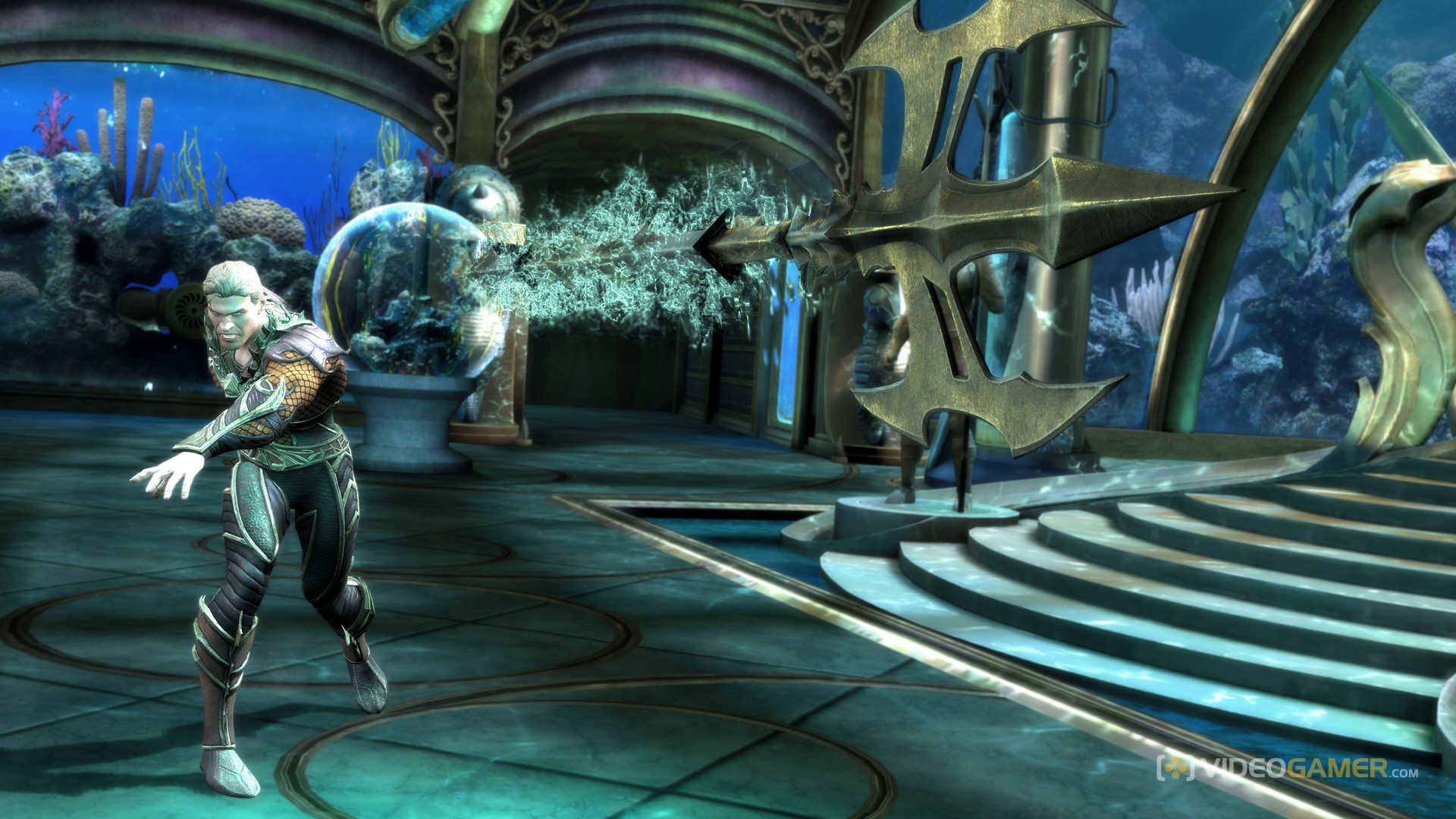
The fighting system takes a little while to get used to because it’s unlike anything else out there. It breaks the mold of traditional fighting games, which the genre desperately needs. Injustice has some of the best over-the-top action seen in a fighting game, thanks to the source material. Blood and gore are exchanged for comic book action, which you can’t get anywhere else. I also like how NetherRealm made Aquaman cool again. He looks awesome, and he’s one of my favorite fighters. He feels a lot like Jade from Mortal Kombat, where he whips his trident around a lot and is quick and jabby. I just wish they didn’t use so many obscure comic characters like Sinestro, Grundy, Black Adam, Raven, and various others. I also wish the roster was a bit bigger. At least it makes up for it in content elsewhere.
The first thing you will dive into is the story. Unlike Mortal Kombat, you won’t fight like every character in the game. I was also highly disappointed in the story because it’s just a pointless mess. Superman is tricked by the Joker to kill Lois Lane, and this causes some sort of rift, and everyone crosses dimensions. Superman, on the other hand, wants to take over the world and suppress everyone, so everyone is fighting their doppelgangers, which is kind of uninteresting. The plot is just a bunch of DC characters beating each other up, and it doesn’t really come to a head. I was glad that the story was as short as it was and was just over. It seems the story was kind of slapped together and wasn’t given much thought; DC fans will be highly disappointed in it.
After you finish that, you can go online or partake in the 240 S.T.A.R. Lab missions that are similar to the Challenge Tower in Mortal Kombat. Go to the Archives to unlock alternate costumes (not enough!), battle mutators, and concept art. This is similar to the Krypt in Mortal Kombat but doesn’t quite offer enough.
Overall, Injustice is a very solid fighter that tries to break the mold but offers a weak story mode, and the game just feels like it’s missing something. Is it because it feels so close to Mortal Kombat that everyone is expecting fatalities or something similar? Is it that the roster isn’t big enough? Too many lesser-known characters? I can’t really say, but I can’t quite place my finger on it either. What’s here is great, not to mention that the Wii U gamepad can be used to play the game off the TV or used as a display for special moves. The game does look good, with the Wii U getting higher resolution textures and some nicer lighting effects than the PS3 and 360 versions. The Wii U version is definitely the best of the three. With that said, there are dozens of hours of content here, and you will be playing for months.
Super Hexagon is a game where I can say it’s barely that; in fact, it’s a game you might quit in less than one minute. I don’t know what the designers were thinking, but this game is so hard that it becomes no fun in less than 5 minutes. You are just a triangle rotating around a circle, trying to find your way through gaps in a giant hexagon that closes in on you. I couldn’t get past 28 seconds of survival, and that was after I memorized every stage and died about 50 times.
That’s really all I can say about this game, because it’s hardly a game at all. The graphics are so simple, with just basic colors and shapes; the only praise I can give this game is the awesome 8-bit soundtrack. The game requires memorization and super-fast-twitch reflexes to win. It doesn’t help that there are only hard difficulties; there is nothing easy to start out with. It doesn’t help that the visuals will give you a headache in less than 10 minutes, and it just hurts your eyes. I like the fact that the game is trying to be challenging, but I’m glad I didn’t pay much for this game.
With that said, I really can’t recommend this to many people unless you are seriously hardcore, but the majority of players will uninstall it in less than 5 minutes. Why play a game that takes over 20 minutes of practice just to advance past the 30-second mark? I honestly don’t understand why this game was even made or what audience it was supposed to be for. I really can’t say much else about this game because there just isn’t anything there to say; it’s hardly a game as it is.

























































 thebinarymessiah.com
Try multiplayer. A lot of fun !