The idea of AI taking over the world is an intriguing subject, and it is becoming more and more of a reality with current deep-learning AIs. Ever since Isaac Asimov touched upon the thought of machines becoming closer to humans, we have thrust this into science fiction. The Enigma Machine does just this. The Enigma Machine tasks you with a simulation of entering a rogue AI’s “dreamscape” and finding the hidden code to terminate it. The story moves very fast as there are only four levels, and despite being able to type in pre-baked commands, I would have loved to see some hidden words give interesting results.
A level thrusts you into a first-person view with PS1-style graphics. You can interact with objects and sprint. That’s about it. Your goal is to find hidden codes in the level, either written down or audibly given. You must enter these codes in the correct order, as they are somewhat obscure. The levels are small, with only a couple of rooms. Upon reaching level three, the game requires you to combine all three codes in a specific sequence. The lighting is odd, and the textures warp and shift just like on the original PlayStation, but the game takes this a bit too far. The textures will stretch farther than they should, and the final level is a glitch fest of walls disappearing and textures overlapping each other. It can be an attack on the senses, but given the setting, it’s acceptable.
The story itself, which unfolds as text on the terminal, captivated me beyond the haunting sound effects and the suspense of not knowing what will happen next. Unfortunately, the short length of the story prevents us from learning more about the program and its AIs. You have the ability to type in words enclosed in brackets, and each time you re-enter the terminal, you receive additional information about each item, though the list is not extensive. I tried typing in random words, cuss words, and various other things, but the game doesn’t seem to have any hidden Easter eggs in that regard.
Even though the horror elements are minimal, the computer’s deception and the mystery surrounding your presence and participation in this simulation remain. The game’s four levels limit our learning opportunities, and the ending text largely explains the game’s mechanics. I did find some of the puzzles too obtuse to understand, such as the fact that there’s a hidden gun and you need to complete the last level. This is a game that puzzle enthusiasts will find enjoyable; however, it is not suitable for those who prefer pure horror or a game that revolves around terminal text.
Here we are 30 years later, and the series has literally made a full circle. Mortal Kombat is my favorite video game series, and it was the first game I ever played as a toddler on the Sega Genesis back in 1992/93. While this game is technically a reboot, it’s still a continuation of the overall timeline and a sequel to Mortal Kombat 11‘s story. You follow the cast of characters: Liu Kang and Kronika split time into multiple timelines. Liu Kang wanted to reset everything and create a timeline of peace, but somehow old enemies are returning, and he can’t explain why. I don’t want to spoil anything. Mortal Kombat still has the best story out of any fighting game to date, and this story is fantastic. There were a lot of twists and turns, and I was sad when it ended. The voice acting is fantastic, and many favorite characters return.
Clearly, Ed Boon and his team were reminiscing about the later 3D games, from Deadly Alliance to Armageddon, because there are a lot of references and characters returning from that era. Nitara, Ashrah, Darius, Shujinko, Sareena, and Havik are among those returning. These characters were one-offs who never made it into any other game, and it’s quite shocking to see these seemingly nobodies make a huge comeback. The only caveat is that they aren’t all playable. More on that later.
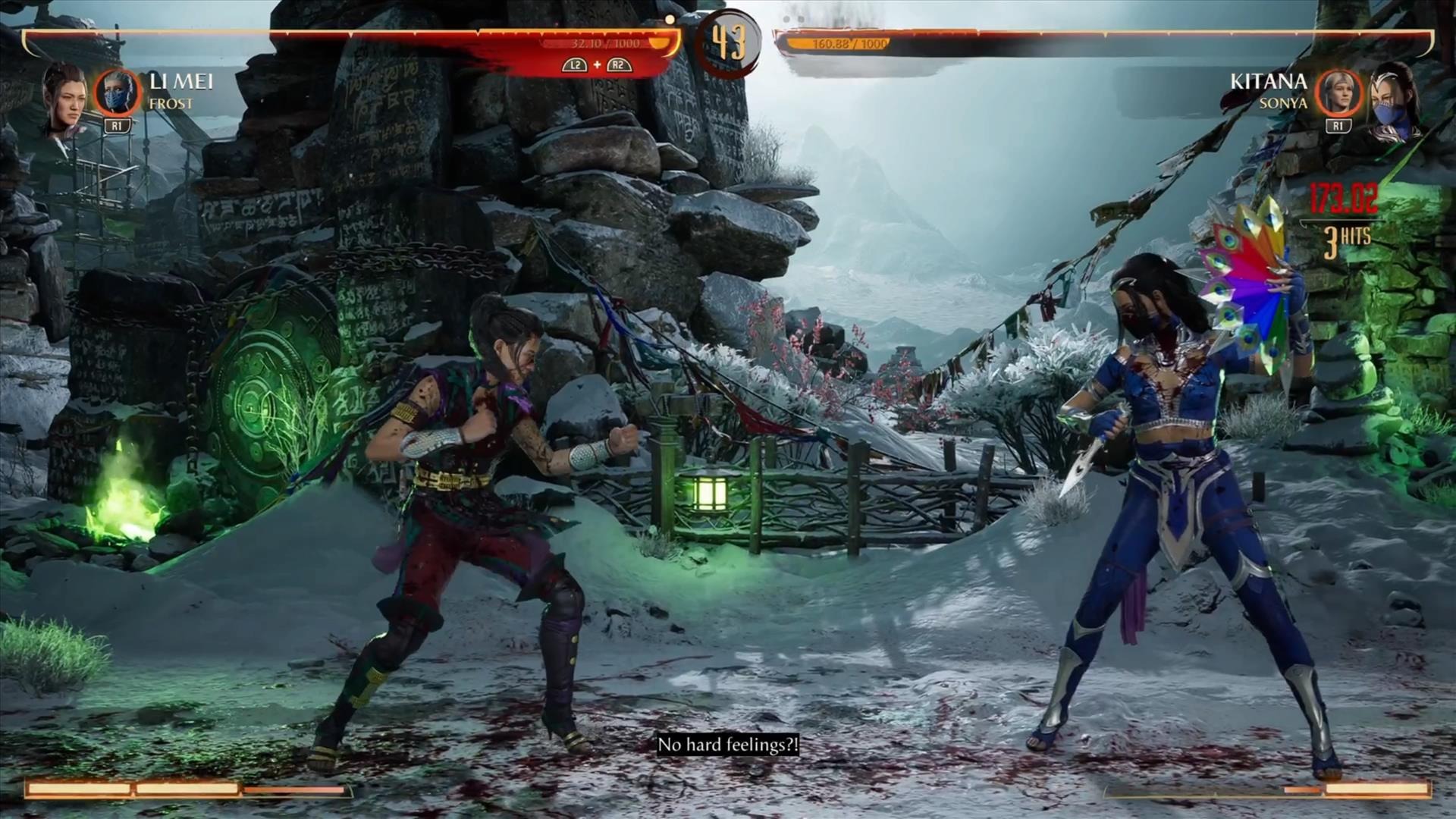
The story mode plays out the same as in MK9. You watch a cut scene, and it flows into a single fight. Not all characters are playable during the story, but you get rewards for every fight you win; more on the extra content later. I highly recommend completing the more advanced tutorials, followed by the challenges for learning specific characters. They have tweaked and refined the fight system to make it feel faster-paced and more reminiscent of the classic 2D Mortal Kombat games we all grew to love. Air combat has come back, and there is a higher emphasis on creating your own combos rather than relying on set combos already programmed into the game. There’s a lot more freedom in the fighting system.
Of course, there are more advanced systems in play, such as cancellations, interrupts, combo breakers, and the usual throws and final blows. The same tri-segmented special meter is back, allowing you to enhance your moves almost exclusively, just like before. After removing the shackles of pre-programmed combos that have been around since Deadly Alliance, you feel more in control, and the game is so crunchy, punchy, and fluid. The game’s animations and controls are incredibly smooth, enabling even the most advanced players to cancel and interrupt as they please.
Kameos is a new major gameplay feature. We had tag battles before in MK9, but these characters aren’t playable. Kameos have replaced environmental interactions. You can no longer throw someone into the background or grab things. Your health bar now features a Kameo meter, which you can summon twice before it requires charging. You can combo in and out of Kameo summons, as well as hold down the button to use more advanced moves. Throws and fatal blows now bind Kameos. Most fatal blows only have one or two X-ray shots rather than the usual three. They still look cool and are one of the best features to ever make it into a fighting game.
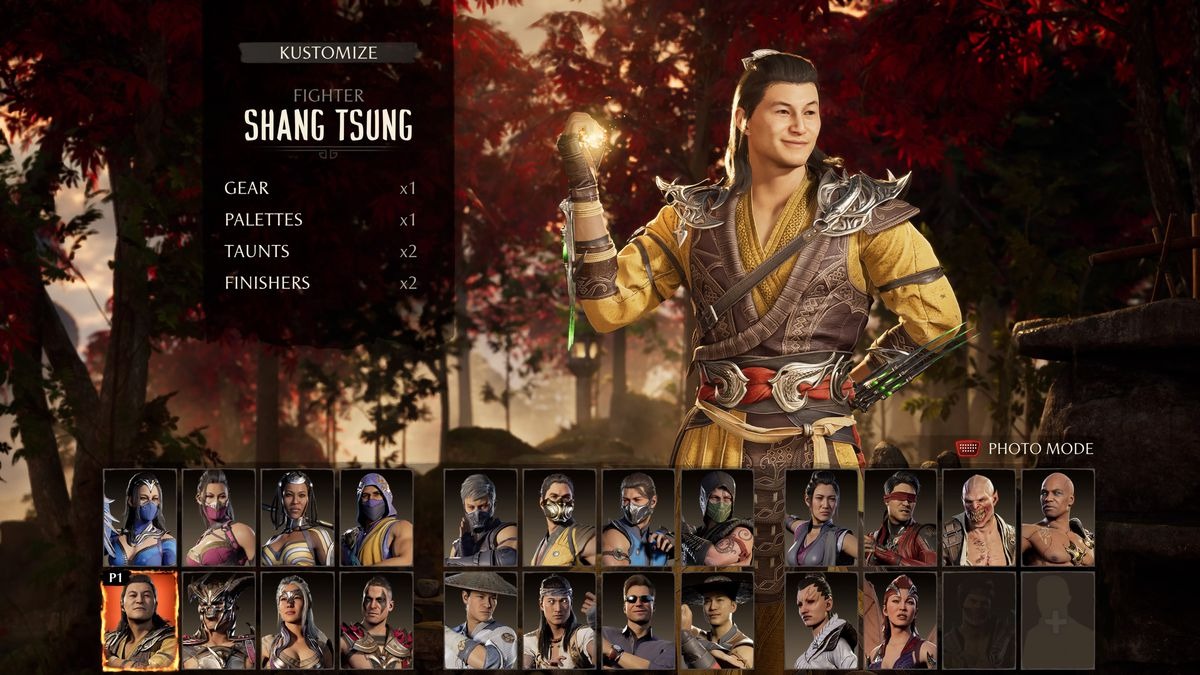
Mortal Kombat 1 is the first MK game in a very long time that actually lacks content. Gone are the multiple modes for replay value or experimental ideas. We only get a new Konquest-style mode that has you moving along a grid on various maps. Each tile has something on it, from a reward to a fight, but gaining Koins (there is only a single currency now) is a serious grind and feels worse than MK11‘s grind. Customizing characters is awesome, and the outfits here are much more varied than MK11‘s numerous pallet swaps. You can even personalize your Kameo fighters. Sadly, the new Konquest mode is sluggish, mostly boring, and resets with each new season. Yeah, MK1 has seasons now. Yikes.
I sadly have to admit that this might be the beginning of the franchise’s downfall. With a bigger emphasis on microtransactions (cosmetic only) and making the player grind into tedium for cosmetic items, the series is losing what made fans love it for so many years. The fight system itself is better than ever, with top-notch animations and a fantastic story mode, but this is short-lived. Online play increases replay value, but the costumes and unlocks are what MK fans love, and they’re being turned into something to profit off of. Though stunning, the images don’t quite erase the vinegary taste of greed.
I’m not the biggest fan of visual novels. Most visual novels, or VNs as the community likes to call them, either lack a compelling story or engaging characters, or they drag on for more than 30 hours without achieving anything. Mediterranea Inferno drew me in because of its visual style and advertised player choices that could shift the story. While this does exist, the story is incredibly basic, with some very elementary writing and characters that are as interesting as a wet napkin.
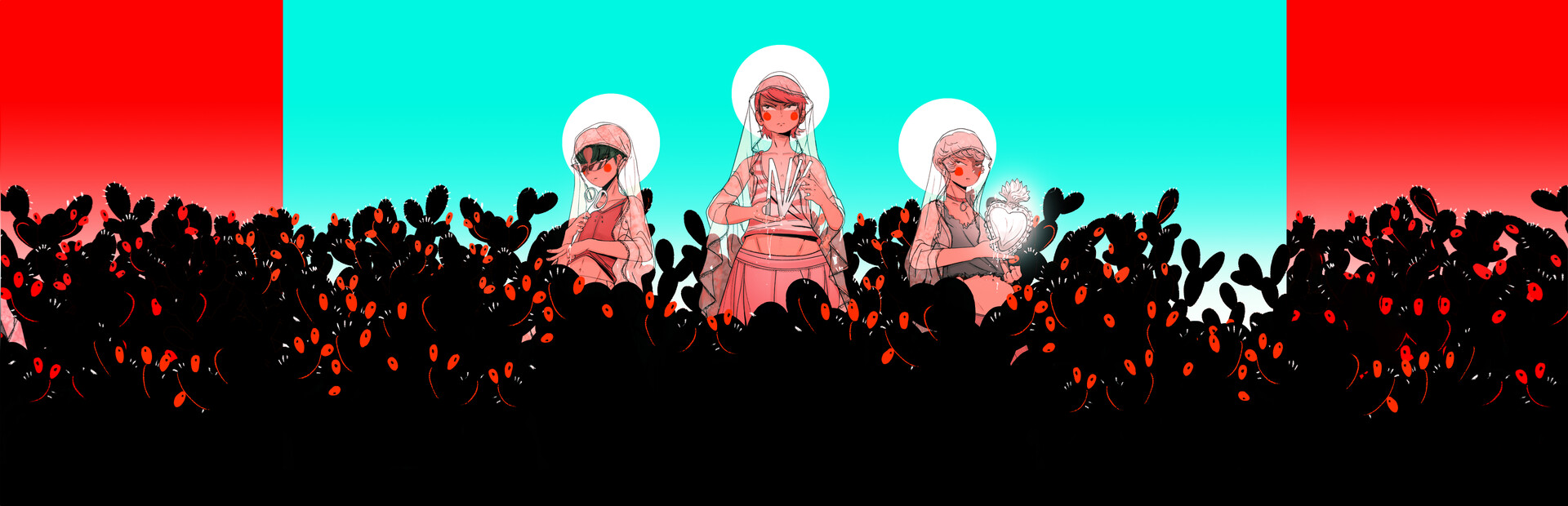
The game’s inclusion of queer culture may offend many people, but for individuals like me, it suggests that the story could feature some intriguing characters. The game takes place in modern-day Italy, amidst the COVID-19 pandemic (it’s mind-boggling to think we’ve built entire game stories around this pandemic), and depicts the disintegration of these three friends during that period. The overall story hints at how COVID broke friends apart and how the isolation and lockdowns made it difficult for all three of these men to maintain their social lifestyles.
This VN is very “slice-of-life,” with not much going on. The endings express no inner turmoil, and there is no gameplay. The choices you make during Mirages imply that the characters might be taking drugs at these moments. A mysterious character appears and offers a strange fruit that you can peel or turn down to alter the story a bit. You get coins to purchase these fruits by interacting with objects in the mirages. This game’s best ending for each character requires four tarot cards, but only one character can get them in one playthrough. There are three days and three nights to live through.
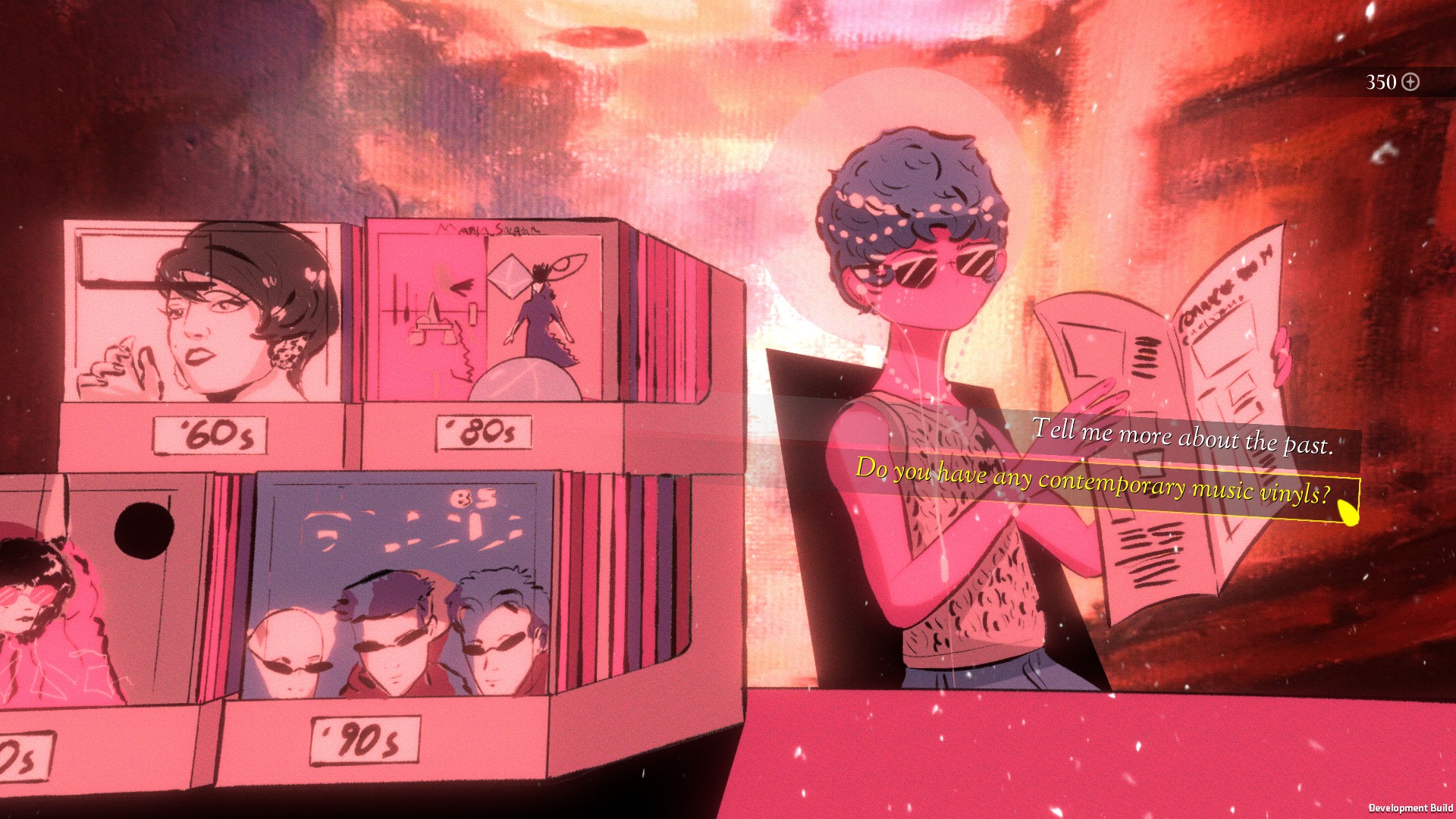
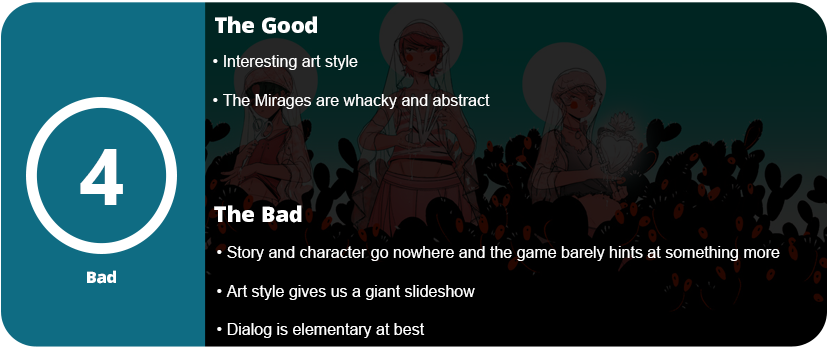
We learn a small amount of backstory for each of the three men here, but it’s mostly just dialog about complaining or what feels like random, boring daily conversations. I almost wanted to stop the game after the first day, but I kept going, hoping that there would be some crazy plot twist. Sadly, this never happened. I can’t spoil too much of the story (like it matters with how bad it is), but there’s not much here for anyone. Those who enjoy storytelling, queer gamers seeking a connection with LGBTQ+ characters, or anyone seeking a visually appealing game will not find it appealing. The art, while hand-drawn, just isn’t very appealing at all. The game is mostly just a giant slideshow, with an occasional low-poly 3D model thrown in for good measure.
By day three, I just didn’t know what to really expect anymore. The Mirages are weird, abstract, and poetic, but nothing means anything in this game. There’s no reason to care or keep moving. Early on in the game, there’s no hook to keep you in your seat. Most people will click away before the end of the first day. I understand it takes time to set up a story, but for a game that only has a 2-hour runtime, there isn’t a lot you can do. Overall, there’s not much here to recommend, as there aren’t too many redeeming qualities in this game.
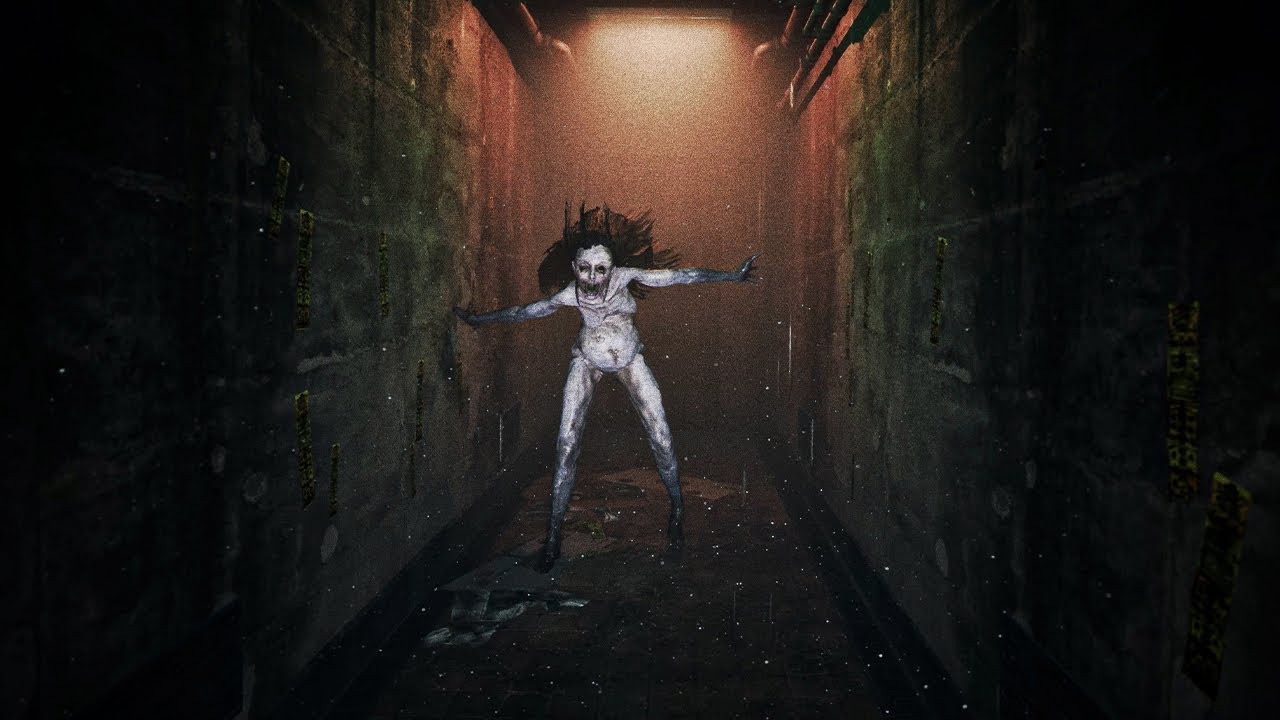
Another independent horror game featuring a convoluted narrative and characters we find uninteresting. I keep giving these games chances, and while a lot of them nail their main monster and atmosphere, almost none can bring home a good story or good characters. This game is based on Taiwanese mythology and the 2020 film of the same name. I have never seen or heard of the film, but the folktale is interesting. A group of six university students challenge the curse on the bridge near Tunghu University and accidentally “trigger” it. You spend a lot of the game running from ghosts of sorts and finding objects in the first person.
The game begins with a promise for the entire setup. The number of voiced lines and cutscenes suggests a promising story. The voice acting is in Taiwanese and is pretty adequate for what the story needs. The first scene of the game has you running around a small park, hiding from a ghost, and trying to escape. The monsters are fairly well done, but they are nothing we haven’t seen before. Pale skinned girls with long black hair, red eyes, and really skinny. There are a few more imaginative monsters, such as a possessed mannequin, but after so many exposures to this ghost, it’s not scary anymore.
There are a few Asian horror tropes, such as a random limb grabbing something when you open a cupboard, or the main ghost appearing behind someone and showing a single eye. These cheap jump scares detract from the overall game experience and give the impression of a cop-out. Despite this, the atmosphere was rather tense, and just wandering the halls and hearing the ominous music and strange sound effects made me stay on edge for the entire game. The stealth sections were my least favorite parts, and it seems that non-combat horror games tend to focus primarily stealth. The ending sequence was the most frustrating, as these are all trial-and-error events. When caught, you must restart and complete the run in a single attempt because you are unsure of the correct path to take. The ending sequence requires you to restart each time, and you must collect many objects that increase the frustration. I ran into a glitch where a locker wasn’t in the spot I needed, and I couldn’t progress anymore.
Most of the game tells you exactly where to go, and there are signs everywhere that help guide you. There aren’t many puzzles in the game, and the ones that are present are relatively simple. The majority of the game involves revisiting the same locations with six distinct characters, and while their narratives should eventually converge, they never do. The timeline lacks clarity, and the explanation of the school’s shifts and changes remains elusive. Is it a hallucination or is it actually happening? Even reading the flavor text in journals doesn’t explain anything. I’m so tired of the poor storytelling in these games. I feel like there is some sort of love story involved, but I couldn’t really figure it out.
In the end, there’s nothing really here for anyone unless you want a cheap 3-hour horror adventure. If it weren’t for the flawed stealth mechanics, I would have enjoyed this game more, but even the graphics fall short of expectations. It uses Unreal Engine 5, and it is very poor at that. The entire time I thought it was Unreal 4 or even 3. However, the lighting effects give the impression that it’s Unreal 5. They are pretty decent, but the texture and modeling are horrible. Even cranked up to max, the game just doesn’t look good. With that said, The Bridge Curse has a lot of potential but falls flat in too many areas.
I absolutely love walking simulators and adventure games. Any day, I will choose a game with a fantastic story over anything else. The complex story and moral choices in 1000xResist initially drew my attention, but ultimately, it left me with a walking simulator filled with anime tropes and more questions than answers. This game swiftly teaches you that there are no definitive answers or absolutes. The game begins with a reasonable number of questions, but towards the end, only a few remain. What remained for me was a game I will soon forget.
You play a character named Watcher. She is one of the Six Sisters, who are part of some sort of post-apocalyptic society or group. The environment is very sterile and too perfect. It almost feels like a starship or something else. The game thrusts you into an unknown part of this timeline. It is up to you to unravel and follow the linear path that the game leads you on. There are a few instances where you have more control over Watcher, specifically when you explore the “center” and engage in conversations with people. This ends up feeling like a chore because you have to do it multiple times, and only yesterday (as of this writing) did the developers patch in a map. There is almost no gameplay. If you consider zipping around the sky on some flying orbs as gameplay, you shouldn’t expect much more. You will likely navigate through thousands of lines of spoken dialogue. The voice-over is decent, if mundane. Even side characters and NPCs speak in every scene.
The pacing is the only thing the game has going for it. While the first few chapters feel repetitive, as you commune with various sisters, you go from location to location, simply walking around in small rooms and engaging in dialogue. This will bore anyone who isn’t an adventure game fan. The story is hard enough to follow, and when you try to make sense of it all, you get more characters to trust you. The game advances when you talk to the correct person. At times, the game presents this as a task, while at others, it becomes more evident.
This game defies easy description or explanation. At times, the dialogue and story can be quite poignant, touching on topics such as adolescence and parental conflict and separation. Additionally, the game heavily references the COVID-19 pandemic, with characters donning masks and discussing a disease that could potentially wipe out humanity. Honestly. I can’t even tell you if that’s exactly what the story is about, as it’s so vague all the time. We don’t get any true, hard facts on what’s going on in this world. The “Allmother” named Iris serves as the foundation for these Six Sisters, who have the ability to replicate themselves. It’s just a bunch of confusing threads that don’t really lead anywhere.
I had a strong desire to enjoy this game. The narrative exhibits promise, featuring numerous characters on the verge of likability or memorability, yet it succumbs to the anime conventions of guiding you through a perpetually perplexing plot, only to leave you feeling let down at the conclusion. At times, the narrative excels, presenting you with a flurry of answers towards the conclusion. This can be satisfying and memorable, but 1000xResist just refuses to give in. I just wanted the game to end, but it goes on for 10–12 hours even if you read all of the dialog and skip most of the voice lines. The choices don’t really matter until the very end of the game, and even then, you aren’t sure if there were choices earlier that mattered.
1000xResist is hard to recommend, even to anime lovers. The animations, visuals, and everything else are fairly generic, forgettable, and mostly dull. The game’s overuse of bloom and lack of lip-syncing during dialog gives it a cheap, low-budget feel, which is normally acceptable if executed well. The game drags the player along for so long that, in the end, you expect a massive pay-off but end up with a fizzle and sputter. I can’t really recommend this game to anyone outside of die-hard adventure game fans.
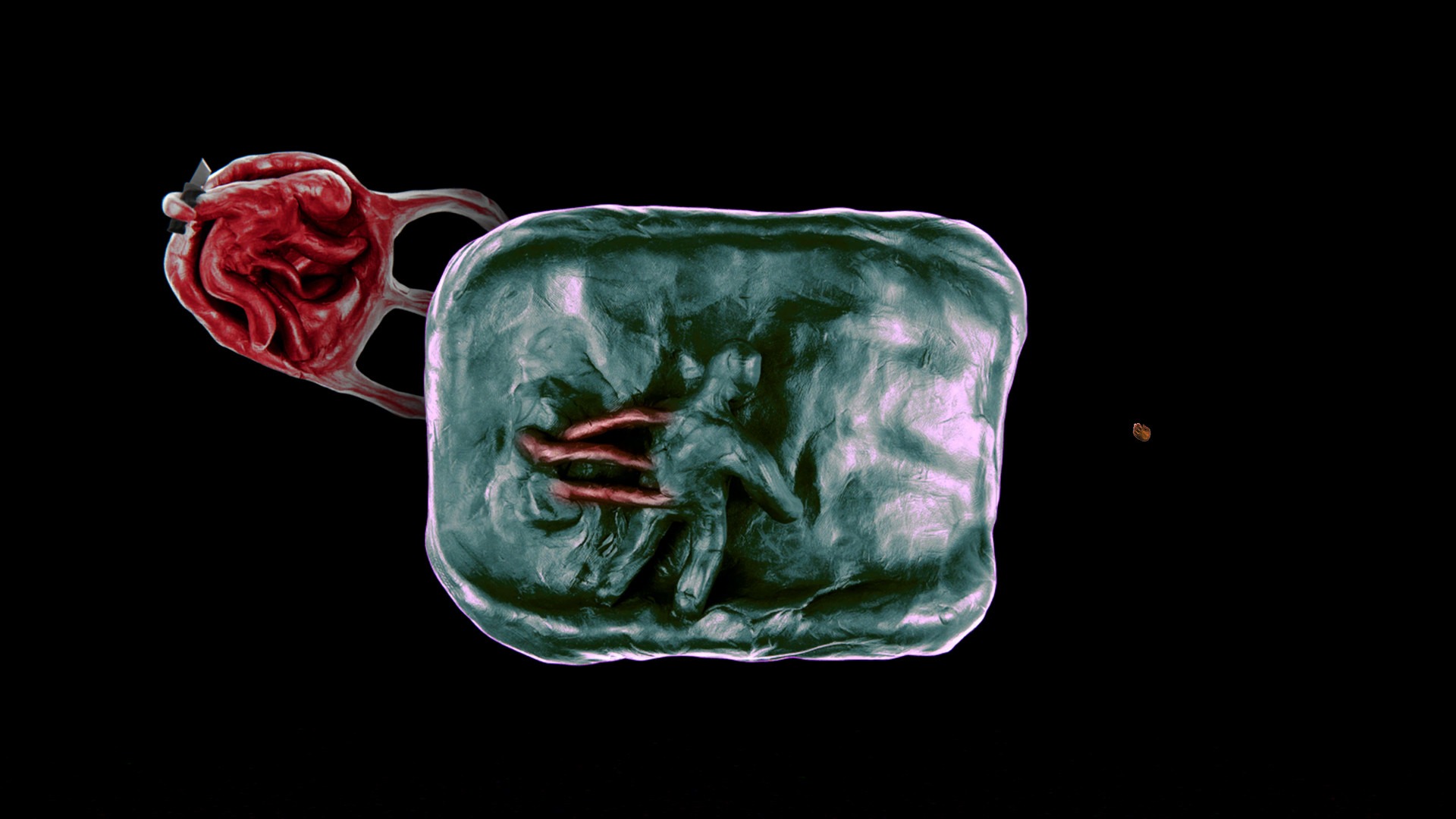
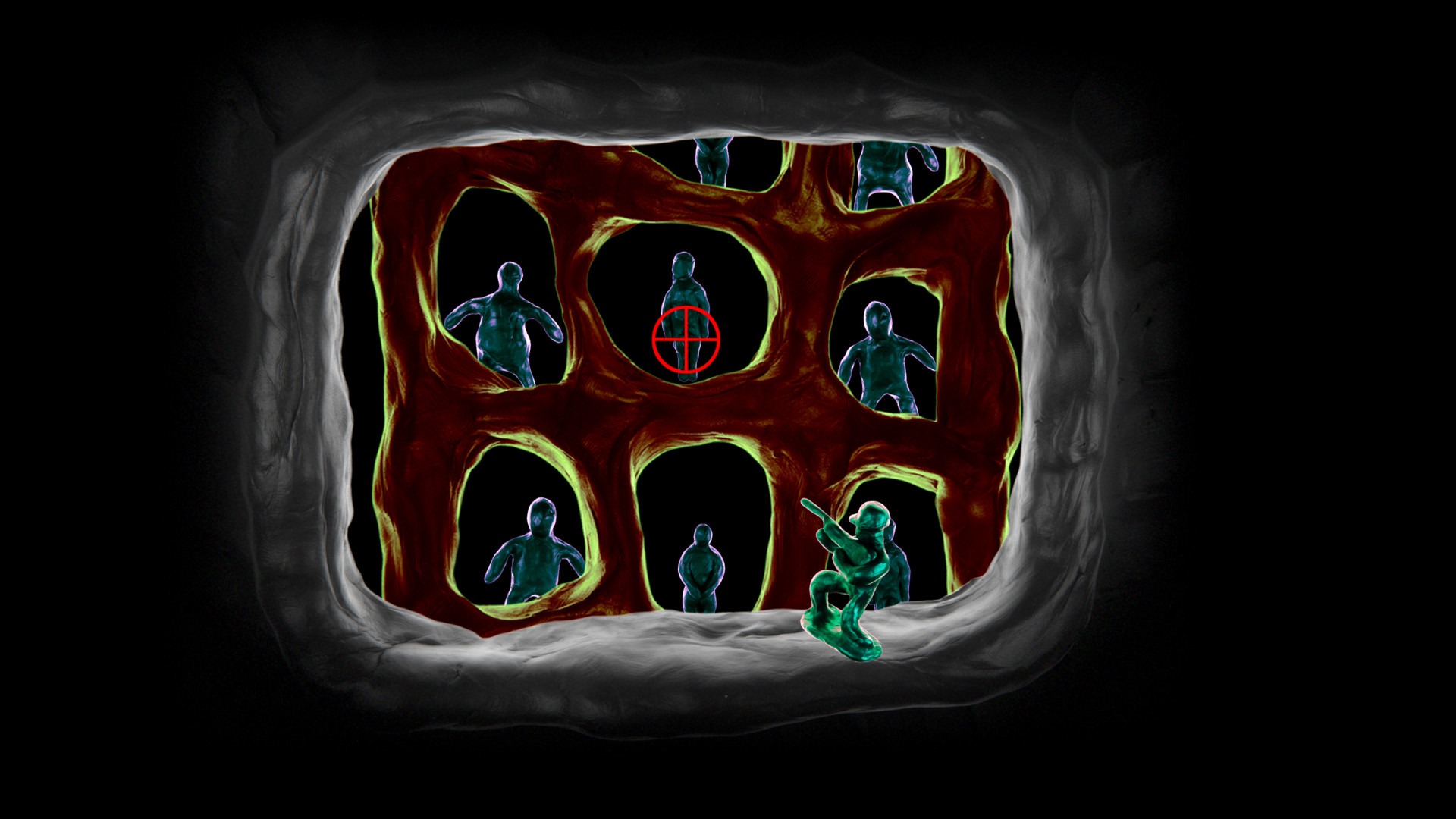
Surrealism in gaming is fascinating to me. It’s one thing to see a painting or photo, but to see it moving and interacting with it is a whole new scale. In my bottomless hunger for the surreal, dreamlike, and psychological in gaming, Isolomus fits a few of these categories. This claymation interactive art exhibit is not for those looking for a full-on game, puzzles, or even a story. There is a lot the player needs to interpret or just be square with not having an answer to. This is a game that can be completed 100% in less than an hour. My interpretation of the game is that it represents humans being slaves to our daily schedules and needs. I will leave it at that.
Each “cycle” of the game starts out the exact same, and there are two different endings. You just start clicking on objects on the screen. Squishing green men into blobs and then watching the “hub” of the day and night cycle as a man does a task you select. This can be eating, using a computer, looking out a window, brushing your teeth, etc. Each task is shown in full during the first cycle, and then you sleep. Once you sleep, you can choose two different doors. Once you start the next cycle, each activity is an interactive scene. I don’t want to spoil them too much, but you need to figure out how to advance the scene by interacting with their objects in a certain manner. Each scene has two different endings, and how you interact determines that ending.
The entire game barely represents anything human or discernible to the human eye. Strange shapes, sounds, and the eerie, dreamlike soundtrack playing in the background will keep you glued to the screen just to see what whacky thing comes next. The animations are uncanny, inhuman, and downright bizarre, but that’s what I love about this game, if you can even call it that. The gameplay here isn’t much, but you still need to be curious and find new ways to interact with the game, which I found a lot of fun.
There is no dialog in the game or even any written text. Just grunts, sounds, and ambient music. Sometimes this is just what the doctor ordered. You can vibe out and relax in a game like this that doesn’t require any skill to even interpret a story. This is a game that will stick with you. Maybe even more than a 50-hour-long AAA game. It’s so strange and surreal that you will need to talk about it with somebody just to make sense of it all. Isolomus may not get the players or attention it deserves, but for $1, what more can you ask for? You can’t buy anything for $1 anymore.
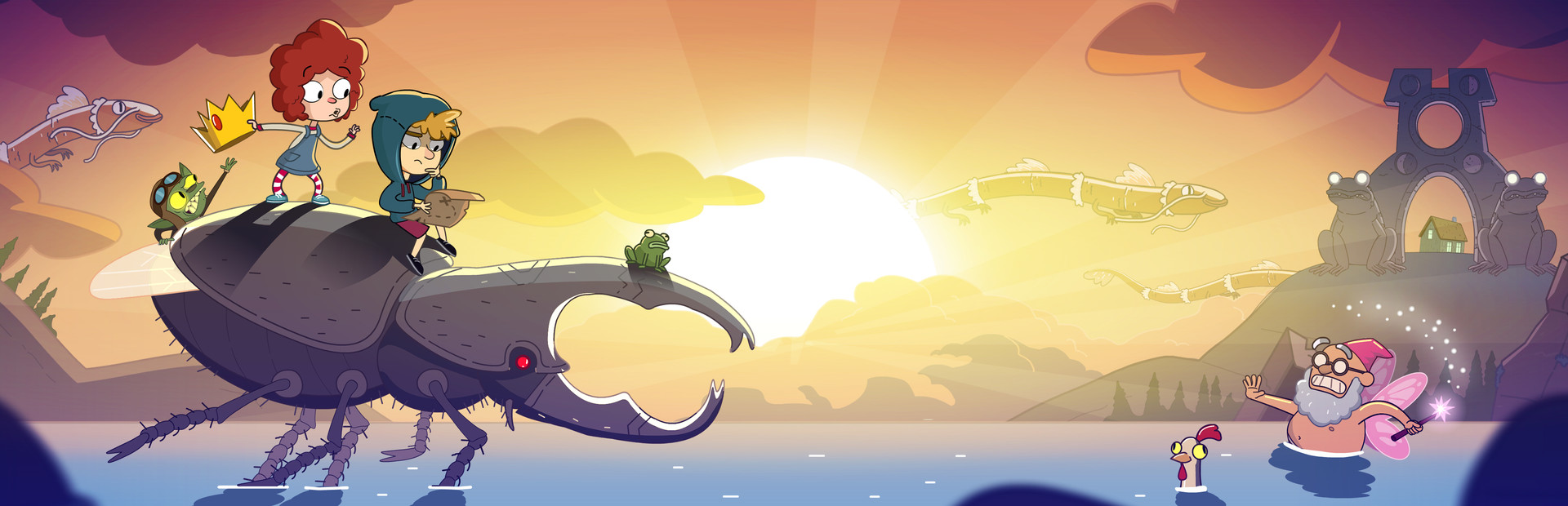
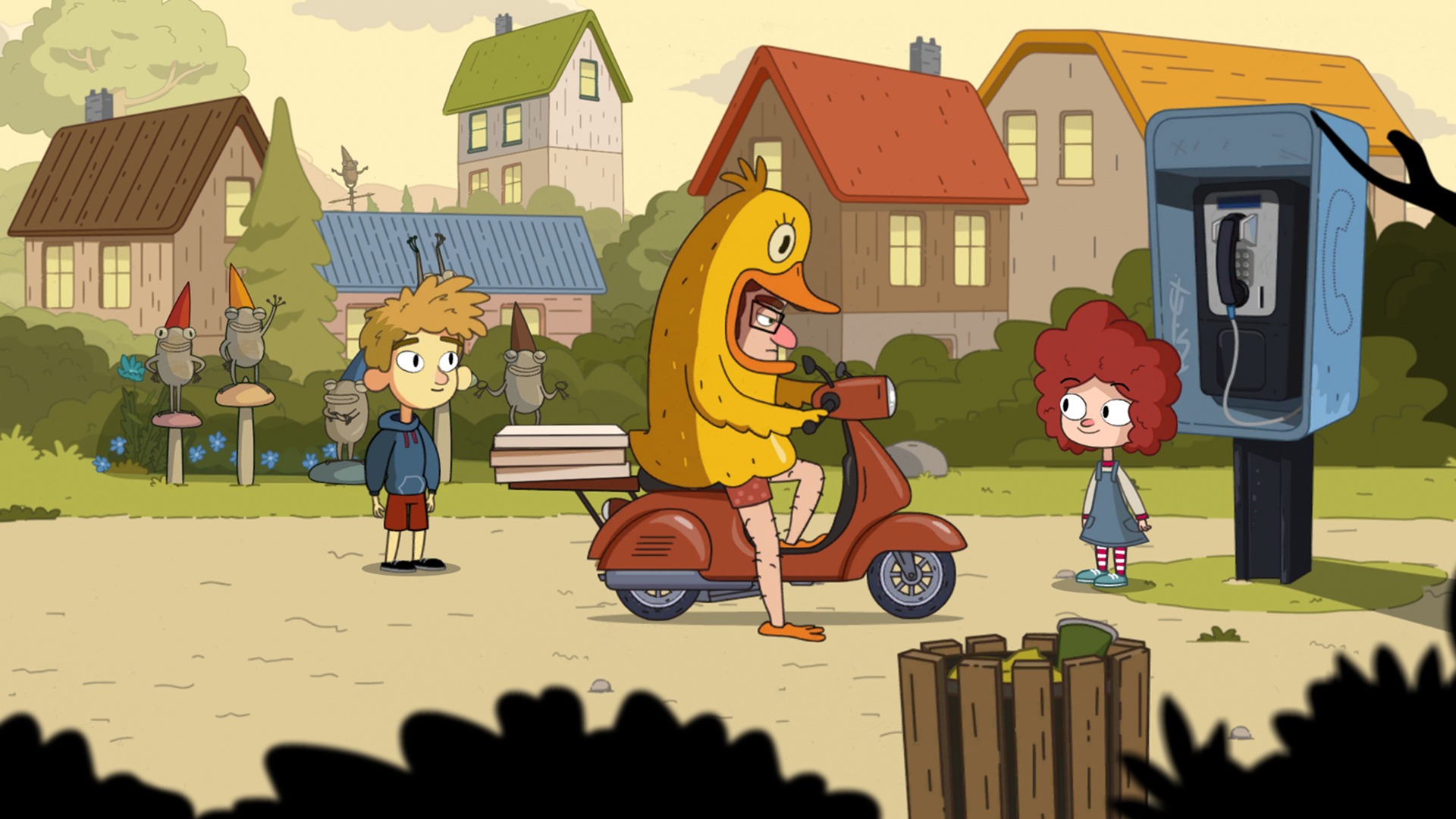
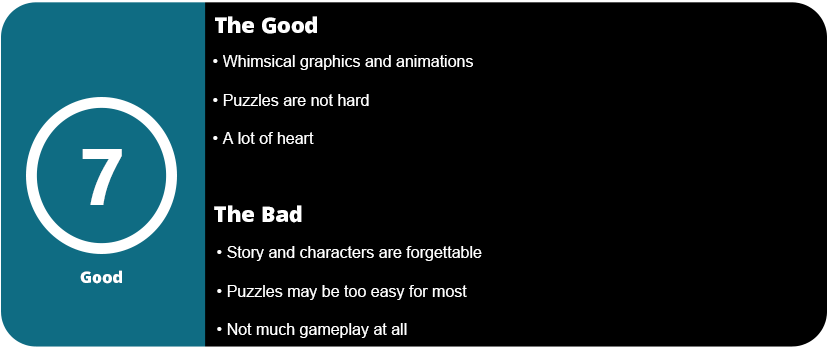
We all played with our imaginations as children. Pretending to go on adventures, or actually going on adventures against our parents chagrin, was what made up our most precious childhood memories. Whether it was spending long summer days playing with friends or staying inside with your siblings playing the latest revolutionary video game, That is what Lost in Play is about. Making adventures and memories as a child.
You play as a brother and sister, Gal and Toto, who wake up on a bright summer day and decide to get lost in their own imaginations. The first few chapters have you going from their reality to actual reality to give you this idea of what’s going on. The game is full of a lot of puzzles and figuring out what items go where. This can be both fun and frustrating at the same time. I wasn’t a fan of most of the puzzles, but the screen increases in numbers as you look for objects and figure out what needs to go where.
The first screen is a perfect way to introduce this. It’s just a single screen, and you learn to click on objects that are standing out. The characters will interact with it or talk to the person. A bubble will pop up with the item the character wants, or your player character will pop a bubble up explaining in one single picture what they need to do. There is a generous hint system that shows a single picture of what to do next or helps you get started with a puzzle. I love this, and it doesn’t punish the player at all; however, some of the hints were not helpful.
As you progress through the game, you get to chapters with many screens and many things to interact with. Once you find your first object, you can usually build momentum and realize who needs what and where. The puzzles are the worst part of the game. Extremely hard slider puzzles; some games are won purely on chance, which is frustrating. Sometimes rules aren’t explained well enough. A particular puzzle with lasers and having to slide animals around to deflect gets very frustrating as it’s a sliding puzzle. The worst one in the game is the final puzzle, in which you have to trap a jumping frog on a grid. It’s done by pure chance, and no walkthrough will help you. There are also some puzzles with symbols, and it seems impossible to figure out what they represent or how to interpret them.
The puzzles aren’t very common, but they do hamper some of the experience. I really loved seeing all of the detail poured into this game’s animation. It feels like a high-quality cartoon. Every interaction is a new animation. One particular point where this stood out was Gal or Toto picking up the same type of object numerous times. Instead of the same pick-up animation, each one was unique. They didn’t have to do that. It makes the entire game feel alive and soulful. The story itself isn’t anything complex or deep, and there’s no voice acting. Characters speak in a simple fashion, which adds to the charm of the game. The visuals are bright and colorful, and every screen and moment feels special. They don’t make many games like this.
Outside of the puzzle issues, there was just a small annoyance with touch controls on mobile. Tapping the screen can sometimes cause you to interact with the same object or character, but it was nothing serious. Every area felt unique and different, and I couldn’t put the game down until the end. You can probably finish this in 2-3 hours, but it’s so much fun and constantly feels fresh and new. Lost in Play is a rare adventure game that I actually might remember and talk about later with people. This game proves that every little detail can make a difference.
Have you ever wondered what it’s like to play a game as the actual code or program inside the game? Well, now you can! TING is a game in which you embark on an adventure with the game’s code. You start out at the title screen and must dismantle the entire screen to get the code’s attention. In this process, you discover a “glitch” that is trying to destroy everything. You get sucked into other dimensions and try to find your way back. The entire game is in the style of a point-and-click adventure, but instead of controlling a single character, you are the “user” that the code talks to. He gives you hints along the way as well as being able to unlock actual hints, which makes some of the more obscure puzzles easier.
You have to really think outside the box with this game, as you can take down parts of the UI and completely break the smaller games inside to progress. You will end up with a classic adventure title and a JRPG that makes fun of Zelda tropes. The game also pokes fun at other games and mechanics, such as microtransactions and free-to-play mechanics. I don’t want to spoil the Easter eggs, but the game has a great sense of humor, and anyone who has watched a few behind-the-scenes videos on how games are made will appreciate this game and the message it’s getting across.
Every area is new and different, and no two puzzles are the same. Some areas have multiple screens, and you can manipulate them in interesting ways, such as unscrewing the computer monitor you’re playing the game on and getting the back of the scene through the back panel. You have to also be okay with dragging the objects onto everything and trying combinations. Some things may not look obvious, but they make sense once you get the object or discover its use. Things like a mouse cursor popping a balloon, a metal letter T being used as a screwdriver, and the sign to a game title being used as a bridge. Almost every puzzle can be figured out with a bit of thinking, but a few were so obscure that I had to use all the hints available to me. When you press the hints button, it will show locks over the object that has hints. This can also be useful just to figure out what objects can be interacted with or what your focus should be without even using a single hint.
There are cutscenes in the game that can’t be interacted with, and this is shown with filmstrips going up the sides of the screen. Because this is a “joke” game and you can break actual games inside, you need other cues as to what’s a joke and what is not. Sometimes I didn’t know what was a joke and wound up restarting the game, but you also need to trust the game. There isn’t much else in terms of gameplay, but there doesn’t need to be. This is a very clever idea for a game that I have never seen before. The story is interesting, the characters are likeable, and it’s just an overall fun time and something really unique. The visuals are charming and switch up all the time, which makes you think outside the box.
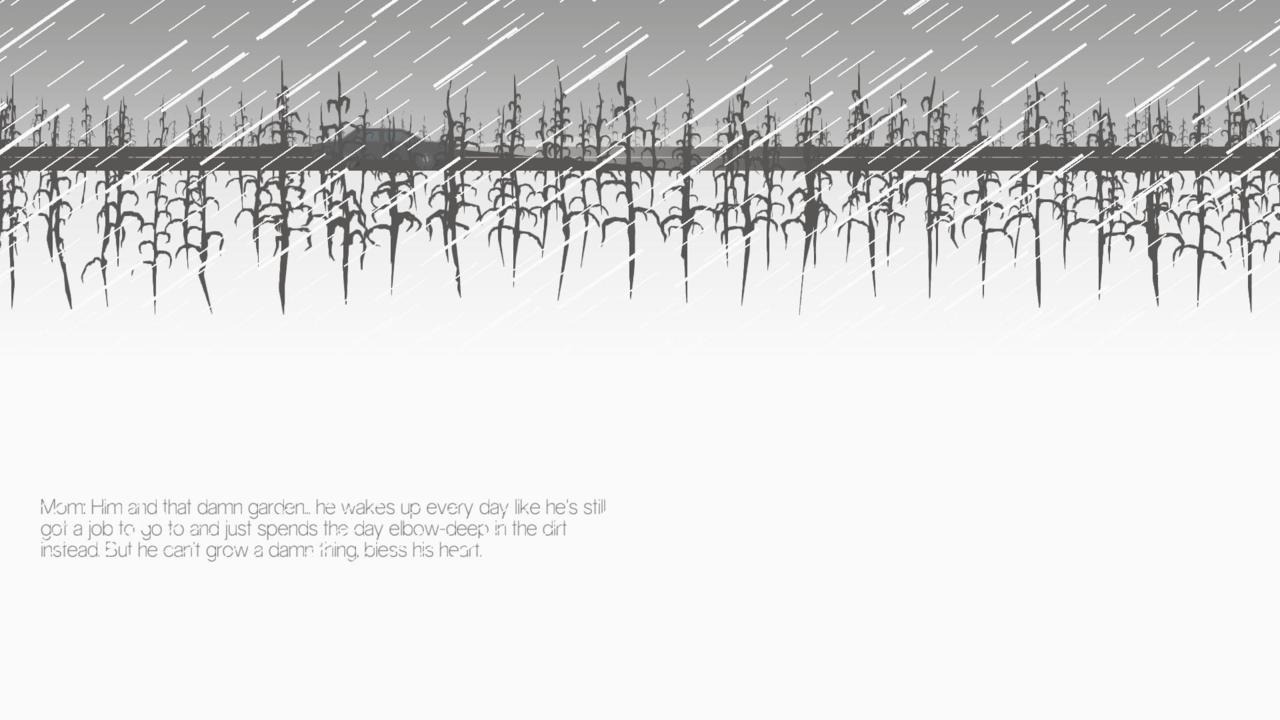
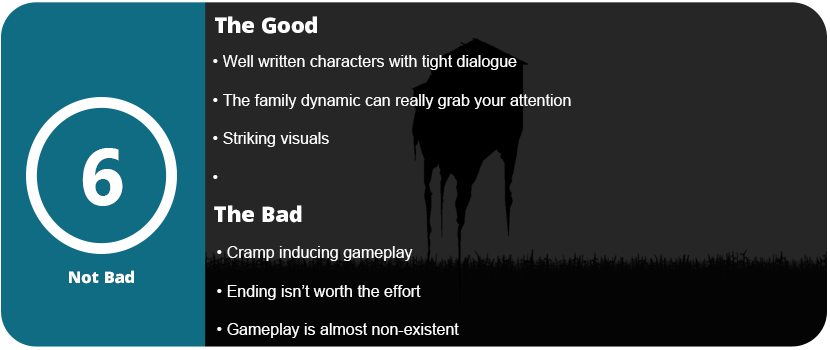
Minimalistic, story-driven games can be quite memorable and fantastic. The lack of gameplay requires you to have a laser focus on the story and characters, and the subtle gameplay can bring a visual element that no other medium can provide. Three Fourths Home isn’t one of these, sadly. While the visuals are striking and minimal, the story and writing have so much potential, but they are let down by a short and disappointing ending.
You play a teenage girl named Kelly who is driving home in a violent storm in rural Nebraska while talking to her family on the phone. Gameplay consists only of holding down a button to continue driving and choosing a few dialogue options. Holding down a single button for the entirety of the game is a really dumb idea. It introduces hand cramps and constantly breaks your focus on the story. You can honk your horn and turn off your lights, which is entirely pointless, and you can’t move the car at all. You can also choose to turn the radio on and off. There is no spoken dialogue in the game, but this requires you to make up voices and visuals for the game in your head. This may sound really dumb to most people, and some might argue that you should just read a book, and in this specific context, this would be a better medium for this story.
Choices in dialogue don’t seem important at first, but your response to your family plays into how they react to you on the phone. I guess multiple playthroughs could be worth it as there are a couple of different endings, but with how mundane the gameplay is, no one will want to sit through the hand cramps to make it worthwhile. I had issues with the controls, causing me to choose the wrong option as well. You need to skip through dialogue with a button to advance each line while holding down another to keep driving, and some times you wouldn’t know that a dialogue option would be coming up and you would just advance forward.
See, with minimal games like this, you need some sort of gameplay hook to keep it interesting enough. Three Fourths doesn’t do this at all. The mom, dad, and brother are all interesting characters, and you slowly learn about this family dynamic through this phone call. You learn about why you “ran away,” what kind of person the dad is, whether or not this is a broken home, etc. The dialogue is tight and interesting enough to keep you glued until the end, that is, if the hand cramps don’t send you packing first. I also wish more was going on visually. Occasionally, a background object will be brought up in the conversation, but it’s just black-and-white visuals without any type of payoff. The visuals, gameplay, and everything else are just an excuse to call this interactive story a game, and it does the bare minimum to qualify as that.
Most games like this have a story that ends in sudden tragedy to flip the entire thing on its head and stun the player, but this one doesn’t really do that either. If it did and the pay-off was incredible, all of this could be worth it, and there are plenty of games similar to this that pull that off. As it stands, Three Fourths Home is a well-written story in a terrible game with an even worse gameplay mechanic.
Kingdom Hearts has a special place in my heart. I remember when the first game came out, and it was talked about by a lot of people on the school grounds. I was in junior high when it was released, but I didn’t get it until it was a Greatest Hits release at $20. I found it hard at the time and never finished it. When the second game came out, I rented it from GameFly and actually cried at the ending. It was so memorable and engrossing for me as a teen.
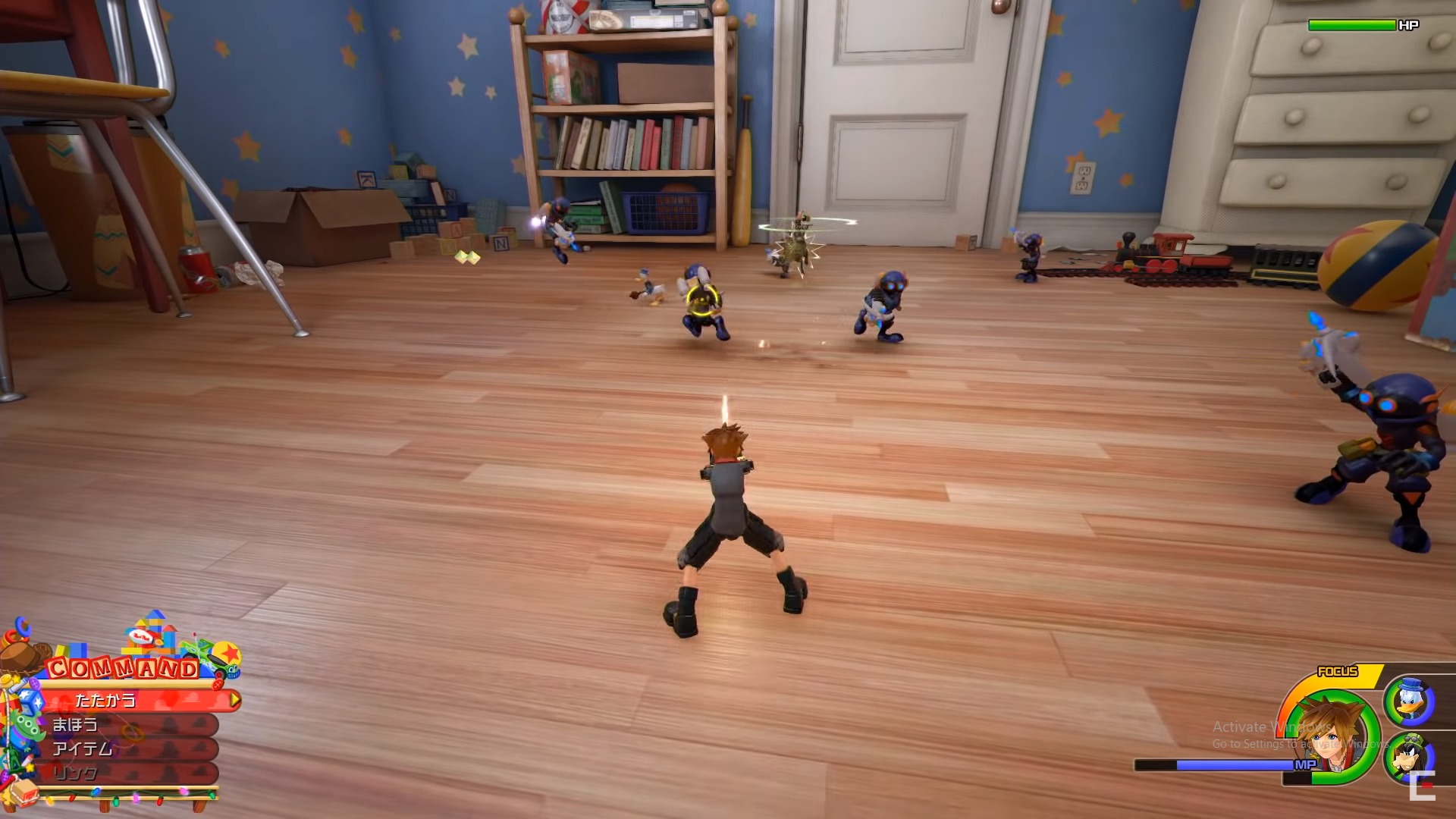
Here we are, almost 15 years later, with the third installment in the mainline series. I was insanely excited and didn’t follow any previews or reviews for the game leading up to actually getting around to buying this game. I played the first area of Hercules (again?) and got to Toy Box (Toy Story!) and lost interest. Yeah, the game hasn’t really evolved all that much. My biggest problem with Kingdom Hearts III is the lack of imaginative level design and the use of mostly modern Pixar movies. The best part about a new Kingdom Hearts game is discovering what the next Disney movie will be that you get to explore. It’s like a surprise each time, and I loved that with previous entries. This was the first time I was praying it wasn’t another modern Pixar movie.
While Hercules was very cinematic, scripted, and looked great, it’s an overused Disney movie in the series. Toy Story was exciting, especially when we were in Andy’s room, but we wound up in a generic boring mall? It was such a boring level to get through, and I didn’t feel anything like the movie. We then move on to Repunzel. Why? Another issue with this game is playing each movie scene by scene around the second act. We’re stuck at a generic forest level here. After this, we get into Monsters Inc., which is actually pretty cool, but it’s a generic monster factory. Then it’s…FROZEN?! Why Frozen? We even get a literal, scene-by-scene, shot-by-shot rendition of the “Let It Go” song. If I wanted that, I would just watch the movie. A generic snow level awaits us here.
Then we go back to Pirates of the Caribbean, of all movies. I appreciate that the visuals are improved enough to give us realistic versions of this movie and not the cartoony one we got last time, but I didn’t care as the original voice cast wasn’t present again. And it’s based off of the third film for some reason. I liked the fact that you get to sail an open ship and go find crabs to upgrade your ship, but I skipped all of this. The ship steers like a hot-wheeled car, and the generic seaside town and ship battles weren’t very interesting. Then we finally arrive at Big Hero 6, which is also pretty cool, but it’s a generic large map of San Francisco, and it is incredibly boring. That’s it. No more worlds, and you are stuck in the last level for about 10 hours doing boss rushes like every other RPG has done, and this seriously needs to stop to just bloat game time.
Even if you like or dislike these Pixar movies, the fact is that the levels are incredibly boring, and each one plays out the same way. You get through several mini-bosses, fight waves of enemies, collect some stuff, and fight the movie’s main antagonist. Every world is a generic feeling with no life from the movie injected into it. The reliance on playing through scenes of these movies isn’t what I want in a Kingdom Hearts game. I want a unique experience at each level that makes me feel like I’m part of that world. Not just some character who crashed the movie in the middle of its runtime.
I can go on and on about how much I hated the uninspired level design and repetitive nature of each world, but then there’s the Gummi Ships. I hated these in the first game, and I really don’t like them here. I like that the Gummi Ship part is a large open map that you can explore freely between worlds, but there’s nothing interesting here. You fly around collecting parts, Munni, and you can find shooter waves flying around that have levels and stars attached to them. Upgrading your ship but being able to buy parts to put together blueprints is a staple of the series, but I just don’t find it interesting. A new alpha Gummi part can be attached now to help fight in battle. It’s essentially a satellite ship flying around yours. There are speed tunnels all over the place, asteroids, and various obstacles, but I just wanted to get to the next world.
Finally, there’s the combat itself. I never really cared for Kingdom Hearts‘ combat. It works, it’s fine, and it can be fast-paced, but you fight the same Heartless over and over again, and the game is heavily reliant on keyblade transformations. Actual attacking and magic have taken a back seat. I rarely touched magic, and it felt useless. I was just attacking until I got my three pips and I could transform my keyblade into a more powerful weapon and execute its finishing move. This does the most damage and is a must for bosses, or you won’t survive at all. The final act of the game pits you against around a dozen bosses, one after another, and it’s a frustrating chore. You can still use Link commands, but they aren’t that great this time around, and I felt like they hindered battle more than anything. The goal was to attack and get a few combos in, transform my keyblade, execute attractions that put you on famous Disney park rides that do damage, and just rinse and repeat. Items are useful for sure, and it’s important to keep abilities tagged, as adding combos and modifiers to combat really gives you an edge. However, this all gets so repetitive, and you just stop caring before you get to the third world.
Then there’s the story, which I haven’t even touched on yet. It makes zero sense, even to people who have played the series up until now. My main interest was in the little stories inside each world. I never cared for the overarching Kingdom Hearts story. It’s a bloated, overcomplicated mess involving Organization XIII, and Final Fantasy isn’t even a part of this story anymore. Xehanort was the X-Blade. Aqua is trapped in a world, I think, where there are multiple versions of everyone. Yeah, I don’t know. Go watch a comprehensive timeline explanation on YouTube instead. Sadly, each world is just a retelling of each movie, which I could just go watch if I wanted to. At least the visuals are really good, and everything is bright, colorful, and full of life.
The voice acting is also hit-and-miss, but mostly terrible. Haley Joel Osment as Sora again was a bad choice; he’s just not a good voice actor. Outside of some of the mainline Disney characters, the voice acting is just wooden and awkward. Most Disney films don’t retrain their original voice actors. Especially in Pirates of the Caribbean…again. What’s worse is the writing. The script feels like it was written by a grammar school student. It’s just the most basic lines, replies, and banter. It’s just enough to get through each scene. There’s a lot of nothing being said by most of these characters. Shouting each other’s names a lot, and a lot of “You will never stop us!” or “I will defeat you!” over and over again. Yawn.
So, there’s a lot I don’t like here. The lack of older Disney movies, the complete absceneness of Final Fantasy stuff, and the fact that each movie is just a scene-by-scene replay of the original movie are boring. The levels feel generic, uninspired, and repetitive, and the combat, while flashy, uses an overreliance on keyblade transformations, attraction attacks, and links and magic. Enemies repeat far too often, and the final act is nothing but a frustrating slog of a boss rush. The story is insanely and wildly confusing and unnecessarily complicated, but at least the visuals are a nice treat. If you didn’t like previous games in the series, this does nothing that will convince you to like it now.
Side note: I was incredibly disappointed by Utada Hikaru’s song with Skrillex on this one. Both Simple and Clean and Passion/Sanctuary are classics and some of Utada’s best work. This song was terrible and wasn’t a good start to the game for me.













































 thebinarymessiah.com
Try multiplayer. A lot of fun !