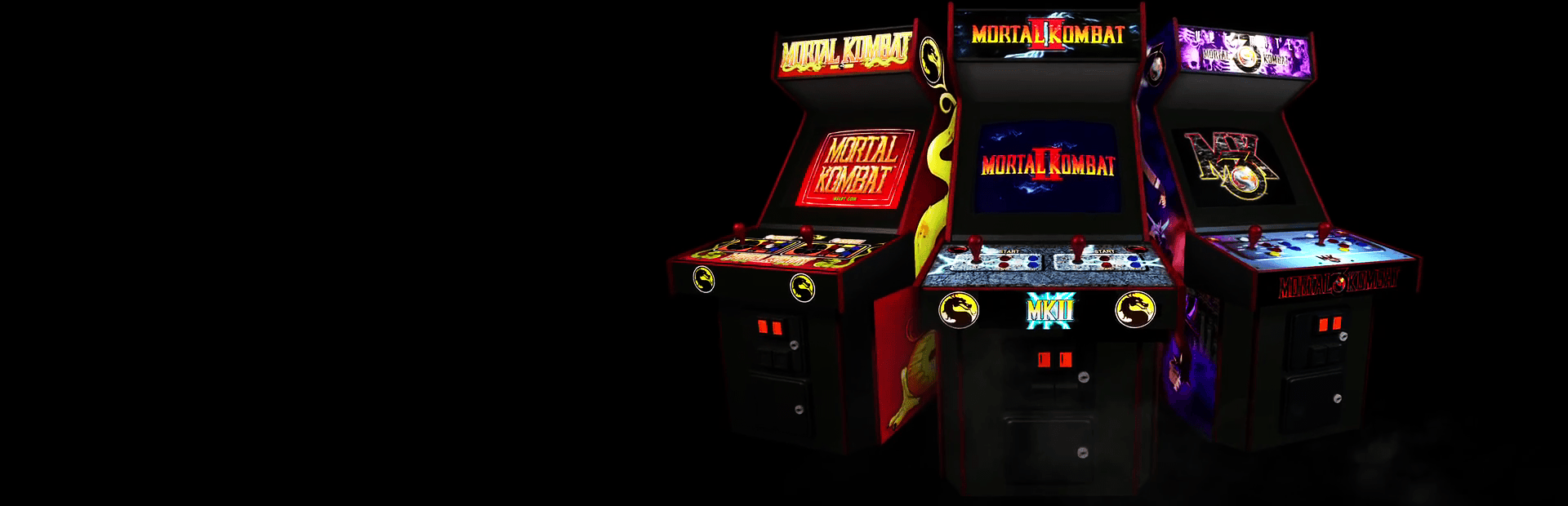
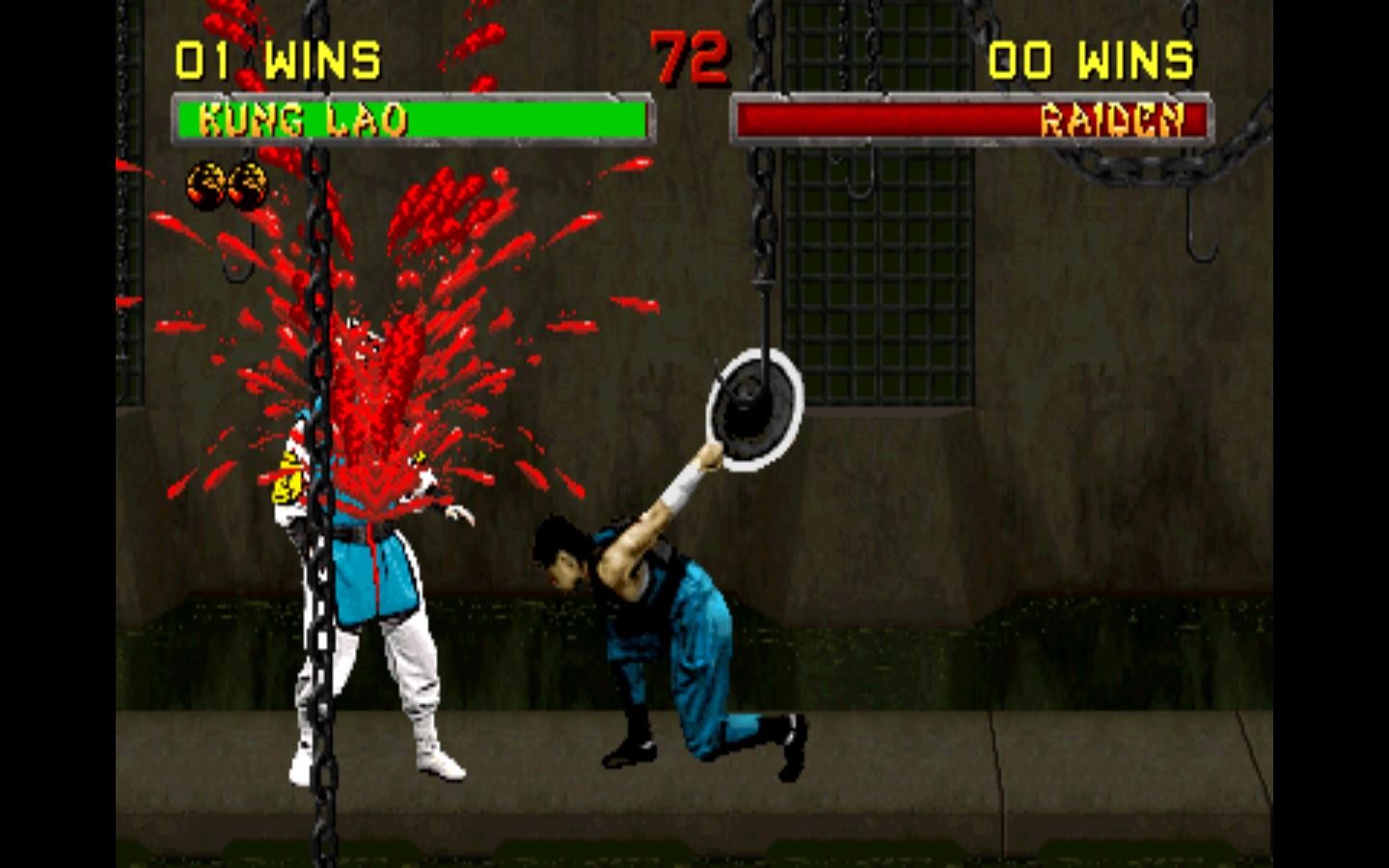
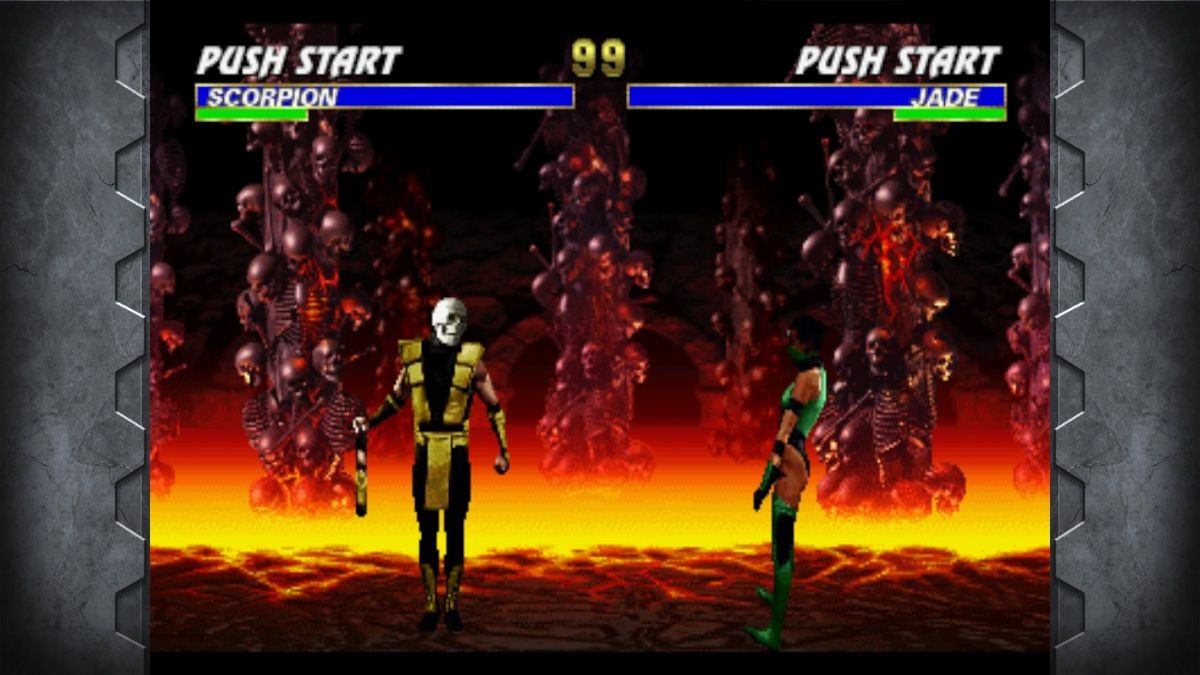
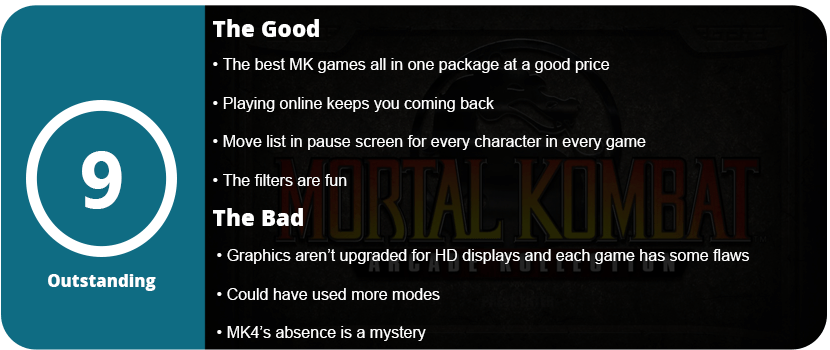
The first three MK games saw dozens of ports over the years, and not all were very good. The latest port of the three is all packed into one tight collection, and they are perfect arcade ports. I won’t go into each game in detail, but it’s great to see the progression over the three, and they all have their strengths and weaknesses. People who are used to the new fighters with tons of combos won’t like the first two as much because combos weren’t implemented until MK3. The first two are just spamming special moves and getting someone stuck in high-punch spam. The good old sweep and uppercut move worked, and the feeling of nostalgia came back.
While each game has great “alities” and characters, each game suffers from some visual quality because these are arcade ports. You can turn on various filters, but overall, don’t expect the games to look amazing. MK1, for example, is very pixelated, but what can you expect? Each game has online play, and that is what will keep you coming back. The CPU is cheap when fighting solo, and I always hated MK’s AI system, with MK2 being the worst. I also loved how all the “-alities” and special moves are on the pause screen, which prevents you from having to have an FAQ near you.
Arcade Kollection could have used more features, such as being able to play Test-Your-Might mini-games separately from MK1, throwing in the great Puzzle Kombat, and maybe even adding some more online modes. Including the Mortal Kombat Trilogy would have been nice, despite it never being in arcades. I’m also not sure why MK4 wasn’t included because it was the last arcade MK game. What is here is excellent, but only hardcore MK fans will really appreciate this collection.
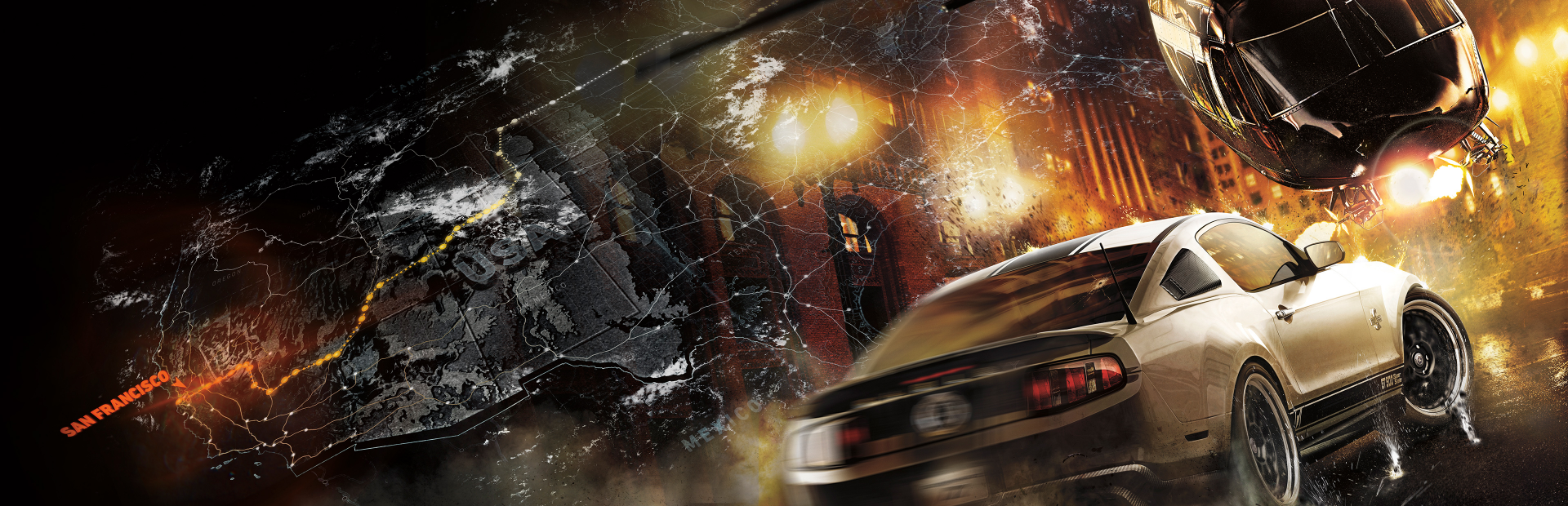
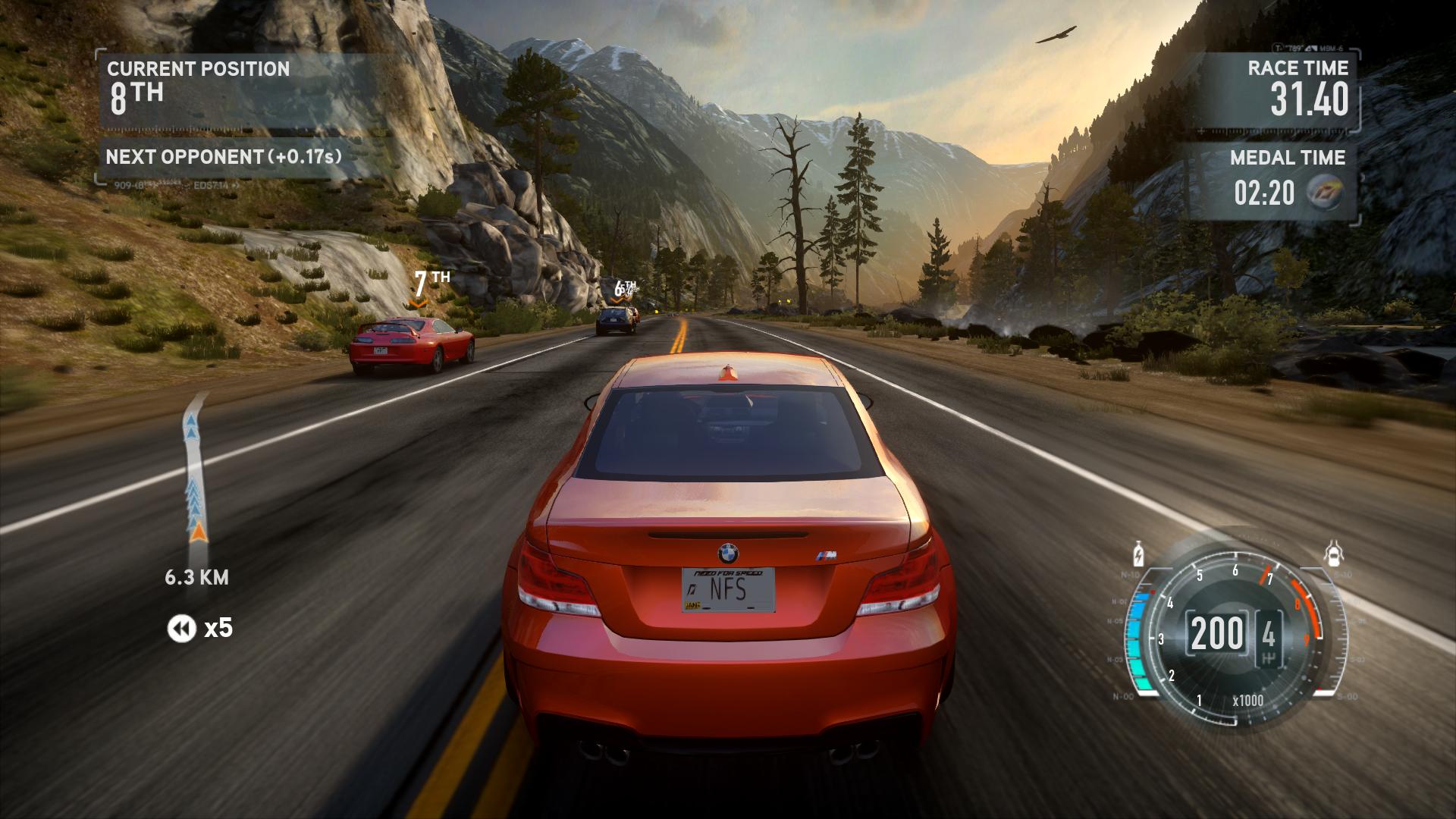
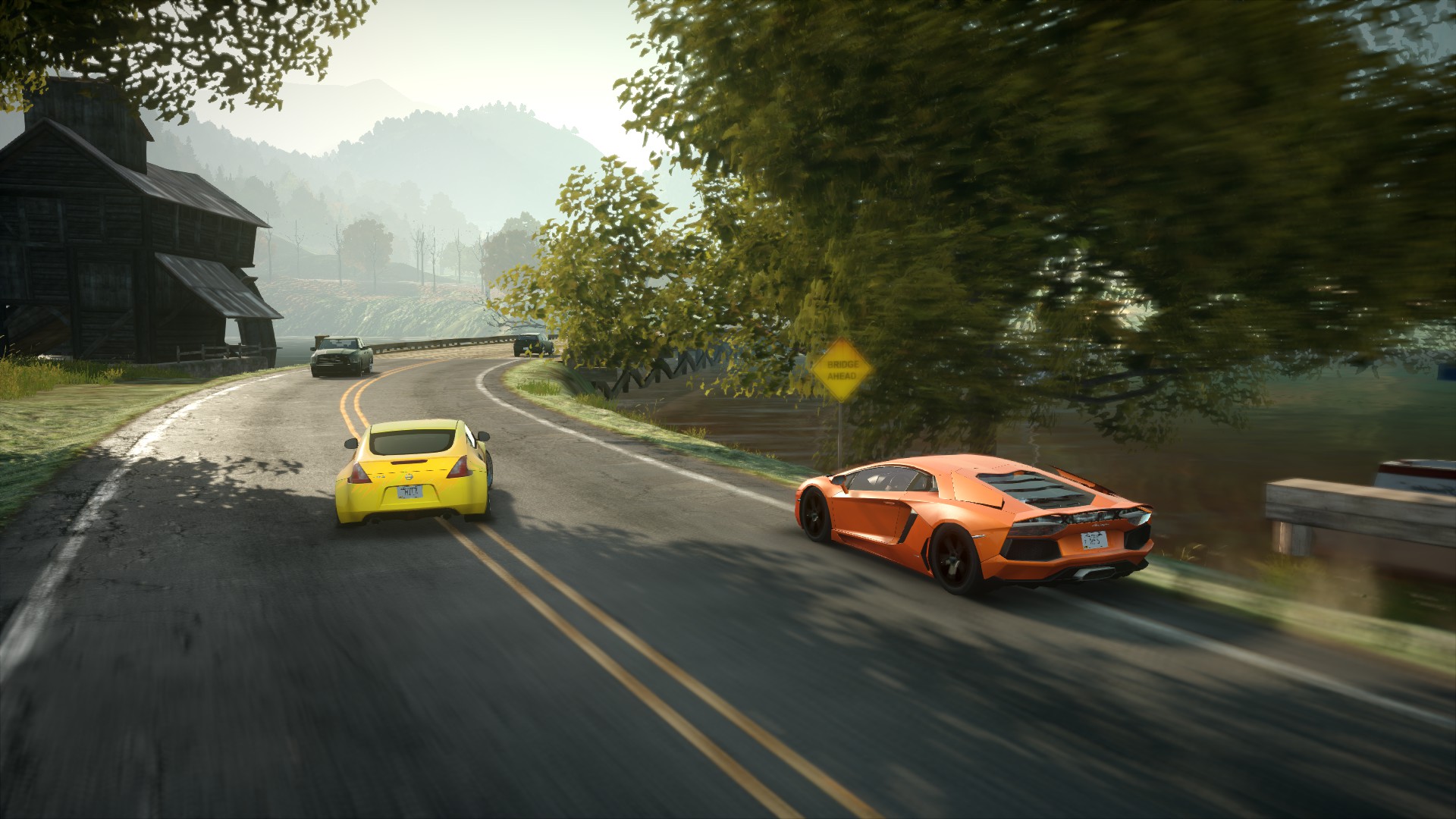
Need for Speed has taken many different directions in the last decade, but The Run tries to go back to its roots while trying something new. Sure, you’re being chased by cops, doing illegal stuff in a car, having great graphics, and having a super-fast sense of speed. It sounds like an NFS game, right? Well, in a sense, it is, but it won’t change haters’ minds or make hardcore fans happy. This isn’t the true return like Hot Pursuit was, but it does convey a nice idea. You play a guy named Jack Rourke who owes a mob a lot of money. You hear about a race from San Francisco to New York, and your “agent” will give you a cut of the prize money and make your little mob problem go away. You start at the 200th place and make your way to the 1st.
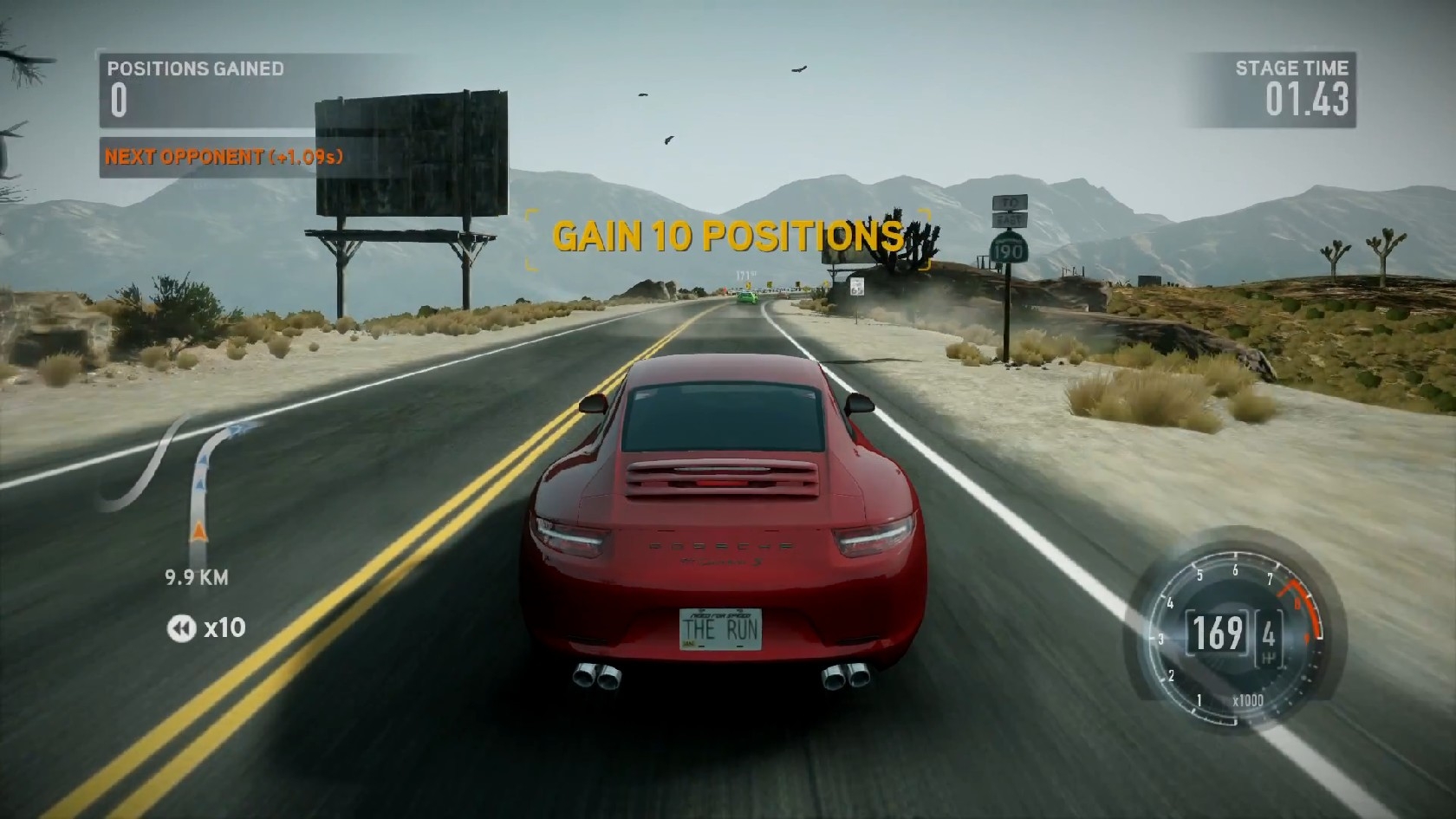
This sounds like it would take forever or be just one straight race, but it isn’t. The game is broken down into 10 stages, and each stage has various races. The terrain obviously changes a lot, and this means lots of different environments to look at, which gets help from EA’s latest Frostbite 2 engine that was used in Battlefield 3. While it doesn’t look as amazing as that game, it looks fantastic and is probably the best-looking NFS game to date. There are so many different places to race—snow, open fields, farms, factories, cities, you name it. There are several different race types, but they are thrown up variously, and the overall experience is repetitive.
Races range from gaining a certain number of positions to battling against the clock in elimination races. There are “boss” races that have you racing a good distance; there are also races solely against the clock to catch up time. That’s about all there is, and the only thing keeping you from getting really bored are the constantly changing environments, which are great to look at, and not one stage is the same. There are some better elements that make the game thrilling, and these are the survival sections. One has you running from an avalanche, another from a helicopter shooting at you, as well as a mountain demolition, but these are so far, and few of you yearn for them between the constant drag of gaining positions.
While these moments are highly entertaining, and probably the moments in the game, a few times Jack will get out of his car and initiate quick time events, which are also entertaining but pretty pointless since you normally don’t play an on-foot NFS game. Don’t worry, you don’t control him; just think of it as an interactive cutscene.
A great NFS game needs fast real-world cars, and there are plenty here, from Ferrari to Lamborghini. You will find them here. You can change cars by pulling into gas stations throughout stages, but overall, you usually stick with one car until the next group is unlocked. You can earn experience through things like drifting, jumping, overtaking cars, etc., but I found this kind of useless since you only earn one thing when leveling up, and it’s usually an avatar or something like that. You can use resets during a race if you crash or really screw up, but watch out; they are limited.
The game features Autolog, which everyone has grown to love, plus there are Challenge Series races to do after you beat the short 4-5 hour campaign mode. Multiplayer is pretty standard and nothing to write home about, but The Run is a fun weekend rental and nothing more. You will quickly forget about this one, but the whole idea is fun while it lasts.
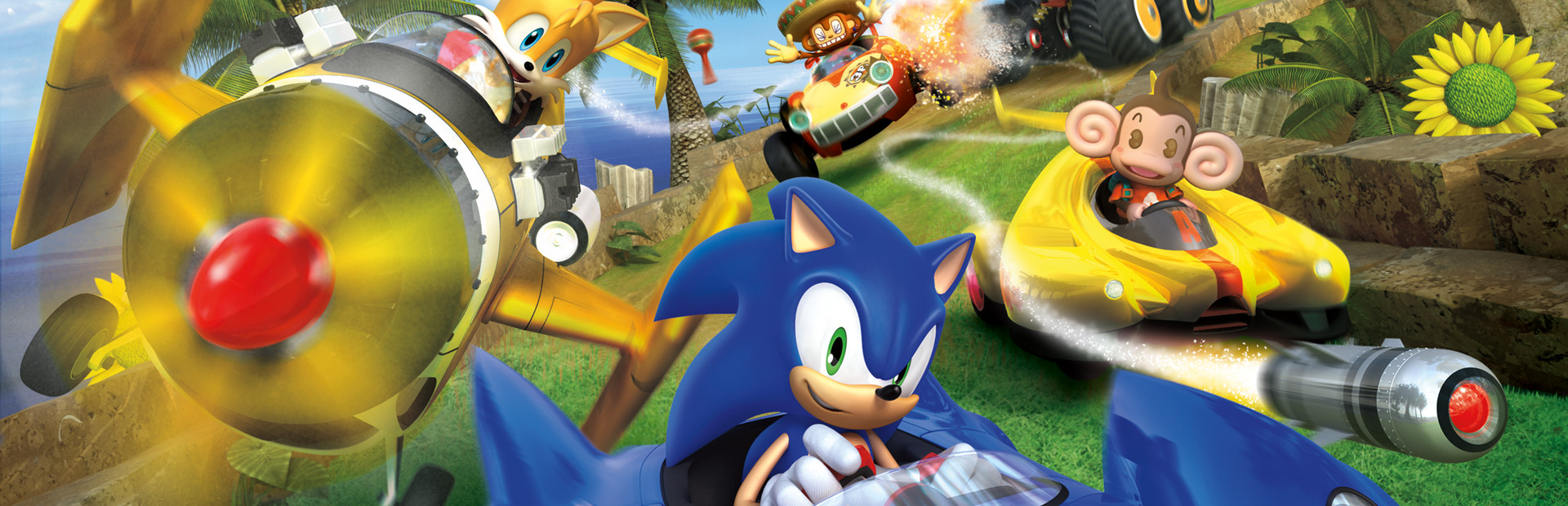
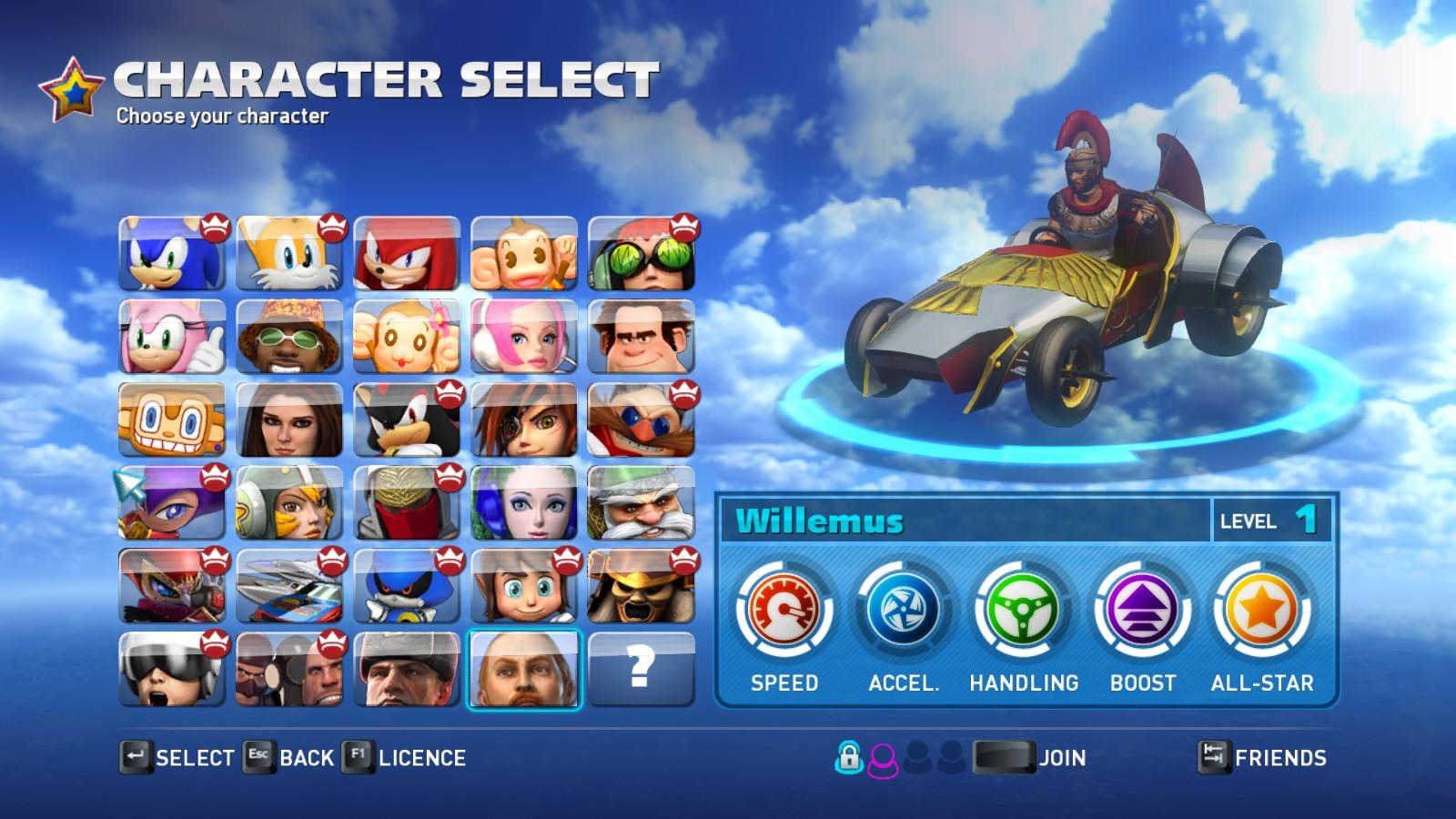
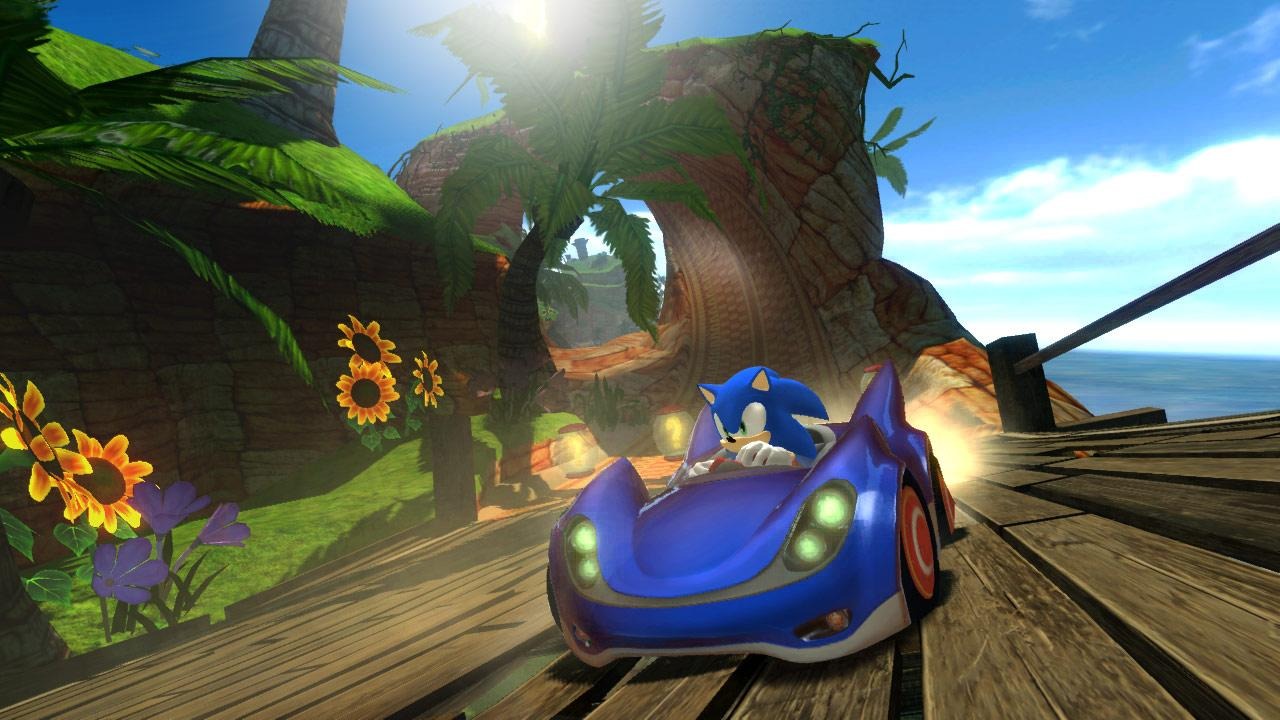
Kart racing games tend to be able to beat the king of them all: Mario Kart. While that game started, all a few entertaining offbeat ones have raced by, but this is Sega’s serious attempt at it, and it works. You can play as almost every major Sega mascot, such as most Sonic characters and familiar faces from Space Channel 5, Super Monkey Ball, and others. You race around tracks that reflect the design and setting of various Sega games while using power-ups to stay ahead of the pack.
The game has a power sliding ability that will increase your boost, which is the key to getting in the first place, but also picking up capsules that hold random power-ups such as a homing missile, mines, shields, speed boosts, and various other power-ups we have seen countless times. The game has a great sense of speed, and sliding around corners and doing various stunts is exciting, but the overall experience is borderline juvenile and very easy, even in the hardest mode. There are various missions you can complete as well as buying characters with Sega Miles, but this only goes so far.
The ideal way to play is with friends, but you need several controllers to do so because there is no online play. Why this was stripped from the PC version beats me, but it really brings down the experience since crowding around one computer isn’t very convenient. Once you do get some friends aboard, the game is a blast, and power-sliding and knocking enemies down makes for great laughs.
But when it’s all said and done, the game is a really average kart racer and has dated graphics as well as some annoying sounds. The game just feels the same no matter what you do as a single player, and I highly doubt anyone over 10 can play all 50+ missions without going crazy. If there was just some online play in here, it could sweeten the deal some, but the single-player can only be tolerated for so long.
Mortal Kombat 4 was probably the most carefully watched game in the series due to abandoning the 2D root and going for 3D. No one knew what was going to happen to the series, and a lot of fans lost hope, thinking the silky smooth controls and excellent digitized graphics would go by the wayside in 3D. However, the game featured excellent visuals (for the time), and the silky smooth controls stayed despite some slippery and awkward animations. The fourth game also introduced some new characters who I thought were some of the weakest in the series. So despite the weaker roster, we got some pretty good fatalities and excellent stages to fight in.
The new characters like Kai, Jarek, Fujin (a weak attempt at making another Raiden), and Tanya were pretty “blah.” They didn’t have the same impact as the classic characters, but some returned, like Scorpion and Sub-Zero, Sonya, and Johnny Cage, who came back for the first time since MK2. The run button and combos were carried over into 3D, which were smooth as well as a first stab at moving in a 3D environment. You would hit a button to kind of strafe to the side to avoid attacks, and this added a whole new level of strategy. Weapons were introduced in free form now, and every character had one. Get hit, though, and you lose the weapon until you can pick it back up.
The fatalities were extremely brutal, some of the best the series has seen, and they looked even better in 3D. This leads to a new level of detail and creativity that can’t be done in 2D. This was also a slow departure from other “alities,” and the series stuck with just fatalities. A new boss was introduced as Shinnok, and Goro returned as the mini-boss. The game carries over a lot of elements that make it still feel classic, but then injects some new stuff as well. I really felt the game was well balanced and was exactly what the first MK in 3D should be. Overall, MK4 is a classic and did an amazing job of transferring over to 3D, which was very difficult. This, of course, paved the way for all future MK games, but we can always look back on MK4 as children.
What better way to end an era for a fighting genre than to throw it all into one big game? MKT does just this, so for people only familiar with the 3D era, this is what Armageddon was based on. Every MK character up to Ultimate Mortal Kombat 3 is in here, plus all the mechanics from UMK3 that everyone loved. The game introduces a new aggressor meter, which is the predecessor of the power meter in the new MK. Getting attacked will increase it (which is just text at the bottom that fills up, which I really hate), and then you do extra damage while in aggressor mode. The combo system is still intact, as are the weapons from UMK3.
The 2D games were silky smooth, and the graphics look great in Trilogy. Every level, as well as a lot of fan-favorite music, is in the game (you can pull the soundtrack right off the disc). Using the run button, pulling off a 5-hit combo, and then blocking, jumping around, and using all the signature moves brings back a great feeling of nostalgia. There are some secrets hidden here, such as a special code screen (1-button Fatalities are awesome), plus some original outfits like Raiden and Kano’s original outfit, which also unlocks their original Fatality. Of course, the game is best played with two people, but a single player is also a lot of fun.
There are a few minor problems, like Shang Tsung’s morphs requiring loading, loading times between menus and fights, and the game freezing sometimes, which is no good. I also wish maybe Test Your Might would have come back, but this really just feels like Mortal Kombat: The Greatest Hits. I also hate how cheap the computer can be on even normal difficulties, plus Shao Kahn is one of the cheapest bosses in gaming history, so good luck beating him. Overall, this is the ultimate MK experience for the 16-bit era that made history. If you loved the older MK games, then Trilogy is exactly what you need, plus this is probably the last time you’ll see Animalities and Brutalities.
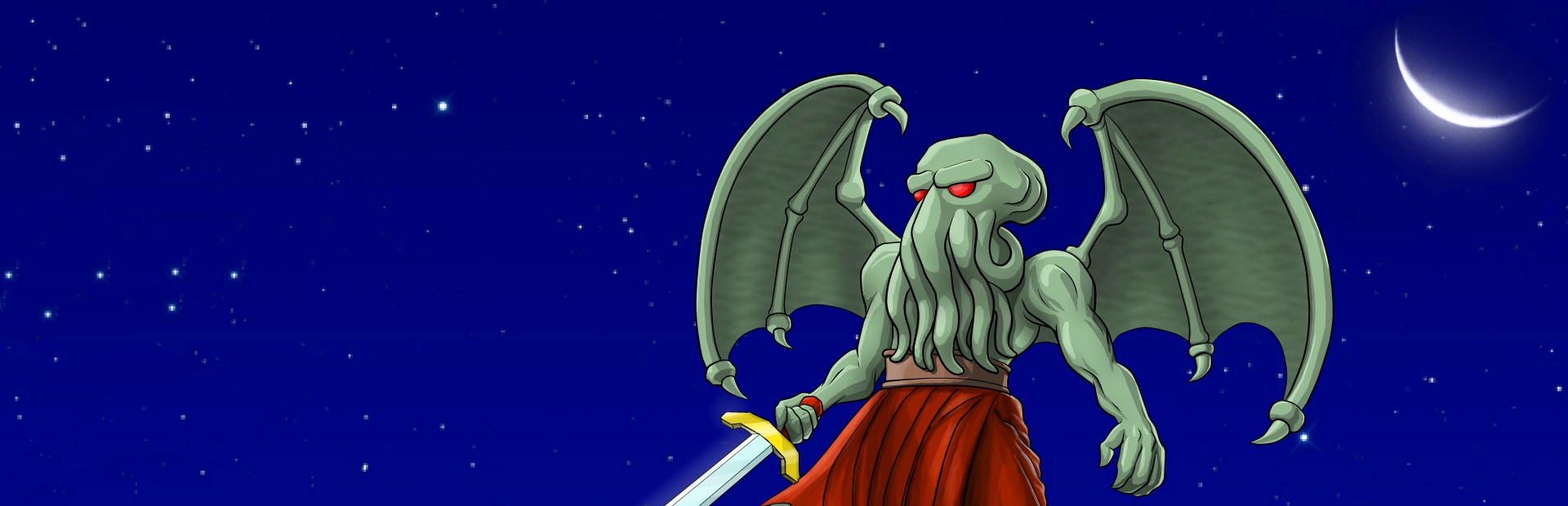
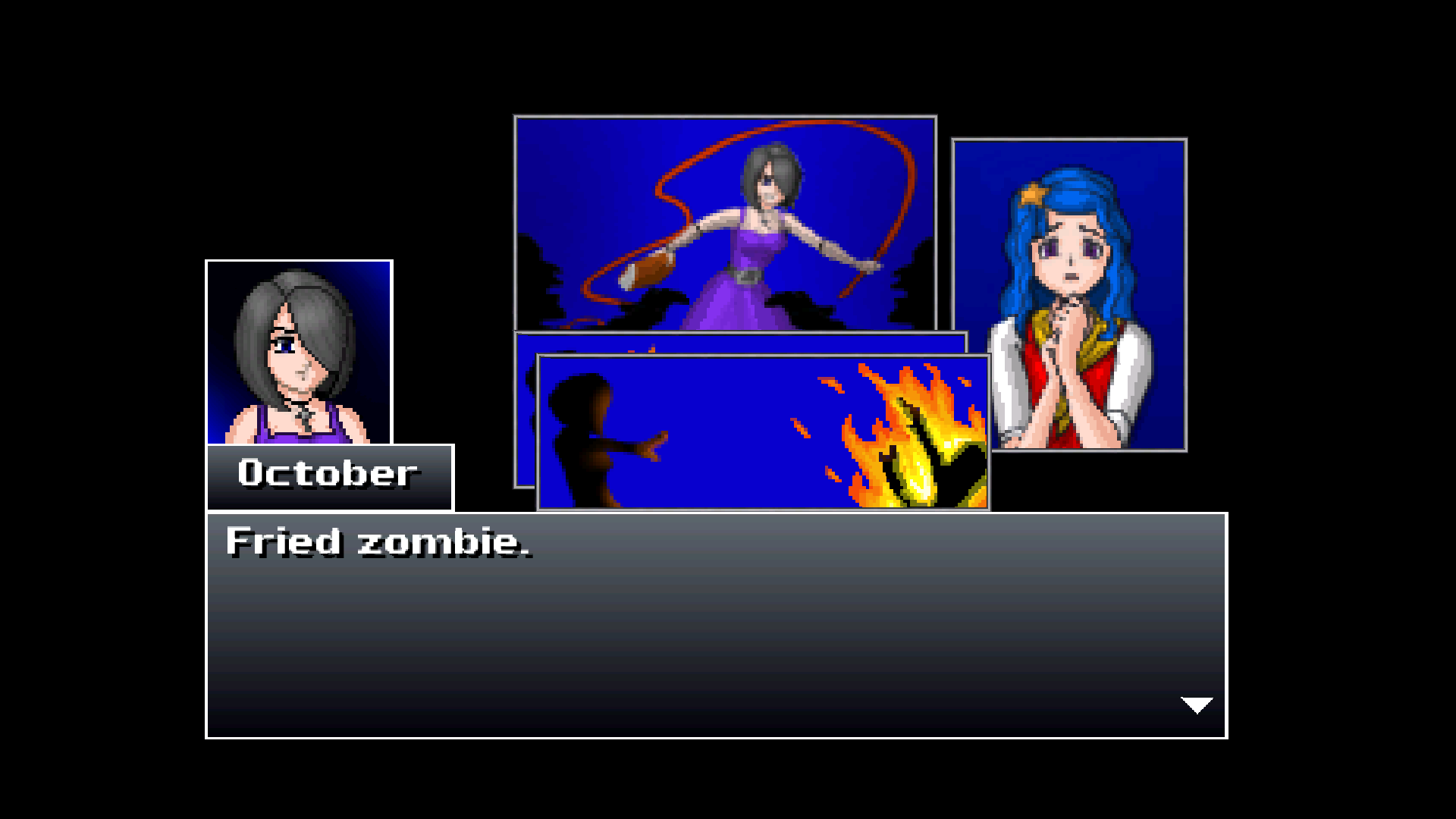
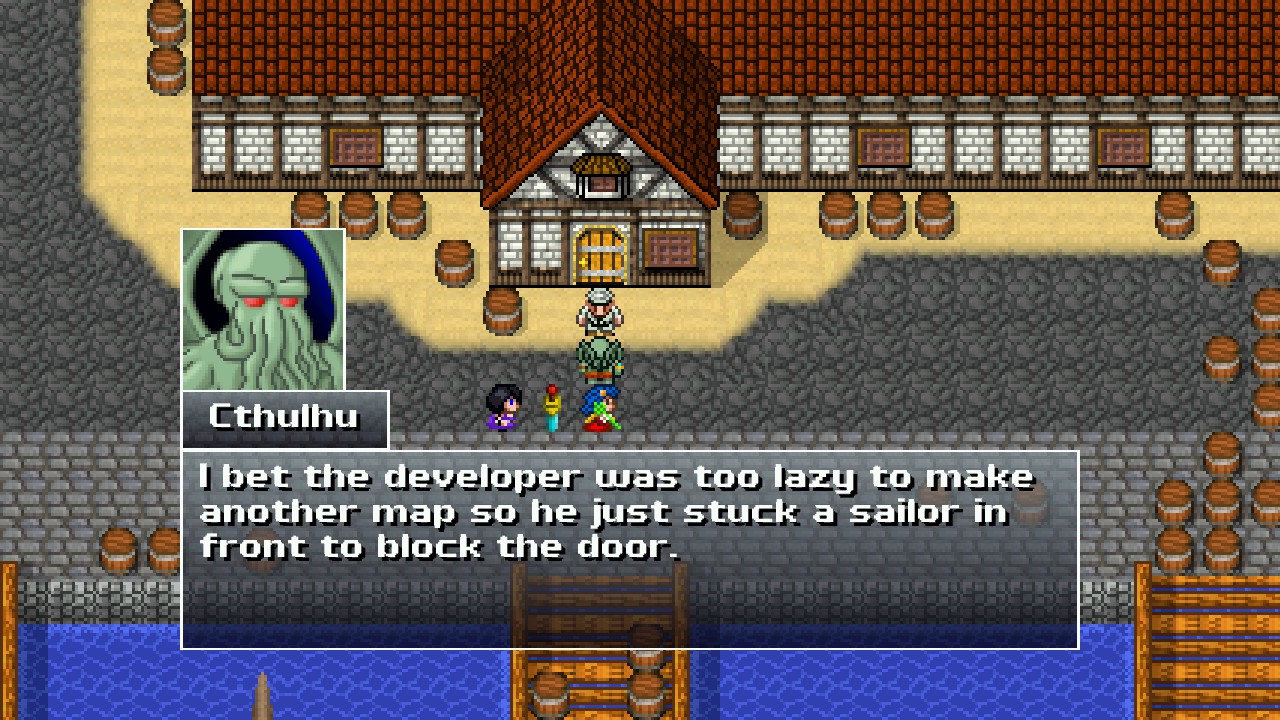
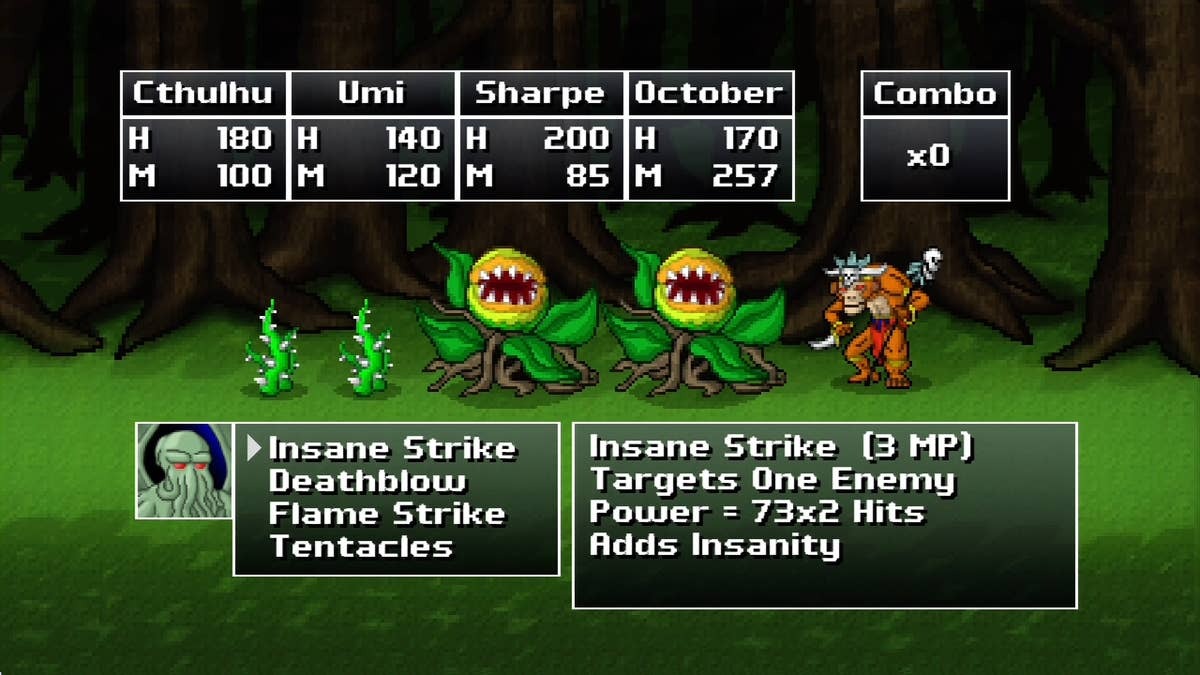
The Cthulhu series from H.P. Lovecraft hasn’t seen much love in the form of games, but indie developers Zeboyd picked it up and turned it into a whimsical/parody 8-bit RPG, and it’s done very well. You play as Cthulhu and pick up many party members along the way, but the whole point of the game is the great dungeon crawling that harkens back to the ’80s. You can attack like any RPG, but you have tech attacks that are more powerful and magic, and then you can unite with other members to combine devastating attacks. There are a ton of different attacks you learn when you level up, and you get a choice between two different things to level up with either stats or an attack, so by the end of the game, each member has a huge arsenal to use.
The game is very close to the mythology, with bosses that are from the story, towns named after the exact towns from the stories, and art-style matches. The music is amazing, with sweeping orchestral scores (in 8-bit midi audio, mind you) that really move you and sound great. The story is hilarious, with Cthulhu trying to redeem himself and become a true hero to raise his city of R’lyeh, but his interaction with characters in the world is really funny. Of course, the game wouldn’t be complete without a huge map to explore that has some secret dungeons, plus the environments and dungeons vary with lots of loot and chests to find.
However, the game’s biggest flaw is the extreme difficulty later on in the game, as well as the constant random battles that really drag the experience down. The developers tried to tone this down by disabling random battles after you do 25 of them, but you will probably go through a dungeon before you hit that number. I also didn’t like how if you don’t level up high enough, the end boss is impossible to beat, but each dungeon just really racks up the difficulty and requires you to grind a bit to get through the dungeon. I also didn’t like how you don’t really need a strategy to beat the enemies because you can just use the same one over and over through several dungeons. This causes the feeling of repetition to set in and makes you want the game to just end a little faster.
While the visuals are nice and give you a feeling of nostalgia, they don’t look good in HD, and the lack of battle animations and everything else that goes along with 8-bit graphics grates on your eyes after a while. However, the Cthulhu license is rarely explored, so any game to do so is welcomed, but this game is probably for hardcore RPG fans.
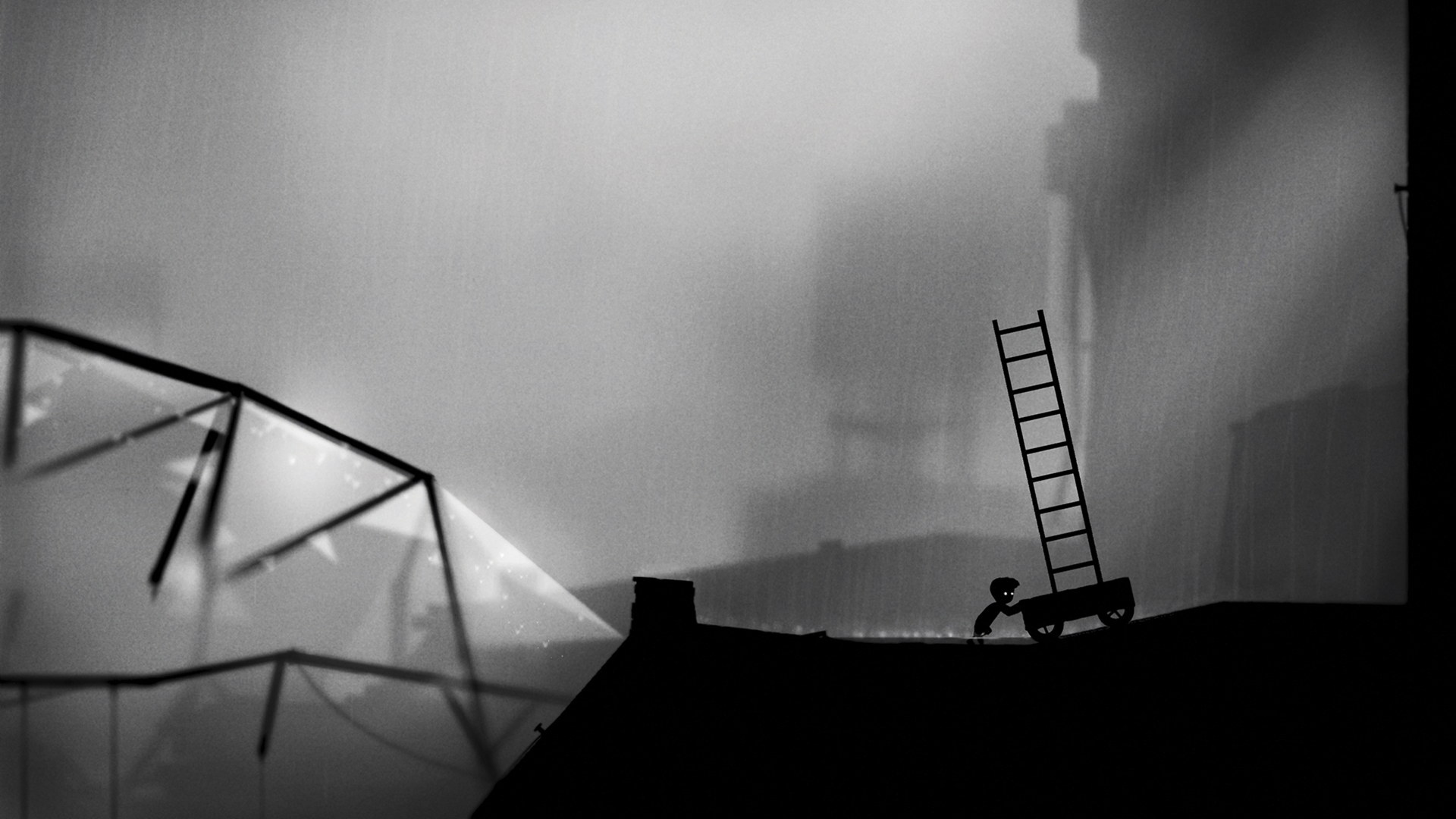
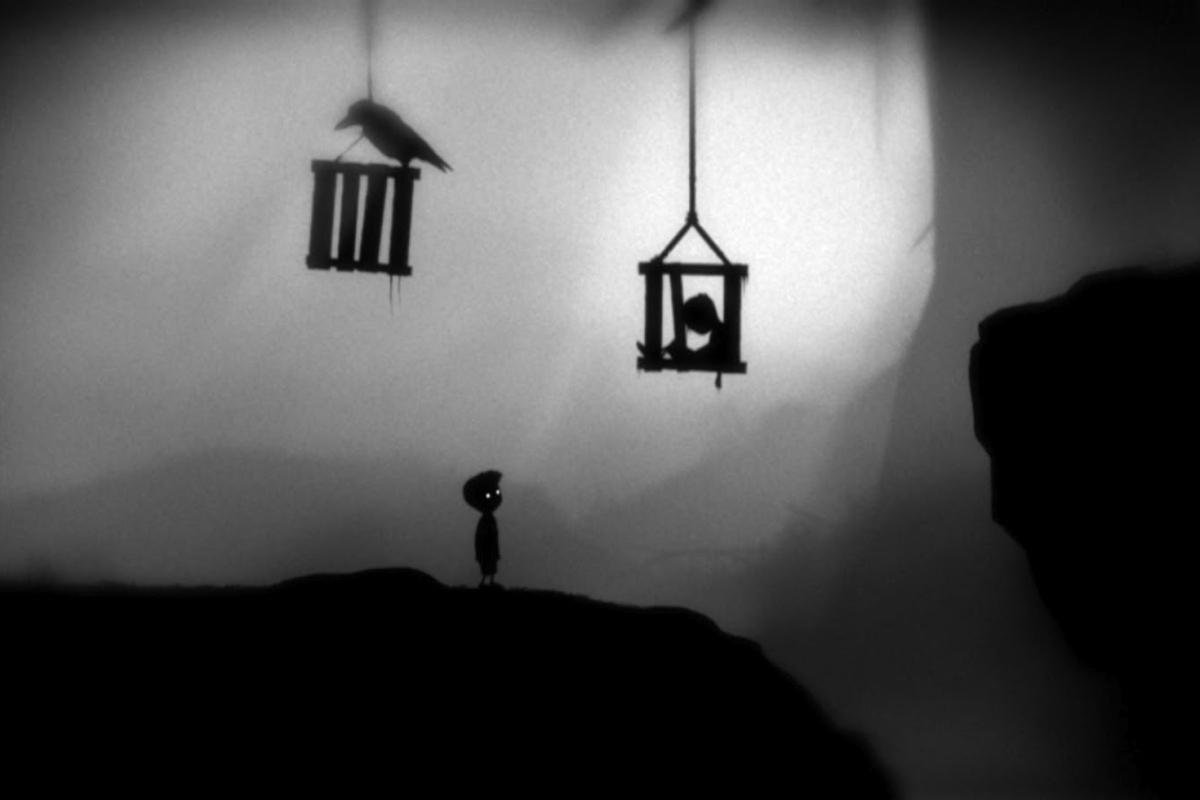
Leave it to an indie game to be clever, atmospheric, and do things that AAA titles wouldn’t dare do. Limbo starts out with just a simple message: Find your sister. No voice acting, no characters—just a black-and-white 2D platformer and a nameless little boy. This can be risky because why would you care about it with none of those elements? You won’t need to, because the game makes you care for the boy through your actions. He can be dismembered and killed in every way possible via deadly and horrific obstacles and traps like getting caught in a saw blade, getting hung, or being impaled by a giant spider leg. You cringe at every death because this is a little boy and not some nameless soldier or thug.
Limbo offers tons of atmosphere thanks to the great ambiance and visual cues that make you just wander through the whole game. The puzzles start with simple ones that deal with gravity, pushing stuff around, and pulling switches and levers. Later on, you have to manipulate gravity, and these puzzles get pretty complicated, but the game also gets darker and more dangerous as you go on. Limbo approaches typical platforming elements like bosses, enemies, and puzzles differently. Enemies are few and far between, but there is such a unique way to eliminate them that you wish there was more of it.
This short, 3-hour game feels like a sample because you really want more. The sudden and seemingly unsatisfying ending is made purposefully to just make up your own ending in your head. Yeah, this isn’t for the narrow-minded, but keep in mind that the game is juicy and gives you tidbits along the dark journey to make you feel satisfied at the end. Limbo delivers a lot more creativity and atmosphere than a lot of top-budget titles because it uses subtly over the explosion and big scares. My only issues are that some of the puzzles are pretty obscure, and the game can be very difficult in spots that will frustrate you to no end.
I also didn’t like such an abrupt ending that didn’t solve anything for you. However, this is a case-by-case basis for whether you like this sort of thing or not. The game has a lot of variety, but I wish there were some more of the unique scripted events that made Limbo feel really fun and intense.
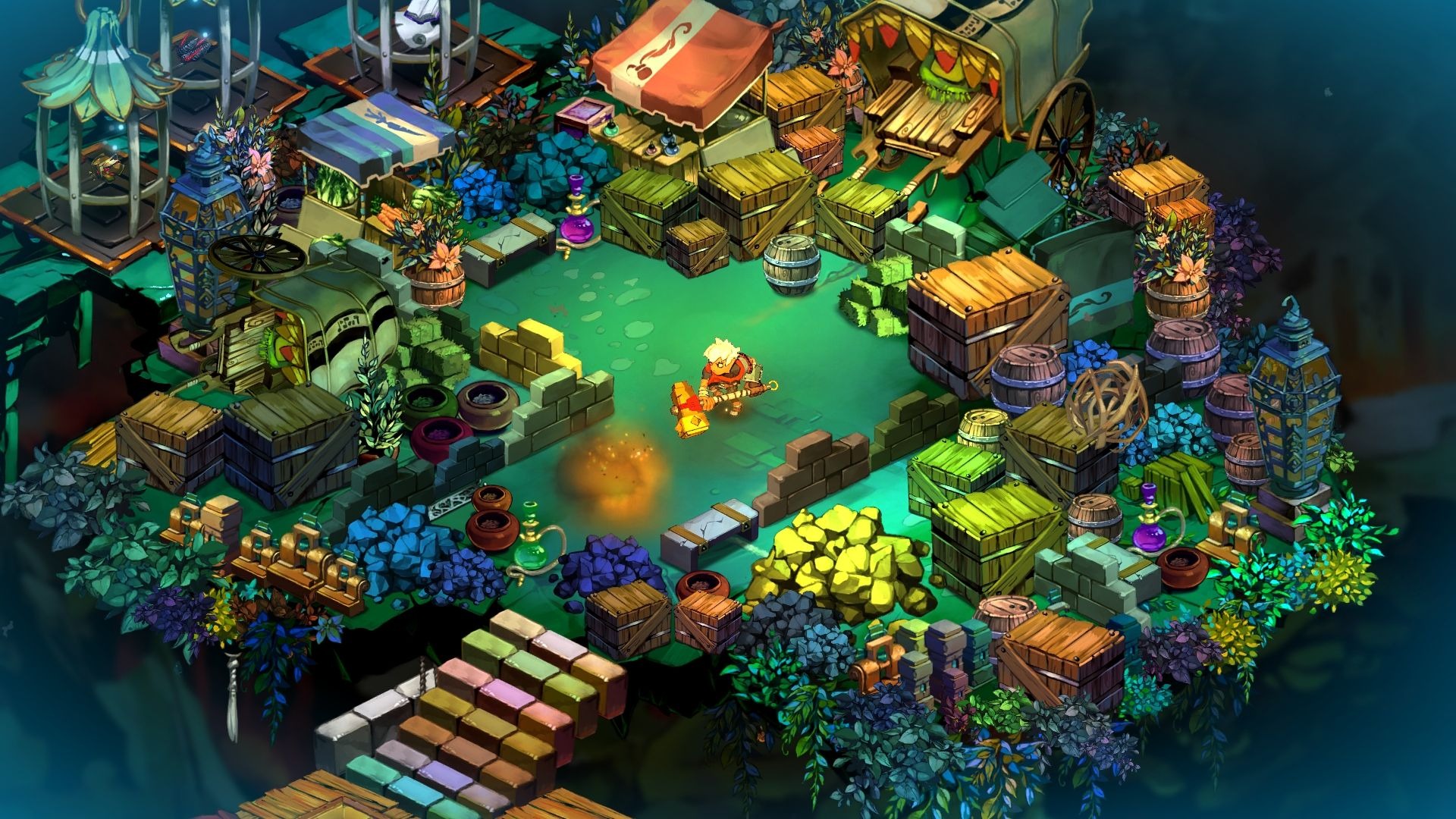
One thing that Bastion does differently from most games is its strong and unique narrative. A man narrates the boy’s every step and action in Bastion, and this is a very interesting way of telling a story. It’s like you’re playing an interactive storybook, especially since it looks like one too. You are trying to re-build The Bastion, which is a safe spot to run from The Calamity, and throughout the story, you find out what this is and why this boy is trying to find these shards to build this thing. Rucks (the narrator) guides you through the story as it unfolds, so you don’t know anything until it actually happens, like a storybook, but it’s happening while you’re doing it.
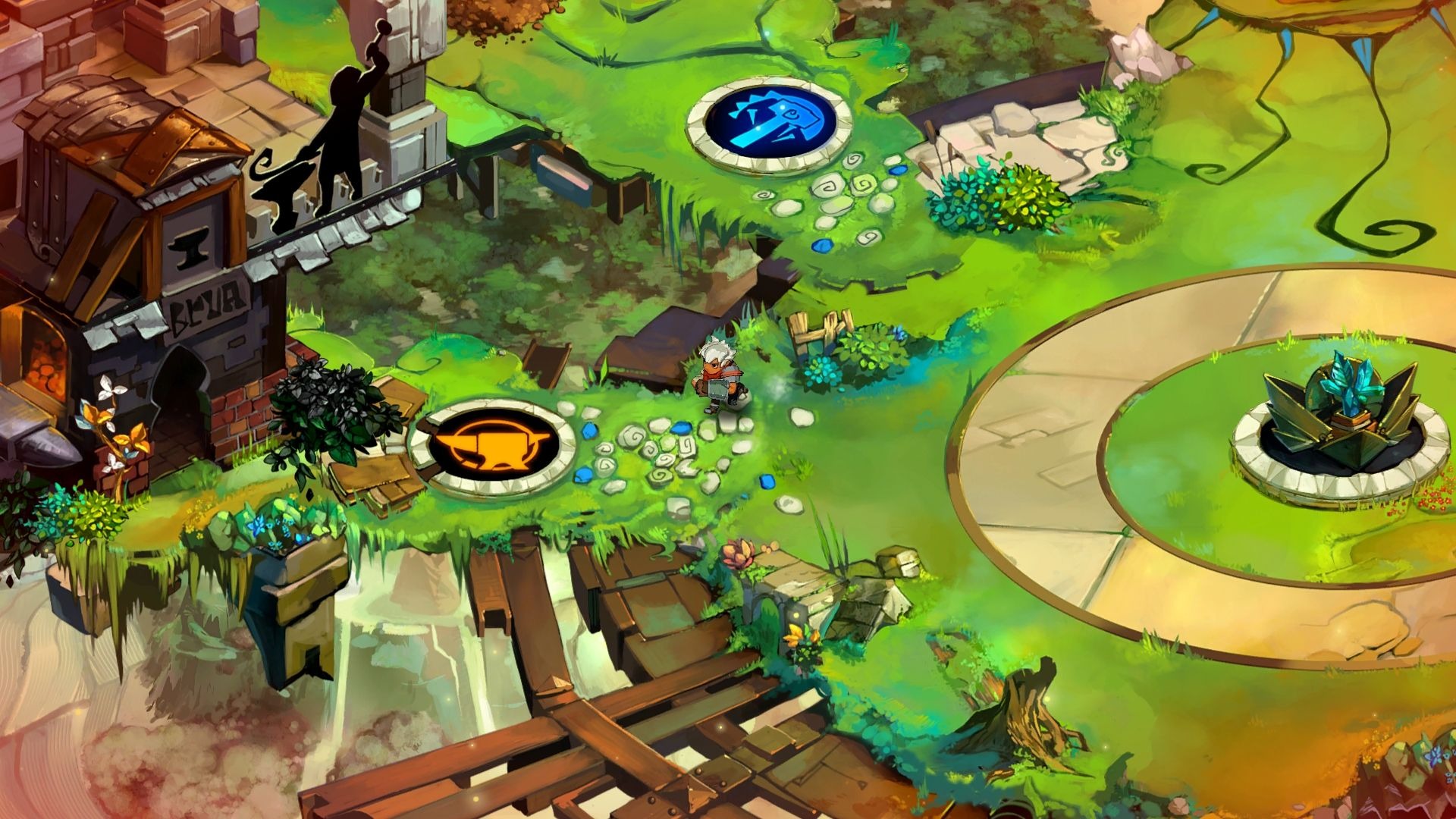
With the excellent narrative aside, the combat is top-notch and responsive. You can use a regular attack, a special attack, a block, or a projectile weapon. There are plenty of weapons, and you can upgrade them to add different attributes and bonuses. As you progress through the game, you unlock six different areas, which include an arsenal to swap weapons, a forge to upgrade your weapons, a shop to buy upgrades and special powers, a shrine to make the game harder, and an “achievement” area where you can meet requirements for extra shards (in-game currency). The customization and upgrades are deep and will keep you busy for a long while thanks to the proving grounds, which are unique challenges for each weapon. If you meet certain criteria, you get prizes based on your performance. These are not easy by any means, and a few were almost impossible to beat for me.
Combat is very responsive and challenging. The enemies are quick and smart and vary from stationary, fast-moving, slow-moving, heavily armored, etc. I should probably say that the balance is perfect, and you slowly get introduced to tougher enemies as the game progresses. You really have to use a combo of everything to stay alive because you will gulp health tonics constantly if you don’t use block and dodge a lot, so stay on your feet. The action gets hectic, and you start realizing this game is for hardcore action fans and not the casual gaming crowd that the visuals might seem to cater to.
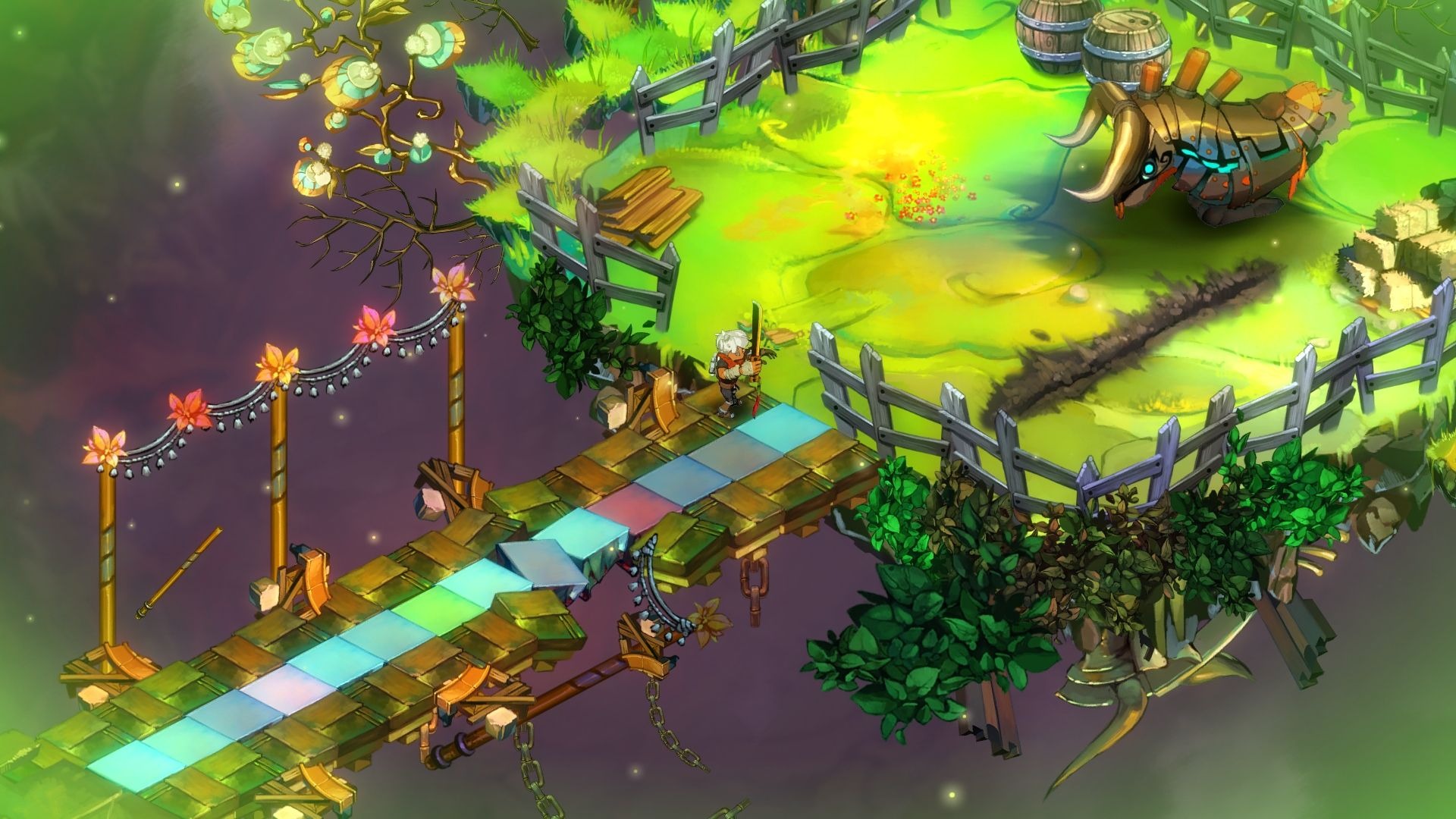
There are a lot of levels, and the length varies from 5 minutes to 15, but one thing I can’t get over is the visuals. As you run through the levels, the walkways appear under you and seem to float in the air. The levels vary so much that not a single one looks the same. The hand-drawn visuals are just gorgeous, plus you can’t forget about the amazing soundtrack, which is something you stick on your MP3 player and listen to. This feels like a high-budget game, but only an indie game can deliver something on this side of creativity and originality. Bastion is a unique game, and nothing is quite like it in terms of narrative and visual delivery. Every action fan should own this because it’s $15 well spent.
I have to come right out of the gate and say Rage is probably one of the most disappointing games I have played all year. With all the hype about the amazing and revolutionary graphics engine and weapon system that id Software (the inventors of first-person shooters) has made, you would think they would fall through. The game is completely 180 degrees from what id Software said the game would be like. The first thing you will notice is the enormous number of bugs and game-breaking glitches, especially for ATI card users. The graphics will literally be completely distorted, or the entire game will be blue. How do you fix this? Extract a file from the graphics driver update and put it in the Rage folder. Or you can fiddle around with the Catalyst Control Center, or how about the game not even running right unless you have it open? This is completely absurd and should not be like this upon release. I spent a total of four hours fixing this damn game so I could just play it. So you’re probably asking, Is it worth it?
Well, the shooting is solid, and that’s a fact. I know what they are doing, and the guns are great and super fun to use. You can upgrade them at stores in towns and use various ammo types because the enemies do need different approaches. This is by no means a straight-up stand in one area that shoots everything. You will die quickly, so use what you have available to your advantage. Guns like assault rifles use regular steel rounds and felt-rite rounds, which are more expensive but more powerful. The shotgun can use buckshot but also pulse rounds and pop rockets, which act like explosive shells. You get a rocket launcher, a sniper rifle, and a pistol that shoots four different types of ammo. There’s a decent amount of guns in the game, and you slowly unlock them as the game goes on.
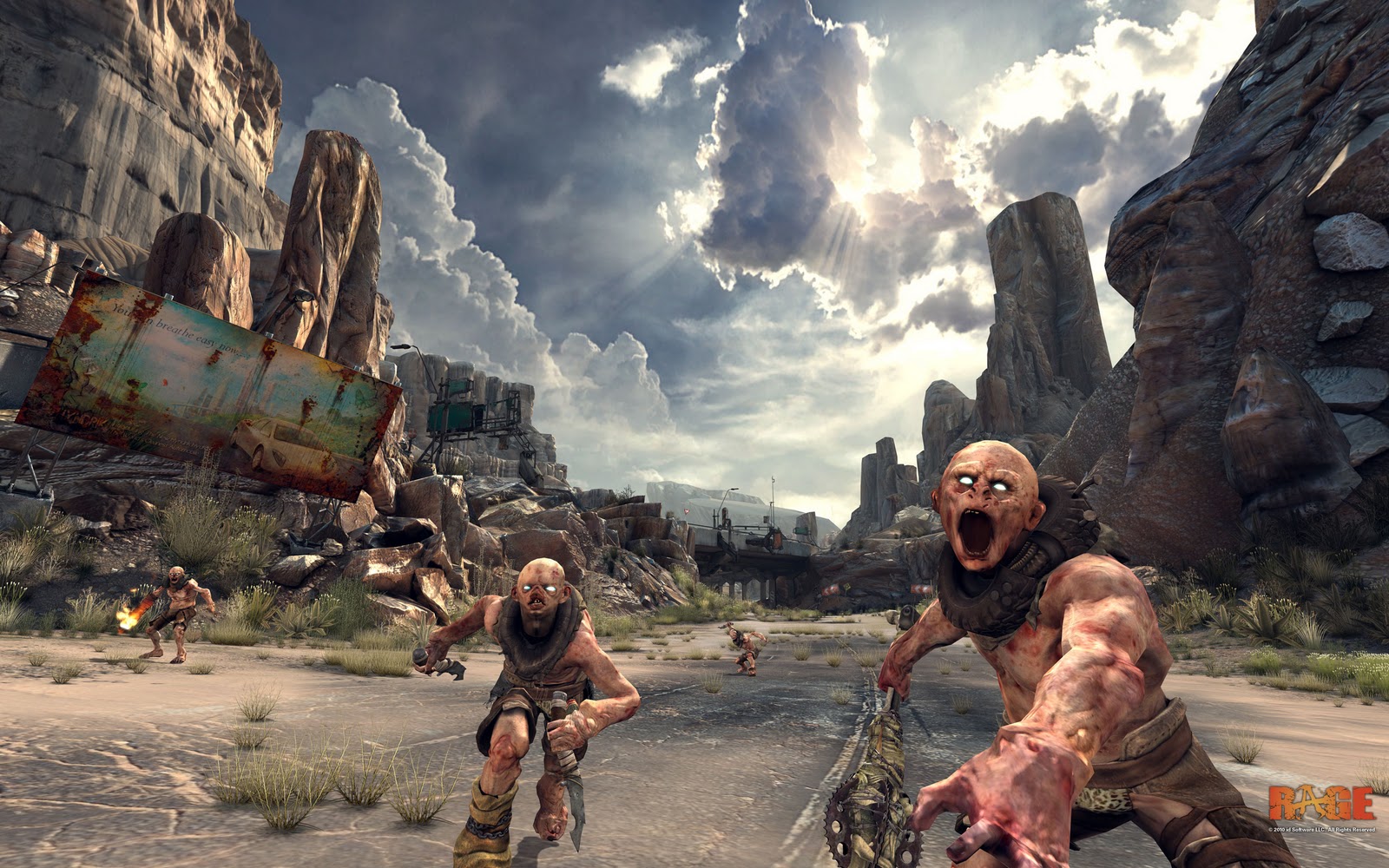
Shooting enemies is fun because each weapon packs a punch and feels good to shoot. Enemies have great animations and fight worth a damn, so the game isn’t too easy. There are even some pretty fun boss fights as well. The enemy variety is pretty low; however, you get maybe five different kinds through the whole game, with some just swapping out outfits, such as different bandit groups. The whole point of Rage is to run around the world and explore dungeons to complete various mission types. The dungeons are varied and have a lot of loot in them to engineer items such as bandages, wing sticks (boomerangs that are instant kills!), sentry bots, RC cars that explode, ammo, grenades, and a whole slew of things you can build in your menu while you’re on the field. This can be really fun and encourages exploring every corner for junk to sell or use.
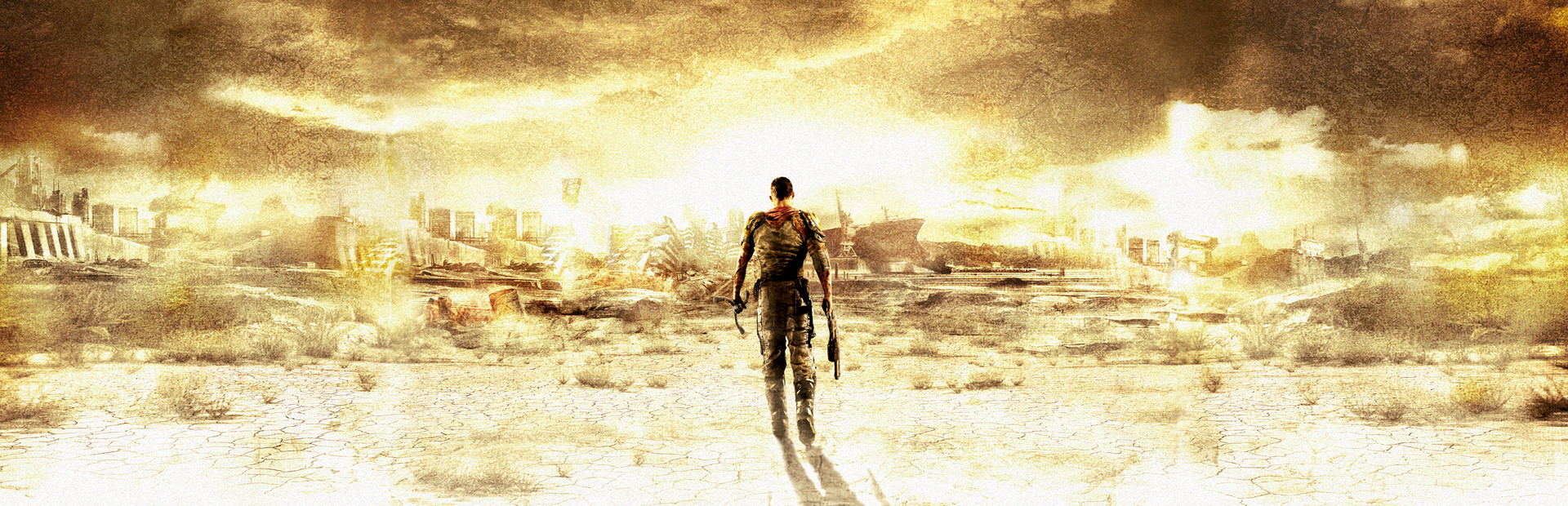
Now you’re probably wondering how the game is like an open world. While the game has a great art style and feels a lot like Fallout, it isn’t trying to copy it in any way. The game has a nice post-apocalyptic art style and has some great designs and pulls of atmosphere, but it falls short because the game has a false sense of freedom. The outdoor areas must be driven (more on car combat later) and cannot be traversed by foot because, for one, it will take forever, and on the other, cars will kill you almost instantly. The world has a lot of “hallways” that you can drive in that lead to each dungeon, but by no means is it a free, open world like Fallout at all.
This tends to be very depressing because you can see all this great open land, but it’s barren and closed off by cliffs and walls around you. I mean, there are only three towns in the whole game, and they are spread out in two different areas that you have to load between. There are a nice amount of side missions as well as races that involve over-hyped car combat. You drive your car, which controls very well, and do various races to earn certificates to upgrade your vehicle so you can survive out in the “wasteland.” The combat is fine and all but mainly serves as just a way to get to your missions in the “open world” because car combat out here is far and few between.
I also had a problem connecting with characters because you don’t talk to them much and they really just give you missions. I also had a problem connecting to the story because, while it has potential, it falls short with a terrible and lame ending, plus it just ends abruptly with a poor final mission with no boss fight. Some of the side missions are probably more interesting than the main missions. Overall, you’re looking at a 15-hour campaign, even if you complete every side mission. I also have to mention that the graphics look good, but there are better-looking games out there thanks to Rage’s weird low-resolution texture problem, but there are some really nice lighting effects throughout.
Overall, Rage is a buggy, broken technical mess that most people will just give up on. However, the game has solid shooting, excellent weapon design, and engineering stuff that is really fun. The false sense of freedom and so-so car combat really bring the game down to just a mediocre experience that will not leave an imprint like Doom or Quake did all those years ago. Sorry, id, but try again.
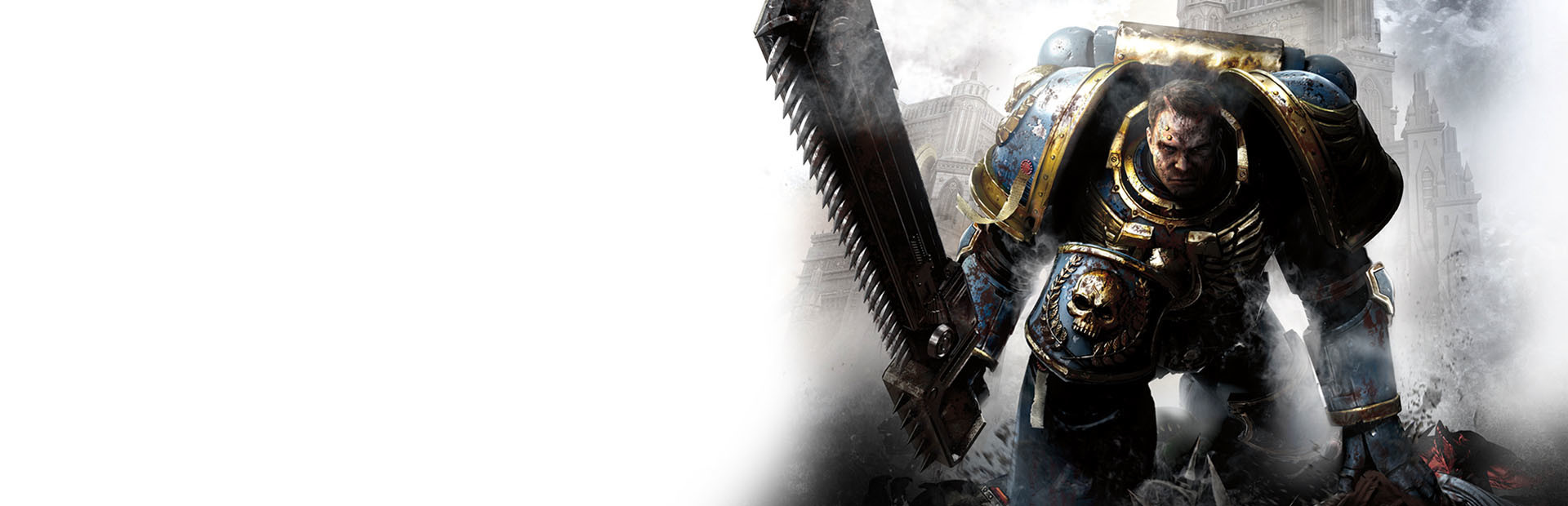
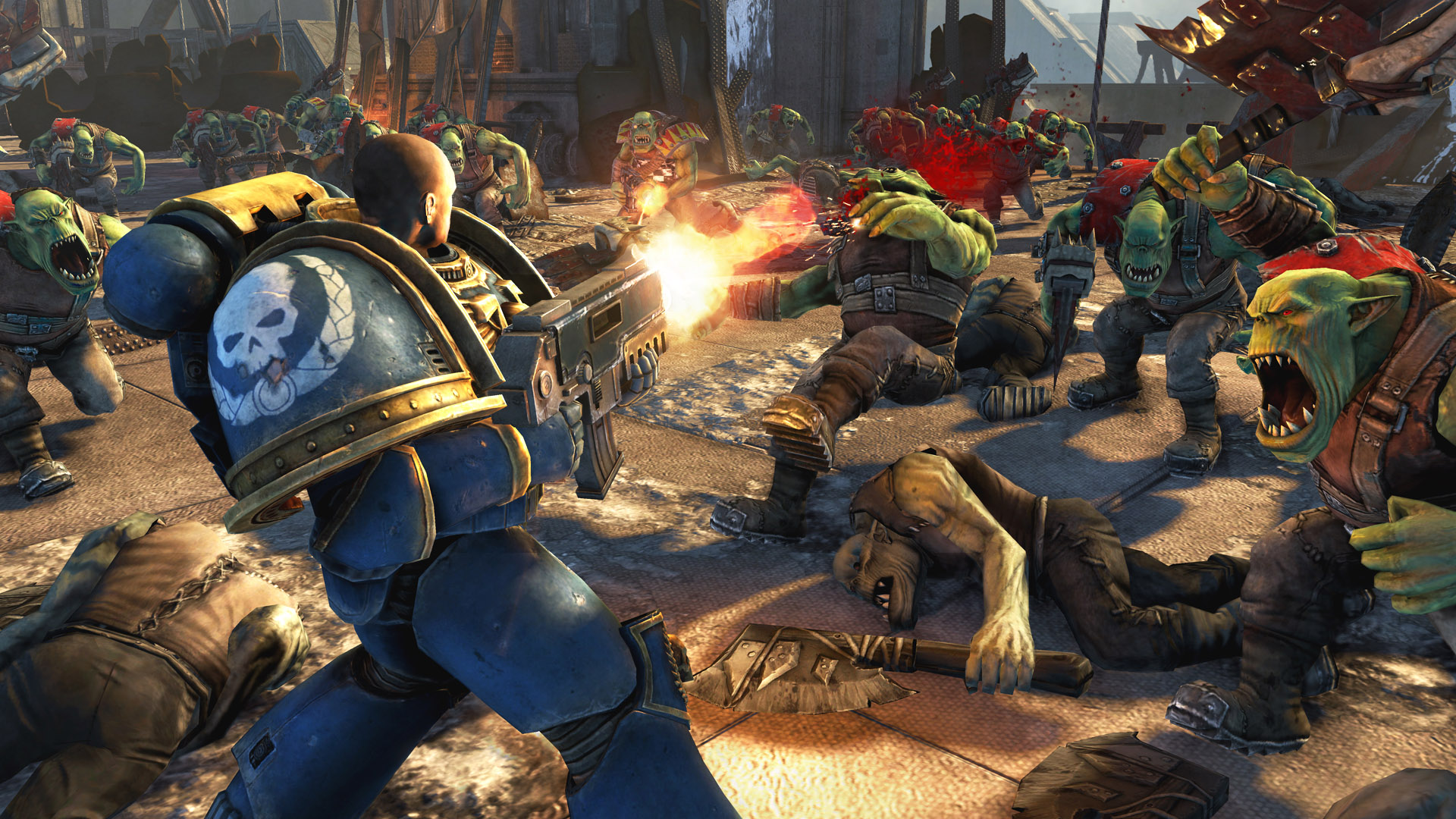
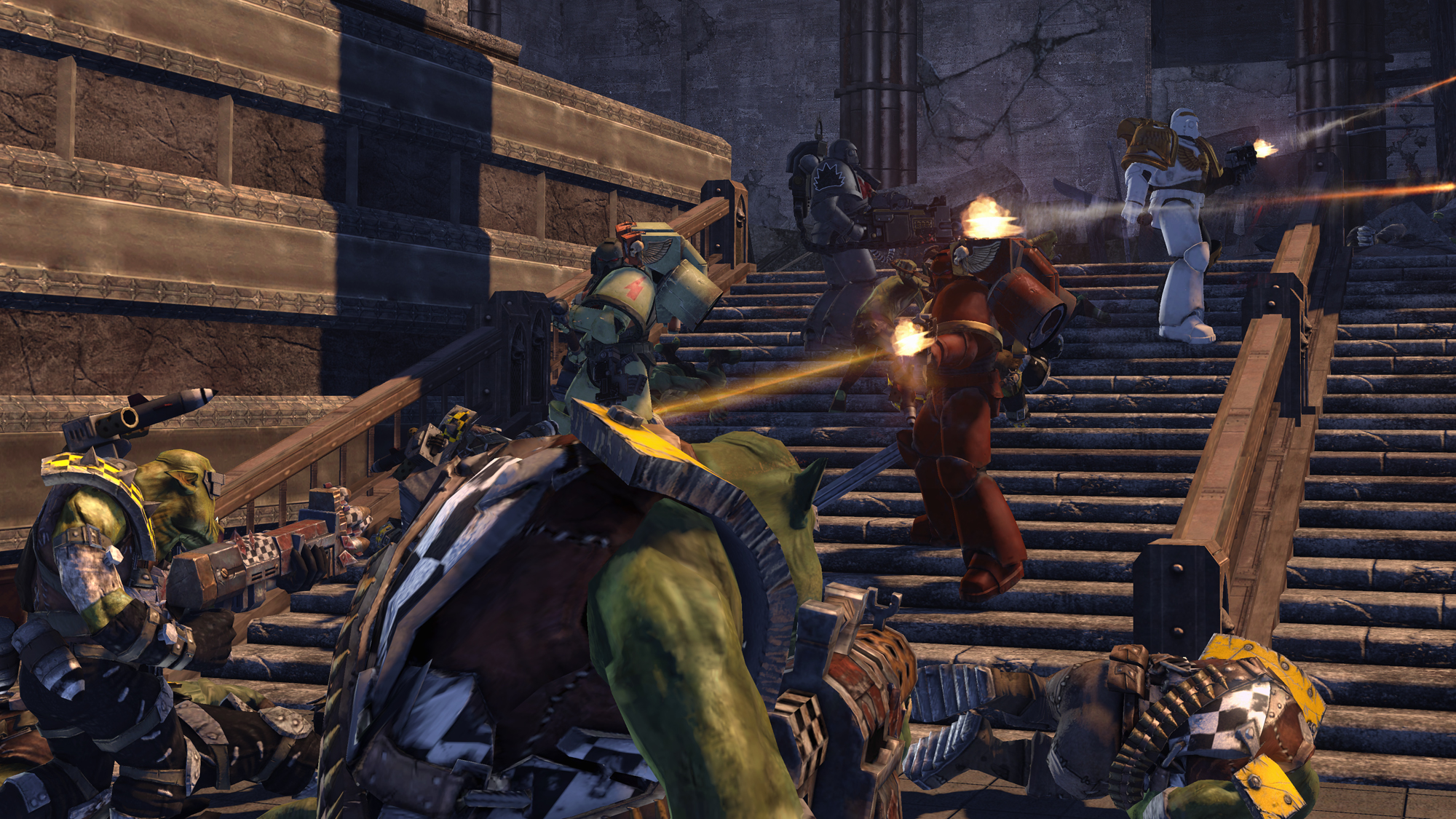
The Warhammer series is an extremely expensive tabletop game that has grown to be more popular as an RTS game than anything else. Space Marine is the first outing in the genre, and with lots of speculation, it was deemed to be a complete failure. Relic proved everyone wrong by delivering a good game that has tons of action, gore, and a good story that the RTS games pack in. You play Captain Titus of the Ultramarines. You are the leader of the elite force, which is part machine and can take out whole battalions of troops that regular marines couldn’t. The Space Marines believe in the religion of the Machine God, and anything else that isn’t machine-related is heresy. You and your three squadmates are fighting back the Ork invasion and are trying to reach the Titan Manufactorum, which holds the most powerful war machine ever built. On the way, some weird twists happen, and you end up fighting the Order of Chaos and Daemons towards the end. How that happens, I’ll let you find out for yourself.
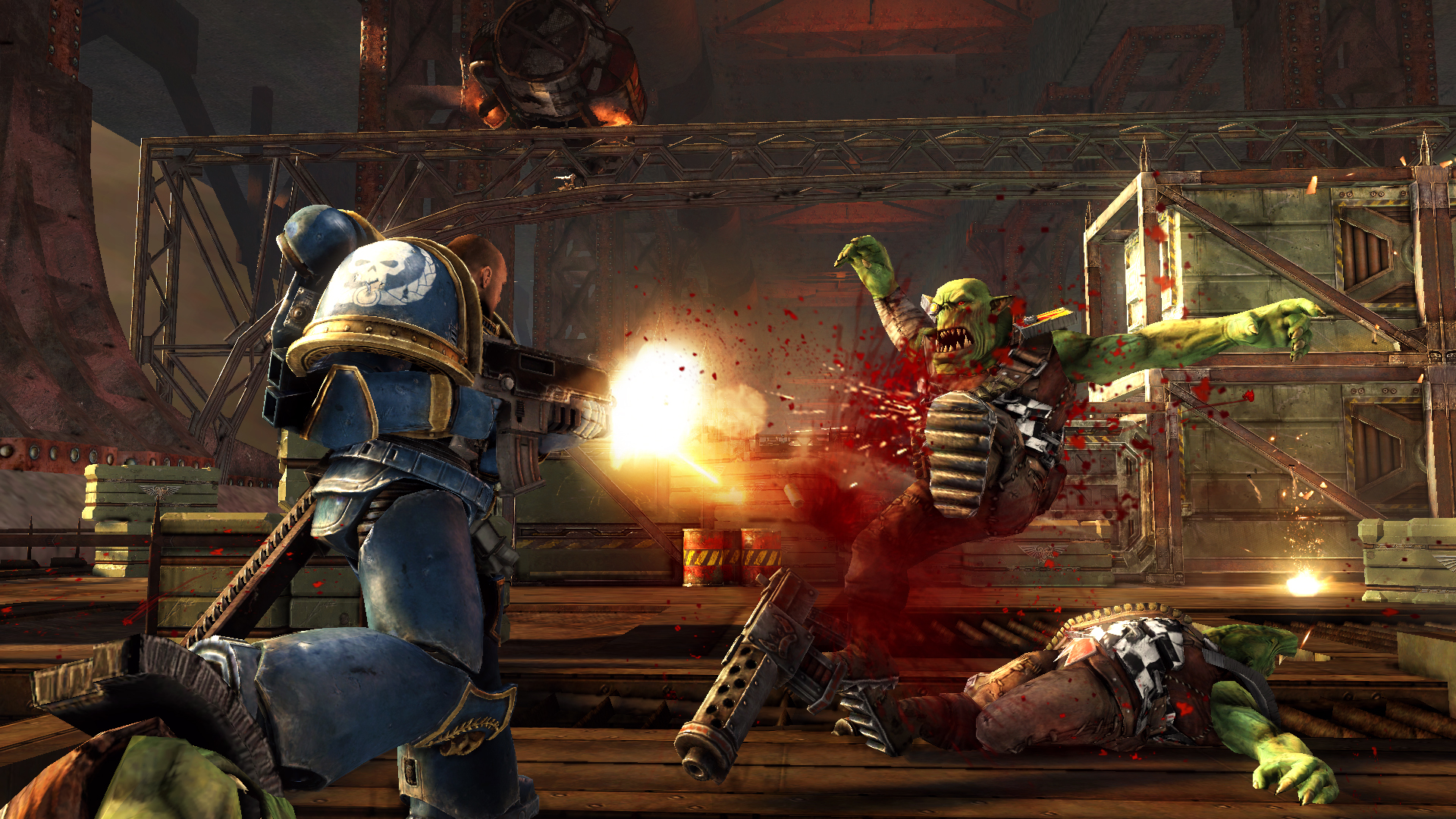
The story is decent, not very deep, but it’s entertaining, and the voice acting is superb. Relic got the art style and feel of the Warhammer universe across, so the game looks good, but technically it’s nothing special (using the Unreal Engine 3). The fighting system goes two ways with melee weapons and guns. There are a lot of cool guns to shoot, and they are unlocked slowly throughout the campaign. They each feel different and powerful, and you have to mix up your strategy of how you’re going to use what weapons for what situation. You can’t just use the same ones throughout the whole game. The melee weapons are smaller in number but just as cool to use. The chain sword allows you to tear enemies to shreds, and executing awesome kill moves is fun. This is actually how you get healthy, but it’s flawed in a way. When no ground enemies are around, you can’t heal and have to rely on your shield charging, so it’s a unique idea, but we need a way to heal up when fighting aerial units. You also get to use the Thunder Hammer and the Axe, which are all great weapons to use, but the hammer only lets you use the pistol and bolter, so no heavy weapons can be used (I’m assuming a balancing issue).
While you chop down Orks by the dozens, you will get to use the jetpack a few times. Launching into the air and pounding the ground while enemies fly around is great, but you don’t get to use it enough. What is enough (actually too much) is everything else. The same orks come at you through 2/3 of the game, and the same execution moves are repeated over and over again. By the time you get 1/4 of the way through the game, you wonder if there is anything but Orcs that exists. A few different types show up throughout, but not many, and the game just gets harder and harder as you go along instead of throwing in variety. Towards the end, you can’t really do much melee, and you start relying solely on guns because charging in will just get you killed. I didn’t like this form of balancing because a melee is much more satisfying and fun than shooting everything.
Overall, the game would have been even more amazing if there were some scripted events instead of just the same run-and-kill scenario over and over until you puked. The multiplayer is ok, but just has two modes and gets boring after a while because it’s the campaign, but with human players. I loved the characters, story, and world of Warhammer, but let’s add some more depth to the action, some more enemies, and make the game feel more intense, besides ramping up the difficulty. We didn’t even get to use the Titan! Sure, you get to be on top of it for a few minutes, but these are the events we need to make Warhammer an amazing action experience.


















































 thebinarymessiah.com
Super, thank you