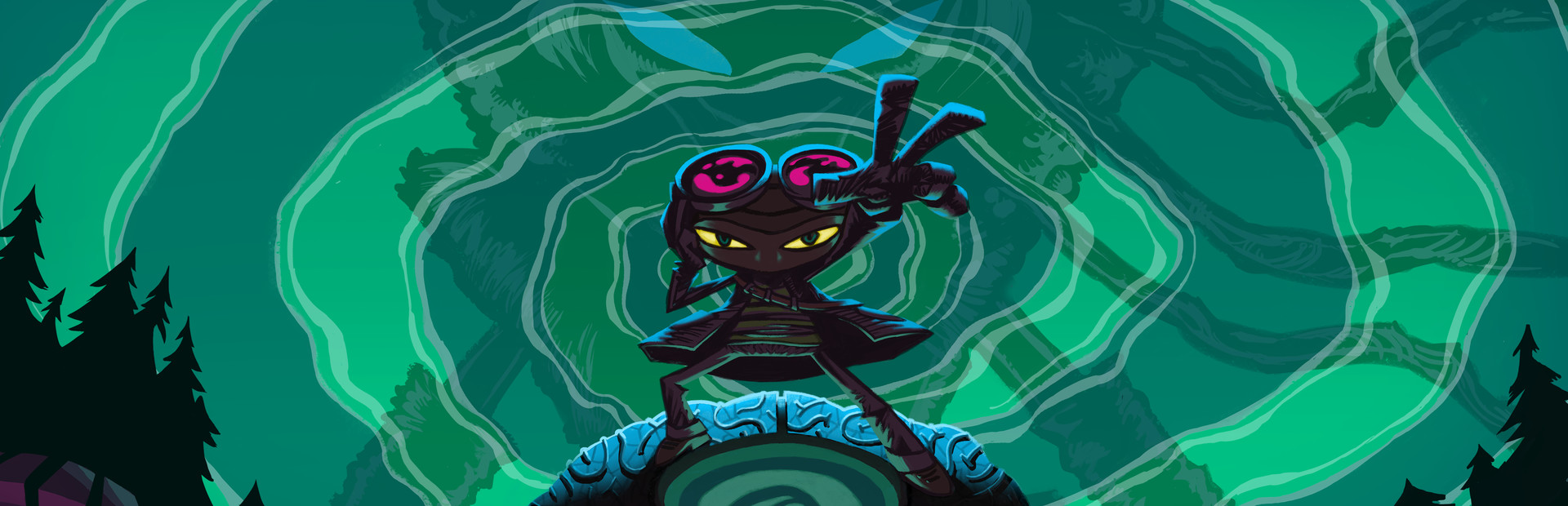
If you were really into gaming back in the mid-2000s, then Psychonautsis a game you either played or heard of, and that’s thanks to Tim Schafer’s voice being heard. The game was critically well received but sold poorly due to a lack of advertising and support from the publisher. The game was great on PC and Xbox, but didn’t do so well on PS2 due to the system’s lack of power, framerate issues, and downgraded visuals. A few years later, a petition was released to put the game on Xbox Live Arcade for the Xbox 360. I remember signing that petition, and that’s how I finally played the game. It was visually brilliant, but it did have issues with the camera and felt a bit repetitive.
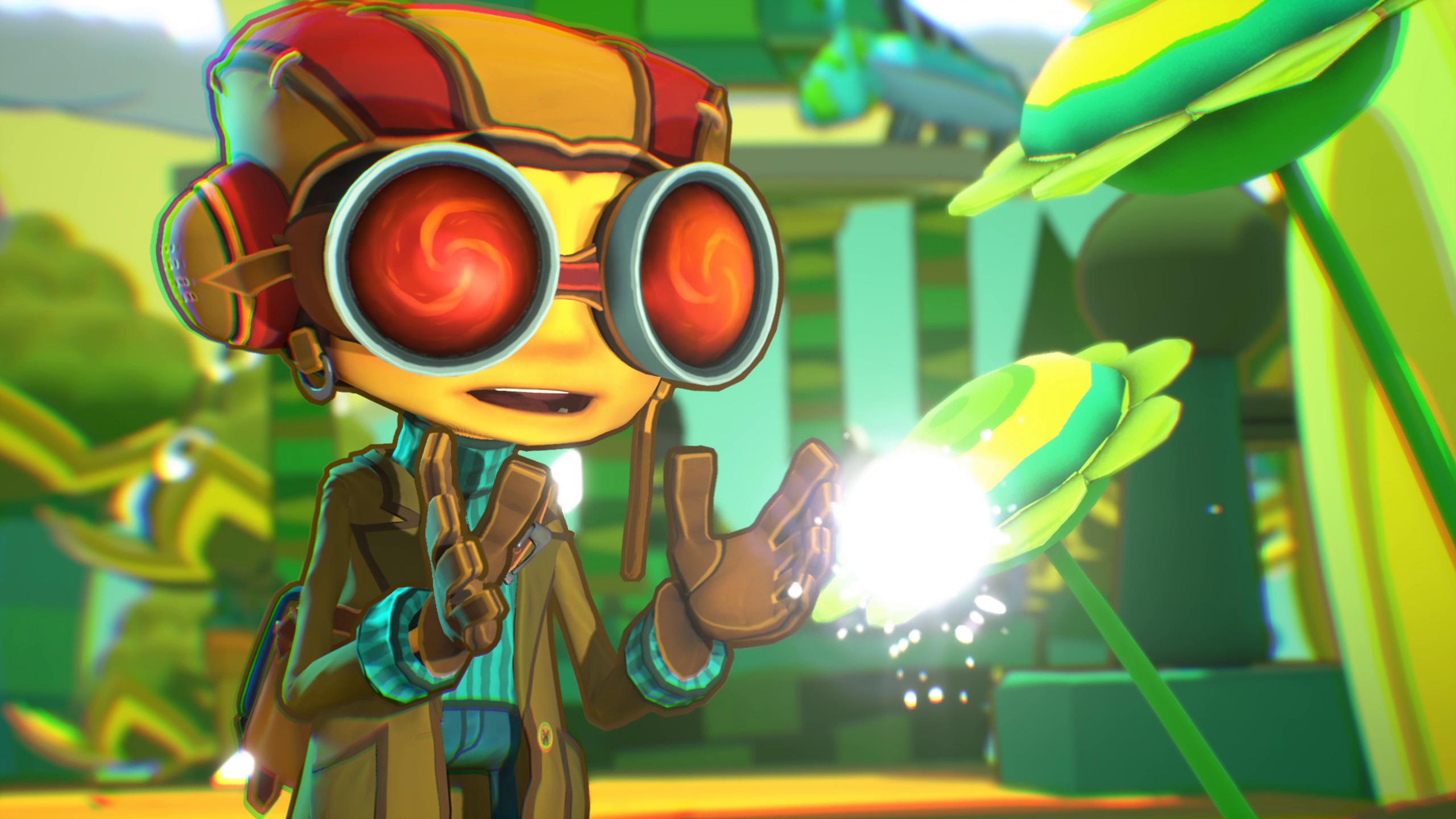
Here we are 15 years later and that same brilliance has happened again. You play as Razputin, a large-headed boy whose dream is to be a Psychonaut. This team of mind-bending heroes is trained to enter people’s minds and rid them of anything dangerous and help people get back to being mentally more stable. I won’t spoil the story and tell if Raz gets in the Psychonauts or not, but the game’s main hub is the Psychonaut headquarters. The story itself is entertaining with the main villain, Maligula, who needs to be stopped before she…does something. It’s never really told what danger Maligula can do to the world as Psychonauts‘ story solely focuses on just the team and never anything outside of it or how they affect the world around them. It feels like a very claustrophobic world and seems a bit strange to be like this, but the voice-acting is wonderful and the dialog is clever and witty at every turn and it never misses a beat. While the story feels a bit rushed towards the end and feels a little too convoluted for what it is, it’s entertaining and all of the characters are a joy to see on screen.
Psychonauts‘ combat has always been something to be desired and kind of takes a back seat to platform and that’s the same for this game. You get one melee button and have to use other Psi-Powers in tandem with this and it feels too easy and a bit lazy. Most of the Psi-Powers aren’t useful in combat so I just stuck with Psi-Blast, Telekinesis, and Pyrokenisis which sets things on fire. Enemies are either too easy or are just damage sponges and towards the end of the game, it really feels unbalanced and just an annoyance. While the combat plays well and there are no control issues, it just feels like it needs more work if there is going to be a sequel. Bosses also just felt like damage sponges and aren’t really challenging. Even the final boss is a push-over. Thankfully the game mostly focuses on platforming.
With that said, platforming and collecting are where Psychonauts shine the most. Each level oozes personality and style. The art in Psychonauts 2 is absolutely gorgeous, with some of the most creative levels you will ever see in gaming. This is art in raw video game form, and they just don’t make them like this, especially in AAA form. Most of the Psi-Powers are used for platforming, and this is another issue with those powers. They are either really useful for a few things or useless for everything but one thing. Projection is gained last, and towards the end of the game, it’s mostly used for that level and collecting a few items in others. Mental Connection is used to swing between nodes; Time Bubble is used to slow down spinning fans and platforms; and Clairvoyance is mostly used to read people’s minds for fun and use their eyes to find treasure in hub worlds. Despite this, you can collect 2D Figments, which are colorful sprites scattered around; emotional baggage and their associated tags, which are needed to collect the bags; memory vaults; relics; and others. You can skip all of this, as it’s mostly for completionists and achievement hunters, but you’re missing out on most of the more difficult and fun platforming if you do. The hub areas, of which there are four, have Psi Cards, Half-A-Minds, and Psi Ranks to collect. There are vending machines to spend the cards on, and you can use Psitanium to buy pins that passively enhance some Psi-Powers, but I felt this was a last-minute tacked-on feature since the combat is already easy.
With that said, the game’s art style is bananas. It feels alive, and there’s so much detail in every single level, and neither level is the same. There’s a 60’s-style acid-induced mind-trip level, an amusement ride level, a library, a hospital, and others. They all feel unique, and I couldn’t wait to see what the game brought next. While the story does feel convoluted, it’s still entertaining, and seeing the characters on screen was never dull. While most people will skip all the collecting, you miss out on a lot as you won’t see what all the levels have to offer. This is interactive art, and there’s no denying that this is just one of the most artistically impressive games to be released in the last decade. While it’s not technically impressive since it uses Unreal Engine 4, it still looks good with great textures and good lighting effects, and there were no bugs in my playthrough.
Overall, Psychonauts 2 is a mascot platformer dream, and you only get these games once a decade these days. While indie games have taken over this hole in the gaming space, it’s nice to see larger-budget AAA games do this too once again. The story is entertaining, albeit a little too claustrophobic in its world-building and convoluted for what it is, but the character writing is clever and the voice acting
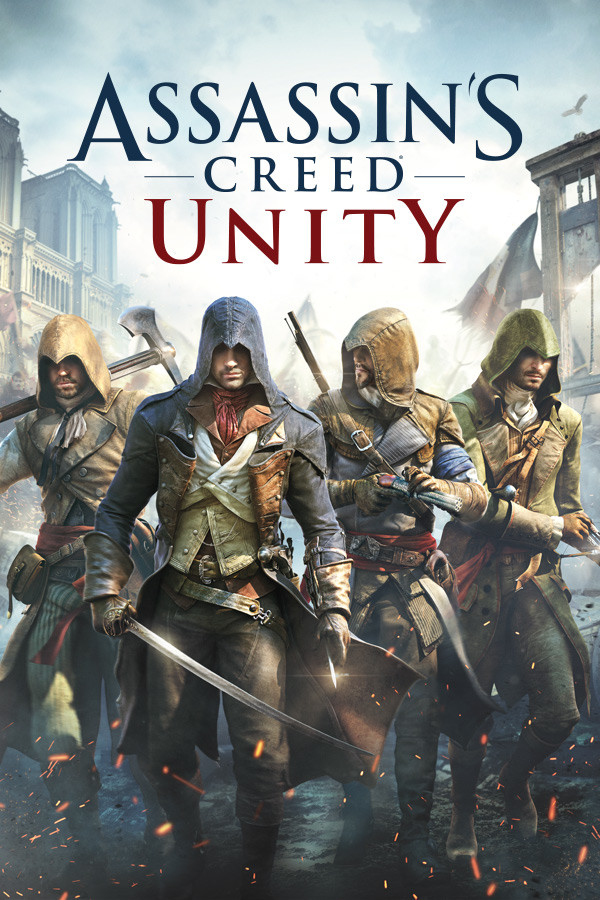
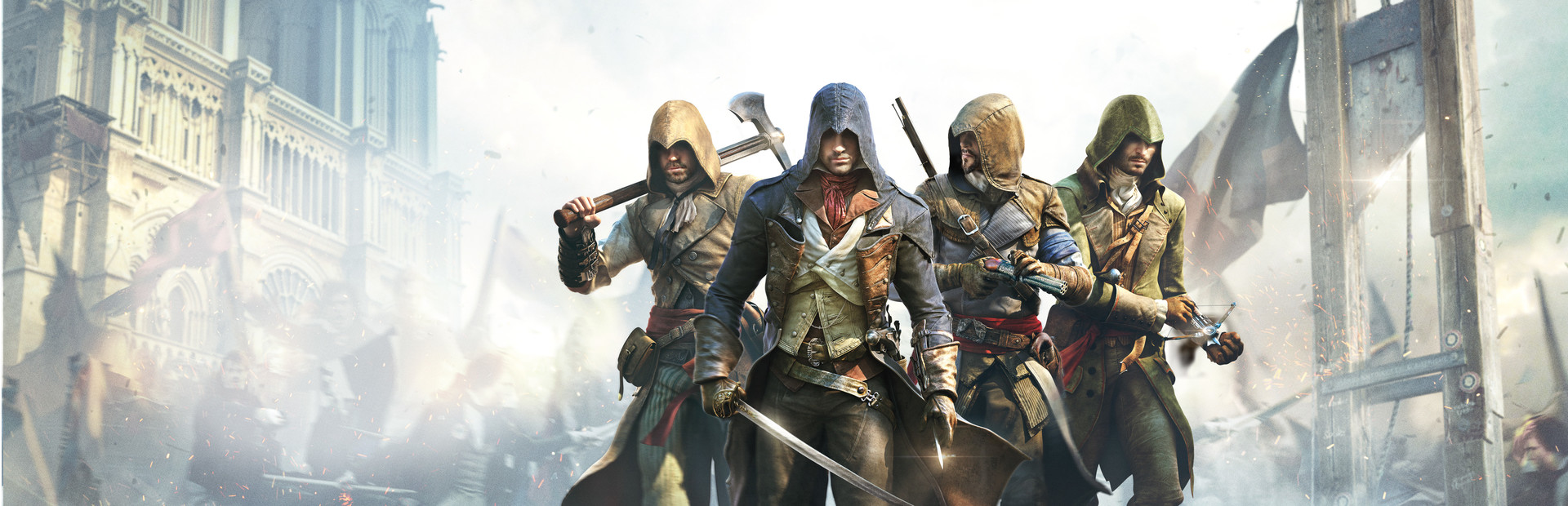
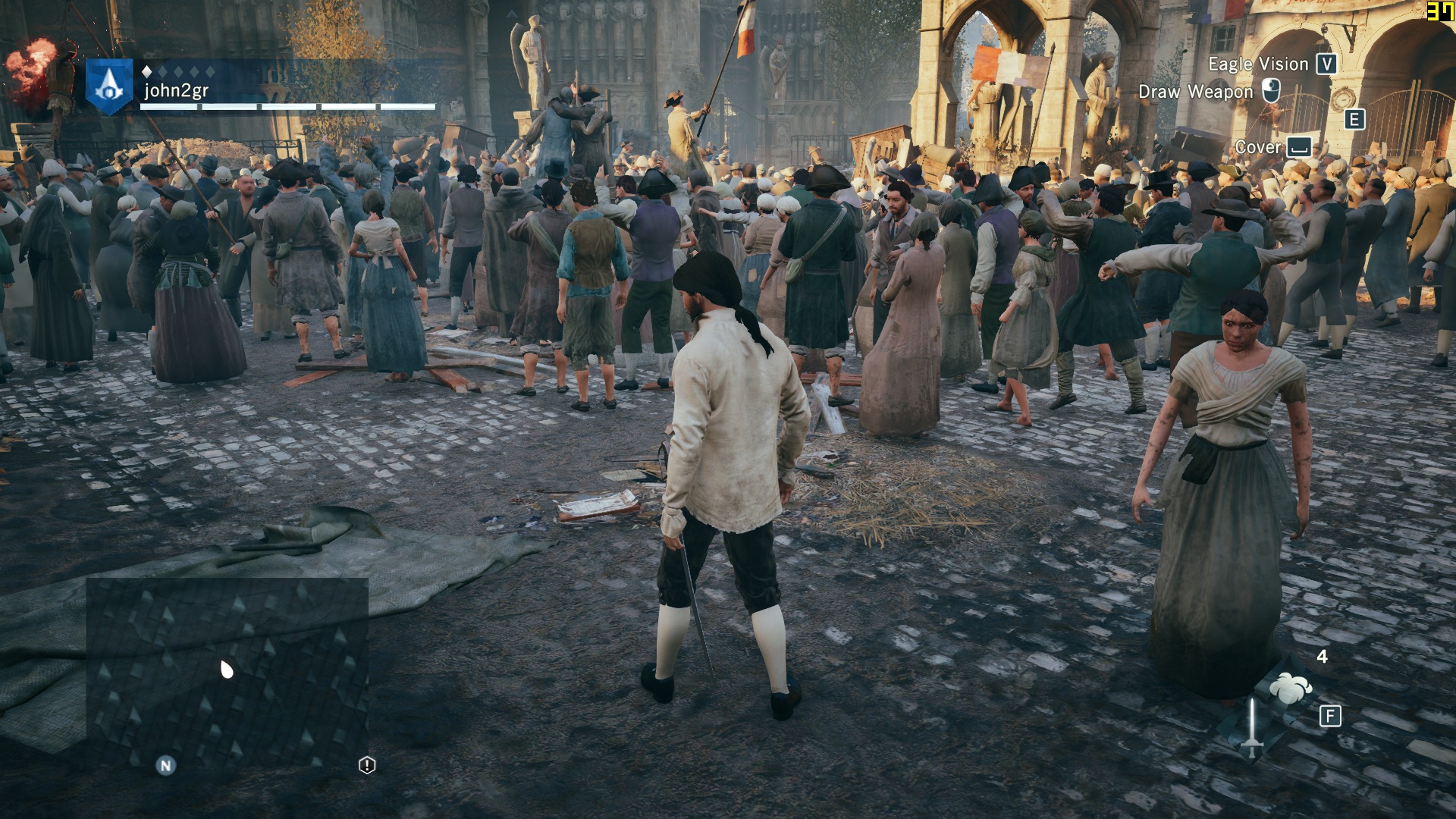
Up until this point, Assassin’s Creed had pretty much overstayed its welcome. With the release of Rogue, it was clear Ubisoft was just wanting to use the series as a yearly cash grab. While no single game is inherently awful or bad, the formulaic nature of every game playing nearly the same but with new characters and stories just wasn’t appealing anymore. The game was starting to feel less unique and made from love and care and more like just copying and pasting and inserting a few new characters. Unity was the series’ first next-gen outing with updated visuals, mechanics, and co-op. Unity scales the series back to its roots and focuses solely on the narrative and less on varied mechanics. For instance, naval battles are gone as the game focuses just on Paris, set during the French Revolution. So, like in the original games, we get to run around a large town area full of chests, side quests, and things to collect to gain money to buy customization pieces. Then there’s the meat of the game, which is the story missions.
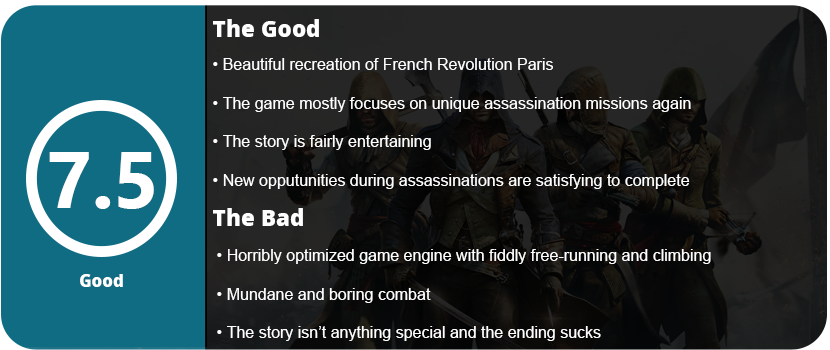
Honestly, this is where AC shines best—just a large, historically accurate city with fun story missions and a few side quests. Unity’s side activities are abundant and completely optional. These range from various co-op quests to helping solve mysteries using your Eagle Vision to finding chests that contain various amounts of money or customization pieces, emblems, and secret relics. I personally feel there’s too much here, and it’s all padding and filler. I spent a couple of hours doing these activities just to try them out, and they don’t interest me at all. Once you finish the game, there’s no reason to keep playing unless you’re a completionist and want to hunt for achievements. The series has always been great for that.
Unity has a five-tier difficulty system in which missions are rated from one to five diamonds. Of course, you can increase your rank by buying or finding better armor pieces and weapons. You also need to buy skills to increase this rank. I finished the game at rank four and never found the game overly difficult combat-wise. You should never engage 8–10 enemies anyway, and that’s been a rule in the series since the beginning. The skills you can unlock are rather useful, and some are acquired just by playing the game. Poison darts, health, lockpicking, and various things like these have been done in the series before, and at this point, I don’t find it necessary to lock these things away anymore. Just give them up in the beginning and let me acquire armor pieces. It’s just another excuse to pad the game and make you finish missions for skill points. The only reason to acquire franks in the game is to increase your ranking and allow you to buy armor and weapons; however, this is completely optional. You should be at least rank four by the end of the game, but I didn’t have to end up buying much.
The story itself is decent at best. At least we get to see Arno rise and fall as an assassin and regular person. You start out playing through Arno’s childhood and how he discovered the Assassin Brotherhood, and he is on a path of vengeance to kill the murderer of his father. You also have a love interest, Elise, whom you knew as a child, and the strife they go through is okay. Unity’s story was never gripping or kept me on the edge of my seat. There were a few twists and surprises, but nothing amazing. The ending is rather disappointing and typical. The “real world” here with Abstergo mostly takes a back seat, and you never control any character like you did with Desmond. It’s told through dialog and pre-rendered scenes. It’s mostly pointless, and I wish the series would just get rid of this part of the story. I say this in every AC review I do, and I’ll keep saying it.
Sadly, while it did go back to its roots in terms of scope, the game still has mundane, boring combat. The animations are silly with weird clipping issues, and the game is still just a parry fest. You can unlock heavy attacks, but when the enemy’s life bar flashes yellow, you parry and attack. Its uninteresting and head-on combat has never been the series’ strong point, as it should be avoided. Most of the missions require you to find a target, assassinate them, or find your way into a stronghold and gather evidence for something. Eagle Vision is key here, as it lets you see enemies through walls and tag them on your mini-map. As the game progresses, these strongholds get tougher, bigger, and more confusing to navigate. A new addition to assassination missions are side objectives that allow you to make the hit easier. There is usually one assistance and assassination opportunity that requires extra thinking and legwork. Sure, you can just charge in and kill the target, but usually, in later levels, there are just way too many enemies around, and you will never even make it. You also can’t finish the missions unless you’re anonymous, so the target will lay there. You then have to run away and work your way back without being seen to finish the job. It’s best to just do it the correct way the first time around, and it’s satisfying every single time.
I found these side objectives to be rather neat and fun. Sometimes you can free some people to start a distraction and clear out an open courtyard, which gives you quick access to the target. The assassination opportunity puts you right in front of your target without being seen. One mission had me kill someone attending a ball in a mansion. I freed a fireworks cart that would force the target out of the ballroom and into the hallway, which let me blend in with the crowd and kill her without fighting through guards. Some of these were fiddly, and you have to be in the right position at the right time or you will blow it, so a lot of trial and error is still needed, which can be really frustrating but satisfying once you figure out where the target is and the quickest way to get to them. I did find that traversing the buildings can still feel finicky and too sticky. Sometimes I just wanted to hop down to go to a specific platform, and Arno would hop around like a bunny and jump down or go up to something when I just wanted to run straight. It made me fail some missions, and this is still an issue that needs to be addressed.
The visuals of Unity are outstanding, but it’s a technical nightmare. At launch, Unity was one of the most broken games to ever be released, and while now it’s been patched up just fine, the engine is horribly optimized and runs like garbage even 7 years later on new hardware. The anti-aliasing is a resource hog, and I had to turn it off just to get 60FPS on an overclocked RTX 2080. Back in the day, it was impossible to run the game maxed out and get 60FPS, and it ran even worse on consoles. At least Paris is beautifully recreated, and the historical buildings look beautiful and are fun to explore. Everything just looks so good here, but at the cost of a terribly optimized game engine.
With that said, Unity isn’t the worst AC game, but it’s not the best either. I appreciate the return to simpler times with just a core story to focus on and one city to explore on foot. There are still too many side activities to pad the game, and the ranking system is guilty of this as well. Combat is still boring and rough-looking, and climbing around things is sticky and fiddly. While the new opportunities during assassinations are fun to accomplish, it makes the trial and error that much more prominent and frustrating, despite the satisfying pay-off. Unity is worth a play-through if you
Here we are, another year, another Assassin’s Creed game. Having to actually say this is just sad as Assassin’s Creed has always been a good series. The games are high quality, play well, and look amazing for their time, but when you release that same greatness over and over with only minor changes it can grow tiresome. I was personally done with AC when Black Flag was released. I just couldn’t get through it. I already played them all up until that point and I felt AC3 hit the series peak, but they had to keep going.
Syndicate doesn’t do much new, but as it’s the last of the “older AC style games” it does everything very well but is also a little too familiar. While we do get new characters and the continued “real-world” story of the Assassins vs the Templars, the most interesting part of any AC game is the historically accurate world you explore. This time its 19th century England, specifically the London area and surrounding cities. You play as two characters this time, Jacob and Eevie Frye who are rogue assassins that are trying to stop the Templar plot in London. The main villain is Starrick who is pretty decent and well hated, but overall, the actual story is not much to really care about as it drags on a bit too long and takes forever to really go anywhere. Most of the game is just interaction cut scenes on what to do for the current mission and very little progression overall. Eevie is trying to obtain the Shroud relic which grants eternal life and Jacob doesn’t believe in the relics and pieces of Eden and wants to just stop the Templar threat. Both characters play exactly the same minus a few skills, but Jacobs’s missions lead him on a separate path.
Assassin’s Creed has been slowly eeking in RPG elements over time and I hate them. It doesn’t belong in this game at all and it really shows here. The entire map is sectioned off with leveled areas up to level 9. Of course, story missions also require you to be at certain levels and the only way to level up is to complete missions and use your points in the skill tree. Once you acquired enough skills, you will level up. The grinding isn’t too bad here, but a few times the story missions didn’t give me enough XP to level up, so I had to end up liberating sections of the map. This is where the game really becomes formulaic, and you can see the series has hit a brick wall. Each side’s mission that requires you to liberate an area repeats throughout the game. The missions range from assassinating templars to bounty hunts that require you to kidnap the target dead or alive, then there are child labor camp liberations where you just have to assassinate the foreman and free the children, and there are gang strongholds. The gang in this game is the Blighters, and they all dress in red, so they stand out. You just need to kill everyone in these areas. Once you liberate all areas of the city, you then have to fight the gang leader. You get an opportunity to do it out in the open, but more often than not, the thugs will take you down, as there are so many of them. Whether you kill the leader or not, you have to challenge the gang to a stand-off and just eliminate a bunch of them in a closed-off area. Once that area is 100% liberated, you can recruit those green-dressed members to fight for you.
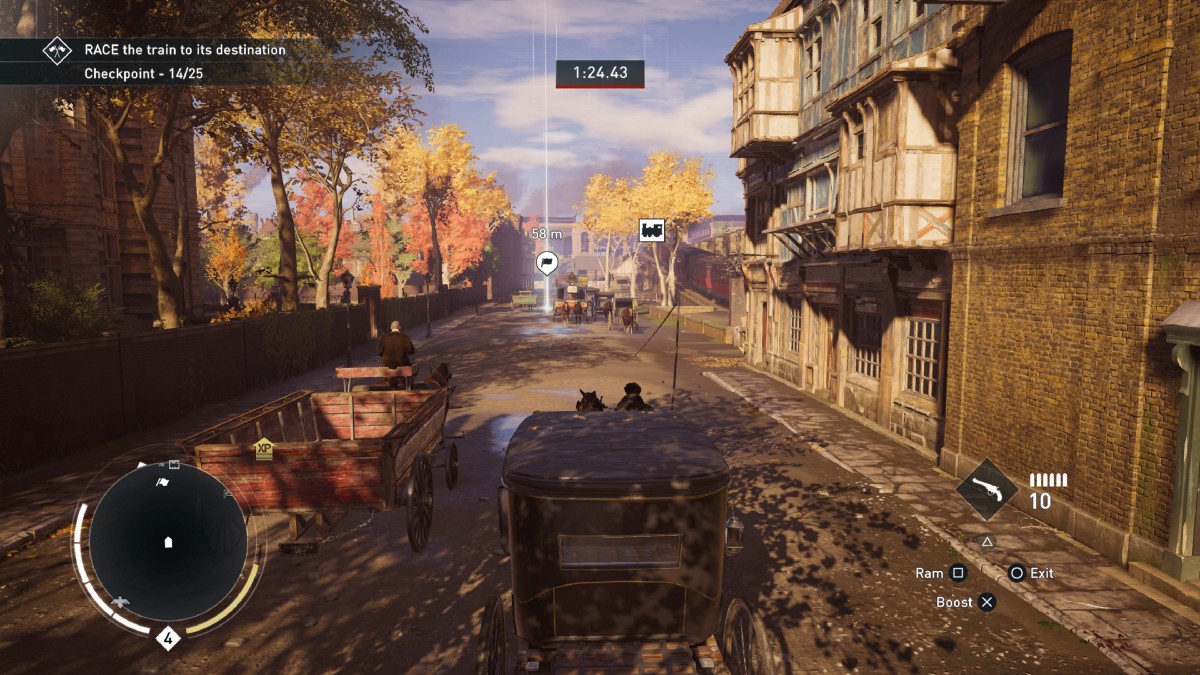
After you liberate your first two areas, these missions get old really fast, and I didn’t bother with the last two cities. Most of the main missions are pretty much this combined with just unique areas and circumstances. Kidnapping, assassinating, stealing, blowing things up, and of course, there are secondary optional objectives you can meet for more XP and money, but some of these just seem impossible to accomplish. It was fun to try and strive for these, but if I blew it, I didn’t bother restarting or anything. One new addition to the series is vehicles in the form of horse-drawn carriages. These drive okay for the most part but are pretty useless once you start unlocking more fast travel points by syncing up at high points. They drive okay, but there are a lot of physics glitches in this game, and often you’d see horses fly off into space or freak out and run off into the abyss.
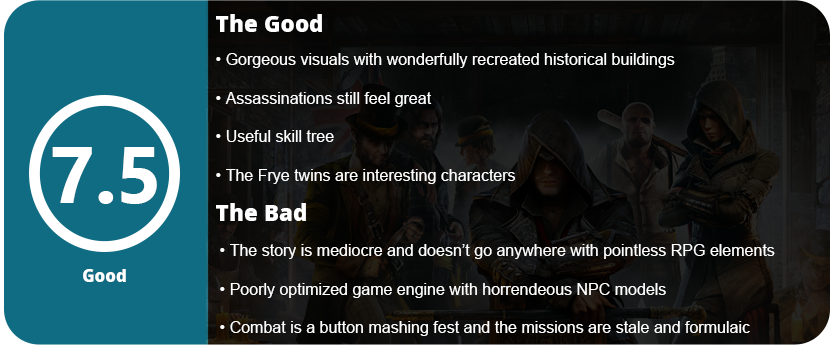
Syndicate has a lot of great-looking outfits and items to unlock. Each character has an outfit, gauntlet, and sidearm to equip. Most of these have to be crafted or met at a certain level, and you can find them by meeting secondary objectives on missions, locked chests, or by just playing the game. I feel the game is far too small in scope to need RPG elements. Once you get to level 8, you can finish the game, and there’s no point in continuing to play anymore. The only reason you need to level up and get better equipment is to survive the story missions. I was able to finish the game in about 13 hours, and I still felt this dragged on. Without the grinding, the story takes about 6–8 hours to complete with 8 sequences. I enjoyed the story, and the Frye twins have great personalities, but overall it felt average and forgettable at best. They didn’t go through enough personal issues; they got away scot-free for going against the order’s rules, and overall, the entire Assassins Order played no part in this game. The missions felt like they were just stringing you along and barely had a story to tell as an excuse.
As it stands, when I finished the game, I felt the side stuff was pointless and boring. I enjoyed the unique story missions the most, and yes, acquiring skills is just fine, and the skill tree was actually useful. My characters felt more powerful as I leveled up, and it made doing certain things easier, like when Eevie can stay still and become invisible when she masters the Stealth Tree. There are crowd events to complete in each area, like stealth, kill a messenger, or scare some bullies, but these aren’t fun. They are just there for completionists and to pad hours onto a game. I felt no reward or accomplishment when just checking these boxes for items I wouldn’t even need to use. You can upgrade each piece of equipment once to add a stat, but this is mostly for melee combat. Which, in fact, is terrible. It tries to be like Batman Arkham’s combat system, where you mash one button and then counter or break defense. When the enemy’s health bar flashes yellow, you can press the parry button, and when the health bar is gray, you can break their defense. It doesn’t chain together smoothly, and half the time it felt unresponsive. Some of the kill animations are also way too long, and there’s a lot of clipping. While it feels and looks brutal, it’s just button mashing.
The overall movement and flow of Syndicate feel a bit janky. A lot of time, the character would hop around like a rabbit when I was trying to get down somewhere to hang on to a specific thing. A lot of the time, this blew missions, and I had to restart. You can free-run up or down with two separate buttons, but you also get a grappling line, and it doesn’t work as you think. You have to be directly under a building to grapple up, and you can grapple across rooftops, but it does come in handy for assassinating people in large open areas. The problem is that you can’t grapple back out quickly, as you must be right next to a building. This felt only half-useful most of the time. Other than this, the only side missions I enjoyed were with real-life people such as Alexander Graham Bell and Charles Dickens. These missions are always enjoyable in AC games, but the same repetitious missions repeat here as well.
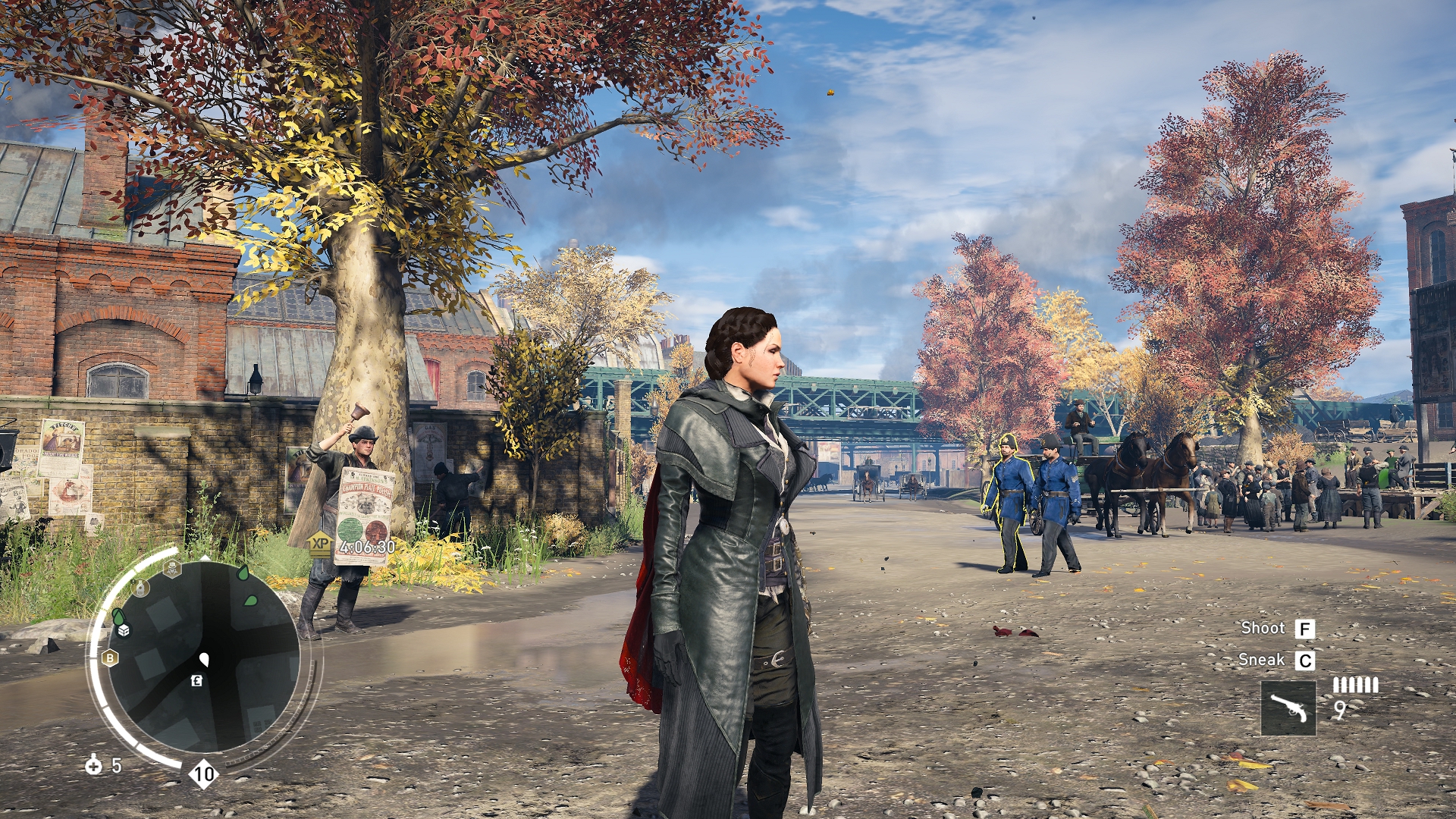
The game does look absolutely stunning, though. For the time, the game was ahead in terms of technical achievements for graphics, and no GPU could run the game at maxed-out settings and 60FPS, but now that it’s been five years, I can see why. The Anvil engine is horribly optimized and runs poorly on GPUs that are four generations newer. I had to turn anti-aliasing completely off on an overclocked RTX 2080 as I couldn’t get 60FPS with everything else maxed out at 1440p. That’s the game’s fault, not my system. When you do get it running well, it looks stunning, even today. Great lighting effects, outfits that look gorgeous, and beautiful recreations of historical buildings. I enjoyed exploring London. However, the facial animations and models on everyone, but the main characters, looked horrendous, and the same five-character models repeated. The game is a little rough here and there, and I also found on my 1660ti system that the camera had jerkiness to it despite hitting 60FPS with everything maxed out and anti-aliasing set to FXAA (otherwise you lose 20FPS and it’s not worth the cost).
As Syndicate stands now, the series really needs to reboot or go back to simpler times when you just had a nice narrative and a few things to collect. Outside of the mediocre story and somewhat fun story missions, the side missions are repetitive, formulaic, and get old fast. There are only chests and newspapers to tear down walls, and even these are old as they have been in every single game except the first one up to this point in time. You can make beautiful, historically accurate worlds, and you can have state-of-the-art graphics, but in the end, the series will get stale and tiresome fast.
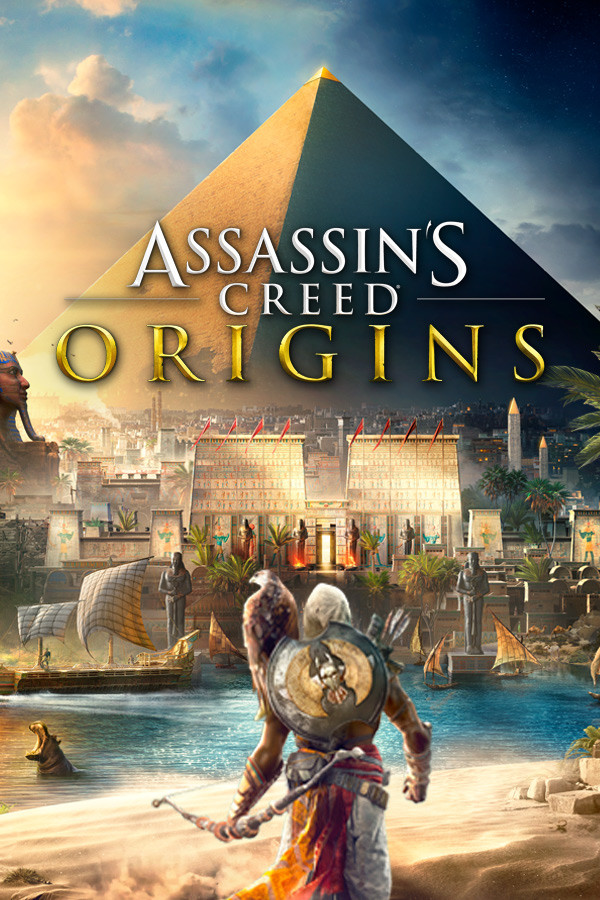
Let’s get one thing straight: Assassin’s Creed needed a reboot, for sure. Syndicate was by no means bad, but the only thing really changing were the locales, and the gameplay was getting stale. Origins ups the ante with the largest game yet, but…also adds RPG elements? RPGs aren’t something I associate with Assassin’s Creed. At least the story is entertaining and the new settings are daring and beautiful all at the same time, but do the RPG elements hurt more than help, and is the series going to find itself stuck in a new rut it can’t get out of?
You play Bayek of Siwa, a man who had his son murdered by The Order of the Ancients, and he is on a journey of vengeance and revenge. Bayek is actually a great character with a good amount of personality and spirit. He’s a likeable character and isn’t just hellbent on revenge. He changes over the course of the story, becoming even colder and bitter towards the end (not a spoiler), but this is also the story of how the Assassins came to be. The origins of the Creed we have all come to love. This was also long before the Templars stepped in too.
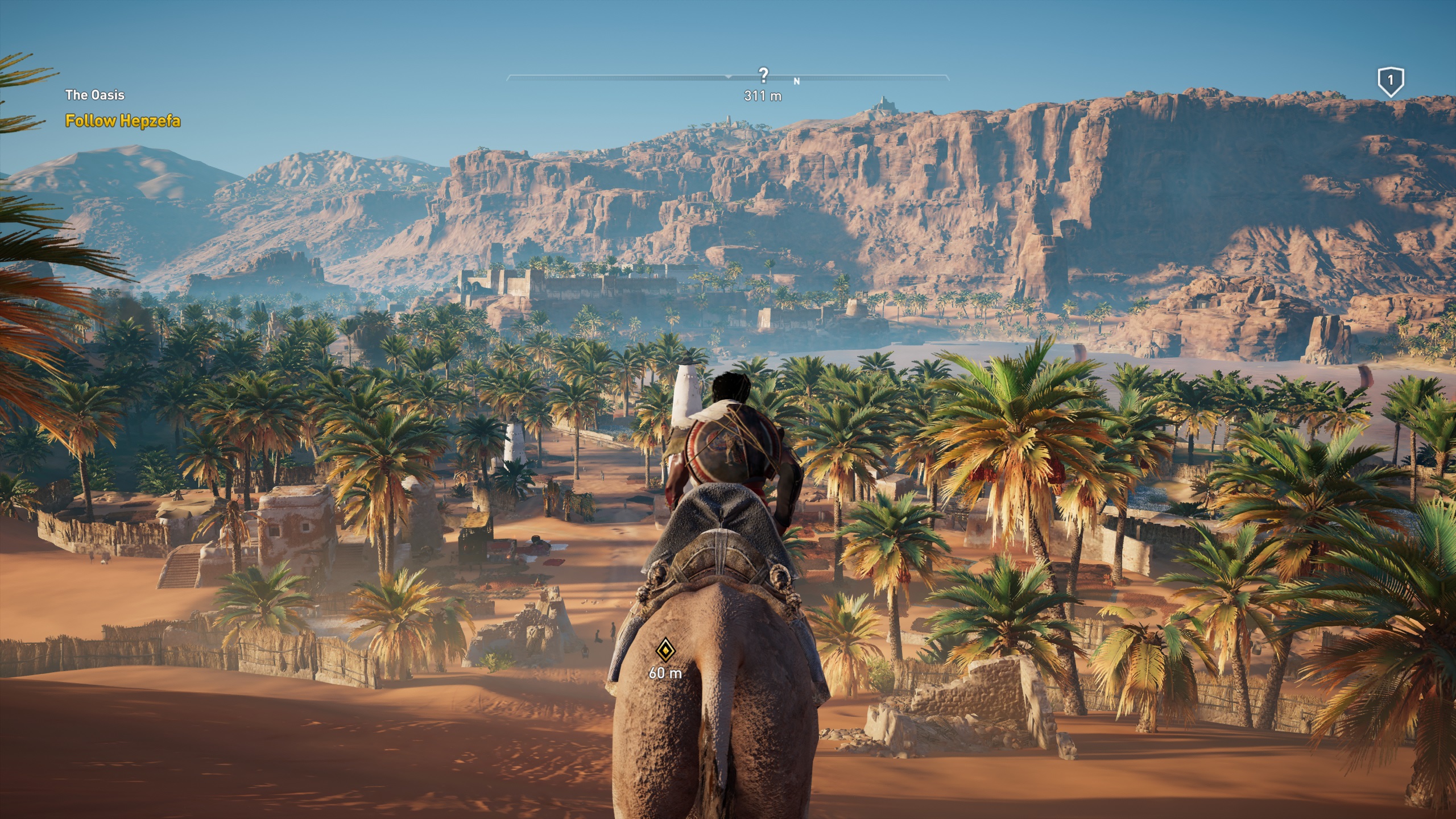
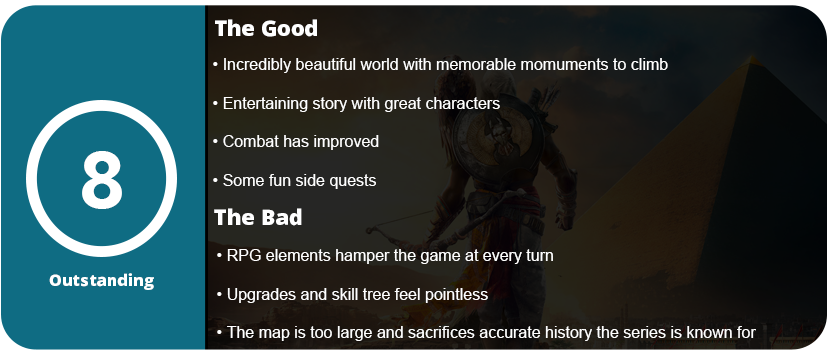
One of the first things you will notice in the game is the size of the world. It’s incredibly massive, and sadly, too massive. Almost two-thirds of the map isn’t explored during the story and is reserved for just going around, finding collectibles, and doing side quests. There are dozens upon dozens of side quests, and these are needed to grind levels. That’s the first major damper on this game. Yes, it has RPG elements, but you need to grind just to complete the story, which is not ideal. The cap here is level 44, and thankfully the first twenty or so levels come fast. By the eighth hour, I was already level twenty, but it slowed down a lot after that. You need to be at least level 33 by the end of the game, and those last 15 levels are a serious grind as missions are the fastest way to level up, and most don’t grant more than 3,000 XP. You would think that higher-level missions would give more XP, but the game chose quantity instead. The higher you get, the more you need to complete to move on. I hate this so much, and it feels like an absolute chore.
The combat is refreshed and isn’t a total parry fest like previous games were. You have light and heavy attacks, as well as a block and parry button. It works well enough, but it’s still just button-mashing in the end. You get an adrenaline bar that can be used for powerful attacks that are unlocked in the skill tree. Ranged weapons are added in the form of bows. There are various types of weapons and bows. Two-handed and one-handed weapons, plus various bows with different ammo types. These come in handy when hunting animals and trying to take out guards from a distance. However, your level will impede one-hit assassination kills and how much damage your bow can do.
You do get the hidden blade in this game about a fourth of the way through the story. Assassinating is the same as usual and just as satisfying. Leapfrogging from guard to guard is fun when you are at least two levels below theirs. The game is tightly locked around this two-level plateau, and if you are three levels or more below the enemies, they are almost impossible to kill. It makes the game more frustrating, as you just want to take these guys out, but you need to come back when you level up so you don’t die all the time. The whole RPG system just hampers Assassin’s Creed‘s fundamental gameplay, which was best when you could just go into any fight and take them out with stealth if you were good enough.
You can loot weapons off of enemies, chests, and other places and even upgrade them at the blacksmith, but I found this useless as I was getting a constant stream of better weapons by just playing. I didn’t even really need to buy anything either. It’s just a wasteful system, which means I didn’t really need any money either. I just refilled my arrows when needed, sold stuff to empty out my inventory, and maybe bought outfits for Bayek, which all look great. You don’t get any armor in this game, as your health and damage are all determined based on your level. You can hunt animals for their skins to upgrade your hidden blade and overall armor rating, but that’s about it. I didn’t even bother doing this, as hunting is just another chore added to the game that isn’t really needed. One of the few things the series scaled back on was collectibles. There are hidden scrolls, Ptolemy statues to destroy, and, of course, viewpoints to sync up with, but most of the collectibles are in the form of taking out guard outposts and looting them. You need to kill the captain as well to make the fort takedown complete. I found this boring and tiresome after I did a few and just skipped them entirely.
There are some entertaining side quests, and most are different, but the majority require you to either rescue someone, as you can carry them out of a camp and put them on your horse, or assassinate someone. These got old quickly, and even the dialog in between didn’t matter much. Some missions have you “investigating” an area, but again, just filler to cram on more hours to the playtime. The most enjoyable part of the game was climbing up to viewpoints and doing story missions. Naval battles are also back, but only during a few scripted events, and they are fun, sure, but it’s nothing different than previous games. You play as Bayek’s love, Aya, during these missions, and they mostly consist of just taking down ships with different life bars. There’s no upgrading, no customization, or anything like that. You get this set ship and controls for about three missions. You can use boats in the main game, but they are just used as transportation and nothing more, as there isn’t a whole lot of water in Egypt.
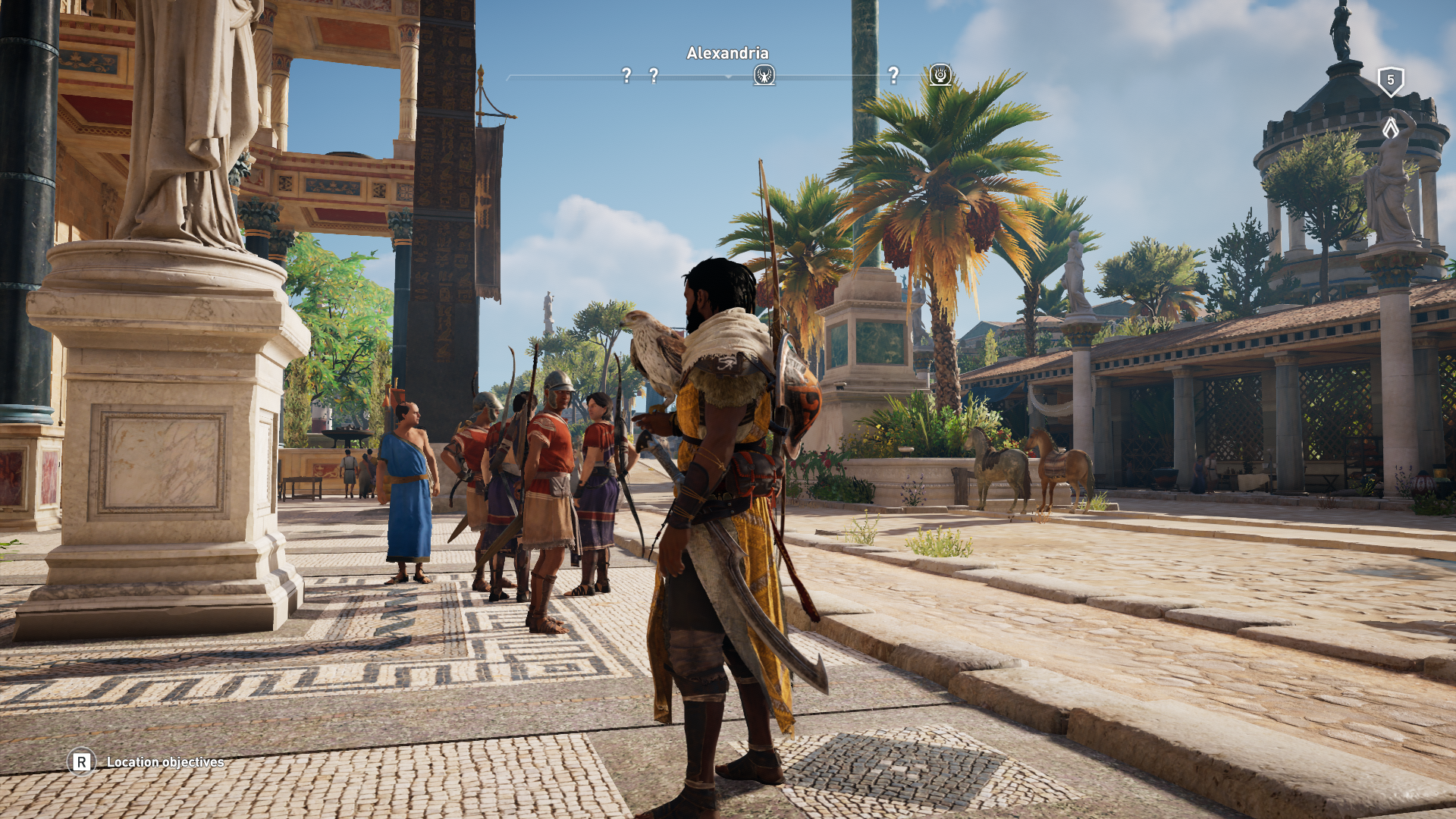
I can’t deny that the story was entertaining, especially towards the end, but the game is just beautiful. Large, sweeping vistas of deserts and climbing the Pyramids of Giza are memorable and incredibly fun. However, a lot of the realism that was well-loved in previous games is gone. This isn’t a painstakingly recreated Egypt with buildings that are realistic down to the brick. It’s a hodgepodge of real-life objects thrown into a somewhat realistic-looking Egyptian landscape. The game recreates the biomes and environments of Egypt, but the map has large areas smashed together. While it flows well and looks pretty, I don’t particularly care for this. I like the smaller, more realistic, and historically accurate places. I liked reading about each building I discovered or a real-life person. Yes, there are real historical figures here like Cleopatra, Ptolemy, and Caesar, but they’re fictional recreations, and their backstories aren’t told anywhere. If this is sacrificed for larger, more open worlds, I just don’t want it. Assassin’s Creed is getting too big, and there are not enough interesting things within to fill it.
In the end, Origins‘ RPG system hampers the game at every turn. You have to stop advancing the story to level up with mostly repetitive side quests, which are filler to force you to explore the world. While the main story is really entertaining, I still didn’t care about Layla or the real-world stuff with Abstergo. You cut away maybe a few times from this, but that “side story” just doesn’t feel like it ever goes anywhere. Just keep me in the historical world, and that’s it. We don’t need the Animus; we don’t need Abstergo or any of the science to make an excuse to keep exploring various worlds. We don’t need the Apple of Eden or any other artifacts. Origins also has a poorly optimized engine with frequent slowdowns and AI issues everywhere. I even had plenty of physics glitches. Sure, it looks stunning, but there are problems here. The combat system is fine, but again, the skill tree doesn’t even help much here, as most of the skills felt pretty useless and I didn’t even need them. These systems were never needed in an Assassin’s Creed game. I don’t mind more side quests, but make them optional like they’re supposed to be. The RPG system is the worst thing to ever happen in the series, and sadly, it seems like it’s here to stay.
Man, I am completely exhausted. That’s the feeling you will get when trying to slog through this insanely beautiful yet equally insanely bloated mess of a game. I have a complete love-hate relationship with Odyssey. It’s been installed on my PC since it launched in 2018, and it’s taken me three years to finally get around to completing it. There is so much to digest and chew with this game that I don’t know where to even begin. I have a lot of negative things to say about this game and will probably go on a tirade about certain mechanics and systems the game has, but there is still something here to be enjoyed.
Let’s just start with the story in which Odyssey doesn’t really have a meaningful one. Unlike previous games where there was a hand-tailored narrative tightly woven between assassins and templars, this game seems to forget most of what Assassin’s Creed‘s makeup really is. The game features a seemingly generic male or female protagonist who is trying to bring their family back together after a tragic event that took place while they were children. Therein lies one of the first major issues with the game: the story has no meaning, takes way too long to unfold, and there are no characters worth caring about. The game features generic, dull voice acting with badly faked (I think it’s faked?) Greek accents with cookie-cutter models that repeat throughout the game. They are mannequin-like, stiff, and just boring. Gone are the well-thought-out historical characters we can grow to love, but instead Ubisoft thought it was cute to shove nearly every single major famous Greek person in this game and give them lifeless personalities and stale dialog to spew.
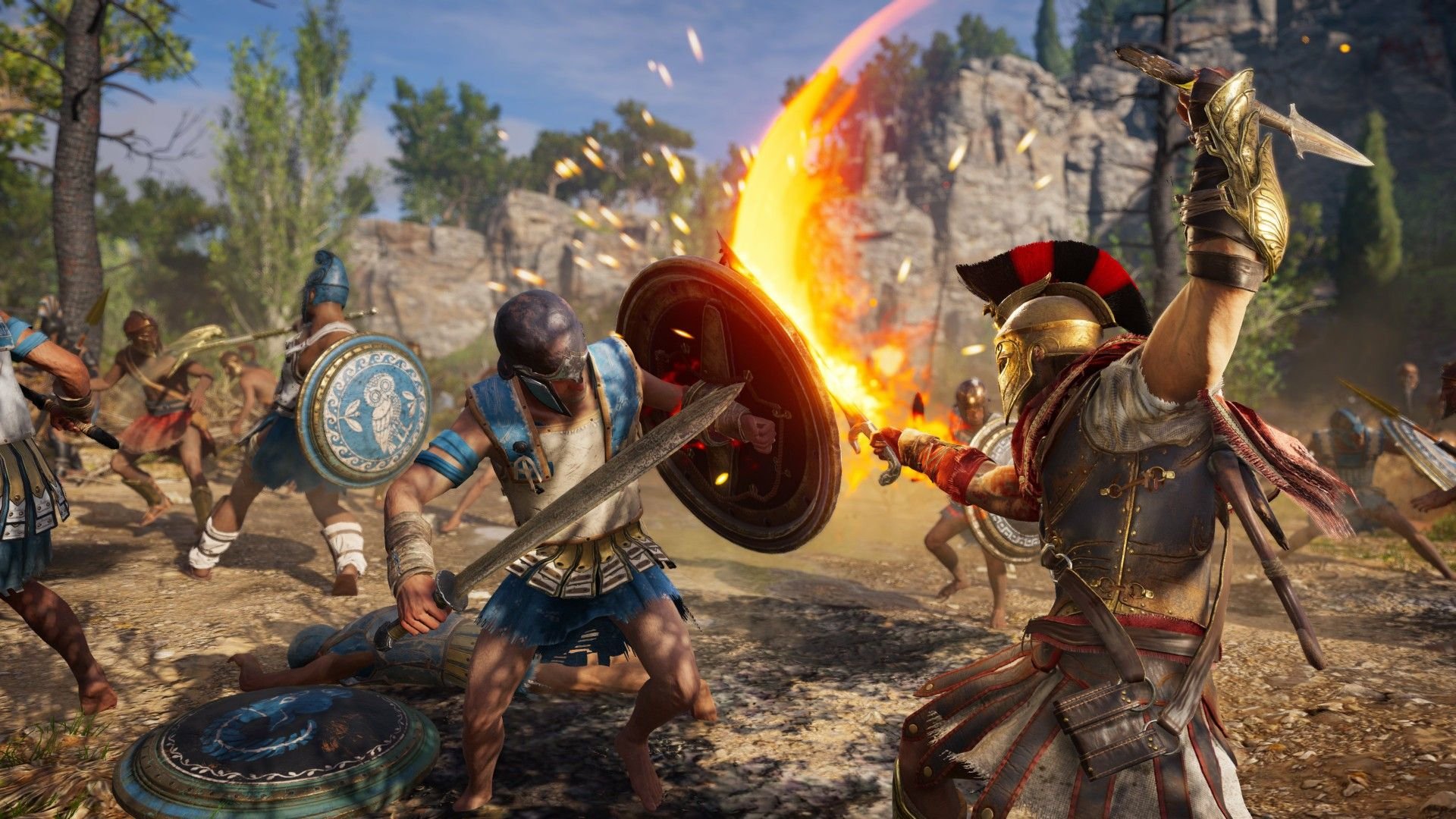
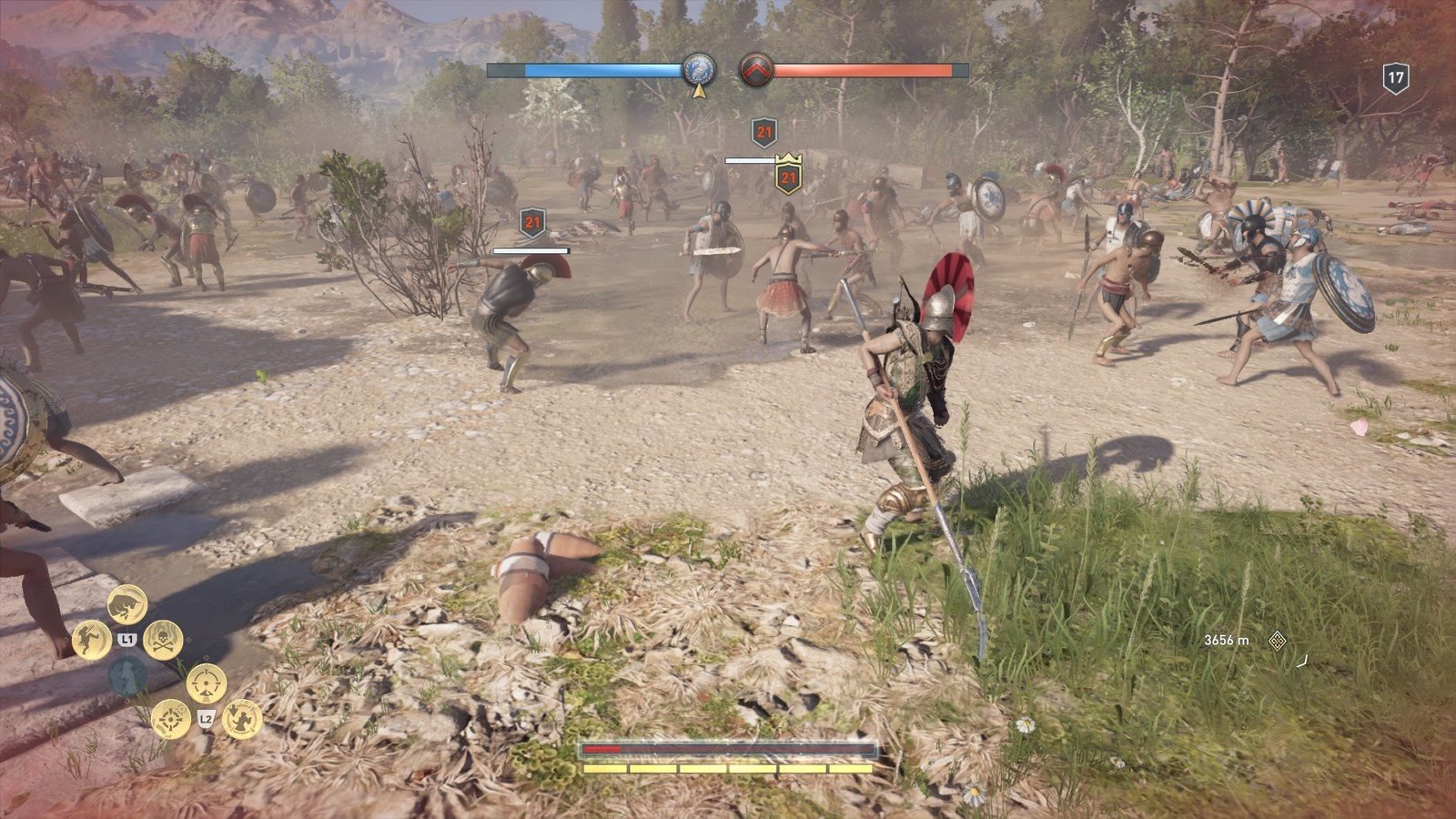
The second issue lies with the fact that this is an RPG and not really an action adventure anymore. In fact, assassinations take a major back seat in favor of head-on combat, which rolls into the level grinding and enemy leveling that plague this entire game. I miss the days when you could just do what you wanted when you wanted in an AC game, and that’s that. I miss the well-crafted and unique assassination levels, but instead, we get generic everything, as Odyssey is the epitome of quantity over quality in every single aspect of the game. There are a lot of layers to the gameplay loop in Odyssey, but let’s just start with forts and restricted areas in general. The combat itself is fine. It’s slightly tweaked from Origins, which I haven’t played much of yet. However, it’s boring, dull, and repetitive, like the rest of the game. You get to assign four abilities from the skill tree for ranged and melee, respectively. There is a heavy and light attack, and most of the game requires you to perform a perfect dodge, so time slows down and you can get hits in to fill your ability bar. Each segment is needed for various abilities to activate, and you will rely heavily on this. The combat looks good and feels fine, but it’s just the usual ACbutton mashing, dodging, and parrying fest we’ve grown tired of.
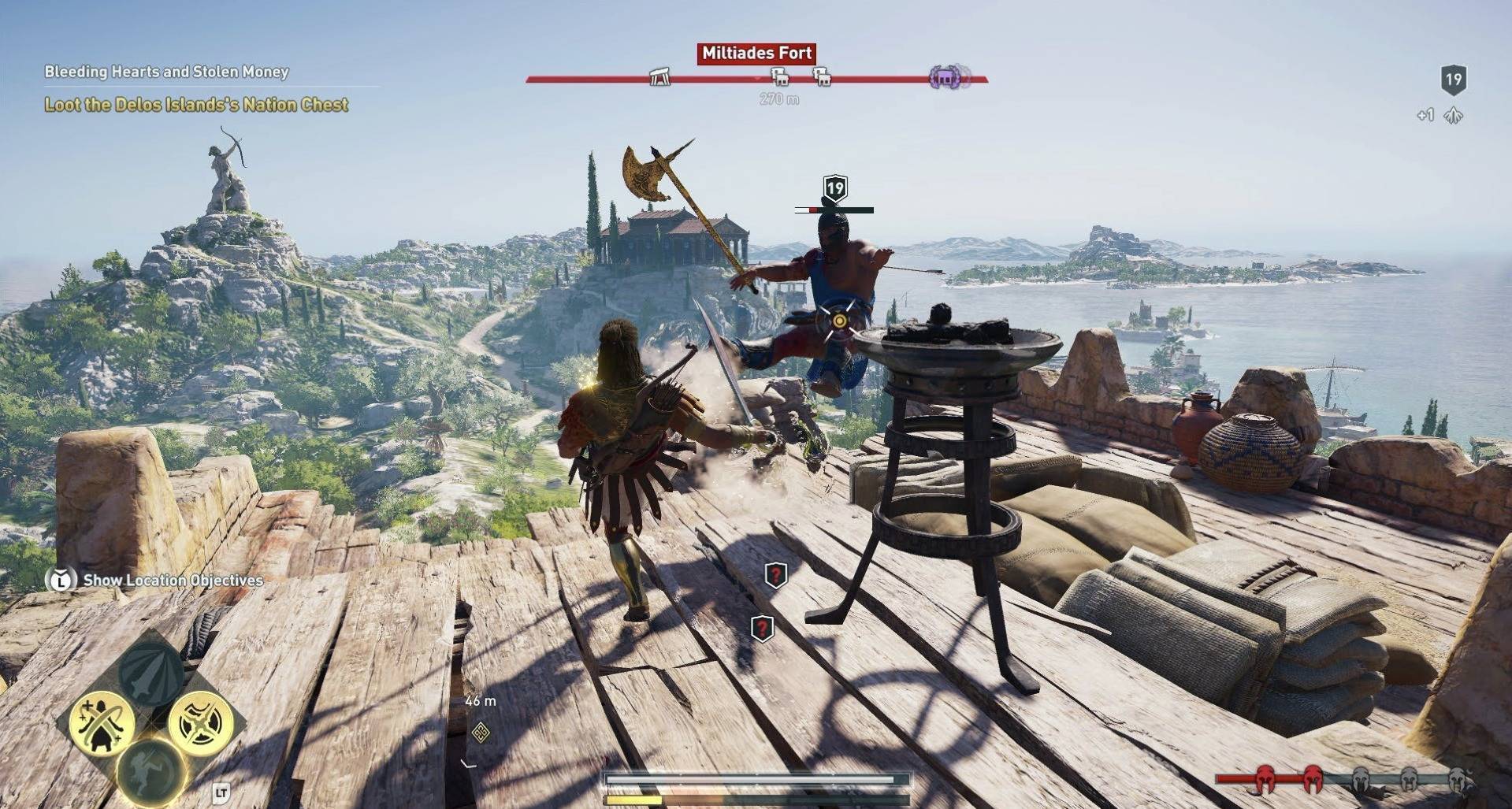
There are probably hundreds of them in this game, and that’s not an exaggeration. Most side quests, some story missions, and the Cult of Cosmos main/side storyline make you go into a lot of these. This was fine back in the early days, as these areas felt unique and well-thought-out, but here it’s just a random splattering of various enemy types. Each fort or restricted area has a variety of things you can do to “complete” that area. Burn supplies, steal loot, kill a leader to bring that area’s stronghold down (which, as far as I know, doesn’t mean anything), and kill various types of leaders. Some have specific mission-based items. The issue here is the whole RPG/leveling thing, as assassinations now require you to be at a higher level before you can one-hit kill them like in past games. So, taking down an entire fort can be a slog when you have to fight every enemy head-on.
It doesn’t help that these areas don’t feel well put together, with hardly any cover to hide inside most, and it takes forever to become anonymous. You can’t blend in as well as you could back in the older games. It either doesn’t get caught by the awful AI that seems to make enemies just wander around aimlessly with no set patrol pattern or fight it out head-on. That’s your only option. I miss the satisfaction of running through a restricted area and just assassinating everyone with a leap-frog type of momentum. It was incredibly satisfying to get everyone without blowing the horn, but in Odyssey, this rarely ever happened. The game keeps the entire world either two-level above or below you, no more or less. You can’t go back to a previous area at level 5 and just slaughter everything in sight. Eventually, that area levels up too.
If that doesn’t sound bad enough, the main story missions are locked away behind these level walls. I would then have to go do maybe a character-world mission to go up two levels to finish the next few story missions. This would normally be okay, but I don’t care about a single character in this game! For such a massive and detailed open world, everything in it is so boring and lifeless. I only kept playing to explore the world and nothing else. Let’s also not forget the “real world” that AC games keep shoving in our faces. There’s maybe an hour of this at the most, and I never went back during the main story. The Cult of Cosmos is where most of the “real-world” jumps are, and yes, I could care less about those too. Can we please just completely cut out this real-world Abstergo nonsense already? It was okay with Desmond Miles in the Altair/Ezio saga, but now it’s just stupid and silly.
Honestly, the game is mostly just overbearing and exhausting to explore and ingest. I tried the old strategy of going through each area and doing all the side missions and quests, but that became incredibly boring fast. The entire game comes to a screeching halt as you constantly run into leveling walls and need to stop one mission to do another to get certain items or complete repetitive “kill all of these” missions to get the XP to level up. The majority of XP comes from completing missions. Discovering new areas, killing enemies, and other things like this don’t ever give you enough to level up. I just wish this whole RPG system was gone, as it really hurts this game badly. Then there’s the loot system with armor and weapons, and you can engrave them and upgrade them, but this was a completely useless system as I was constantly getting new loot from dead enemies that were at higher levels. This was a completely wasted system and was poorly implemented.
I also haven’t even gotten into the ship battles. This has become boring as well, and the first 15 hours of the game are a serious chore as you have to sail around a lot to get to new areas, where you need to hit every synchronization point you can find so you can fast travel around the map. I didn’t have a sync point in every major area until maybe 20 hours into the game. It’s that much of a grind. Ship battles are exactly like they have always been. Shoot javelins or arrows to bust down a ship; you can board it; you can also use flame arrows or ram it. That’s pretty much it. It’s very basic, dull, and underwhelming, despite how nice the ships handle and how fantastic the water looks. You can upgrade your ship and assign lieutenants that add stat boosts and change your crew theme, but this mostly seems pointless as I spent almost no time in the water once I could fast travel around the map. This is mostly used for dull missions that require taking down certain ship types, and that’s really it.
Through the first 15 hours of the game, all I wanted to do was constantly quit. I felt like I was making progress, and then suddenly I had to grind 2-3 levels to get the next set of story missions, and that required completing dull side missions of all kinds. There are notice boards in every major town that offer these, apart from the ones just sitting out in the world. There are also timed missions that expire like this is some MMO, and boy are these the absolute worst of the bunch. I honestly can’t say I ever felt like the game was actually a lot of fun. The forts are probably the worst part of the game, and sadly, it was the opposite in the past. I wound up just jumping in, killing the person I needed for the mission or item, and jumping out. I stopped completing forts about five hours in.
Traveling around on horseback is also boring, as you have to clear large swaths of land before finally getting enough fast travel points, and I just can’t express enough how big this game is. It’s too big and bloated for its own good. Most people will probably never finish this game, as it takes a minimum of 30 hours to grind through the story. I spent 15 hours just trying to complete everything and gave up in the end. The final system I want to mention is the mercenary system. Committing crimes will get you a bounty on your head, and mercenaries will come after you. You can defeat them to climb the tiers, but finishing this requires being level 50, which is the cap, and it’s not worth it. There are at least 50 odd mercenaries to kill, and you will end up killing at least half by the end of the game just because they are there and in the way. Thankfully, you can pay off your bounties on the map to get them off your back, so it’s completely optional.
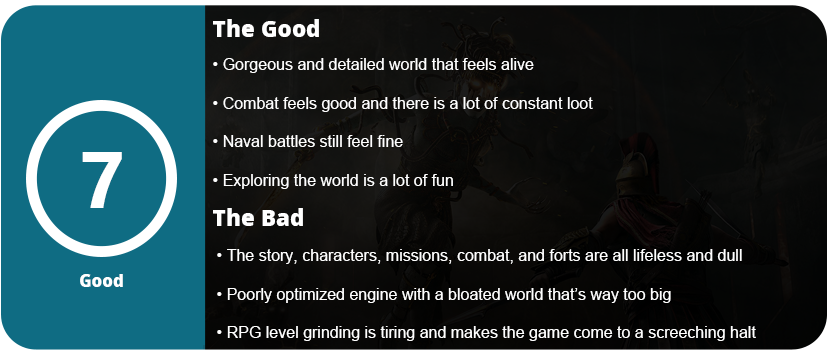
Overall, Odyssey is just too damn big and too generic to be considered a memorable game. Sure, the game wonderfully recreates ancient Greece with many amazing monuments, buildings, statues, and towns, but they all start looking the same after a while. There are far too many forts to conquer; the leveling requires way too much grinding of boring side missions and lame quests, and it becomes incredibly overwhelming and exhausting even as soon as five hours in. There just aren’t any interesting characters, and the story is fairly simple and dull. I couldn’t care about anything in this game except exploring new areas, because that was at least fun. Naval combat hasn’t evolved much, there’s a useless equipment upgrade system, and assassinations have taken a back seat over combat. Hell, you don’t even get the hidden blade in this game. The skill tree, which I didn’t talk about, is also a mix of overreliance on certain abilities, as they do large amounts of damage, and not caring about a good majority of others. It’s a poorly balanced skill tree, and I didn’t use 90% of them. The entire game is just unbalanced and a boring grind, and most of the game feels like a chore with no pay-off. I hope to eventually try out the DLC, as it seems more entertaining, but we will see.
So, it sounds like I hate the game, but I don’t. I enjoyed the feeling of accomplishment when I finally reached that next level and could move on. Most of the fun was literally just exploring the land, and no, not even looting stuff that I came across, as I skipped most of it. The world is beautiful, and it looks amazing, but there’s so much here that’s just generic and pointless. This is my least favorite AC game to date (alas, I haven’t played any games between Black Flag and Origins, so that might change). If Ubisoft had cut the game down even by half and removed the RPG system, this game could have been much more than the sum of its parts. Lastly, I’d like to mention that the engine is poorly optimized and runs like garbage on hardware well above the recommended specs. Even after numerous patches, there’s a slowdown everywhere.
Beautiful indie games are something that comes only once in a while. When you think about games like Journey, Limbo, Inside, Braid, Monument Valley, and Flower, These are memorable games that most core gamers know of and look up to when it comes to quality indie games and what defines an indie game. Omno tries this but doesn’t quite reach that height for several reasons.
So, when it comes to these minimalistic indie games, they usually try to tell a story with no voice acting through the music and action of the protagonist. Games like Journey and Inside pulled this off amazingly well, and I even remember tearing up a bit with Journey despite no written or spoken dialog being present. Omno has some great music and tries to pull off the adventurous fast-paced snowboarding/gliding on linear pathways with epic music and opening up to a beautiful vista kind of like how Journey did, but it doesn’t quite work here. Once you land, you get the camera ripped from you, and your little guy walks up to the vista, and the camera pans around. That detracts from the user’s perspective and takes away that epic experience. Diving into the open area without any cuts adds to the sense of exploration and discovery because now I don’t quite know where I landed, but if I get a camera cut, it kind of ruins the surprise.
Most of what Omno consists of is repetitive puzzle-solving in open areas that all play out exactly the same. There are white orbs you must collect to unlock the final puzzle to move on, but there are optional things you can do to get 100% in the area, which isn’t hard. I was able to play 100% of the game on my first try without a walkthrough. You get an area map once you get to the waypoint, and this shows where the orbs are. Each area has about five orbs that require gathering white cubes from animals and plants around the area. Once you have enough, this unlocks one of the five orbs. You then have a few books to find that have a dialog about another creature going on their pilgrimage. Some orbs require platforming puzzles, moving blocks, or shuffling things around. It’s very easy, and I found almost no challenge in these puzzles. You do unlock new abilities as time goes on, such as teleporting to certain waypoints, surfing on your staff, and dashing.
There is a small sense of progression, and each new area is beautiful and looks great. However, I felt like it was a chore by the tenth one because I knew exactly what was coming up. Find five orbs, gather the cubes for that one orb, find the books, solve at least three puzzles, etc. It became predictable, and there is really no story or character development between them, so the game relies on pretty graphics and whimsical music to keep you going. The platforming and controls work okay most of the time, but I felt dashing was a bit hard to control, and landing was a bit slippery. Many times, I slid off a cliff or block just to start over again.
If the game were just a linear adventure traveling through these valleys, I feel it would be a better and more memorable experience. Having a dozen levels that play out exactly the same for literally no reason is boring and a chore, despite how pretty the game looks. Maybe four or five pieces spread out between more eye candy would have been better for this type of game, but what’s here turns into a slog towards the end. I still recommend the game as it can be finished in less than four hours and it is charming to look at and explore, but just be prepared for repetitive level design and unchallenging puzzles. The story is pretty much nonexistent, and there’s no type of character development even through actions. Omno (I think that’s his name?) has a flying axolotl-type creature flying around with him, and the creature is sick, maybe? At the beginning of some levels, he picks him up, and the thing looks like it’s dying. I honestly don’t even know.
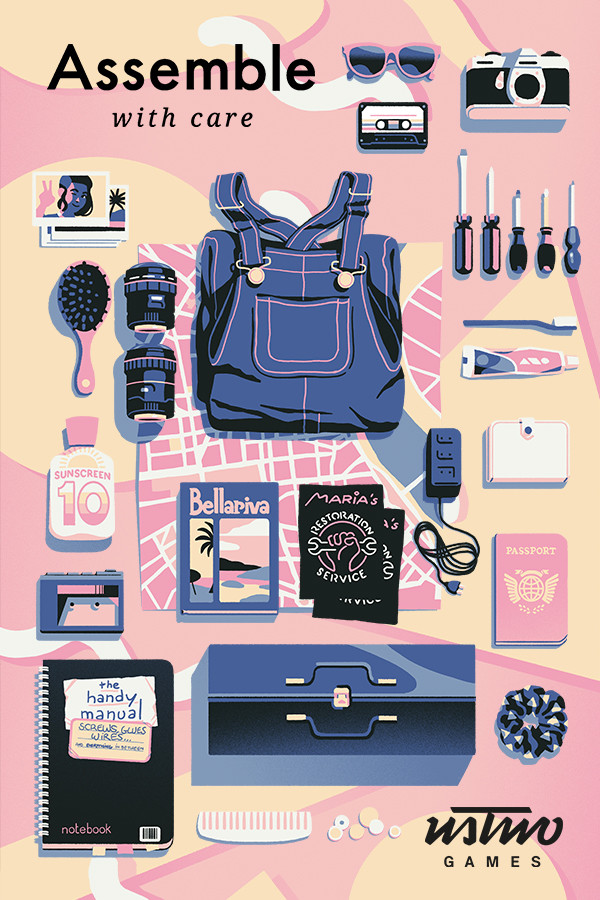
When I think of casual games, I usually think of games that are relaxing, stress-free, usually offer a good story and characters, and have a great world to explore. With mobile games, this is true as well, but I feel that despite how great Assemble with Care is, it’s held back by the casual game constraints too much. The mechanics and idea of taking apart devices and fixing them is an itch that games like House Flipper and PC Building Simulator scratch, and when I saw Assemble with Care, I thought it was going to be the same. The fact that a voiced narrative is included was just a bonus.
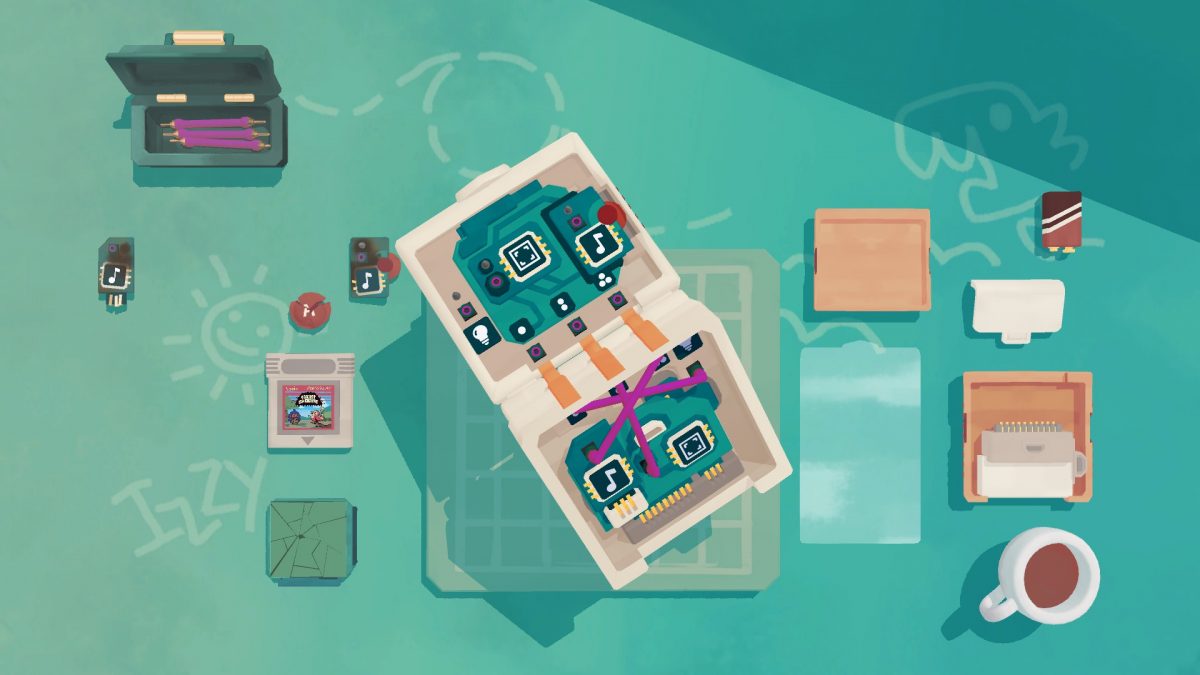
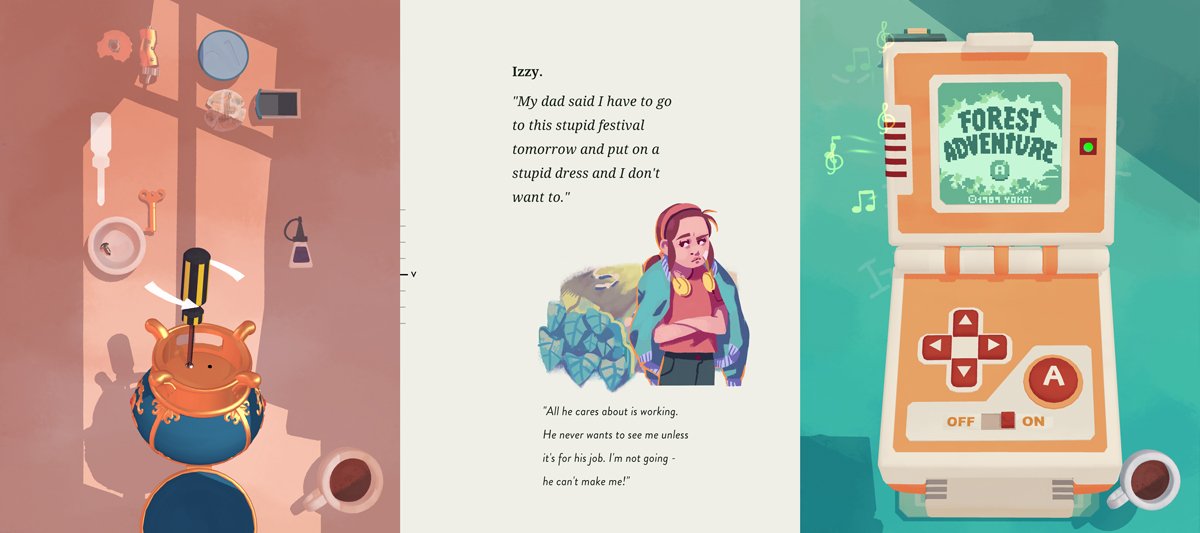
You play as a female hobbyist repair woman who travels to Belariva for a vacation and relaxation when she ends up getting involved in the town’s squabbles. She runs into a mayor and his daughter, and a cafe owner and her sister. She is the key to getting each party to resolve their family issues, and of course, her tinkering helps that. The story itself is well voiced, and UsTwo games are well known for gorgeous visuals and unique gameplay, but the game falls short here. Every chapter, out of thirteen, has a device you need to disassemble and fix and it’s really neat. I couldn’t wait to get the next device, as they did get slightly more intricate as you went on, but the game handicaps itself by allowing snapping of parts that are allowed only in one spot, so it’s not really a puzzle anymore. The biggest challenge came in disassembly, as there’s not much to tell you about how to do this.
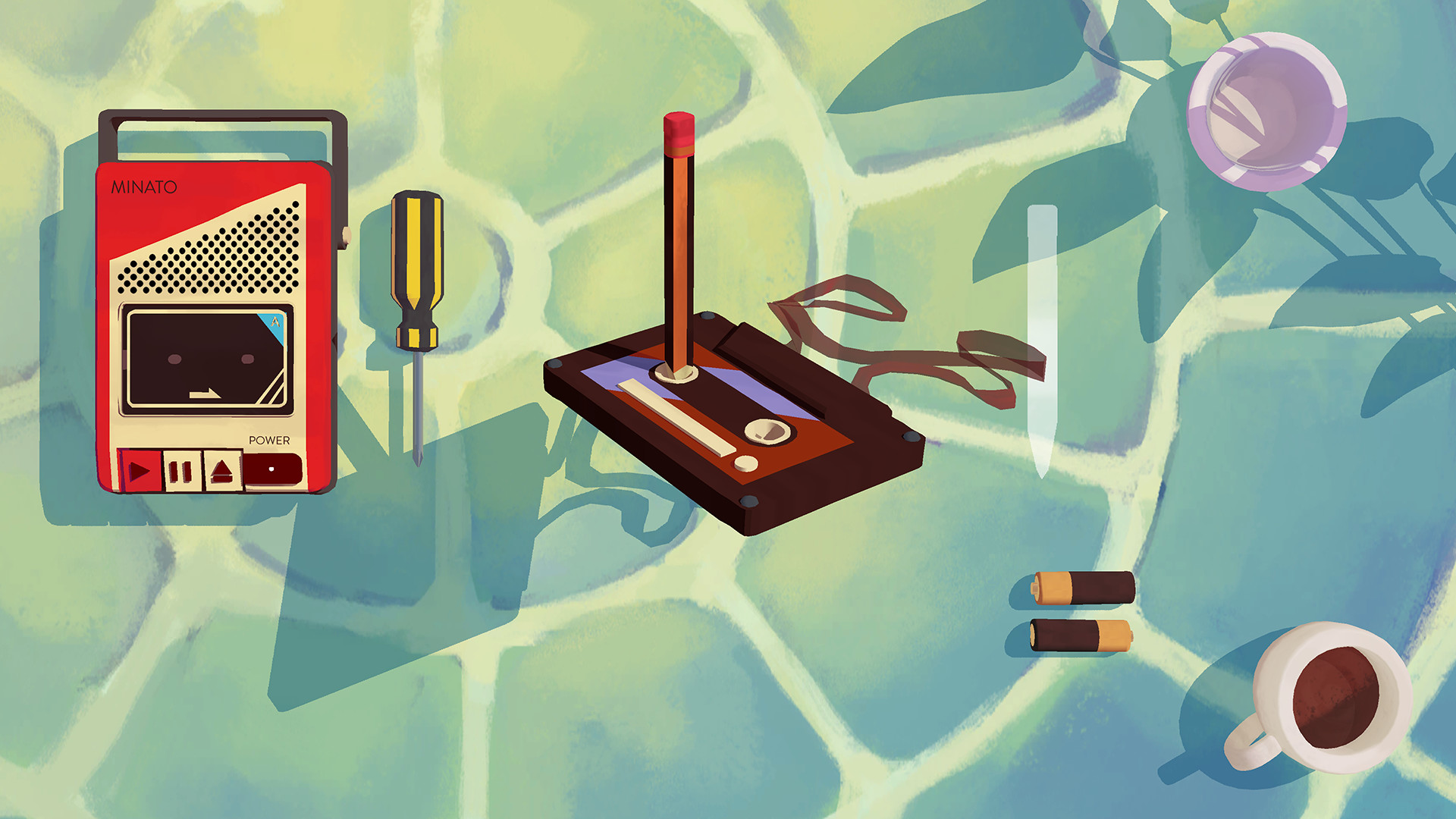
Various devices range from a GameBoy Advance SP to a watch, a music box, a record player, a portable cassette player, and others. You get everything you need laid out in front of you, such as a screwdriver, cables, or various parts to repair the item. Long pressing allows you to take things apart, and there is a swiping motion for screwing things in and out. You can rotate the device, as every side needs to be inspected. Most of these puzzles can be completed in just a few minutes, and each chapter has voice dialogue at the beginning and end.
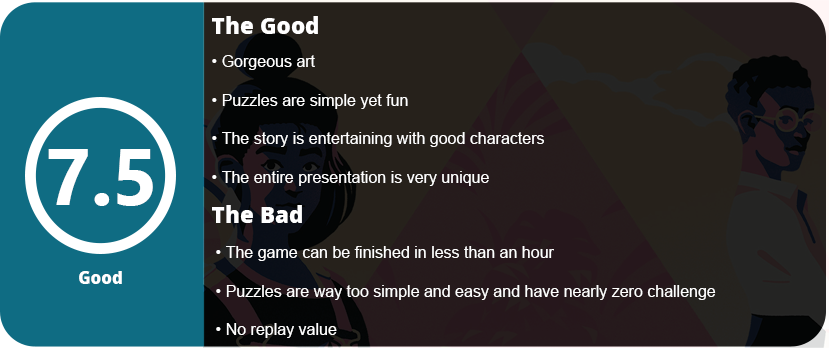
The art is great in both the story stills and the 3D graphics of the objects. Bright watercolor drawings and flat pastel textures just pop on the screen. I didn’t want the game to end, however. I felt like more chapters could be added, as the story isn’t memorable but entertaining and a bit touching. I still wanted to know the fate of each party’s families, and for less than an hour of gameplay, UsTwo did a great job with the storytelling. Sadly, once the game is over, there’s no reason to go back at all. The puzzles will never change, and they’re way too easy to be replayed. I wish the puzzles weren’t as easy and had more intricate and smaller parts, or just something more complicated.
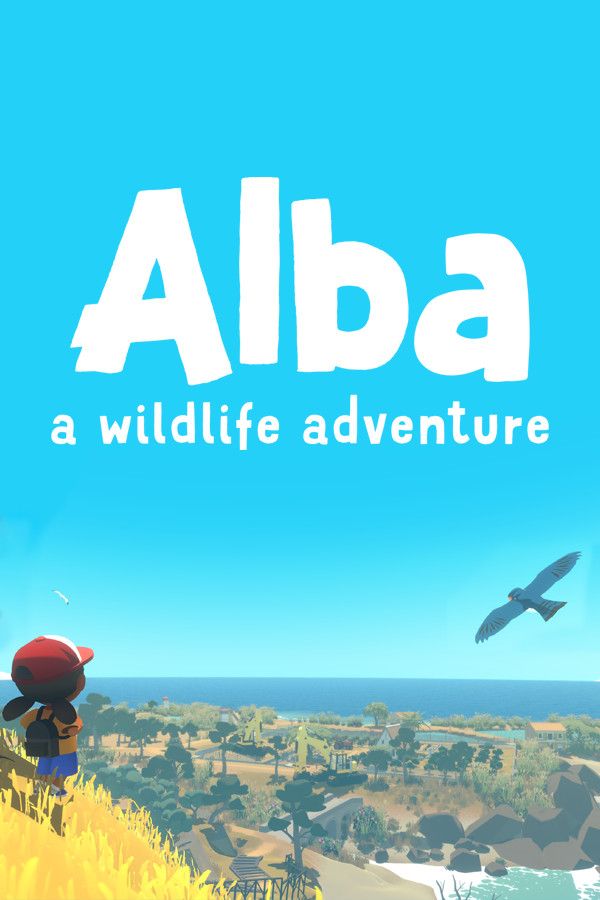
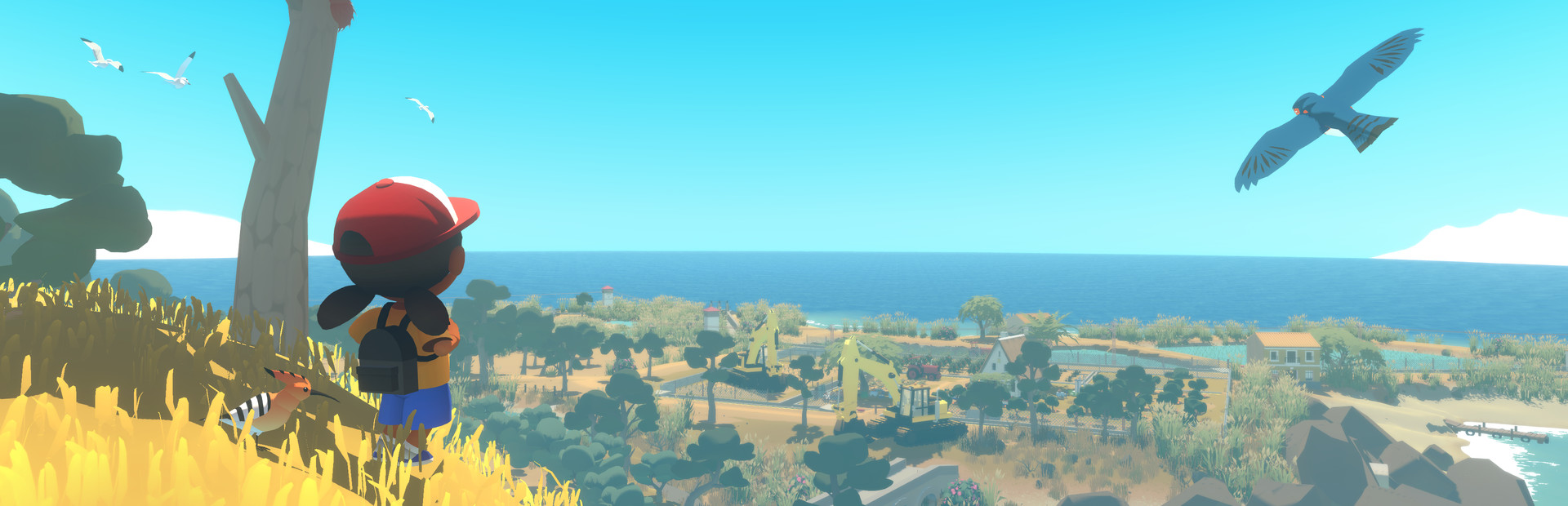
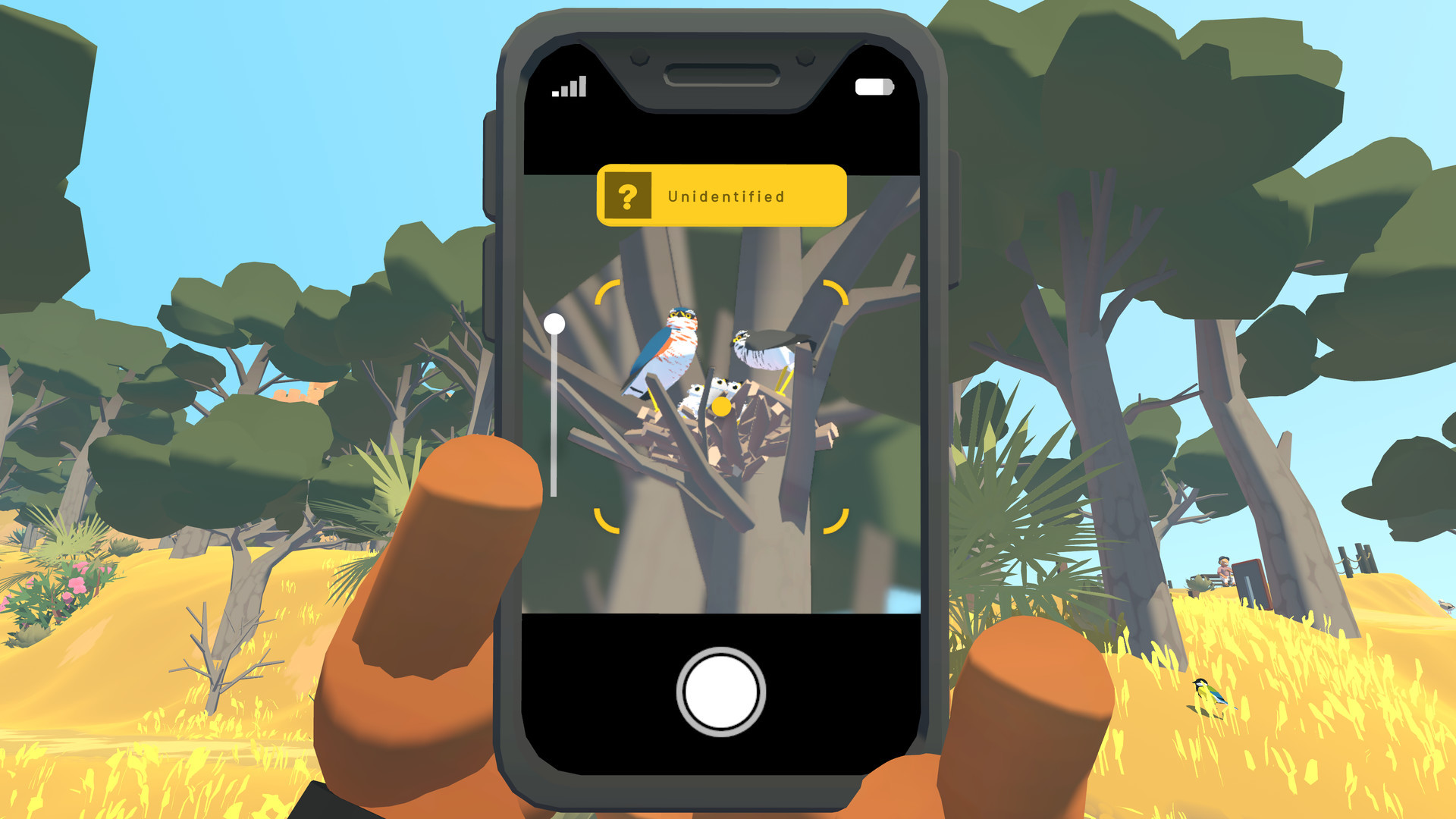
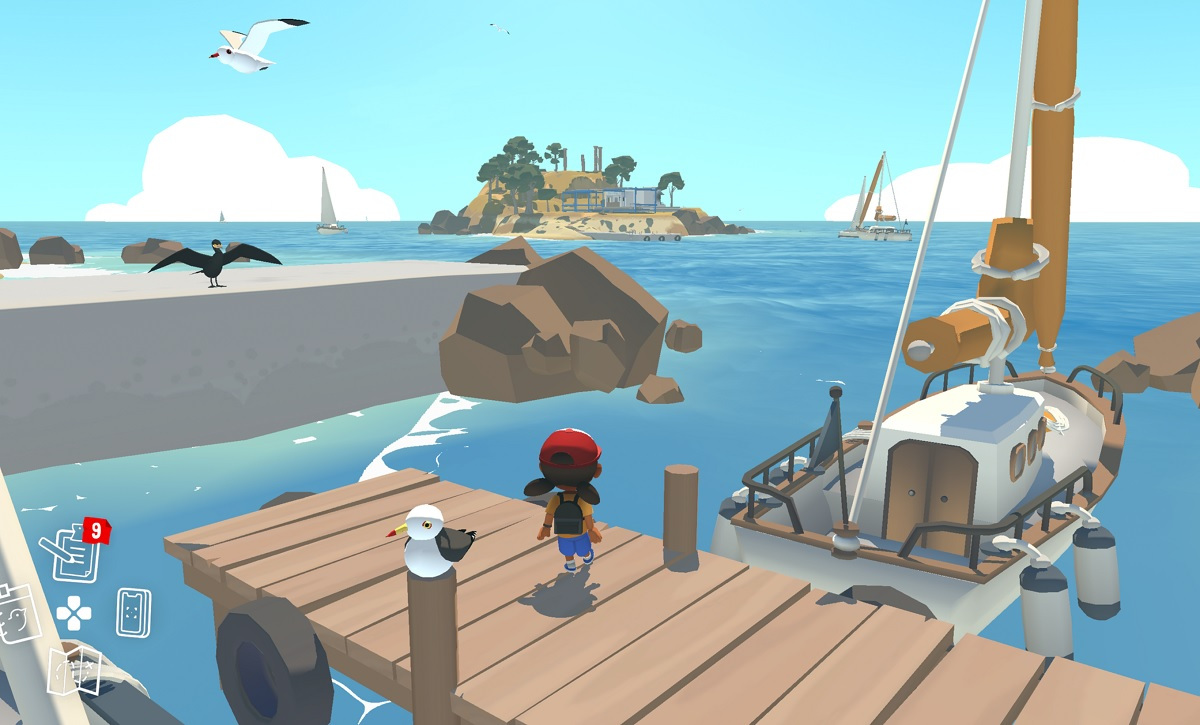
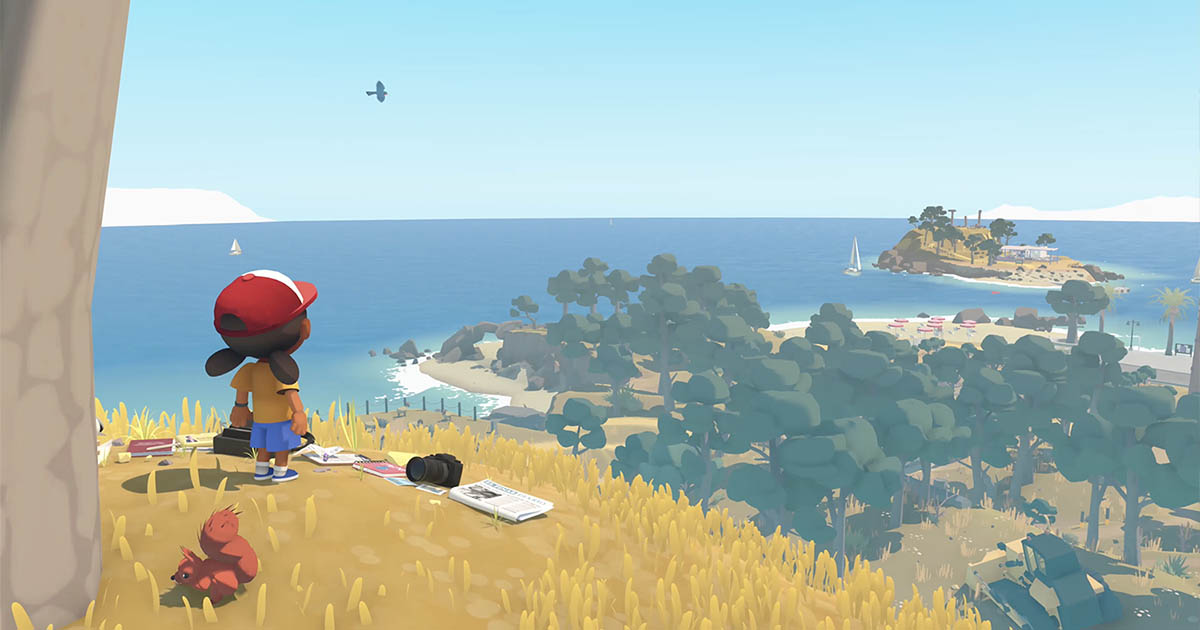
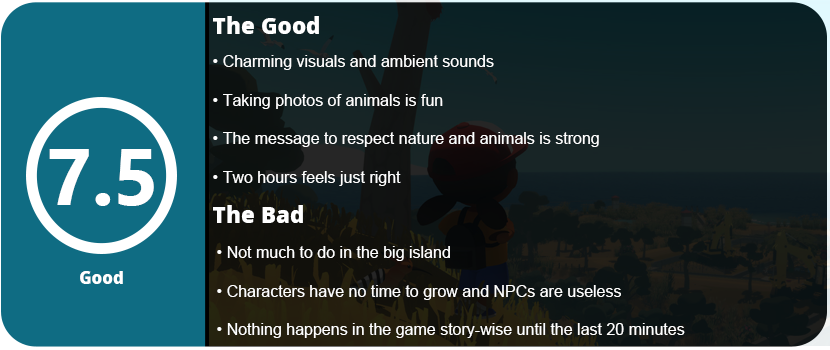
UsTwo’s next game is a small adventure game where you play as a girl named Alba, who is trying to save the local wildlife reserve from corporate hotel moguls. You run around the island trying to gain 50 signatures on a petition to give to the mayor in hopes it will stop the construction. The main gameplay loop of the game is taking photos of 62 different animals on the island via your phone and scanning them with an app. Other objectives include picking up trash, restoring birdhouses and feeders, and rescuing animals from toxic chemicals.
The island is broken up into small areas, so it’s easier to navigate and find where you need to go. Side quests have a green arrow, and the main objectives have gold ones on the map. The entire game is broken up into three days, and you will complete most of the game within two hours fairly easily. Sadly, most of the game is running back and forth between areas with very little to actually do. Picking up trash and fixing items is about all there is to do here. You can also replace photos on info boards, but most everything is done during the main story, as you will come across every area at some point. You can talk to most of the townsfolk, but they have nothing important to say except to waste your time as per NPC regulations. They don’t even offer side quests, which feel odd.
I did enjoy taking photos of the animals, as tracking them was a lot of fun, but sometimes there is just one bird you can’t find somewhere to complete a side objective, and it’s quite irritating and frustrating. While the idea of respecting nature and animals is a great message to get across in a game, I felt nothing for the characters as there wasn’t enough time to do any world-building. For most of the game, you’re just trying to get the 50 signatures, and nothing really happens until the last 20 minutes of the game. For such a large island, I felt there could have been more to do with maybe some mini-games or more side objectives. Even adding more animals that aren’t 90% birds would have been nice as well. Animals are categorized as rarities, but I don’t see how this has any bearing as there’s no point or rating system for finding these animals. Hell, there isn’t even an achievement for finding all the animals in the game!
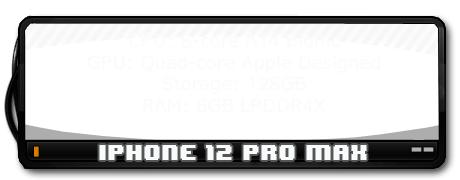
The game at least looks really pretty, and the low-poly art style with bright, vivid colors is great. The game has good lighting effects, and the sound effects of animals everywhere are a nice touch. Alba controls well as she runs around the island, and I didn’t run into any bugs or crashes of any kind. However, on my iPhone 12 Pro Max, I still ran into frequent slowdowns, especially when zooming in on the phone. This phone is more than capable of running this game at 60FPS, but it needs better optimization. You will end up seeing what the entire game offers in the first 30 minutes of the game, but that’s not to say this game is boring. Two hours is probably just the right length, to be honest, as any more would overstay its welcome due to the lack of things to do. I highly recommend this game to young players for the message it delivers and to any gamer for just a relaxing and chill game.
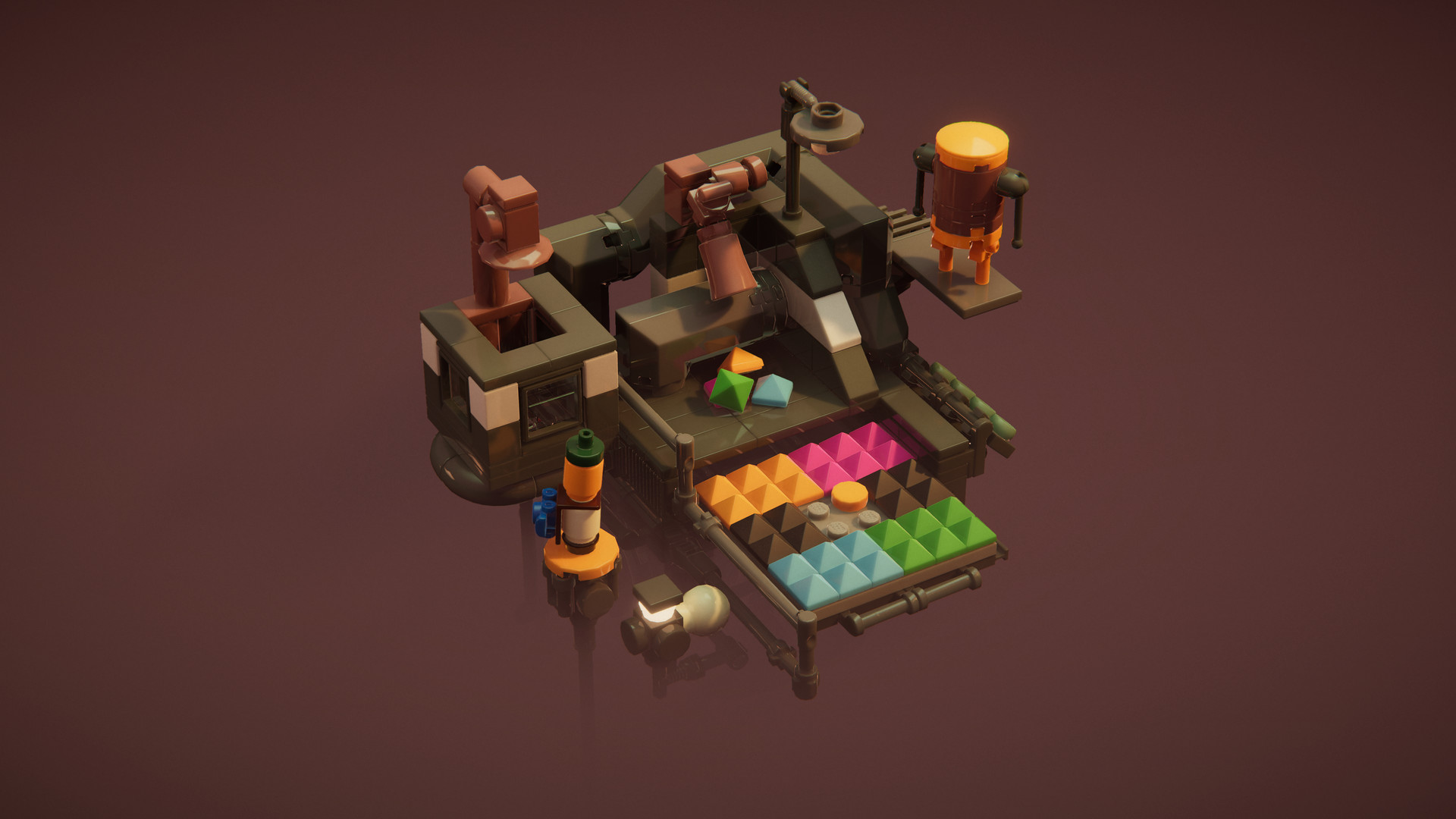
When I first saw Builder’s Journey, the first thing that popped into my mind was Monument Valley. It looks similar with a bright and colorful art style, no voice acting, and a story told through actions. It features small, spinnable tower-like levels that only take a couple of minutes to solve. The game is imaginative and a nice departure from the typical movie license LEGO games we get from Traveler’s Tales. It’s relaxing, fun, and feels like you’re using Legos to get around these levels to reach your destination.
You play as a boy and his father, who are essentially trying to take down some evil company the dad works for. The game is so short that there isn’t time for a feel-good story or emotions to set in, but the game at least tries. You pick up Lego pieces and set them down on the round pegs like you would in real life. You hold the pick-up button to let go, and that’s about it. You can spin the level a little bit, but the great thing about this game is that there’s no preset design you need to follow. You get a few pieces, and the puzzle is to figure out how to put them together with the limited pegs in the level to get your characters across. Each character has two orange platform pieces that you use for them to hop around on. Sometimes you need to build something, but the game gets tough towards the end.
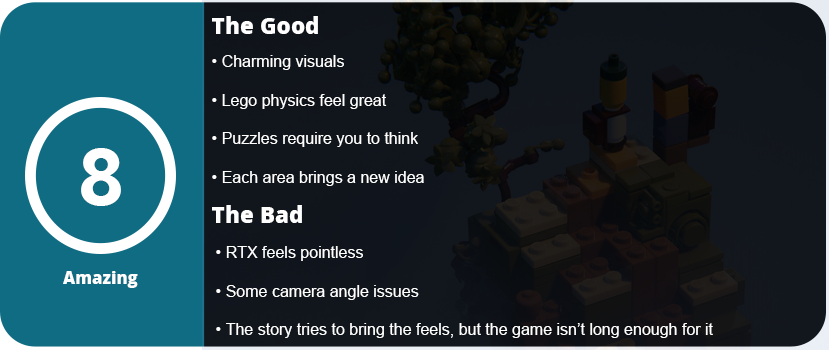
Puzzles towards the end involve two screens in which you need to either place blocks a certain way or get blocks to the other screen in a certain way. Each area has maybe five puzzles before the next idea is brought in. One idea is using race track-type pieces with curves and straights to get across on a roller skate. Another idea is using blocks to grow more if you put them down. It’s all very imaginative, and it never gets boring or old. The game has a “just one more puzzle” feel to it. You get breaks in between with a scripted puzzle that just requires putting a few pieces together, but it’s a nice break. I did have issues placing and dropping blocks as the camera would be at a weird angle. The blocks do snap over the pegs they need to go in, but sometimes I just couldn’t get them positioned right, which required fiddly placement.
There were a few occasions in which where to go in the level wasn’t obvious or my character wouldn’t start hopping across the level because a certain block was too high or too far away, and I couldn’t figure out which one. The levels that take this kind of trial and error are frustrating and ruin the pacing, but thankfully there were only a few. I also feel that this game could have been made without the Lego branding. While it feels and looks charming, generic blocks would have worked just as well too. There’s nothing that the Lego branding brings to this game to make it feel unique.
That’s basically it for the entire game. It ends in 90 minutes, as it was originally designed for iOS devices with 5–10 minute pick-up-and-play sessions. There is an RTX option for PC, which is super weird for this kind of game, and it looks okay, but why cut your frames in half for a game like this? There are only a few levels that use light that uses RTX, so it feels kind of pointless. Other than that, the game looks great, and the physics are also good. I highly recommend this game if you want a zen-like, relaxing puzzle game to kill a couple of hours. It’s not memorable, but it sure is fun.
I would have to say this is the first “adult” game I’ve ever played that’s actually good and can be considered a game. Most are shameless excuses for games just to throw nudity up on the screen, but Lust From Beyond does it with a purpose as it’s part of the story. You pay as Victor, who ends up having dreams that teleport him to the world of Luust’ghaa. This is a land of lust that is ruled by strange gods who want to bring everyone to the Land of Ecstasy. You end up going back and forth between these two worlds. Luust’ghaa is a puzzle-solving world with little combat, and then the current world is mostly sneaking around and opening new paths. This is a Lovecraftian game all the way through, and it’s what lured me in. The art design is also inspired by H.R. Giger’s work, Aliens.
I won’t beat around the bush or hide it. The main selling point for Lust is the hardcore sex scenes throughout the game, but when I say throughout, I mean spread out across the entire game. It’s done tastefully, and it’s actually part of the story. With this occult worship of a god of lust, they partake in orgies, torture, maiming, dismemberment, and all sorts of horrible acts. The game is incredibly violent and disturbing. You have sex with mutilated bodies and strange monsters, and it’s also pretty entertaining and fascinating to see this used in a halfway decent game. There are only a handful of sex scenes in the game, and they are key points in the story. To get to Luust’ghaa, you have to feel the extreme pleasure of being transported there.
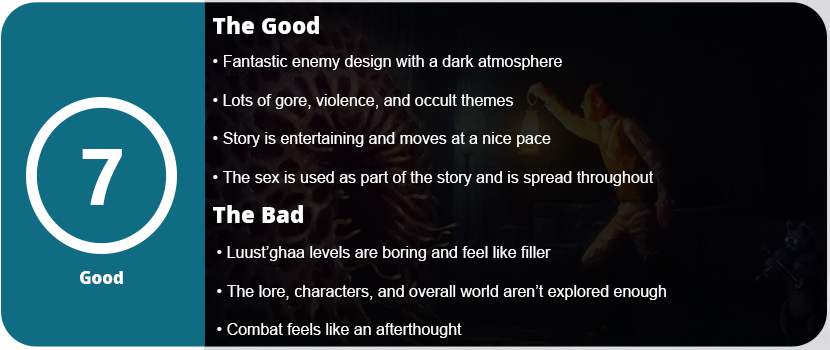
However, this is an adventure game with light combat, so there is some light puzzle solving, but most of the game is running around labyrinthine levels, collecting baubles and keys to open doors. Sneaking around is mostly done early in the game when you learn of a rival cult that split and tried to use the opening of Luust’ghaa to their advantage. This is the most disturbing part of the game, where there’s lots of gore and strange sexual encounters. Sneaking in this game is pretty easy but still tense. If you stay crouched, no one can hear you, no matter how close you are. There are a few chase scenes, some bosses in fact, and you do get a gun towards the end of the game to use in small parts. Overall, the game never got boring as the gameplay was always tossed up, but I didn’t care for the Luust’ghaa levels. It looks gross and creepy, with shiny flesh everywhere, but after a while, it was just the same boring corridors to find ways to open doors. Sometimes I use a lever to move a block, but mostly they get boring. Nothing really happens on these levels, as there really isn’t much storytelling here. It feels like an excuse to fill the game out.
I also felt that having the power of Essence felt like a waste of time, as you only use it towards the end of the game. You can find Essense pools and use them to raise bridges and lure gross monsters near tumors that they can absorb to open a pathway. It just felt like silly filler content and a pointless gameplay mechanic. However, I did like the creature and enemy designs. Overall, the entire game looked pretty good, and the art direction was great. The atmosphere was very memorable, and I feel like I will remember this game for a long time. The characters, however, are something to be desired. The voice acting is spotty, and I could tell they tried to make these characters stand out, but you don’t spend a lot of time with them, and their backgrounds aren’t explored enough. Victor is a cookie-cutter protagonist who is trying to find his girlfriend and save her and then disregards everything just for her. That whole story is cliche and gets old and tiring. I also wish the lore was explored more. What’s here is solid, and you get an overall sense of what these gods of lust can do and the cult’s basic history, but instead, we get filler levels of boring key findings.
But can Lust stand out without the hardcore, uncensored sex scenes? Yes, it actually can. Even the censored mode works because the game isn’t built around sex and gore. While it helps and adds to the atmosphere, you can still enjoy the story and game without all of it. There are a few plot twists in the game that surprised me, and I played the game straight through to the end; it was entertaining enough. However, the only time I wanted to quit was when another Luust’ghaa level came up because I knew I was in for more boring corridors, key finding, and lever pulling. At least it’s not too easy to get lost or not know what to do. Occasionally I missed a ladder or had to quickly learn the layout of a level because of the number of enemies around, but somehow it just all works.
Overall, Lust From Beyond is a surprisingly decent adventure game with tons of atmosphere, dark horror, and excellent enemy design. The shock value of sex, gore, and dismemberment is second-hand to the entertaining story and levels, and that’s okay. There is a bonus called the Chamber of Pleasure that is just rooms with two sex scenes each, a few not in the game, and that’s just there, I guess. It doesn’t really add to the value of the game as a whole. I just want to say don’t go into this game thinking it’s sex every 10 seconds. It’s spread out and used to advance the story or be part of it.








































 thebinarymessiah.com
Clearly you have been blocking everything you or haven't played the game at all. Maybe pay attention to the story…