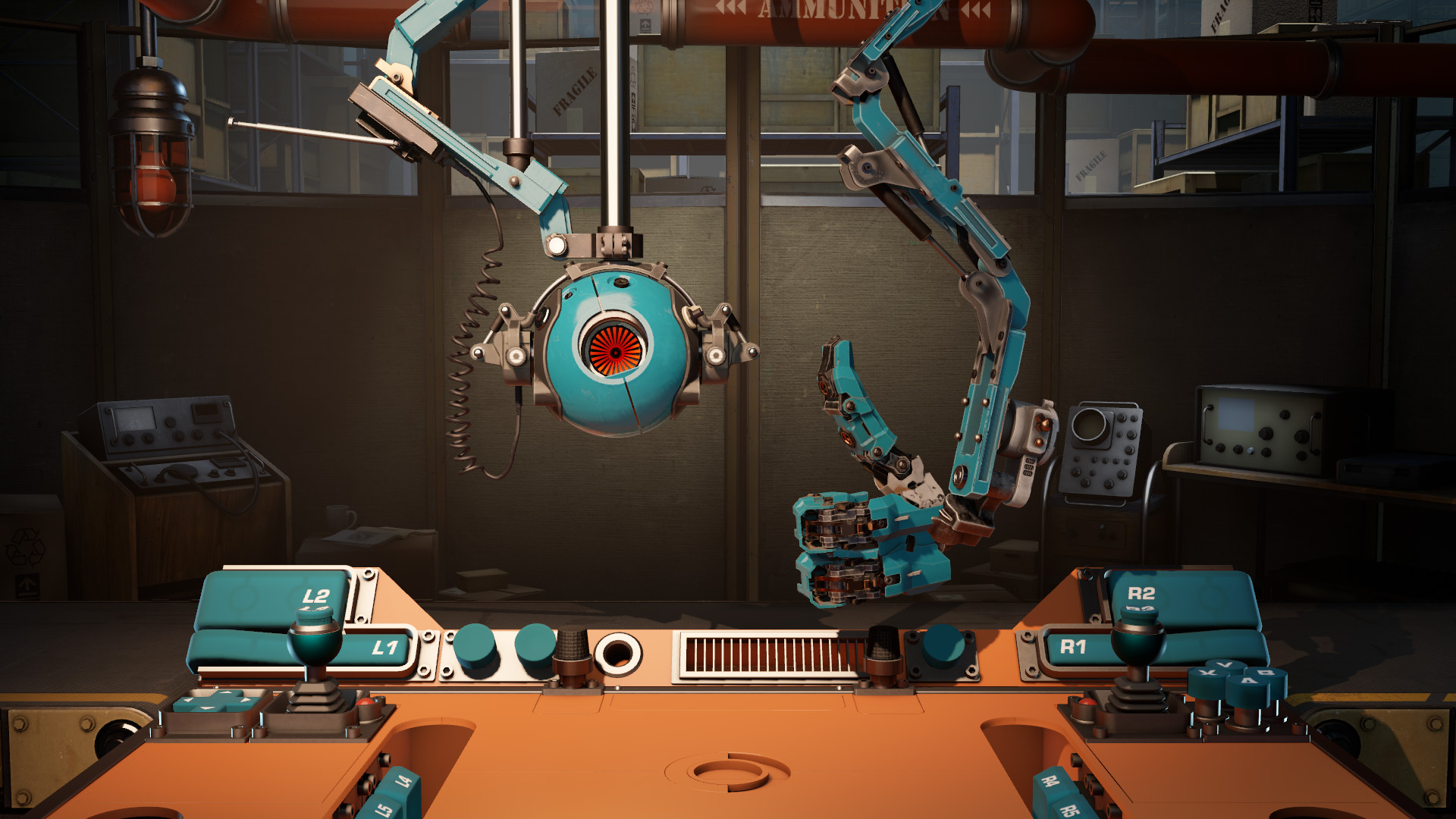
Whenever Valve releases a new in-house first-party game people pay attention. They are masters at storytelling and world-building. Aperture Desk Job is set in the world of Portal. You’d think this is a Steam Deck exclusive Portal game, but it’s not. This short 30-45 minute tech demo shows you the Steam Deck’s unique features.
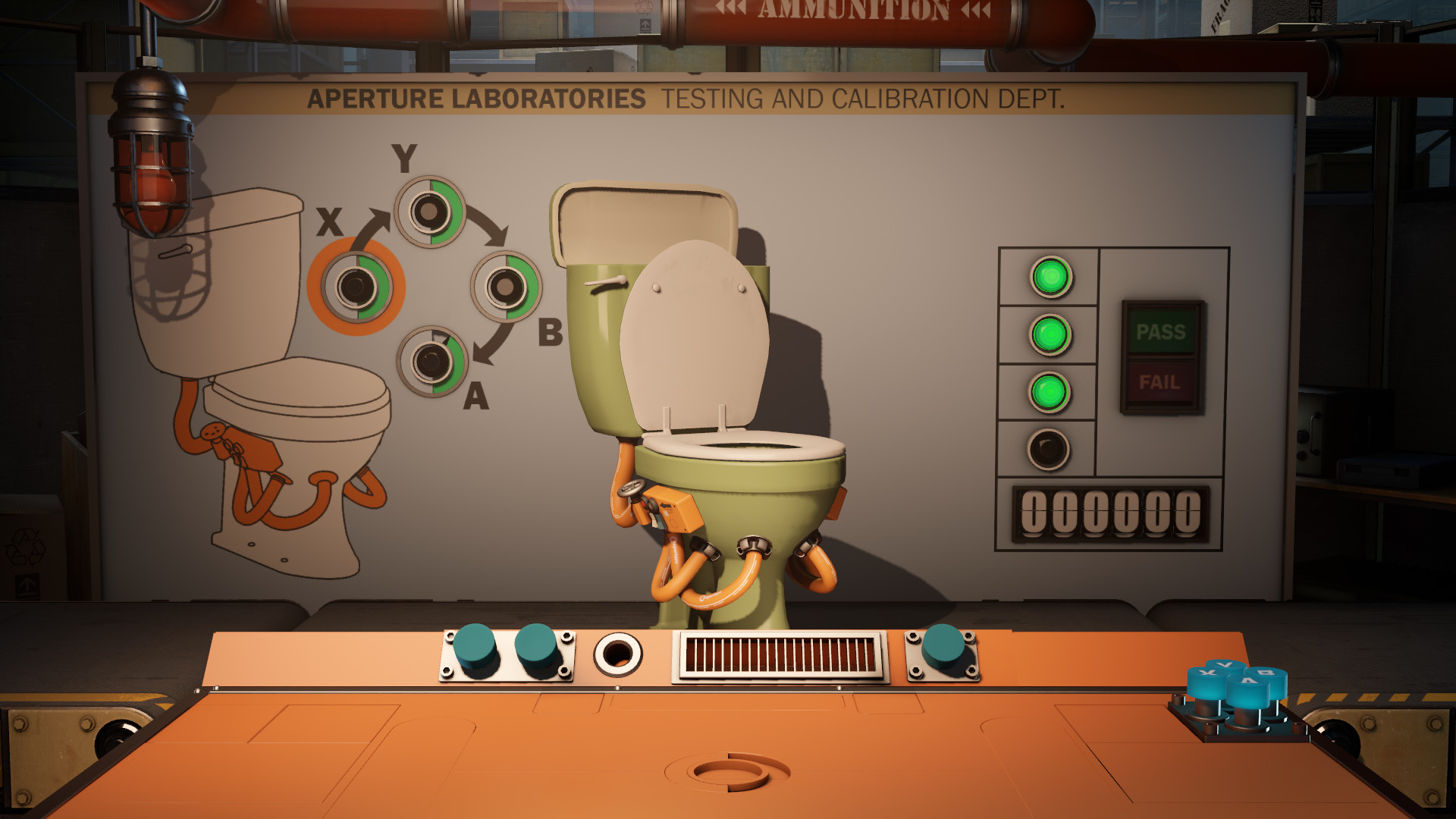
Desk Jobopens up with Cave Johnson giving a riveting motivational speech to his employees (J.K. Simmons retains his role) and the game pans down a factory level by level. You arrive at your desk with a new Wheatley-type character. He’s funny and got some laughs from me, but he isn’t as energetic. He’s a bit masochistic and Valve did a great job with his writing for the short time he’s on screen. Your desk has the exact layout as your Steam Deck and the short story unfolds with you as a toilet tester. Valve’s on-point humor hits here with the subtly they’re known for. You test a few toilets and then time goes by and you see some ridiculous number on the counter board.
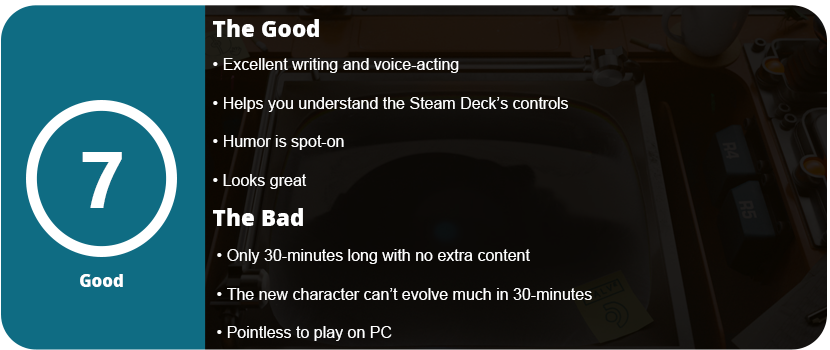
You eventually turn the toilets into turrets which is pretty funny. Here you learn about the right stick’s touch sensor inside the Steam Deck for gyro controls. It’s calibrated pretty well, and I haven’t used good gyro controls before. It’s done right here. Without telling too much more of the story you take a ride back through the factory and you get a fun turret song at the end. The humor punches throughout and I had a good time. There are a lot of missed opportunities here like just a longer game or even some mini-games. It almost seems pointless for Valve to go through all this effort to create such a well-produced tech demo. I’m hoping this means more is coming along, but knowing Valve, it’s not.
The visuals are great and run well on the Steam Deck. 60FPS throughout with great textures and lighting effects. I don’t see the point of playing this on PC unless you just want to enjoy the writing and characters. In Valve’s defense, handhelds are subject to tech demos. Sony did it with the PSP and Vita, and Nintendo loved doing this with the DS and 3DS. Anyone who has played handhelds their whole life won’t feel so shocked or hate Valve for this. They just used such a beloved IP and didn’t go anywhere with it. It’s a painful tease as we all know there’s nothing else coming from it.
If you have a Steam Deck this is a no-brainer. It’s a fun 30-minute demo to play while you wait for other downloads or something. While the main character didn’t get enough time to fully mature like in other Valve IPs just the fact that they got laughs out of me in 30-minutes says a lot. Most games can’t get a smile over the course of hours.
I recently picked up the Complete Edition on Switch as I never got around to The Kid’s DLC, Secrets of the Maw. I replayed the original game and will post my original review below and address further thoughts with the DLC review.
Minimalist side-scrollers have become very popular in Limbo. Inside is just another example of these horror side scrollers done right. Little Nightmares doesn’t really tell a story through voices or words, but through actions. Unlike Inside, Little Nightmares doesn’t have too much of a story to tell. You play as a child trying to escape a ship from humongous fat monsters trying to eat you. That’s all we get really.
Sadly, the story doesn’t really explain much as the art direction, monster design, and backdrops are wonderful and beg for more storytelling. The beginning of the game is made up of basic platforming with simple physics puzzles and a lot of atmosphere. Eventually, you start seeing the occupants of this ship and that’s when things get creepy.
Little Nightmares does a fine job of creating a tense atmosphere and suspense. Grabbing and sneaking are tied to the shoulder buttons, so when you grab something you must hold the button down. This makes things more intense as you are running away from a monster with a key to unlock a door and if you let go of that button it’s all over. The middle of the game is made up of outsmarting these monsters and the puzzles get bigger, but not really harder.
There’s not much to really explore outside of lighting lanterns for checkpoints and breaking porcelain dolls to unlock achievements. The game is definitely intense throughout the 3 hours it takes to complete, there wasn’t a dull moment that I can remember. I always felt like I was running and overpowered and small. From climbing stacks of dishes and escaping on meat hooks to chopping off the arms of a doll maker. The game gives players something that most don’t and that’s solid gameplay while combining excellent visuals and touching moments.
Overall, there are some of the best 3 hours you will spend. From beginning to end,Little Nightmares has something interesting to offer and it’s never boring. The graphics are gorgeous with art styles that reminded me of Box Trolls mixed with Coraline. If you love horror games and platformers then this is for you.
Secrets of the Maw DLC
After replaying the original game I still felt the same about it. The game portrays a really creepy atmosphere and digs into the fears of children and well – their nightmares. TheSecrets of the Maw DLC tells the adventure of the kid you see in the cage when you first start the game up. The DLC is about as long as the original game and is divided into three chapters as well, however, there are more gameplay elements mixed into each chapter to make it more interesting gameplay-wise.
The DLC still gives off that creepy and dark atmosphere and sense of dread that the Kid has to go through. Sadly, we only get one new monster known as The Granny in the first chapter. You spend this chapter at the bottom of the ship in the sewers escaping her grip in the water. The main gameplay loop here is jumping around platforms in the water and swimming for your life to the next segment. I wish we could have seen her more instead of just bubbles in the water. She does appear at the end of the chapter, but with this being the only new monster it’s a bit of a letdown.
Overall this chapter focuses mostly on platforming and the DLC didn’t address any issues such as the camera problems and not being able to line up your jump correctly. The Switch version suffers greatly from long load times so dying often can be a frustrating mess on the Switch. Loading can take up to a minute between each death and sometimes I died shortly after loading just to wait another minute to try again.
The second chapter brings back The Janitor which was the first monster in the main game. This is a very long chapter that consists of three puzzle areas. Here you also get to solve puzzles with the little gnomes from the main game to push things around and activate levers. I found several bugs here such as gnomes disappearing through floors which required checkpoint restarts. Overall, running from The Janitor again isn’t as terrifying as the first time.
The last chapter brings back The Geisha which was the final monster in the main game. This one mostly focuses on a new flashlight combat system in which you shine your light on phantoms and they turn to ash. I found this frustrating as the closer they are to you the less effective the light is which doesn’t make sense. The smallest point of the cone of light is what causes this and it seems like an oversight. I found there were too many phantoms coming after you at once and it became overwhelming. The puzzles in this chapter are the best in the entire game, but again it’s another monster we’ve seen before.
Overall, Secrets of the Maw is a great DLC that doubles the length of the entire collection. It feels more like a game and less like a haunted house ride and just feels more thought out. There were some glitches, the platforming and camera need work, and reusing monsters brings the tension down too much. With the entire package wrapped up, you have about 3 hours of fun creepy atmosphere here.
Bright Memorywas an impressive tech demo that was in Steam Early Access a couple of years ago. It had a scantily clad female protagonist (which doesn’t do anything for the game honestly) and a mix of sword and gunplay in the first person which felt fast-paced and punchy. Infinite is the fully released game, and it’s basically a much longer tech demo. You can finish the game in 90 minutes and this leaves nothing for story or character development which is almost non-existent. All I gathered is that there’s a black hole forming near-Earth and you must stop an evil military guy from taking some sort of artifact that will bring Earth back to Feudal Japan? I’m honestly not even sure.
The best part about the game is the gunplay. The swordplay kind of takes a back seat and is only needed in certain situations. You get a standard arsenal of four weapons. Automatic pistol, auto-shotgun, assault rifle, and sniper rifle. Each weapon has an alternate ammo type that’s usually explosive and does massive damage which is best saved for larger enemies and bosses. The weapons feel heavy and punchy, and they are fun to shoot and use. The gunplay was so good that it kept me wanting more from the game. It had a AAA budget quality to it that’s not seen in many indie shooters. The swordplay consists of mashing a single button or launching enemies into the air. There’s a tacked-on afterthought of a skill tree that lets you unlock abilities and upgrade your alternate ammo firepower, but in 90 minutes you upgrade almost everything pretty quickly so it feels trivial.
There is a grapple line for traversing long distances which are scripted, and you can wall run. These ninja acrobatics feels a bit stiff and not as refined as the actual gunplay. In fact, all of the animations feel stiff and like they were hand done. The faces almost don’t animate and thankfully there are less than 10 minutes of total screen time where the camera shows any faces. Your main character, Shelia, is questionable in the sexy department since you hardly ever see her and there are DLC costumes that seem pointless due to the short run time. You can go through the game again on higher difficulties, but I don’t see the point.
The issue with a short game like this is there is no incentive to come back. There are no modes, no multiplayer, and hardly anything to aim for. The visuals in the game are fantastic with great use of ray-tracing, but again the animations are weird. There’s a short scene where you drive a car and it feels really janky and half-baked. Overall, the boss fights are fun, but there are literally only four types of enemies in the whole game so it gets repetitive quickly. At a sale price, this could be a fun evening, but that’s about it.
I’m not the biggest Postal fan as I didn’t grow up with it. With Postal 4being another turd in the series, I can easily say this is the best game in the whole series despite being a spin-off. It takes the meta-humor, gore, and whacky character designs of the main series, puts them into a Doom clone, and does it quite well. You are put into the shoes of the main protagonist who falls asleep on this couch and end up playing the levels of his nightmares. There are plenty of locales, fun weapons, and tons of enemies.
You start the game out like you do in the main games. You are in a lively neighborhood and go, postal because your TV is broken. The game ramps up the difficulty quite nicely as this first level has simple enemies like redneck shotgun MAGA hat-wearing enemies, dogs, and innocent people to slaughter. These people give you Wal-Mart bags that give you health. Later on, you run into floating fat enemies that chuck McDonald’s burgers and cups at you. Mind you they don’t use the actual names in the game, but you can easily tell what they’re making fun of.
Later levels bring on various enemies and there are three main bosses in the game. There are three different campaigns to play in. You eventually go through the desert, asylum, sewer, forest, and swap levels to eventually get to the F4 Expo campaign to take on Leon Dusk (har har) and his space program. Each level consists of mostly linear hallways to shoot through but there are many blocked doors that require certain items or colored keys. Finding these can sometimes be a bit of a pain as the levels can be quite long and labyrinthine and the level design overall isn’t the best among these Doom clones. I honestly felt a lot of the time that the pacing was off with arenas being way too large for the loadout you get (you frequently lose your entire arsenal and have to gain it back again) and it can sometimes feel overwhelming just in terms of getting your bearings. The enemy designs are well done as you know what enemies are weak against what types of weapons. You have enemies that mob you, strong enemies that stand back, and some with long-range weapons.
The humor in this game is a bit different from the main entries as it stays meta and makes fun of current global issues. Coronavirus (it’s literally a boss), various memes like Elon Musk, the toilet paper shortage, and various one-liners that poke fun at what’s been going on for the last five years globally. No racism, sexism, chauvinism, or anything like that is needed to be a fun game. The game pokes fun at things rather than promoting them. Anyone saying “Twitter will end this game” is just creating fake outrage. It’s funny no matter who you are and isn’t offensive. The developers got with the times and actually had to make an effort to be humorous. What a crazy idea right?
With that aside, the game does get really repetitive after the first campaign is over. Previous enemies cycle in, the same 8 weapons can only do so much, and most of them are pretty basic weapons, but a few are unique like the Pussy Blower that shoots cats out and you can recall them to do damage on the way back. Most other weapons are just clever or funny renditions of normal weapons with alt-fire modes. You do get items to use such as slowing down time, refilling a weapon’s ammo, and refilling health, and you also get a piss button. Peeing on things is useless unless you have fire or nitrogen bottles to burn or freeze enemies with your pee. Yeah, it’s pretty funny. There is also an Akimbo item which is probably the most valuable in the game.
Overall,Brain Damaged has excellent art direction and retro visuals that harken back to the 64-bit era of games like Quake II and Unreal Tournament. The controls are great, the game is fast-paced, the weapons and enemy designs are awesome, there is varied level design, and the humor is actually funny and not offensive just to be offensive. There are plenty of nods to video games, gaming culture, and world events from the last five years that everyone can relate to. If you can get past the repetitious design and so-so-level design problems then you will have a great 5-6 hours on your hands.
The first Shadow Warrior was a lot of mindless fun that brought back the craziness of the original DOS game. It did a good job with great visuals, crazy monster designs, cool weapons, and that fast-paced feeling of classic FPS action. Shadow Warrior 2 really sets the series back by trying to do too much and not doing any of it very well. First off, the story is just stupid and pointless. You are once again doing jobs for the Chinese mafia, and you end up stuck in some sort of family drama about a woman’s soul getting trapped in your head, and you must reunite her with her body. It’s pretty dumb and uninteresting, including the barely passable voice acting and lame jokes.
After DOOM came out in 2016, it set the standard pretty high for rebooting classic 90s FPS games. Shadow Warrior 2 misses the mark in almost every way. One thing it does get right is the awesome monster and enemy designs and cool levels, as well as plenty of interesting weapons, but less is more, and Shadow Warrior 2 doesn’t implement this practice. For starters, the game is incredibly repetitive and poorly balanced. You repeat the same themed levels just to meet different objectives. A couple of levels were literally repeated twice over, and I just hated it. There are three different themes at play here. There’s Hell with demons and monsters, the real world with assassins and ninjas, and then a weird cyber world with robots, drones, and mechs. The monster designs are pretty awesome, but there’s no strategy for each enemy like in DOOM. In that game, you know what weapons work well against each enemy and can strategize on the fly, but here you just empty all your weapons as fast as you can, starting with the most powerful.
I really hate this, as it leads to more useless filler, such as weapon upgrades. These are just mindless stats that boost weapons, and there’s no strategy here either. There are so many of them, and I literally just equipped the highest-level ones and got rid of the rest. It honestly never mattered. Some enemies are immune to or weak to certain elements, but I didn’t bother with this either. I’m not going to sit and sort through dozens upon dozens of upgrades for different enemy types. DOOM did this right with just a couple of weapon upgrades per weapon, and you knew how you wanted to use these. Less is more. Then there are just an insane amount of weapons. There are different styles that match each area, such as demon, real-world, and cyber weapons. Sure, they look cool, but they all mostly felt the same. They had no personality or uniqueness to them. I just picked the most powerful ones and spaced out my arsenal with one of each type. Then there are the pointless powers. I rarely ever used these, as I was so busy mowing down enemies and trying not to get killed. They’re not even useful. spikes to hold a single enemy down, and it doesn’t work on larger enemies? Invisibility? Why?
So combat is pretty mindless, there’s no strategy here, and the story is pretty silly and pointless. This leads to the fact that you get side quests and trials. I didn’t even bother with these. The game starts feeling like a chore less than halfway through the game. The thing is, I started this game back when it came out and shelved it for years because it was just so boring and monotonous after the first few missions. I had it installed on my PC this entire time, and I finally just plowed through the story in about 7 hours, and I didn’t have a lot of fun. Sure, sometimes when you get the right weapon and kill a group of enemies, it’s pretty satisfying. The bosses are pretty cool and felt good to take down, but these are little bites in a giant cake that just don’t taste very good. The developers should have stuck with a more linear design and fewer weapons and upgrades. Other than that, the visuals are really good, and the art style is great.
I love Lovecraftian horror, but video games have really struggled to bring these myths to life. Most of the games get the atmosphere and monster design down but can’t nail a good gameplay loop or decent story. By far the best game for this is still Call of Cthulhu: Dark Corners of the Earth. While its gameplay is clunky, it has great storytelling that’s somewhat memorable. The Sinking City does a great job nailing the twisted town of Oakmont with great visuals, but that’s about it. No single gameplay element or loop comes together to create anything interesting or worthwhile enough to make you want to stick around outside of the main story.
Unlike most other Lovecraftian games, this one doesn’t take place in Innsmouth, but it is mentioned that many are fleeing from that town. You play Charles Reed, who is a private eye investigator searching to end his visions. That’s about it, as far as the entire story goes. You bounce around from case-to-case-solving problems of townsfolk in the form of favors to get one step closer to where you need to go. This is where things start falling apart. Not a single character is interesting, including Reed; the dialogue is drab and boring despite the voice work being pretty decent. There are small little stories for each case you can unravel, but I didn’t care about any of them. I just wanted to progress further and hoped there was some cool twist, but that never came.
When you are inside investigation areas, you can examine items and look at objects. There are key evidence items to progress the story and bonus items to complete all evidence for achievements. This is mostly uninteresting, and there are dozens and dozens of these with you just wandering and looking at everything to find any object you can examine. Once you examine everything, you are given clues to advance the case, but nothing is marked on your map for you. You are given a district and then cross streets and have to pin that yourself. I found this kind of interesting until I found out that all of the main story cases are almost always right near fast travel points.
Speaking of fast travel, it’s so necessary because the town of Oakmont is boring and lifeless. Sure, there are people wandering around, but they are just animations to fill space. They don’t make any sound or have any dialog, and there are no stores or anything like that. It’s just linear streets that look pretty broken up with water-logged streets that require a motorboat to navigate. Some areas are sectioned off as infested areas full of monsters and aren’t worth going into for any reason outside of a few side cases that require it.
That gets us into combat, which is another half-baked idea. The game is trying to be a survival horror game by making ammo scarce, but you can craft ammo and health! Sure, but you will literally be scrounging bullets, and some areas have tons of monsters. I got lucky, but usually went down to my last bullet, and aiming carefully is a must. There are five different weapons, including throwables and traps, but honestly, you just start with your weakest gun and work your way up until you’re spent. There’s no strategy to this, all the weapons feel the same and don’t have any weight to them, and there is no cover system. Like any Lovecraftian game, there is a sanity meter, and as this drops, you hallucinate wylebeasts, and they will attack you unless you take psych meds.
There are some underwater levels in which you walk around in a diving suit and avoid hot air vents and a couple of monsters, but it’s slow-paced and even duller as they are all pretty much the same, just with different layouts and an excuse to maybe add filler. You can shoot a harpoon gun to slow the monsters down, but there was no challenge in these six or so underwater areas. There’s a single boss fight, and you occasionally attack humans, which are easy but usually come in large numbers. Part of the appeal of this game is story choice. Choosing who lives and dies doesn’t really affect much except what endings you can choose, which are uninteresting and unfulfilling.
There’s literally nothing else to do in the game. I desperately just tried to find all the fast travel points. I don’t understand making this open-world if it’s so boring and uninteresting to explore and feels so lifeless. The same loop of investigating cases, fighting some monsters, fast-traveling around to the next case, and listening to the dialog is so dull, and I only kept playing because of my love for the lore. If you don’t care about Lovecraftian mythos, then I wouldn’t even bother with this game. I also didn’t bother with any side cases, as the main story takes around 12 hours and drained me. I couldn’t spend another minute in this game.
Overall, The Sinking City is another barely passable Lovecraft-inspired game that gets the atmosphere and looks right but can’t nail any gameplay elements. While none of them are broken or bad, they are just boring and could have been greatly expanded upon. The main story doesn’t really go anywhere; there are no interesting characters, the dialogue is drab, and the bullet scrounging gets tiring because of the number of monsters that get thrown at you. Not to mention
I love Japanese horror as it has such exciting mythology and creatures that are great for video games. Ghostwire does a great job making an entire game focused on Japanese folklore and mythology while also mixing it with the modern world of Tokyo. Ghostwire has great visuals and art direction, as well as fantastic monster designs, but it falls flat in more ways than I wish it did.
You play as a man named Akito who finds himself awake in the Tokyo streets, apparently dead, and being possessed by a spirit named KK who is trying to stop a demon named Hannya. And that’s about as far as it gets. Sure, there’s a side plot of Akito wanting to bring his dead sister Mari back to life, and Haanya wants her to seemingly become queen of the underworld. I don’t know or care. The story is so underbaked and doesn’t really go anywhere, and that’s no thanks to the story only lasting about 6 hours or so. It’s incredibly short compared to the rest of the repetitive and mostly boring filler throughout the game.
Let’s just start out with the combat, because Ghostwire is pretty exciting during the first two chapters of the game, and then that quickly fizzles out. You get three elemental attacks that are thrown out with your hands. A speedy green wind gust, which is your main weapon, a more powerful fire-piercing attack, and a wider-range water attack Think of it as a shotgun. You can charge these up and do more damage, and then there’s a super ability that lets you do extra damage. You can manage your health with food items, and you acquire “ammo” by destroying enemies or ghost-like objects scattered all over the place. One of the gimmicks of the combat is destroying the cores with a cool animation of Akito using his hands to pull their soul out with a wire (thus the title of the game!). The animation looks cool, but it’s fleeting at best. This becomes incredibly repetitive early on, as you’re just spamming attacks and using each weapon depending on whether you have a tougher enemy or not.
That leads to enemies. They are super cool-looking. They reflect Japanese mythology and folklore, such as the Students of Pain and Misery, which are headless schoolchildren who were either bullied or had some other issue in real life. These are fast-moving enemies. There are Rain Walkers who look like slender men who are salary men or women in real life. They block with umbrellas and are slower-moving. These enemies all look cool, but in the end, there are only half a dozen kids with different variants of them. They aren’t all that challenging in the end, as you just spam all your weapons until you run out of ammo, essentially. Despite all these cool visuals and monster designs, there just aren’t that many.
That leads to the open-world filler, which many games unnecessarily think they need to do these days. Ghostwire would have been a really great 8–10 single-player linear adventure, so more focus could be had on the story and enemies and deeper combat. While Tokyo seems big, it all looks the same. The same empty streets with nothing on the outside of groups of enemies you can walk into. There are various tasks here, such as cleansing trees, finding Jito statues to max out your ammo, and cleansing Tori gates to clear the deadly fog that opens up more of the world. You can find coins and food spread throughout, and you can give animals food for money too. There are various collectibles you can find and outfits to deck out Akito, but once you finish the story, you never see his body again, so I feel this is pointless. Most of your cash will be used to buy more paper dolls to capture spirits, but again, this is another large task that felt like it wasn’t worth doing. There are hundreds of spirits throughout the area, and most side quests give you more spirits to capture.
You can cash in spirits at payphones to empty your paper dolls and get some XP. This leads to the most useless ability tree that takes pretty much getting 100% completion to unlock, but once the story is finished, there aren’t any tough bosses or anything anymore, so why would you continue to unlock more stuff? You could argue it’s for a new game plus, but that’s also pointless as the story isn’t worth revisiting as it’s so shallow and underdeveloped. You’re left with this huge, empty, boring world with stuff to do that leads to basically nothing outside of 100% completion. Games like God of War make you want to find everything thanks to challenges you can complete that still require further upgrades beyond what the story can give you, and Ghostwire just completely fails here.
There’s also a vertical element to Ghostwire in which you can grapple up to demons that are flying and jump around rooftops, but platforming in this game is quite annoying. You can glide around a bit, but it requires upgrades to glide longer. But, with all that said, Ghostwire is a shallow game that tries to be bigger than it needs to be. It’s another victim of trying to cram a pointless open world when there’s so much great mythology and art to make a solid single-player experience, and it’s just squandered.
I do have to mention that you need to complete at least a couple dozen side quests to upgrade enough to make the game not super difficult. Getting more health, max ammo, and some abilities really help, but things like sneaking and your bow are totally useless outside of specific story scenes. It’s clear that this was meant to be a single-player linear adventure that was crammed and stretched out into an open-world game that no one asked for. It looks cool enough and plays well enough to warrant maybe 15 hours inside this world (I clocked in 12 and I explored quite a bit and nearly unlocked).
Even if you aren’t a fan of the movies, I want to say right now that the game is based more on the comics and original takes on the characters. I’m actually glad Eidos Montreal went this route. The game features a new story, and even if you don’t like Guardians of the Galaxy, you should enjoy this game as just a pure action-adventure romp. The game is chock-full of humor, clever writing, a great story, and fantastic visuals.
You play solely as Star-Lord, the leader of the Guardians. The game’s length is something I want to mention first, as it’s fairly long. running for at least 15 hours, and there’s honestly not much in terms of venturing off with side quests or anything. This is a very linear game with small side paths that lead to components for upgrades or extra skins, but that’s about it. You start off the game with a story-heavy intro. There’s tons of licensed 80’s rock music, and right away you can see there’s a lot of care and detail put into this game. Fantastic voice work, great sound effects, and tons of great artwork The game consists of two main parts. Exploring planets on a linear path that includes light puzzle elements—well, barely that, to be honest—and some platforming Then there’s the combat, which this game relies heavily upon and uses as filler.
Let’s just get the combat out of the way here. As I stated earlier, you only play as Star-Lord, and you can order your other three teammates around. When you start out, you slowly acquire up to four different abilities for each member, including yourself, and these are acquired with ability points earned through combat. I feel this is meaningless in the end and feel tacked on as there’s not much strategy involved in combat. You can shoot your pistols until your heat meter fills up, and then time the gauge in the green to offload the heat for a burst shot. Then you can mash a melee button as well. Honestly. Star-Lord is fairly weak by himself, and I heavily relied on spamming the abilities of my teammates. Even my own abilities were fairly weak in comparison. Drax is a heavy tank, while Gemora is like a ninja and can jump around, slicing enemies. Groot is eventually upgraded as a healer towards the end of the game, but in the meantime, he can hold enemies in place. Rocket uses explosives and focuses on AOE damage.
This all sounds fine on paper, but in the heat of combat, the different abilities don’t do enough, which is different enough to mean much. I usually just relied on a couple of abilities from each member, mostly AoE-type abilities for maximum damage, and stuck with those through the entire game. I only really used my own pistol barrage ability, as it was the most useful. Enemies come in usually only three varieties. Easy to kill, medium damage and health, and larger enemies with multiple health bars The enemies mostly repeat on their respective planets, and then there are the same Promise enemies over and over again. There are a few boss fights thrown in, but they aren’t anything unique or special.
It’s sad that the combat is a dance of spamming the same abilities from your teammates and running around to stay alive. The fact that you yourself do so little damage is really odd. There are a few other contexts thrown in, like a bar under the larger enemies’ health bar that determines when they are weak. If you spam enough attacks in a row, you can then do an instant kill. There are also a few environmental items that you can order teammates to toss around, but they’re very underdeveloped and rely too heavily on these fundamentally useless abilities. The fact that there is so much combat in the game can make it feel like it’s dragging on far too long and is just there for filler. I much preferred the story elements and more exploration areas than the combat.
The exploration is mostly just running around and listening to the banter of the Guardians, but also light puzzles in which you must match the correct teammate’s ability with the right obstacle. Gemora can slice things open, Drax can punch through walls, Groot can create bridges, and Rocket can hack panels. There are four weapon elements you acquire, such as lightning, ice, fire, and a grapple ability, that are used here as well, but it’s not rocket science. Again, another idea that is undercooked and feels like filler. I mostly enjoyed the choices you have to make during the story, which determine which allies help you during the final events of the game, and the overall voice work and writing are clever, sharp, and really funny. I just wish the rest of the game had the same care attached to it.
That’s not to say it’s downright bad. The controls are responsive, the animations are smooth and look great, and the combat does work. It’s not clunky or a chore to use; it’s just full of underwhelming features. The various planets you explore are fantastic-looking, really draw you in, and make you feel like you’re in the comics. There are intermissions in between in which you are on the Milano ship and can walk around and explore. There are also Easter eggs and lore scattered throughout the game for hardcore fans too. However, the biggest element of all is: is this enough to warrant sitting through 15–17 hours? If you aren’t a huge Marvel, Guardians of the Galaxy, or comic book hero fan, then no. I feel like almost 5 hours could have been cut with less combat thrown in, and the story does go on and on. It’s supposed to, as you get a solid beginning, middle, and end. There’s enough run time here to really get you to connect with each character. I didn’t finish the game and have no clue about anyone or care about anything, like most video game stories these days. It was daring for Eidos Montreal to really push the story through and allow you to grow with these characters, and it paid off.
Overall, with weak and repetitive combat, mostly useless abilities that don’t allow for any type of strategy, and a weak attempt at environmental puzzle-solving, the only saving graces here are the visuals, story, characters, and voice acting. I played this game all the way through because I wanted to see and hear more. It was highly entertaining, but every time I went through a chapter full of nothing but combat, I grumbled and just wanted these parts over with. I then enjoyed exploring various planets but got annoyed with the poor attempt at puzzles. If the
Adventure games seem to be making a comeback, which is a great thing. My fondest memories of PC games are adventure games, with The Longest Journey being my favorite of all time. They are basically interactive novels with visuals, and sometimes voice acting, to help illustrate the story. Norco is one of the better modern adventure games of late, but it still fails in a few spots.
The story itself has moments of clarity, but like most text-heavy adventure games of late, it becomes a convoluted mess with few characters to care about and a disappointing ending. You play two different characters: a mother and a daughter. You play as the mother, Catherine, in the past, playing events that lead up to the present daughter’s events. The daughter is chasing her mother’s ghosts and trying to recover belongings that a corporation took from her. These belongings are supposed to have answers as to why this corporation targeted your family. The whole game is set in a 20-minute-into-the-future borderline post-apocalyptic New Orleans. There isn’t too much world-building, but a lot of poetic metaphoric dialogue that a lot of games right now think is clever and interesting, but just compounds the fact that a more normal, cohesive story is what makes adventure games memorable.
There are a few moments where you might enter a combat mini-game, but these are far and few, and it seems almost impossible to fail them. Various typical adventure game elements are lightly sprinkled throughout, like inventory items, backtracking, and code memorization, but surprisingly, there are no puzzles. A lot of important clues and context will be shown in green during dialog, and talking to your party can give you hints, which is helpful. I rarely couldn’t figure out where to go. The explorable areas are just still images that you can move your mouse around and click on to interact with. The entire game is from a first-person perspective. There is a small mini-map in the corner that lets you click around to various “rooms” you’ve unlocked, and then there’s a larger map to jump around to the main areas.
The best part about the game is the art and abstract character design. There is some weird imagery here, and I really enjoyed the pixel art. The entire game gives off a great sense of atmosphere and foreboding helplessness. You meet weird characters, an occult, strange objects, and overall, the game just pulls off a great sci-fi setting, but just the setting. As the game progresses, the entire reason why you’re doing any of this is lost, and it just devolves into abstract poetry and makes no sense. Sometimes things seemed normal, and there was decent character building, but it just wasn’t enough to push it to that top-tier adventure game level. I still didn’t care about anyone in the game enough, as right when things seemed to pick up, the game dropped the ball with more abstract poetry, weird imagery, and unanswered questions.
Overall, Norco has great art and super weird characters and settings, but the overall story is just a convoluted mess that devolves into poetic abstractness that seems to be plaguing adventure titles.
I love adventure games, especially ones that do something interesting or unique for the genre. Mostly, I love adventure games with fantastical stories and great characters. Graphics usually come last with these kinds of games. Kentucky Route Zero does have an interesting art style that is signature for Annapurna, but it doesn’t really add anything to the game either. The first couple of acts of the game start out well enough and are easy to follow, but the game’s story quickly devolves into visual novel-level walls of text and pointless stories that lead nowhere.
You play an antique shop delivery driver who needs to make one last delivery before the shop closes at 5 Dogwood Drive. You start out at a gas station on a highway, and a strange man tells you about taking “the Zero” out to the address. You soon meet an electronics repair woman and end up seeing strange stuff on a TV. You follow clues to get the zero, and this is where Act 2 leads you. Once in act two, the game’s pace stays sharp and breezy. There’s nothing to really play here, as you mostly just click around, leading the characters to icons to read more dialogue and text. There are no puzzles, combat, scripted events, etc. This is a straight-up borderline text adventure. Once you hit act three, things slow way down, and then there are the pointless interval chapters in between each act. One chapter was 30 minutes of nearly endless, boring dialogue that didn’t add to the main story at all. It was painful to read it all, and I actually read novels in real life regularly. It’s dry and dull and not interesting in the slightest.
Each act has several scenes, and they are usually rather short. Once you click on each icon and read all the dialogue, you will advance to the next scene. There are at least a lot of locales, and the visuals are striking in some scenes. There’s little spoken dialogue, but I actually quite liked the songs here. They were very sad and helped set the tone of the entire game. This isn’t a horror adventure either. It’s just super weird, and I wish I could have followed the story or cared about any of the characters. If the dialogue wasn’t so damn boring, I would care more. In some areas, I just skipped through the dialogue because it was either really abstract and poetic that didn’t add anything to what was going on or just super uninteresting. Many people will probably shut the game off after act two, as that’s when things really slow down and drag.
I want to say that the ending was worth all the hours of reading, but it wasn’t. It made no sense to me, and the entire trip to the address almost felt like it was an afterthought. I would say I don’t want to spoil anything, but there’s not much here to spoil. There’s so much character and world-building that the actual adventure is eventually forgotten about, and said world-building is dull. There are a lot of slice-of-life moments talking about real-life personal situations from the past, and then there will be some sort of narrative poetic thing for a while, and then back to two random characters talking about how much they like a certain food. Normally this is great, but in this game, it doesn’t add anything, as I have to already care about the characters to want to read this stuff.
Overall, Route Zero starts out great and quickly drags on into a dull and uninteresting visual novel with interesting visuals. There isn’t a satisfying ending and the intervals between acts are pointless and dull. There is zero gameplay involved and mountains of text to click through. This would normally be fine if the actual characters and scenes were interesting. Some may like the abstractness of some of the writing while most others will fall asleep.
Try multiplayer. A lot of fun !