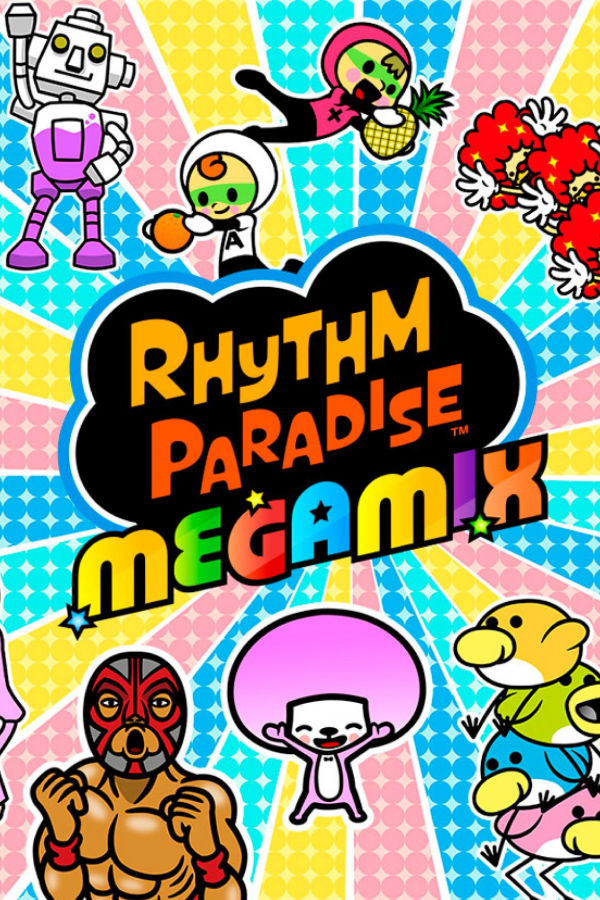
Rhythm Heaven has always been a difficult game to master. This isn’t Warioware or Hatsune Miku. This game requires precise timing, and you must be really in tune with the beat. I had to physically tap my foot or nod my head to keep myself in rhythm for some of these minigames.
The game has a typical Nintendo-esque storyline in the vein of Warioware, with goofy characters. The art style is nice and cute, with skippable dialogue, which most people will probably do. Each section contains four mini-games that you must pass to move on to the next set of four mini-games. These games are some new and mostly old from the previous two games. Mini-games require you to press the A or B button or tap the stylus (this is an optional alternative). Being on the beat is a bit more forgiving than previous mini-games, and scoring is a lot more generous. If you are just a couple of points from passing, the game will give them to you out of pity, and the boss stages will let you pass if you spend 30 coins for at least trying. My biggest gripe with the previous games was the lockout from progression, which would make you want to quit playing.
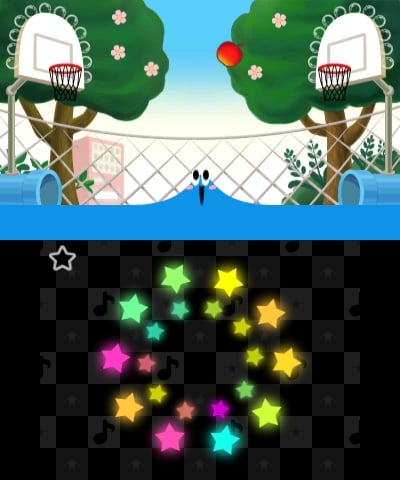
My favorite mini-games are the ones that have something physical to track. The LumberBear one is a perfect example. Logs get laid out in front of you, and each mini-game has a second type of beat to follow. There is usually a fast-paced rhythm and then one where it requires longer pauses or rapid-fire button presses (in the form of three most of the time). The first tower you play is actually much harder than the later towers because the second version of these mini-games is longer, which allows you to miss more and still pass. There is a practice mode before each game starts and if you miss too much the bottom screen will show a rhythm pattern for you to follow. This helps as some patterns are just hard to get down. Again, another way for the series to be more forgiving this time around.
There are some mini-games I was just terrible at or weren’t designed in a way that made staying on beat intuitive. There is always a visual or audio cue, but sometimes the mini-games will trick you and pull the camera out, obscure your view, or cut the audio, and this requires mastering the mini-game. It all becomes muscle memory at a certain point. This isn’t a casual rhythm game or mini-game compilation like we’re used to. Can we call this a hardcore rhythm game?
You can unlock trophies and other extra mini-games in the museum and cafe. This never really interested me, as this isn’t a game I wanted to finish 100%. Once you finally finish the story mode, there’s no real reason to come back to this game unless you really love punishment. I found this game wasn’t relaxing at all for how tense and focused you have to be to play it and pass the story stages. Even with the goofy characters and skippable dialogue, the story mode is quite long, with seven towers to finish. The graphics are great, and each mini-game looks unique and charming. This has that wacky Nintendo signature all over it. If you disliked previous Rhythm Heaven games, I would give this a shot since it is more forgiving and the timing has been somewhat refined.
This is my first time playing a Mario & Sonic Olympic game outside of an arcade room. The series never appealed to me, and it’s been around for what seems like forever. They never reviewed very well; they all looked and seemed to be too similar, and they felt aimed at kids. A mini-game-style game set around the Olympics is usually something you can blow off. Anything Olympic-branded is most likely hot garbage, but there is something here.
The 3DS version of the game has a story mode, unlike the Wii version. The mini-games are also hand-tailored for a more pick-up-and-go style and are much shorter. The story mode is quite simply dead-ass boring and a complete snooze fest. There was zero effort put into it, and there is no reason to play it other than to get used to some mini-games. The basic premise is that Mario and Sonic can’t start the opening ceremony because Bowser and Dr. Eggman have set off a fog machine that produces evil versions of everyone. The cutscenes last way too long, sometimes up to five minutes, and consist of characters standing around grunting, showing emotes, and yapping about a whole lot of nothing. All of your usual Sonic and Mario characters appear, such as Team Chaotix, Princess Peach and Daisy, Yoshi, and Metal Sonic. That means absolutely nothing. When everyone is done running their mouths, you can pick a challenge. Some challenges are one event only; some can be more. There are five chapters in the story mode and then bonus chapters focusing on Bowser Jr. after the fog has cleared.
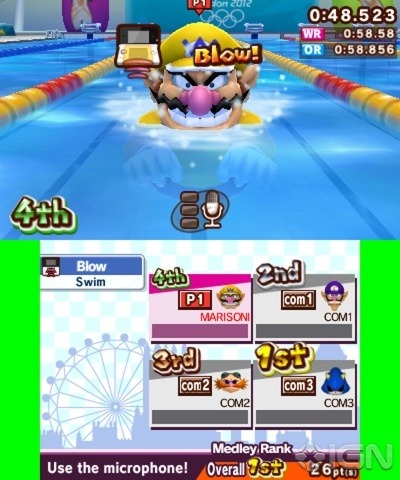
There are a lot of mini-games, so I will give the game credit there, and they are varied. You use everything in the 3DS to play these games. Shooting mini-games uses the gyroscope and the shoulder buttons; swimming might have you partially rotating the circle pad. A swimming game has you using the touch screen with your fingers. Some require timing and reflexes, but I felt some were pure dumb luck unless you played against an actual person. Some mini-games are just hard to understand, with about four screens of instructions before each game starts. This makes the story mode drag on, as you just want to jump in. I don’t need to confirm three times and get instructions more than once. Even restarting an event resets all of this, and it’s back to confirming everything. It drove me crazy.
Mini-games play fine on normal difficulty, but hard feels nearly impossible. Not one mini-game ever feels right or perfected. Some feel sluggish and unresponsive; others are hard to grasp and take multiple tries to understand. Some I never quite knew what was causing me to fail, such as the BMX sport excusive to the 3DS. You press A to jump, but you need to tilt the 3DS to land flat. I could never figure this out and always landed wrong, no matter what I did. Games that require timing, such as fighting sports, just get frustrating because it seems the CPU knows what you pressed, and it’s a dice roll as to whether it fails. This is most notable in table tennis and badminton. I would get 50 rallies on one match and fail, but the next serve, the CPU would fail in 3 rallies. It never felt fair.
It got to a point in the story mode that I avoided the timing and reflex mini-games and went straight for ones that required physical ability to win, such as blowing into the mic, tapping a button really fast, or using the stylus. When you finally beat the story mode, you can mix and match event types through unlocked playlists or create your own. Once you’ve played every game a few times, there’s no reason to keep playing against the CPU. This game really needs a second player to feel fun, but then you still run into issues with sluggish controls, and the game never quite gives you the control you need or that would make the mini-game feel more organic.
The visuals are pretty good for a 3DS title, but they’re nothing special to write home about. Textures and character models look pretty decent, but it’s your typical Sonic or Mario visual style, which can feel pretty boring around this point in time. I wish the story mode was better and wasn’t geared towards pre-schoolers, and there are a few really fun games in here, but they are buried by the sheer weight of many other sub-par games.
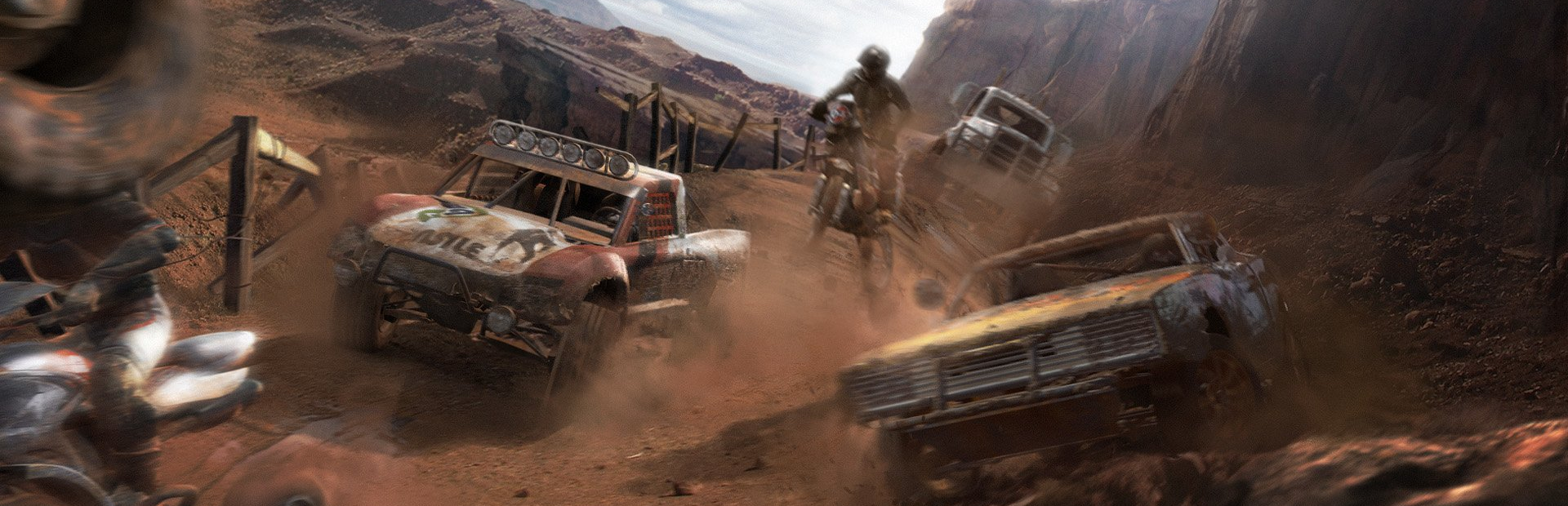
I remember seeing the trailer for this game during the PS3 reveal when Sony briefed the world on their latest console. The trailer blew my mind. No one knew if it was real-time gameplay footage or not. I remember being impressed by the mud deformation effects and how light reflected off the water in the mud. After playing this game, I realized that it never looked anything like that or that the trailer was pre-rendered. MotorStorm still looks pretty good even today, but there are other problems than my foggy memory.
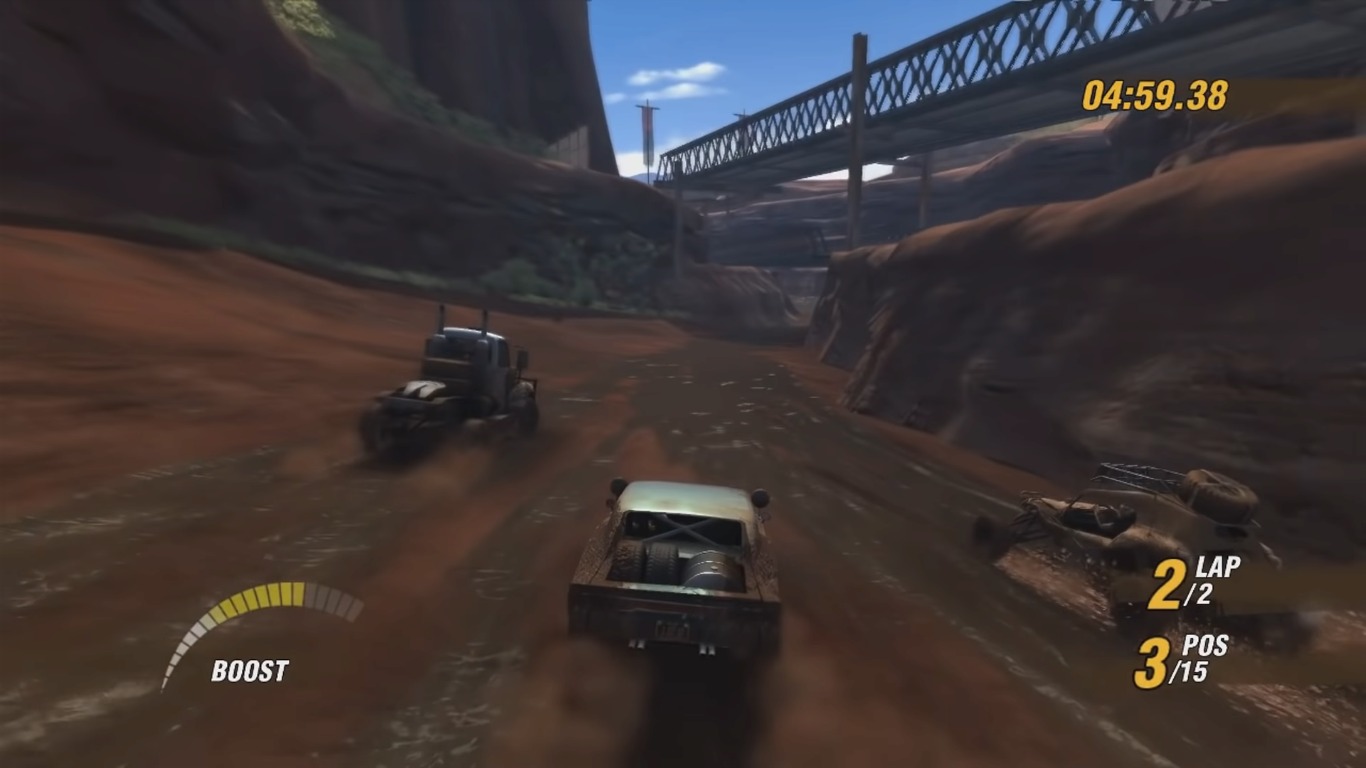
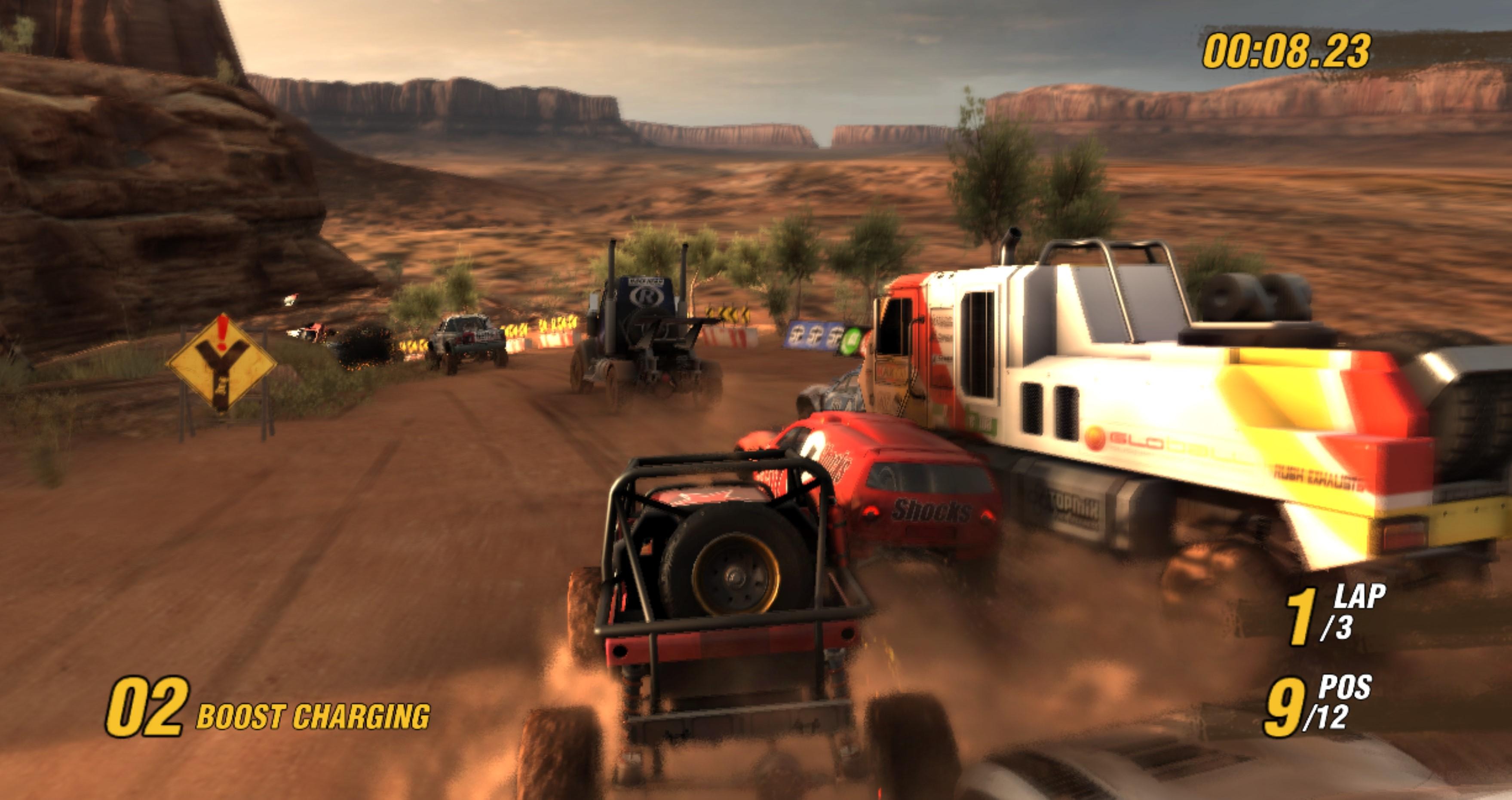
The game is fairly basic, but for a first-time effort for a new franchise, the game isn’t too bad. This was also what feels like a slightly rushed title to get it out the door for the PS3’s launch (which it missed). The game consists of only circuit races around nine different tracks. The draw of MotorStorm is the different vehicle types and how they interact with the terrain. There are trophy trucks, rally cars, buggies, motorbikes, ATVs, and even big rigs. Each vehicle does feel unique, and the interaction works in terms of agility and jump height. There are different paths on each track that are best suited for a different vehicle type. Motorbikes are best at jumping large gaps, but big rigs won’t make the jump. Buggies are great at lots of small bumps, but some cars might slow down a lot here. There are even areas with a lot of junk that you have to maneuver around, or you will crash.
Crashing is incredibly annoying in this game. Every crash activates a slo-mo cam, and you can’t skip this. Your car resets back to where you crashed, but the game has some serious rubber-band AI as you fall way behind after just a couple of crashes, and sometimes you can’t catch up depending on your vehicle. You have to memorize each track well and master them to get first place, or even think about qualifying. Sharp hairpin turns can send you off a cliff; the wrong path can slow you down too much if you’re not in the right type of vehicle; and the signs posted on some tracks for the vehicle aren’t helpful. I wish there was a vehicle recommendation during the ticket selection so I didn’t have to trial and error with each vehicle. Vehicles are also all the same in each category. You get to pick between three styles and three colors. There are no stats at all. Annoyingly, each vehicle must load in during a real-time vehicle selection screen.
The main campaign is played by advancing in tickets by winning points. You must place third or better in each race to continue. There are 25 tickets and up to five races in each ticket. Races all have three laps, so you can imagine it gets tedious. And boy, does it. The same tracks repeat over and over again with no variation in even types. Why not drag races? How about tracks with lots of jumps? Something, anything, to break up the monotony. After tickets 7-8, I got tired of the game and shut it off for good. By then, I had finished around 40 races and had raced every track multiple times.
That’s another big issue with this game. The tracks are all similar. There are only desert or dirt tracks that mostly look the same. It’s just dead brown flat textures with nothing in between. The layouts themselves, in terms of jumps, turns, dangers, etc., are well done. Once I learned a track, it felt good to race around flawlessly and know what paths were best for the vehicle I picked, but after 3–4 times on each track, I got tired of it. Not to mention having to constantly restart the same one over and over again (some were a dozen times) because one crash too many made me fall too far behind. You need to flawlessly race around these tracks, and it can get super frustrating and punishing.
MotorStorm has a lot of potential to be a great arcade racing series. There needs to be more focus on terrain deformation, more track and event type variety, and a bigger distinguishing difference between vehicle types. I also felt the menus were sluggish with constant loading, and the game suffered from texture pop-in a lot, but in the actual races, the gameplay and framerate were smooth. Can we also get another color in the sequel besides brown, please? Please, and thank you.
I never thought that a GTA game would be in handheld format. We had the original two games on the GBA, but that was kind of expected. Chinatown Wars is a brand new hand-tailored experience for the DS and later shoehorned onto the PSP. There are touch-screen controls, a whole new interface, and mini-games galore. This game feels like what GTA 3 would have been if it hadn’t gone full 3D. You get the over-the-top perspective, but everything is still in 3D. The game looks really good for a DS game and feels like a unique GTA experience.
The story is your typical GTA gangster revenge story. You play as Huang, whose father was murdered for an ancient sword that was passed down to mark the next mob boss leader. Huang flies to Liberty City to avenge his father’s death, get to the bottom of the Triad and gang squabbling, and get that sword back to help his uncle move to the top. The story is full of deceit, betrayal, deception, and revenge and is mostly uninteresting. It doesn’t have the charisma, flair, or flavor that the console versions have, mostly due to the lack of voice acting. The story is told through stills and text, which makes sense on the DS, but definitely doesn’t give the characters any well-being. Many of the mob members are stereotypical drug and sex addicts, power-hungry, stupid, and Huang can’t trust anyone. The story has around 50 missions, and they play out similar to the console version.
The main interface is custom for the DS. You get a PDA-style screen that you can touch. The map is displayed here as well as your radio stations, throwables, and weapon switching, and the menu in the PDA will show your trade info, emails, settings, stats, etc. It’s very intuitive and just makes sense. New story missions are given via red emails. These will also give you a shortcut to place a waypoint on the map leading to that new story. There are a lot of quality-of-life things like this thrown in. The GPS map has shortcuts for everything you need, from odd jobs to your safehouses. You can also order ammo and weapons from Ammu-Nation on the PDA as well. They show up at your house, and you get an email telling you when it’s ready.
Running around the world of Liberty City feels lively because of the limitations put in place. You can run and jack cars, drive off and kill everyone on the road, and gain your infamous wanted stars. Stars can be dropped by making police cars crash, which will help lower your wanted meter faster. I did feel there were way too many cops around in this game. It seemed every 5–10 cars was a cop car or a pig walking around. I was constantly caught carjacking or running over someone, and I was always running into cop cars. This felt way overdone in this game. Driving around Liberty City does feel great. The game never slows down, and the ambient sound effects of the original radio tunes (they’re instrumental and not licensed due to space limitations on the DS carts) make it feel like a living and breathing GTA game on the go.
Missions are varied, but some elements of missions can get quite annoying, causing multiple deaths and restarts. The auto-lock-on feature for shooting isn’t that great. You don’t always lock on to the closest enemy or an enemy at all. This caused many deaths when I locked onto a car instead of a person shooting at me. You can roll around and dodge people, but many times I was stuck without a weapon and would have to order something from Ammu-Nation, go to my safehouse, wait, pick it up, and go back and restart the mission. Thankfully, you can trip skip if you get to a certain point in longer missions, which saves you time, and you can skip cutscenes. A lot of mini-games surround missions, such as tapping the screen to break locks, mini-games to use cranes, plant bombs, scratch cards, tattoing, and many others. These were a lot of fun, and I was always looking forward to the next one. However, trying to jack a car and being stuck in a mini-game of hot starting it for the 100th time got old and would make me get busted as you can’t back out of it. Most missions vary from shooting, following, and chasing, and some put you on turrets or throw bombs out of a car. Overall, the mission variety is awesome, and I never got bored.
The biggest setback in the game is the new feature of drug dealing. You can use your PDA to see the drug turf map for who buys and sells what. This is required to actually make money for weapons and sometimes even start missions. Some missions require a certain drug type or a large amount of cash. This means setting a GPS waypoint for a dealer who sells said drug and buying some from them. You need to make large profits, so it’s best to wait for an email when a dealer is selling at a discount and then turn around and sell it. This takes a lot of time—driving around and waiting around, however. Buying and selling drugs at market value won’t get you anywhere. Odd jobs can give you a few bucks, but they don’t pay out enough. This really slows the game down and hampers an otherwise fast-paced game.
When it comes to visuals, the game really shines on the DS. There are small, subtle things, like street lights turning off when you hit the poles. Weather patterns such as lightning strikes casting shadows on the ground, sparks, fire effects, and even being able to close the driver door if it’s still open while driving (let go of the accelerator and Huang will close the door). These small changes help make this a high-quality DS experience and set it above the rest in terms of production values. Chinatown Wars may have a forgettable story and characters, some control issues when shooting, some frustrating missions, and a drug dealing mechanic that hinders more than helps, but overall the game is miles above what I thought a portable GTA game could be and in some ways feels better than the PSP GTA games.
While the main next-gen console version of the game is considered to be an all-time classic and helped revolutionize the online FPS genre, the lower-powered hardware versions were completely different games. While they share the same name, you wouldn’t know these were Call of Duty games if you played them and no one told you.
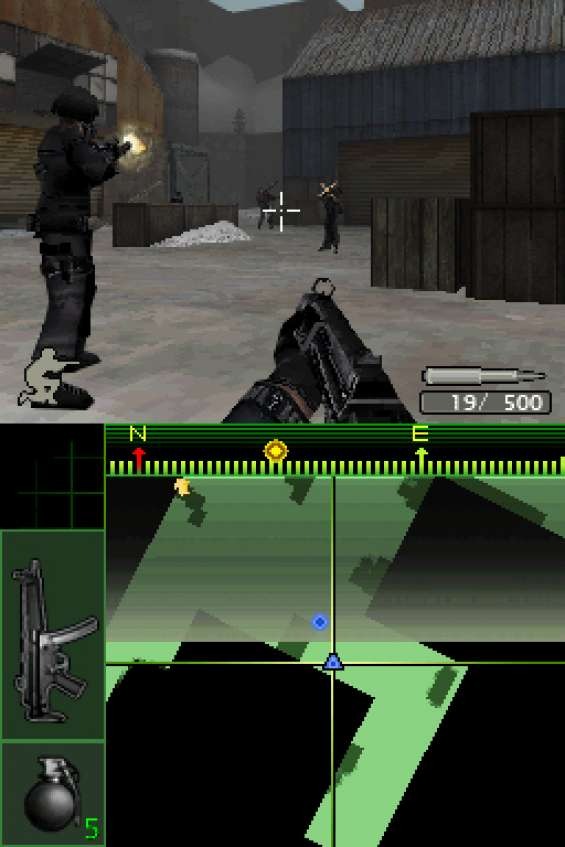
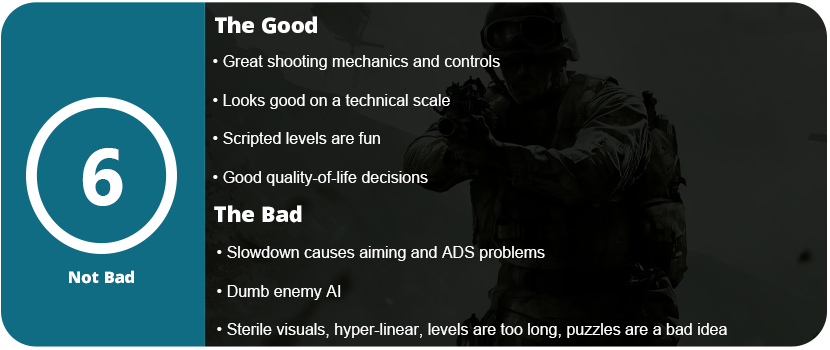
Modern Warfare for the DS loosely follows the plot of the main game but instead takes liberty with its own unique levels and design choices. Obviously, we are working with barely better-than-PS1-level hardware here. n-Space really had to be creative and make entirely new games, mostly “themed” around the franchise. The game is still in first-person view, and you can switch between two different weapons. By default, you always start out with a pistol and another firearm. You can pick up weapons with the touch screen (a hand icon) and use that as your main weapon will not have any extra ammo available when you run out unless you die. When you die, you start out with your default weapons again and lose whatever you picked up, but your ammo is refilled. Weapons in this game feel decent, but the slowdown from the DS being pushed too hard (especially when enemies pop in) makes aiming a bit sluggish and janky.
Aiming with the touch screen feels fine. Using the D-pad or face buttons to strafe isn’t an issue either, but using the R or L button to fire can give you massive hand cramps even with larger DS systems. Most everything is controlled by the touch screen. Double-tap to bring up the ADS (Aim Down Sights), switch to grenades, and tap the weapon icon to reload. There are a few quality of life things that n-space did think of, such as when you reload, you go back to ADS if you are in that mode already, and spriting pulls you out of ADS mode. My issue with ADS is that while it’s more accurate, there’s a delay in bringing it up on screen, and that delay can cost you your life. When enemies pop in and the slowdown happens, it won’t respond to my double-taps fast enough, and I would constantly bring up the ADS and back out a few times caused by the delay. It’s not game-breaking, but very annoying.
There are two mini-games when setting explosives and defusing bombs. I found the pipe puzzles annoying, and following the wires to defuse bombs isn’t really fun or challenging. These were just thrown in here to make use of the touch screen. Honestly, who wants to solve puzzles while playing Call of Duty? It’s weird and just doesn’t fit. It really breaks the flow of combat. The enemy AI is also pretty dumb. Enemies just stand there and shoot at you; don’t take cover or move out of the way. This is literally an on-rails shooting gallery and is insanely linear. Levels are way too long, and some objectives have unfair checkpoint placements or none at all. Objectives range from collecting something to planting a bomb or just shooting everything in sight. I found the scripted mounted machine gun levels pretty fun, but the AC-130 level (similar to the console version) is awful and boring. You can barely make out any enemies, and you can’t use larger weapons against smaller enemies. There are only a couple of buildings to blow up, and you just mow down dozens of enemies over and over again in almost complete silence. It was a bad level, for sure.
The visuals are decent for what the system can do. They are definitely sterile and boring to look at, with no artistic flair. The game tried capturing the hyper-realism of the consoles, and the DS just can’t quite do this. It’s a very brown and beige-looking game. There’s no personality put into this game. It feels like a copy-and-paste FPS that you could attach any name to. Multiplayer is the same as single-player, but with another person. It’s not very exciting, and your friends will get bored fast. I appreciate n-space for trying to capture the excitement of the console versions on the limited hardware, but it needs something else. Better enemy AI, less linear-feeling levels, more interesting scripted levels, and fewer storyboard-cut scenes. It’s a great first start, but it has a lot of work before it becomes a staple DS shooter.
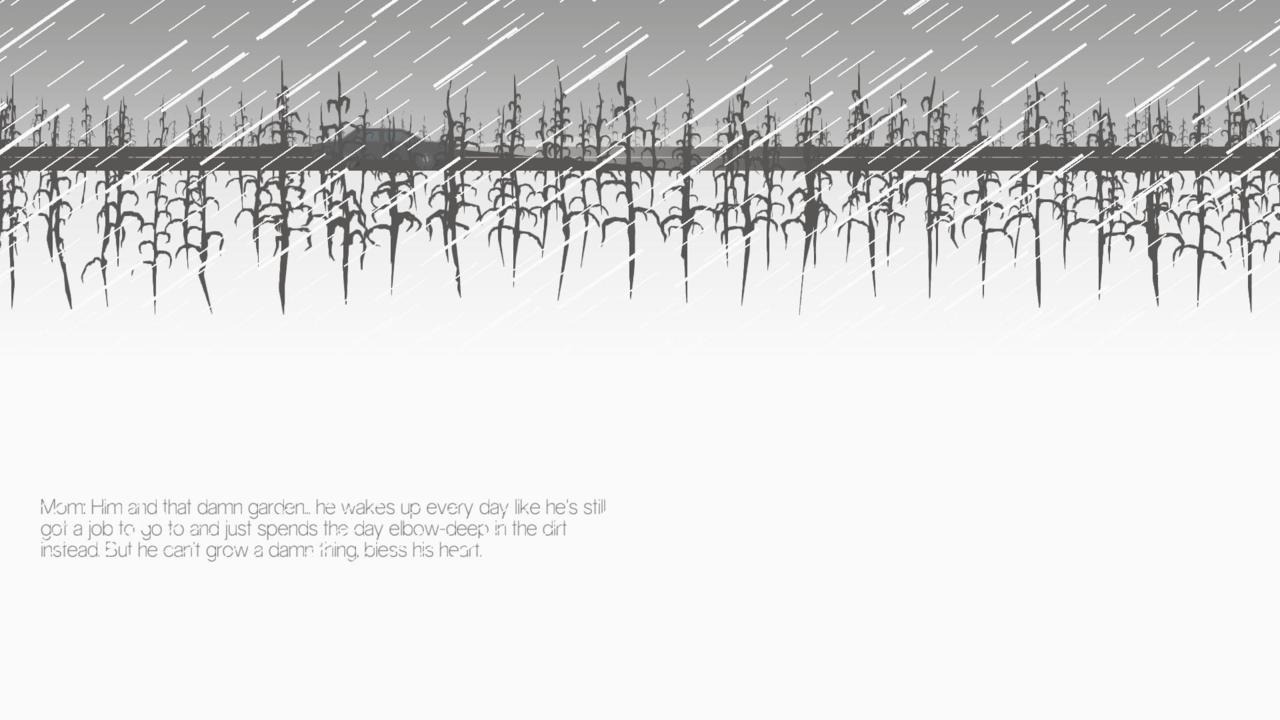
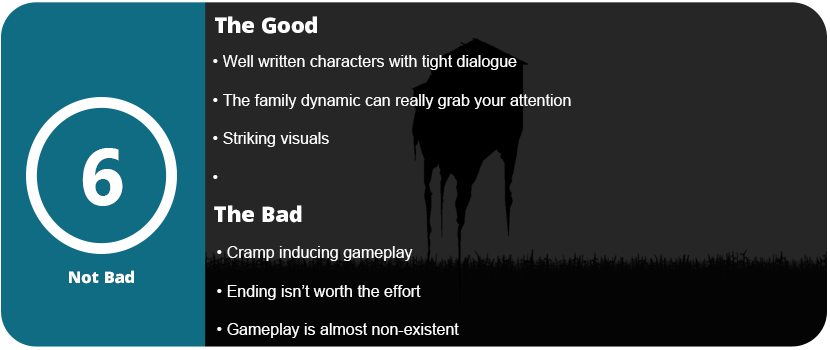
Minimalistic, story-driven games can be quite memorable and fantastic. The lack of gameplay requires you to have a laser focus on the story and characters, and the subtle gameplay can bring a visual element that no other medium can provide. Three Fourths Home isn’t one of these, sadly. While the visuals are striking and minimal, the story and writing have so much potential, but they are let down by a short and disappointing ending.
You play a teenage girl named Kelly who is driving home in a violent storm in rural Nebraska while talking to her family on the phone. Gameplay consists only of holding down a button to continue driving and choosing a few dialogue options. Holding down a single button for the entirety of the game is a really dumb idea. It introduces hand cramps and constantly breaks your focus on the story. You can honk your horn and turn off your lights, which is entirely pointless, and you can’t move the car at all. You can also choose to turn the radio on and off. There is no spoken dialogue in the game, but this requires you to make up voices and visuals for the game in your head. This may sound really dumb to most people, and some might argue that you should just read a book, and in this specific context, this would be a better medium for this story.
Choices in dialogue don’t seem important at first, but your response to your family plays into how they react to you on the phone. I guess multiple playthroughs could be worth it as there are a couple of different endings, but with how mundane the gameplay is, no one will want to sit through the hand cramps to make it worthwhile. I had issues with the controls, causing me to choose the wrong option as well. You need to skip through dialogue with a button to advance each line while holding down another to keep driving, and some times you wouldn’t know that a dialogue option would be coming up and you would just advance forward.
See, with minimal games like this, you need some sort of gameplay hook to keep it interesting enough. Three Fourths doesn’t do this at all. The mom, dad, and brother are all interesting characters, and you slowly learn about this family dynamic through this phone call. You learn about why you “ran away,” what kind of person the dad is, whether or not this is a broken home, etc. The dialogue is tight and interesting enough to keep you glued until the end, that is, if the hand cramps don’t send you packing first. I also wish more was going on visually. Occasionally, a background object will be brought up in the conversation, but it’s just black-and-white visuals without any type of payoff. The visuals, gameplay, and everything else are just an excuse to call this interactive story a game, and it does the bare minimum to qualify as that.
Most games like this have a story that ends in sudden tragedy to flip the entire thing on its head and stun the player, but this one doesn’t really do that either. If it did and the pay-off was incredible, all of this could be worth it, and there are plenty of games similar to this that pull that off. As it stands, Three Fourths Home is a well-written story in a terrible game with an even worse gameplay mechanic.
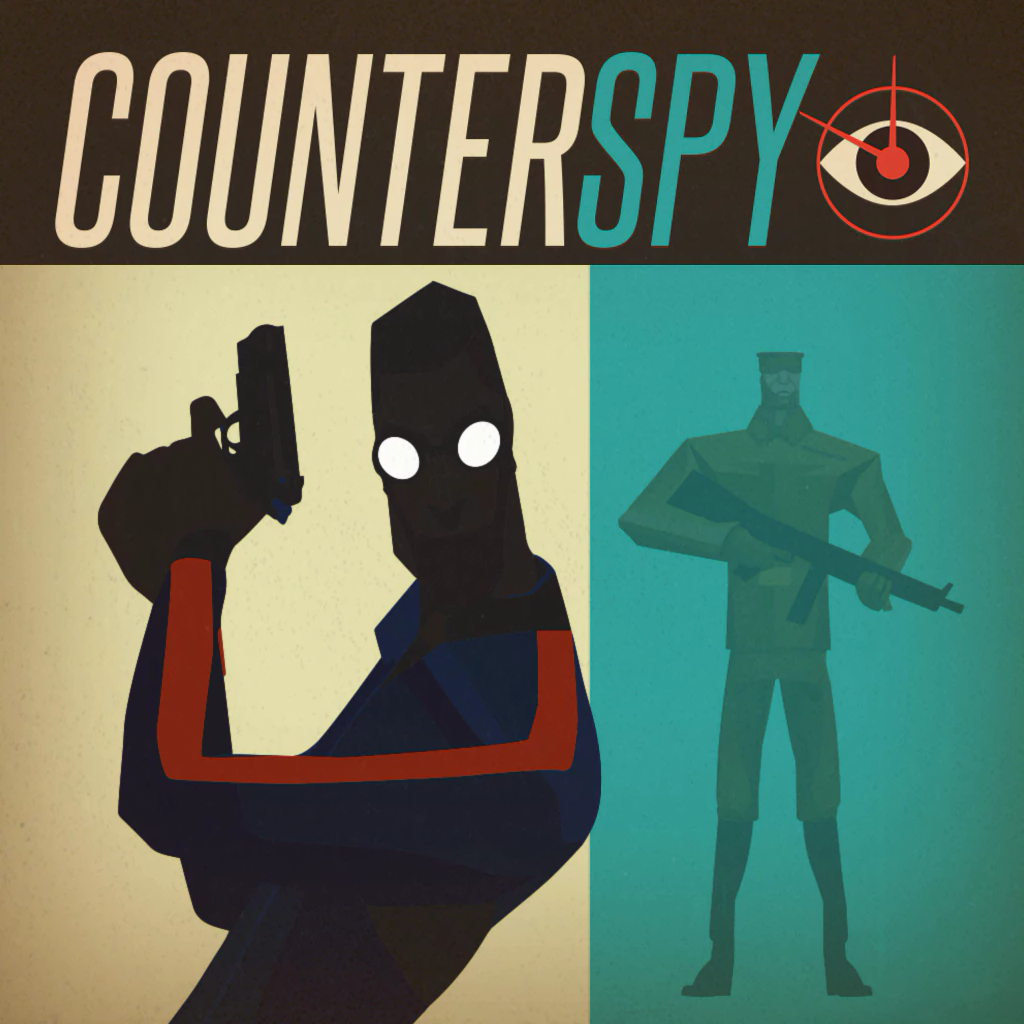
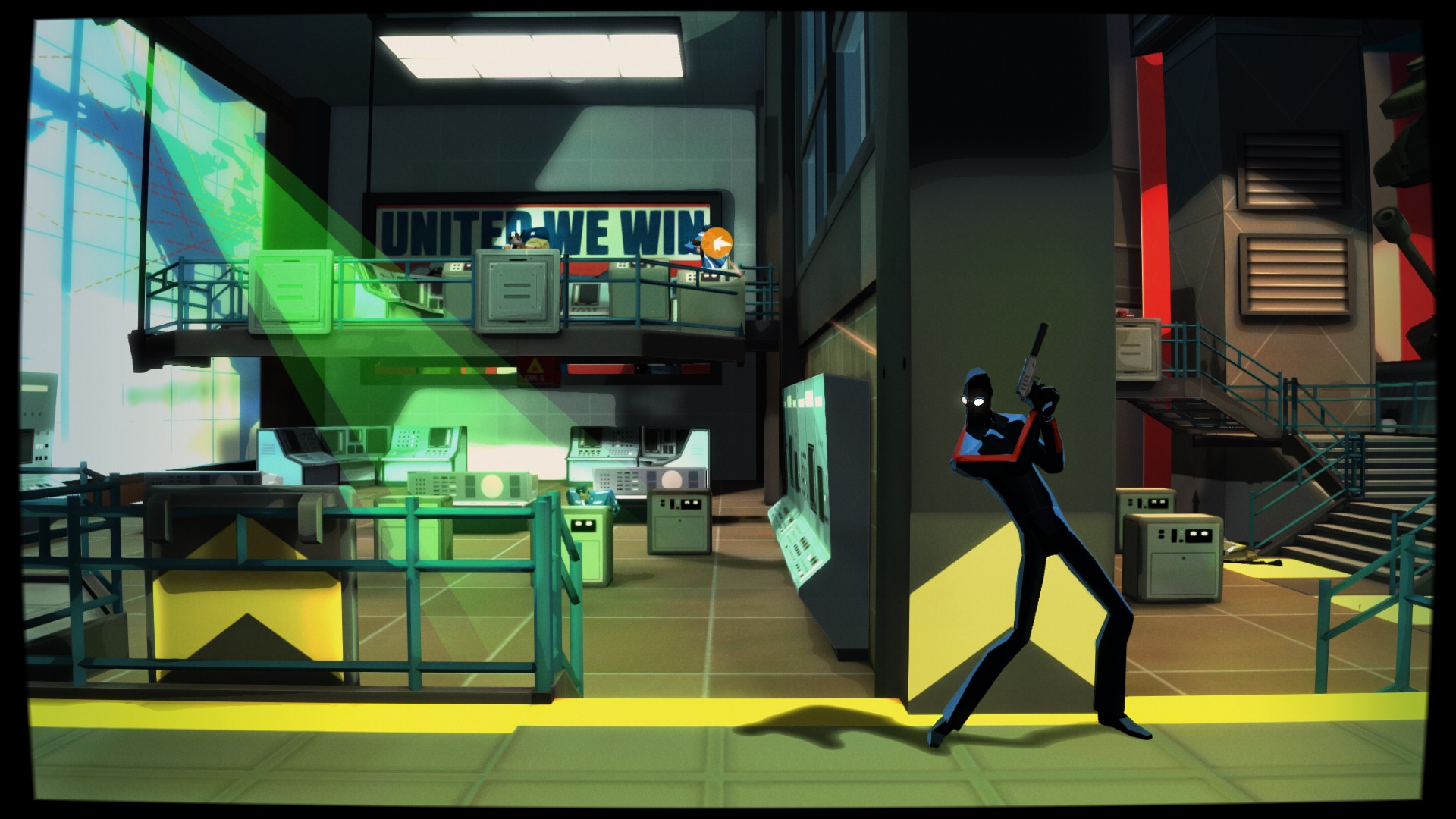
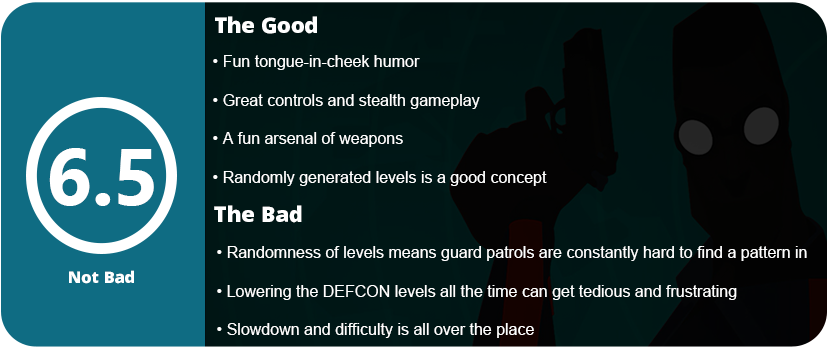
Tongue-in-cheek comedies about the Cold War are something I quite enjoy. Movies like Austin Powers that make fun of the time period can be downright hilarious. CounterSpy tries this with the player working for an unknown neutral agency called C.O.U.N.T.E.R., and everything they do and their plans are all spelled this way with no actual meaning. You play either the Americans or Russians’ bases to steal sets of plans to stop nuclear weapons from destroying the moon. The goal is to keep the DEFCON level as low as possible (5), and if it reaches zero during a level, a one-minute countdown starts, and you need to find the computer to finish the level to stop it. Thankfully, if it does reach zero, the level ends, and you start from DEFCON 1 again.
The only way to lower the DEFCON level is through passive items or getting officers dressed in white to surrendy by pointing your gun at them. This can make having to repeatedly repeat levels very difficult. The levels are randomly generated each time, but that doesn’t mean the difficulty doesn’t increase. You will need to search more rooms while plans for weapons and items are hidden better. More guards will appear and there will be more open areas. These can be the most difficult to navigate, especially when security cameras come into play. The green ones can be shot down with weapons, but the orange-armored ones can only be taken down with explosives. You can dodge and roll your way through a camera’s cone of vision, but you need to be fast. I found the randomness of levels to be frustrating, as a lot of guard patrols just don’t line up to be able to be stealthy. A lot of times, you will need to mow down every guard, and some levels can be multi-tiered. Thankfully, the alertness only lasts for that section of the level. Once you go through the door to the next section, the guards don’t know you’re there.
Cover is your best friend in this game. Yellow arrows on the cover will tell you which way you will face, and lining up your shot is important. The longer you pop out of cover to aim, the quicker guards will notice you. Guards are pretty dumb, and cameras won’t even notice dead bodies, so shoot them out to your heart’s content. This is the only saving grace for the randomness of these levels. If this was a more realistic stealth game, it would feel impossible to finish. However, I still wound up getting each side to DEFCON 1, so I had to constantly restart a level once the countdown timer started. It’s futile to try to run to the exit in 60 seconds unless you’re already close. If you quit the mission, you just restart back to where you were prior to that level.
Once you do get all the launch plans, you can continue to play either side to get more weapons and item plans and lower the DEFCON level as much as possible. The final mission will start on the side with the highest level, so this can lead to a lot of frustration unless you really want all of those weapons. I honestly felt the game got pretty tedious towards the end and just wanted to get the game over with. I didn’t feel the need to continue playing, as the randomness kind of ruins the fun gameplay elements with poor guard patrol patterns, making it impossible for really perfect stealth runs. The Vita version suffers from frequent slowdowns when the action starts. The game will pause for a split second, causing accuracy issues when shooting.
Overall, CounterSpy has all of the elements of a fun arcade-like action stealth game, but the randomness of the levels makes it hard to get that perfect run, which can discourage the player from wanting to collect all the weapons. The tongue-in-cheek humor does the job just fine, and the controls are well thought out. Just be prepared for some frequent restarts.
Dead to Right: Retribution was a surprising sleeper hit. The series never got the backing it deserved and is, sadly, another dead franchise lost to time that will probably never be revived again. Reckoning tried to take Retribution and squeeze it down to a handheld form factor, but it just didn’t quite work out. That’s not to say Dead to Rights couldn’t make a good portable game, but this wasn’t it. It’s a quick, cheap cash grab with no thought or effort put into it.
There is zero voice acting in this game, so the “story,” if you can even call it that, is narrated by a few lines of text and a cutscene. I will describe one level, and then you can copy and paste that about a dozen times, and there’s the game. You run around using the lock-on feature to kill enemies in boring, drab, and cramped levels and just blast them with whatever you have. It doesn’t matter what you use, as the game automatically switches weapons once you run out of ammo. Ducking behind cover is pointless, as you can’t shoot out from it, so your best bet is to run around like a madman and mow down everything in your path. That could be fun, but here it’s not. The camera swings around every which way, so cycling enemies is pointless as you will also cycle through explosive objects like cars and barrels, which are handy for large crowds.
This just continues forever. Some areas have fewer enemies than others, but once you shoot your way through, you kick down a door and move on to the next boring area to continue this process. Weapons range from silenced pistols, machine guns, and even a heavy.50 caliber machine gun, but who cares? Dual-wielding is always the way to go for one-handed weapons. You want to do the most destruction as quickly as possible. Enemies chew through your health with larger weapons, and life and armor pickups aren’t very common. There are no throwables like grenades, which would have come in handy as well.
There’s one gameplay feature in the console version, and that’s bullet-time. You can dodge and slow-mo your way through enemies, but I found this pointless as the environments are too cramped for this. You can send your dog Shadow out to get a one-hit kill, but the bar needs to refill. I saved this for large groups of enemies. Every so often, a boss will be thrown at you, but they all play and act the same. Just mow them down until they die. The entire game can be finished in under two hours as well, and then there’s a multiplayer mode that you can even subject your friends to.
Overall, Reckoning suffers from the same issues many PSP games did. A lack of a second analog nub means no camera control, and no one wanted to write a smart camera that could follow the player or change the controls around to work better. The game looks incredibly ugly, probably one of the worst-looking games on the system, and it’s repetitive, boring, and plays nothing like the console version.
First-person shooters were new to me when Red Faction launched in 2001. I didn’t have a gaming PC growing up, so games like Doom, Wolfenstein, and Quake were nearly foreign to me. Red Faction was an overhyped game full of development issues and overpromised ambition. The “Gen-Mod” destruction model is half-baked and barely there. The visuals are dull and boring (even for the time), and the story doesn’t go anywhere at all. Not to mention zero character development. I rented this game and got bored with it maybe an hour in, and I can see why.
Sure, the game looks much better on PC, but there’s not much to really look at. Even for the time level, the design in shooters was fairly dull. Very few had interesting things to look at, such as Half-Life or Halo. Red Faction is just browns and reds with boring caves and industrial buildings. You are on Mars, by the way. You are part of a rebellion group called the Red Faction, who are miners uprising against the overbearing government. You are trying to fight your way to the top and stop a deadly plague that’s killing the miners. This story starts and stops here. It doesn’t go anywhere; there’s nothing to spoil. You end up finding the cure, and that’s really it. The voice acting is actually really good for the time, but the only thing that kept me playing was pure curiosity to finally see this game through to the end.
There are quite a few weapons in this game, but most aren’t found until the last third of the game. You have your standard array of guns. Submachine, assault, precision, sniper, pistol, rocket launcher, and rail driver There’s also a heavy machine gun and grenades. It’s a standard list of weapons we’ve used in so many shooters, and Red Faction doesn’t do anything interesting or fun with them. The shooting in this game feels pretty good and holds up well today, but the enemy AI is terrible, so don’t expect much of a fight. There are vehicles you can pilot in this game, but they aren’t anything fun or interesting. They shoot bullets or rockets, and a lot of the time I would end up stuck in weird physics glitches.
The game isn’t very long. You can finish it in under 4 hours, and thankfully there’s a quick save feature, which I suggest using often. Enemies are run-of-the mill faceless military dudes, and there’s an occasional weird creature thing to mow down in the caves. Environmental detail is what you can expect from this era. Rooms are equipped with an occasional table, chair, or monitor. Nothing stands out or looks interesting in this game. Destruction is boiled down to blowing open a wall to get to a button (there’s a lot of button pressing in this game), and that’s about it. The occasional chunk of wall breaks off, but this is far from what Volition was touting back in the day.
Red Faction is at least a solid shooter. It’s fun while it lasts, and the last act throws new enemies and weapons at you, and there are two whole boss fights in this game. Vehicles don’t feel great to pilot, destruction is minimal, the story has a strong premise but goes nowhere, and the visuals are pretty bland. I did find the stealth section of the game pretty fun. Trying to find your way around without being spotted is like a giant puzzle, but that’s all there is that changes things up. In the end, if you never play this game, you aren’t missing out on gaming history.
With retro gaming becoming as huge as it is—bigger than ever!—the Analogue Pocket has found itself to have received the status of a unicorn over the last 3–4 years. The Pocket was first announced in late 2019 as a first wave of pre-orders. I personally missed out and was ready to wait for wave two—and then COVID hit. All throughout the pandemic, the Pocket was released in very limited batches, but only for those who pre-ordered during the first wave. Open pre-orders eventually came, but shipments would take over 6 months. Analogue has just finally caught up over the last few months, and hopefully they will be in stock in their store soon. With that said, the Glow in the Dark Pocket was their first limited edition version, and I somehow magically got one. I’ve sat in line for special edition releases of other types of electronics before and have never had any luck. You click the add to cart button, and usually you are put in a virtual line. This time I was greeted with a complete purchase page, and I jumped for joy.
Now that you know how hard it is to find this thing, you can imagine how excited I was to finally get one in my hands. These things have been scalped online for years for 3–4 times the price. The Glow in the Dark Pocket sits on Mercari and eBay for $500–$800 as of the time of this writing. The dock goes for as much as the pocket is new. It’s insane and completely unfair. I did order a dock and Game Gear adapter, as those are readily in stock on Analogue’s site as of this writing, but I also pre-ordered the other three adapters for the Neo Geo Pocket Color, TurboGrafx-16, and Atari Lynx.
Unboxing
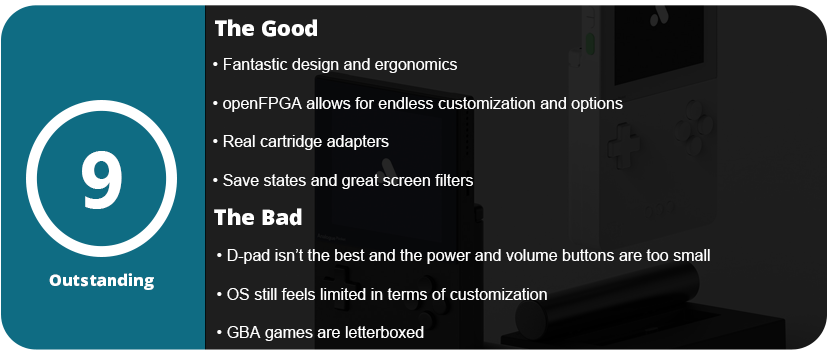
The box itself is rather heavy. It’s a premium package with a nice little QR card inside a tiny little envelope that gives access to the quick start guide. I would have loved to see a physical manual, but these take up a lot of room, and things change over time. You don’t want to ship devices with outdated manuals, but I digress. The pocket itself has a screen film and a film over the back of the unit itself. When I picked it up, I was surprised at how heavy it was. This is what I’m assuming, with the battery taking up most of the bulk. The plastic shell is really thick, and the overall feeling is very minimalistic. This isn’t a flashy system with different colored buttons, weird laser cutouts, RGB buttons, or anything silly like that. This is a very serious-looking device, but it’s sleek and sharp, similar to Sony’s design DNA from the PSP. There’s a power and volume buttons on the left, a microSD slot on the right, a GameBoy link cable, USB-C, and a 3.5mm headphone jack on the bottom. The rear has a ridged texture, the cartridge slot, the Analogue logo, and shoulder buttons, and that’s your setup.
I’m happy to see the pocket has stereo speakers. That is useful for GBA games that have stereo output options. The front gives you unlabeled face buttons, a D-pad, a FPGA logo, and three little buttons at the bottom acting as Start Select and the Analogue or Home button. The 3.5″ LCD screen is vivid and colorful, but it has a high resolution of 1600×1440. So you’re gaming in 1440p on a handheld. Pretty cool. The FPGA does a fantastic job of upscaling everything.
Software and OS
When turning on the device for the first time, you are greeted with a tutorial on how to navigate the OS and what each button does. This is a really cool thing, and more consoles need to do this! Remember, this has no wifi or Bluetooth chip inside of it, so it’s not spending all of its time getting you to sign up for some service like current-generation consoles do. Once you drop into the OS, it’s just a simple black-and-white list. You can play the cartridge currently inserted or play an open FPGA core (more on this later). view the library, Memories (save states and screenshots) go into Tools for developers and tweak settings for each built-in core. There are also settings inside to dump the memory cache to the SD card and various other advanced things, most likely for troubleshooting. The OS is very basic and simple, but it doesn’t need to be anything else. Sadly, there is no custom OS right now for a more advanced user interface, even if you do want one.
Playing Games
This is why you have one, right? Let’s start with the original GameBoy games. Each core has a filter you can use, and this is important to get the feeling of the game right. Instead of a million useless ones, Analogue gives you three for each core. Their own analog filter removes scanlines, grids, and smoothing. You just get raw pixels, and this is how we play older games on the Switch or any other device running emulators. It looks sharp and utilizes the hardware of the pocket. There are also original modes that add scanlines (which don’t look half bad but darken the screen a lot) or add the original grid back. There are also color filters for the GameBoy Light, Pocket, green, and red from the Virtual Boy. GameBoy Color is the same without the color filters but adds a different scanline option. These filters only work on original cartridges and not emulated games, so keep that in mind. Systems also have options for different display ratios, which is nice. GBA games will have borders, but you get used to them. The sound is amazing, and some cores have different audio options to tune everything to your liking.
When it comes to actually playing games, they feel great. The pocket is nice to hold in the hands; the button mapping can be customized and moved around; but the Dpad isn’t perfect. It’s not the best when it comes to rolling your thumb around. It’s a bit stiff, but it gets the job done. The face buttons feel nice, with two convexed and two concaved, similar to the SNES controller, but the three small buttons at the bottom are tiny and hard to press with bigger fingers. While the buttons aren’t 100% perfect, they are fine for 8 and 16-bit games. We’re not playing competitive shooters here.
Customization
Just recently, the open part of the FPGA was released, and emulated cores are now available. Any 8- and 16-bit system can be run to your heart’s desire now, but you lose access to those fancy screen filters and resolution settings as a result. They also play perfectly, though. I played through SNES, Genesis, NES, GameBoy Color, and GameBoy, and they all ran perfectly fine. Some Genesis games that need six buttons use the shoulder buttons, so it’s a bit awkward, but you can play these on the dock with a controller, so that can help eliminate that problem. Getting some emulators working like the Neo Geo is a royal pain because you need specific ROMs and BIOS files to get anything to run. But once you do, it’s worth it. I wish the OS itself was more customizable, such as having a wallpaper or varied themes. Startup images would be fun too. Maybe one day the OS will open up, or someone will hack it and give us that option.
Overall, the Analogue Pocket is a retro handheld gamer’s dream. You can play any games you currently own or emulate them on the microSD card. While it took years for the FPGAs to become open source, they are finally here, and if you have been holding out, this is the time to get one. This thing is great for those who love both worlds. Physical cart-owning purists and those who don’t own a single cart and just want to emulate. While we will never see physical adapters for certain systems, you can still rock both worlds and have all of your 8 and 16-bit favorites on the go. The battery life is great, the buttons feel good minus the Dpad, and it has all the modern trimmings for a reasonable price.




































 thebinarymessiah.com
Yeah, it's pretty damn awful. Notoriously one of the worst games on the PSP. A 4 was actually being generous.…