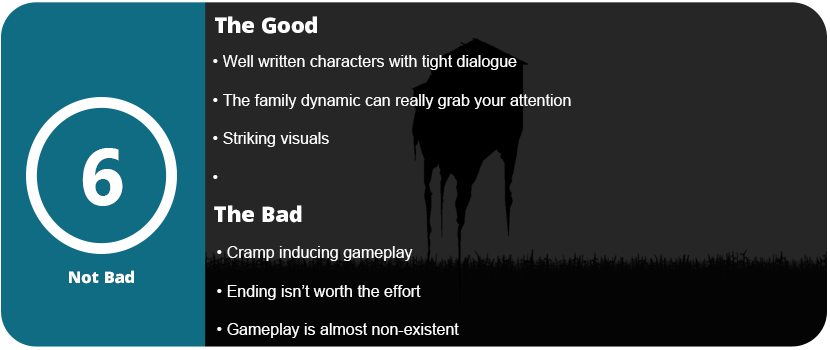
Minimalistic, story-driven games can be quite memorable and fantastic. The lack of gameplay requires you to have a laser focus on the story and characters, and the subtle gameplay can bring a visual element that no other medium can provide. Three Fourths Home isn’t one of these, sadly. While the visuals are striking and minimal, the story and writing have so much potential, but they are let down by a short and disappointing ending.
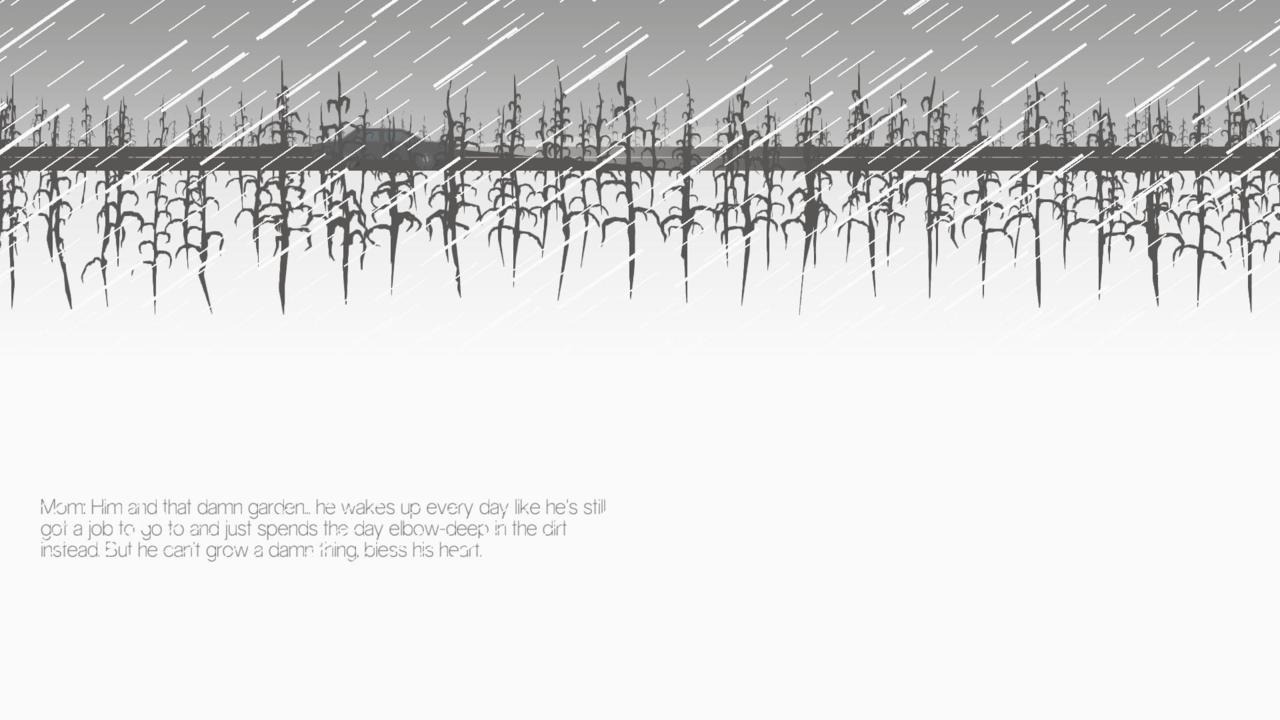
You play a teenage girl named Kelly who is driving home in a violent storm in rural Nebraska while talking to her family on the phone. Gameplay consists only of holding down a button to continue driving and choosing a few dialogue options. Holding down a single button for the entirety of the game is a really dumb idea. It introduces hand cramps and constantly breaks your focus on the story. You can honk your horn and turn off your lights, which is entirely pointless, and you can’t move the car at all. You can also choose to turn the radio on and off. There is no spoken dialogue in the game, but this requires you to make up voices and visuals for the game in your head. This may sound really dumb to most people, and some might argue that you should just read a book, and in this specific context, this would be a better medium for this story.
Choices in dialogue don’t seem important at first, but your response to your family plays into how they react to you on the phone. I guess multiple playthroughs could be worth it as there are a couple of different endings, but with how mundane the gameplay is, no one will want to sit through the hand cramps to make it worthwhile. I had issues with the controls, causing me to choose the wrong option as well. You need to skip through dialogue with a button to advance each line while holding down another to keep driving, and some times you wouldn’t know that a dialogue option would be coming up and you would just advance forward.
See, with minimal games like this, you need some sort of gameplay hook to keep it interesting enough. Three Fourths doesn’t do this at all. The mom, dad, and brother are all interesting characters, and you slowly learn about this family dynamic through this phone call. You learn about why you “ran away,” what kind of person the dad is, whether or not this is a broken home, etc. The dialogue is tight and interesting enough to keep you glued until the end, that is, if the hand cramps don’t send you packing first. I also wish more was going on visually. Occasionally, a background object will be brought up in the conversation, but it’s just black-and-white visuals without any type of payoff. The visuals, gameplay, and everything else are just an excuse to call this interactive story a game, and it does the bare minimum to qualify as that.
Most games like this have a story that ends in sudden tragedy to flip the entire thing on its head and stun the player, but this one doesn’t really do that either. If it did and the pay-off was incredible, all of this could be worth it, and there are plenty of games similar to this that pull that off. As it stands, Three Fourths Home is a well-written story in a terrible game with an even worse gameplay mechanic.
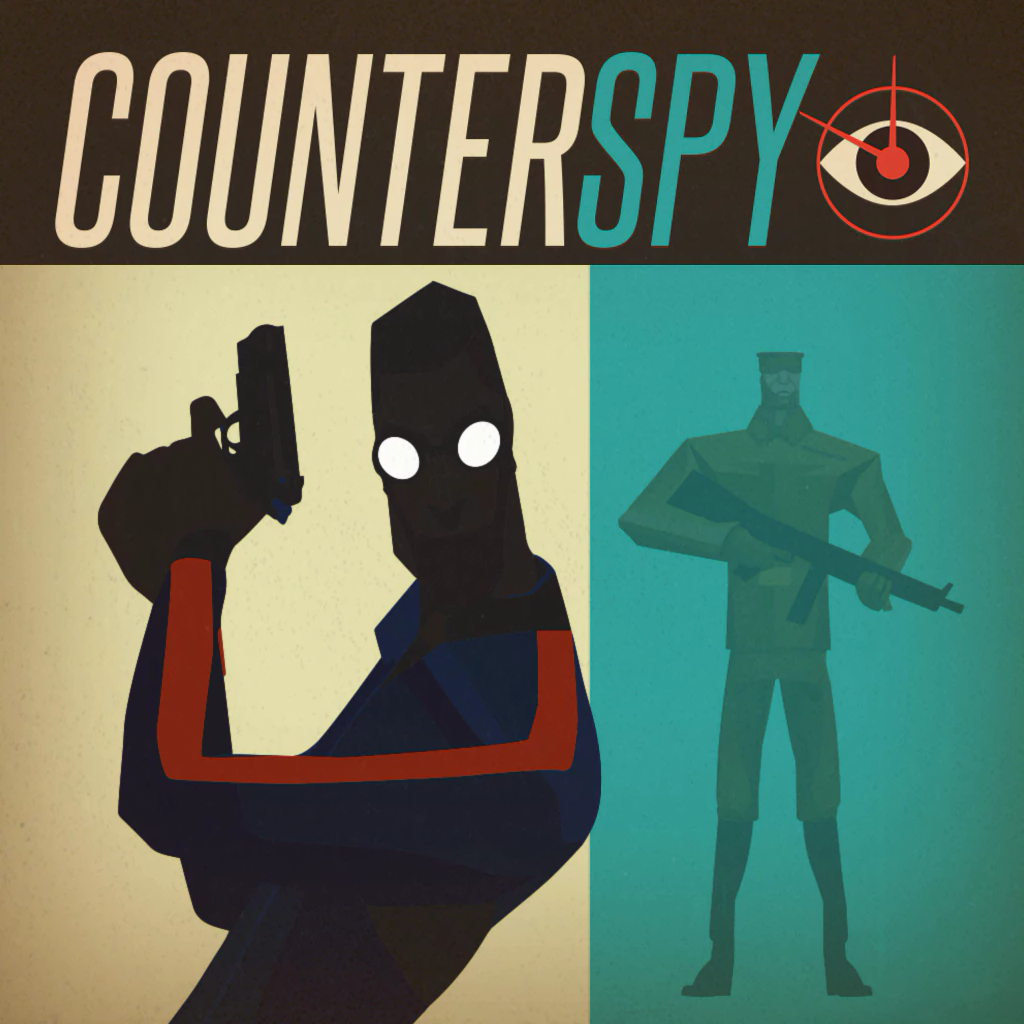
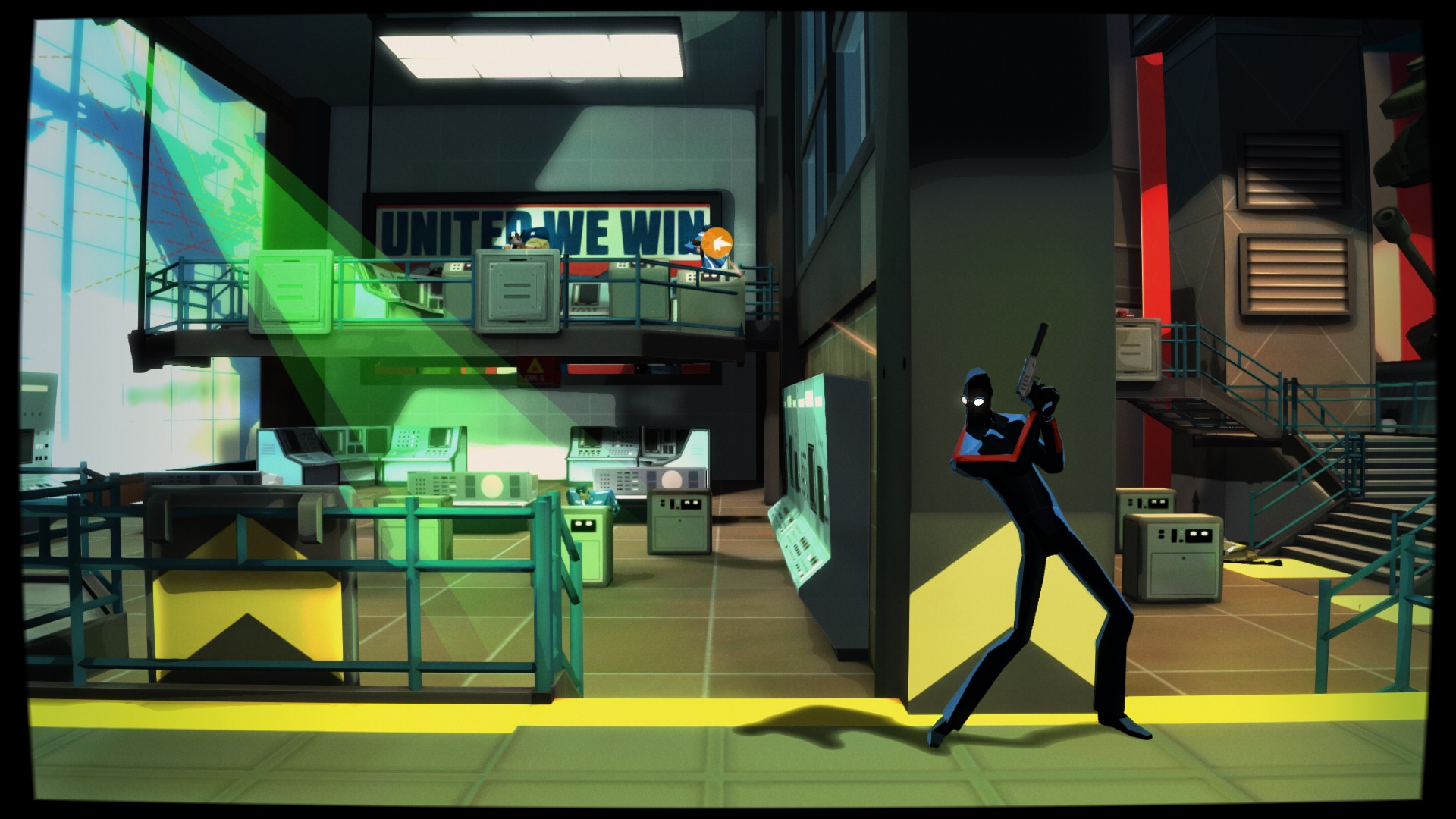
Tongue-in-cheek comedies about the Cold War are something I quite enjoy. Movies like Austin Powers that make fun of the time period can be downright hilarious. CounterSpy tries this with the player working for an unknown neutral agency called C.O.U.N.T.E.R., and everything they do and their plans are all spelled this way with no actual meaning. You play either the Americans or Russians’ bases to steal sets of plans to stop nuclear weapons from destroying the moon. The goal is to keep the DEFCON level as low as possible (5), and if it reaches zero during a level, a one-minute countdown starts, and you need to find the computer to finish the level to stop it. Thankfully, if it does reach zero, the level ends, and you start from DEFCON 1 again.
The only way to lower the DEFCON level is through passive items or getting officers dressed in white to surrendy by pointing your gun at them. This can make having to repeatedly repeat levels very difficult. The levels are randomly generated each time, but that doesn’t mean the difficulty doesn’t increase. You will need to search more rooms while plans for weapons and items are hidden better. More guards will appear and there will be more open areas. These can be the most difficult to navigate, especially when security cameras come into play. The green ones can be shot down with weapons, but the orange-armored ones can only be taken down with explosives. You can dodge and roll your way through a camera’s cone of vision, but you need to be fast. I found the randomness of levels to be frustrating, as a lot of guard patrols just don’t line up to be able to be stealthy. A lot of times, you will need to mow down every guard, and some levels can be multi-tiered. Thankfully, the alertness only lasts for that section of the level. Once you go through the door to the next section, the guards don’t know you’re there.
Cover is your best friend in this game. Yellow arrows on the cover will tell you which way you will face, and lining up your shot is important. The longer you pop out of cover to aim, the quicker guards will notice you. Guards are pretty dumb, and cameras won’t even notice dead bodies, so shoot them out to your heart’s content. This is the only saving grace for the randomness of these levels. If this was a more realistic stealth game, it would feel impossible to finish. However, I still wound up getting each side to DEFCON 1, so I had to constantly restart a level once the countdown timer started. It’s futile to try to run to the exit in 60 seconds unless you’re already close. If you quit the mission, you just restart back to where you were prior to that level.
Once you do get all the launch plans, you can continue to play either side to get more weapons and item plans and lower the DEFCON level as much as possible. The final mission will start on the side with the highest level, so this can lead to a lot of frustration unless you really want all of those weapons. I honestly felt the game got pretty tedious towards the end and just wanted to get the game over with. I didn’t feel the need to continue playing, as the randomness kind of ruins the fun gameplay elements with poor guard patrol patterns, making it impossible for really perfect stealth runs. The Vita version suffers from frequent slowdowns when the action starts. The game will pause for a split second, causing accuracy issues when shooting.
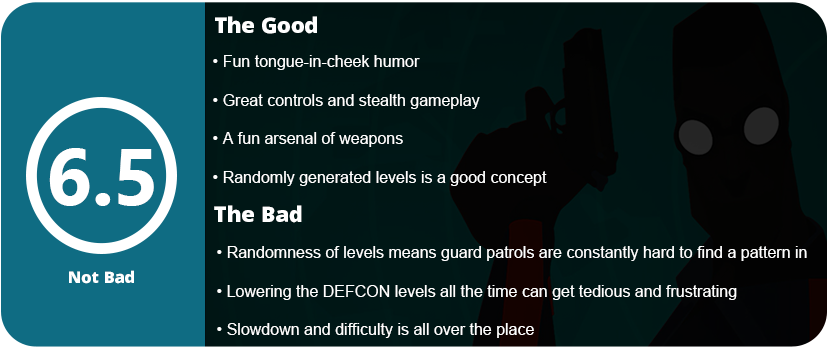
Overall, CounterSpy has all of the elements of a fun arcade-like action stealth game, but the randomness of the levels makes it hard to get that perfect run, which can discourage the player from wanting to collect all the weapons. The tongue-in-cheek humor does the job just fine, and the controls are well thought out. Just be prepared for some frequent restarts.
Simulator games that mimic mundane, everyday jobs can be surprisingly cathartic and relaxing. The zen-like repetitive tasks that give you the serotonin boost of progress over time, organization, or customization flood Steam and are eeking out onto consoles if they become popular enough. Sadly, most aren’t done very well and either have janky mechanics, a very low budget, or feel like copy and paste or an asset flip. Very few do it well, with PowerWash Simulator, Truck Simulator, Cooking Simulator, and PC Building Simulator being some of the top kings that do it right. House Flipper was one of those, and it felt janky but had so much potential. It was almost there, and I feel they got there with House Flipper 2, but there’s still tons of room for improvement.
The first thing you will notice are the much improved graphics. Better lighting, effects, higher resolution textures, and an overall better-feeling game. It feels less low-budget and more like how it really should be. There’s also a lot more variety, and the game’s new grid-based placement system completely rewrites how the game plays. Forget everything you knew from the first game. That game feels essentially like the foundation for this new vision the developers have. The game now has a story mode, which is of course unimportant and pretty much filler, but there is some voiced dialogue and you can answer phone calls. Your email map that you take jobs from is sectioned into different types of neighborhoods. Rich, suburbs, oceanside, rural, etc. Once you accept a job, the game starts very slowly. Just simple cleaning, washing windows, picking up trash, and selling items. That’s about it for a good while. The perk system still exists but feels more useful. As you do each type of job, you will be able to make it faster, better, and more efficient for much larger jobs.
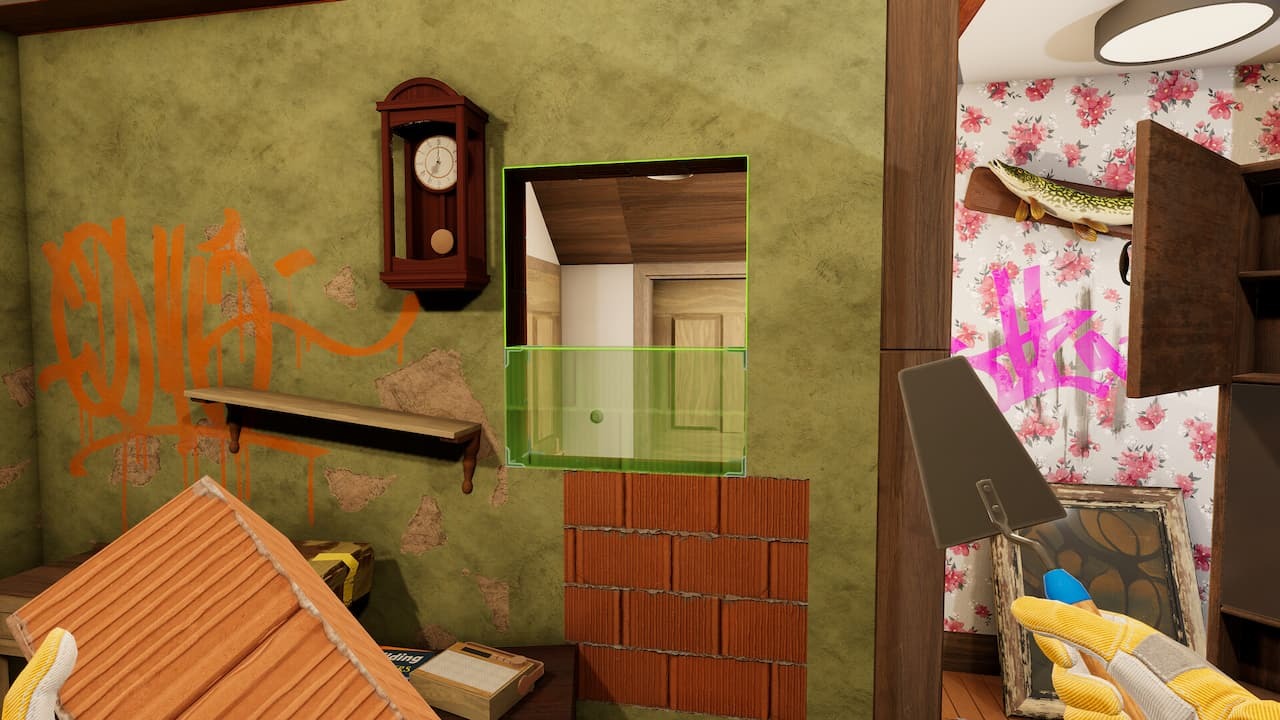
Just the simple tasks of trash pickup and cleaning are much better. You eventually get spray that can turn all the dirt soapy, it’s easier to wipe up, and things go faster. Trash pickup eventually expands your pickup grid, so it goes faster. Vacuuming is better and looks nicer. Leaves, coffee beans, rice, marbles, and many other forms of dirt are new and present, so it doesn’t feel so repetitive. Stains range from paint to foot prints now as well and can be on any surface. When you start demolishing, building, painting, and surfacing, some of the most repetitive and boring tasks from the first game are more fun now. The entire game is based on a 1×1 block grid system, so these tasks let you fill out a grid on a wall or floor and fill that in more efficiently. Demolishing lets you hold the button back and fill out a grid. As you get more perks, this grid fills. Painting now lets you select a border, and you can just fill it with your brush. Eventually, your brush gets bigger, and you use less paint.
The same goes for surfacing and building. You can select borders for the building and fill in the bricks this way. Everything just goes faster, feels more satisfying, and feels less like a chore. When you buy objects from the quest list, you can place them easier thanks to this 1×1 block system. You can place any item anywhere, even stack items, as long as it fits. There are so many more items to choose from, and they look better as well. Just the effects of paint trying and demolishing walls crumbling better add to a much better overall experience. I also like how assembly is now stripped away from building and left as a mini-game. There are only a dozen objects you can assemble, and it’s time-based. These were done in your workshop and are much more detailed. They come together like IKEA furniture, where you drill holes, hammer wooden pegs, and attach every screw. This makes remodeling homes less tedious, and your assembly score gives you discounts in the store. Now you can just place radiators, tubs, showers, etc. without having to assemble every single one.
When you finish the story, you can still complete jobs, build homes from the ground up, and just have fun in sandbox mode. There isn’t a lot of story content—about 15-20 hours—but you will blow through it due to how much fun you are going to have. This is one of the best job simulator games next to PowerWash Simulator, and I can’t wait for the third game to see where the developers will go with it. My only real complaint is that the requested furniture doesn’t have the required layout, which would have been nice. You can just throw it all in the middle of the floor, and it counts as complete. This makes buying furniture pretty boring unless you just want to make these homes look nice without any type of reward. As it stands, House Flipper 2 is a night-and-day improvement over the original and is heading in the right direction.
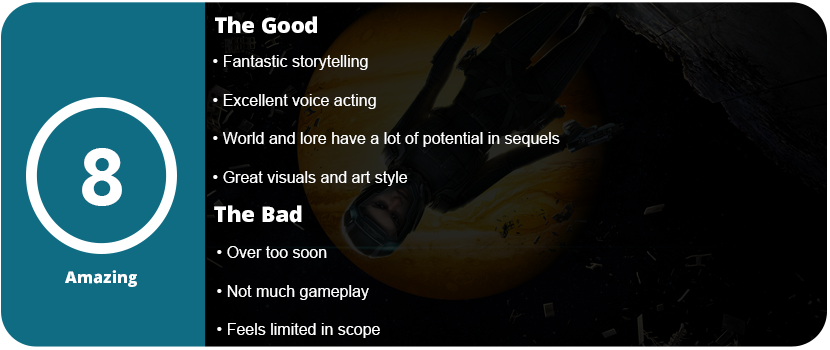
Telltale is mostly known for licensed adventure games such as The Wolf Among Us and The Walking Dead. They shut down and started back up, and now they probably don’t have the money to license these franchises anymore. I actually prefer this. Telltale has created their first original IP in years, and it has so much potential. The biggest takeaway from this game is the usual Telltale style of storytelling and choice-making. You think you know what you’re going to choose ahead of time and how it will pan out in your head, but things always make a left turn and change on you, and you’re left speechless. They are also, sadly, known for having almost no gameplay and very dated visuals.
Gameplay is more frequent in this game, but you just control your character in a walking simulator situation, walking or gliding down long hallways. There are a couple of elementary puzzles thrown in, and that’s your lot for gameplay. It’s fine, as I go into Telltale games for the story and characters and not much else. You can use zero-G movement in some areas and move around that way. You can also optionally scan a few items here and there for collectibles, but it’s very limited and linear in scope.
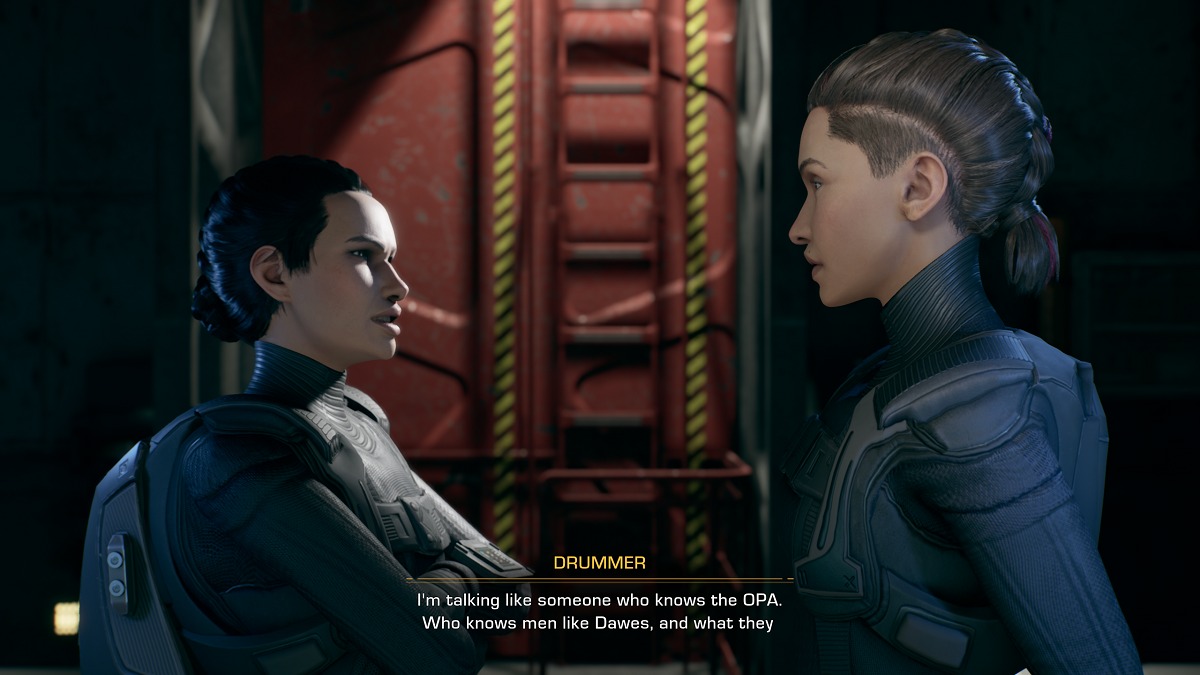
The best part about the game is the atmosphere, characters, and overall story. While this game is the beginning of a larger story arc that will give us more lore and behind-the-scenes politics on the goings-on of this world, this game solely focuses on establishing Captain Drummer as a brand new protagonist, and I love her so much. She has a lot of charisma and is a dark and brooding character without being cringy and formulaic. Her voice actress does a fantastic job portraying this. The other characters are written in your typical telltale manner, which allows you to constantly hate or like a character and then suddenly doubt everything in the end. The cast is small, but the game has a fantastic pace that keeps things interesting.
You’re essentially scrappers, and there is an established order of inners: people who live inside the astroid belt and those who love outside of the astroid belt. There are pirates involved, and there is a secret treasure that everyone is fighting over. I don’t want to go too much into the story, but the game’s atmosphere is dark and haunting, but there’s no horror. The monster here is the human element and just how brutal we can be to each other in a split second. I found the ending very satisfying, and it opens up for a clear sequel that hopefully expands this entire universe that Telltale has created.
The visuals are a huge improvement over their past games. While they aren’t ground-breaking and are required to run on previous generation hardware, the stylized visuals look great, and the blacks, whites, and grays really make you feel alone and claustrophobic all the time. The voice acting is top-notch, as always, and the only thing I left with was wanting more from this series. I also wanted more gameplay, as quick-time events are incredibly dated and there are other things you can do for adventure titles other than these dated gameplay elements. More side quests, an actual gameplay loop, and more side dialogue would be nice to be able to expand upon everything. As it is, the game takes 6-7 hours to finish, but it’s incredibly enjoyable, and I couldn’t put the game down.
Kingdom Hearts has a special place in my heart. I remember when the first game came out, and it was talked about by a lot of people on the school grounds. I was in junior high when it was released, but I didn’t get it until it was a Greatest Hits release at $20. I found it hard at the time and never finished it. When the second game came out, I rented it from GameFly and actually cried at the ending. It was so memorable and engrossing for me as a teen.
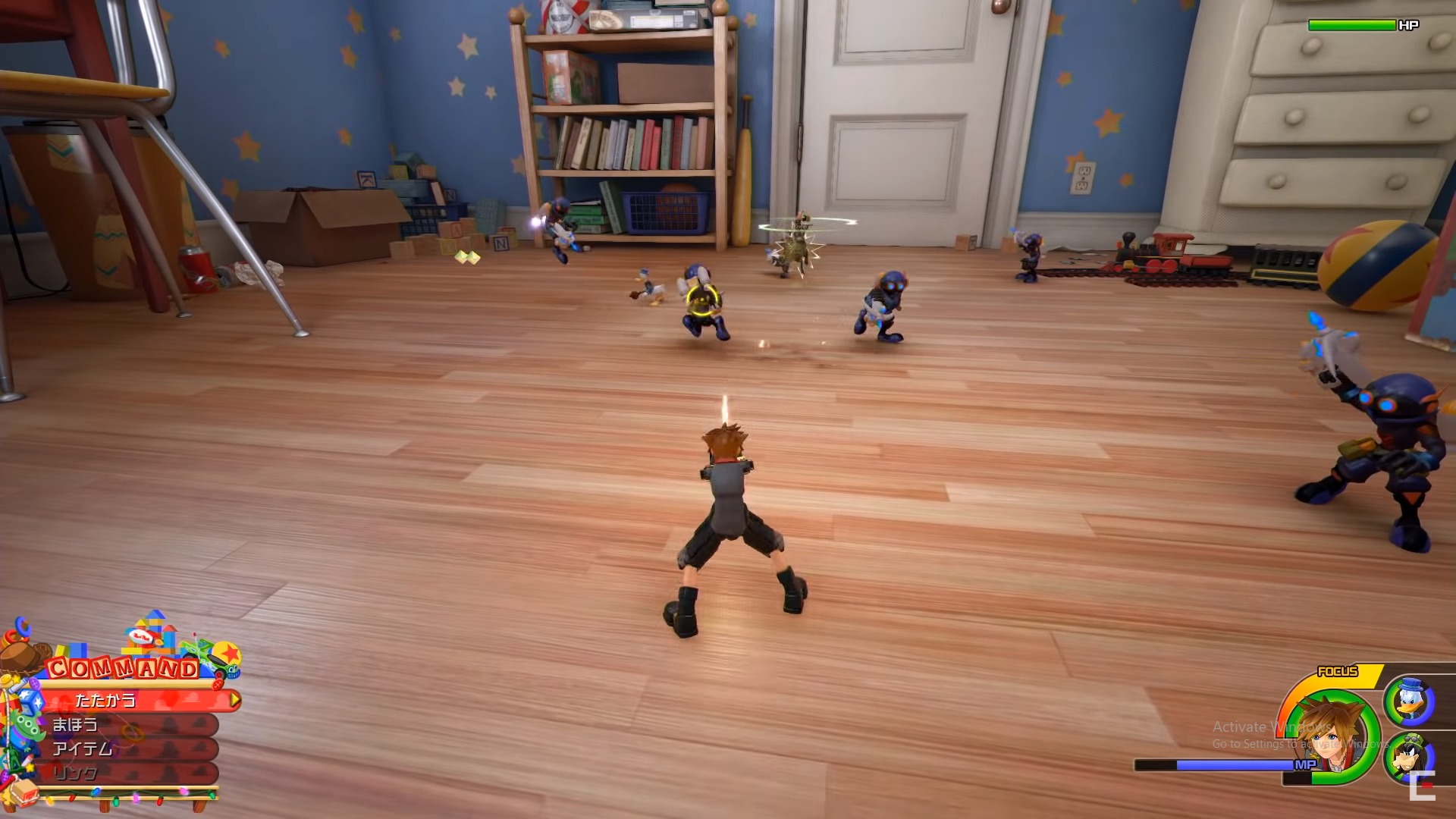
Here we are, almost 15 years later, with the third installment in the mainline series. I was insanely excited and didn’t follow any previews or reviews for the game leading up to actually getting around to buying this game. I played the first area of Hercules (again?) and got to Toy Box (Toy Story!) and lost interest. Yeah, the game hasn’t really evolved all that much. My biggest problem with Kingdom Hearts III is the lack of imaginative level design and the use of mostly modern Pixar movies. The best part about a new Kingdom Hearts game is discovering what the next Disney movie will be that you get to explore. It’s like a surprise each time, and I loved that with previous entries. This was the first time I was praying it wasn’t another modern Pixar movie.
While Hercules was very cinematic, scripted, and looked great, it’s an overused Disney movie in the series. Toy Story was exciting, especially when we were in Andy’s room, but we wound up in a generic boring mall? It was such a boring level to get through, and I didn’t feel anything like the movie. We then move on to Repunzel. Why? Another issue with this game is playing each movie scene by scene around the second act. We’re stuck at a generic forest level here. After this, we get into Monsters Inc., which is actually pretty cool, but it’s a generic monster factory. Then it’s…FROZEN?! Why Frozen? We even get a literal, scene-by-scene, shot-by-shot rendition of the “Let It Go” song. If I wanted that, I would just watch the movie. A generic snow level awaits us here.
Then we go back to Pirates of the Caribbean, of all movies. I appreciate that the visuals are improved enough to give us realistic versions of this movie and not the cartoony one we got last time, but I didn’t care as the original voice cast wasn’t present again. And it’s based off of the third film for some reason. I liked the fact that you get to sail an open ship and go find crabs to upgrade your ship, but I skipped all of this. The ship steers like a hot-wheeled car, and the generic seaside town and ship battles weren’t very interesting. Then we finally arrive at Big Hero 6, which is also pretty cool, but it’s a generic large map of San Francisco, and it is incredibly boring. That’s it. No more worlds, and you are stuck in the last level for about 10 hours doing boss rushes like every other RPG has done, and this seriously needs to stop to just bloat game time.
Even if you like or dislike these Pixar movies, the fact is that the levels are incredibly boring, and each one plays out the same way. You get through several mini-bosses, fight waves of enemies, collect some stuff, and fight the movie’s main antagonist. Every world is a generic feeling with no life from the movie injected into it. The reliance on playing through scenes of these movies isn’t what I want in a Kingdom Hearts game. I want a unique experience at each level that makes me feel like I’m part of that world. Not just some character who crashed the movie in the middle of its runtime.
I can go on and on about how much I hated the uninspired level design and repetitive nature of each world, but then there’s the Gummi Ships. I hated these in the first game, and I really don’t like them here. I like that the Gummi Ship part is a large open map that you can explore freely between worlds, but there’s nothing interesting here. You fly around collecting parts, Munni, and you can find shooter waves flying around that have levels and stars attached to them. Upgrading your ship but being able to buy parts to put together blueprints is a staple of the series, but I just don’t find it interesting. A new alpha Gummi part can be attached now to help fight in battle. It’s essentially a satellite ship flying around yours. There are speed tunnels all over the place, asteroids, and various obstacles, but I just wanted to get to the next world.
Finally, there’s the combat itself. I never really cared for Kingdom Hearts‘ combat. It works, it’s fine, and it can be fast-paced, but you fight the same Heartless over and over again, and the game is heavily reliant on keyblade transformations. Actual attacking and magic have taken a back seat. I rarely touched magic, and it felt useless. I was just attacking until I got my three pips and I could transform my keyblade into a more powerful weapon and execute its finishing move. This does the most damage and is a must for bosses, or you won’t survive at all. The final act of the game pits you against around a dozen bosses, one after another, and it’s a frustrating chore. You can still use Link commands, but they aren’t that great this time around, and I felt like they hindered battle more than anything. The goal was to attack and get a few combos in, transform my keyblade, execute attractions that put you on famous Disney park rides that do damage, and just rinse and repeat. Items are useful for sure, and it’s important to keep abilities tagged, as adding combos and modifiers to combat really gives you an edge. However, this all gets so repetitive, and you just stop caring before you get to the third world.
Then there’s the story, which I haven’t even touched on yet. It makes zero sense, even to people who have played the series up until now. My main interest was in the little stories inside each world. I never cared for the overarching Kingdom Hearts story. It’s a bloated, overcomplicated mess involving Organization XIII, and Final Fantasy isn’t even a part of this story anymore. Xehanort was the X-Blade. Aqua is trapped in a world, I think, where there are multiple versions of everyone. Yeah, I don’t know. Go watch a comprehensive timeline explanation on YouTube instead. Sadly, each world is just a retelling of each movie, which I could just go watch if I wanted to. At least the visuals are really good, and everything is bright, colorful, and full of life.
The voice acting is also hit-and-miss, but mostly terrible. Haley Joel Osment as Sora again was a bad choice; he’s just not a good voice actor. Outside of some of the mainline Disney characters, the voice acting is just wooden and awkward. Most Disney films don’t retrain their original voice actors. Especially in Pirates of the Caribbean…again. What’s worse is the writing. The script feels like it was written by a grammar school student. It’s just the most basic lines, replies, and banter. It’s just enough to get through each scene. There’s a lot of nothing being said by most of these characters. Shouting each other’s names a lot, and a lot of “You will never stop us!” or “I will defeat you!” over and over again. Yawn.
So, there’s a lot I don’t like here. The lack of older Disney movies, the complete absceneness of Final Fantasy stuff, and the fact that each movie is just a scene-by-scene replay of the original movie are boring. The levels feel generic, uninspired, and repetitive, and the combat, while flashy, uses an overreliance on keyblade transformations, attraction attacks, and links and magic. Enemies repeat far too often, and the final act is nothing but a frustrating slog of a boss rush. The story is insanely and wildly confusing and unnecessarily complicated, but at least the visuals are a nice treat. If you didn’t like previous games in the series, this does nothing that will convince you to like it now.
Side note: I was incredibly disappointed by Utada Hikaru’s song with Skrillex on this one. Both Simple and Clean and Passion/Sanctuary are classics and some of Utada’s best work. This song was terrible and wasn’t a good start to the game for me.
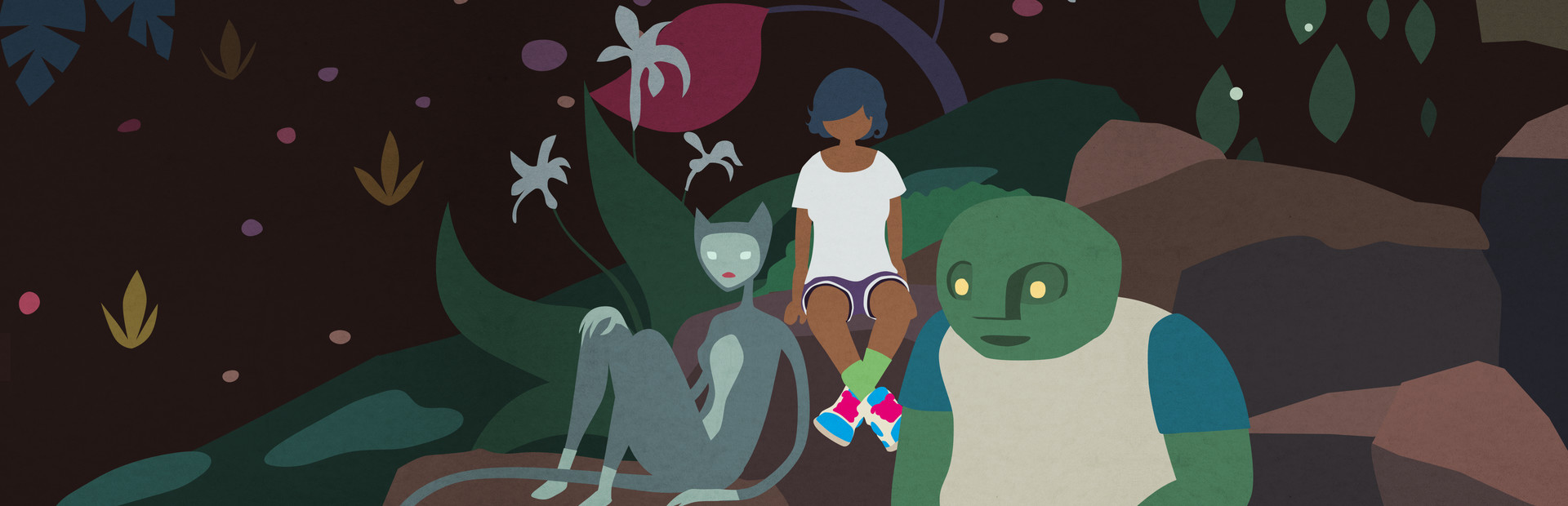
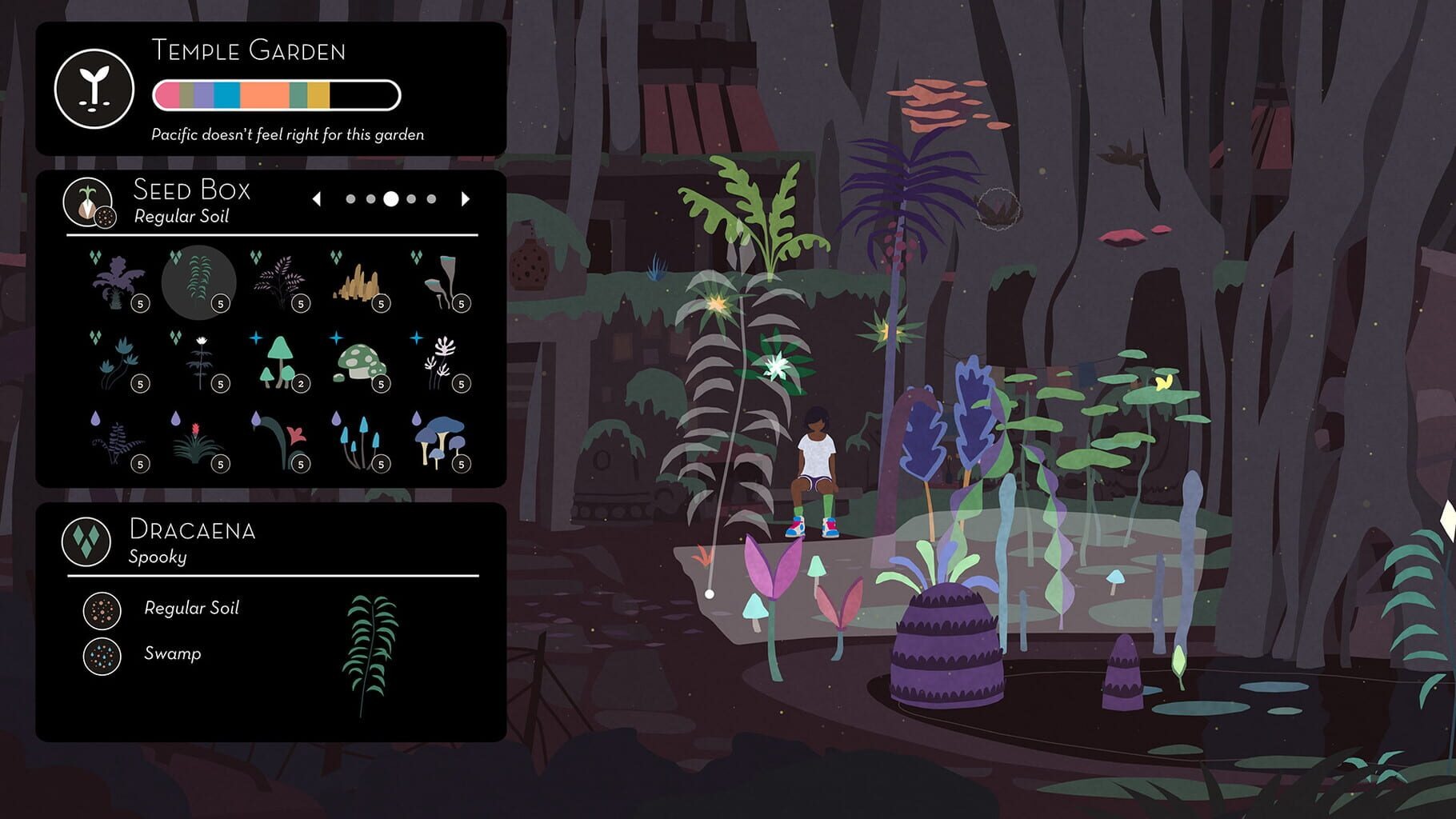
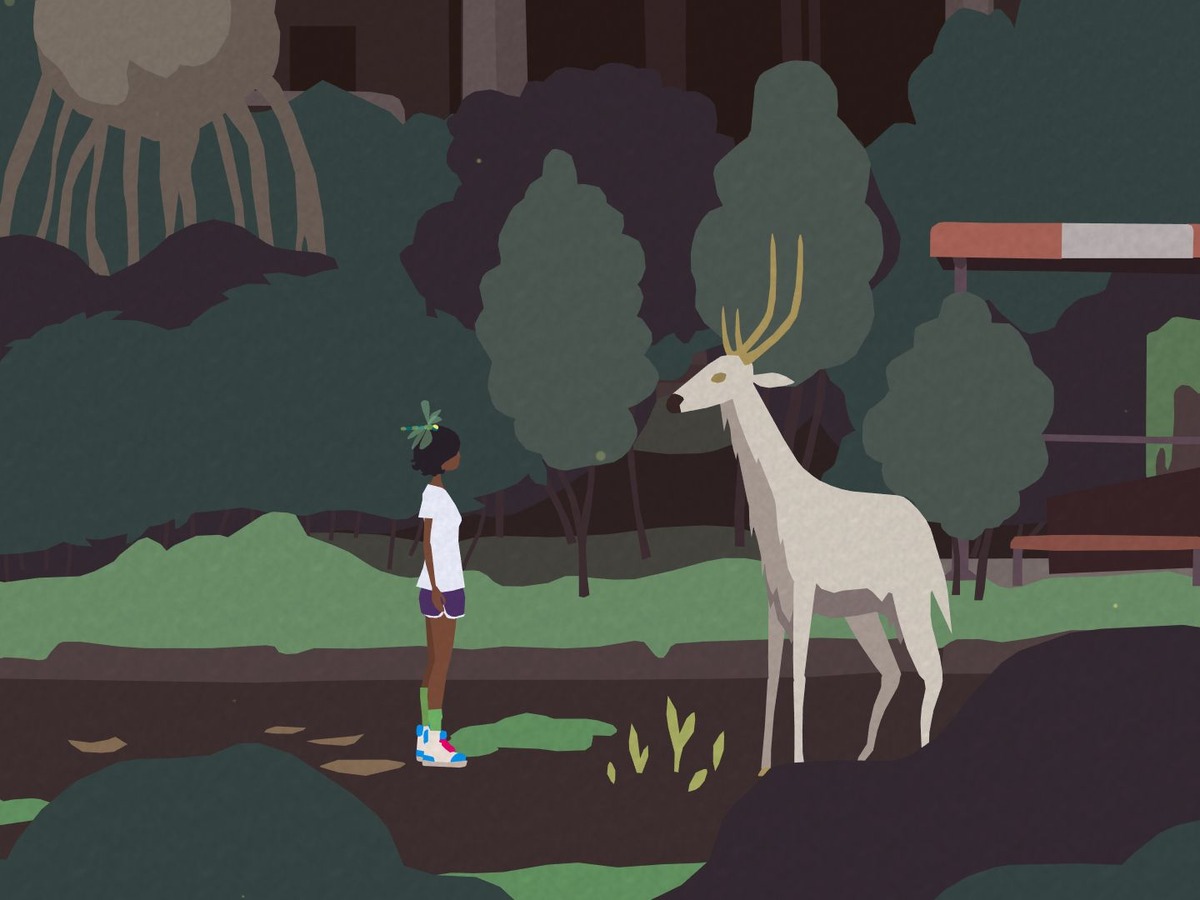
You play as Kai. A girl is sent away to a strange village in a post-apocalyptic world to re-connect with her extended family. You spend the entire game walking around to the various dozen or so screens, collecting seeds, planting gardens, and learning more about your past and the ties between the village and your family.
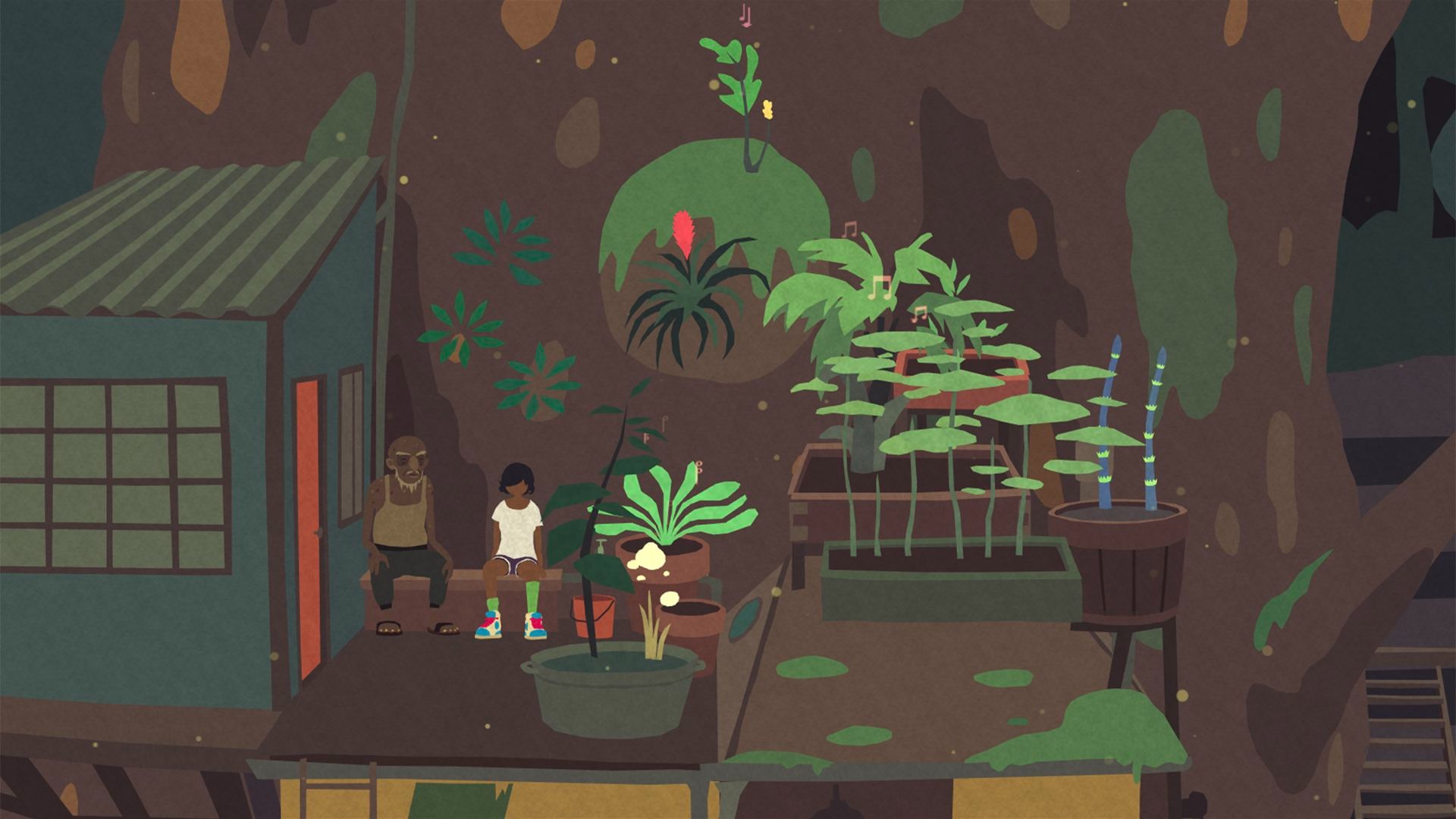
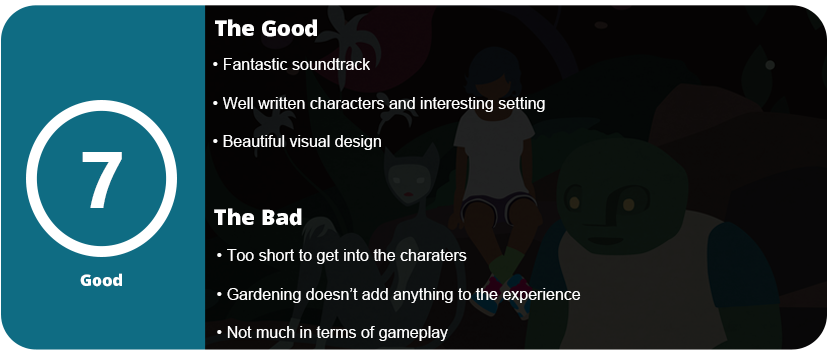
I have to give credit to the developers for their tight and well-written dialogue. The characters have, well, character. For the short time you spend in the games (under 4 hours), you really get to know these people, and the dialogue is written in a way that feels organic and like you’re listening in on a conversation. Talk of relationship issues, depression, carelessness, death, suicide, and many other emotions that we face in ourselves and amongst our own families. There’s an atmosphere that’s both uncomfortable and familiar. You will plant your own life in this game and strategize relating to certain characters or hating them. It’s just so well done.
As for the rest of the game, there’s something to be desired. As you walk around the screens, you will see a hand icon over anything you can pick up. These are usually plants, and you need the seeds to plant gardens to advance the story. There are eye icons for objects that Kai will comment on and a clock icon for an interaction that will advance the story. You never really get lost. Kai’s journal gives hints on who to talk to and what area you need to be in. Using a little common sense and learning the screens and where everyone resides helps a lot. As you pick up seeds, you learn songs that help you grow the garden. Each seed grows based on its song, so it’s recommended to plant seeds of that type. You can place the seeds with an outline of the plant that will tell you if there’s enough space for it. Sing the song a few times, plant enough seeds, and your garden grows. You can then harvest the plant for what you need to advance the story.
Don’t get this confused with something akin to Animal Crossing or Stardew Valley. This isn’t a farming simulator at all. The planting and gardening are rudimentary at best and mostly uninteresting. I just threw seeds around until I filled up the meter, spammed the correct song, harvested, and off I went. I was more interested in the characters and the story. There’s a mystery behind the village that I couldn’t wait to unravel, and unfortunately, gardening got in the way. I did love the music; it’s amazing and good enough to listen to outside of the game.
The art style is well done. It’s bright and colorful, but it can be really dark when needed. The characters have unique humanoid designs that seem familiar but are still alien, and the paper cut-out look just fits so well. I just wish the story was a bit longer, as I wanted to get to know the characters more. I can’t really complain about gameplay, as you do move around constantly and patterns change and mix up, so it never really gets boring. This is a great little adventure game that can kill an evening, and you might have a new favorite OST.
2D walking simulators seem to be a whole new genre of their own, are more interesting, and tend to be better than fully 3D ones. Games like Limbo, Little Nightmares, and Inside are perfect examples of this. There is some light platforming, some puzzle solving thrown in, and maybe a little bit of stealth. While none of those had stories that blew me away, they did make up for it in atmosphere and character. Shady Part of Me sadly doesn’t accomplish any of those things. The only thing going for it is the dual-character puzzles, and that’s about it. There really isn’t even a story to speak of. Yourself, your shadow, and some disembodied voice narrate the entire game with cryptic dialogue that really is either open for translation to the player or is entirely meaningless.
This game reminds me a lot of Limbo and Lost in Shadow. You play as a little girl in a white dress who is afraid of light, and her shadow (always on the wall) is afraid of darkness. You switch between both to help each other advance. Puzzles involve pushing boxes and pulling switches, and in later levels, your shadow can defy gravity and even take over puppet bodies. Most of the puzzles have that “Aha!” moment, which can be satisfying, but there were a few that really stumped me and took a lot of time just fiddling around until something changed. Most puzzles have you manipulating objects in front of lights to make new shadows, move them, or make them grow or shrink. The real girl can’t jump, but your shadow can. This means there is light platforming in the shadow, but nothing complicated.
I did find the aspect of two characters to be a bit tedious. Some areas just have you running to the right to stop in the circle to advance to the next area. You then have to switch to the other character and run that full length again. It’s not a major problem, but it happens too frequently. I also found the rewind feature to be really handy. This prevents constant deaths and restarts. You can rewind as long as you want, so I have to applaud the developers for making this a frustrating mess. A lot of times your shadow will die or you will get caught in light, and it stops the game, but rewinding allows you to see the error you made and correct it. If you fully died every time and went back to a checkpoint, this game would be unbearably frustrating.
Overall, the visuals are great. The sketchbook look and early 20th-century aesthetics are fun, but they’re also nothing memorable. We’ve seen this kind of art style before in other games. That’s the biggest takeaway from Shady Part of Me. It does what it does fine. Nothing more, nothing less. It doesn’t leave a lasting impression like the above mentioned games. Limbo was gruesome and had a memorable atmosphere. Little Nightmares’ ghoulish monsters stood out, and Inside’s dystopian world put you on edge. You will spend around five hours in this game and mostly forget about it the next day.
One of the scariest things to me is being alone on a planet. I’ve had a recent fascination with this, especially after reading The Martian by Andy Weir. It’s a different form of psychological horror. The human mind is a vast pit of emotions and an endless imagination. The fear of the unknown and the human mind running rampant combined is a scary combination that very few media tackle. The Invincible is one such story, and it’s done well.
First and foremost, this is a walking simulator, but with a bit more freedom. There’s really no gameplay, but you can interact with objects and control a vehicle a couple of times, but that’s about it. It does what walking simulators are supposed to do well, and that’s provide good characters with great writing and a story that keeps you hooked. The Invincible starts out slow and may come off as a typical space adventure with pretty colors and nothing more, but the story just gets darker and darker as you move along. The length is a couple of hours longer than a typical game of its kind, and it helps. There is more character development, more explanation of what is going on, and more of this planet, Regis III.
It’s a desert planet similar to Mars, but with an ocean. You play as Yansa, one of a small crew of scientists scouting out a possible Earth-like planet. You learn about two warring factions known as the Alliance and the Commonwealth. The space race to find a planet of paradise is very apparent. I don’t want to talk too much about the story, as I can easily spoil something. I will just say the story keeps going when you think it ends and gets darker and deeper, and the theories behind what is going on are very fascinating. There seem to be some choices you can make in the game, but I’m not sure if they impact the ending or not. Most of the dialogue is between Yansa and another crew member on her ship, the Dragonfly. The story has so many ups and downs, emotion-wise, as your fight for survival takes a back seat to a larger plot point, and the excellent voice acting helps suck you into this void.
You spend most of the game climbing ledges, dropping down ledges, and examining objects. There are a few large open maps, but you have a linear path you need to follow thanks to the well-designed map system. The interactions are always changing, and the pace is great after the first opening sequence, and things pick up. There is always something new happening, and I love that about this game. You aren’t just walking in a straight line in a borefest like Everybody’s Gone to the Rapture, and it’s not a jump-scare-induced horror roller coaster like Layers of Fear. The terror of survival, death, and being alone is omnipresent in The Invincible. Just seeing a robot can make you feel less alone. The atmosphere is so well done in this game.

I usually start complaining about a lack of gameplay or that the story is so short that there’s no time for anything interesting to happen, but The Invincible does what walking simulators haven’t really done in a long time: make you want to walk through something and keep going. Between the 50’s art deco-style designs of the ships and equipment, the immersive first-person view, and the excellent voice acting, there’s so much to take in. Sure, the visuals aren’t impressive on a technical scale. There is also no ultrawide screen support, which is a real bummer, but it’s not enough to knock this game down. The Invincible makes you think and talk about the story to your friends because you want to theorize, and it entices you to think about life on other planets, which might make you go read a book or watch a movie like Apollo 13 or The Martian to continue experiencing this fear of being alone on a planet. Walking simulators aren’t this good very often. Enjoy it while it lasts.
When a studio says they take inspiration from adventure games like Life is Strange, I pay attention. We follow a maid during the late 1950s, working in a hotel for a crass boss. You are basically a snoop and end up getting involved in a mystery of a love triangle, and you take it upon yourself to get co-workers involved, and the entire thing spirals out of control. Is this game a lesson on minding your own business or doing what you think is right?
You play as Ms. Roy. You start out by getting to know your co-workers, learning the game’s mechanics, and starting your amateur sleuthing. There’s not much to the game’s mechanics. You can interact with dozens upon dozens of objects, mostly letters you end up reading, and either throw them away or just inspect them. You spend your time between three floors. The fifth floor, the basement, and the lobby You eventually pick a male or female co-worker to help you dig into other people’s business, but you also have a job to do. You need to clean and tidy up each room, and all of your actions have consequences towards the end of the game. I don’t want to say what can or can’t cause these, as it can really spoil the ending, but just know that picking things up and keeping them is something the game tells you to think about the most.
Inspecting items doesn’t really matter as you’re putting them back down, but scouring all the drawers, every item, no matter how simple it seems, might give you a clue to figure out what’s happening in the love circle you want to so desperately be a part of. Sometimes you need to go to the basement and get items you don’t have, and there are a few puzzles thrown in. These aren’t difficult either. matching up pieces of paper, deciphering a code, or just finding a few clues here and there. You can hear Roy’s inner dialogue to help give you hints, and you can read everything you picked up in your inventory.
Outside of interacting with objects and solving the occasional puzzle, there isn’t anything else to do. There’s no exploring, character interactions are scripted, and there are only three characters in the entire game. This is a very short game with a runtime of about 3 hours. I do have to give credit to the developers for creating such a tense mystery at that time and actually giving the characters some depth. It’s not long enough to really give an entire backstory like other adventure games, but they cut out the nonsense and get to the meat of what they want to do and the story they want to tell. The writing is well done, and the voice acting is pretty excellent too. Your choices also really do matter, but the physical interactions with objects make you realize what you could have done differently as the final moments of the story pass.
The visuals aren’t anything impressive, but the game looks period-correct, and it’s not ugly. The lip syncing is off, but the characters look good, and they have a unique look and a lot of character in their personalities. Sadly, my biggest complaint is that I wanted to know more about these characters. The game focuses solely on this mystery, but just enough personality in the characters pokes through that this could have been a much longer game. I wanted to know more about Ms. Roy and who she is as a person. That’s what made Life is Strange so great. It focused a lot on the characters, who they are as people, and their lives. There’s a lot of potential here for something greater, but the end product of an interesting and gripping mystery is done well enough. This makes for a fun evening with choices that really matter, but that’s about it.
The Cold War was a rough time, and you really feel it in the South of the Circle. You play Peter, a British scientist struggling between love, his career, and being stranded in the Antarctic during one of the most strenuous times with Russia. Peter is a climatologist and ends up meeting a Scottish woman, Clara, who is protesting the war. He ends up torn between her companionship, his career, and the present times of him stranded at a remote research station trying to find rescue.
I don’t want to spoil the story because that’s all that South of the Circle has going for it and is the only reason to keep playing. There is almost zero gameplay outside of pressing buttons for dialogue choices. These come in the form of emotion bubbles that range from neutral, scared, sad, happy, and so on. I don’t quite know if this effects the overall story path, as my choices almost seemed to not matter. As Peter is talking to people, a bouncing red ball means a scared response. A blue ball hanging low means a sad response. A sun icon will make Peter respond joyfully, etc. These come up pretty frequently, so you’re always pressing something. Occasionally, you can move Peter around and interact with the rare object here and there, but that’s all there is to it. There are no puzzles or anything like that.
You follow this linear path of Peter trying to find people at this station while seeing flashbacks. You start in the middle, and as you move forward in the story, the flashbacks start from the beginning. It’s very entertaining, and I was interested in the story until the end thanks to the well-written dialogue and fantastic voice work. The visuals are striking in the sense that they almost look rotoscoped. There is motion capture for this minimalistic style of art, and it’s quite captivating.
The entire game is a linearly scripted adventure and lasts less than four hours. It’s a bit longer than most super-short story-driven walking simulators, and the excellent writing will keep you hooked. All of the characters have depth, and you actually have feelings for certain characters, despite some having only a short time on screen. Scenes can get intense and emotional, and you can feel the dread that Peter is facing in his struggle for survival. It’s just so well done, and it’s sad there isn’t more gameplay attached to it. It’s one of the better walking simulator stories I’ve finished in recent years.
Overall, South of the Circle provides an entertaining, well-acted, and well-written story and script, but the lack of gameplay makes you question whether this is just enough here to be an excuse for a game. The art is fantastic, and the motion capture is enticing. I wish the dialogue choices were a little more obvious about what they did or if they changed anything at all.
Yeah, it's pretty damn awful. Notoriously one of the worst games on the PSP. A 4 was actually being generous.…