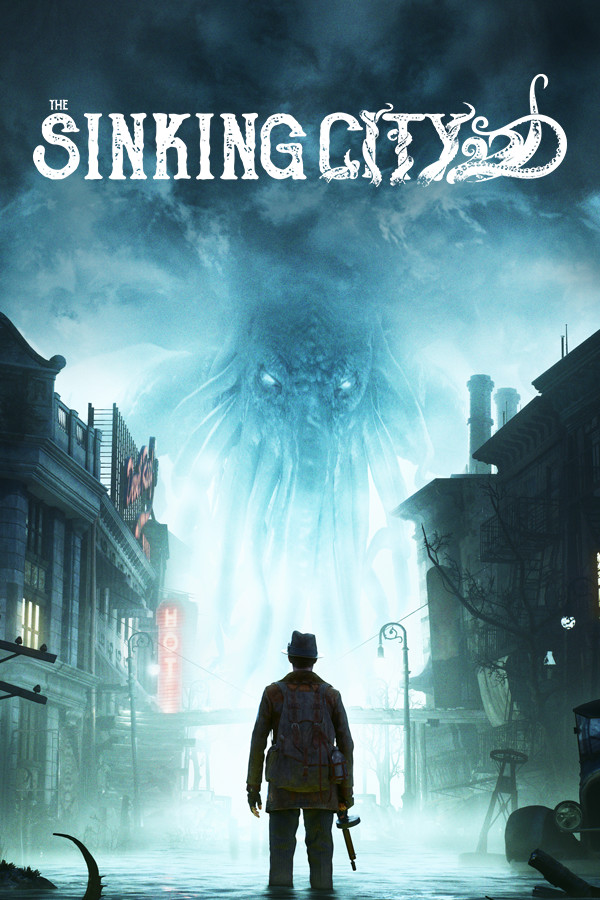
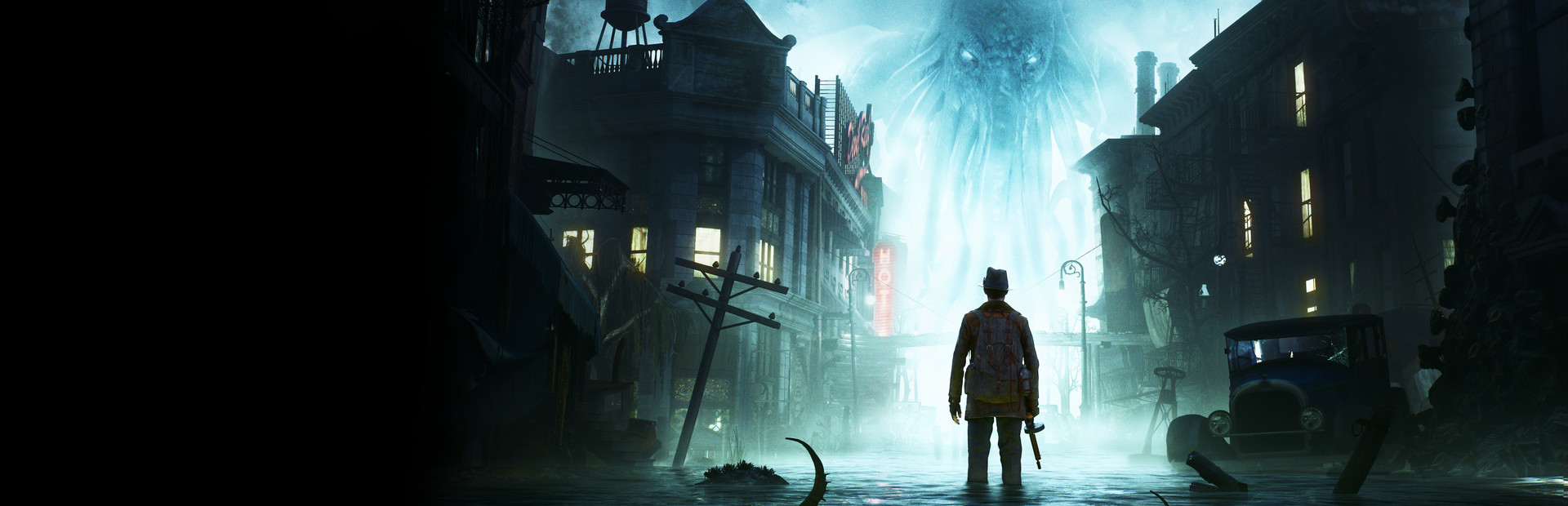
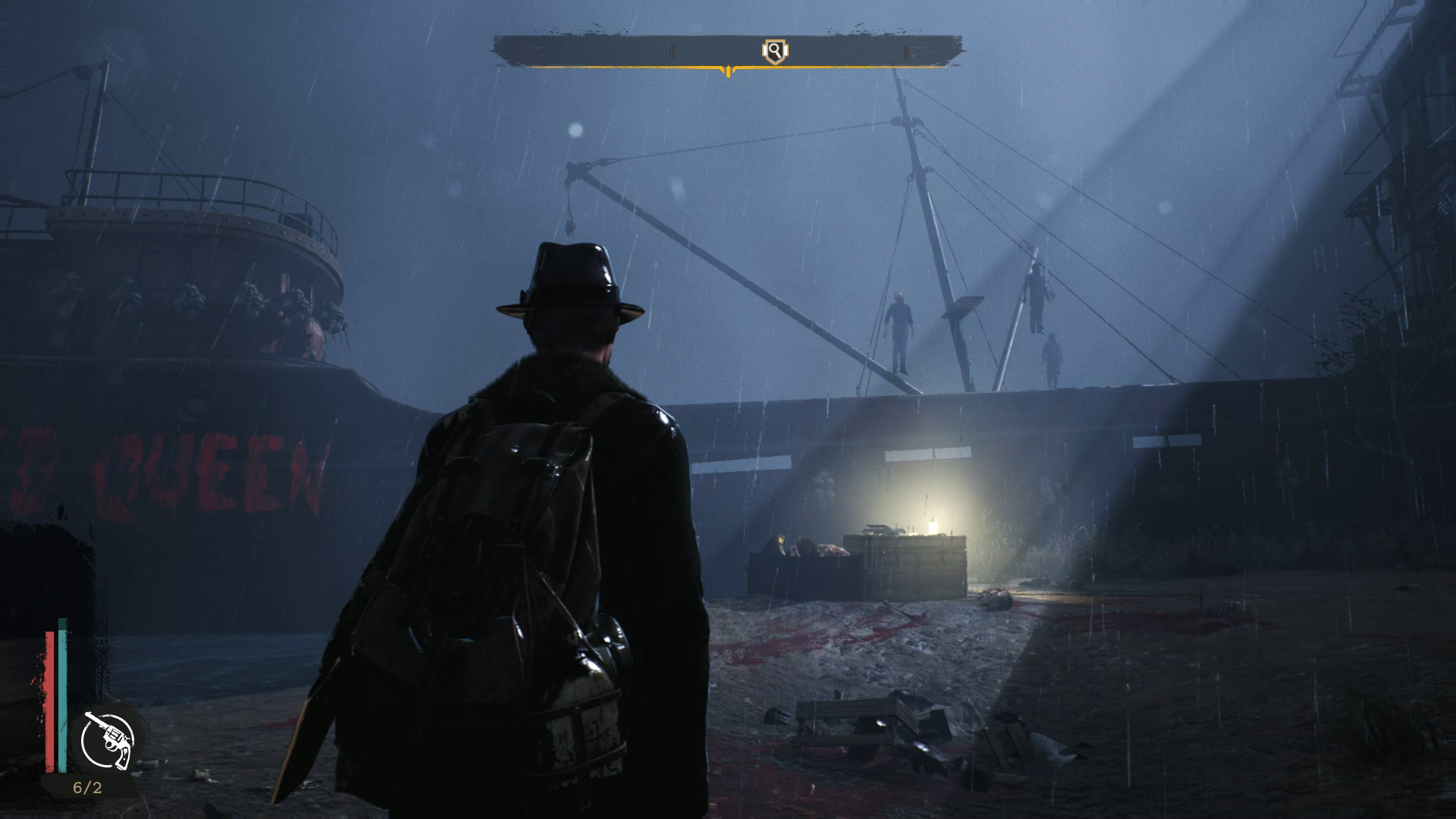
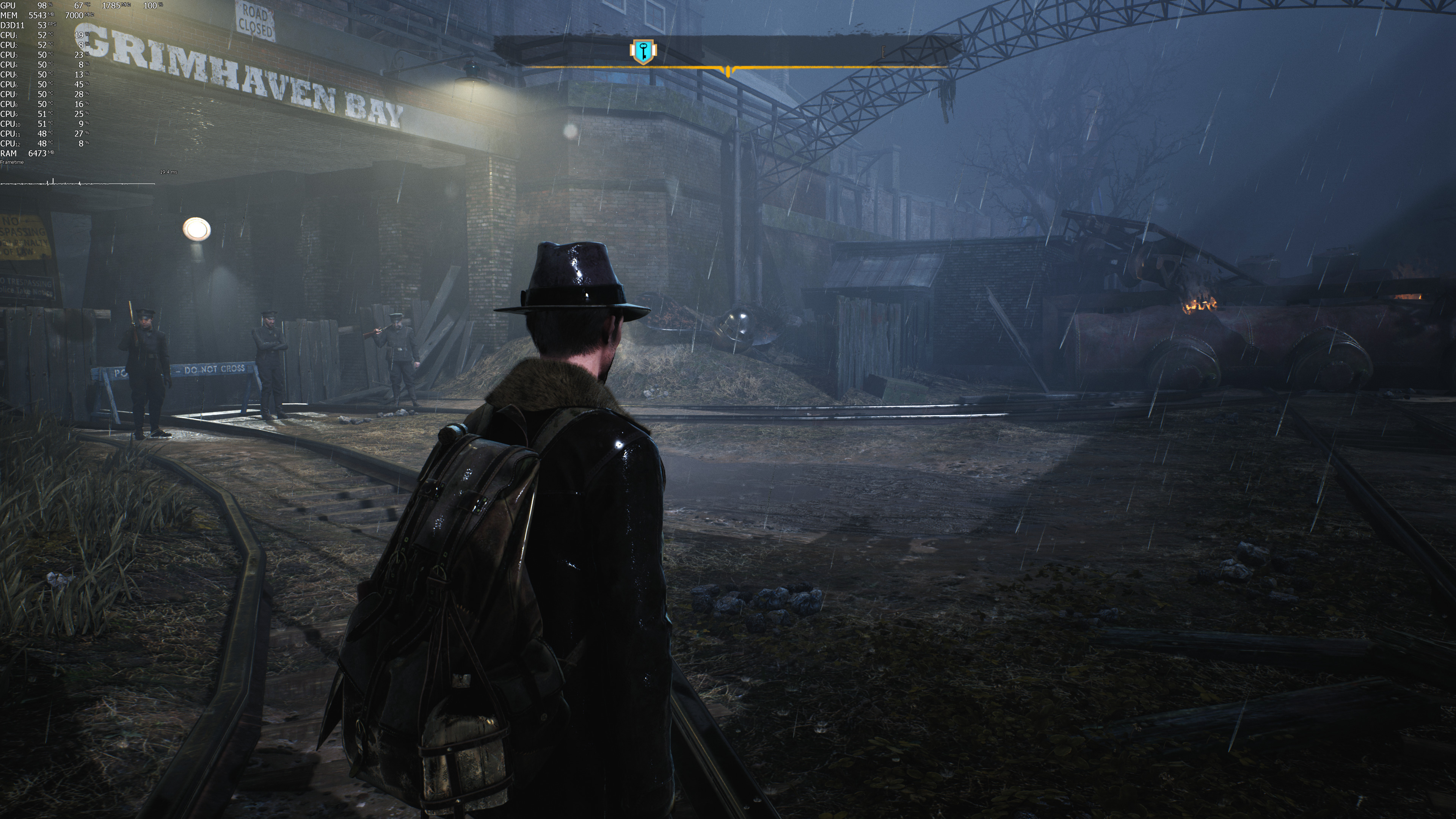
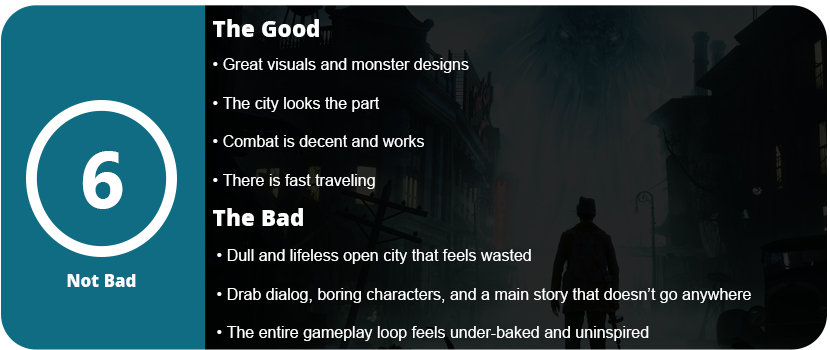
I love Lovecraftian horror, but video games have really struggled to bring these myths to life. Most of the games get the atmosphere and monster design down but can’t nail a good gameplay loop or decent story. By far the best game for this is still Call of Cthulhu: Dark Corners of the Earth. While its gameplay is clunky, it has great storytelling that’s somewhat memorable. The Sinking City does a great job nailing the twisted town of Oakmont with great visuals, but that’s about it. No single gameplay element or loop comes together to create anything interesting or worthwhile enough to make you want to stick around outside of the main story.
Unlike most other Lovecraftian games, this one doesn’t take place in Innsmouth, but it is mentioned that many are fleeing from that town. You play Charles Reed, who is a private eye investigator searching to end his visions. That’s about it, as far as the entire story goes. You bounce around from case-to-case-solving problems of townsfolk in the form of favors to get one step closer to where you need to go. This is where things start falling apart. Not a single character is interesting, including Reed; the dialogue is drab and boring despite the voice work being pretty decent. There are small little stories for each case you can unravel, but I didn’t care about any of them. I just wanted to progress further and hoped there was some cool twist, but that never came.
When you are inside investigation areas, you can examine items and look at objects. There are key evidence items to progress the story and bonus items to complete all evidence for achievements. This is mostly uninteresting, and there are dozens and dozens of these with you just wandering and looking at everything to find any object you can examine. Once you examine everything, you are given clues to advance the case, but nothing is marked on your map for you. You are given a district and then cross streets and have to pin that yourself. I found this kind of interesting until I found out that all of the main story cases are almost always right near fast travel points.
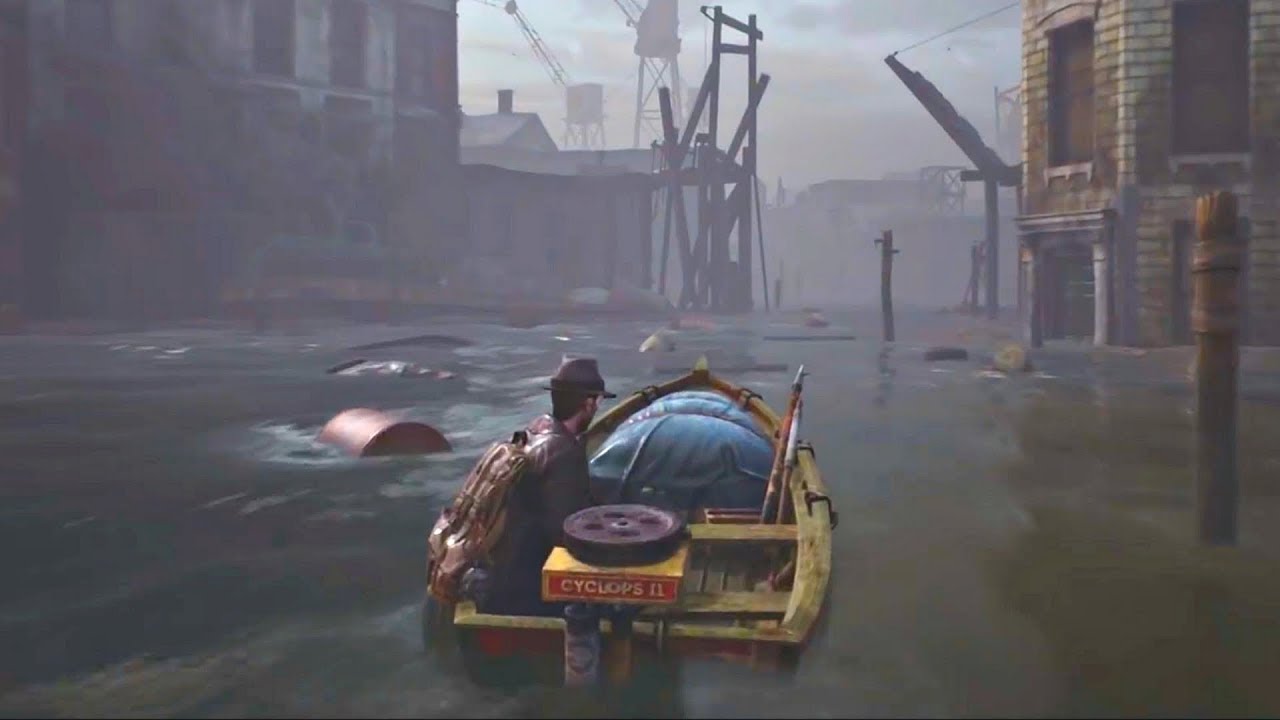
Speaking of fast travel, it’s so necessary because the town of Oakmont is boring and lifeless. Sure, there are people wandering around, but they are just animations to fill space. They don’t make any sound or have any dialog, and there are no stores or anything like that. It’s just linear streets that look pretty broken up with water-logged streets that require a motorboat to navigate. Some areas are sectioned off as infested areas full of monsters and aren’t worth going into for any reason outside of a few side cases that require it.
That gets us into combat, which is another half-baked idea. The game is trying to be a survival horror game by making ammo scarce, but you can craft ammo and health! Sure, but you will literally be scrounging bullets, and some areas have tons of monsters. I got lucky, but usually went down to my last bullet, and aiming carefully is a must. There are five different weapons, including throwables and traps, but honestly, you just start with your weakest gun and work your way up until you’re spent. There’s no strategy to this, all the weapons feel the same and don’t have any weight to them, and there is no cover system. Like any Lovecraftian game, there is a sanity meter, and as this drops, you hallucinate wylebeasts, and they will attack you unless you take psych meds.
There are some underwater levels in which you walk around in a diving suit and avoid hot air vents and a couple of monsters, but it’s slow-paced and even duller as they are all pretty much the same, just with different layouts and an excuse to maybe add filler. You can shoot a harpoon gun to slow the monsters down, but there was no challenge in these six or so underwater areas. There’s a single boss fight, and you occasionally attack humans, which are easy but usually come in large numbers. Part of the appeal of this game is story choice. Choosing who lives and dies doesn’t really affect much except what endings you can choose, which are uninteresting and unfulfilling.
There’s literally nothing else to do in the game. I desperately just tried to find all the fast travel points. I don’t understand making this open-world if it’s so boring and uninteresting to explore and feels so lifeless. The same loop of investigating cases, fighting some monsters, fast-traveling around to the next case, and listening to the dialog is so dull, and I only kept playing because of my love for the lore. If you don’t care about Lovecraftian mythos, then I wouldn’t even bother with this game. I also didn’t bother with any side cases, as the main story takes around 12 hours and drained me. I couldn’t spend another minute in this game.
Overall, The Sinking City is another barely passable Lovecraft-inspired game that gets the atmosphere and looks right but can’t nail any gameplay elements. While none of them are broken or bad, they are just boring and could have been greatly expanded upon. The main story doesn’t really go anywhere; there are no interesting characters, the dialogue is drab, and the bullet scrounging gets tiring because of the number of monsters that get thrown at you. Not to mention
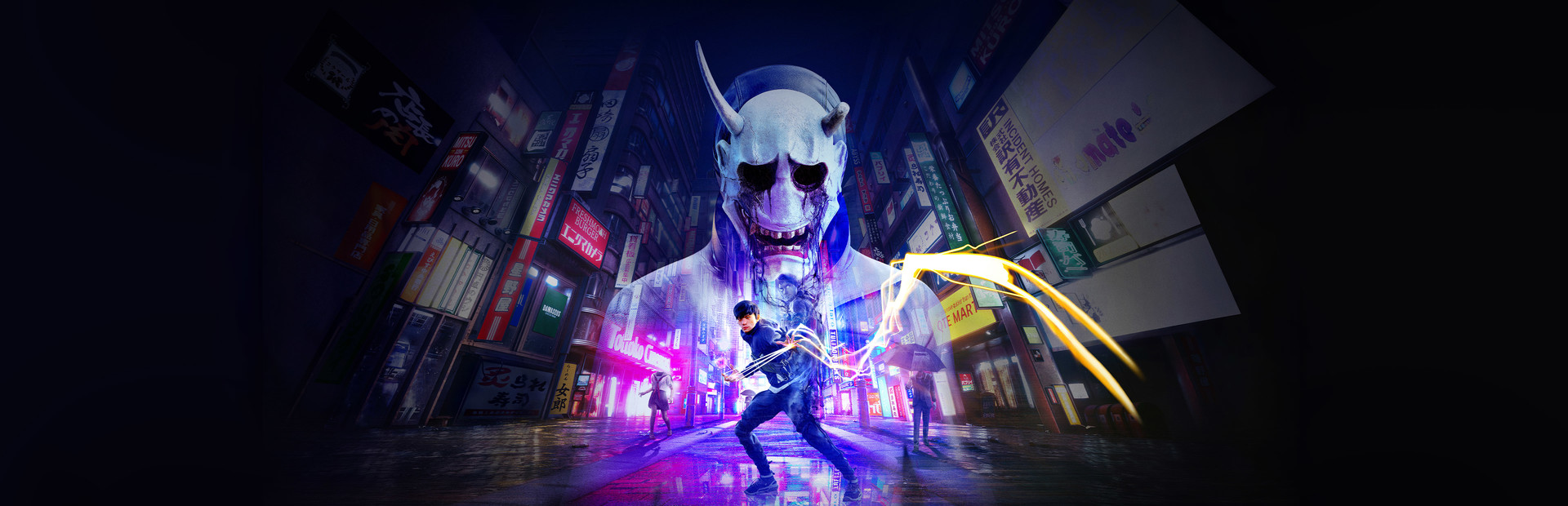
I love Japanese horror as it has such exciting mythology and creatures that are great for video games. Ghostwire does a great job making an entire game focused on Japanese folklore and mythology while also mixing it with the modern world of Tokyo. Ghostwire has great visuals and art direction, as well as fantastic monster designs, but it falls flat in more ways than I wish it did.
You play as a man named Akito who finds himself awake in the Tokyo streets, apparently dead, and being possessed by a spirit named KK who is trying to stop a demon named Hannya. And that’s about as far as it gets. Sure, there’s a side plot of Akito wanting to bring his dead sister Mari back to life, and Haanya wants her to seemingly become queen of the underworld. I don’t know or care. The story is so underbaked and doesn’t really go anywhere, and that’s no thanks to the story only lasting about 6 hours or so. It’s incredibly short compared to the rest of the repetitive and mostly boring filler throughout the game.
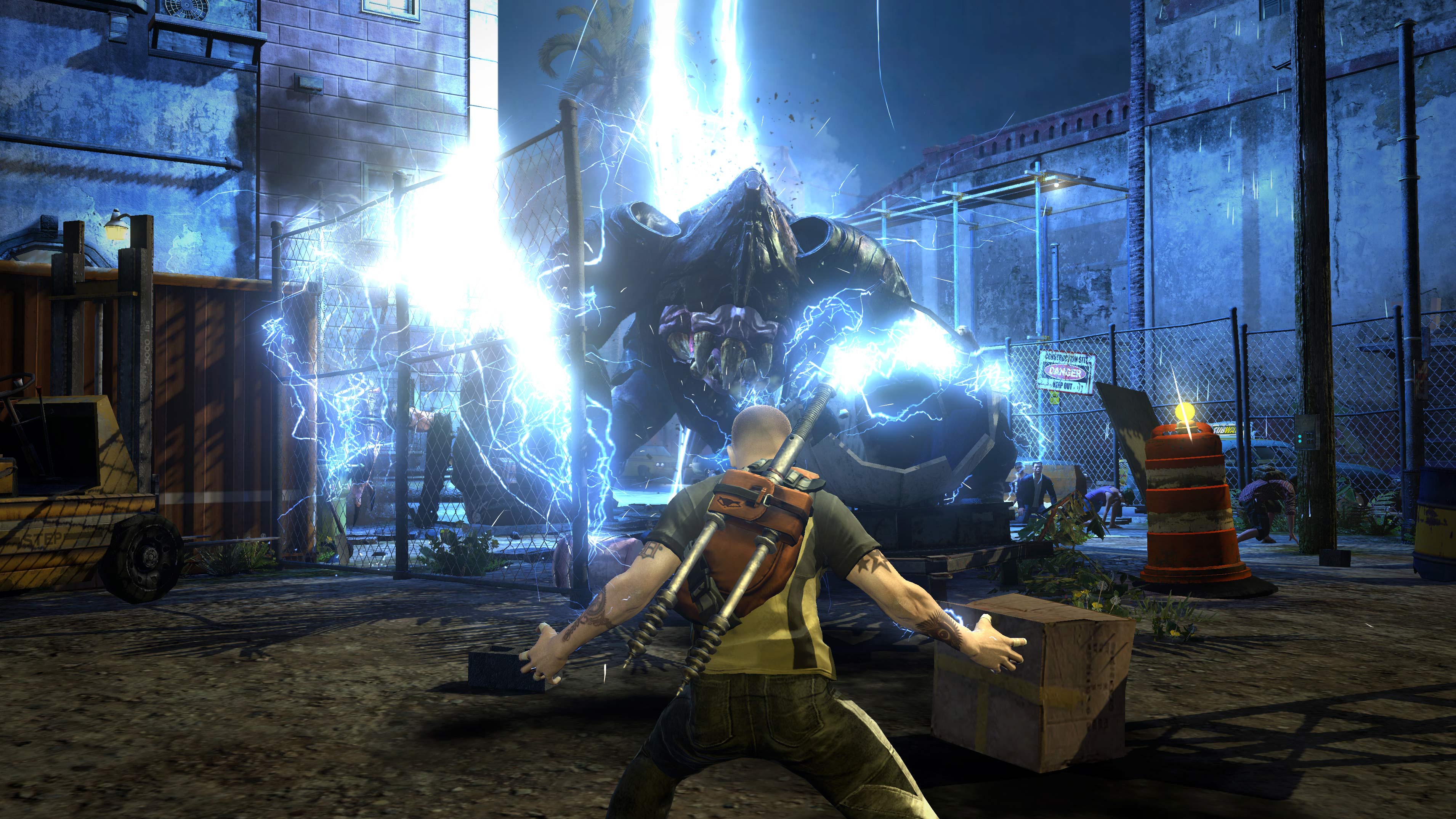
Let’s just start out with the combat, because Ghostwire is pretty exciting during the first two chapters of the game, and then that quickly fizzles out. You get three elemental attacks that are thrown out with your hands. A speedy green wind gust, which is your main weapon, a more powerful fire-piercing attack, and a wider-range water attack Think of it as a shotgun. You can charge these up and do more damage, and then there’s a super ability that lets you do extra damage. You can manage your health with food items, and you acquire “ammo” by destroying enemies or ghost-like objects scattered all over the place. One of the gimmicks of the combat is destroying the cores with a cool animation of Akito using his hands to pull their soul out with a wire (thus the title of the game!). The animation looks cool, but it’s fleeting at best. This becomes incredibly repetitive early on, as you’re just spamming attacks and using each weapon depending on whether you have a tougher enemy or not.
That leads to enemies. They are super cool-looking. They reflect Japanese mythology and folklore, such as the Students of Pain and Misery, which are headless schoolchildren who were either bullied or had some other issue in real life. These are fast-moving enemies. There are Rain Walkers who look like slender men who are salary men or women in real life. They block with umbrellas and are slower-moving. These enemies all look cool, but in the end, there are only half a dozen kids with different variants of them. They aren’t all that challenging in the end, as you just spam all your weapons until you run out of ammo, essentially. Despite all these cool visuals and monster designs, there just aren’t that many.
That leads to the open-world filler, which many games unnecessarily think they need to do these days. Ghostwire would have been a really great 8–10 single-player linear adventure, so more focus could be had on the story and enemies and deeper combat. While Tokyo seems big, it all looks the same. The same empty streets with nothing on the outside of groups of enemies you can walk into. There are various tasks here, such as cleansing trees, finding Jito statues to max out your ammo, and cleansing Tori gates to clear the deadly fog that opens up more of the world. You can find coins and food spread throughout, and you can give animals food for money too. There are various collectibles you can find and outfits to deck out Akito, but once you finish the story, you never see his body again, so I feel this is pointless. Most of your cash will be used to buy more paper dolls to capture spirits, but again, this is another large task that felt like it wasn’t worth doing. There are hundreds of spirits throughout the area, and most side quests give you more spirits to capture.
You can cash in spirits at payphones to empty your paper dolls and get some XP. This leads to the most useless ability tree that takes pretty much getting 100% completion to unlock, but once the story is finished, there aren’t any tough bosses or anything anymore, so why would you continue to unlock more stuff? You could argue it’s for a new game plus, but that’s also pointless as the story isn’t worth revisiting as it’s so shallow and underdeveloped. You’re left with this huge, empty, boring world with stuff to do that leads to basically nothing outside of 100% completion. Games like God of War make you want to find everything thanks to challenges you can complete that still require further upgrades beyond what the story can give you, and Ghostwire just completely fails here.
There’s also a vertical element to Ghostwire in which you can grapple up to demons that are flying and jump around rooftops, but platforming in this game is quite annoying. You can glide around a bit, but it requires upgrades to glide longer. But, with all that said, Ghostwire is a shallow game that tries to be bigger than it needs to be. It’s another victim of trying to cram a pointless open world when there’s so much great mythology and art to make a solid single-player experience, and it’s just squandered.
I do have to mention that you need to complete at least a couple dozen side quests to upgrade enough to make the game not super difficult. Getting more health, max ammo, and some abilities really help, but things like sneaking and your bow are totally useless outside of specific story scenes. It’s clear that this was meant to be a single-player linear adventure that was crammed and stretched out into an open-world game that no one asked for. It looks cool enough and plays well enough to warrant maybe 15 hours inside this world (I clocked in 12 and I explored quite a bit and nearly unlocked).
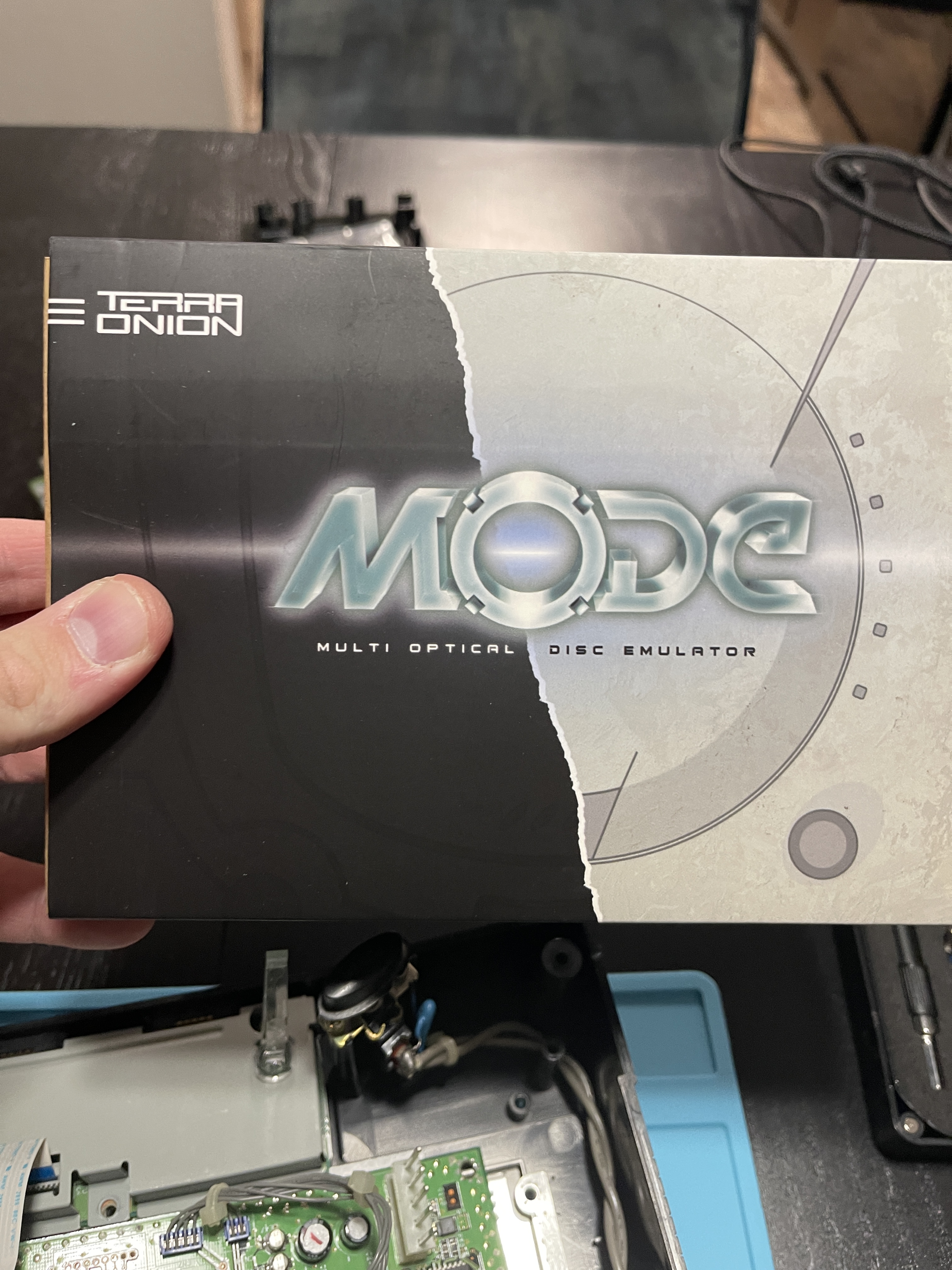
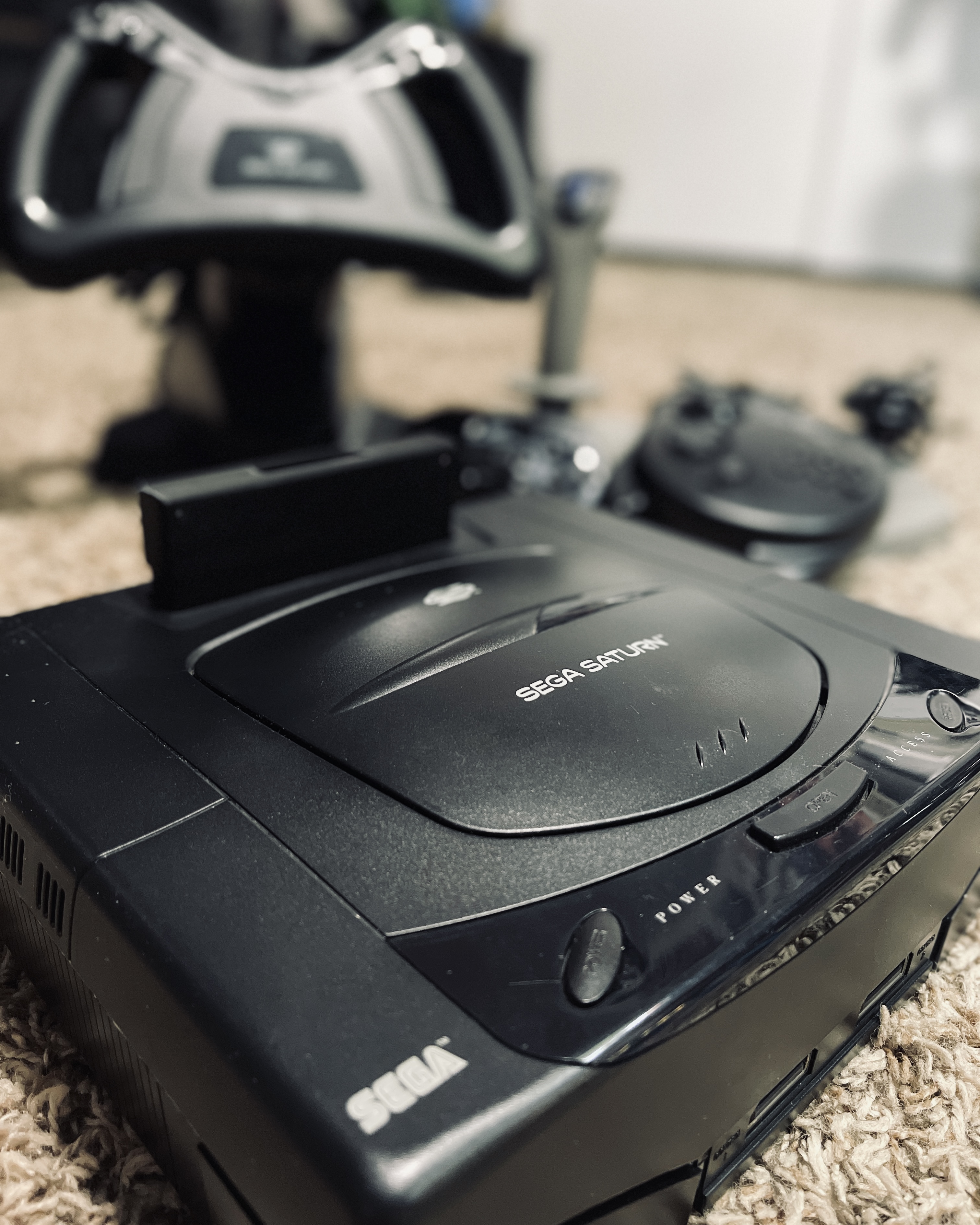
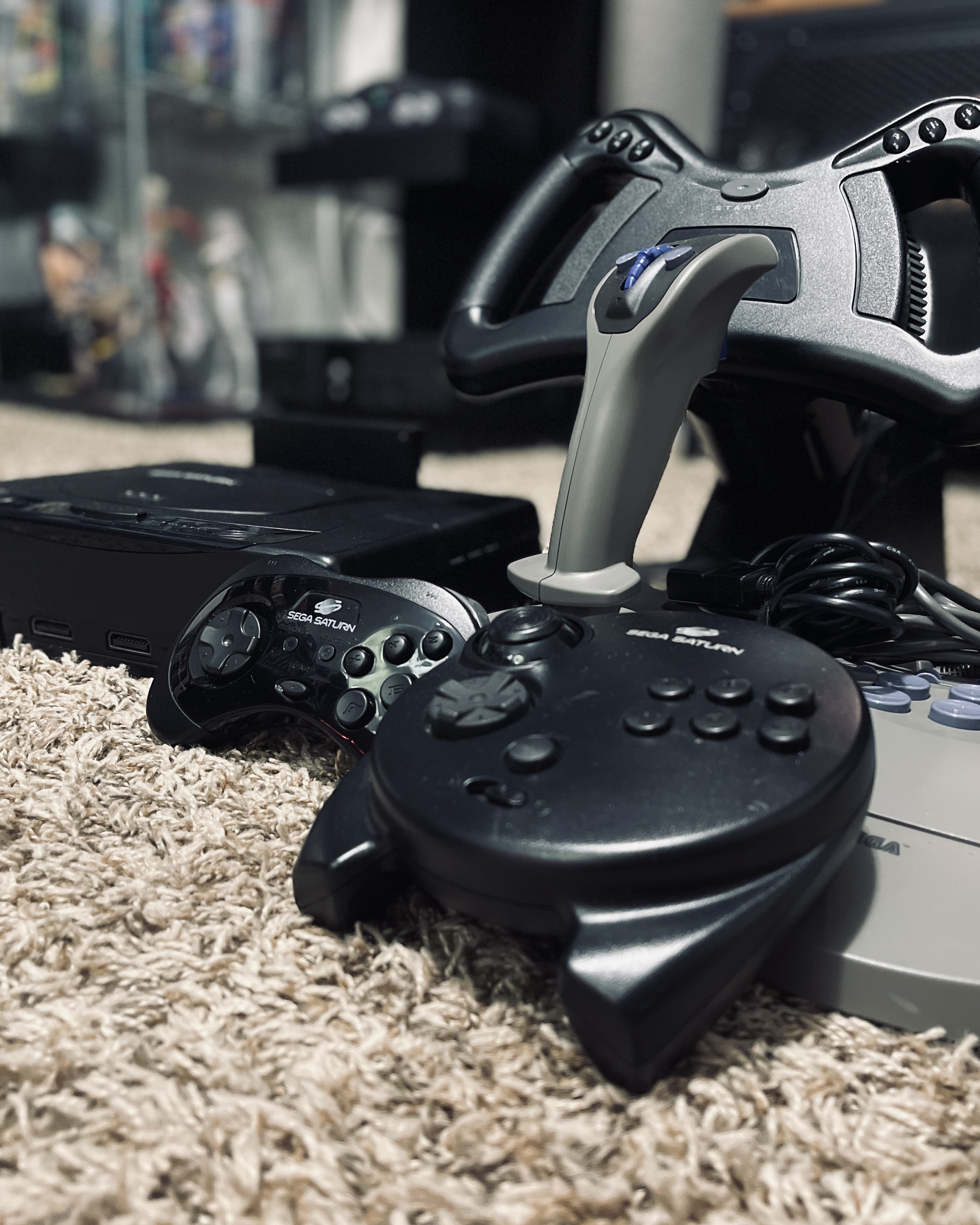
The Sega Saturn has always been a system that felt like unobtanium to me. It’s expensive, fiddly, has a very obscure and small library, most of the good games are Japanese imports, there are very few accessories, and they are big and expensive, and on top of all that, the games are insanely priced. Saturn games are some of the highest-priced games on any system. These days, there are things like optical disc emulators, RAM cart hacks, and things like the Satiator that allow you to run games through the video CD port. A lot of people are defensive and go to bat for their favorite way to emulate games on native hardware. I get it. There is no correct way to do it, with each having strengths and weaknesses. I went with the TerraOnion MODE due to its high build quality and support, as well as its multiple storage options.
I will run through an install of TerraOnion MODE, but unlike most install videos or articles, I want to talk about snags and problems I ran into that other people might discover. I want this to be a comprehensive resource for beginners to just buy a Saturn second-hand and know what to get and how to set things up correctly. I will also talk about proper video setup, and again, like various disc emulators, there are numerous ways to get good-quality video out of the Saturn.
“When you have Sega Saturn, nothing else matters”
Do I want a Japanese, European, or US console? For disc-based gaming, this matters as the Saturn is region-locked. There are also Saturns with a power supply mounted to the lid (VA0 model), but they are not that common. Most disc emulators work on any console since they unlock region locking, but thankfully most hacks for the Saturn have every version in mind. Usually, you can rest easy without seeking out a specific model, unlike the Dreamcast.
Japanese Saturn
So, even if your Saturn doesn’t read discs, this is a great option for you. There are also other mods, like ReSaturn, that replace the power supply completely if yours is failing. It’s a good idea to open up your Saturn and check the capacitors on the PSU for leakage.
There are also new shell mods you can swap your guts into if your Saturn is in bad shape cosmetically. Overall, these are some mods to consider and systems to look out for when shopping for a Saturn.
It Needs to Look Good
The first thing you probably want to invest in after getting a Saturn system is the video output. There are two main things you need to consider. Good S-Video or component cables and a good upscaler I went with the Retrotink 2X Pro and HD Retrovision component cables. Yes, these are expensive but worth their weight in gold. I have never seen a retro console look so crisp and nice as this setup. While that’s the high end of things, there are also cheaper ways to hook up your Saturn, and that also includes the TV you’re playing on.
Of course, this is mostly true if you’re gaming on a newer HD TV. Buying cheap composite or S-video upscalers on eBay isn’t going to get you good results. Even plugging the console into the back of your TV would be better than those awful upscalers. However, there are cheaper routes, and that might be to just buy a CRT TV. They are going up in price due to retro collectors, but you can get many locally for free. While the tube itself might be old, it’s the most authentic experience.
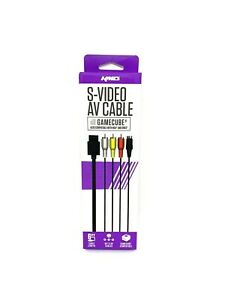
With that said, there are other upscalers that do a good job, like an OSSC, but these can be a little much for just casual players who want a good picture. Cables are a huge thing as well. Don’t get cheap S-video cables off of eBay. Most S-video cables actually don’t have the chroma or luma in the actual S-video part and are empty. Most are fakes that just feed in composite. If you have a Retrotink, you can find fake cables by plugging them into the S-video, and they will be in black and white or won’t display correctly under the S-video input. A correctly wired cable won’t do this. There are some better-known brands out there, like KMD. I own one for my N64, and it displays S-video correctly. If you can find them, proper S-video cables won’t have a yellow plug.
Good KMD S-video cables
Optical Disc Emulators – Pros and Woes
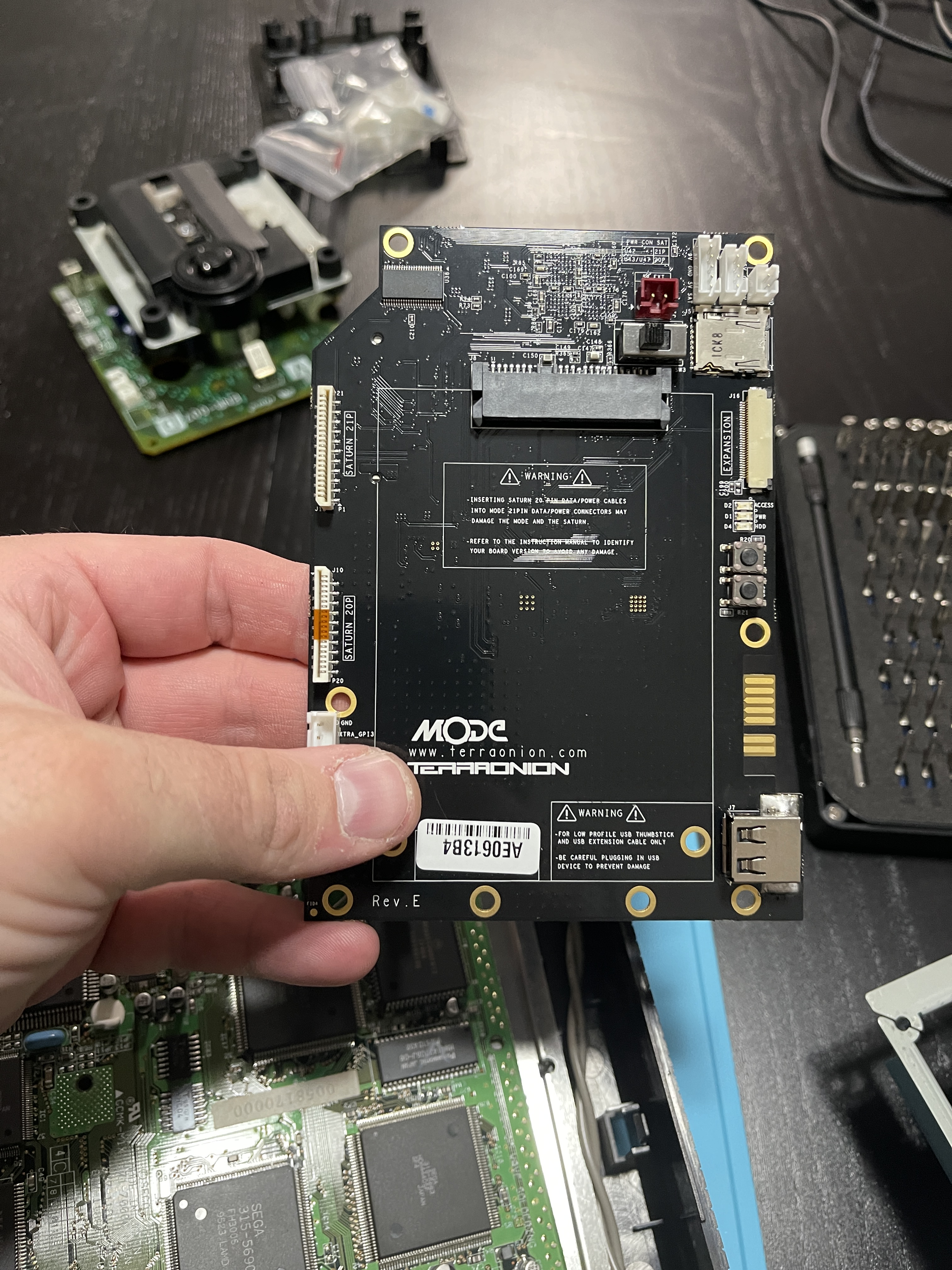
These range from carts to full-on boards, and while there are plenty of good choices, I’m going to cover the TerraOnion Mode. It’s a very well-made board with both positives and negatives to it, but overall, I am very pleased with it. I’ve had it for two weeks now and figured out some kinks and bugs using various hardware and software that I thought people might run into. A lot of these issues I had to figure out myself, as there just isn’t enough information out there.
Installing the MODE is pretty straightforward, but new casual users may be a bit scared to dive into this. If you already did some other mods listed before, like the ReSaturn, or checked the PSU for leaking caps, then you clearly shouldn’t have had an issue up until this point. The Saturn is a very single device in the end. just a disc drive, motherboard, and power supply. There are literally only three components in this thing. One thing I do recommend when installing the MODE is StoneAge Gamer’s 3D-printed bracket mount. I personally also don’t see the need to use an actual hard drive in this thing, and I will get to that later, but they also make an adapter to allow easy access to the drive.
The Optional Power Cable
Now one snag I ran into when installing was for the “optional” power cable. It’s needed for running mechanical drives as the Saturn doesn’t have enough juice to power them, but I recommend installing the cable regardless just to relieve strain on it. The installation shows pushing the leads into the power supply clip but doesn’t explain how. I watched a few videos, and no one has covered this. When you push the power supply down into the motherboard, the pins will push a metal “pincher” to the left of the pins. If you press the PSU down slowly, you will see this in action. The leads need to get “pinched” by this. I tried sticking them in while the PSU was installed, and it just wouldn’t work. You need to fully lift the front side of the PSU and stick the leads into the correct spots. Hold them firmly down and then press the PSU down onto the pins, and the “pincher” will firmly hold those wires in place. The other alternative is to just solder the wires directly to the pincher area.
Firmware Updates and Freezing on Boot
Other than that snag, the installation went smoothly, and I had no issues. Now comes the majority of issues with the software. When I opened up the MODE, there wasn’t any explanation of how it actually works. My Saturn booted straight into CD player mode, and I didn’t understand why. Without changing settings, you need to put the lid on! I then got into the mode, and it froze up and wouldn’t do anything. After several reboots, the mode would just read games and freeze. I then updated the firmware, and this worked. Remember, the MODE will only auto-detect firmware on SD cards and USB drives. I couldn’t get into the menu to access the update on my 2.5″ laptop drive, so that was a major issue. I don’t know what caused the freezing, but this fixed it.
Action Replay Flash Carts Not Working
This was one of the biggest headaches I had. The Action Replay 4M carts you can get everywhere are supposed to work with the MODE, but mine didn’t. I didn’t have one with the physical switch, but with the auto-switching one. When you plug one of these into their menu, it takes priority over an ODE because it’s technically just a disc. While this is fine and it works, it’s irritating to have to quit the menu of the flash cart to get into the ODE menu. You have to erase the boot menu from the flash cart and make it a standard “dummy” cart. With MODE, this is fine, as there are manual backups. You can now easily just fill up your saved RAM and then back it all up on the MODE for more games. I will walk you through the process of making an Action Replay an annoying free dummy cart.
The first thing you need to do is download a boot loader called Pseudo Saturn Kai. This is a “game” you can put on an SD card and launch from the main menu of the MODE. It’s important to download and install the tools cue/iso so you can actually erase the entire menu. This is found in the full version of the download. The lite version for “other” ODEs just erases the firmware but still boots to PSK every time. We also don’t want to boot into another menu. Remember, you can always restore the flash cart back to the way it was through this utility as well. Just remember what firmware version your flash cart had.
Load up the utilities, go to the save manager, press the R button, and go to the erase boot menu. This will now turn your cart into a standard RAM cart. Mine works flawlessly for 1MB and 4MB games. I tested nearly every game that uses one and didn’t have any issues.
My Flash Cart Isn’t Being Recognized
This is common, and it probably isn’t the cart itself. When you insert the cart to erase the menu, you might notice that the detection of the cart in yellow text flashes, or it seems the cart is wiggly. This is usually a dirty RAM slot or one that’s too loose or too tight. There are two screws in the RAM slot, and you can try tightening them first to see if that works, but if not, you need to loosen them. Sega didn’t solder the RAM slot to the board, so 6 to 7 turns with a screwdriver on each screw should help until they’re really loose. Mine had this issue, as I would load up games and it would only see the cart sometimes, despite the cart working fine. Loosening the screws fixed this, and I no longer had to set the cart in softly, head-on, and not at an angle, or pull it out a couple of millimeters. It’s not the best fix, but it’s better than sticking paper between the cart and the slot.
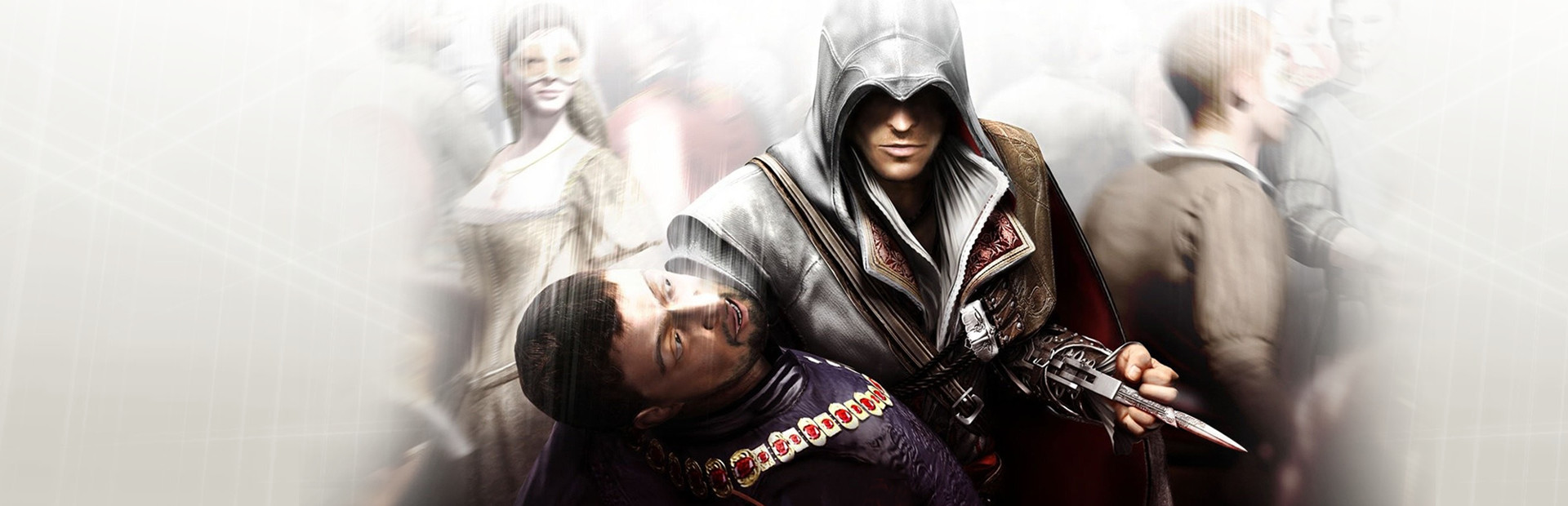
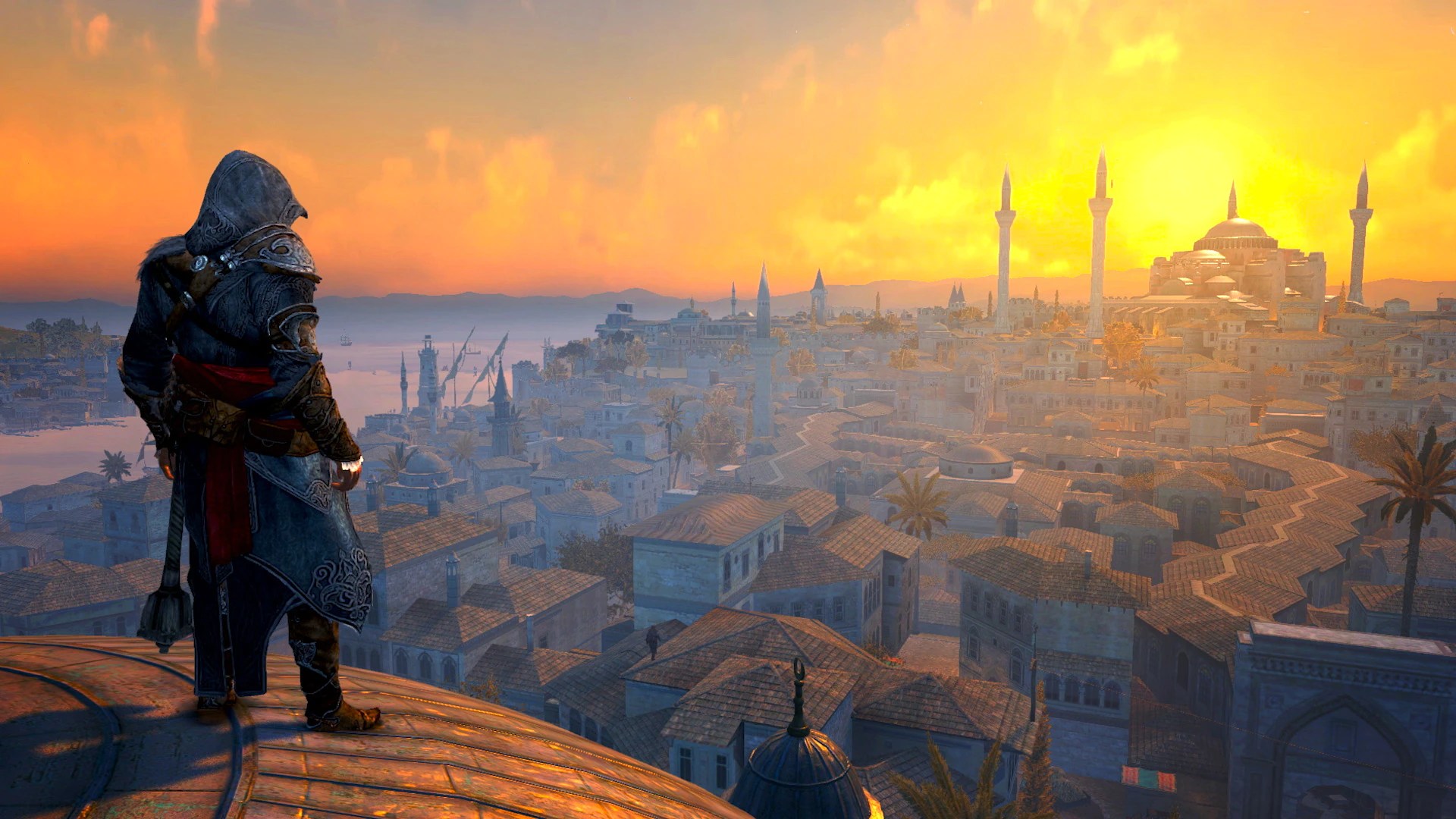
Assassin’s Creed II is by far one of the biggest sequels in video game history. When it came out, everyone was blown away by the scope and ambition put into this game. It made the first game feel like a concept demo. It felt like just the core of the first game was present, and so much was built on top of that game. The world was five times as big; there were new mission types, cinematic story missions, and tons of overall additions and improvements; however, the game did suffer on its own for various reasons.
This game starts the epic saga of Ezio Auditore de Firenze. one of the most iconic video game characters of all time. It was a surprise that Ubisoft scrapped Altair and his story so quickly, but we are greeted with 15th-century Italy and various historical characters that appeared during that time, such as Catarina Sforza, Leonardo Di Vinci, and Machiavelli. The story itself is fairly easy to follow and has a few twists, but most of all, it has a really surprising ending. Ezio works his way up as an assassin, knocking down templars, to retrieve the apple of Eden and keep it from the templar’s hands. The main villain, Rodrigo Borgia, is a nasty snake, and overall, all the characters are well written, and I wound up really liking most of them.
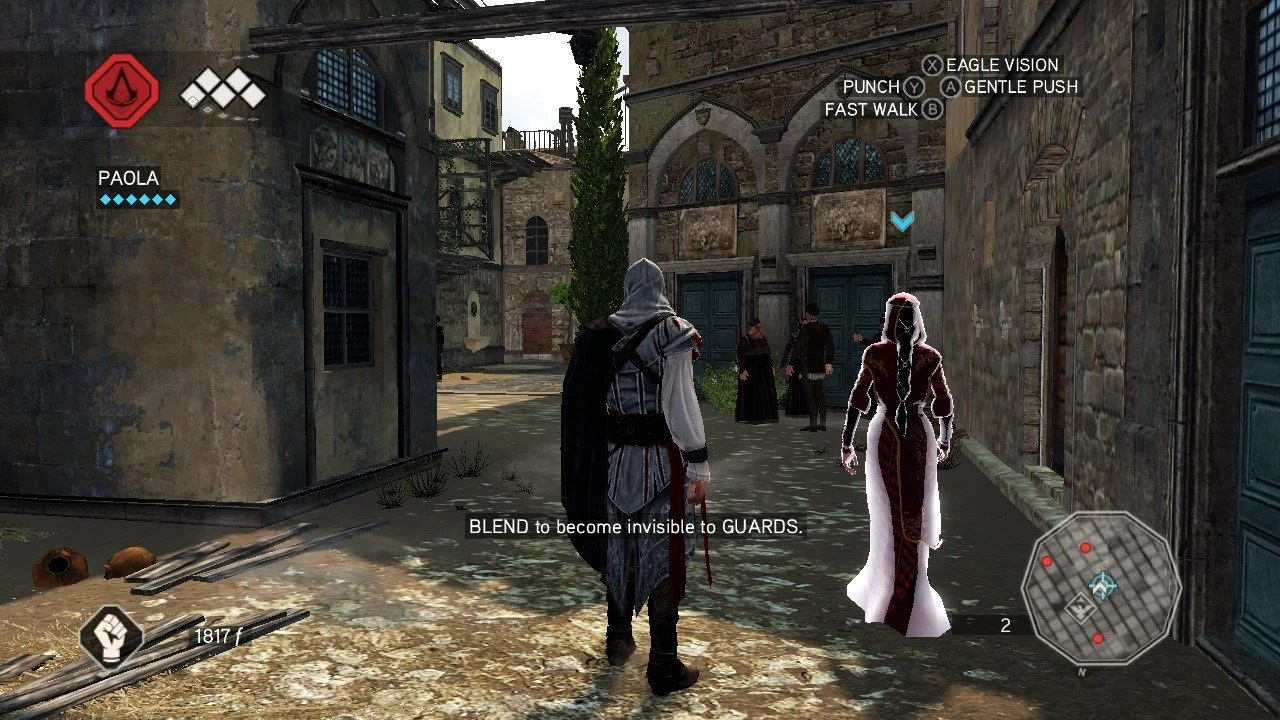
First off, the overall way you maneuver has been improved slightly, but more things have been added. While you can swan dive into haystacks and climb ladders, the entire game has been built with parkour free-running in mind. You can climb every building and stay off the streets by staying on the rooftops. Overall, the system was impressive back in the day, but it has a lot of quality-of-life issues. The overall parkouring feels too sticky. Ezio will jump around like a rabbit sometimes, so fine-tuning your turns makes it difficult to forget any type of mid-jump change. Once you get close to a wall or object, Ezio will climb, and quick button presses just aren’t responsive. I would start climbing a wall and then try to tap the descent button, but instead, he would just fall to the ground. Other instances had guards chasing me while I was trying to round a corner, and Ezio would cling to the wall and get stuck or jump onto the wall or object nearby instead. This can get incredibly frustrating as the system just doesn’t allow fine tuning or sudden changes.
That’s not to say the parkour system is bad. When you have a good line of sight, it works well, or you just want to climb broadly over a building. There were other instances in which precise jumping became a chore during Assassin’s Tomb missions. There is a fast walk button, and holding down the run button together allows Ezio to scale things quickly. If you are holding that run button after each jump, Ezio will just go in that direction, whether there’s something to grab on to or not. For small jumps across beams, I had to let go of the run button after each jump to re-align myself for the next jump. Quickly parkouring around just isn’t possible due to this finicky system.
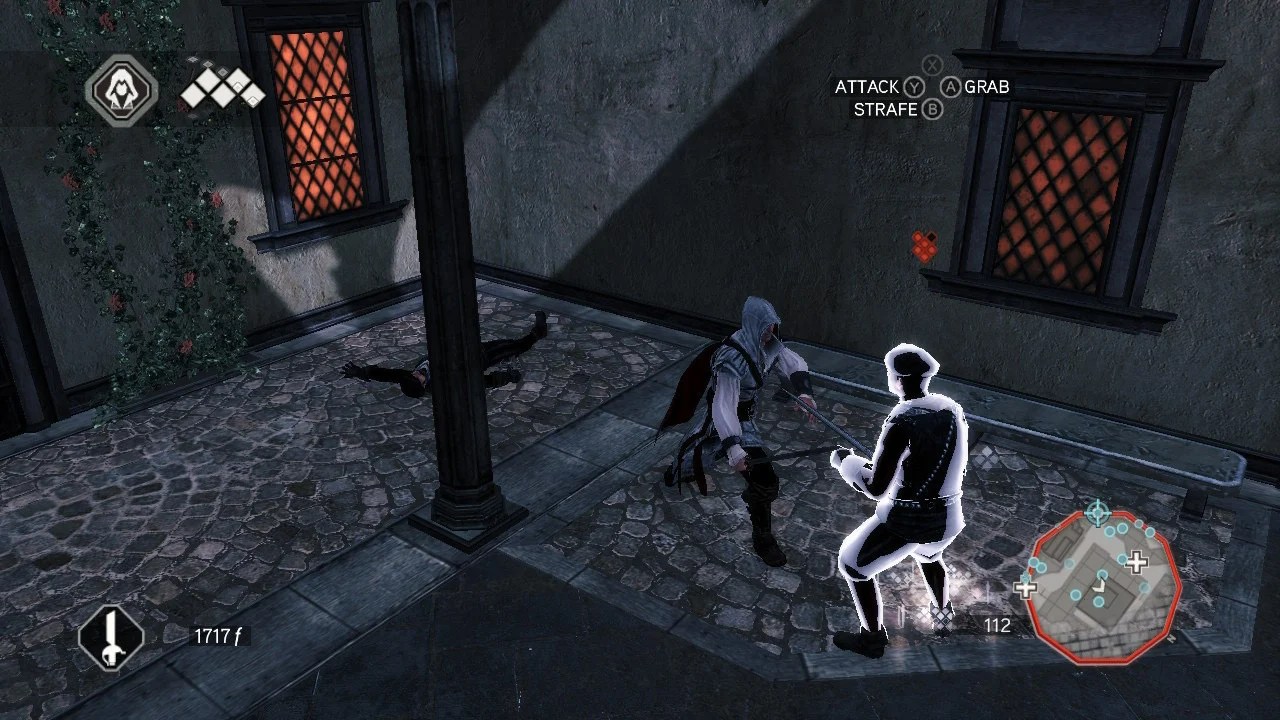
Some other frustrations stem from combat. Firstly, the system is mostly the same as the first game, as it can be easy due to the whole system being a parry-fest. You can whack away at enemies, but instead, just hold the block button and parry when enemies strike, and it’s a one-hit-kill city. Once I acquired my wrist blades, I didn’t even use my sword anymore and never once used my secondary dagger weapons. This is a flaw in the combat itself and needs serious overhauling. It makes open combat boring and sometimes too easy. What is challenging and annoying is trying to lose guards and become anonymous. Sure, you can blend into crowds, benches, and haystacks, and you can now hire prostitutes or mercenaries to distract guards and get them off your tail, but the combat and finicky parkour system make losing guards incredibly frustrating. You have to lose their line of sight by rounding corners or jumping off buildings, and if you can get far enough away, it will create a search radius. You can hide in that radius or continue escaping. There is an anonymity meter, and once it’s solid red, every guard will recognize you, and it’s a frustrating mess to find a town crier to bribe and take 50% of the meter away.
With those two major things out of the way, that leaves content itself. The sad thing about all this new content is that it’s meaningless in the end. There are no rewards for any of it except for achievements or completion’s sake. There are 73 viewpoints to find that are actually fun, as most of them are climbing puzzles on their own. Now it does still feel like overkill, as each viewpoint only reveals the surrounding buildings and not much else. I felt there were just too many. There are races, assassin contracts, courier missions, and fights. These are boring and pointless, and they are just there to add filler. You can really tell this is where the Ubisoft plague of too much crap to do in a game starts. The only rewarding side content is The Truth Puzzles. There are 20 hidden glyphs throughout the game, and finding them will grant you puzzles to solve. These get increasingly hard—absurdly hard, in fact—in which the clues become obtuse and impossible to decipher. However, what’s revealed is a cool video.
The story missions themselves are mostly varied, with various tasks such as assassinations, tailing, fights, horseback riding, and the occasional scripted mission. I really liked the story and characters enough to stick around and wound up completing all viewpoints, The Truth puzzles, and finding all the codex pages that max out your health. I do need to mention the various gadgets you get, which are mostly useless. Poison darts can make enemies go berserk and attack each other, but you also have smoke bombs, throwing knives, and a pistol, and that’s about it. I mostly used the throwing knives to take out rooftop guards, and smoke bombs were great to get away from large groups of enemies and become anonymous. In fact, they’re required to reduce frustration.
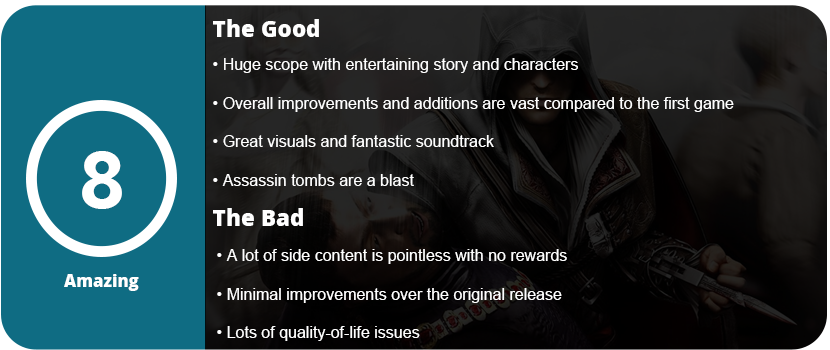
The visual upgrade for the Ezio Collection is minimal. There aren’t any actual improvements outside of some draw distance gain, anti-aliasing, and texture filtering. The lighting is slightly improved as well, but not by much. The game runs incredibly well with no slowdown, but I did run into a few crashes and glitches. I wish we got a full remaster or remake, but what’s here is fine. It’s crazy how well this plays so many years later and just shows how far ahead the game was at the time. There are a lot of quality-of-life improvements that need to be made, and most of the core mechanics have frustrations you will need to forgive or work around, but the story and characters are worth sticking around for. There is also a lot of bloated side content that has no meaning or rewards, including fully upgrading your villa, which literally just generates more income and isn’t used for anything besides dying armor, buying weapons, and armor itself. The assassin and templar tombs are a lot of fun as well.
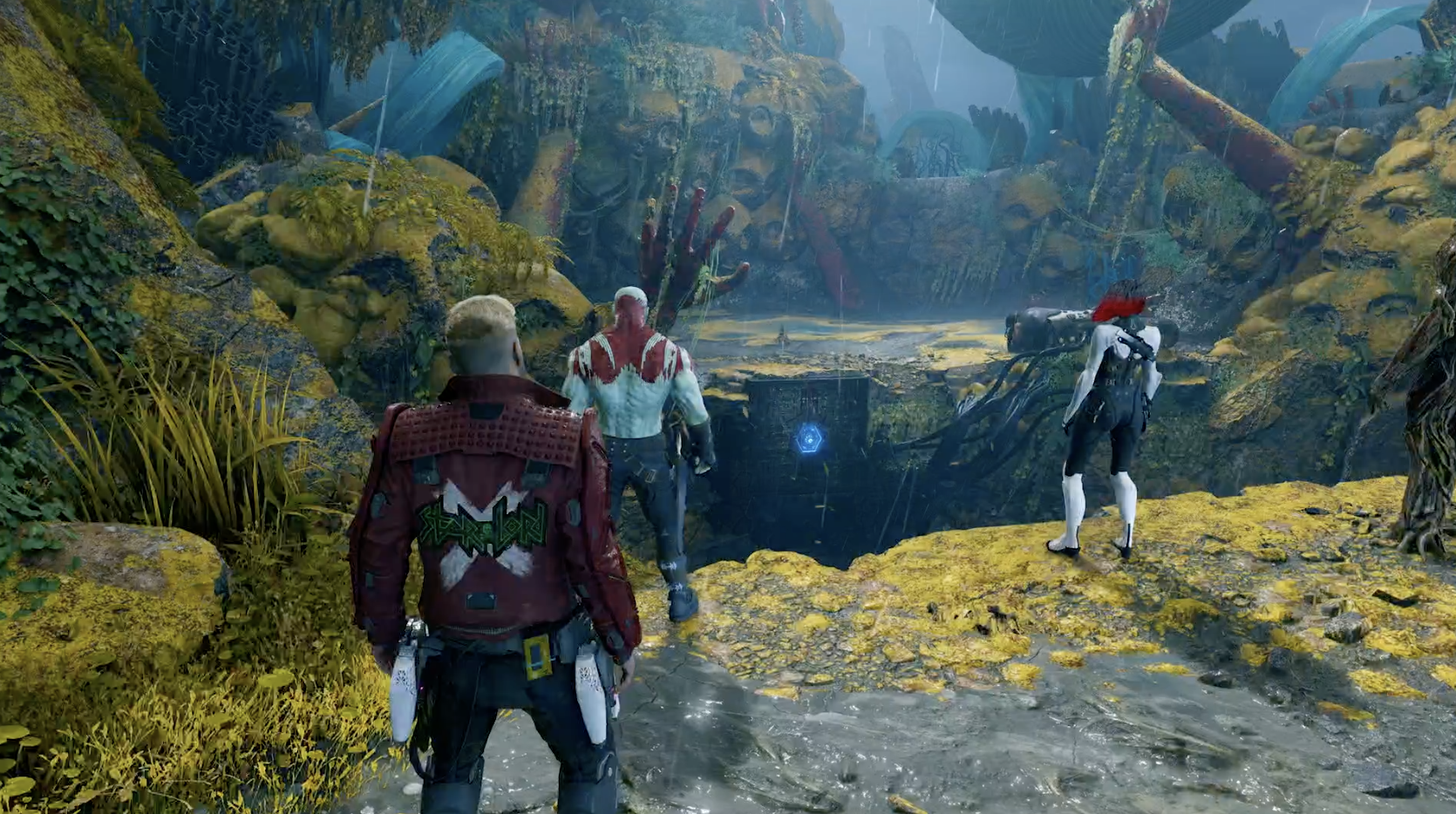
Even if you aren’t a fan of the movies, I want to say right now that the game is based more on the comics and original takes on the characters. I’m actually glad Eidos Montreal went this route. The game features a new story, and even if you don’t like Guardians of the Galaxy, you should enjoy this game as just a pure action-adventure romp. The game is chock-full of humor, clever writing, a great story, and fantastic visuals.
You play solely as Star-Lord, the leader of the Guardians. The game’s length is something I want to mention first, as it’s fairly long. running for at least 15 hours, and there’s honestly not much in terms of venturing off with side quests or anything. This is a very linear game with small side paths that lead to components for upgrades or extra skins, but that’s about it. You start off the game with a story-heavy intro. There’s tons of licensed 80’s rock music, and right away you can see there’s a lot of care and detail put into this game. Fantastic voice work, great sound effects, and tons of great artwork The game consists of two main parts. Exploring planets on a linear path that includes light puzzle elements—well, barely that, to be honest—and some platforming Then there’s the combat, which this game relies heavily upon and uses as filler.
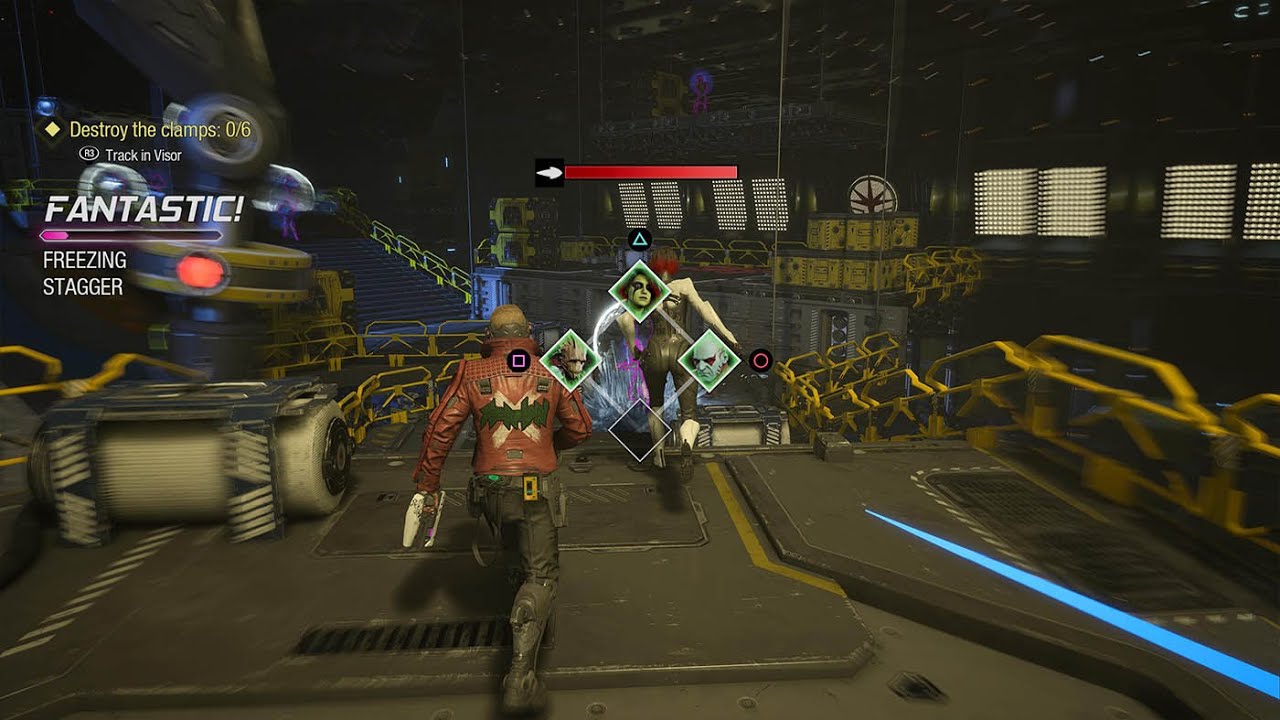
Let’s just get the combat out of the way here. As I stated earlier, you only play as Star-Lord, and you can order your other three teammates around. When you start out, you slowly acquire up to four different abilities for each member, including yourself, and these are acquired with ability points earned through combat. I feel this is meaningless in the end and feel tacked on as there’s not much strategy involved in combat. You can shoot your pistols until your heat meter fills up, and then time the gauge in the green to offload the heat for a burst shot. Then you can mash a melee button as well. Honestly. Star-Lord is fairly weak by himself, and I heavily relied on spamming the abilities of my teammates. Even my own abilities were fairly weak in comparison. Drax is a heavy tank, while Gemora is like a ninja and can jump around, slicing enemies. Groot is eventually upgraded as a healer towards the end of the game, but in the meantime, he can hold enemies in place. Rocket uses explosives and focuses on AOE damage.
This all sounds fine on paper, but in the heat of combat, the different abilities don’t do enough, which is different enough to mean much. I usually just relied on a couple of abilities from each member, mostly AoE-type abilities for maximum damage, and stuck with those through the entire game. I only really used my own pistol barrage ability, as it was the most useful. Enemies come in usually only three varieties. Easy to kill, medium damage and health, and larger enemies with multiple health bars The enemies mostly repeat on their respective planets, and then there are the same Promise enemies over and over again. There are a few boss fights thrown in, but they aren’t anything unique or special.
It’s sad that the combat is a dance of spamming the same abilities from your teammates and running around to stay alive. The fact that you yourself do so little damage is really odd. There are a few other contexts thrown in, like a bar under the larger enemies’ health bar that determines when they are weak. If you spam enough attacks in a row, you can then do an instant kill. There are also a few environmental items that you can order teammates to toss around, but they’re very underdeveloped and rely too heavily on these fundamentally useless abilities. The fact that there is so much combat in the game can make it feel like it’s dragging on far too long and is just there for filler. I much preferred the story elements and more exploration areas than the combat.
The exploration is mostly just running around and listening to the banter of the Guardians, but also light puzzles in which you must match the correct teammate’s ability with the right obstacle. Gemora can slice things open, Drax can punch through walls, Groot can create bridges, and Rocket can hack panels. There are four weapon elements you acquire, such as lightning, ice, fire, and a grapple ability, that are used here as well, but it’s not rocket science. Again, another idea that is undercooked and feels like filler. I mostly enjoyed the choices you have to make during the story, which determine which allies help you during the final events of the game, and the overall voice work and writing are clever, sharp, and really funny. I just wish the rest of the game had the same care attached to it.
That’s not to say it’s downright bad. The controls are responsive, the animations are smooth and look great, and the combat does work. It’s not clunky or a chore to use; it’s just full of underwhelming features. The various planets you explore are fantastic-looking, really draw you in, and make you feel like you’re in the comics. There are intermissions in between in which you are on the Milano ship and can walk around and explore. There are also Easter eggs and lore scattered throughout the game for hardcore fans too. However, the biggest element of all is: is this enough to warrant sitting through 15–17 hours? If you aren’t a huge Marvel, Guardians of the Galaxy, or comic book hero fan, then no. I feel like almost 5 hours could have been cut with less combat thrown in, and the story does go on and on. It’s supposed to, as you get a solid beginning, middle, and end. There’s enough run time here to really get you to connect with each character. I didn’t finish the game and have no clue about anyone or care about anything, like most video game stories these days. It was daring for Eidos Montreal to really push the story through and allow you to grow with these characters, and it paid off.
Overall, with weak and repetitive combat, mostly useless abilities that don’t allow for any type of strategy, and a weak attempt at environmental puzzle-solving, the only saving graces here are the visuals, story, characters, and voice acting. I played this game all the way through because I wanted to see and hear more. It was highly entertaining, but every time I went through a chapter full of nothing but combat, I grumbled and just wanted these parts over with. I then enjoyed exploring various planets but got annoyed with the poor attempt at puzzles. If the
One of the most obscure gaming handheld systems, besides the Gizmondo, is the Nokia N-Gage. I fondly remember this system, yet I never owned one until recently. I remember the giant cardboard stands in GameStop for it. The system even had its own game rack next to the GBA games. It was a massive deal back in the day because merging cell phones and video games wasn’t even a thing yet. The iPhone wouldn’t be out for four more years. Sure, phones could play simple Java games, but just barely. The days where simple Snakes and Tetris were starting to sunset, and we finally were getting real 2D mobile games. But 3D games on a mobile device? It’s why the N-Gage was so expensive. At $299 ($462 adjusted for inflation), you were getting a mobile powerhouse. The graphics capabilities were about on par with the original PlayStation. However, it was the same price as the PS2 and Xbox and twice the price of the GBA.
So, what happened? Well, there are plenty of YouTube videos that dive into the history of the N-Gage extensively, but there isn’t a cohesive guide on how to use one in 2022. There are a lot of roadblocks to getting the game running. You can’t buy games at stores anymore; you can use the device like a cell phone, but it’s impractical today, and it doesn’t take standard removable media. The N-Gage is a pain in the ass to get working for just 65 measly games. However, these weren’t just shovelware. They were released by big AAA companies like Activision, THQ, and EA. This guide will help you choose your device and get you started.
Yeah, so this is at the peak where gaming was full of cringy sexism and objectification of women. Just read any gaming magazine from that time period. Even for a 13-year-old, I thought these ads were stupid.
Anyone, Anywhere
The Nokia N-Gage was released on October 7, 2003, to mixed reception. The device looked fine, but it had a few flaws. Firstly, the device had to be held like a taco to speak into it, and the battery had to be removed to insert games. This was a problem, as you could possibly miss a call during that swap time, and you had to wait for the phone to restart. It also had middling battery life, not just for gaming running for around 3 hours but for talk and standby time as well. Talk time was around 5 hours. The system launched with seven titles, all of them ports. Tomb Raider, Pandemonium, Sonic Advance, Super Monkey Ball, Puzzle Bobble VS, Puyo Pop, and Tony Hawk’s Pro Skater All were solid titles for the platform, but the fact that these seemed like great to decent ports worried many early adopters. The exclusive and more anticipated releases weren’t set to be released for another 30 days or more. The original N-Gage model was quickly replaced by the QD just 7 months later. The price was reduced by $100 just two weeks after release, and games retailed for $30 ($46 adjusted for inflation).
Should you get a taco model? No. Unless you’re a collector, there’s no reason to get this version. The only advantage is the USB file transfer, so you won’t need an MMC reader, and you can use it as an MP3 player if you want. They are also more expensive than the QD and harder to find. The N-Gage also boasted its rival to Xbox LIVE, which was the N-Gage Arena. It’s dead these days but gave way to multiplayer options and game interactivity such as new levels, scoreboards, and more that were never seen before on mobile devices.
The QD model was released in May 2007 to quickly fix many of the original model’s problems. While game stores were thinking about booting the system, the QD put the speaker on the face of the phone and added a card slot at the bottom of the unit for MMC cards and games. The issue here is that you can only have one. Instead of adopting SD cards and having a third slot, Nokia cheaped out. They also removed the USB port, MP3 functionality (most likely a chip they decided to axe), and only a dual-band antenna. The design itself was also rounder and easier to hold. The QD is more available, running at around $50–$60, and is really cheap.
How Do I Get It Running?
SIM Card
So you just bought your shiny N-Gage, and it won’t work! That’s normal. First off, make sure you have a new battery. There is old, new stock on eBay as well as third-party batteries such as those from Polar Cell. The model number for the battery is BL-6C. You also need to have a SIM card in the system, or it will not run. You will get a continuous “Insert SIM Card” error that you can’t back out of. You can either get one from a local phone store or buy a deactivated one on eBay for less than $10. It’s another cost on top of the system, but unless you already have a full-size SIM card, you need to do it.
MMC Card
Second, the games are rather expensive. Some launch titles are under $20, including sports games, but the better exclusives, like Ashen, are $50+. The rarest game is The Elder Scrolls: Shadowkey, which can run for $600+. So, holy Christ I just bought this $50 to play some obscure mobile games, and the games can cost more than the system! Unless you’re a hard-core collector, don’t bother. You will need to fork out even more cash by buying an MMC card, which is hard to find and only really available in China.
There are 13 pin MMC+ cards and 7 pin standard cards. Most plus cards or dual-voltage cards won’t work in the N-Gage. I haven’t been able to get any current 1GB cards you can buy right now to work reliably. I recommend sticking with 512MB cards, as there’s plenty of space for games and they usually work more reliably. You will also need an MMC USB card reader that you can get cheap on eBay for less than $5. The maximum size you can use in the N-Gage is 1GB. The 2GB cards will not work and are unnecessary anyway. The entire N-Gage library is just a bit over 1GB. You also need to remember to never transfer games via Bluetooth. If your system memory is full during the transfer, you can get the “White Screen of Death” and will need a flash box to flash the system. The system memory only holds 4MB. It seems laughable today, but ROM chips were incredibly expensive up until maybe 10 years ago, and the same went for removable storage. In total, that’s another $15-20 on top of the $10 SIM card. So in all, you need to spend $70 or so just to get the system up and running.
Customization
There was not much in the way of customizing cell phones back in the early 2000s. The most you could do was buy ringtones from stores and wallpapers. The N-Gage doesn’t have much either, despite its high price point. I couldn’t even find an option to change the ringtone at all. Wallpapers are about it, and I have made a folder of official N-Gage wallpapers resized to fit on the device here. Just place these on the root of your MMC and go into Tools>Settings>Display>Standby Mode and select your wallpaper.
The Games
So there are, of course, the retail-released N-Gage games, but you can’t just get direct ROMs and copy them to the MCC card. You need to get cracked games, as these do have DRM. I can’t link to where to get them, but they are available. All you need to do is copy the numbered folder, for example, 6R31, to the System>Apps folder, and it will show up automatically under the main menu. If it doesn’t, the game isn’t cracked properly. There are also Symbian games that work on the system as well. While certain Java J2ME games run on the system, they must be MIDP-1.0 environment games, and they run poorly. It seems the N-Gage just wasn’t designed to run these games. While Symbian 7.0s was released before the QD, Nokia did not update the software to run these newer games. So sadly, you are limited in your game selection. The Symbian games run much better on here, though. Le
A
Ashen – N-Gage exclusive and developed in-house by Nokia. This is as close to Quake or Doom that you will get. It’s a horror-themed FPS and was highly anticipated for the system.
Asphalt Urban GT – A fun arcade racer and one of the few games that got a sequel. This really showed off the graphics power of the system.
Asphalt Urban GT 2 – Back again already? While just as fun as the first game it literally doubles the amount of content. I recommend finishing the first and then playing the second. You’ll get a lot of racing game time on your N-Gage this way.
Atari Masterpieces Vol. I – N-Gage exclusive. An awesome collection of Atari 2600 games. Asteroid, Battlezone, Millipede, and Super Breakout just to name a few. There are also four unlockable games.
Atari Masterpieces Vol. II – N-Gage exclusive. More Atari 2600. More fun. A couple of repeats oddly enough, but mostly all new.
B
Barakel: The Fallen Angel – N-Gage exclusive. One of the few dungeon crawlers on the system and it looked good too. This was a lot of fun and didn’t push the system too hard controls-wise. This was an unreleased game, but a full working copy is floating around online.
Bomberman – A multiplayer classic. It’s 16-bit Bomberman and it plays really well here. Not much content, but still worth a quick playthrough.
C
Call of Duty – A refined port of the PC game. Using a special engine to accommodate the portrait mode. It was one of the few shooters on the system.
Catan – N-Gage exclusive. Released late in the console’s life Catan somehow managed to actually work on the tiny screen. What helped were objectives and a quest mode to also help with longevity.
Civilization – A port of the original PC game, but with the Civ II’s graphics. There’s even a full Civilopedia and tutorial here too! A pretty impressive game overall. There was no multiplayer released most likely because this came out just before Nokia officially axed the system.
Colin McRae Rally 2005 – Overall one of the best racing games on the system. Solid visuals, physics, and somehow managed to just play well on the tiny system.
Crash Nitro Kart – A visually dumbed-down version of the PS1 game. Instead of 3D models, the game uses 2D sprites but still plays fairly well. Sadly, it’s another straight port from an older console.
E
The Elder Scrolls Travels: Shadowkey – N-Gage exclusive. One of the most impressive and sought-after N-Gage games. Period. This isn’t just a fun RPG, but it’s a freaking Elder Scrolls game! It just makes me think more and more how much I wish Travels: Oblivion would have turned out on PSP.
F
FIFA Soccer 2004 – A port of the GBA version, but with 3D stadiums. A fairly impressive game and was a best seller as well.
FIFA Soccer 2005 – More FIFA! Basically the same as the GBA version as well and just new rosters and mostly the same. Try each version to see which you like best.
Flo-Boarding – N-Gage exclusive. A pack-in title for Europe systems only. The was one of the few region-exclusive games. It’s a decent snowboarding game and helped tide, early adopters, over.
G
Glimmerati – N-Gage exclusive. A weird arcade racing game with supermodels to attract the equally strange. Boasted N-Gage Arena features at launch that don’t matter today.
H
High Seize – N-Gage exclusive. A fun strategy game with a lot of content packed in. This is as close to Advance Wars as you will get on N-Gage. Thankfully this game supports hot-seat mode so you can play multiplayer on a single device.
K
The King of Fighters: Extreme – N-Gage exclusive. One of two traditional fighting games and the best on the system. While its controls are limiting it works, and there is Bluetooth multiplayer so that’s not completely cut-off today. It looks good and does surprisingly well on the portrait screen.
M
Marcel Desailly Pro Soccer – An interesting release from Gameloft. While not as graphically impressive as FIFA it’s an alternative.
Mile High Pinball – N-Gage exclusive. One of the few in-house developed games from Nokia and just one of the best for the system period. 85 tables? Yes, please! The portrait screen is perfect for this kind of game. Lots of content here.
MLB Slam! – N-Gage exclusive. The only baseball game on the system. It isn’t graphically impressive, but it is a lot of fun and has a lot of content.
MotoGP – Probably the worst racing game on the system. It’s worth playing just to check out for curiosity. The game was rushed and feels incomplete with missing sound effects and choppy visuals.
N
NCAA Football 2004 – The only football game available. Full 3D visuals and a lot of content.
N-Gage Freestyle – N-Gage exclusive. Another European exclusive game. A weird motocross game mixed with button timings.
O
One – N-Gage Exclusive. An impressive fighting game exclusive to the system. It’s one of the best-looking games on here too. Feels a bit generic, but you can tell effort was put into the game.
Operation Shadow – N-Gage Exclusive. A decent shot at a military-style third-person shooter. Nothing special, but still fun.
P
Pandemonium! – A port from the PS1 version. This was a good 3D platformer despite its weirdness.
Pathway to Glory – N-Gage Exclusive. Probably one of the most impressive and highlighted games on the system. This was a killer app on the N-Gage. A really fun WWII strategy game similar to Company of Heroes.
Pathway to Glory: Ikusa Islands – N-Gage Exclusive. A direct sequel to the first game due to its popularity. More WWII strategy goodness awaits and it has Bluetooth multiplayer.
Payload – N-Gage Exclusive. A 3D car combat game similar to Wipeout.
Pocket Kingdom: Own the World – N-Gage Exclusive. The only MMO on the game and it’s a 2D one at that. You can still play this offline and dungeon crawl and level up. The online features just let you text other players and trade items which isn’t much of a loss today.
Pool Friction – N-Gage Exclusive. Another European-only game. Decent 3D pool and the only one you’ll get.
Puyo Pop – I was fairly surprised a Japanese puzzle game would make it to the N-Gage. It’s standard fare and not much different from the Game Gear of GameBoy Color versions. It’s still a fun puzzle game on the go.
Puzzle Bobble VS – Another great puzzle game. Essentially just good ‘ol Bust-A-Move. It’s perfect for the portrait screen as well.
R
Rayman 3 – A fun port of the GBA version with clean visuals and bright colors. One of the better platformers on the system.
Red Faction – Another high-profile game. While being a port of a PS2 game it worked surprisingly well and is rock solid. It does have control issues, but you can get used to it.
Requiem of Hell – N-Gage Excluive. A pretty decent action RPG with awesome horror and gothic themes.
Rifts: Promise of Power – N-Gage Exclusive. Absolutely rock-solid RPG. Backbone Entertainment was behind the wheel here. They only did one game before this one (an Incredibles game) but would later go on to create Death Jr. for PSP and become a porting powerhouse. It looks good, has a decent story, and has tons of content.
The Roots: Gates of Chaos – N-Gage Exclusive. A simple colorful action RPG. Nothing special, but still really fun.
S
Sega Rally Championship – A port of the Dreamcast version. This is a great game…to see just how not to do a racing game on the N-Gage. Yeah, this was a pretty awful port, but fun to play just to see how things could really go wrong on the system. It was only released in Europe so US gamers didn’t miss anything.
The Sims: Bustin’ Out – A port of the GBA game, but has N-Gage exclusive mini-games. If you like the Sims you will like this as well.
Snakes – N-Gage Exclusive. What would a Nokia phone be without a Snake game? This is the sixth generation of the game and is now in 3D! It was available for free on the N-Gage website and could be transferred to any other N-Gage via Bluetooth or Nokia N95 phones. However, only the N-Gage got the full 42 levels.
SonicN – A middling and lazy port by Dimps. This is a straight port from the GBA Sonic Advance, but instead of tailoring the game to the portrait screen, it’s just filled in from the top and bottom with a large border. The play area is incredibly small and it doesn’t run at the best framerate.
Space Impact Evolution X – A port of the Symbian version. Just a simple arcade shooter and high-score game.
Spider-Man 2 – A short but sweet N-Gage exclusive version. This is a 2D platformer with 3D races against time. You can probably beat it before the battery even dies.
SSX: Out of Bounds – Being the first mobile SSX game it had a lot of attention. Even my 13-year-old self at the time was reading about this game for N-Gage up to its release. It works surprisingly well but sadly had no online multiplayer.
Super Monkey Ball – Being a port of the GBA game it actually is in full 3D and plays better than the GBA version. It’s a lot of fun with a ton of levels and works well with the portrait screen.
System Rush – N-Gage Exclusive. One of the best games on the system. A mix between F-Zero and Wipeout. The excellent-looking tracks and models show what the N-Gage can do graphically.
T
TechWars – N-Gage Exclusive. A simple mech game. Great visuals.
Tiger Woods PGA Tour 2004 – Not the best version of the game, and not having an analog stick makes swinging less accurate, but it’s still a solid title. A little more 2D than 3D graphics here.
Tom Clancy’s Ghost Recon: Jungle Storm – A port of the PS2 exclusive. Ubisoft did a fantastic job here and it’s one of the best-looking N-Gage games. It also received a lot of press and attention. I remember fondly seeing ads for this in GameStop at the time.
Tom Clancy’s Splinter Cell: Chaos Theory – Another high profile game for the system and a true killer app. This is one of the few games that really showed how to do games right on the N-Gage.
Tom Clancy’s Splinter Cell: Team Stealth Action – A weird choice despite how impressive Chaos Theory is. This is a more traditional phone-style game and is a 2D platformer. Still great, but not as good as Chaos Theory.
Tomb Raider – A port of the PS1 game. While technically impressive the controls take a lot of getting used it and it plays link a tank.
Tony Hawk’s Pro Skater – A fantastic port from the PS1 version. It plays incredibly well and has a smooth framerate.
V
Virtua Tennis – Ideal for quick game sessions and a disappointing port of the Dreamcast version. The game is mostly 2D sprites, but it still plays decently enough.
W
Warhammer 40,000: Glory in Death – N-Gage Exclusive. A pretty good strategy game overall. It’s a shock that this genre is one of the strongest on the system despite the hardware and screen working against it.
Worms World Party – Again, another solid strategy game for the system. This is one of the best mobile Worms games you can play.
WWE Aftershock – N-Gage Exclusive. A surprising 3D wrestling game and the only one on the system. It’s mostly playable, but it’s not the best it could be.
X
X-Men Legends – A fantastic dungeon crawler hand-tailored for the N-Gage. This is one of the best games on the system.
X-Men Legends II: Rise of Apocalypse – Another fantastic dungeon crawler like its predecessor. While it plays it safe it’s basically more X-Men Legends goodness.
Xanadu Next – N-Gage Exclusive. An early release title, and while not the best RPG on the system, it’s still pretty decent.
Adventure games seem to be making a comeback, which is a great thing. My fondest memories of PC games are adventure games, with The Longest Journey being my favorite of all time. They are basically interactive novels with visuals, and sometimes voice acting, to help illustrate the story. Norco is one of the better modern adventure games of late, but it still fails in a few spots.
The story itself has moments of clarity, but like most text-heavy adventure games of late, it becomes a convoluted mess with few characters to care about and a disappointing ending. You play two different characters: a mother and a daughter. You play as the mother, Catherine, in the past, playing events that lead up to the present daughter’s events. The daughter is chasing her mother’s ghosts and trying to recover belongings that a corporation took from her. These belongings are supposed to have answers as to why this corporation targeted your family. The whole game is set in a 20-minute-into-the-future borderline post-apocalyptic New Orleans. There isn’t too much world-building, but a lot of poetic metaphoric dialogue that a lot of games right now think is clever and interesting, but just compounds the fact that a more normal, cohesive story is what makes adventure games memorable.
There are a few moments where you might enter a combat mini-game, but these are far and few, and it seems almost impossible to fail them. Various typical adventure game elements are lightly sprinkled throughout, like inventory items, backtracking, and code memorization, but surprisingly, there are no puzzles. A lot of important clues and context will be shown in green during dialog, and talking to your party can give you hints, which is helpful. I rarely couldn’t figure out where to go. The explorable areas are just still images that you can move your mouse around and click on to interact with. The entire game is from a first-person perspective. There is a small mini-map in the corner that lets you click around to various “rooms” you’ve unlocked, and then there’s a larger map to jump around to the main areas.
The best part about the game is the art and abstract character design. There is some weird imagery here, and I really enjoyed the pixel art. The entire game gives off a great sense of atmosphere and foreboding helplessness. You meet weird characters, an occult, strange objects, and overall, the game just pulls off a great sci-fi setting, but just the setting. As the game progresses, the entire reason why you’re doing any of this is lost, and it just devolves into abstract poetry and makes no sense. Sometimes things seemed normal, and there was decent character building, but it just wasn’t enough to push it to that top-tier adventure game level. I still didn’t care about anyone in the game enough, as right when things seemed to pick up, the game dropped the ball with more abstract poetry, weird imagery, and unanswered questions.
Overall, Norco has great art and super weird characters and settings, but the overall story is just a convoluted mess that devolves into poetic abstractness that seems to be plaguing adventure titles.
I love adventure games, especially ones that do something interesting or unique for the genre. Mostly, I love adventure games with fantastical stories and great characters. Graphics usually come last with these kinds of games. Kentucky Route Zero does have an interesting art style that is signature for Annapurna, but it doesn’t really add anything to the game either. The first couple of acts of the game start out well enough and are easy to follow, but the game’s story quickly devolves into visual novel-level walls of text and pointless stories that lead nowhere.
You play an antique shop delivery driver who needs to make one last delivery before the shop closes at 5 Dogwood Drive. You start out at a gas station on a highway, and a strange man tells you about taking “the Zero” out to the address. You soon meet an electronics repair woman and end up seeing strange stuff on a TV. You follow clues to get the zero, and this is where Act 2 leads you. Once in act two, the game’s pace stays sharp and breezy. There’s nothing to really play here, as you mostly just click around, leading the characters to icons to read more dialogue and text. There are no puzzles, combat, scripted events, etc. This is a straight-up borderline text adventure. Once you hit act three, things slow way down, and then there are the pointless interval chapters in between each act. One chapter was 30 minutes of nearly endless, boring dialogue that didn’t add to the main story at all. It was painful to read it all, and I actually read novels in real life regularly. It’s dry and dull and not interesting in the slightest.
Each act has several scenes, and they are usually rather short. Once you click on each icon and read all the dialogue, you will advance to the next scene. There are at least a lot of locales, and the visuals are striking in some scenes. There’s little spoken dialogue, but I actually quite liked the songs here. They were very sad and helped set the tone of the entire game. This isn’t a horror adventure either. It’s just super weird, and I wish I could have followed the story or cared about any of the characters. If the dialogue wasn’t so damn boring, I would care more. In some areas, I just skipped through the dialogue because it was either really abstract and poetic that didn’t add anything to what was going on or just super uninteresting. Many people will probably shut the game off after act two, as that’s when things really slow down and drag.
I want to say that the ending was worth all the hours of reading, but it wasn’t. It made no sense to me, and the entire trip to the address almost felt like it was an afterthought. I would say I don’t want to spoil anything, but there’s not much here to spoil. There’s so much character and world-building that the actual adventure is eventually forgotten about, and said world-building is dull. There are a lot of slice-of-life moments talking about real-life personal situations from the past, and then there will be some sort of narrative poetic thing for a while, and then back to two random characters talking about how much they like a certain food. Normally this is great, but in this game, it doesn’t add anything, as I have to already care about the characters to want to read this stuff.
Overall, Route Zero starts out great and quickly drags on into a dull and uninteresting visual novel with interesting visuals. There isn’t a satisfying ending and the intervals between acts are pointless and dull. There is zero gameplay involved and mountains of text to click through. This would normally be fine if the actual characters and scenes were interesting. Some may like the abstractness of some of the writing while most others will fall asleep.
I absolutely love Lovecraftian horror. There’s something about it that’s so incredibly mysterious and still leaves it that way after the story is told. There isn’t much in terms of monsters or jump scares, but mostly just really weird imagery, atmosphere, and psychological effects on characters. The Alien Cube nails the atmosphere and strange landscapes and imagery, but sadly, not much else.
You start out in a forest where you find a weird cube that crash-landed from the sky. It’s obviously extraterrestrial, but after getting this cube, it’s just one weird, trippy event after another. There is a weird occurrence after the cube, and you’re trying to keep it from them while also following clues left by your uncle. That’s it as far as the story goes. Most of it is told through journal entries, but don’t expect deep lore, character development, or world-building here. This is straight-up your typical “walking simulator,” with just decent graphics and strange imagery.
There are different environments you’ll end up in, from indoors to outdoors. There aren’t any puzzles here, but there are roadblocks that require you to find an item to advance, such as bolt cutters to break a lock, a shovel to clear a path, an axe to chop down a path, etc. These items usually aren’t hidden at all, so there isn’t a challenge to this game either. It’s really just a rollercoaster of weird images. There is some minor backtracking, such as visiting areas from before just to pass through them, and it’s hard to die. There are a few areas that require you to make it to a certain other area before you freeze to death, and there is one long swimming session towards the end, but nothing crazy. You will run into monsters here, but these are scripted chase scenes, and unless you stop to take in the sights, you can’t really die.
The sad part about this game is that it doesn’t break the Lovecraftian video game stereotypes. Usually, they’re clunky, void of any type of cohesive or interesting story, no character development, and just really weird imagery. The Alien Cube doesn’t help this at all. I still feel Dark Corners of the Earth is the best Cthulhu-based game so far, and it hasn’t been beaten. While it’s clunky by today’s standards, it’s a much longer adventure and actually has somewhat of a story. Outside of just walking forward forever, the graphics are rather decent using the CryEngine, but not on a level we’ve seen in the past. Most of the game is very dark and foggy. It can also be finished in less than three hours.
Overall, The Alien Cube is a decent Cthulhu game but doesn’t do anything we haven’t already seen. Thanks to its short length, it’s an enjoyable rollercoaster of weird imagery, but nothing
I’m not the best at reviewing monitors, CPUs, GPUs, or anything that needs lots of graphs, comparisons, statistics, and whatnot. I can give you my honest opinion as someone who’s picky about their displays, however. I purchased a second monitor to go on top of my 34″ ultrawide as I was tired of games not being natively supported for 21:9 ratios. This way, I could play games in ultrawide or 16:9 and it wouldn’t matter anymore. I also wanted something that had G-Sync, looked bright, crisp, and had great color.
First off, I have to say that the HDR400 is pretty useless right off the bat. Sadly, Windows 10 doesn’t have a feature for HDR400 (8-bit HDR) to auto-detect it when games are running. You either have to turn HDR on all the time or leave it off, and the pay-off for that inconvenience isn’t worth it. HDR is barely noticeable on this monitor, but I won’t knock it too hard for that as I didn’t get this monitor for HDR anyway.
The fact that this monitor is 280 Hz at 1080p is pretty amazing. While higher-end games won’t ever get that framerate, graphically simple games like CS:GO, Overwatch, Warcraft, and any game made before 2015 might run that high if you have a GPU capable of it. The monitor has Asus’ own anti-blur tech built-in, and unless your games are over 60FPS, it won’t’ do you any good, but I honestly didn’t see a huge difference with it enabled. There are various other OSD settings, like better dark levels, which is a must. Dark areas resonate and pop more with this setting enabled. There are other various presets as well, but the Racing default out of the box was just fine. This is a well-calibrated monitor out of the box, which is always nice. Once you get a calibrated profile off of tftcentral and calibrate it via the recommended settings, the monitor seemed less bright, and the colors looked really good.
Physically, the monitor is nothing special. The base has a weird red ring that I mistook for lighting up, but it does have a vertical arm that the monitor can slide up and down on. I personally mounted the monitor to my desk, and the 100×100 VESA mount was just fine. The buttons are easy to get to, but the monitor has a long wake-up time, and when I first plugged it in, I thought my monitor was dead. My ultrawide wakes up instantly, but this one takes almost 10 seconds, at least on DisplayPort. I also liked the power brick that was supplied. It has a barrel plug, and the brick is round and flat, almost like a laptop brick, and can be easily tucked away.
When playing games, the monitor was bright, sharp, and crisp. Even at the low 60FPS end, things looked good, and at 280FPS, things just flew, and I didn’t notice any smearing or ghosting. G-Sync, of course, is the way to go for best responsiveness and removing all tearing. There are minor issues with IPS panels, like edge bleeding, and it’s not the brightest monitor—only 400 nits—but it looks fine in bright and dark rooms. Overall, this is a great monitor for the price range, and I don’t have many complaints.
Try multiplayer. A lot of fun !