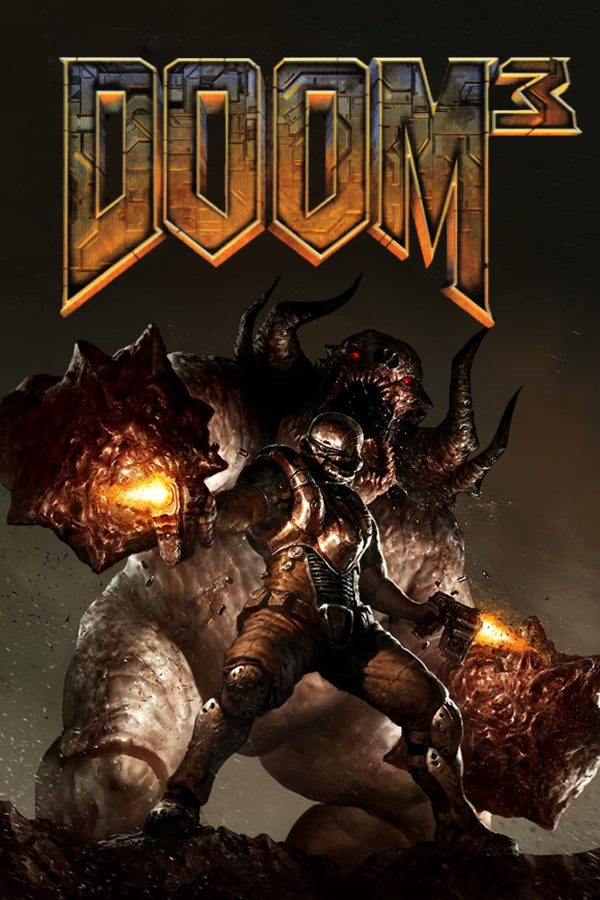
The original release of Doom 3was a huge deal. It was a technical marvel with fantastic new lighting effects and textures that could fill the latest GPU and all of your RAM. It split fans due to the slower pace and focus on jump scares (that honestly don’t really work these days anymore) and a bigger focus on the story (if you can call it that). The game retains the same dark visuals and monsters from before, but being the first game in full 3D it had a lot of problems.
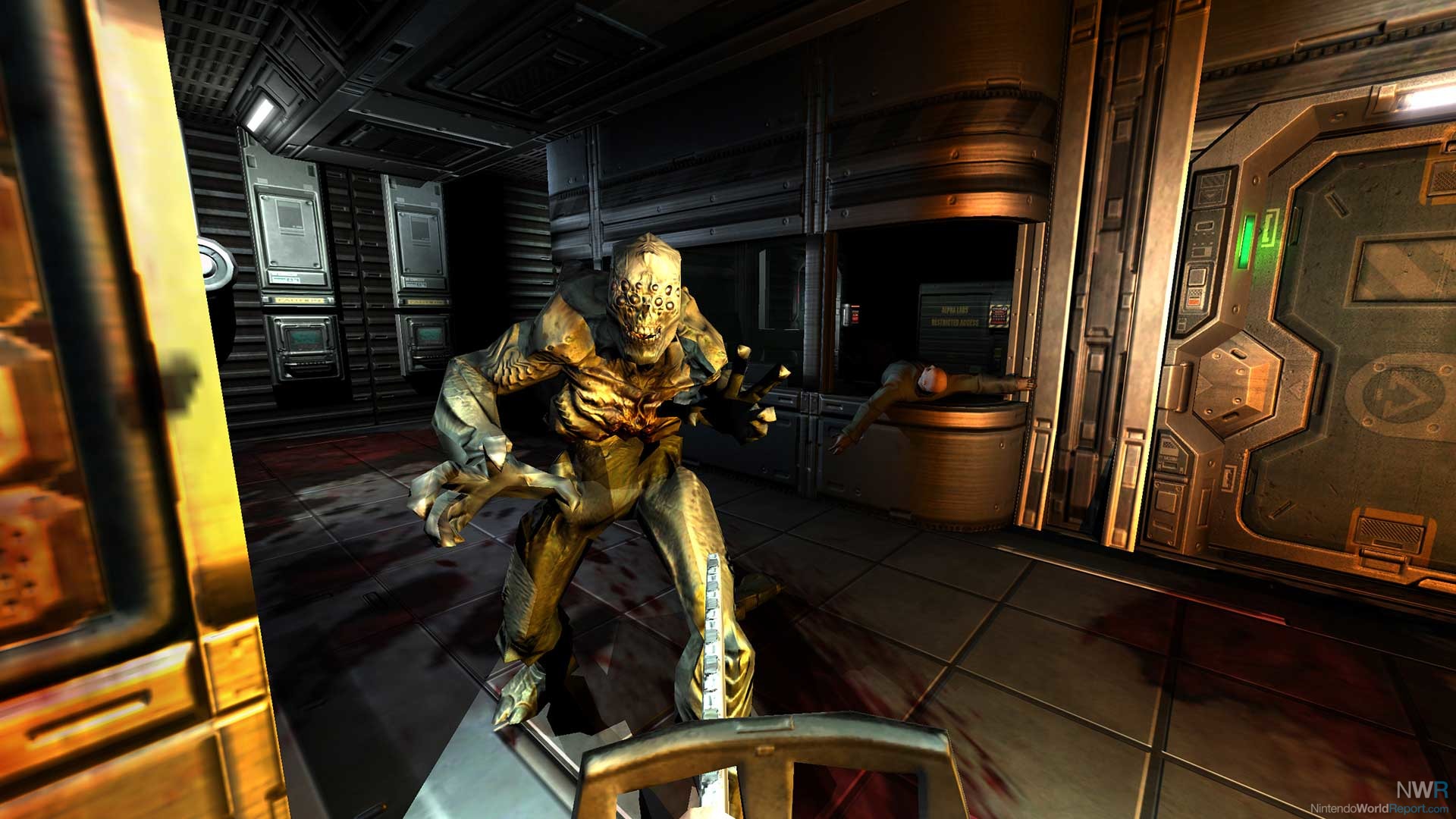
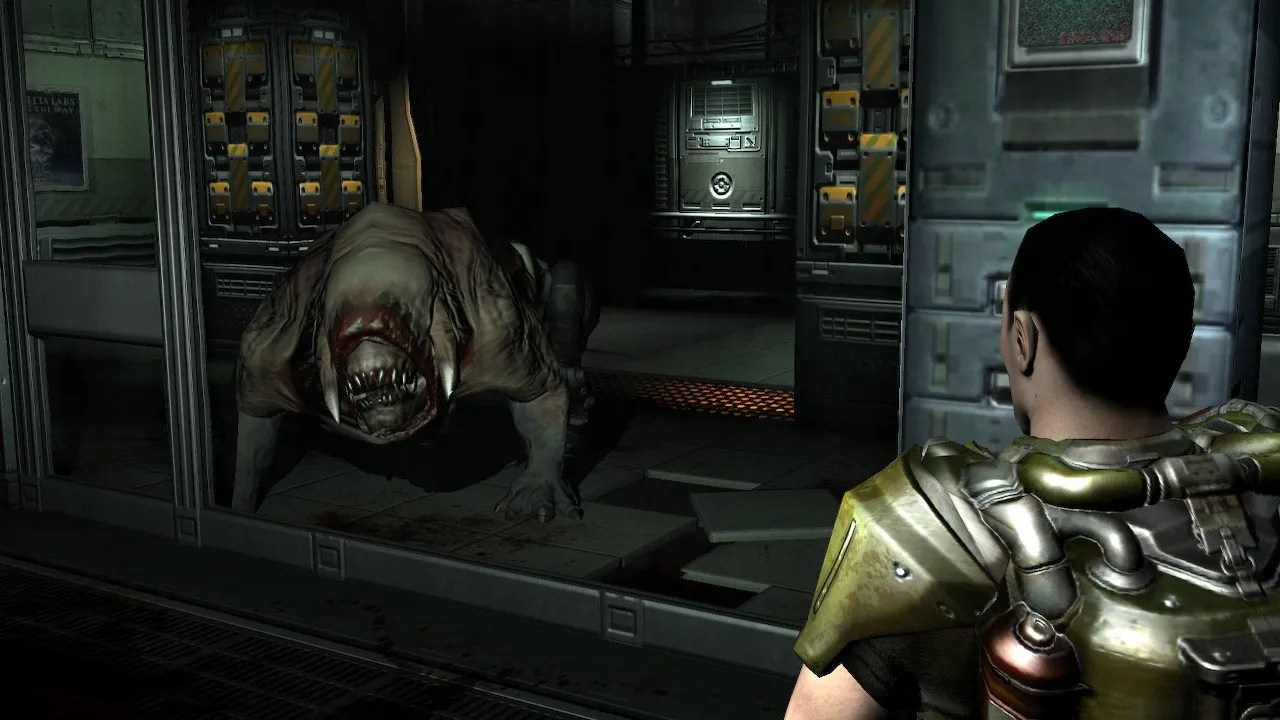
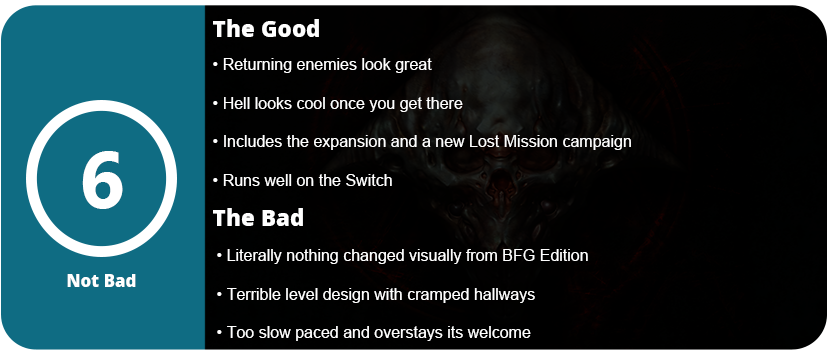
The first thing you will notice is that this release has no visual upgrades outside of some texture filtering and anti-aliasing and slightly better lighting. The textures still look muddy and the models are still low-poly. With this being the third official release of this game I’m surprised more work hasn’t been done to it. You play as a marine who is stationed on Mars when things suddenly go wrong. The first couple of levels is probably the best since they slowly introduce the gameplay to you and have better-designed levels. Zombies emerge from the dark, and your flashlight is a lifeline. It does have a short battery but recharges within seconds.
The main issue with Doom 3 is its much slower pace in every part of the game. The movement is slow (you have adrenaline that’s used for limited sprinting which is annoying), and the weapons reload slowly (why is there reloading anyway?). Not to mention the weapons just plain suck. The pistol is useless outside of the first couple of levels. I never touched it after this. The machine gun is useless in later levels, and everything else just feels slow. Enemies feel slow as well. The environments are also cramped with too many enemies spawning at once and I constantly backed into walls and got stuck in corners trying to get away. Very rarely does the game ever feel like a classic Doom game with more open areas.
The level design is also terrible. The game is way too long as it is and it’s just boring hallways after hallway finding PDA access cards, running back and forth activating switches, and trying to open doors. nearly eight grueling hours of this. It felt like a chore after the first two. Eventually, you do get to Hell, but it’s such a short level with a boss fight at the end, but it still suffered from cramped areas and nothing new except a couple of enemies that finally show up such as the Hell Knight and Arch-Vile which are some of the toughest enemies in the game. I mostly stuck to the strategy of using guns that shot the fastest such as the Cell machine gun being the most powerful with the chaingun being second. I used the shotgun through most of the mid-section of the game until I got the cell rifle.
There are a few boss fights in the game that all play out the same, and in the end, the entire game is just one long boring chore. It’s fun at first, but if you are a veteran of classic Doom games then most of you may just shut this off early. This is my third play-through of this game and it’s less enjoyable each time. I originally played this on Xbox, and then PC, and then dabbled in it a bit on Xbox 360 and never finished it. Now I completed it on Switch.
Speaking of the Switch the game plays fine, but there is some slow down in the larger areas and it doesn’t always stay at 60FPS. In handheld mode, the game runs fine as well, and you have the option to turn off flashlight shadows to help, but overall it’s great to just have another FPS on the Switch. These don’t come around often. Included is the Resurrection of Evil expansion which I already finished once on Xbox and a new Lost Mission short campaign which I will get around to eventually. It’s nice that there’s some new content. Overall, this could have easily been a remake from the ground up or a mode that made it feel faster-paced like the classic games. If you are itching for a mid-2000s FPS game then go ahead. Don’t come into this thinking it’s like the newer Doom reboots. This game was a specific era of id Software at its lowest point (Quake 4, Rage)
Adventure games that both have shock value and a good story are rare and hard to come by; sadly, Martha is Dead is not one of those. You would mistakenly think this is some sort of horror game with monsters and demons, but it’s barely even that. This is a ghost story, a story about battling mental illness, and a story about surviving WWII in Axis Italy. You play Guilia, who is Martha’s twin sister. This is a detective game more than anything, with plot twists and an interesting vintage camera system.
The game starts out simple enough. Introducing controls, the plot, character building, and the whole nine yards that adventure games typically put you through. Martha’s best feature is the camera system. While you can take photos anywhere (I don’t know why you would), you need them for specific plot points. Guilia is trying to talk to the White Lady of the Lake and find out why her sister died. This is kind of the first half of the story, as it jumps around so much. The game is very plodding, slow, and constantly leads you on for little payoff. Taking photos for objectives is simple enough. Just get the focus and distance right, and snap the photo. You then get to develop the photo, but instead of taking you through the entire complicated process, the game explains to you what that is and says it cuts 90% out for better gameplay. Why? You just focus and position the negative for exposure and then develop it in liquid, but the point at which you stop it is the same for every photo. A pretty lame “mini-game,” if you ask me, with tons of lost potential.
With the camera feature out of the way, there are other small gameplay things you do, such as a morse code mini-game, which I actually enjoyed. I had to look up a morse code chart online and decipher it myself. That was actually well done and made me think, but that’s the only part that did. 75% of the game is spent in Guilia’s house or the wood’s winding paths. There are a few scenes where you control a motorboat, but it’s just to get to the other side of the lake. You are mostly wandering around at a slow pace, going from point A to point B, and interacting with objects. Go check out the graveyard, go back to the house and develop the photo, go back to the lake and find an underground bunker, go back to the house, and put up a flag. The constant backtracking is tiring and clearly used for filler.
Then the last hour of the game is zero gameplay. It consists of long puppet shows recapping the entire story, like you already didn’t know what happened. The story thinks it’s more complicated than it is. Honestly, the puppet shows are cool-looking, but they didn’t advance the story. The story here gets recapped numerous times in various forms, which is really annoying and makes the player feel dumb. After the puppet show stuff, you just walk around interesting scenes with narration, and that’s it. The best parts of the game are the gory death scenes, which are pretty nutty. They would make Mortal Kombat fans blush. But in total, this is maybe five minutes of the entire game. There’s a bike you can ride, but the control is terrible, and it’s only used to ride around the house and surrounding path, so what’s the point with that?
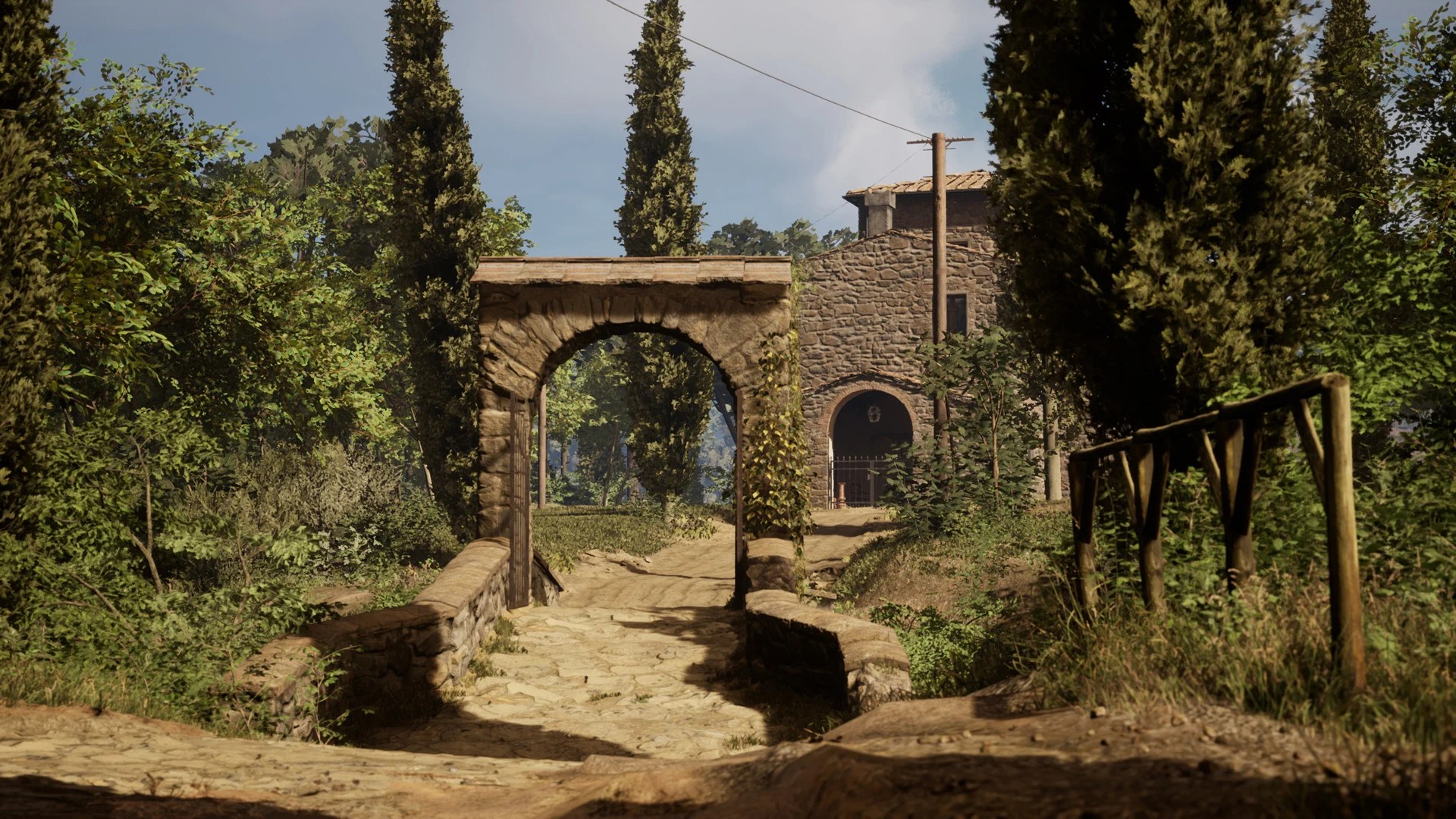
Then there are the visuals. Yes, the game looks damn good. Crazy detailed textures, amazing lighting effects, and models—and it just looks like a AAA title—but at what cost? The game runs horribly on even my RTX 2080 that’s overclocked. There is ray tracing in the game, but I couldn’t tell the difference between that and ultra-graphics settings. I feel this was put in more for next-gen consoles for a subtle effect. The game has constant stutters, frame drops, weird frame rates with ray tracing on, and even DLSS set to ultra-performance. At 3440×1440, I had scenes that ran at above 60FPS with ray tracing on, and then I would turn around and the frames would drop by over half. Without DLSS? Forget it. The game would drop into single digits one second later, and then inside the house it would be 90FPS. Super terrible optimization all around here, and even with DLSS set to ultra-performance without ray tracing, I still saw dips under 60FPS. Totally unacceptable. DLSS shouldn’t be used as a crutch.
Overall, Martha is Dead mostly relies on shock value for the few scenes that have it. It’s neither a horror game nor a puzzle game. It’s just an adventure game with various story elements tossed together, boring backtracking, and little gameplay to keep you interested. The photo mode is ambitious but purposefully handicapped when it could have been as robust as real-life photography back in WWII. It’s a missed opportunity. The game spoils itself constantly with frequent story recaps, and in the end, there’s a final plot twist. The story runs its course about two-thirds of the way through, and you’re left with a giant recap scene with no crazy finale that most adventure games have.
I’ve always been fascinated with space and what planets on the surface look like. Weather patterns, mountain formations, various chemicals, and minerals do certain things with the weather and whatnot. This is what Exo One explores. While there’s a paper-thin story here about a spacecraft being discovered on Earth and NASA trying to use it to launch a crew to Jupiter, The vessel gets lost, I think, and you wind up bouncing around a dozen different planets trying to find your way back to Jupiter. It’s barely there, but it gives you a reason to keep going and provides an overall goal.
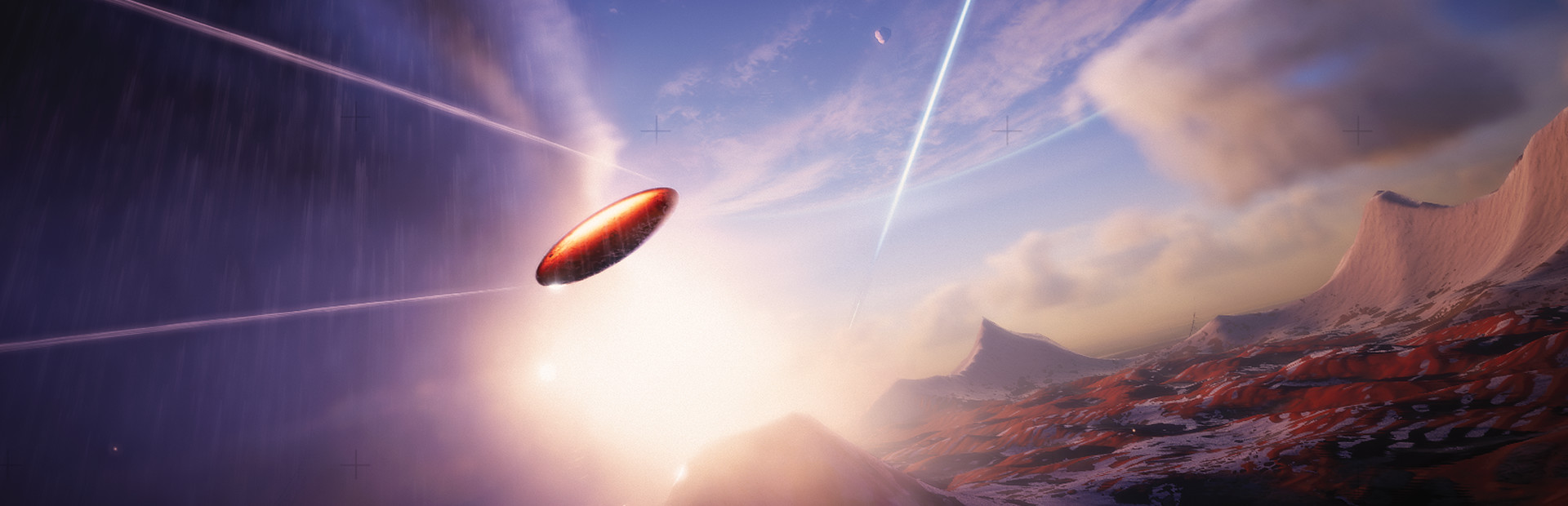
The controls take getting used to, and by the end of the game, I never quite cared for them. They seem overly complicated, but you essentially control the ship’s gravity and flight direction. You can roll on the ground to build up power (the orange glow in the center of the ball) and can lift off or smash down to the ground by increasing gravity. You do also have a double jump button, which comes in handy for fine-tuning your flight path. You want to stay in the air as much as possible, as this is your best form of movement. In the air, you can travel farther, as you will be traveling dozens of kilometers on each planet to get to the goal.
Each planet is completely different in the sense that some are covered in oceans, some have no ground, and some have more complicated terrain to get around. Some have little gravity, and some give your ship a bigger boost due to the increase in lightning in the area. You can boost your ship with various things, like flying into clouds, wind paths, particles, and various other boosters. These boosters are usually visible a few kilometers away, and you want to get to them. There are some instances in which navigating has become irritating and frustrating. A couple of planets have strong winds or will cut your controls completely. One planet had me just rolling along the ground for over 10 minutes, using the wind to guide me. The terrain itself seems almost randomly generated, and hills are your enemy. You want to boost downhills and release gravity, going up like a giant ramp. This is impossible in areas with strong winds, as they slow you down.
There are upgrades for your ship that are kind of spread around on some planets. These increase your glide and overall power, and they are helpful, but getting to them can mostly be a chore. Fine-tuning and aiming for a small spot is really frustrating. You can constantly turn around and try again, trying to gain just the right height to reach an upgrade. The enjoyment is the constant momentum you can create via rolling on the ground, boosters, and using clouds to gain altitude. Once you reach the goal, which will be a giant blue light in the sky, you warp to the next planet, and I love the variety. Not a single planet is the same, and soaring over large oceans or weird formations is just awesome. The visuals are fantastic, with great water effects, rain effects, and an overall amazing sense of speed.
There’s not much else to the game except to enjoy the scenery. There are no high scores, no hidden secrets, or anything of that nature. Think of this as a “walking simulator” but up in the sky. The only gameplay is maintaining your flight and fighting elements on some planets. It’s over in about two hours, but it’s a beautiful two hours. If you love exploring planets in games like Mass Effect, you’re going to enjoy this quite a bit.
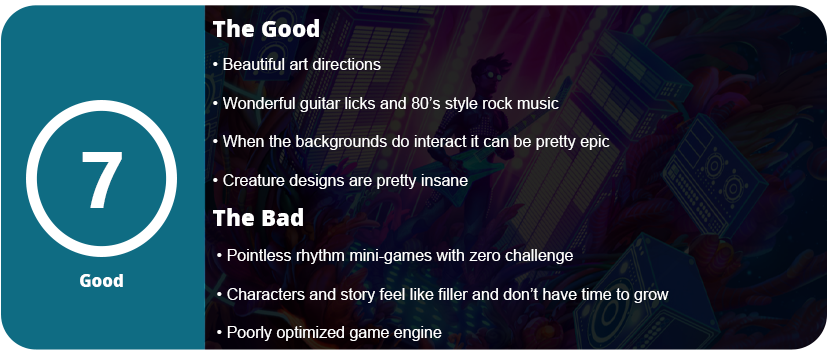
Space rock operas aren’t something you see in gaming much, and The Artful Escape is a visual and auditory treat for the senses. You play a young boy who is living in the shadows of his late uncle, who was a famous folk singer in the town he lives in. He feels forced to follow in his footsteps when he is actually a metalhead at heart. You are sent on an acid trip of a space rock opera through a universe of weird space creatures and worlds. You meet a man named Lightman (voiced by Carl Weathers of Rocky and The Predator fame), who is the most famous person in this universe and shreds like no other. He wants to help you overcome your fear of being yourself, and you go on a journey together to impress the tastemaker, who is the ultimate deciding creature in this universe.
Don’t think too much into the story, as it’s mostly filler for just a sidescrolling walking simulator with light rhythm mechanics. You always move to the right and can hold down a button to shred your guitar. It sounds awesome, and I never got tired of hearing the licks repeat. Each planet has its own licks, but the visual flair and usefulness of these are never explained, and despite being able to just hold down the button and shred while you slide down slopes, jump over platforms, and bounce on things, sometimes the background interacts and the background music will swell as you jump and shred. It’s cool when it does and sometimes gives me goosebumps because the music is so good, but 75% of the time I was just holding down the button, not sure when it would trigger an interaction.
At the end of each stage, you come across a boss of sorts that displays a Simon Says-style rhythm pattern. There’s zero challenge here, as you don’t need to memorize anything as you can play as the buttons appear. You also don’t get penalized for messing up, and that note just starts over. I found this mechanic fairly pointless and just filler, as some of these sessions are only a few notes long. It sounded and looked cool, but that was it. There’s pretty much zero gameplay here. The sidescrolling and shredding are literally an excuse to turn this story into a game. I also loved the art. There are crazy creature designs and lots of vaporwave aesthetics going on, with a multitude of lights and colors all over the place. Sadly, that’s all the game really offers. While the voice acting is also good, the dialog isn’t anything exciting, and I didn’t care at all about any of the characters. The game is so short that you don’t get any time to really invest in these characters.
So what we get is a three-hour adventure with great visuals and music but boring gameplay mechanics that only enhance the game in rare moments. I also found the engine poorly optimized, as even on high-end hardware, the game dipped well below 60FPS in some areas with lots of lighting effects going on. Turning everything down to low didn’t help much, so this is clearly an optimization issue. With that said, The Artful Escape is great for metalheads who want to chill out for a few hours and enjoy the visual treat, but otherwise, you aren’t missing much here. This is sadly just another adventure game where the developers think it’s cute or revolutionary to forgo any gameplay and solely focus on the visuals and music, but they forget this is a game first.
Here we are, another year, another Assassin’s Creed game. Having to actually say this is just sad as Assassin’s Creed has always been a good series. The games are high quality, play well, and look amazing for their time, but when you release that same greatness over and over with only minor changes it can grow tiresome. I was personally done with AC when Black Flag was released. I just couldn’t get through it. I already played them all up until that point and I felt AC3 hit the series peak, but they had to keep going.
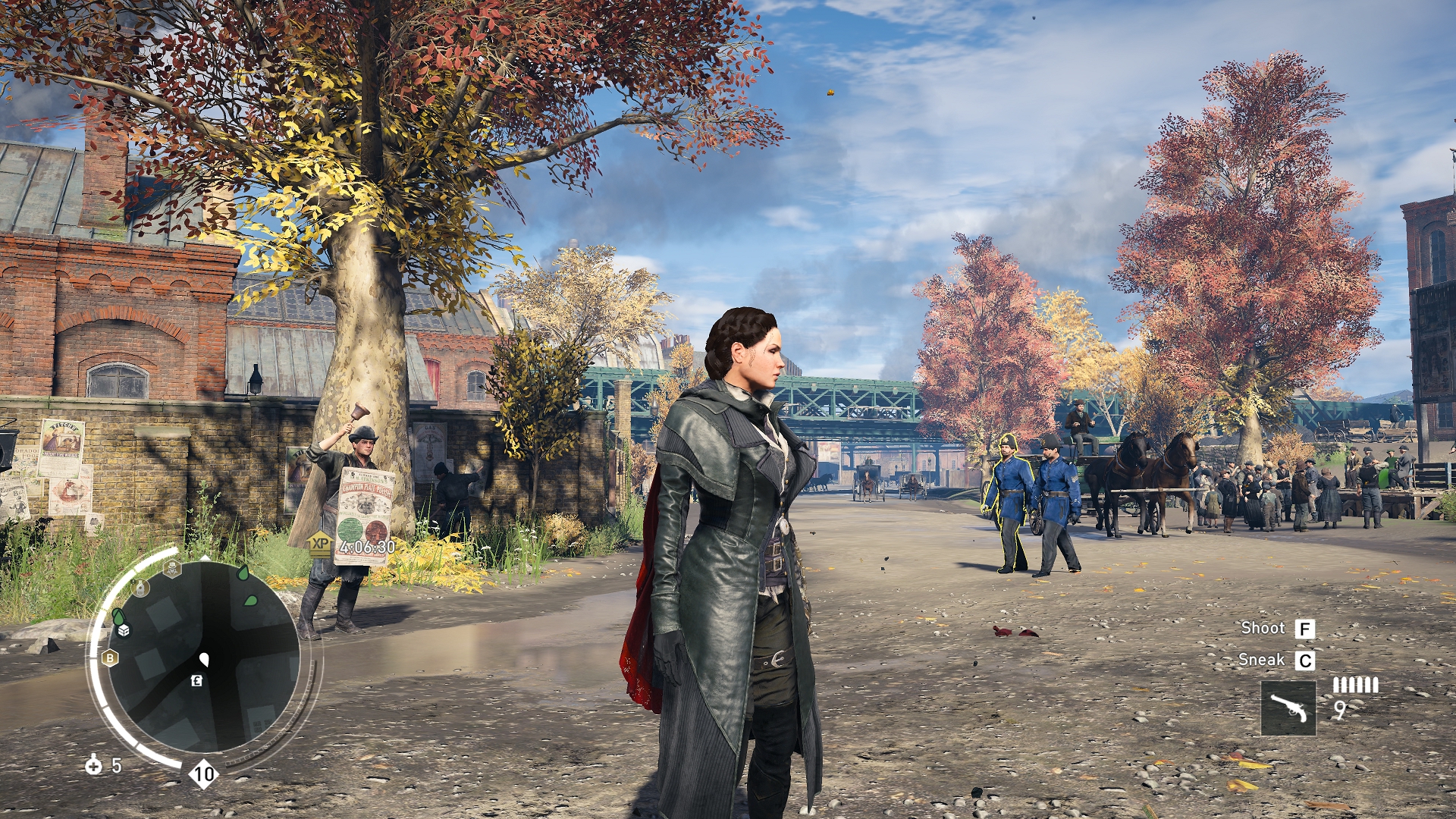
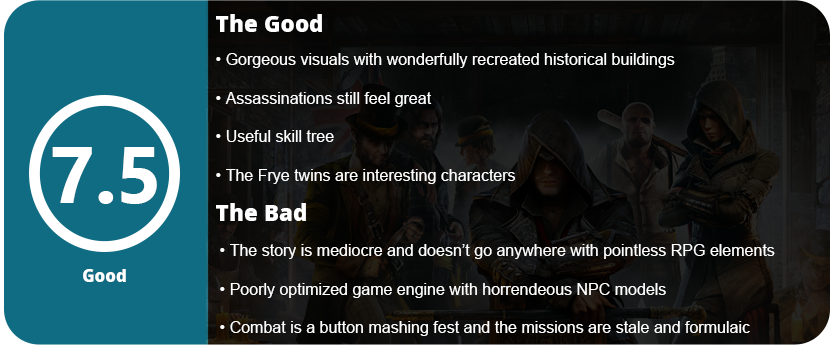
Syndicate doesn’t do much new, but as it’s the last of the “older AC style games” it does everything very well but is also a little too familiar. While we do get new characters and the continued “real-world” story of the Assassins vs the Templars, the most interesting part of any AC game is the historically accurate world you explore. This time its 19th century England, specifically the London area and surrounding cities. You play as two characters this time, Jacob and Eevie Frye who are rogue assassins that are trying to stop the Templar plot in London. The main villain is Starrick who is pretty decent and well hated, but overall, the actual story is not much to really care about as it drags on a bit too long and takes forever to really go anywhere. Most of the game is just interaction cut scenes on what to do for the current mission and very little progression overall. Eevie is trying to obtain the Shroud relic which grants eternal life and Jacob doesn’t believe in the relics and pieces of Eden and wants to just stop the Templar threat. Both characters play exactly the same minus a few skills, but Jacobs’s missions lead him on a separate path.
Assassin’s Creed has been slowly eeking in RPG elements over time and I hate them. It doesn’t belong in this game at all and it really shows here. The entire map is sectioned off with leveled areas up to level 9. Of course, story missions also require you to be at certain levels and the only way to level up is to complete missions and use your points in the skill tree. Once you acquired enough skills, you will level up. The grinding isn’t too bad here, but a few times the story missions didn’t give me enough XP to level up, so I had to end up liberating sections of the map. This is where the game really becomes formulaic, and you can see the series has hit a brick wall. Each side’s mission that requires you to liberate an area repeats throughout the game. The missions range from assassinating templars to bounty hunts that require you to kidnap the target dead or alive, then there are child labor camp liberations where you just have to assassinate the foreman and free the children, and there are gang strongholds. The gang in this game is the Blighters, and they all dress in red, so they stand out. You just need to kill everyone in these areas. Once you liberate all areas of the city, you then have to fight the gang leader. You get an opportunity to do it out in the open, but more often than not, the thugs will take you down, as there are so many of them. Whether you kill the leader or not, you have to challenge the gang to a stand-off and just eliminate a bunch of them in a closed-off area. Once that area is 100% liberated, you can recruit those green-dressed members to fight for you.
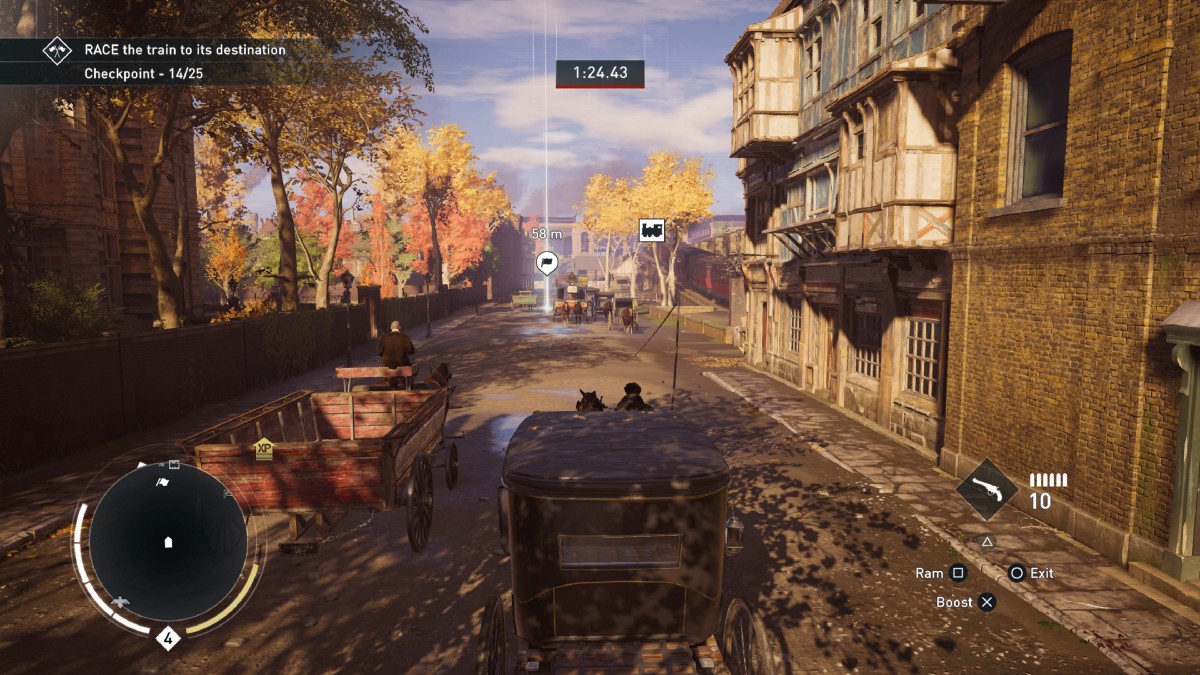
After you liberate your first two areas, these missions get old really fast, and I didn’t bother with the last two cities. Most of the main missions are pretty much this combined with just unique areas and circumstances. Kidnapping, assassinating, stealing, blowing things up, and of course, there are secondary optional objectives you can meet for more XP and money, but some of these just seem impossible to accomplish. It was fun to try and strive for these, but if I blew it, I didn’t bother restarting or anything. One new addition to the series is vehicles in the form of horse-drawn carriages. These drive okay for the most part but are pretty useless once you start unlocking more fast travel points by syncing up at high points. They drive okay, but there are a lot of physics glitches in this game, and often you’d see horses fly off into space or freak out and run off into the abyss.
Syndicate has a lot of great-looking outfits and items to unlock. Each character has an outfit, gauntlet, and sidearm to equip. Most of these have to be crafted or met at a certain level, and you can find them by meeting secondary objectives on missions, locked chests, or by just playing the game. I feel the game is far too small in scope to need RPG elements. Once you get to level 8, you can finish the game, and there’s no point in continuing to play anymore. The only reason you need to level up and get better equipment is to survive the story missions. I was able to finish the game in about 13 hours, and I still felt this dragged on. Without the grinding, the story takes about 6–8 hours to complete with 8 sequences. I enjoyed the story, and the Frye twins have great personalities, but overall it felt average and forgettable at best. They didn’t go through enough personal issues; they got away scot-free for going against the order’s rules, and overall, the entire Assassins Order played no part in this game. The missions felt like they were just stringing you along and barely had a story to tell as an excuse.
As it stands, when I finished the game, I felt the side stuff was pointless and boring. I enjoyed the unique story missions the most, and yes, acquiring skills is just fine, and the skill tree was actually useful. My characters felt more powerful as I leveled up, and it made doing certain things easier, like when Eevie can stay still and become invisible when she masters the Stealth Tree. There are crowd events to complete in each area, like stealth, kill a messenger, or scare some bullies, but these aren’t fun. They are just there for completionists and to pad hours onto a game. I felt no reward or accomplishment when just checking these boxes for items I wouldn’t even need to use. You can upgrade each piece of equipment once to add a stat, but this is mostly for melee combat. Which, in fact, is terrible. It tries to be like Batman Arkham’s combat system, where you mash one button and then counter or break defense. When the enemy’s health bar flashes yellow, you can press the parry button, and when the health bar is gray, you can break their defense. It doesn’t chain together smoothly, and half the time it felt unresponsive. Some of the kill animations are also way too long, and there’s a lot of clipping. While it feels and looks brutal, it’s just button mashing.
The overall movement and flow of Syndicate feel a bit janky. A lot of time, the character would hop around like a rabbit when I was trying to get down somewhere to hang on to a specific thing. A lot of the time, this blew missions, and I had to restart. You can free-run up or down with two separate buttons, but you also get a grappling line, and it doesn’t work as you think. You have to be directly under a building to grapple up, and you can grapple across rooftops, but it does come in handy for assassinating people in large open areas. The problem is that you can’t grapple back out quickly, as you must be right next to a building. This felt only half-useful most of the time. Other than this, the only side missions I enjoyed were with real-life people such as Alexander Graham Bell and Charles Dickens. These missions are always enjoyable in AC games, but the same repetitious missions repeat here as well.
The game does look absolutely stunning, though. For the time, the game was ahead in terms of technical achievements for graphics, and no GPU could run the game at maxed-out settings and 60FPS, but now that it’s been five years, I can see why. The Anvil engine is horribly optimized and runs poorly on GPUs that are four generations newer. I had to turn anti-aliasing completely off on an overclocked RTX 2080 as I couldn’t get 60FPS with everything else maxed out at 1440p. That’s the game’s fault, not my system. When you do get it running well, it looks stunning, even today. Great lighting effects, outfits that look gorgeous, and beautiful recreations of historical buildings. I enjoyed exploring London. However, the facial animations and models on everyone, but the main characters, looked horrendous, and the same five-character models repeated. The game is a little rough here and there, and I also found on my 1660ti system that the camera had jerkiness to it despite hitting 60FPS with everything maxed out and anti-aliasing set to FXAA (otherwise you lose 20FPS and it’s not worth the cost).
As Syndicate stands now, the series really needs to reboot or go back to simpler times when you just had a nice narrative and a few things to collect. Outside of the mediocre story and somewhat fun story missions, the side missions are repetitive, formulaic, and get old fast. There are only chests and newspapers to tear down walls, and even these are old as they have been in every single game except the first one up to this point in time. You can make beautiful, historically accurate worlds, and you can have state-of-the-art graphics, but in the end, the series will get stale and tiresome fast.
You play a woman named Marianne, who is a psychic medium. You start out the game in your foster father’s funeral home, and this is where the game introduces basic mechanics that you will use throughout the rest of the game. It starts out very confusing at first, and honestly, the story is just barely coherent enough to keep up with, but it constantly loses you in spots and then plays catch-up again. The game clearly relies more on characters and atmosphere than storytelling, as there’s no context to keep you engaged, no really long opening scene, just some dialogue that explains who Marianne is and what she can do. Within the first 10 minutes of the game, you will start to experience the scary stuff. Shadows on walls, strange sounds, and the “other side” look very reminiscent of Silent Hill in both concept and design.
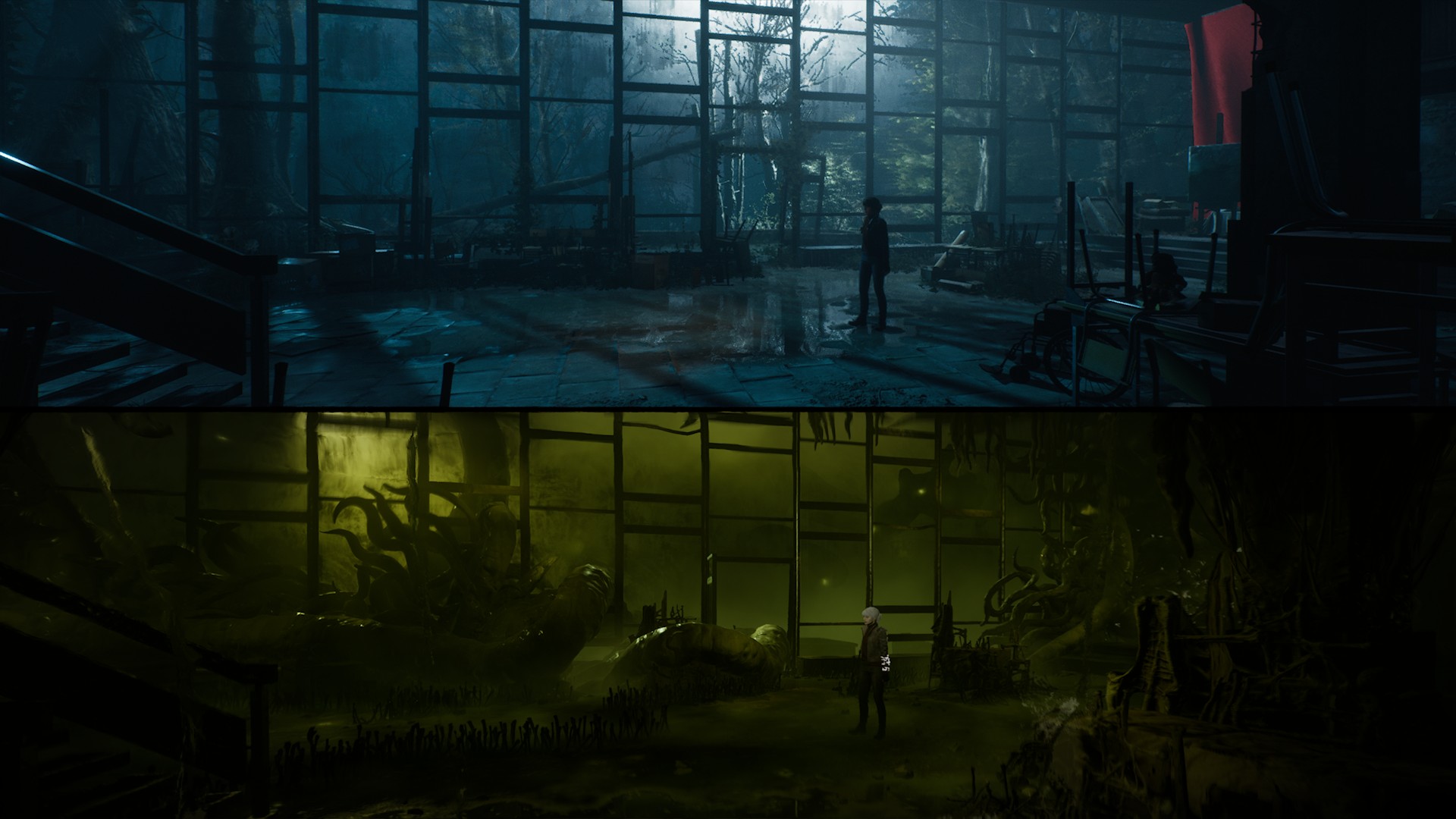
This is an adventure game with very little action. It’s mostly basic puzzle solving and object finding. You walk around areas, reading notes and signs, listening to spirit echos in objects, and picking up objects that will be used at a later point. Thankfully, none of this was overbearing or focused too much on. It all felt pretty balanced and was light enough that the exploration and atmosphere mostly stayed center stage. The various locales are fantastically designed and beautiful to look at. The “other side” was mostly created for puzzle-solving scenarios, as you end up going back and forth between the two at the same time. See, this is Bloober Team’s biggest project and something that’s been in development since 2012. They needed the hardware to render two worlds at once via split-screen. This really does tax your system, as frames can drop by almost half in some areas even with DLSS enabled.
As you play the game, these main elements are switched up constantly, and to be honest, it’s really well-paced and feels just right. Some areas I was mostly exploring in the real world, then I would split off into the other side, and then there are some areas that have mirrors that allow you to go back and forth at will. These areas are the most puzzle-intensive, but never difficult. With that being said, the game is very easy, and only one small section of the game has any form of combat. The horror elements in the game are well done, and I love the monster designs. There is a creature that does stalk you throughout the entire game in certain areas, and these result in having to sneak around areas with barriers and hold your breath. The voice acting is superb, and the performances are great. Everything in the game just sucks you in, and I honestly didn’t stop playing until I finished the game.
I also never got lost or couldn’t figure something out on my own. The game is very linear, and as long as you wander around, examining everything that has a white dot on it, you will find your way around. Since the game mostly focuses on the story, there are times I get confused, but you get caught up with the cryptic stuff during the main cutscenes, and in the end, the game was satisfying and had a nice conclusion. The game can be finished in about 6–8 hours, and there’s no replay value, sadly. Sure, there are items to collect throughout the game, but I found pretty much everything in my first run-through. There are also no multiple endings, so the game will end exactly the same no matter what you do.
The game really has to be praised in the sound department as well. There are a lot of creepy ambient sounds and noises, and the voice acting for the monsters is just amazing. Despite the game being just about exploration, object hunting, and basic puzzle-solving, I never felt bored or wished the game gave me more. If the story and characters weren’t so interesting, I’d probably complain about this, as I’d want more gameplay, but we don’t always need complicated combat systems or deep RPG elements in every game. Bloober Team’s games tend to be a bit rough around the edges, but The Medium is rock-solid and shows they can make AAA titles with the best of them. I wish the game was optimized a little better, but with a fantastic story and characters and gameplay that feels just right, as well as great pacing, I can’t complain much.
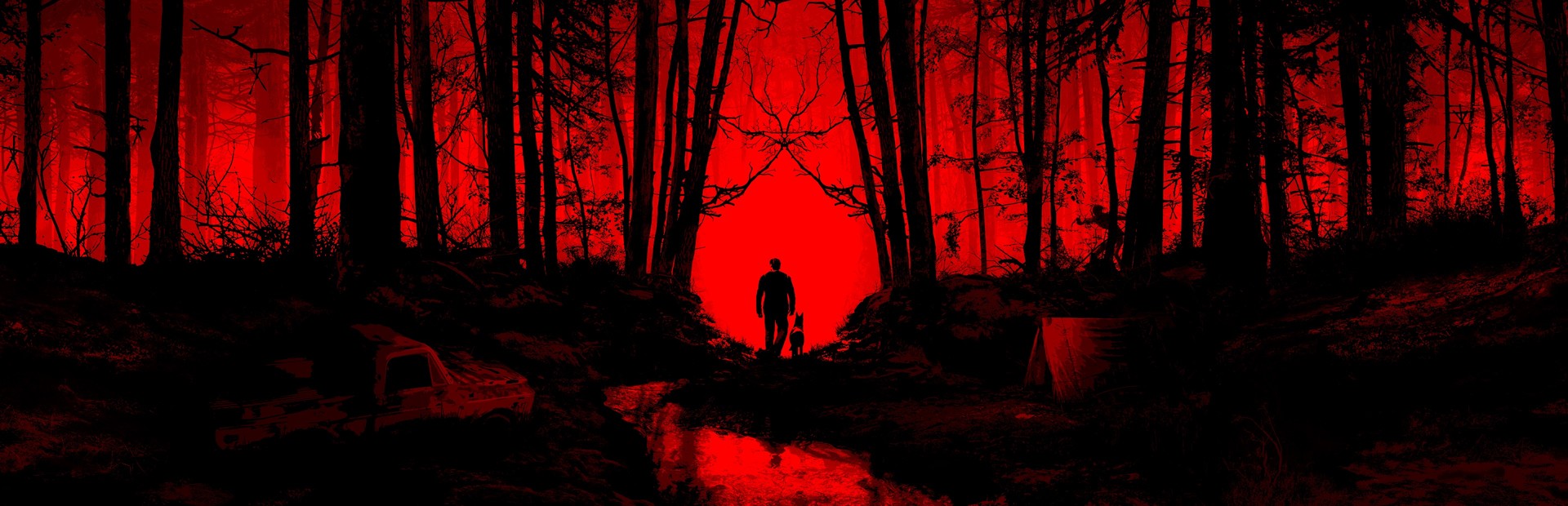
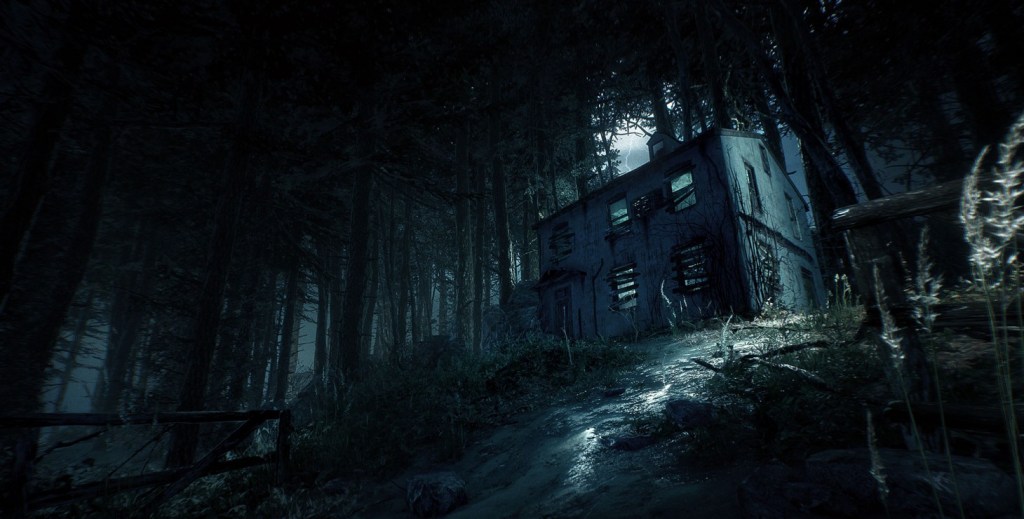
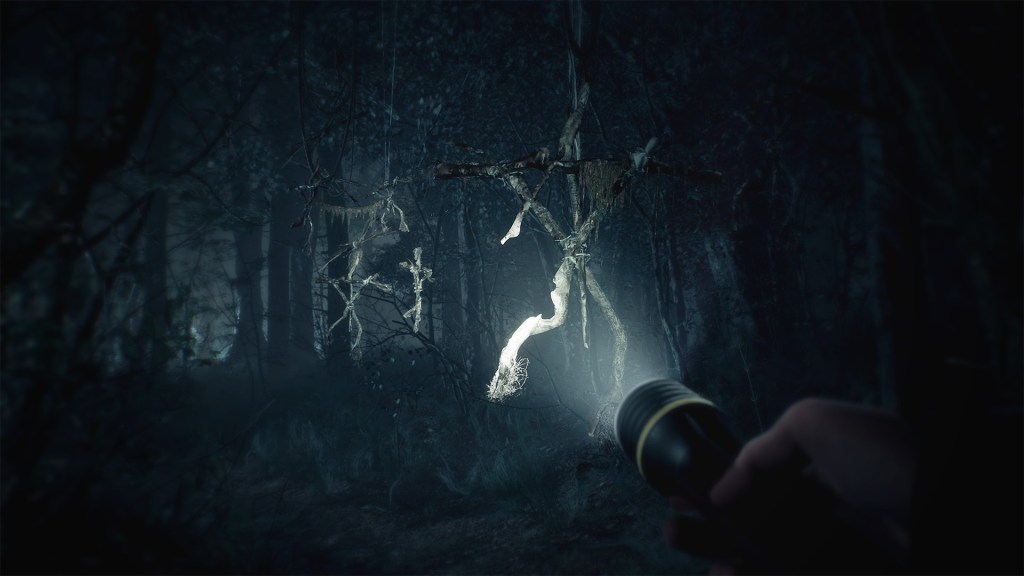
The Blair Witch Project was a movie that scared the living crap out of me as a child and is still scary to this day. The mockumentary-style film was done very well and was so convincing that my own mother thought the movie was real lost footage for the longest time. The iconic effigy of the stickman, the child handprints standing in the corner, the cabin in the woods with the basement—all of it is in this game. You play Ellis Lynch, who is a sheriff in the town where the Black Hills Forest lies. You are trying to find a lost or kidnapped boy named Peter Shannon. Ellis ends up fighting his own demons and becoming another victim of the witch and the forest.
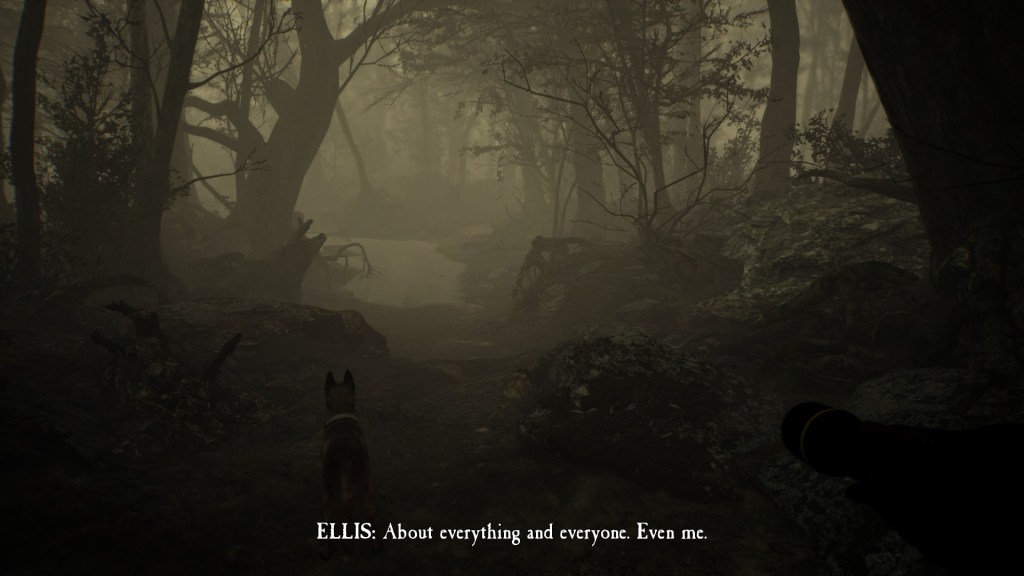
The game starts out easy enough and scare-free. You get introduced to the game mechanics, and the walking simulator begins. Within the first 20 minutes, the first scares start, and you are already lost in the forest. Throughout the entire game, you have a canine companion named Bullet, who is used to sniffing out clues when you find items in the forest to progress further to find Peter. You get a few tools, such as an older camcorder, a flashlight, a cell phone, and a walkie-talkie. These are all used in the game for scares and jumps, and they’re used really well. You can hail Bullet and call him towards you or have him seek to find the next area to explore, but this stops about halfway through the game. A weird “combat” mechanic is introduced and only used a few times by shining your flashlight on ghosts or demons that run around and circle you. Bullets will growl in their direction, and if you don’t flash them to death quickly, they will kill you. It’s only been used a few times, and I felt it was scary the first time, then underwhelming thereafter.
Most of the game is comprised of walking around, collecting photos, breaking effigies, and finding tapes. The camcorder is well used here as it is both a gameplay tool and used for story purposes. Red tapes allow you to manipulate time by rewinding events so they open passages or leave items around Ellis. It’s not super hard to figure out as each clip is less than 20 seconds, and it’s very obvious what the game wants you to pause on. The blue tapes just add story context, but the camera is used later in the game as a way to see hidden objects such as trails and enemies, as your flashlight eventually becomes useless. The game isn’t an open world, but the areas are large, and you will spend each section solving some sort of puzzle, but exploring the game is downright frightening. Bloober did a phenomenal job scaring you with real terror and fright. They use the unknown as a fear factor, and you never know what’s lurking in the woods. You feel isolated, alone, and scared, and for the longest time, I didn’t’ want to play the game because I was really scared. One scene in the middle of the game with Ellis trying to clear a path in a sawmill and running around the area in the dark with the only lights that make you feel safe, even for a few seconds, die on you and go out makes the terror that much better.
However, as the story progressed, I didn’t understand what was going on at all. There were scenes where Ellis was having flashbacks of war, but it never stated he was in one, at least not that I remembered. He’s obviously struggling with depression and PTSD, as he’s constantly fighting with his wife on the phone and has a record of going crazy. I just never understood how the forest worked or how the Blair Witch was incorporated into all of this. It’s obvious the 90’s film’s influence is present with a campsite that has the tent the crew used in the film with the flannel shirt. The cabin at the end of the game is almost a spitting image and is the scariest part of the game, but this section drags on way too long, lasting 45 minutes. I was running down endless hallways with my camera, and the story pretty much stopped here. I didn’t learn anything new about Ellis or the Witch or what was going on. It was just random events that we already know and jump scares. Having to creep around parts of the house to avoid enemies was scary, and using the phone’s messages to tell you not to look up or writing that said look away was sending chills up my spine, but this endless rat’s maze is one of Bloober’s largest problems in their design. Both Observer and Layers of Fear suffered from the endless hallway syndrome with no story progression and random events.
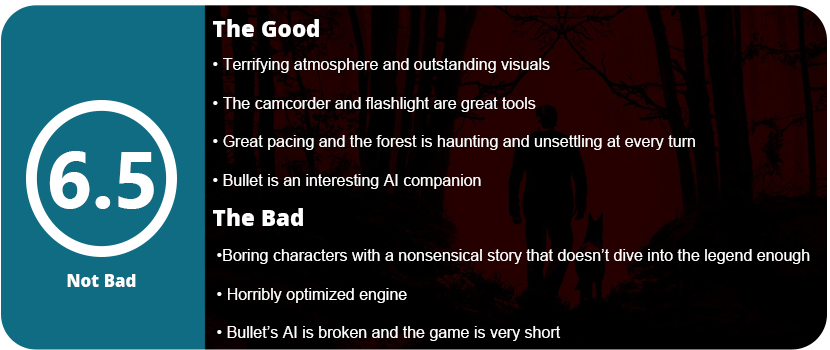
When it was all said and done, the game had an amazing atmosphere and should be played during October, a sleepover, or something. It’s very entertaining, the puzzles are very light, and there are tons of scares here for most people. I would have liked a better story, stronger characters, and more explanation of the witch, the forest, and the entire legend overall. The game has a very short ending in about 4 hours, and there are zero reasons to go back outside of scaring new friends. The game looks really good with great lighting effects, but it has an overall stiffness to it that I didn’t like. Bullet’s AI is dumb as dirt, as it actually broke my game a few times, requiring restarts as he couldn’t find a certain path or would blip out of existence and break the game. The game is also horribly optimized and runs poorly on PCs, even with high-end hardware. There is also no ultrawide screen support. Overall, the game is a fun and scary afternoon, but don’t expect a good story or anything like that.
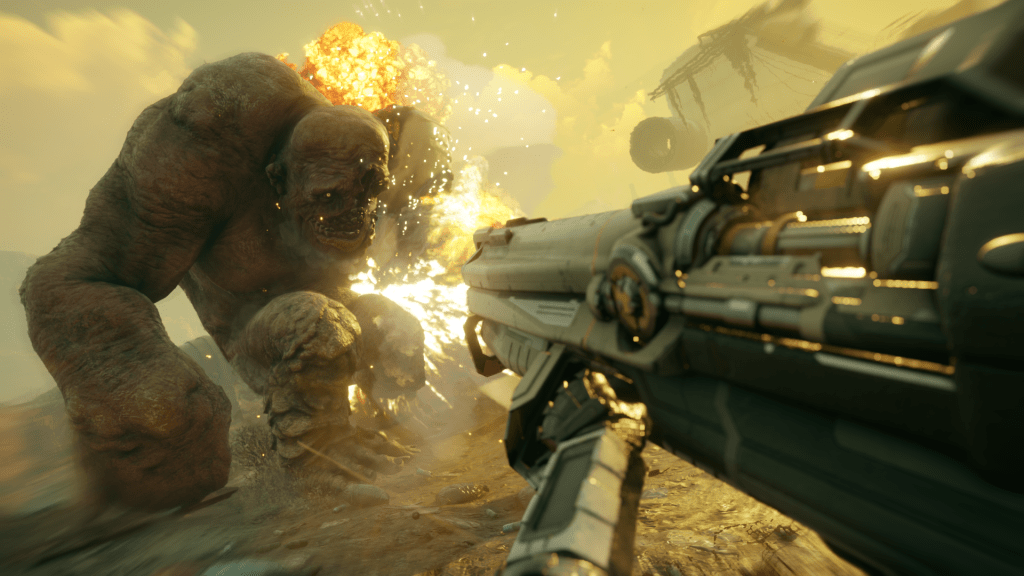
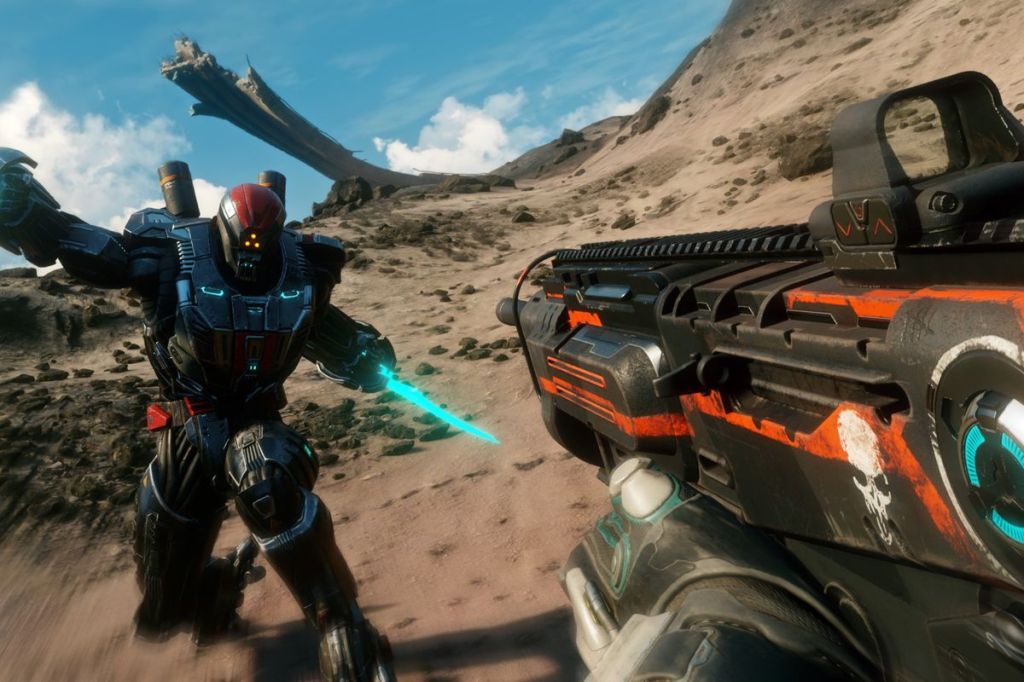
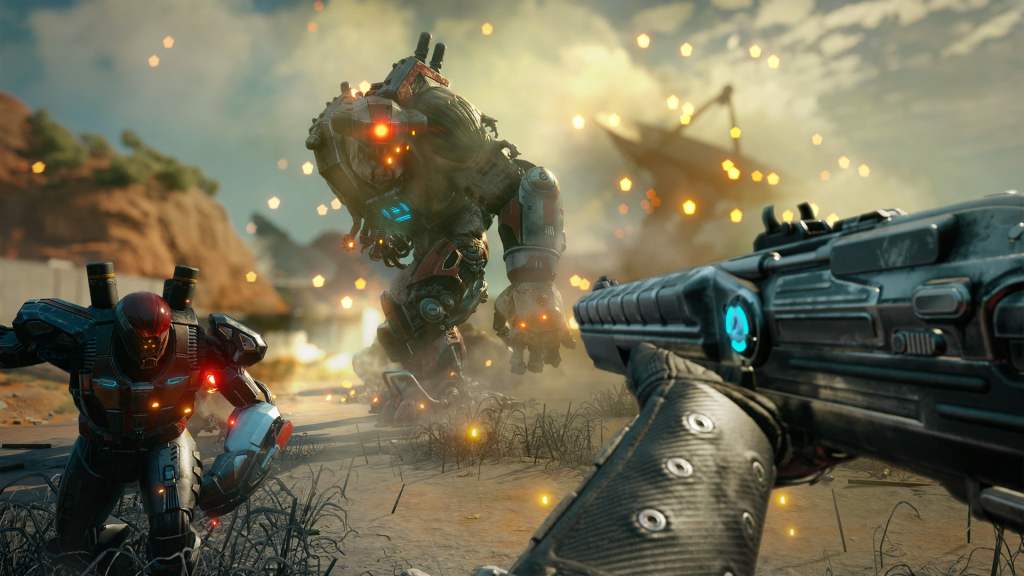
Rage was all the…well, rage back in the day on PC. It featured “super textures” and fantastic gunplay that hadn’t been seen since Doom II or Quake 3 and various other claims from id Software. Upon release, it was a lifeless husk of bugs and glitches, and the only thing that was actually any good was the enemies and shooting itself. The open world was wasted and devoid of life and forget about the story as it was hardly there at all. Fast forward a decade later and we get Rage 2 developed by Avalanche Software known for the Just Cause series. What did we get? Well, a game that’s playing catch up as this should have been the game the first wasn’t. If this released 10 years ago it would have been a smash hit, but today it feels dated and well, still lifeless.
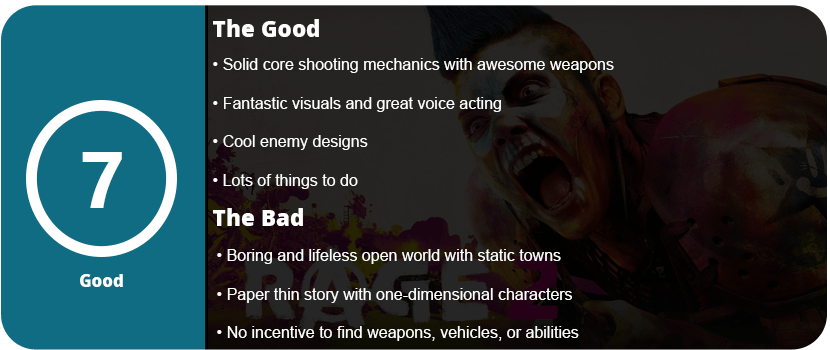
You play as The Ranger named Walker. There’s something about The Authority trying to wipe out humanity and a General Cross is the big bad guy. There are three major players who have main missions for you to ultimately bring about Project Dagger which is to eliminate the machines and genetic monsters roaming the Earth. Yeah, it’s very paper-thin, and the story still barely exists. Some of the main missions have slightly entertaining scripted events, but that’s about it. The voice acting is solid, but the characters are one-dimensional and don’t grow or mature, and you literally have no reason to care for any of them ever.
That brings us to the actual meat of the game, and that’s the shooting. Yes, Rage 2 feels and plays really well. The shooting is satisfying and bombastic, and there’s a wonderful arsenal of weapons to find and unlock, as well as abilities. Yes, I said to find. The weapons aren’t just handed to you. You have to find out where they are, explore the world, and find the Arks that contain these weapons. It’s a neat idea and rather satisfying once you find them, but I played 75% of the game with just the assault rifle and shotgun. That’s not a good thing, either. There was no urgency to get new weapons until I finally got tired of the same two and needed more weapons for harder enemies. Each area has a level from 1 to 10, and this is based on how much armor enemies have, or their faction, and boss health bars.
Once you do start shooting around, the game is a blast. Each weapon has an alt-fire mode, such as the shotgun having an air blast that knocks enemies off their feet. The Fire Revolver has ammo that sticks, and then you can snap your fingers and blow them up. The rocket launcher will lock on to enemies, and then the pulse cannon has a manual cooldown mode. I never got all the weapons, to be honest. There just wasn’t any need to, but what I did get was pretty cool. Even the BFG 9000 was an absolute blast to use but was rarely needed. You have abilities that are also supposed to be found, but I honestly rarely ever used them, as the weapons were enough. I had a shield, a dash, and a push, but that was it. Some abilities are passive, but the overdrive ability is the most useful. This unlocks a third alt-fire for each weapon, but you aren’t invincible or anything like that. You just do more damage. For projectiles, you get wing sticks, which are honestly completely useless despite being a staple weapon in the first game, and grenades. You also get three injectables for health, overdrive, and to recharge your abilities faster. Once you die, you get a defibrillation quick-time event to gain some health back one time until the next death. So, with all of this combined, there is a decent amount of stuff in the core shooting mechanic. It’s solid, but it’s sad that you don’t get the weapons in a way that makes them meaningful or makes you want them.
Once you’re ready to drive around the Wasteland, there’s not much to do outside of small side missions. These are all basically the same, with different names. You essentially kill everything in each outpost, and there are things to find inside them. Containers with cash or filtrite, which is used for upgrades, datapads, and Ark chests, which hold upgrades for mods and vehicles, These are peppered all throughout the game and honestly make up the bulk of the playtime. If you only told the main story, it would be over in about 10 hours. The issue is that after completing maybe 60–70% of the other stuff in the world, I stopped caring. You just run in and shoot everything, collect stuff, and move on to the next one. There’s no incentive to do this once you’ve fully upgraded everything. You need cash to buy ammo, mods, etc. from shops, but filtrite is used for weapon and ability upgrades, and that is taken from enemies. The only really interesting side missions were the Mutant Crusher nests. These are giant bosses, but they are all the same. In fact, every boss in the game is the same. Just blast it to death or blast it until it’s vulnerable, and then blast it some more. It’s very one-note with the action, and the game heavily relies on it rather than using the action in smart and inventive ways.
I also had no incentive to acquire all the vehicles in the game, so what’s the point? Your main vehicle, the Phoenix, is just fine, as it has a gatling gun and homing missiles, and it does the job. Some vehicles are just for fun, such as a giant monster truck and a hovercraft, but honestly, there’s not much out there in the world. There are a few towns, but these are all static and lifeless. There are no interesting characters, as NPCs repeat often, and the dialog is uninteresting. There’s just no reason to care about anything in this game, and most players won’t stick around long enough past the main story. It just grows incredibly repetitive, and you just go on autopilot, driving from one side of the mission to another, just checking them off of your map. One question mark to the next, blasting everything, and then doing it again for 50+ hours. Again, the shooting is solid, but you can only do it in this fashion for so long. It works in games like Doom because it makes the world around it adjust to the constant shooting. I honestly wish Rage 2 was a linear story-driven shooter, and then it would have worked really well. Rage just doesn’t do open-world gameplay right. That was the major flaw in the first game, as it was a pointless, open world devoid of anything. Shooting caravans every so often doesn’t justify an open world. It’s also way too big for its own good. It can take over half an hour just to drive from one side to the other. It’s part of the reason why it took me an entire year and a half to finish this game. It’s daunting and feels like a chore rather than something I can’t wait to see, like The Elder Scrolls or Fallout, which have interesting open worlds stuffed full of lore and interesting things.
So, we just get a boring, empty world with static towns and blast everything to death with a paper-thin story, uninteresting characters, and weapons that are hidden and locked away with no incentive to go get them except out of sheer boredom. That’s not good. Despite all of this, though, the game is fairly entertaining for a good 30 or so hours until you explore most of the map and finish the story, and I was just done. There’s a good core here that Rage 3 should keep and ditch the open world entirely. I liked the enemy design; the graphics are phenomenal and look amazing, but this isn’t it, guys. The series still needs a lot of work and fine-tuning to become a top-notch FPS.
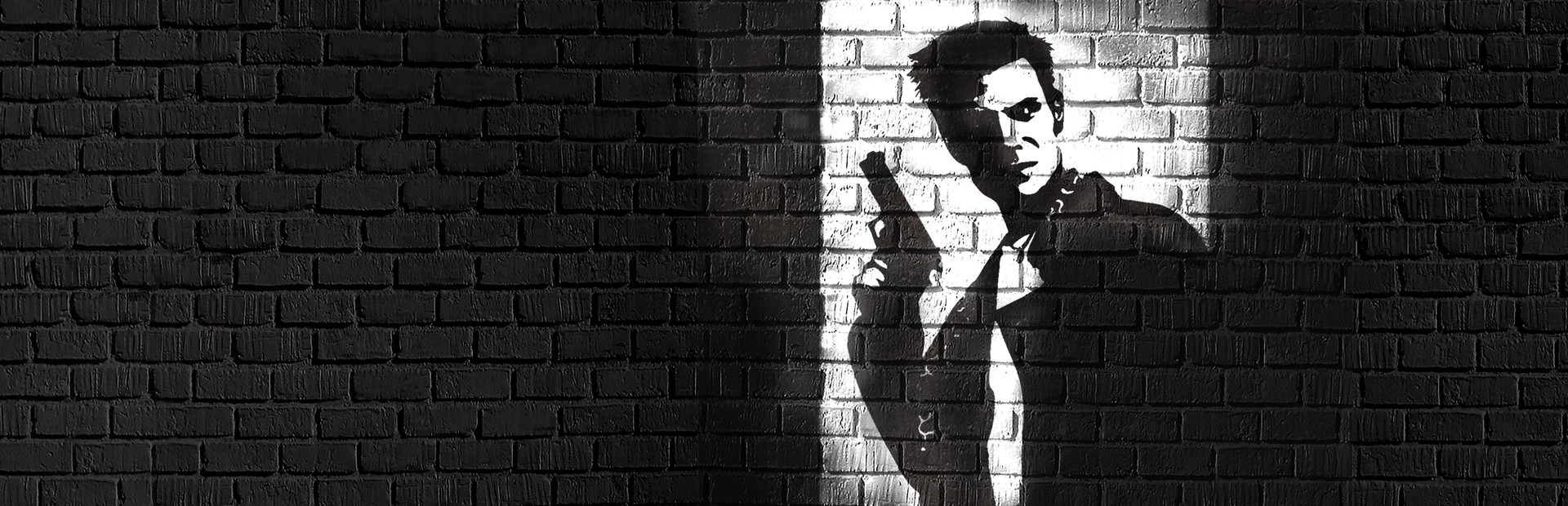
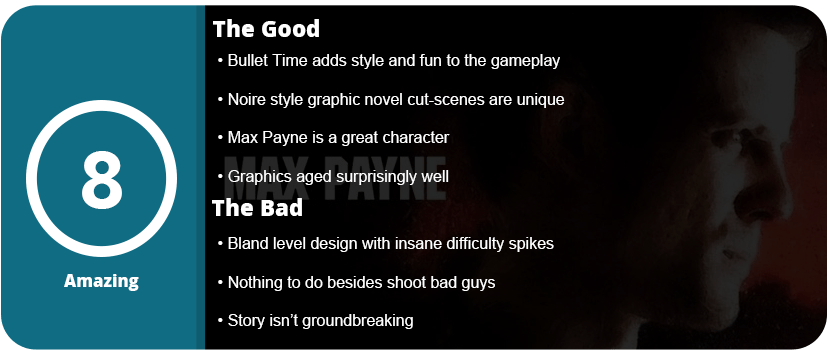
Bullet time. While The Matrix made it popular in pop culture, Max Payne started it all in the video game realm. You play a cop, Max Payne, who is framed for the murder of another NYPD cop. Your wife and newborn child were also murdered, and you are trying to get revenge on the people who did it. The story isn’t anything amazing, but Max Payne’s voice actor and the well-done writing keep you hooked long enough to find out what happened behind the scenes. The game is told in a comic noir graphic-novel style, and it suits the game well. The cut scenes are imaginative and different, and they don’t look cheap or like the developers were trying to take shortcuts.
Outside of the story, the gameplay is all about shooting, because that’s literally it. Max runs around with various weapons, such as Barrettas, Ingrams, shotguns, grenade launchers, Molotov cocktails, grenades, and assault rifles, to mow down the Mafia and corrupt cops. Bullet time is the main gameplay element here, and when activated, Max does a jump dodge in the direction you move, and you can see him dodging bullets in real-time. This is actually a mechanic you must master, as most situations require you to use it to stay alive. You can’t stand in one spot, or you will be dead in a few hits, and there’s no cover system. I had to quicksave every 2-3 minutes as well because the game is so difficult. It’s cool to jump dodge around a corner, but once Max lands, there’s a delay in him getting up, and you are completely vulnerable to gunfire. I had to make sure I jump dodged behind cover or across a hallway so I wouldn’t die the second the bullet time finished. You can also activate bullet time and just run your meter down so you can run and gun with it too.
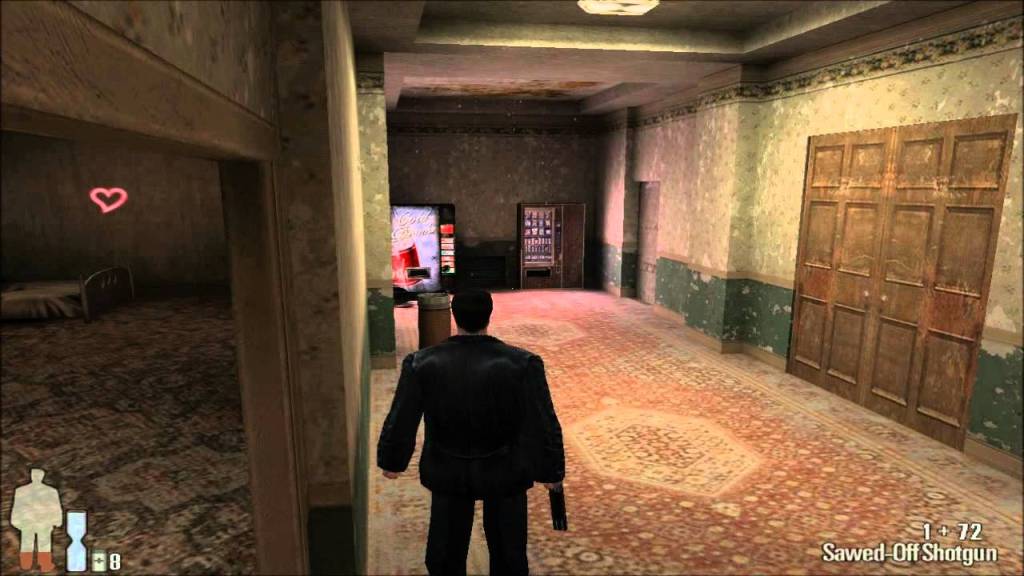
There are very few scenarios in which you do more than press buttons. One scene has Max driving a crate crane around an area, but it’s nothing special, and there are some interactive objects that trigger comic-cut scenes, but 95% of the game is just shooting. The weapons themselves feel good, and I felt I had to switch up weapons depending on the situation to make my life easier. The locales are varied, but they are a bit too stale and boring for my taste. They don’t quite capture the noir feeling of the comic-cut scenes, but there is one level early on called Ragna Rock, which was a gothic cult house that reminded me a lot of Vampire: The Masquerade: Bloodlines, so that’s a good thing. The game really does feel like a first-generation PS2/Xbox game, but it’s very polished. The game flows nicely, but the difficulty is all over the place; you will die dozens and dozens of times in this game.
The visuals are clean and look nice even 20 years later. I installed a texture upgrade patch and some other things to make the game upscale to 4K nicely and play on modern hardware, and it looks pretty good. Even in the original, the facial textures are nice and very realistic, and the aesthetic of the game stands out over most shooters of its time. The voice acting is great, and I finished the game in about 7 hours. After you finish it, there’s literally nothing else to do, as the multiplayer mode was scrapped. It’s a fantastic single-player game that holds up well even today, despite its insane difficulty and unbalanced gameplay. The story isn’t anything special, but Max is a great character to dive into, and it makes for a fun evening.
The superhero video game renaissance all started with Batman. After the Hollywood superhero films grew up and became an epic universe taking over the entire industry, the video game versions feel a little more nuanced and personable. Rocksteady really hit it off with the Batman: Arkham series, and the game just got better from there. Telltale took the storytelling of superhero comics and turned it into an epic original story.
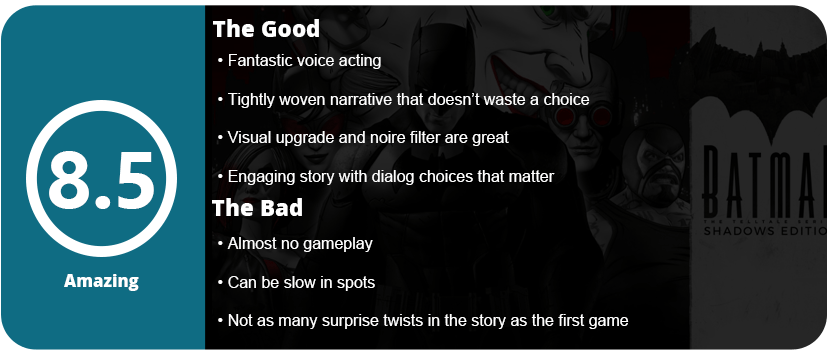
The Enemy Within follows right after the end of the first game, with Bruce having defeated Lady Arkham, The Penguin, and Catwoman. The Enemy Within feels more epic, has a larger overarching story, and has more villains in place. We get Bane, Riddler, Harley Quinn, The Joker, and Mr. Freeze all wrapped up in one big Batman package. The story from Telltale is one of the most unique and interesting I have seen in the Batman universe to date. It feels tightly knit and has resolution at the end instead of spiraling out of control into a million different spin-offs. Main characters can die, and Batman can even break his own code if you choose.
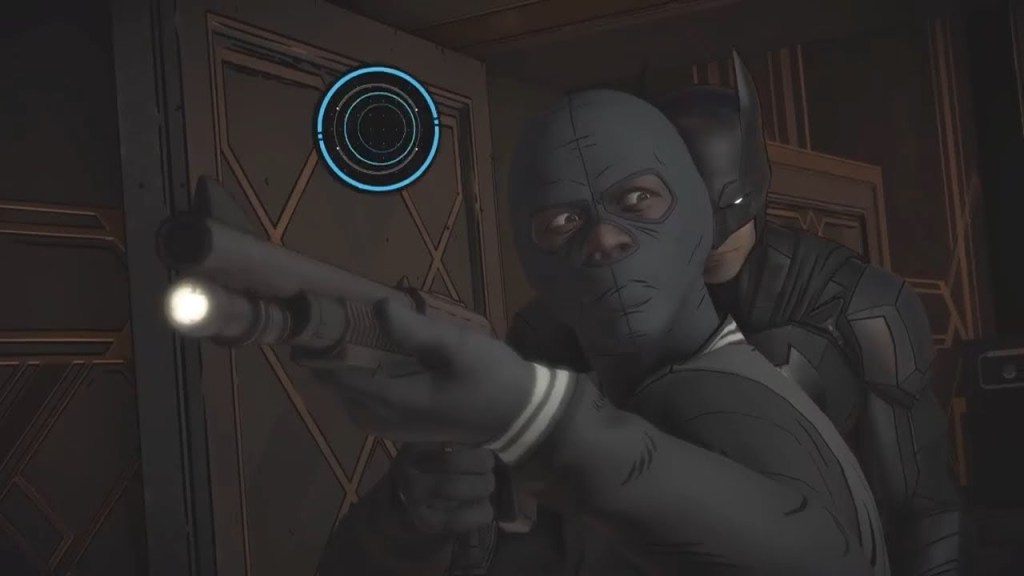
This game is probably one of the only Telltale adventure games that cuts out all the fat from the choices part of the game. Even the dialogue option has meaning and makes a difference towards the end goal. There are larger moments that can turn the story around and fewer twists and surprises in this game, but the overall story is a slow burn rather than starting and stopping as in the first game. Some episodes are slower-paced, sometimes too slow, and this game really has too few action sequences and mini-games for my taste. I like the story, but some of the cut scenes can be nearly 20 minutes long with very little input. Again, this is another “interactive movie” with very little gameplay outside of some quick-time events and even less puzzle solving.
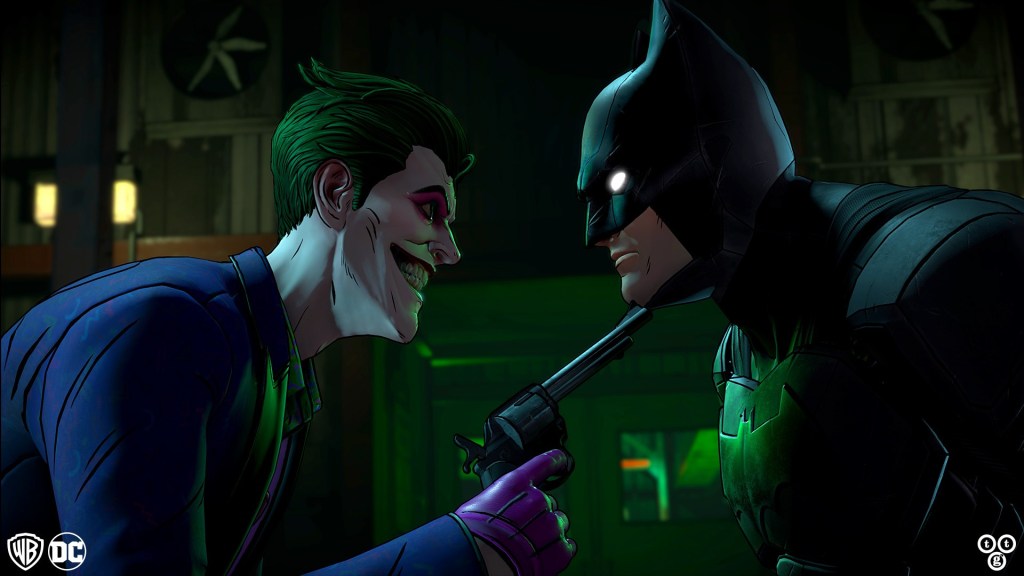
What we get is an origin story that doesn’t go too far back. We get to see how The Joker became insane and hated Batman, how Harley became a psycho herself, and how the relationship between Batman and Catwoman grows or falls apart depending on how you play. We also get to see how Riddler became the way he did, and one thing I need to point out is that this game feels more like it can happen in today’s world. Less magic and fantasy stuff from the villains. Everything looks and feels like it can be explained somehow in today’s world, which I love. All the villains are just normal humans with a slight scientific twist to them.
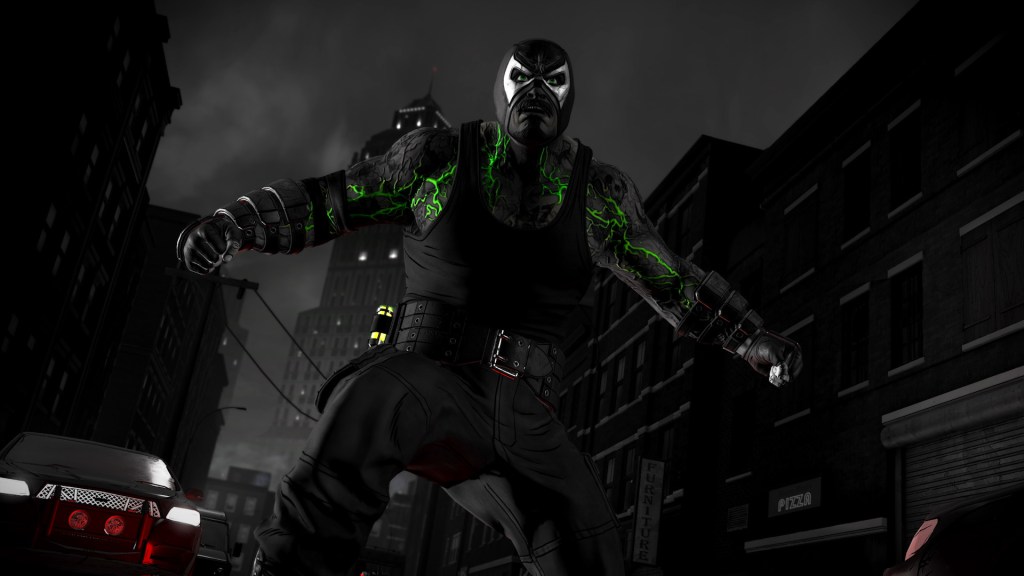
I will say we don’t really get a backstory on Bane or Mr. Freeze. Mr. Freeze isn’t used all that much, and Bane is just an annoying bully through the whole thing. We do get a new entity called The Agency, which is an original faction used in the game to counterbalance The Pact (all the villains), and it’s up to you to decide how The Agency is towards Batman. Amanda Waller is a love-or-hate kind of character and mostly one-dimensional, but we get to see Lucius Fox’s daughter Tiffany, and the game eventually plays into the psychological aspect of Joker and Batman’s relationship like the comics do.
At the end of the day, we really feel like we know Batman, Alfred, Joker, and Harley all too well. Telltale did an amazing job of getting you inside their heads and making you really feel like you’re controlling Bruce’s fate and story. While the game is too light on gameplay and a little slow-paced, I couldn’t stop playing as I wanted to see what happened next. I really weighed my choices and felt that at the end, everything from the first game to the end of this one was satisfying and meaningful. This is clearly the best Batman game to play if you want an amazing story.
The Shadows Edition adds some enhanced visuals, better textures, lighting, and a noir style that I played the game in that makes everything black and white except certain colors like red, green, and various accents of the character’s iconic colors. The game’s upgrades look great, and I didn’t run into any bugs like I usually do with Telltale games.















































 thebinarymessiah.com
Super, thank you