The Ninja Gaiden series is very beloved by longtime fans. The reboot for Xbox was considered one of the hardest games ever made at the time and required extremely precise skill. Yaiba is a spin-off of the series and takes a kind of comical take on it. This isn’t exactly good. Taking the helm is a studio notorious for terrible games like Legendary. That game was considered the worst game made that year. Spark Unlimited has a lot to live up to, and I’ll cut this short: they don’t live up to it.
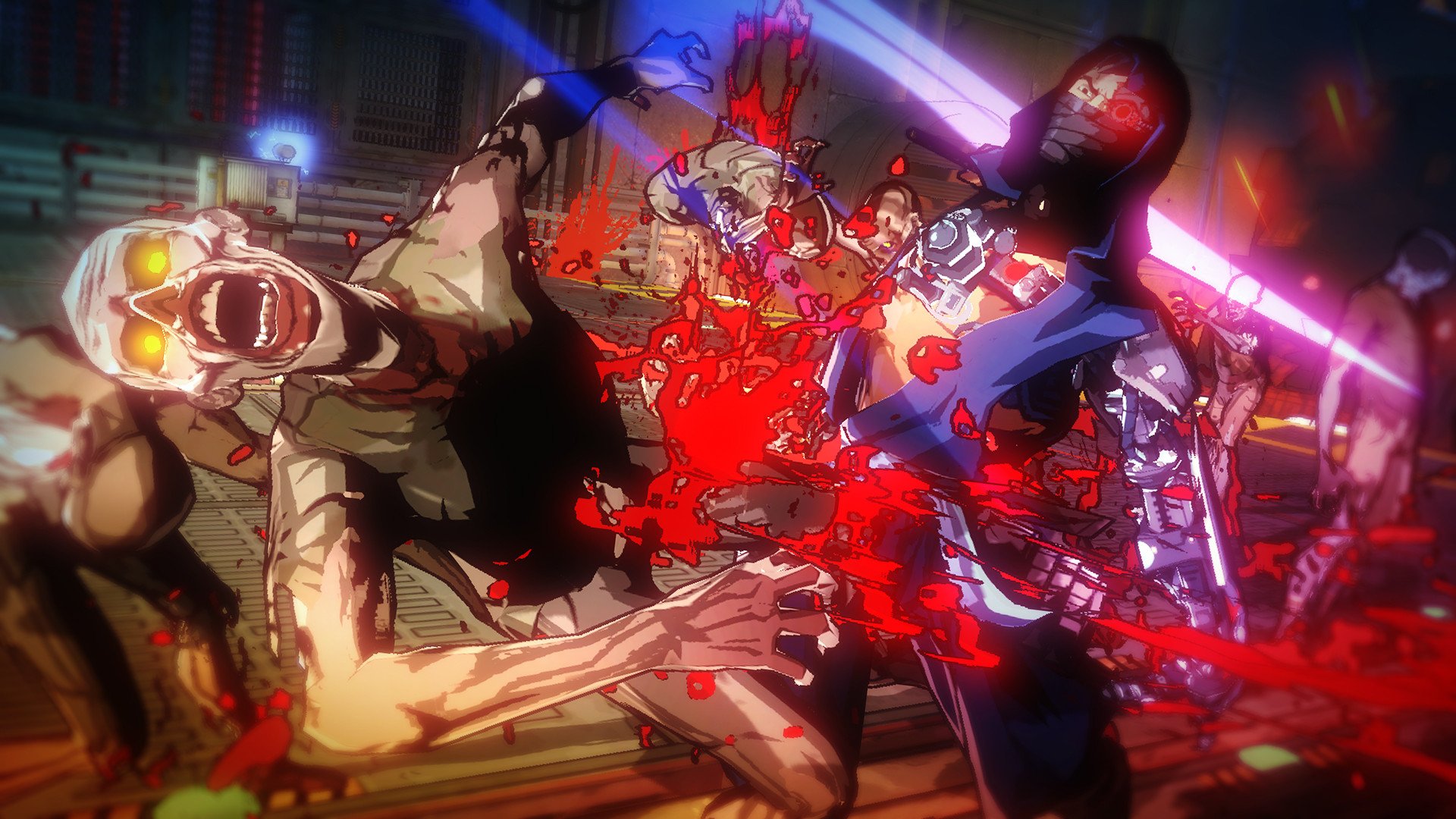
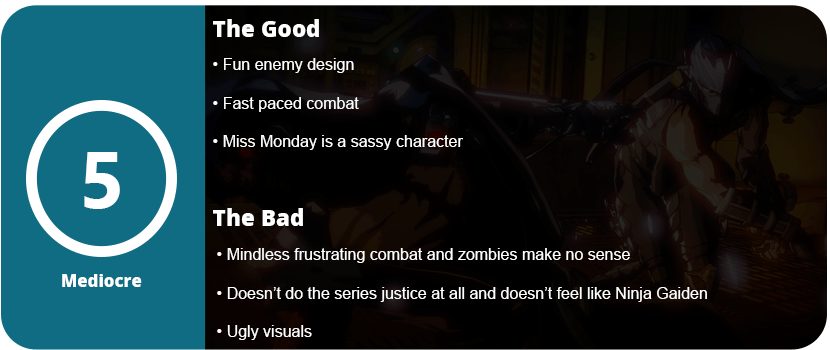
The Z stands for zombies. Yes, and you don’t even play as Ryu Hayabusa. In fact, you play as someone he’s killed who gets a robotic arm and wants to seek revenge. He’s accompanied by a busty, intelligent woman who relays your objectives to you. The story is pretty throwaway, but Ninja Gaiden is known for fantastic combat. Yaiba has a good combat system, but the game relies on fighting way too much and doesn’t break up the monotony.
A weak, powerful, and flail attack are all available. The fighting is lightning fast, but sometimes way too fast. Zombies are represented by comedic puns and act just as stupid. Life is acquired by performing a finishing move on a stunned zombie. The gore and finishing moves are cool, but only the first five times. The rest of the game is made up of overly easy parkour that is performed with quick-time events. The boss fights are slightly more interesting, but not by much.
The combat gets hard in the sense that it feels unbalanced. Some enemies can disable your flail arm; sometimes too many are thrown at you, and there’s a really irritating knockback animation that can’t be interrupted. Occasionally, the environment can be interacted with, but I honestly saw the same patterns on the second level. This game could have been so much more, but it turns out to be a frustrating, unbalanced joke.
The graphics also take on a comic book style, which is way different from the traditional Japanese art style seen in the other games in the series. They also look technically unimpressive, with ugly low-res textures. Most fans will be highly disappointed in a game bearing the Ninja Gaiden name and not take it seriously. Maybe a more talented developer could have done better, but what’s here is something that never should have been.
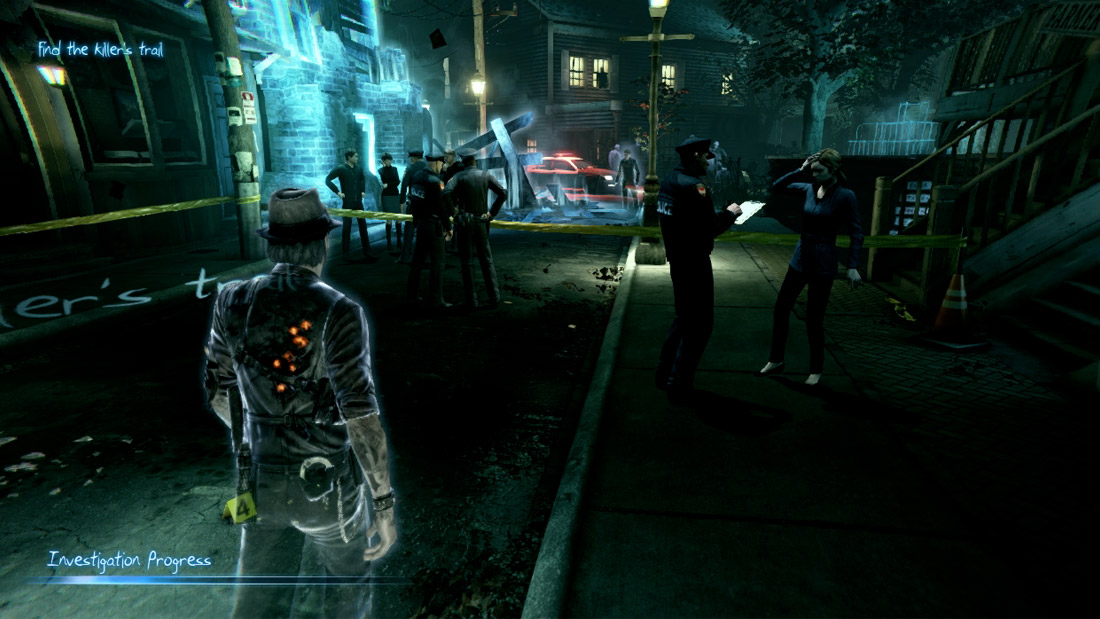
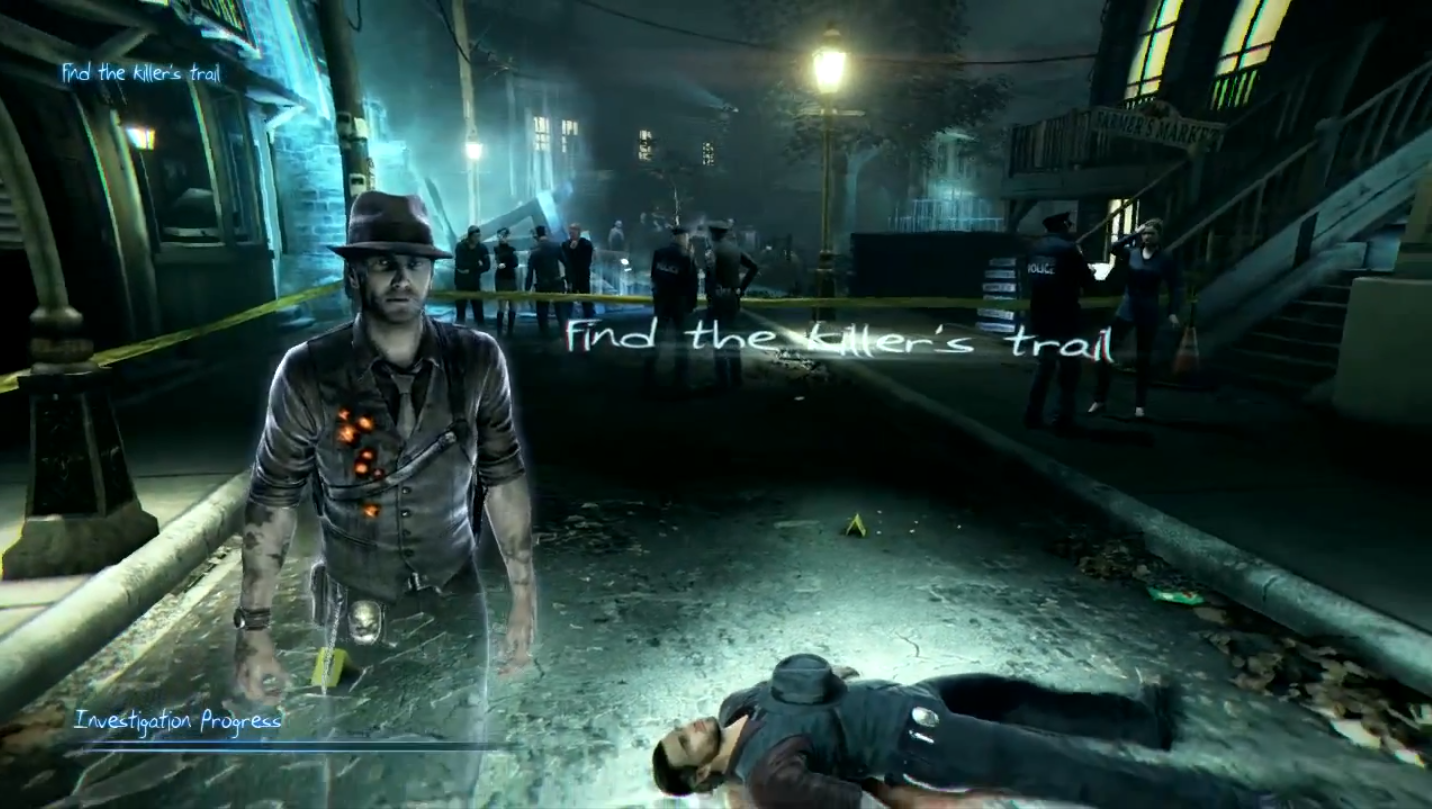
I haven’t been so misled by a game as Murdered. A murder mystery game about a cult in Salem, Massachusetts (my favorite type of murder mystery) is all wrapped around a serial killer known as the Bell Killer. You play a ghost detective named Ronan who gets murdered by this killer during an investigation. You have a bratty teen named Joy who helps you in the real world, and the story all comes to a nice close at the very end.
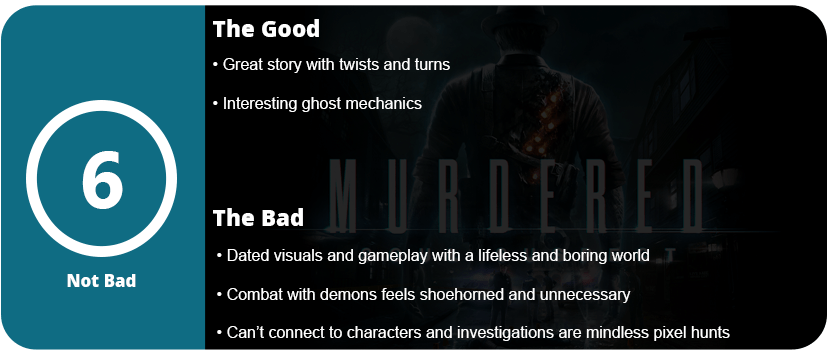
It’s everything in between that really disappoints. This game not only feels about 10 years old but is sometimes downright boring. In each area, you have items that need to be “examined.” This turns into pixel hunting like the adventure games of yore. Sometimes I found myself too frustrated because the examine button wouldn’t come up unless you were facing it just the right way; that’s glitchy and annoying. Once you find all the clues in an area, you conclude the investigation by picking three of the clues that relate to the scene. This is where some of the nonsense gameplay comes into play. Most of the time, you don’t even need all the clues to conclude, and most clues are pointless for the scene. I feel like I’m hunting for all these clues as just filler for gameplay.
Is there any combat? Not really. A shoehorned combat scenario was put in by sneaking around demons and executing them with weird button combos. Sneaking around them is pretty tense, as is running from them. But was this merely an excuse to be able to die in the game and call it a full-on game? The only other way I died in the game was by getting hit by a ghost train in one area. There’s also an open world that is boring and lifeless. The game is also full of items to find, which is archaic and just plain boring. Why would I run around in an empty, boring world, finding items I could care less about?
There are actually rules to this game, though. Just because you’re a ghost, you can’t walk through everything; otherwise, you’d be clipping into the gaming abyss. Most items can’t be walked through, and there are some that don’t have a blue aura around them. You can teleport yourself, which only comes in handy for a few parts of the game. You can possess people to read their minds or influence them during an investigation. This isn’t nearly as cool as it should be.
The only thing that kept me going was the story. The twists and turns were just interesting enough to make you think you figured it out, and then it turns out to be something else. The game actually has a satisfying ending with no cliffhanger. When I played through this whole game, I just couldn’t help but feel how dated it looked and played. The graphics, while not ugly, are simple and boring. This game would have looked amazing about 5 years ago. I also didn’t feel an attachment to any characters because of how boring and cookie-cutter they felt. Ronan is just your typical New England cop, Joy is a snotty goth brat, and the other characters don’t really show up enough for you to care about them. Soul Suspect had a lot of potential, but in the end, it felt like there wasn’t really a goal for what to do outside of the story.
If you’re a fan of adventure games, I would give this a shot. Murdered isn’t going to revolutionize the nearly forgotten point-and-click adventure-style gameplay, but it is worth slogging through the gameplay for the interesting story.
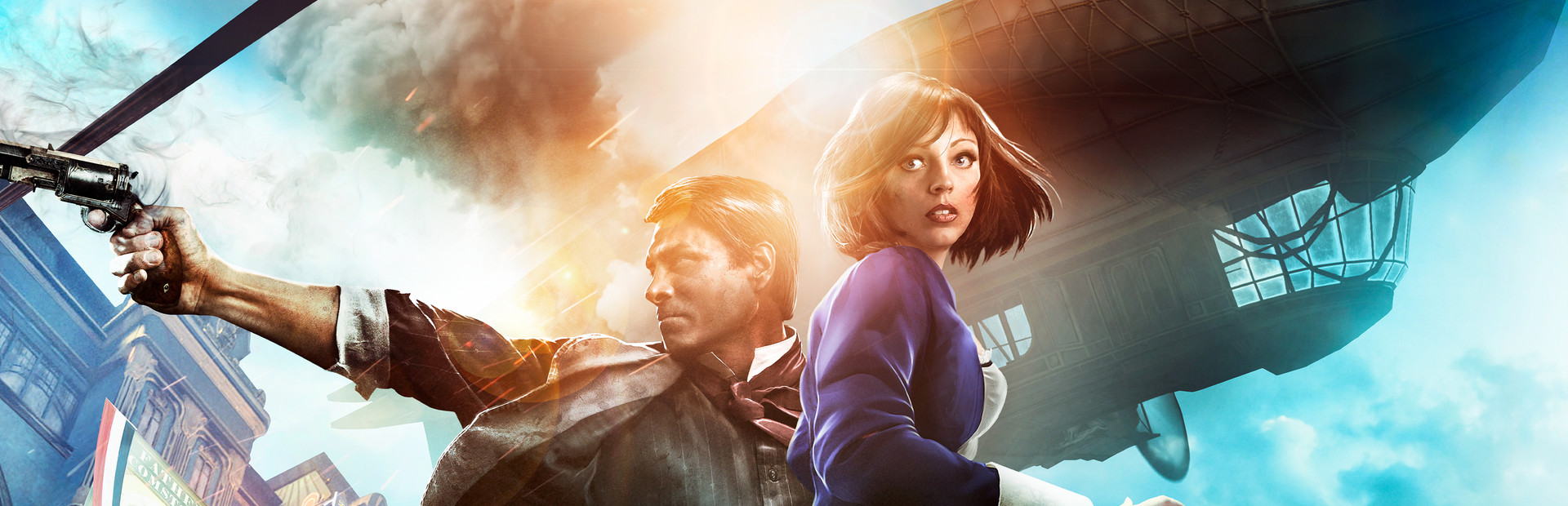
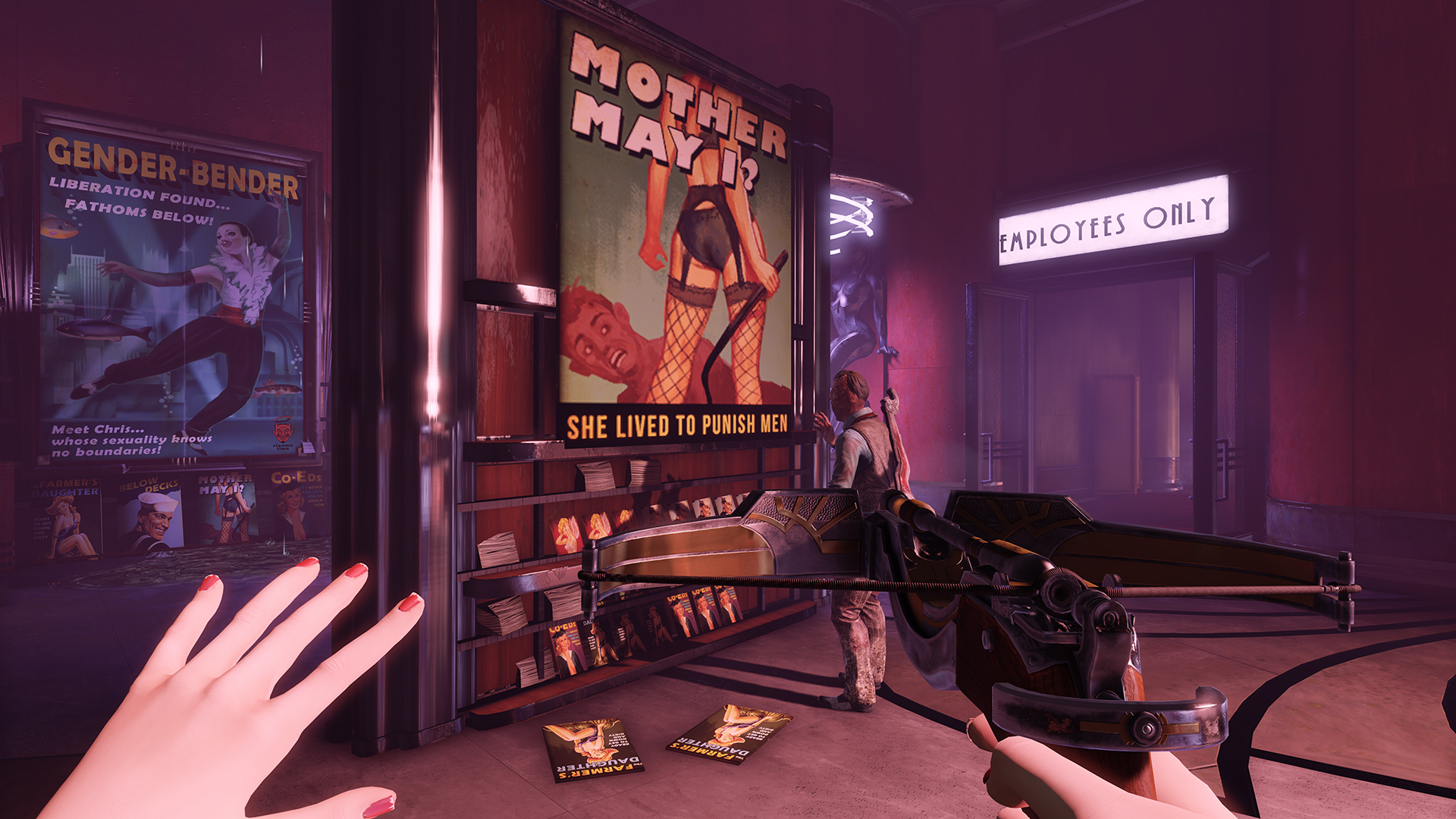
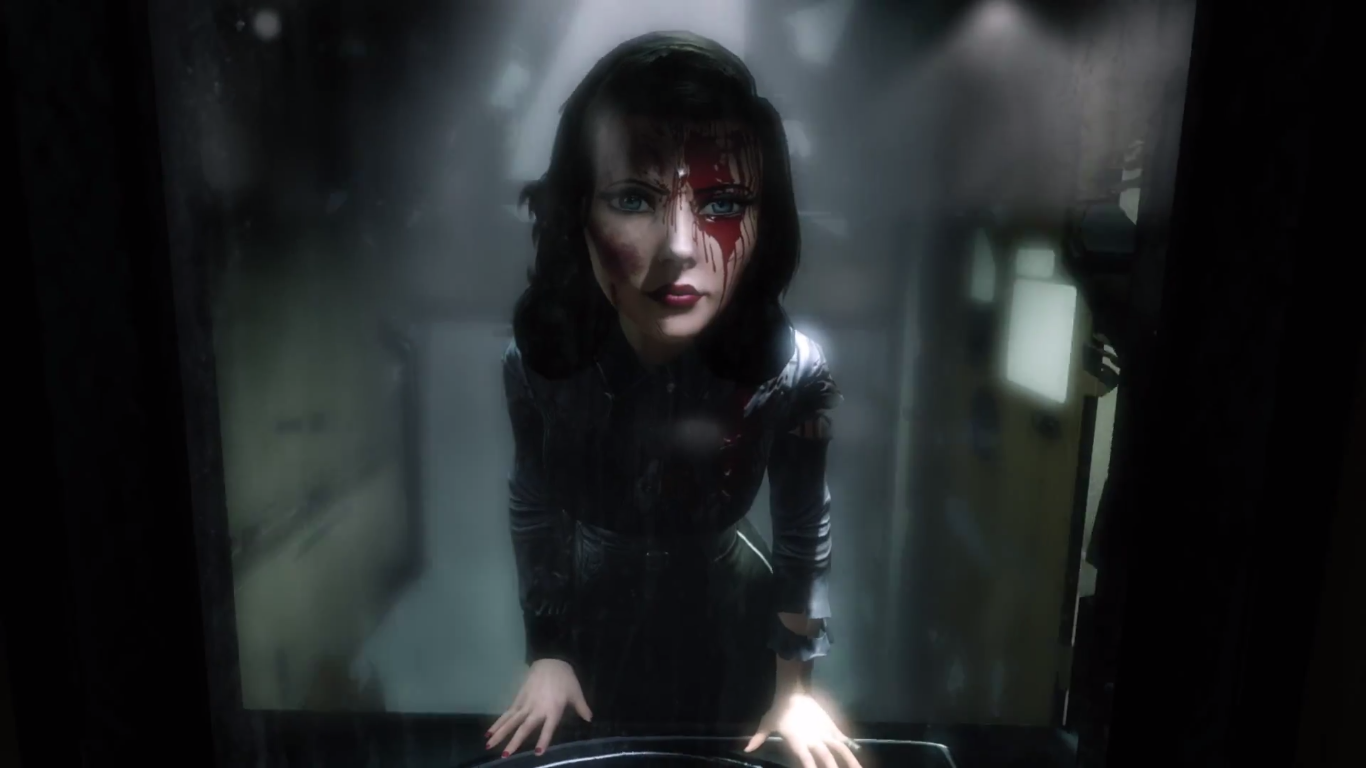
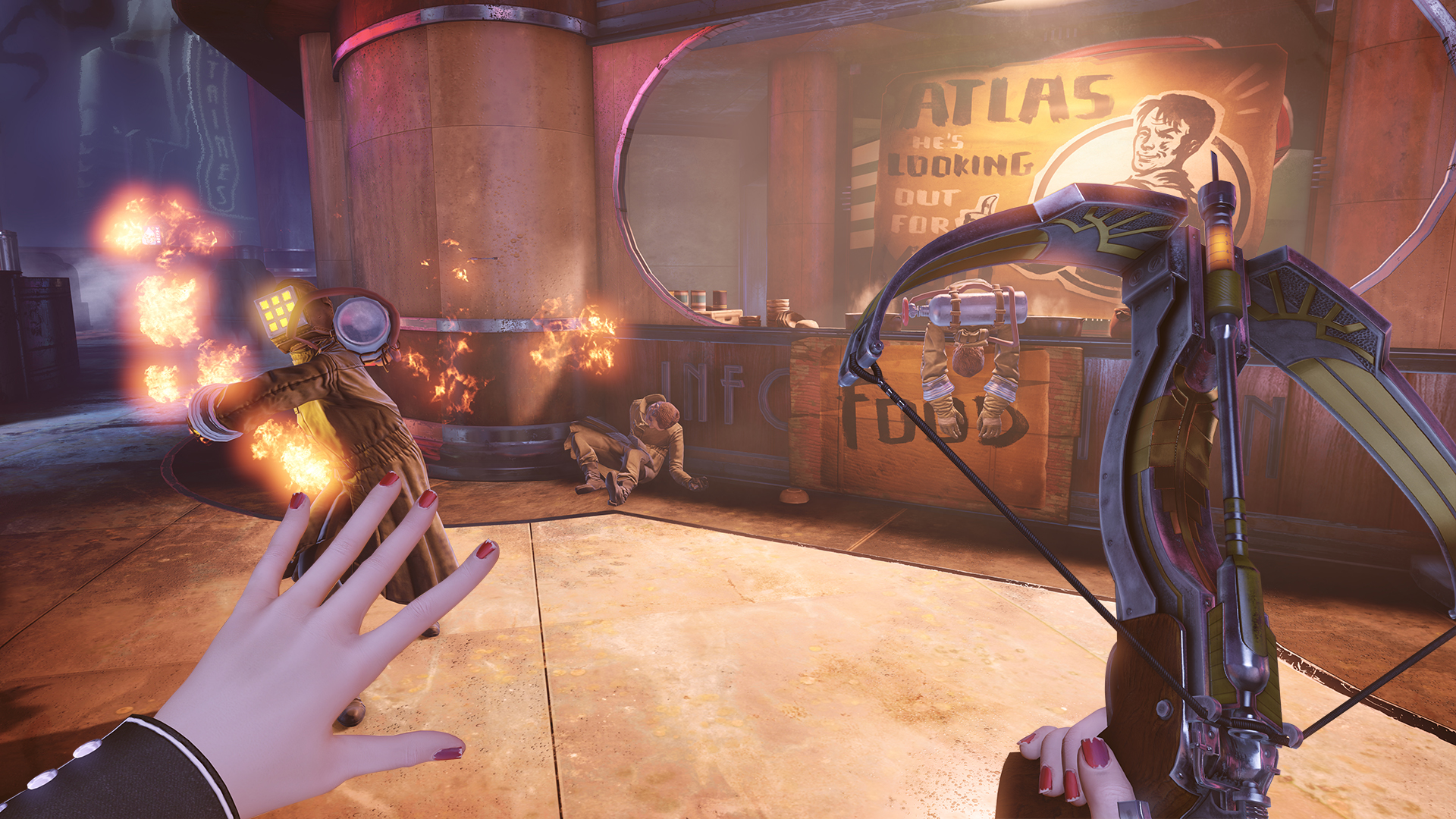
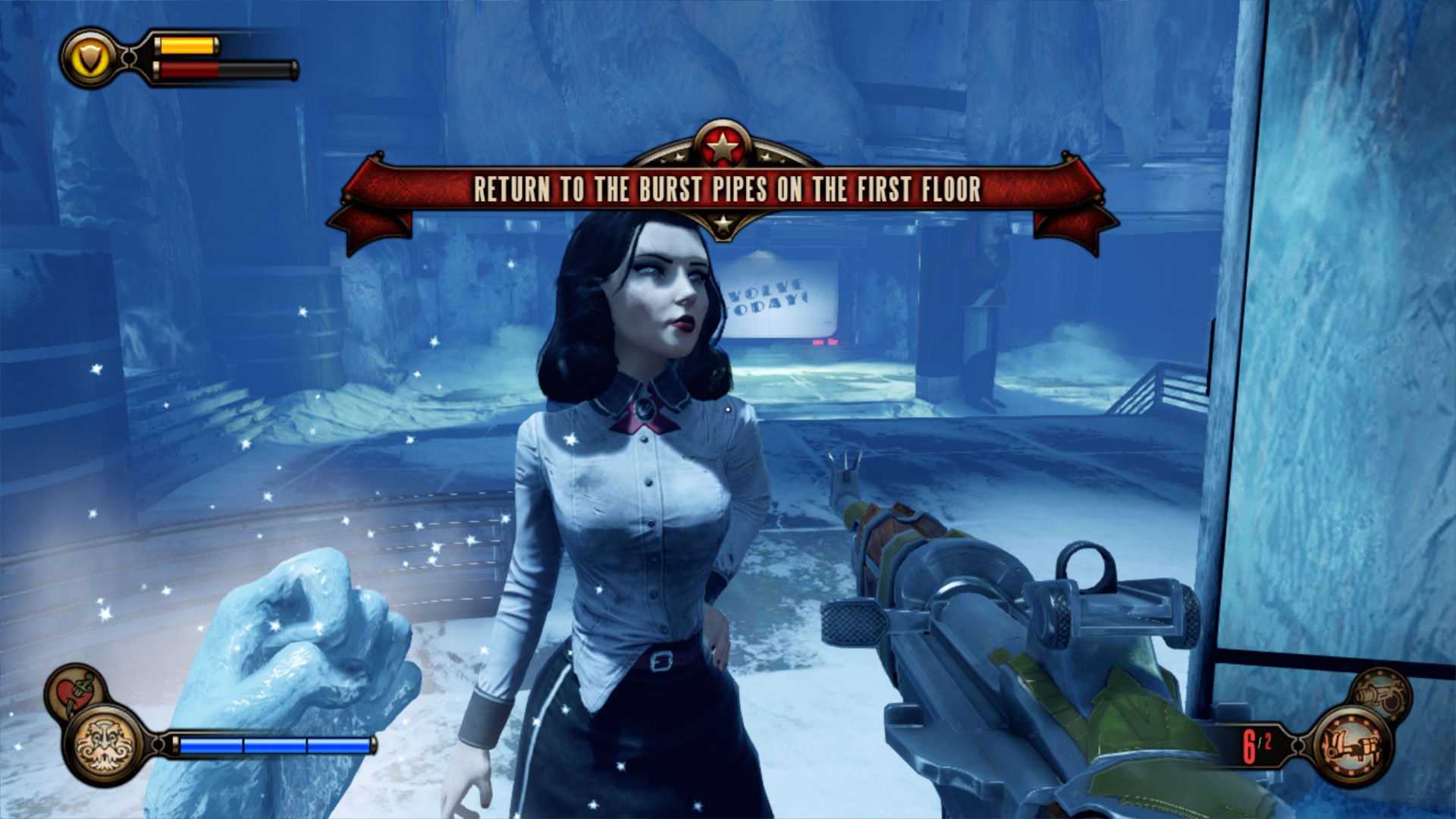
Episode Two takes place right after Episode One, but this time we play strictly as Elizabeth. I love this move-in perspective because Liz can’t fight like Booker can, and it’s noticeable right off the bat. Liz has to sneak her way around using crossbows, vigors that turn her invisible, and ones that add extra armor. She only carries a shotgun and pistol, but very little ammo. The new weapon is one that microwaves enemies, but I was only able to use it a couple of times in the whole episode.
The story still doesn’t make much sense unless you play both BioShock games. This DLC is really for the fans of those games. Elizabeth is on a mission to save Sally, the little sister you were trying to find in Episode 1. With Booker dead, it’s up to you to run from everything bad in Rapture to find her. This includes Atlas, Andrew Ryan, and even Suchong. These characters won’t mean anything to anyone who hasn’t played the first game. I loved the setting and the brief trip back to Columbia, but the atmosphere is really great in this episode, along with less backtracking. Sure, Liz can’t fight off Big Daddies in this episode, but it makes everything more intense. The game is about twice as long as the first episode but can still be finished in a few hours.
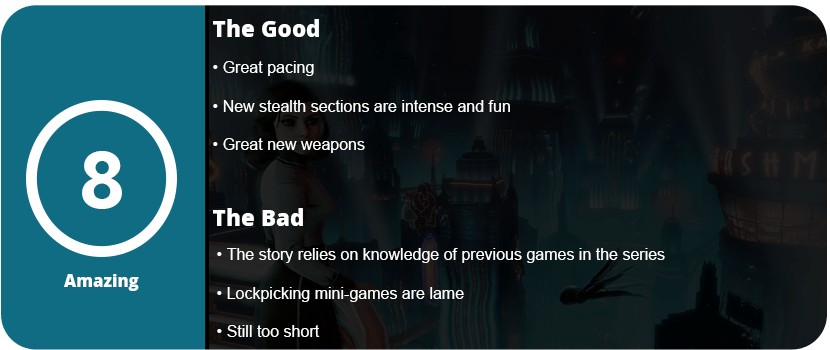
I really appreciated how the stealth sections were interspersed with just exploring and cinematic events; it felt balanced. Sneaking isn’t just as simple as ducking and hiding from enemies. They now have an alert meter above their heads, while a new lockpicking mini-game has been added but is mostly lackluster and just filler. You can even use this mini-game to hack turrets to fight against you, but there were maybe only two opportunities to do this in the whole game. The new crossbow weapon with gas, alarm, and sleeping darts comes in handy, and the shotgun does a lot of damage. I felt the revolver was nearly useless, though.
With all that said, Episode Two really feels like an extension and slight evolution of Infinite in a good way, but anyone who hasn’t played previous games will be completely lost.
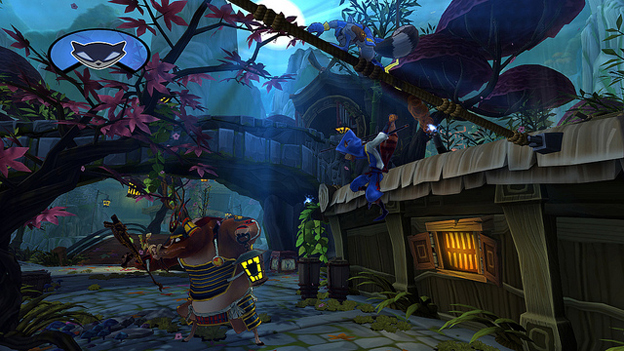
The Sly series was one of the best on PS2. It was original, artsy, had slick controls, and had clever humor that you could only find on Sony’s consoles. After Sly 3, the series went into limbo during most of the PS3’s lifecycle with no sign of a new game insight. With Sucker Punch powering away at the Infamous series, all fans lost hope. Thieves in Time was finally announced with much rejoicing, but once the game arrived, everyone was scratching their heads. Why is this game almost identical to the previous three in every way, shape, and form?
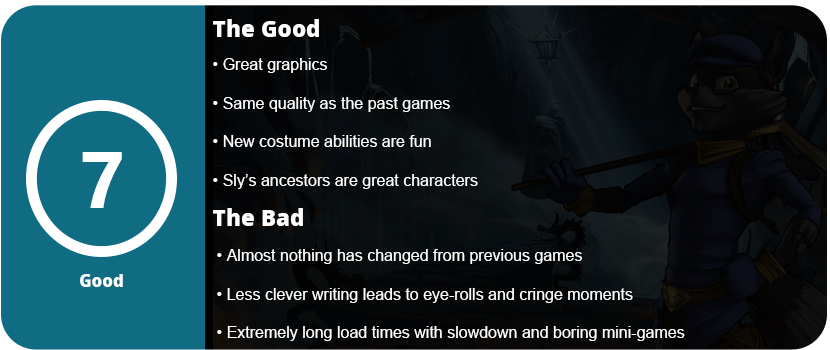
If you’re familiar with the Sly games, you know how this game plays out. 5 chapters of various different villains that the gang must take down. Each chapter starts with an intro from Bentley the turtle (the computer and tech wiz). After this, Sly goes and takes pictures to gather feedback on what to do next. As soon as I saw this in the first chapter, I rolled my eyes. I knew I was in for another Sly game with the same gameplay we are now tired of. Sure, it’s quality, but I wanted evolution in the series. When I say nothing has changed, I mean absolutely nothing. The same guard paths can be followed: pickpocketing, the same yellow flashlights, the same small confusing hubs with 30 clue bottles, and a safe. You get the picture. However, the hubs aren’t as interesting to traverse, and I completely bypassed collecting any extras as it felt like a chore.
That’s not to say every little thing is the same. The clever and witty humor turned into Saturday morning cartoon slapstick humor with jokes written by 8-year-olds. No longer do you find the darker humor that adults can relate to. I didn’t laugh or smile at a single joke or line of dialogue. This is especially sad since you go back in time to find five of Sly’sancestors, which opens a path for great dialog. Roichi is Sly’s Japanese Samurai ancestor, Tennessee Kid is his wild west ancestor, Bob is Sly’s very first ancestor from 10,000 B.C., Sir Gallenth is his medieval ancestor, and Salim is his Arabian Nights ancestor. These are actually interesting characters, but their personalities are limited by poor writing. No longer is the banter between Sly, Bentley, and Murray something you look forward to at every cutscene.
I also miss the more clever gameplay segments; now we just get a ton of boring mini-games and quick-time events. Hell, even the final boss is an easy, quick-time event fest. The most interesting part of the whole game is the bosses, which are rather challenging and fun to fight. The only new addition to the entire series are the new costume abilities. These add a special set of skills Sly needs to get through some missions. Apart from this, you can expect the same controls. It’s a crying shame for a series that is so dear to PlayStation fans.
With all of that said, the game looks pretty damn good on Vita, minus the occasional slowdown and the super long load times. Jumping from area to area was painful due to the 45-second or long loading screens. Some gameplay segments were shorter than the actual load times. This really hurt the game, as I set my Vita down to actually go do something while the game loaded. Long-term fans may either hate this game or love it. Newcomers will actually see it as a quality PlayStation title. As someone who has played the games since the very first one, I find it rather disappointing and almost a chore to play through.
Whether you like it or not, I have to start out by saying Lords of Shadow 1 was a masterpiece. The game was finely crafted from all angles that make up a great video game. It was the best Castlevania reboot ever done, and it was a fantastic action-adventure genre. It was challenging, beautiful, and memorable. Lords of Shadow 2 is not so much. In fact, I don’t know what happened. They took everything that made Lords of Shadow 1 great and threw it out the window.
The story picks up after Mirror of Fate. Gabriel wants to die and have eternal peace. He already has to deal with the death of Maria. Zobek (voiced by Patrick Stewart) will give him the vampire killer in exchange for killing Satan. In order to do this, you must help out various other people and find three of Satan’s acolytes. You see, even the story got screwed up. The first game’s story flowed and was touching. Lords of Shadow 2 takes forever to get interesting and has very few cutscenes until the very end. The setting also really throws the game off; being set in modern times just ruins the whole thing. The level design is terrible and confusing, with a poorly implemented “open world” design that just makes you want to tear your hair out.
The game starts off with a nice pace, but once you step out into the present, all that magic from the first game just disappears. Secondly, the combat hasn’t changed much, and the upgrade system feels meaningless. While the combat is still responsive and quite good, the enemies that defined the use of the combat system have been simplified and cut down to a mere half-dozen. Yes, the same half-dozen enemies through the entire game. It’s repetitive and irritating, and you will end up just running past most of them if you can. Not to mention the increased amount of collectibles in the game that require going back through these labyrinthine levels and remembering where these spots are.
If that isn’t disappointing enough, the ending is just terrible. Unlike the sad, tearful ending of the first game, we just get a “what the hell is this?” ending, leading into another Lords of Shadow game we know will never happen. At least the boss fights are fun and, honestly, the best part of the whole game. They are super challenging, and the designs are pretty cool. Satan is a very challenging boss and worthy of being an end boss. Chipping away at health and scrounging your items is fun, but it should be through the entire game, not just the boss fights.
It also doesn’t help that the only store is in one part of the entire game. You have to go all the way back just to buy something. I honestly wanted this game to have a more linear path, so it feels more unique. But here’s the worst part about the game: the stealth sections. Yes, why the hell are there stealth sections in a Castlevania game? They are broken, just boring, and completely slow the game down. Some are confusing, most are boring, and they are all completely unnecessary. Instead of the clever puzzles of the first game, the developers lazy through stealth sections to replace them. Lords of Shadow 2 is just a lazy excuse for a game that never should have been.
At least the graphics are fantastic, and the voice acting is superb. None of that matters if everything around it is a sub-part of a masterpiece. As it is, Lords of Shadow 2 won’t please fans of the first game and definitely won’t draw in haters of the first game to give it a chance. If you never play this game, you won’t miss out on anything, even if you played the first. Do yourself a favor and just forget it even exists.
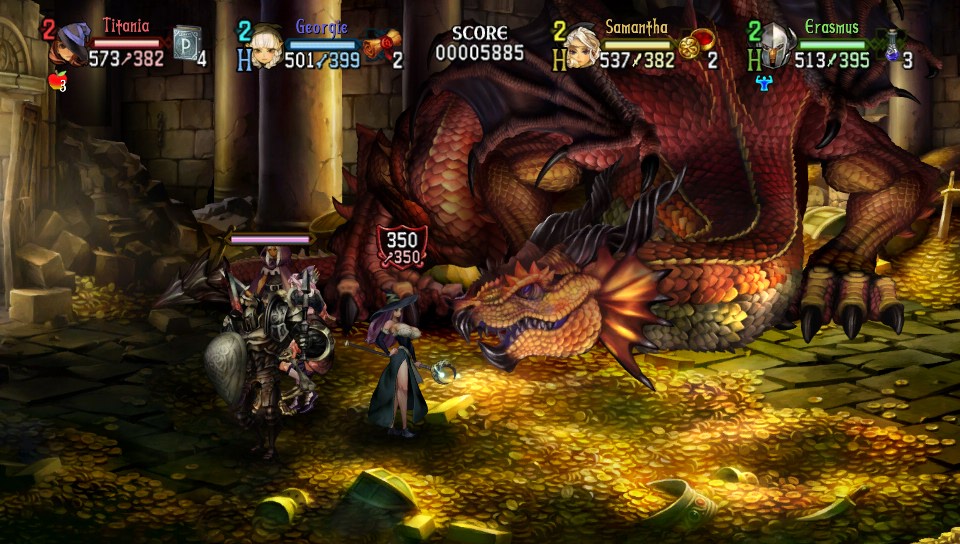
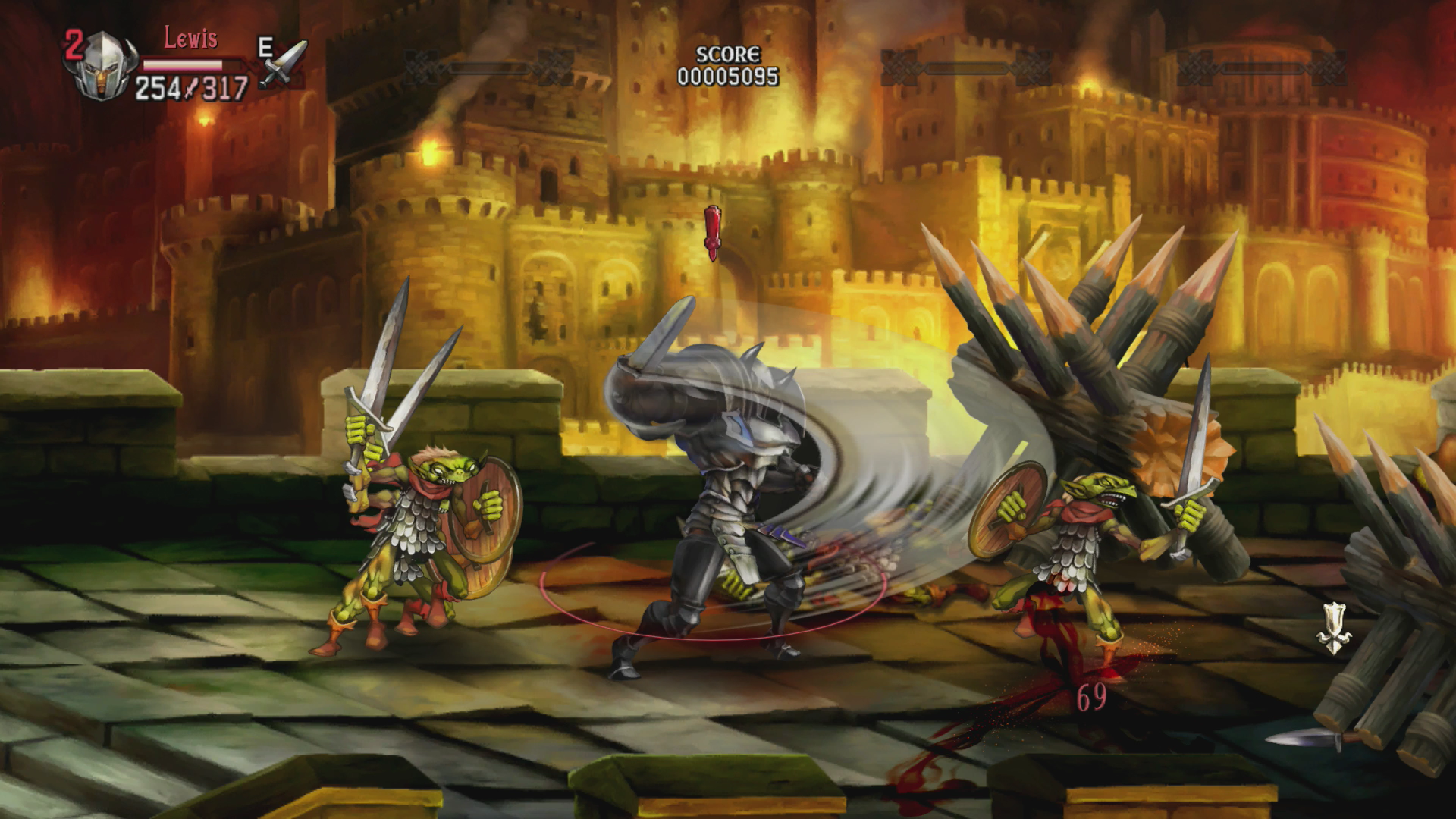
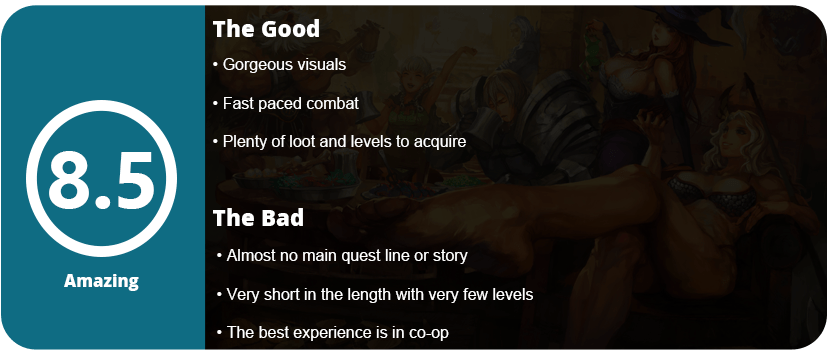
Vanillaware is known for one of the hardest JRPGs on the PS2, Odin Sphere, and I was very excited upon hearing about the spiritual successor to that game. While Dragon’s Crown isn’t nearly as hard as that game (it’s much more forgiving), it still has a lot of challenges that await you. Dragon’s Crown’s biggest disappointment is its short length. There are almost no main quests and mainly side quests (about 50). Once you finish the game, you unlock a hard mode and then an inferno mode. Thankfully, the game can be played with up to four players, so it can be a blast.
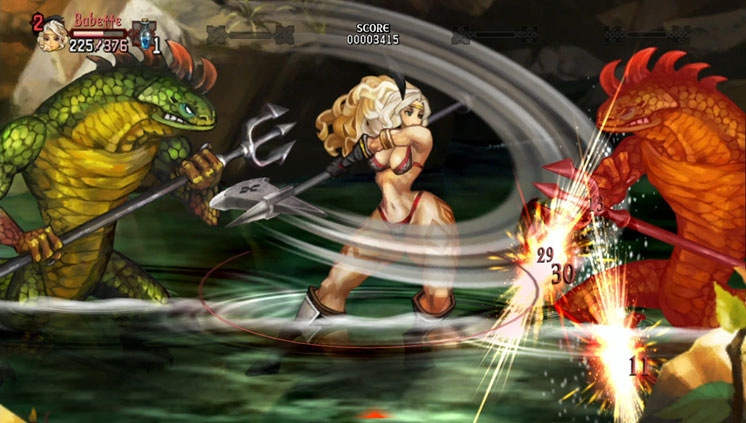
The story is about a crown that has been taken by an ancient dragon. Your job is to return this crown to your kingdom and kill the dragon. The story is very light, and I know there could have been so much more here. But the super short length makes it impossible to write a better story. There are very few cutscenes and not much spoken dialogue (which is only done by a narrator). Once you jump into the game, you can attack, use items, cast spells, and use the right analog stick to move a hand around the screen to collect treasure. You always have a non-fighting thief with you who can pick locks on hidden doors and open chests. Sadly, you can’t change out your equipment during a mission (most levels can be passed in less than 10 minutes). However, at the end of each level is a boss, and they increase in difficulty throughout all 8 levels or so. Each level has two bosses at different levels for various players.
Once you finish a mission, you can return to town to appraise your items, bury or resurrect bones you find in levels for new AI partners, level up, acquire new quests, and buy runes. Runes are found throughout levels in pairs, which need to be matched with runes in your possession. These add various buffs to your party, which can turn the tide of a battle. Outside of those main things, there’s not much to do besides hit the level cap. The missions are extremely repetitive since you need to find nine talismans before facing the Ancient Dragon (that’s almost all there is to the entire main quest line), and once you are able to beat the Ancient Dragon (probably when you’re around level 30), you do it all over again on a harder difficulty. It gets kind of boring after a while and extremely tough towards the end. It’s best to go in with actual people since your AI partners can mess things up. Thankfully, unlike Odin Sphere, you have lives and can even pay to keep reviving with your coins. This alleviates some of the frustration.
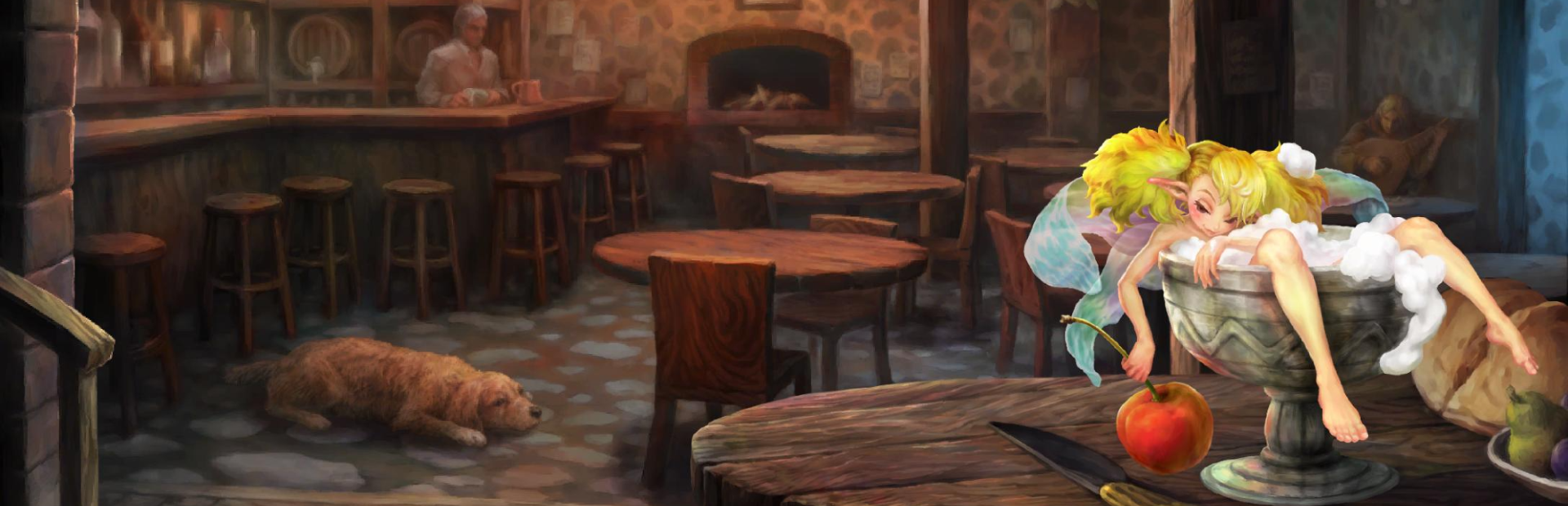
I just wish there was so much more to this game. It feels so small and claustrophobic. The short levels, the nearly non-existent questline, and the story—but at least the characters you pick are fun to use, and the controls work well. The art itself is stunning, with beautiful water-color backdrops and crazy-looking enemies and bosses. This game is mainly designed for fans of the co-op arcade RPGs of yesteryear from Capcom. Not much of a story, but tons of combat, enemies to kill, and levels to acquire. If you want a story-heavy RPG like The Elder Scrolls or Fable, you won’t find that here.
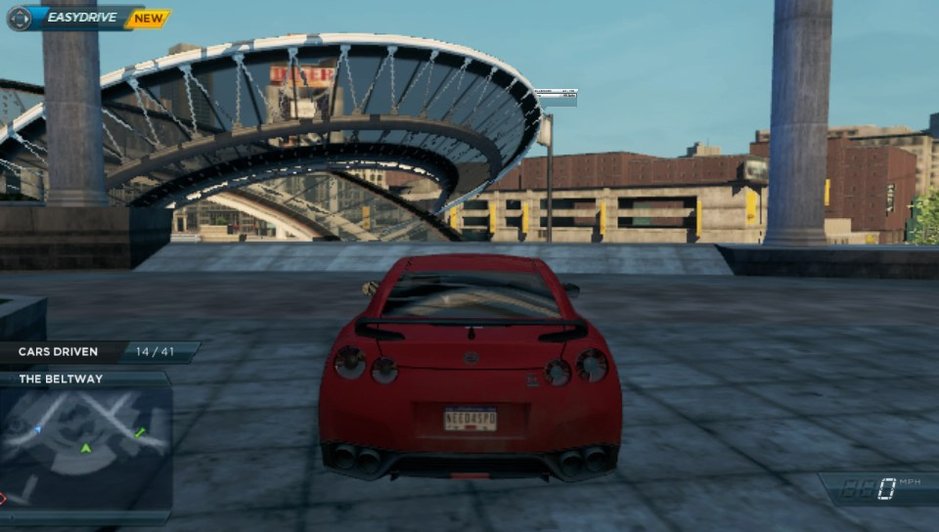
Need for Speed has had a great comeback over the last few years, and Most Wanted seems to have topped it. Being a remake of 2005’s excellent Most Wanted, this version is a whole new beast. The streamlined menus, AutoLog, the massive amount of real-world cars, and the huge world to drive in are something to get excited about.
My favorite feature has to be the new navigation menu. Being able to select races, customize your car, and jump to various cards with just the D-pad is great. There’s not even a need for a map. Select the race you want, and it will put the GPS line on your mini-map. Want to drive a different car? 3 D-pad clicks, and you’re there. This just seems nearly revolutionary for the racing genre, as they have been plagued with nasty menus for years. Outside of the menu are excellent racing moments and various types of races to do.
Sprints, circuits, fastest speed, and losing the cops the fastest are just a few types of races in Most Wanted. The whole goal is to find all the jump areas where cars are hidden throughout the entire world. Win first in each race for each car, and you will win part upgrades to make your car faster and better to drive. Some parts are better for certain areas, like offroad, but will slow you down on the asphalt. There are also various parts to help the cops, like re-inflating tires if you hit a spike strip or a stronger chassis for ramming through roadblocks. Like previous Need for Speed games (and any criterion racer), you can take down vehicles for more points to work your way to the number one most wanted.
A fun feature here (and it threw me for a loop) was having to take down a most wanted car to win their car. Sure, you can beat them in a race, but what about taking them down? It adds a greater challenge, but if you miss them, you can always summon the car back via the navigation menu. It’s not hard to work your way up to the top if you try to get first in every race. Even after you beat the most wanted vehicle, you can earn parts and find every hidden vehicle in the city.
If that’s not enough, try the AutoLog recommended objectives or try to find and hit every billboard in the game. There’s a lot to do in this game, and even though it can feel repetitive after a while, there’s just a great sense of accomplishment from getting first in every race. Let’s talk about graphics. Most Wanted is one of the best-looking games on the Vita. The sense of speed is great, and the controls are amazing. It doesn’t look like the game took much of a hit from being downgraded graphically, but it was hand-tailored to the system. The game even sounds great, and I spent hours just racing around, completing races without ever getting bored. Is there anything bad about Most Wanted? Mainly how repetitive the races can get overall, but the variety of cars keeps this played down a bit. Crashing every 5 seconds can get annoying, but that’s expected. Most Wanted is a must-have racer for any system you can own it on.
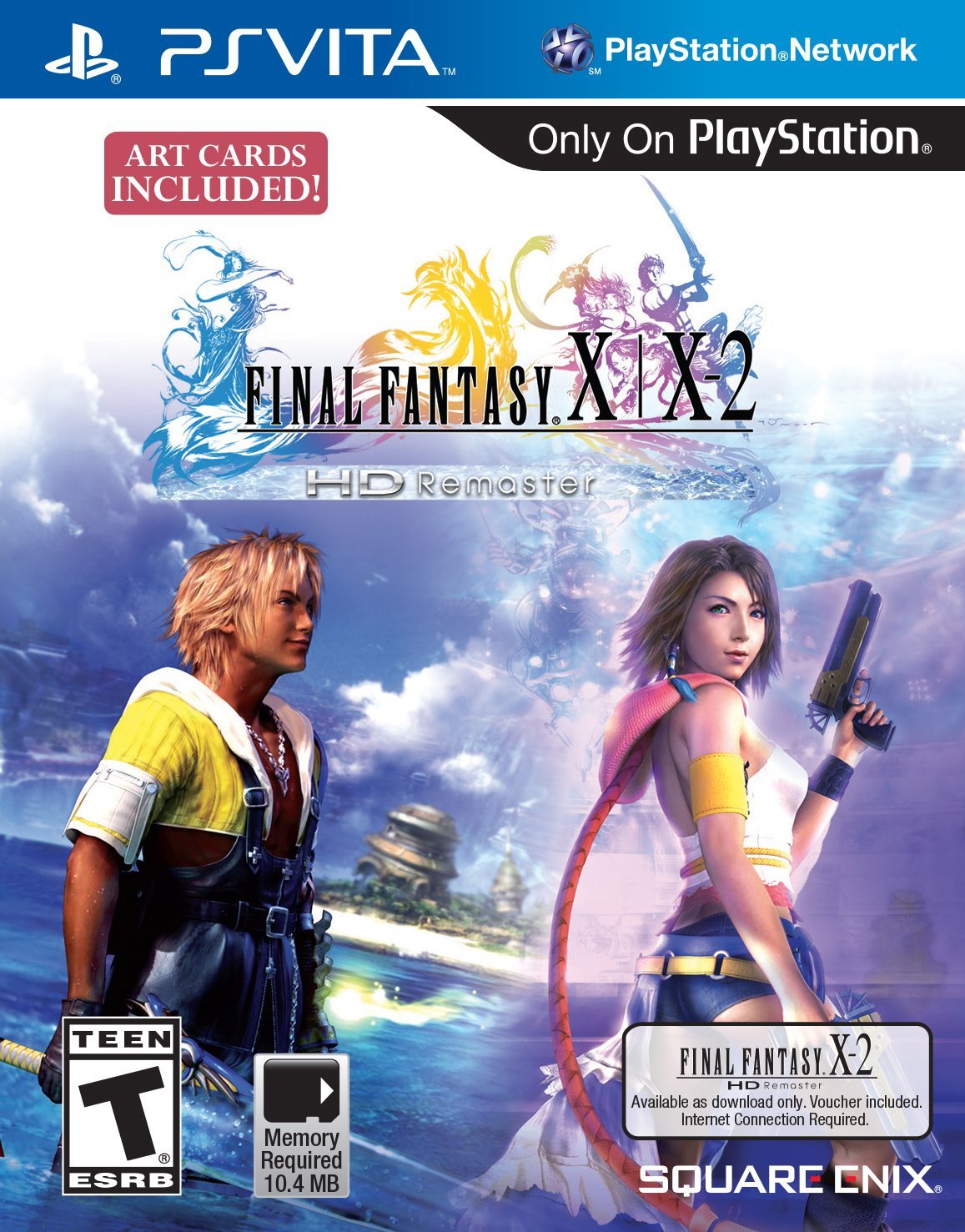
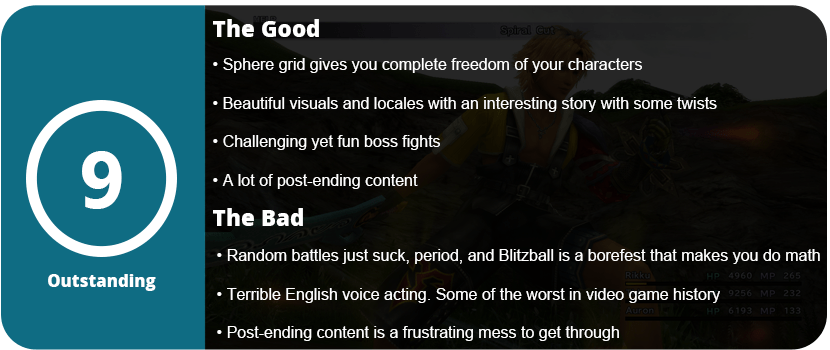
Final Fantasy X was a game in the series that really shifted things around. It broke some common JRPG rules and was a bit all over the place. This was the first JRPG I had ever beaten as a kid, and it was the first Final Fantasy I ever finished. I have a lot of fond memories of this game, and the HD Remaster brought a lot of those back.
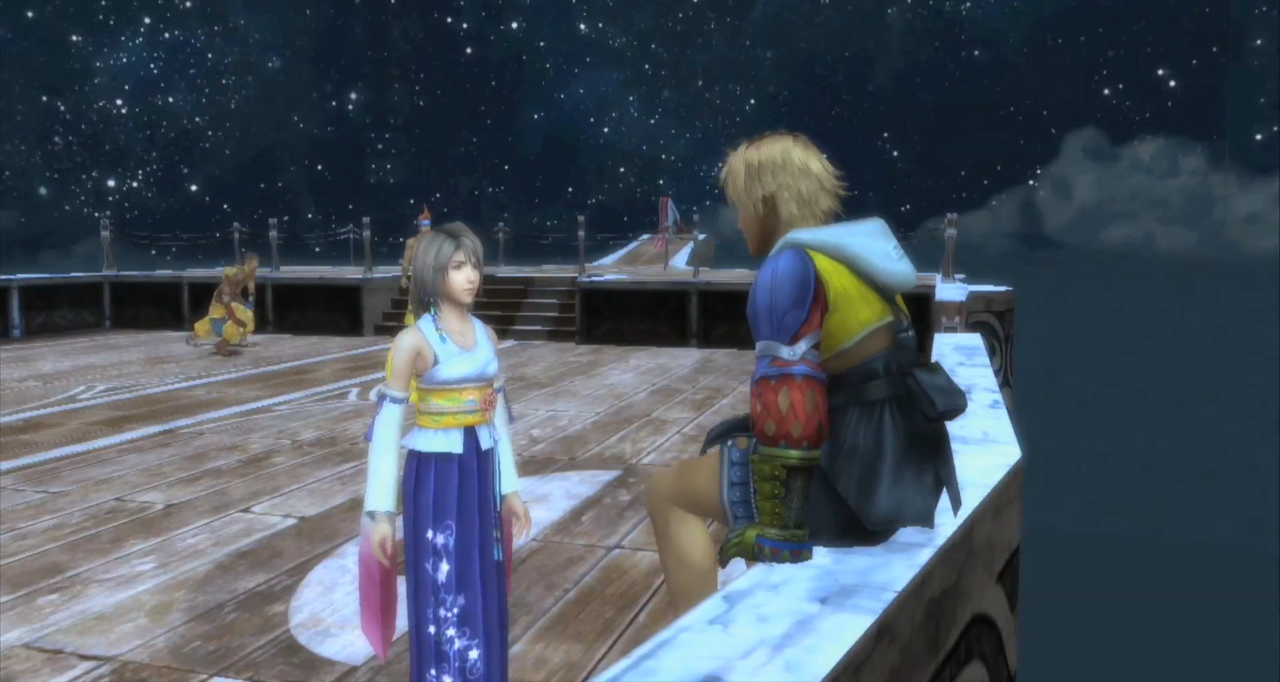
The core game hasn’t really been touched, but US gamers will finally get a taste of the tougher international version, which adds an expert sphere grid and Dark Aeons, which are the toughest enemies in the game (some have millions of HP). Outside of the game, the game is still the same, with great characters that are memorable and beautiful locales. The story is a bit confusing at first, but very original, if not very deep. You play as Tidus, who is a young man sent forward in time hundreds of years into the future. His original home is now a sacred ruin, and a giant being called Sin is destroying humanity. Every 10 years, this sin comes back, and the calm ends. Another summoner must go on a pilgrimage to gather all the Aeons and take down Sin for another 10-year Calm. Your goal is to put a stop to this cycle. You gather your crew along the way to level up and put an end to all this nonsense.
Before you jump into this game, you must have a mindset from when the PS2 first launched. This game was fantastic back in the day and still holds up well. Most JRPG gamers will be thrown off by the Sphere Grid. There is no traditional leveling up where you gain levels. Instead, you acquire AP and get sphere points, which allow you to freely upgrade various attributes and skills for each character. The expert sphere grid allows you to use keys to go off your path and learn other abilities from other characters. This is a lot of fun and gives you total freedom over your character.
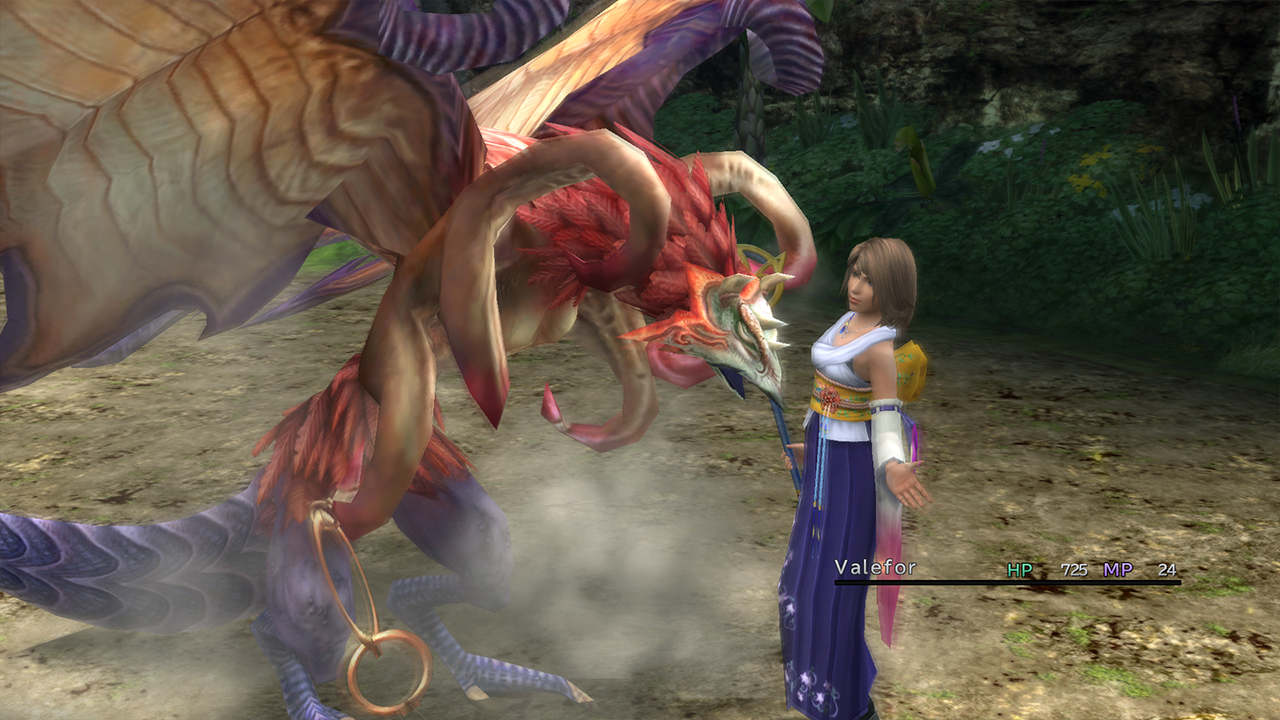
Outside of the sphere grid is the obvious combat. Yes, there are random battles, and some areas are so bad that you hit one every 2–3 seconds—literally. A maximum of three characters can battle at once with the freedom to swap out. It’s the usual JRPG turn-based battle system, but there are overdrives that are crucial to winning boss fights. Characters learn new drives as they battle. Aeons are also essential, but only Yuna can send them in. They are large, heavy hitters that will take away massive damage and can also be overdriven, which is probably the #1 technique for winning tougher boss fights. Like any other JRPG, learning enemies’ weaknesses and battling with magic is a must. Some bosses nearly turn into puzzles where you must cast Reflect on them so their healing spell bounces off of them onto you. Some bosses will cast status ailments that can cripple your entire party. If you don’t grind a bit and stay ahead of the game, you will struggle.
Outside of battle, there are the Cloister of Trials, which are a huge pain and aren’t fun at all. These are puzzles in which you place various spheres to unlock doors. Another huge pain is the Blitzball mini-game. This isn’t fun at all and requires math to actually play. It’s stiff, shallow, and just plain boring. I hated it as a kid, and I hate it even now that I know math better. It’s all nearly luck-based and a roll of the dice. You have almost no control over characters.
FFX is also full of pre-final boss content, but there are a lot of requirements to get this stuff. Ultimate weapons are a must-have to do more than the 9,999 HP damage limit. However, they require you to be in certain areas, acquire certain other items, or even get through harder areas that require getting through other areas just to get to that area. Sounds confusing? It is. I spent a good 15 hours just trying to figure all this out and could get only one optional Aeon (Yojimbo). Anima is another optional Aeon but requires getting through a tough boss with the three weakest characters (Tidus, Rikku, and Wakka) and then getting all the destruction spheres in every trial. It’s a huge pain, requires a lot of running around and backtracking, and can make you frustrated. You can also monster hunt, but this requires training a Chocobo (which is tough as nails to get through), and then capturing the toughest monsters in the game easily requires ultimate weapons, which require more backtracking. It’s a frustrating mess but also somehow extremely satisfying once you do it.
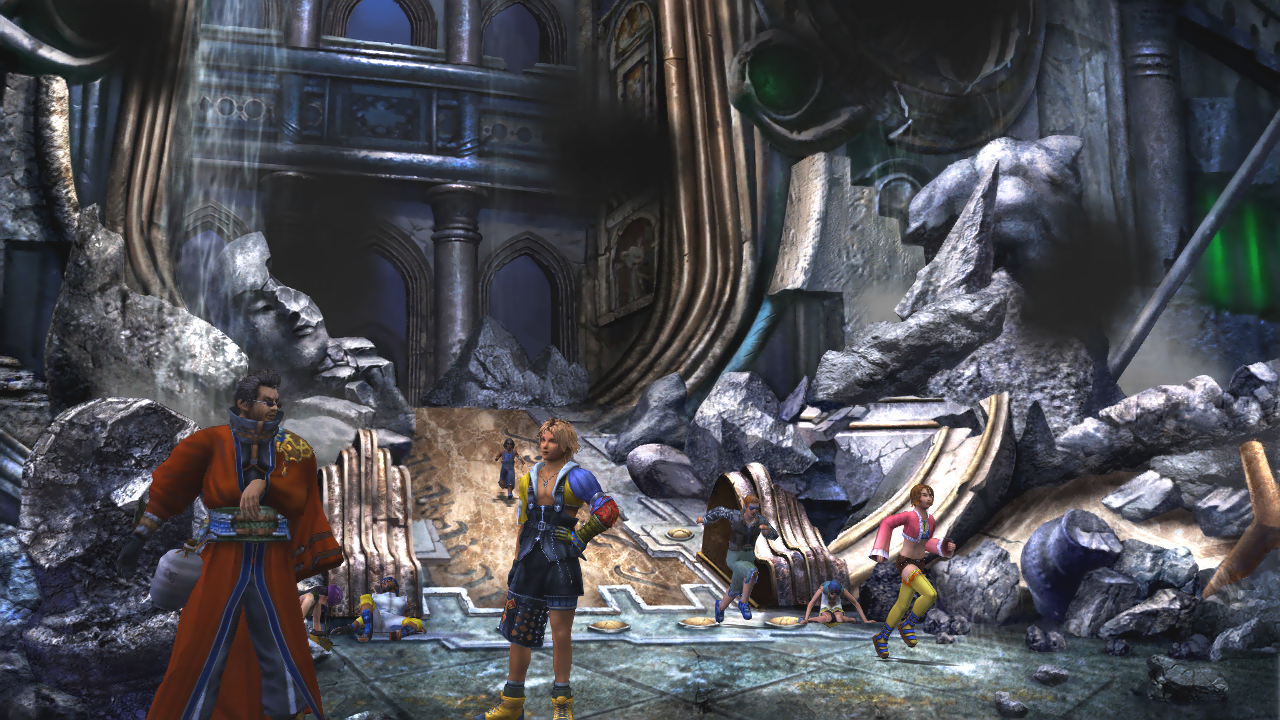
With the main game out of the way, let’s talk about visuals. The HD upgrade isn’t exactly what you think. Most of the game has been remodeled, and all the main characters are completely redone; however, many monsters and NPCs just had a few passes of texture filtering, and that’s it. It really looks ugly in spots, but it’s not so bad if you’ve played the game before. I just wish the Japanese voice track was on here since the English voice acting is so terrible and embarrassing to listen to.
Note: Shame on you, James Arnold Taylor, for your terrible voice acting in Tidus. You’ve done better! Like Ratchet from Ratchet & Clank, Gabriel Logan from the PSP Syphon Filters, and even Marty McFly from the Back to the Future adventure games!
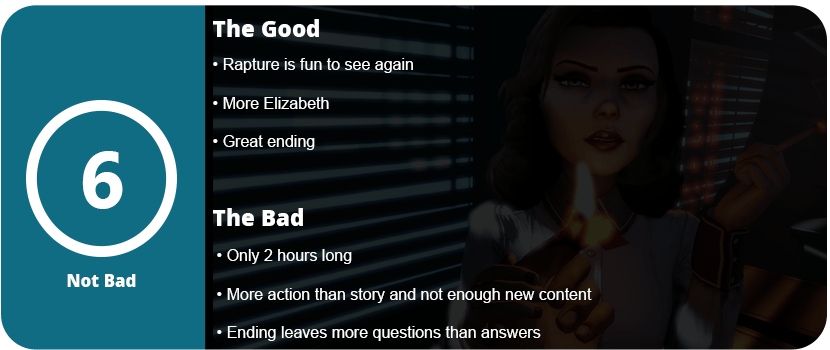
The long-awaited Infinite expansion set in Rapture is out and about. I honestly didn’t know what to really expect from this other than more questions and fan service from Rapture. The story started out very similarly to BioShock 1, where you are riding down the bathysphere into Rapture. It brought back a lot of great memories, and I was happy to see the beautiful Elizabeth throughout the whole chapter. What I wasn’t happy about was the length, the gameplay, and the lack of anything memorable.
You feel more like one level from a full game. The one level that is really just action is more than the story. It doesn’t pick up at all until the last 2 minutes of the ending, which is both shocking and expected and gives us more questions than answers. The same infinite guns are back, but with only one new power, and that is Old Man Winter. It is not much different from the freeze power in BioShock 1. It can freeze running water to make a bridge, and that’s about it. I ran around closing vents to draw Sally out (the girl who Booker must get back) and not much else. The ammo is extremely scarce, so you will be scrounging for it more than at any other moment in previous BioShock games. You also don’t get the full arsenal in Infinite, and nothing much else has changed gameplay-wise.
The setting is fantastic, however. The underwater city is memorable, and it’s great to be back before it went to crap from the previous games. We are seeing the calm before the storm here. The Little Sister program is starting, and so are the new Plasmids. It’s very interesting to see how things are happening when everything is prosperous and fun in the underwater utopia. Another great addition is the return of Sander Cohen, who is probably the most insane person in Rapture. This section is memorable but dies out quickly with more boring shooting and getting lost in hallways.
Outside of the interesting ending, there’s not much else. This was a real disappointment because of how long everyone waited. The gamer who just played Infinite and moved on shouldn’t even bother. This DLC is mainly for hardcore fans who actually want the ending in Episode Three rather than the tidbits from each episode.
Vocaloid may not ring a bell to anyone outside of Japanophiles in the West. In Japan, Vocaloid is a major success, with dozens of albums and countless collaborations with various Japanese music artists. This is the first Project Diva game that has made it to the Western shores. Project Diva has a unique rhythm-based gameplay structure that is both tough as nails and addictive. Don’t let the cute “girly” visuals fool you. This game is for everyone who loves music or rhythm games.
Icons flash across the screen in different patterns, and you must press the corresponding face button. Arrows also require you to press the D-pad direction plus the color of that button. New in F are scratch stars, which also go into the technical zone segments, which are mandatory for getting higher grades at the end of songs. New on the Vita is the ability to use the touchscreen or rear touchpad to scratch these stars. This is so much easier than using the right thumbstick on the PS3. Technical zones are areas where you have to hit every note perfectly to get a huge boost in your score bar. Notes rank from cool, which is perfect, to awful, which is a complete miss. Cool and great scores will build up your multiplier. Safe or lower will drop it. Each song has two technical zones, with a chance zone near the end. New in F is the ability to build up a large star meter in your chance zone to unleash a mega scratch star to play an extra segment at the end. You must hit all of these to even get close to an excellent or perfect score.
These scores will unlock new items to buy in the shop, which is the other half of Project Diva F. You can outfit your diva’s room with new tables, chairs, decor, computers, etc. You can also unlock new costume pieces for your character. There are plenty of items to unlock, so you will be kept busy doing this long after unlocking all 30+ songs. The Vita features a new edit mode for making your own music videos or editing already-made videos and sharing them online. Project Diva F has a lot of content and will keep you coming back for higher scores or just to play your favorite songs.
When it comes to song selections, these aren’t as great or memorable as the PSP Project Diva games, but some songs are fantastic and memorable, while others are pretty lame. It’s a mixed bag, and everyone will have different favorites, but there are enough songs to please everyone who plays this game. The graphics are a step up from the PSP games, but I feel they could have been a bit better on the Vita. The textures look a bit muddy on Vita, but overall, the graphical style is very unique and spot-on when it comes to Vocaloid. I would have liked to have seen at least one pre-rendered video per song, but everything is performed in real-time.
As it is, Project Diva F is a fantastic game and the best rhythm game on Vita. If you love your J-Pop or want to venture out into something new, then take this game for a spin. Just be warned: the songs are all sung in Japanese, and the lyrics are in Japanese as well. Don’t bet on any localization because it wouldn’t be Vocaloid or Miku if it were.
Yep! The fact that I forgot about this game until you made a comment proves that.