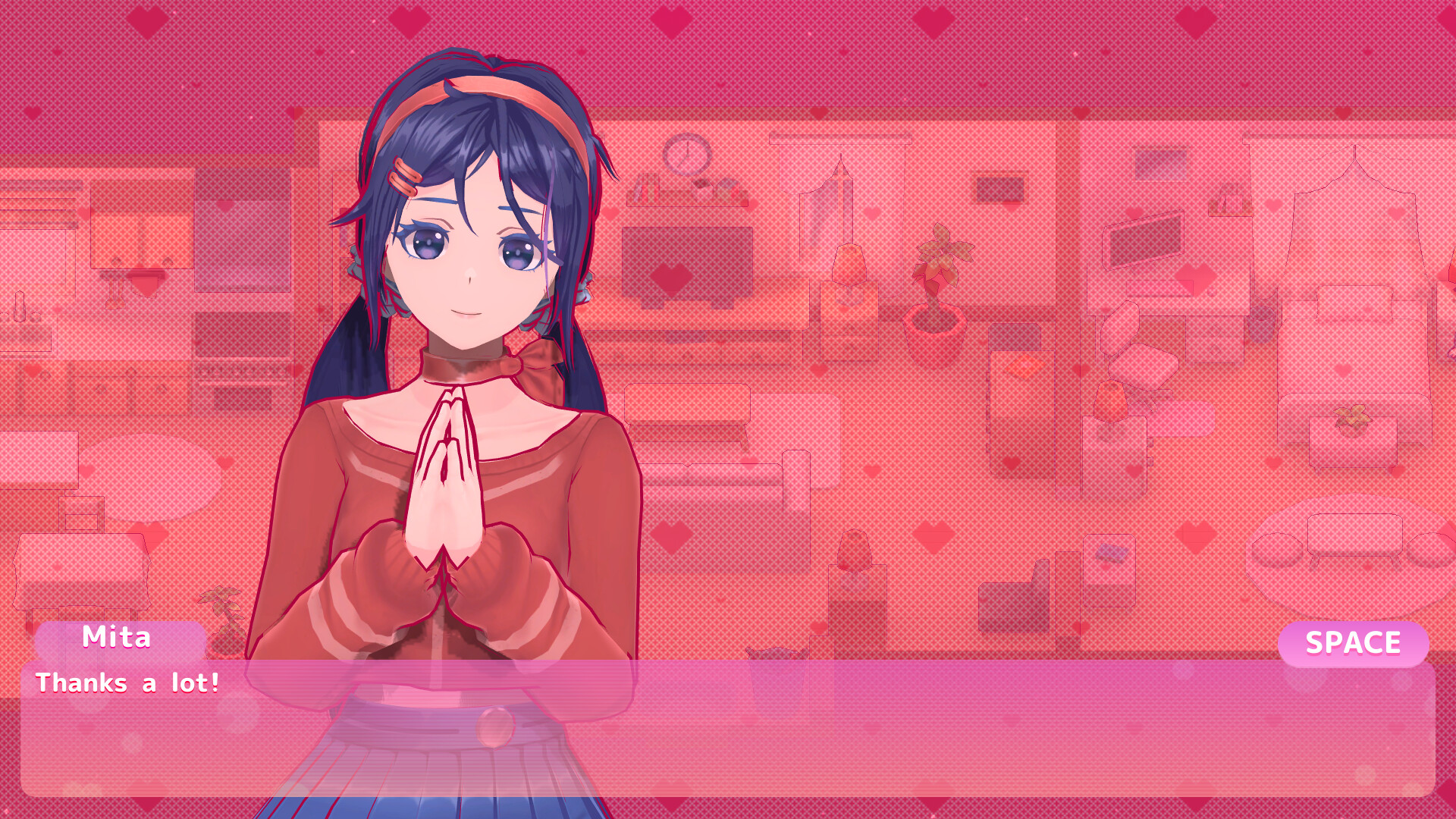
Have you ever wondered what it would be like to be inside of a mobile game? Probably not, but you can now with MiSide. This is a horror adventure title with anime vibes and a surprisingly engaging story. I originally passed MiSide off as a generic anime visual novel, but after digging further I realized there was more to this game. You play as a generic male character who ends up playing a mobile game called MiSide. The main female protagonist and antagonist is Mita. These are female characters that inhabit various versions of the game. My only advice to new players is to give the game time to build, as it is pretty slow to start. You walk around in first person, examining objects and talking to Mita. The game does a great job building up the character, as she’s the only one in the game, so everything rides on how well she is developed. The game’s biggest strength is subtle horror and the feeling that something is never quite right. Weird glitches start popping up, but Mita plays it off as if it’s normal and it’s nothing to worry about.
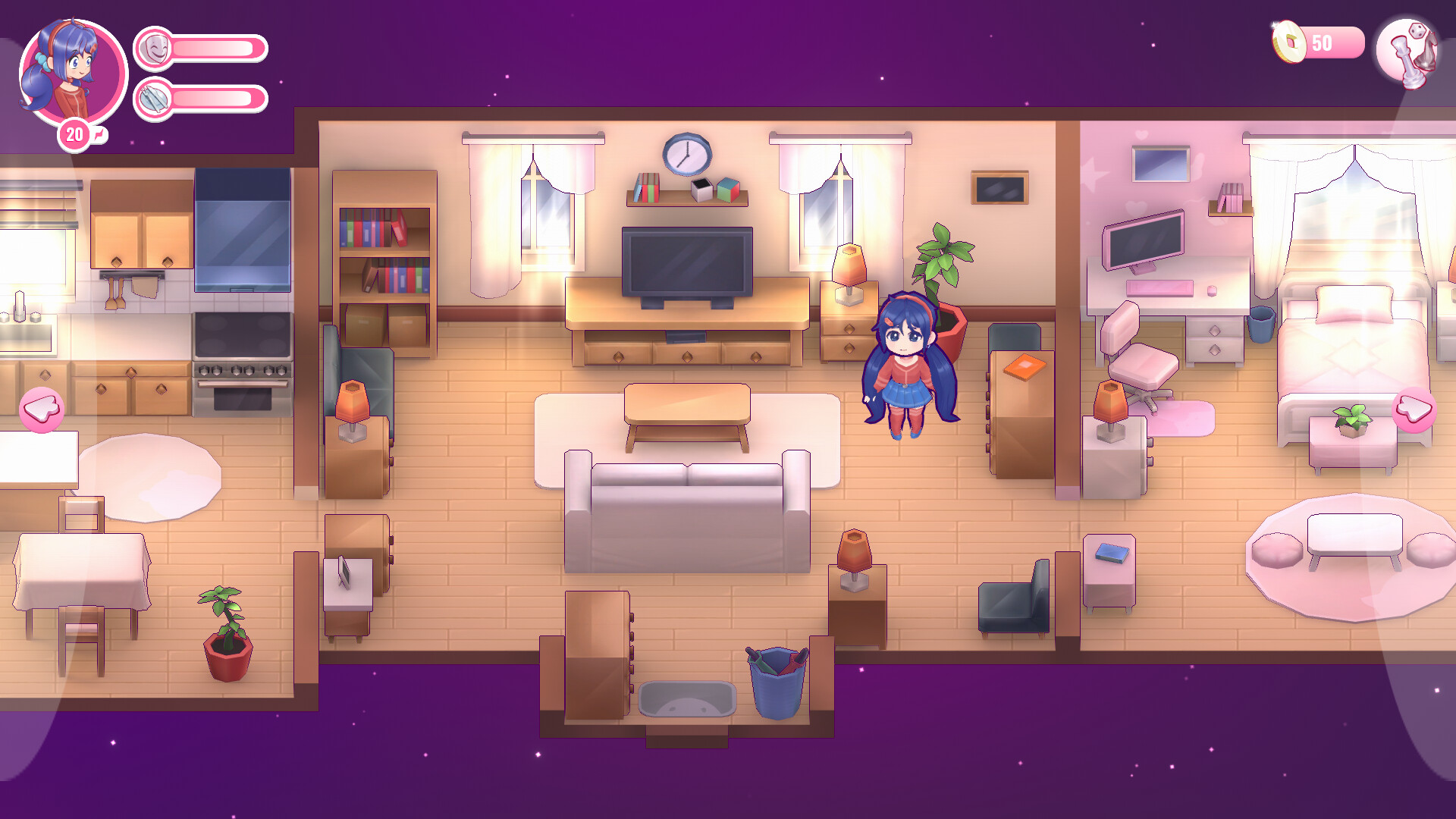
As the first chapter progresses, the horror elements start to kick in. I don’t want to talk too much about the story, as this is the strongest part of the game, and I don’t want to spoil much. There are some other minor gameplay elements, such as light but easy puzzles and some mini-games. You can collect character cartridges for unlockables, but overall there’s not really any reason to replay the game. Despite how repetitive the environments can be (such as Mita’s room), there are some elements when you break through the main game that really get interesting. The “behind the scenes” of the game, or breaking the game’s boundaries, is when things get super weird and fun. There are some short chase scenes, dreamlike sequences, weird monsters, and lots of walking around. The game is paced pretty well, and I appreciate how quickly the visits with each Mita are. Just enough to get an idea of their version’s personality and move on. These end up like little mini levels with a single objective inside of them.
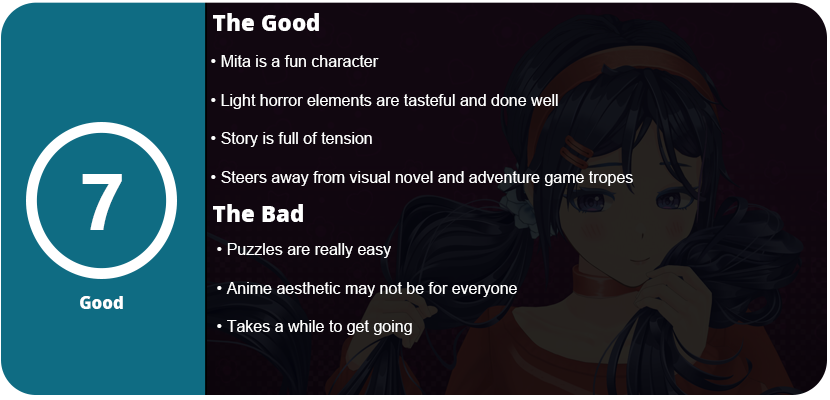
My favorite part about the game is the intensity of escape. You need to break free of this game world before Crazy Mita gets to you. The developers did a great job of giving her some depth, and despite Mita being a single character, her different versions and personalities make her seem like separate characters. The way you interact with the game world in the first chapter determines the outcome of two different endings, and these can easily be overlooked. Interacting with the environment is really strong here, and despite not much being tangible, what you do interact with matters. Visual novels usually can drag on forever with exposition dumping, and this is something MiSide doesn’t do, which was my biggest fear. A lot of the lore and backstory is told as you move on through the game, so things never slow down and bore the player.
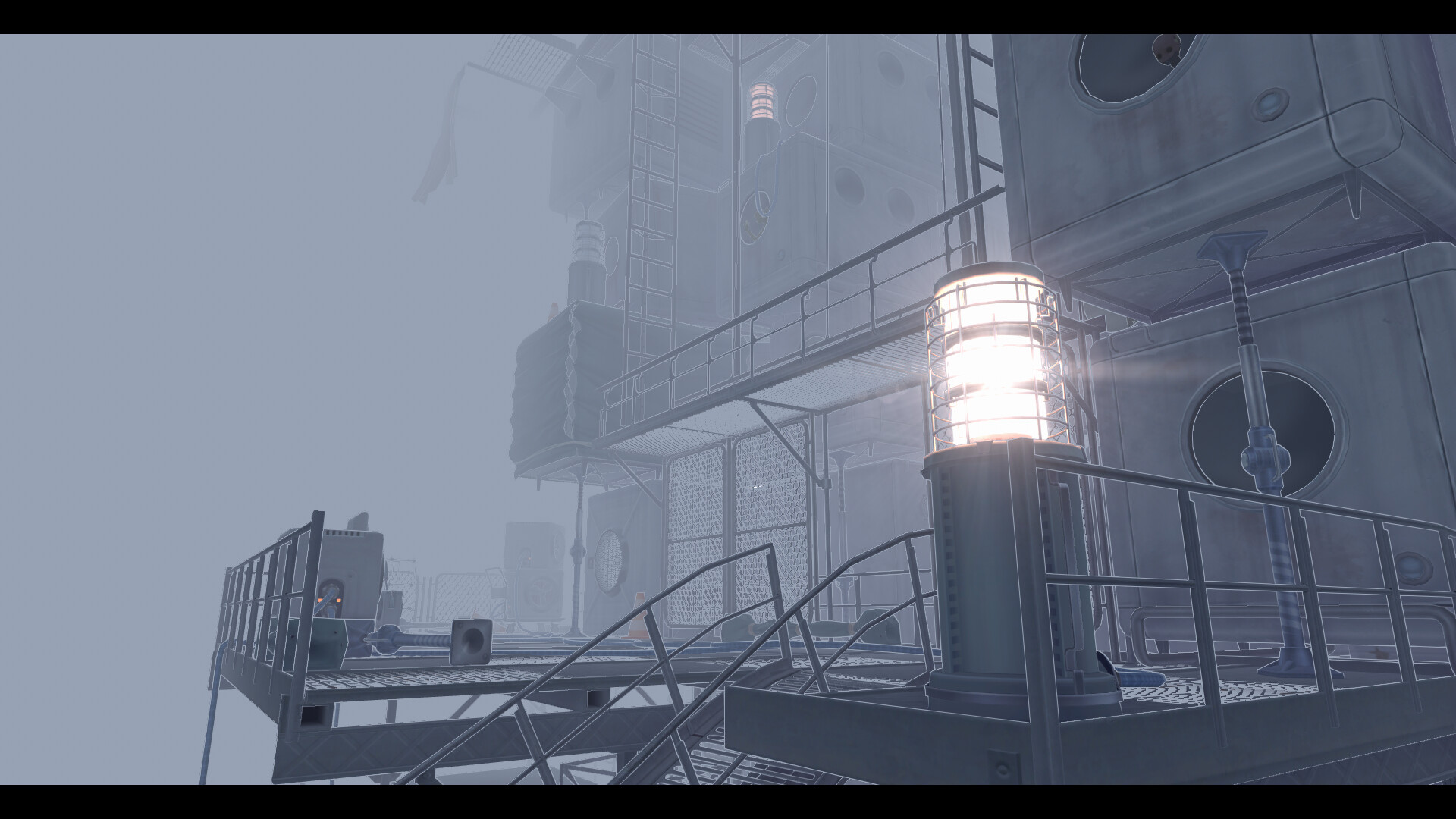
While the visuals have typical anime aesthetics, there are subtle things that make it interesting. It’s very sterile, and the soundtrack is brooding and haunting, like something is just always off. The game purposefully portrays a very fake happy “world,” and despite never being able to see outside of Mita’s room, you know it all feels fake and fabricated, and as you wander outside of the game’s boundaries, you realize this more and more. The game is very claustrophobic feeling, and you can feel suffocated as you feel like you are never going to escape. MiSide does something that good horror movies do, and that’s constantly giving you hope and then dashing that hope moments later. When you feel like all is lost, there’s another silver lining, and you grasp on to that and move along with the story, thinking you finally have it, just for it to happen again. It’s a great way to build tension, and while MiSide is only about 4 hours long, it doesn’t overstay its welcome.
If you don’t like visual novels or adventure titles, I recommend giving this a try. It’s different enough to never veer too far into either genre’s problems or tropes, but if you don’t like anime aesthetics, that may be the clincher for you. The subtle horror elements and constant hope dashing give the story tension and a great feeling of accomplishment. When I was outside of the game’s boundaries, I got Portal vibes, and breaking its own 4th wall is just really cool. The game overall is just fun for an evening of great storytelling.
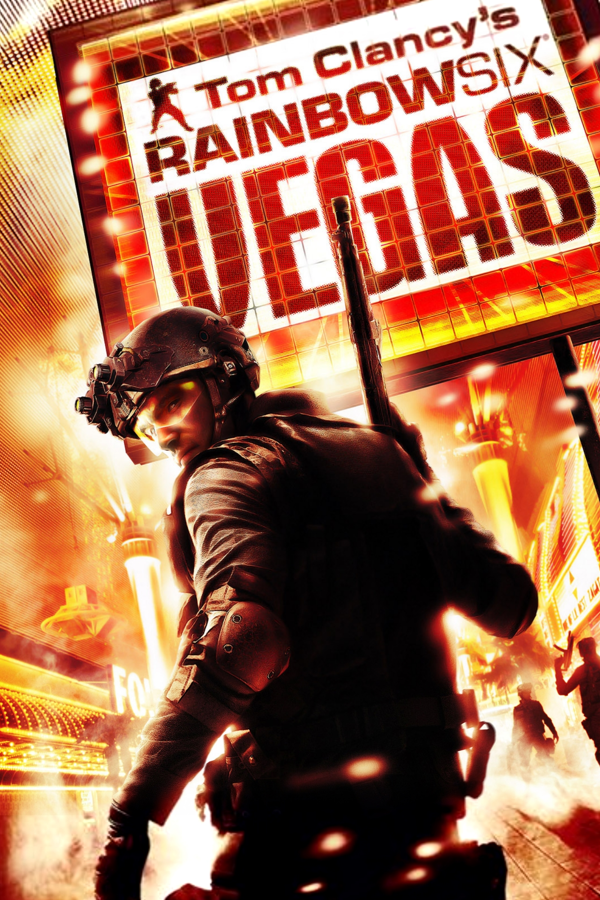
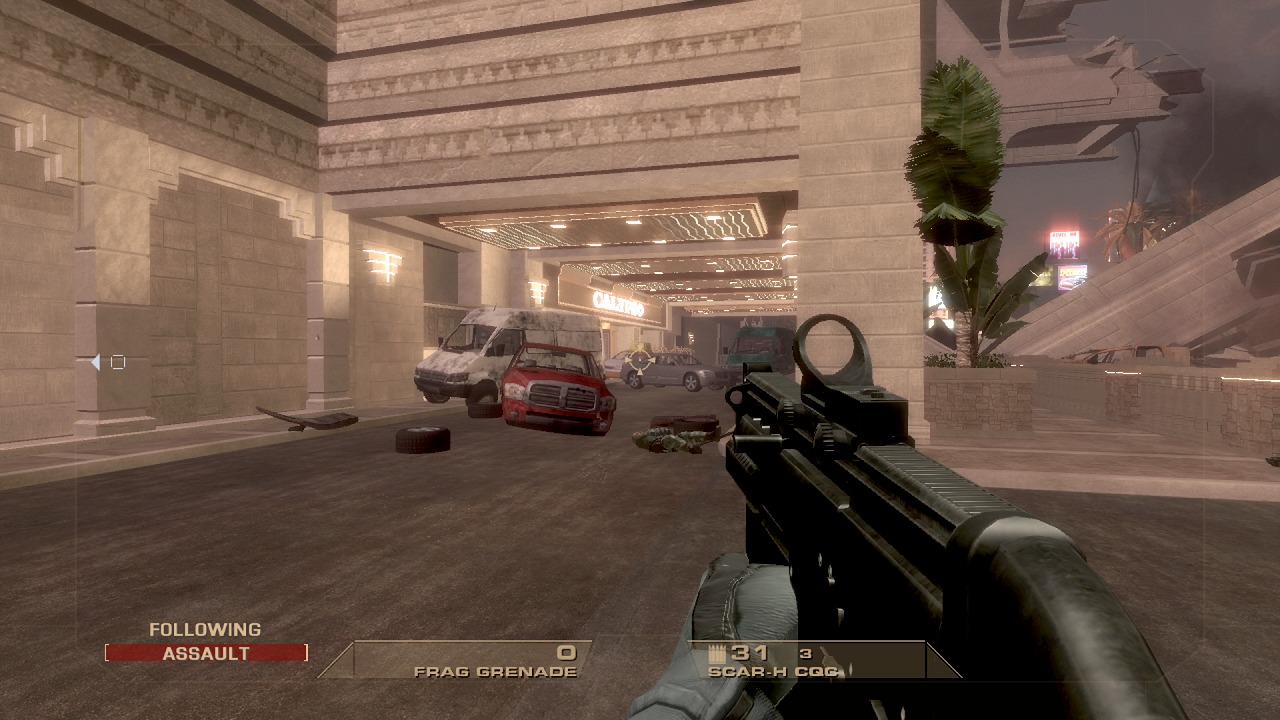
Back in the late 2000s, the Tom Clancy games were on top of the world. Engines that pushed consoles to their limits, great new ways to explore gameplay, fantastic shooting mechanics, and fun multiplayer modes. This was true across all the Tom Clancy franchises, from Ghost Recon to Splinter Cell. Rainbow Six was dormant for quite a few years before being rebooted in the Vegas series. You play as a team of three Rainbow Six operatives trying to thwart a terrorist attack in Las Vegas. Like most of these games, the story is only there to scoot the campaign along and isn’t memorable or anything interesting. There’s maybe a single cutscene per level, and calling these cutscenes is generous. Most scenes involve your operator talking to you via pre-rendered video in the corner of the screen or the Six team talking in a huddle. It’s nothing groundbreaking, but it doesn’t really need to be.
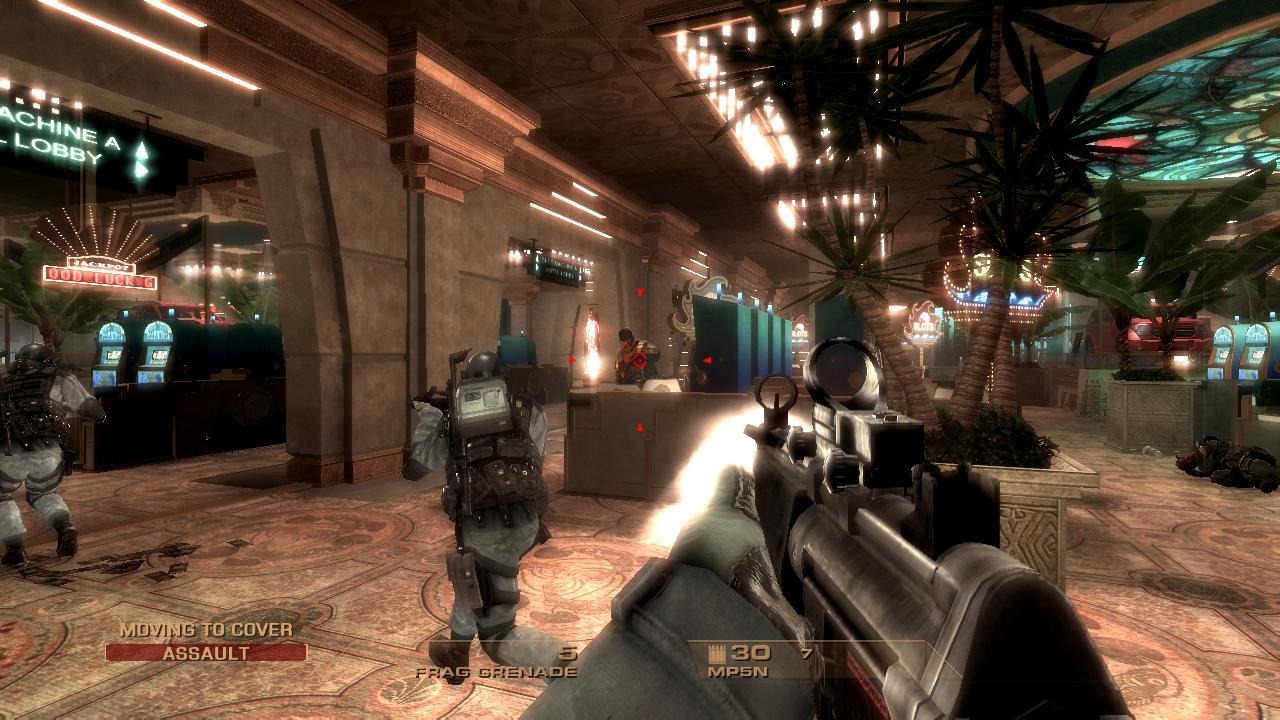
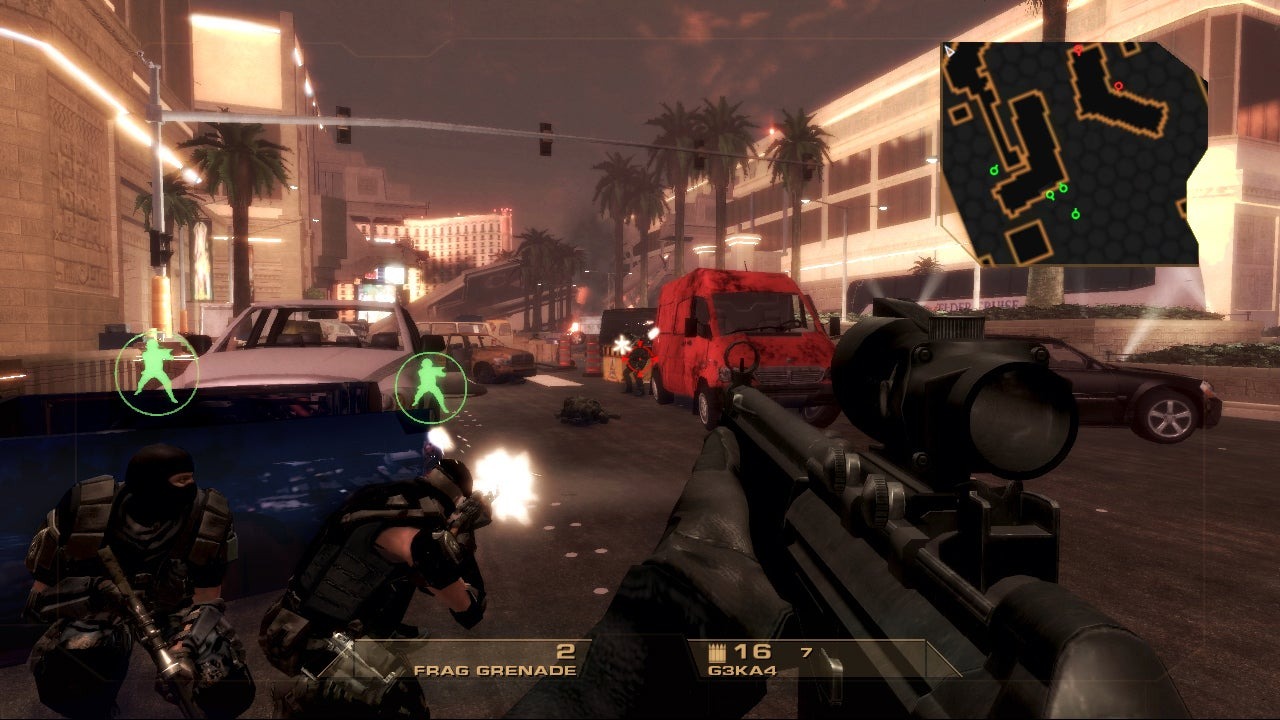
Rainbow Six is a very tactical game. You go in nearly blind and have to watch every single corner. The AI does a decent job in previous games of taking out enemies, and it’s the same case here. You can command your two squad mates to go anywhere with the A button, and an orange highlight will appear. This works great, as you can just point where you’re aiming and always have them scout ahead. We’ll come back to this later. You can order your squad to hold, follow, and stack up on doors, and this is sadly the only tactical part of the entire game that made it through. There’s a serious identity crisis with Vegas, as it can’t decide if it wants to be Call of Duty or Rainbow Six. This tug-of-war is felt in every part of the game, from multiplayer to the campaign to level design.
Going in slow is the name of the game, and that’s no exception even in this more arcadey title. You will die in just a couple of hits, and there are no difficulty options. You need to constantly send your team members ahead around every single corner. Even when you think all enemies are down, one will be hiding behind some box and pop up and kill you. I died dozens of times in this campaign because the levels are just not designed for tactics or even stealth. You can attach silencers to your weapons, and when you do, your teammates will as well. The issue here is once you enter a room everyone suddenly knows your there. Stealth is nearly useless. You can switch from full auto to single shot, which is really useful. Sadly, most levels aren’t designed for a group of three police special tactics officers. This game was designed for the military. Why is Rainbow Six taking down a terrorist group? It makes no sense.
There are many large open areas with tons of hiding spots for enemies. Some areas will have 20+ guys, and remember, you can die in just a couple of hits. You can back off and recover health, and the cover system is actually great. You can buckle against any wall or object and enter a third-person view similar to Ghost Recon: Advanced Warfighter. You can blind fire or pop up and shoot enemies, but the enemy AI feels really unfair most of the time. They can hone in on you from really far away, and their blind fire is too accurate, but mine will barely graze an enemy in a closet. Your teammates are key to clearing out areas by ordering them around staircases, and some micromanagement is involved. You can send them into a room, and they will drop if there are too many enemies. You can revive your teammates with health injections, and these are unlimited, and order a member to revive the other too while you cover them. Some situations allowed for team members to go down at the wrong time and block a doorway. After so long their health goes from yellow to red, and then they die, but you get quite a bit of time to get to them. Enemies can throw grenades and flashbangs, and these are usually only useful in small rooms. They are pretty much useless in large open areas.
The only tactical part of the game is stacking up on doors and breaching them. You can snake cam under a door and tag up to two enemies. You can then order your teammates to breach, frag, or enter and clear a room. That’s it. You can order them up ladders, and you can occasionally rope down the side of the building and turn upside down to shoot inside, which was really fun, but there were only a few times you could do this. Most of the game is just moving from room to room and killing everything in sight, and it gets old really quick. There’s no variation, and you can’t even use the turrets in the game to make some fights a bit easier. I also found that checkpoints were poorly placed. I would need to have a teammate hack a computer, and then I would need to cover them. Instead of restarting before the hack, I would restart two to three rooms back and have to keep clearing them. This game becomes a frustrating chore after awhile because you can’t use any tactics in this game. It’s trying to be Rainbow Six mixed with some Ghost Recon and Call of Duty.
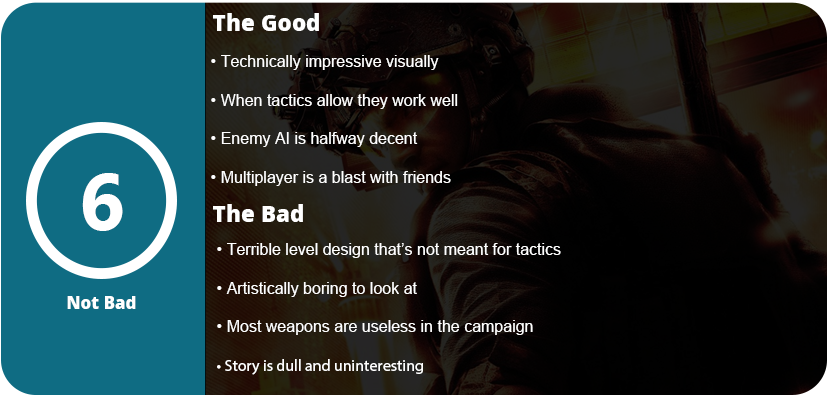
The multiplayer is where the game shines, and while the servers are long gone, you can still get some friends together to play online. I do remember playing the game back in the day online, and it was a blast, but far from what Call of Duty offered. Rainbow Six also looks great technically, even today, but it falls under the same tropes of the era, such as too much bloom lighting and everything being brown and gray. This is a very ugly game to look at artistically, even for a realistic shooter. Sadly, there’s not much value in playing this first game today unless you want to be a Rainbow Six completionist or get an idea of how far the sequel came along. The campaign lasts about 4-5 hours, and then it’s over, leaving you frustrated and wishing there were more tactics to get through the game and die less. You won’t come away happy or inspired in any way. Most people won’t even get through the first level without dying 20 times due to the identity crisis of a Rainbow Six game trying to be Call of Duty.
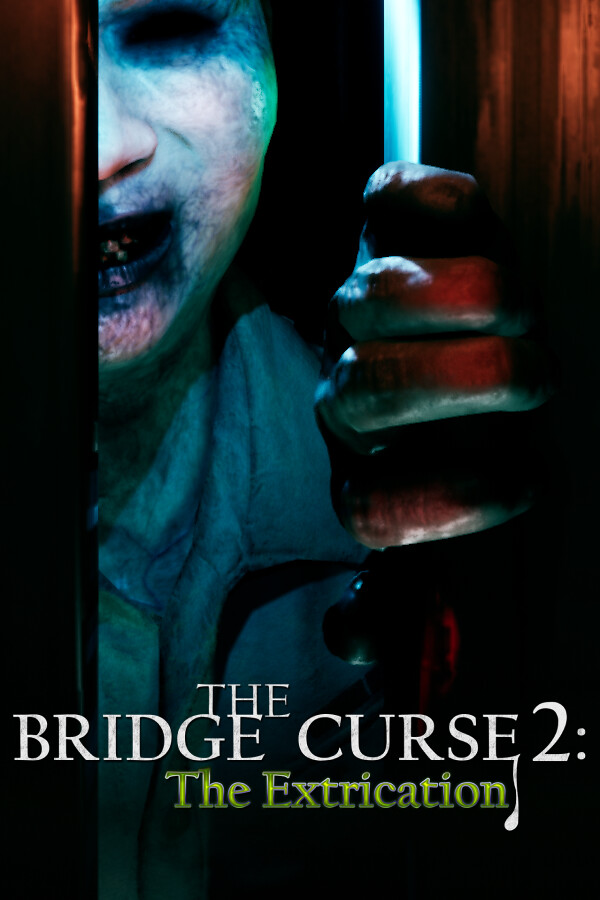
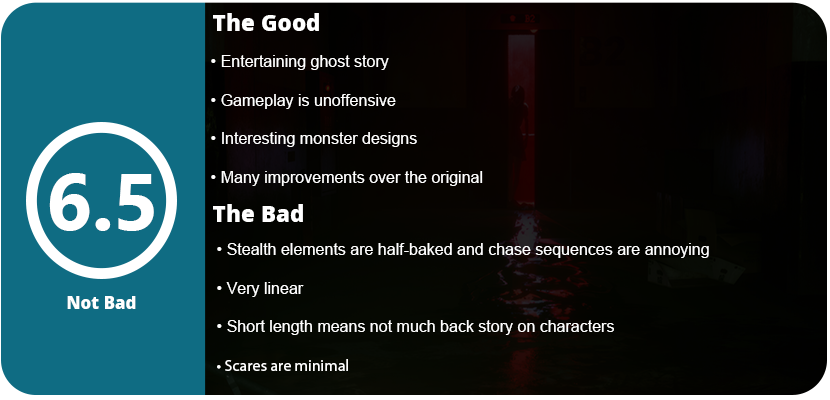
We are back again with another university ghost story. Another student film project raises the question of whether you are playing the film or experiencing everything in real time, with the film resulting from this. Wen Hua University is the location, and the developers did a much better job setting up the ghost story than the first game. This is much more a walking simulator than a survival horror, and that’s fine. You play as four different characters. A reporter and then three film students. It’s a bit more compact than the original game, and there isn’t the issue with the final section feeling like a maze. The environments are more varied as you get whisked away to the university from the past a bit, and it feels much more like a ghost story.
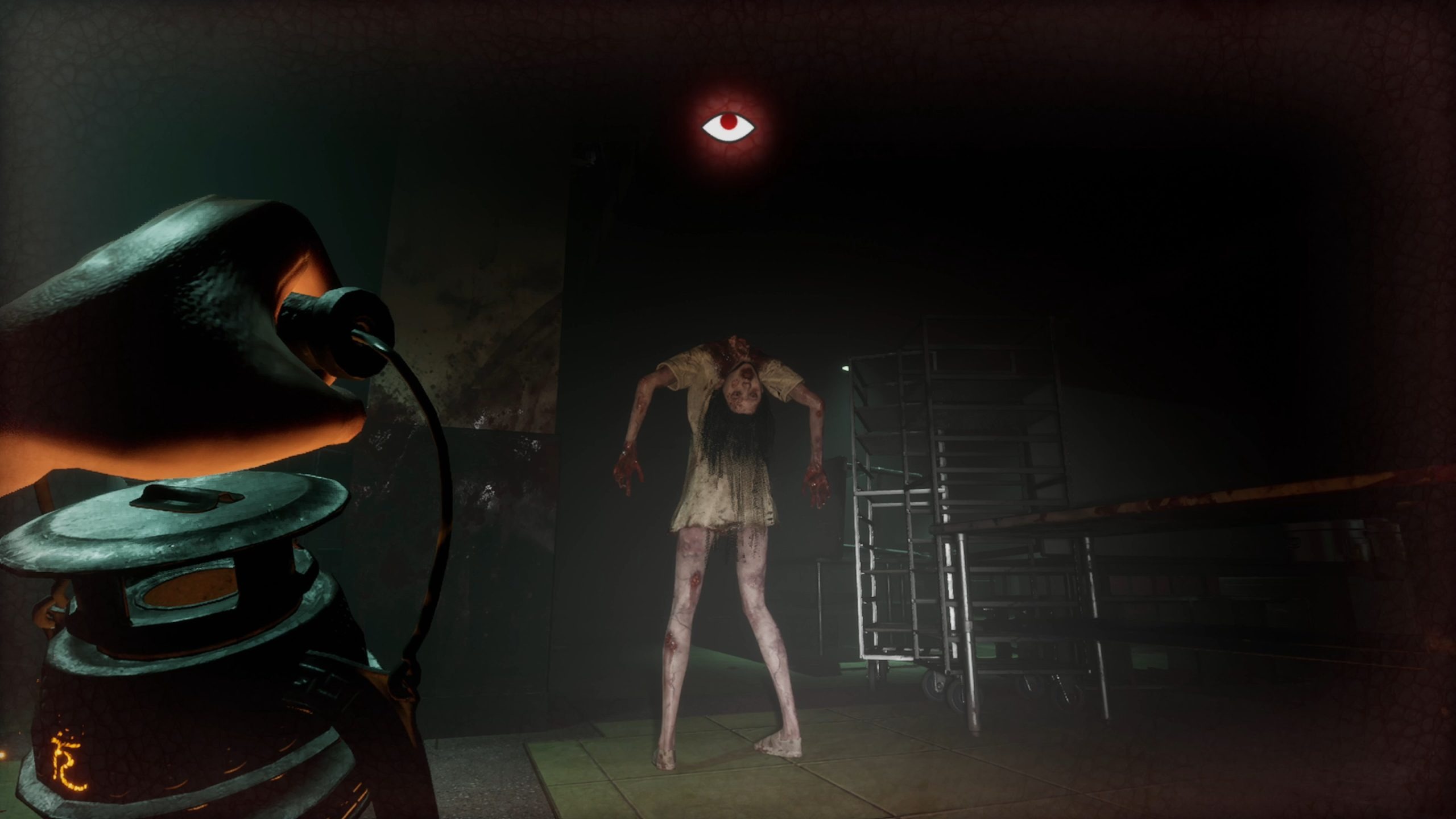
There’s not much action or many controls in this game. You wander around, collect the occasional item, and there’s usually only one way to use it. There are some puzzles in this game, and they aren’t that great, but they work. A few are a bit interesting, but the more elaborate puzzles tend to be really easy and not offer much of a challenge. The only real gameplay part is the stealth with the lantern. You get a lantern in about two scenes, and this is used to hit an enemy to stun them (and then needs recharging) and to get rid of obstacles blocking your path. It’s not frustrating as these scenes don’t overstay their welcome, but stealth is pretty much pointless. You’re better off running around and just figuring it all out. The only real frustrating section was towards the middle when I had to run around a maze of rooms and place a fuse into boxes to open doors in a certain order while an entity chased me. I really just didn’t like the chase sequences. Some sort of ghost will follow you, and it usually means figuring out some sort of maze.
The best sections of the game are during monster reveals. There are quite a few cool ghost designs, and the areas you are in constantly change. The game thankfully doesn’t exposition dump on you, and you kind of learn the tale of the university as you go along via some cut scenes and reading notes scattered around. The tale isn’t anything new, as you are seeking revenge for a scorned spirit (which is typical for these types of games), but it’s still fun nonetheless. The pacing of the game works well, as it constantly keeps you interested in something. Each section either has a puzzle or story element without making you wander aimlessly around object hunting. A lot of scenes can repeat, but they are interesting to look at and feel like less “generic buildings and hallways.”
Sadly, the short 4-hour runtime means you don’t get to know much about the characters. They clearly all have different personalities and have some fun banter back and forth, but there just isn’t time to develop this. The only character development is during the initial opening scene for each chapter, and then it’s just running around with occasional dialog. This is always the sad part about these very short indie games. There just isn’t enough time to develop a relationship with anyone or anything. At least the visuals are halfway decent and are a step up from the original game. While it won’t blow anyone away, there are some cool effects and great lighting.
Overall, there’s just not a lot to say about The Bridge Curse 2. It’s a remarkable improvement over the original game but still lacks in some areas. The short length means no character development, and while the monsters are cool, there’s little scare here outside of just tense atmosphere. The story is at least very fun and the pacing is great. I never felt bored or uninterested in the game. I played the entire thing straight through because the tale of the university is pretty interesting. The puzzles are middling at best, and the stealth mechanics are half-baked. What’s here is a deep discount of one evening of entertainment, and that’s about it. I’m still looking forward to seeing what the third entry brings.
Advent Rising is one of the most infamous video game development disasters ever documented. Its release was at the end of the Xbox’s life cycle, and it got buried under the hype of the Xbox 360. I personally heard about the game, saw the terrible reviews, and ignored it. In 2005 I didn’t own any Xbox consoles, so I didn’t care as a PlayStation 2 and PSP owner. I also purposefully didn’t do any research into this game and let my memory of 15 year old me thinking this was a large RPG saga like Knights of the Old Republic make the decision to buy this and play it. I even bought the physical strategy guide, thinking I was in for a 30-hour adventure. This is one of those rare moments I wish I had looked into the game first. Sometimes the idea of not doing research for a surprise is not fun.
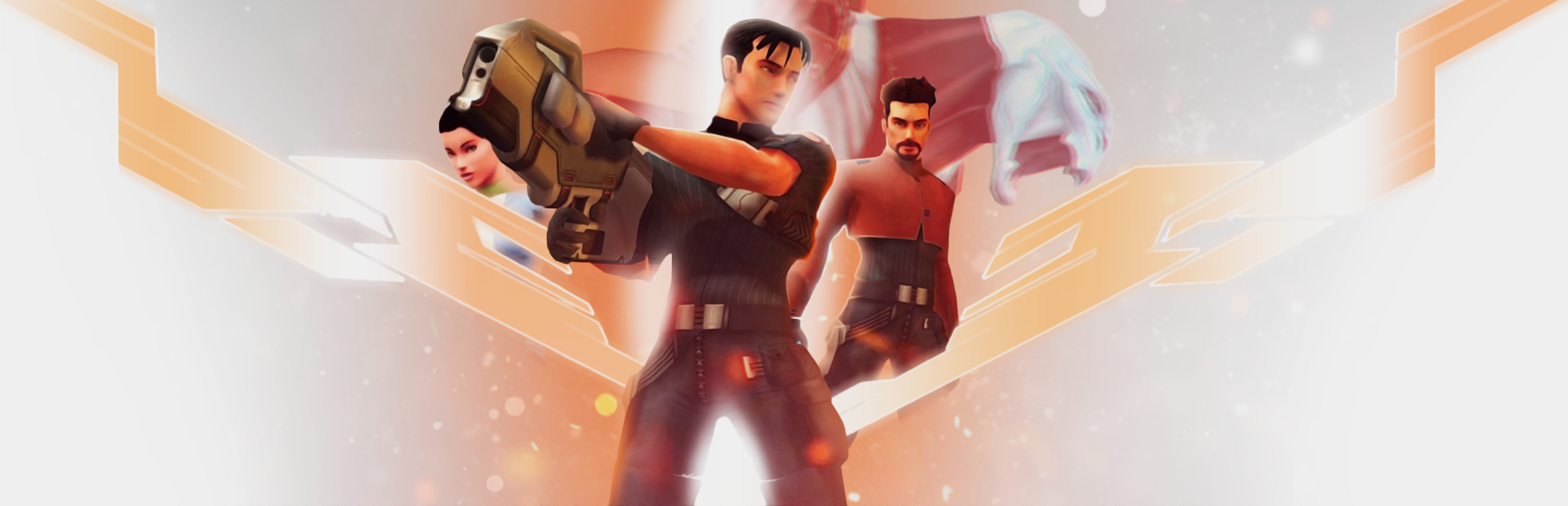
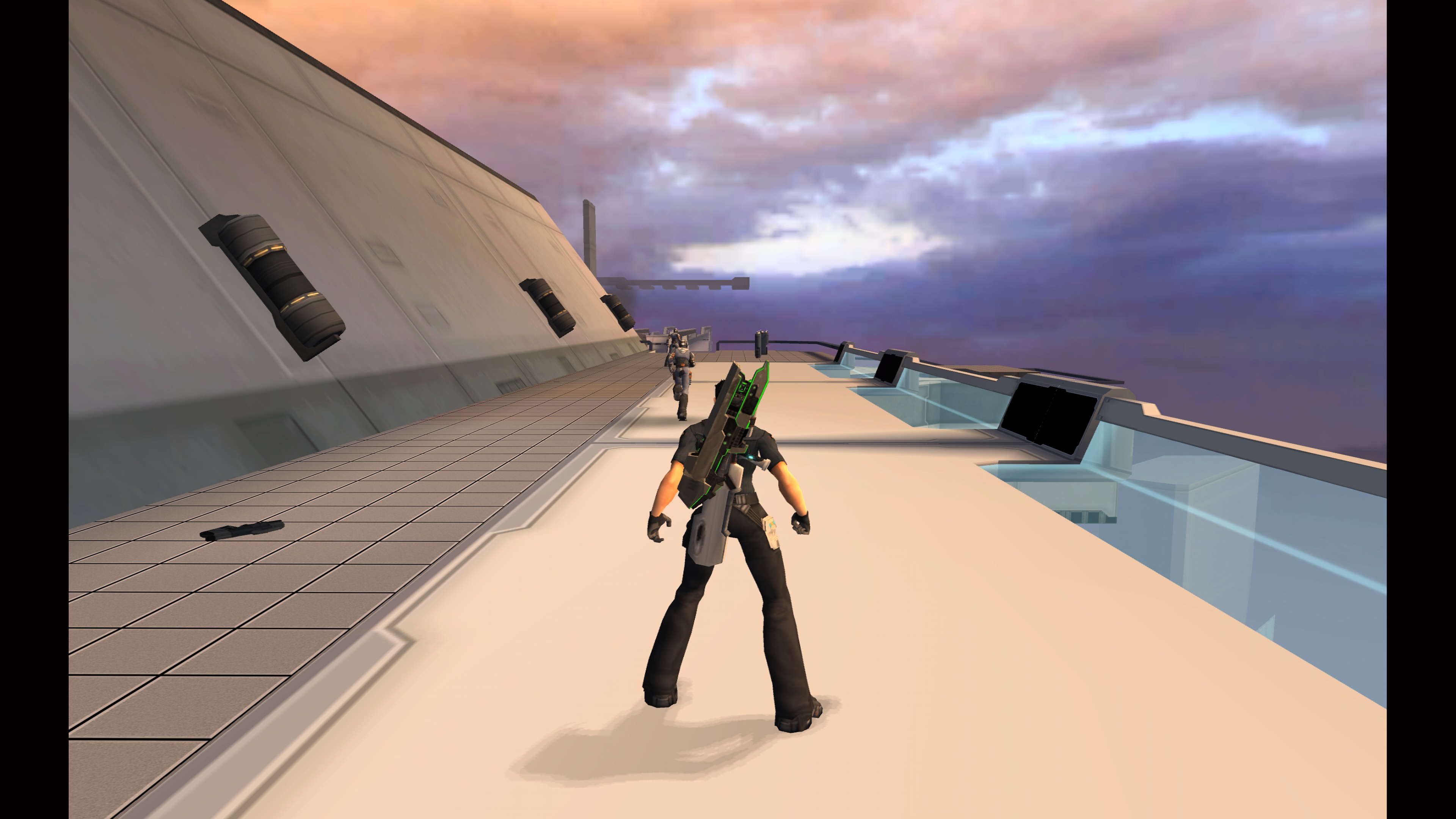
You play as a stereotypical young cocky sci-fi pilot who falls in love with every woman he looks at, and everyone seems to hate him. His older brother is a well-recognized pilot. The game has a, new for the time, cinematic opening, but not cinematic gameplay. This is a very early 2000s 3D action game that struggled to find its identity and gameplay style, and everything in this game is poorly executed. It’s obvious after about 1 hour into the game that most of the focus was on designing the lore, characters, and many cut scenes, but we’ll get that soon. Right off the bat, the lead character Gideon is a terrible character and completely unlikable. He’s just obnoxious and so stereotypical for the time. I honestly wished his older brother was the main character instead. The opening scene is probably the only part that seems to have been made as intended. As you are driving your space shuttle to a docking bay, there are tons of spaceships entering and leaving, credits flashing on screen, and radio chatter, and it feels like what modern games currently do. As soon as you enter the space station, the rest of the game goes to complete crap.
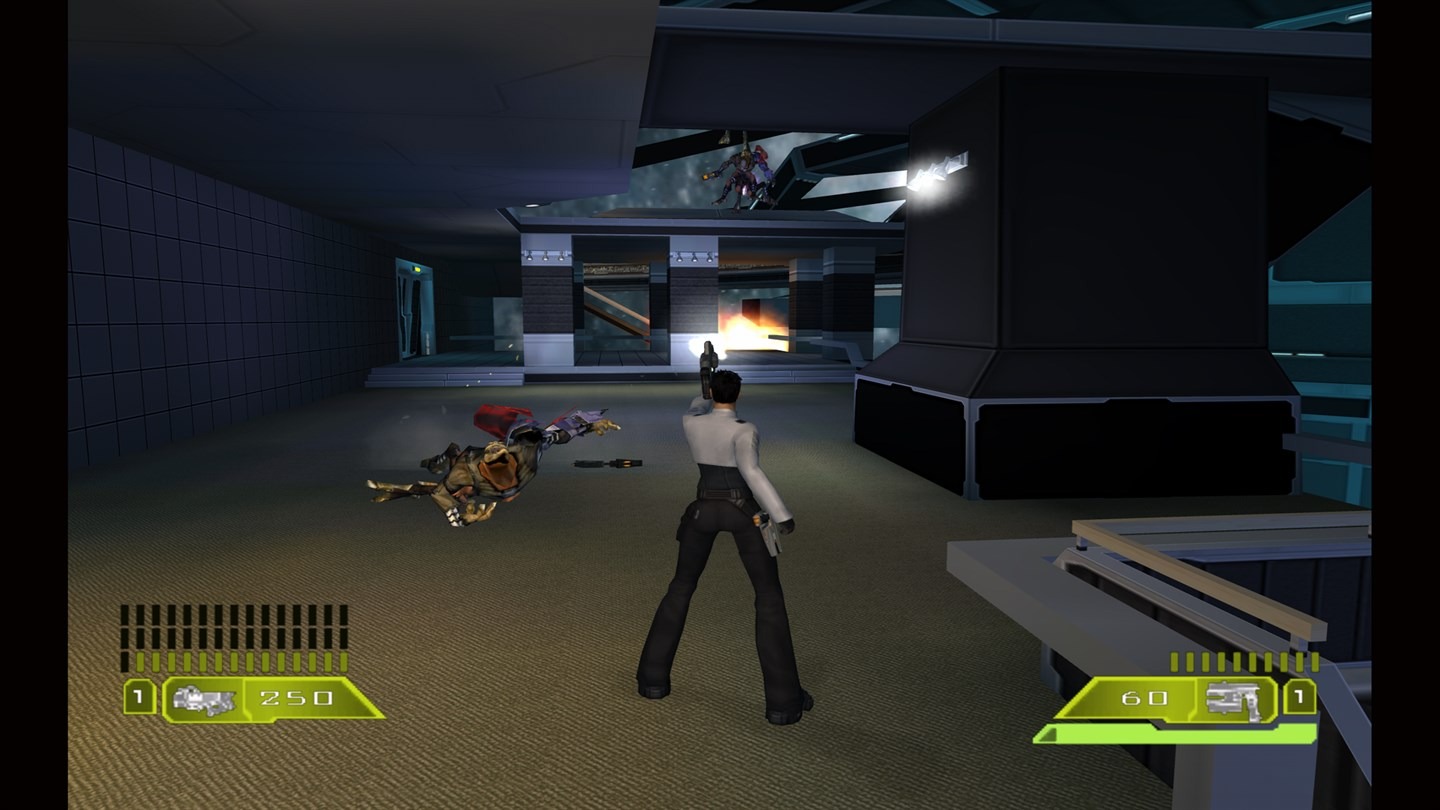
The game controls are like absolute donkey dung. Gideon runs around way too fast for the small and cramped interior areas, but later on you get completely confused after the first level’s design. You play the usual early 2000s tutorial level disguised as a training competition to learn the controls. They are awful. The game uses an auto lock-on feature, so Gideon’s arms are swinging all over the place like a madman, aiming each arm at an enemy, which is pretty neat. The lock-on feature actually works, as he will lock on to whichever enemy is closest. What doesn’t work is you can’t release the lock-on. The camera will face toward whatever enemy is locked on, even if you are running towards the camera. This can lead to frustrating blind deaths from falling off ledges and into death traps. The only way to play this game is to blast everything in sight with whatever guns have the most ammo. There are clearly other ways the developers had in mind. Each weapon does something different. From slow-shooting plasma rifles to rocket launchers, but you won’t care when switching weapons is a complete chore. The dodge button is the same button for equipping in the left hand. The left equip is X, and the right equip is Y. This makes no sense. Other games did this better, like Halo before it and even Splinter Cell. Equipping weapons doesn’t need to be complicated.
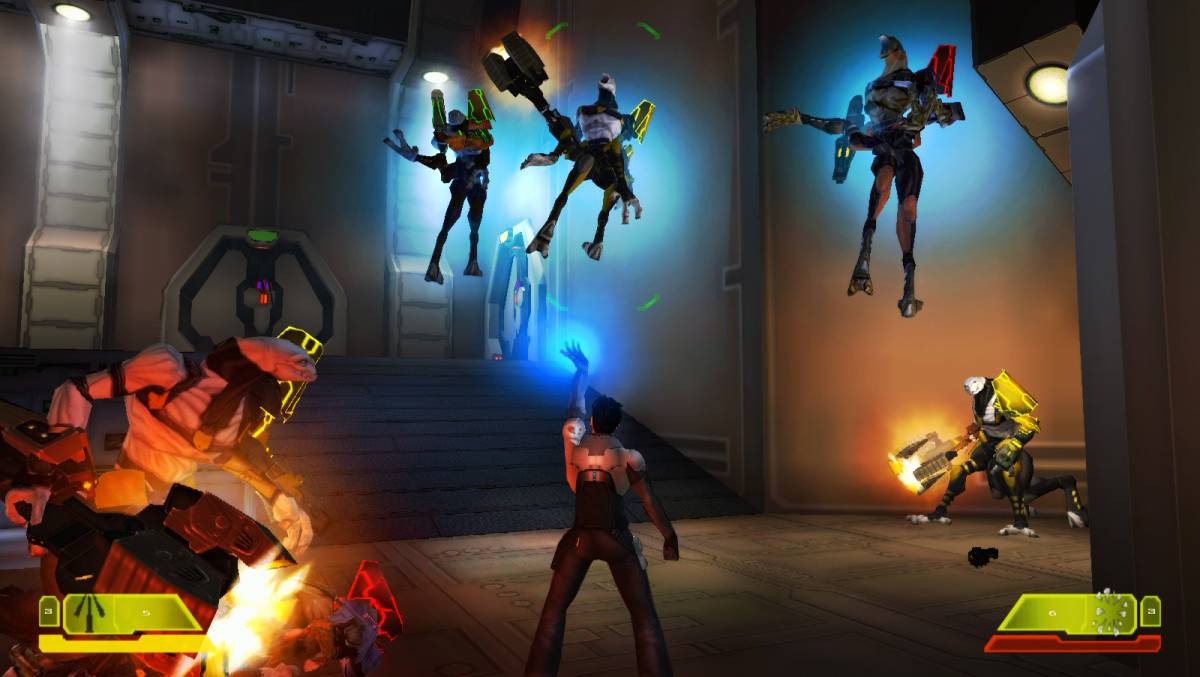
I just lived with blasting everything in my path since it didn’t matter. Once I realized that the current enemies coming at me weren’t dropping ammo for my guns, I picked up their guns and just repeated this so I never ran out of ammo. Enemies come in many waves, and clearly the combat system they had in mind didn’t support this type of combat gameplay. When you’re blasting tons of enemies, you can’t stop and think about which weapon is good in each situation. All enemies attack the exact same way. There are some larger enemies like giant mechs or taller aliens that use a staff to deflect bullets back at you, but that’s it outside of the few bosses there are. Later on the game introduces a bunch of psi powers, and clearly this was not designed around the current working combat system because they are all completely useless. Switching to them is convoluted by pressing the D-Pad to select the power and then pressing X or Y to equip that power into the left or right hand. The game slows down in the background, but then you might want a gun in another hand. So, if you accidentally equip a power in the gun hand you had, that’s another step of finding a gun, pressing the correct button to equip, and then realizing the powers don’t matter.
There are a lot of psi powers, and most of them are given to you in the last two chapters of the game in rapid succession. You can lift, push, and throw ice spikes, laser balls, and even a shield, but they all fall subject to the terrible lock-on system. In theory, throwing stones and objects at enemies is a great way to save ammo, but you end up locking on to every throwable object in the game, and then the camera swings around to lock on to something else, and you have to just guess where the enemy is and fling the right stick towards said enemy, hoping the object lands. This also goes for lifting an enemy up and throwing them. Other games did this better. The shield is completely useless when it’s not much wider or taller than you, and bullets can hit you underneath it as it floats in the air. What were they thinking? Powers and guns level-up by just using them, but there’s no experience bar. It just happens. Weapons supposedly get more powerful, but I didn’t find this to be the case. This is clearly an unfinished idea.
The story itself is fairly intriguing. Aliens worship humans as gods, and the race of Aurelians wants to protect them from the Seekers, but their own race is divided politically on sacrificing the humans to save themselves. There are some plot twists of betrayal, but in the end this lore is never explored because there’s nothing outside of cut scenes. No dialogue between characters, no logs or documents to read. Nothing. The voice acting is also hit and miss. There are many actors who went on to do other things. For example, the voice actress for Olivia, Venessa Marshall, went on to do voices for more games and Wonder Woman for the current DC cartoon series. However, the characters are just not likable. The two female characters are treated like garbage by Gideon, and they get dismissed constantly. Every woman is wearing crop tops and low-cut pants, but the men are in full armor and gear. It’s just very much a product of its time. The industry has matured and grown since then. The alien races have interesting designs but only appear in a few cut scenes.
Let’s talk about the terrible vehicles. They are all floaty and don’t have acceleration physics, so to get over hills you have to use the boost feature, or you will just end up stopped. This boost feature pushes the vehicle by borderline teleporting it, and I also get stuck on every wall and object imaginable. Many games did this better too, like Halo. When you’re not shooting endless waves of enemies, you have to contend with awful platforming, as you will get stuck on objects, not grab onto walls, or fall into pits because an enemy jumped towards you at the same time. The game was only playable because the lock-on system worked well enough to just blast everything in sight, and I didn’t have to aim at enemies.
This leads into the terrible level design and lack of cohesion with the actual story and cut scenes. It feels like the cutscenes were made before the levels. There’s also clearly rushed scripted scenes as I would drive a car through boring empty tunnels and streets with the occasional falling bridge. Clearly, there was meant to be more. Where are all the people? Where’s the chaos of the war with the Seekers? There are cut scenes showing people running out of a city, only for me to suddenly find myself in a vehicle with nothing around. I would run through an enormous empty outdoor area with nothing but enemies coming at me and nothing happening in the background. It feels completely unfinished. These levels felt as if they were hastily inserted between the pre-existing cut scenes, making the transitions feel jarring. Gideon would be up against a wall, leaning around a corner with a pistol out, and I would then just be standing in a hallway with nothing that was in the cut scene around me. No one was screaming or running around. Just a dead empty hallway with a few enemies. It was so jarring.
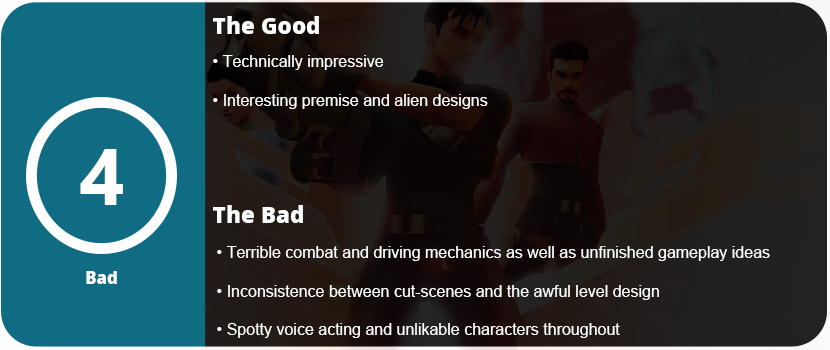
The game is an absolute masterpiece of what not to do. The game is completely unfinished, broken, and buggy. Music will randomly stop playing. Sound effects won’t play at all, and the music will. Falling through floors and getting stuck on objects, forcing checkpoint resets. Even the need to not kill most enemies and just run to the next area for a cutscene to play proves that these levels were shoehorned in between already made cutscenes at the last minute. The levels are boring despite the game being technically impressive at the time with huge chunks of geometry and long draw distances. There’s clearly love here in the beginning, and the game just didn’t evolve into more than AAA slop that would be the future of gaming.
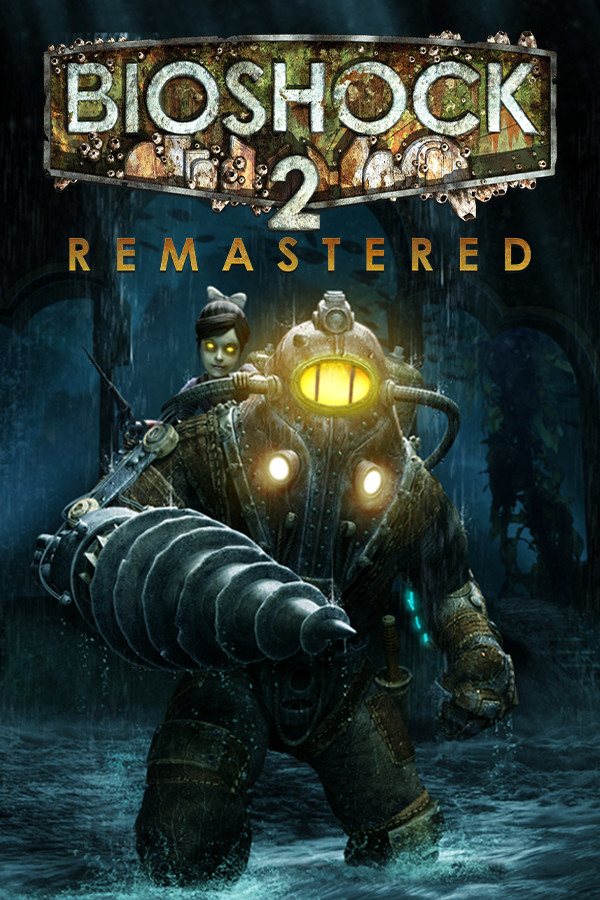
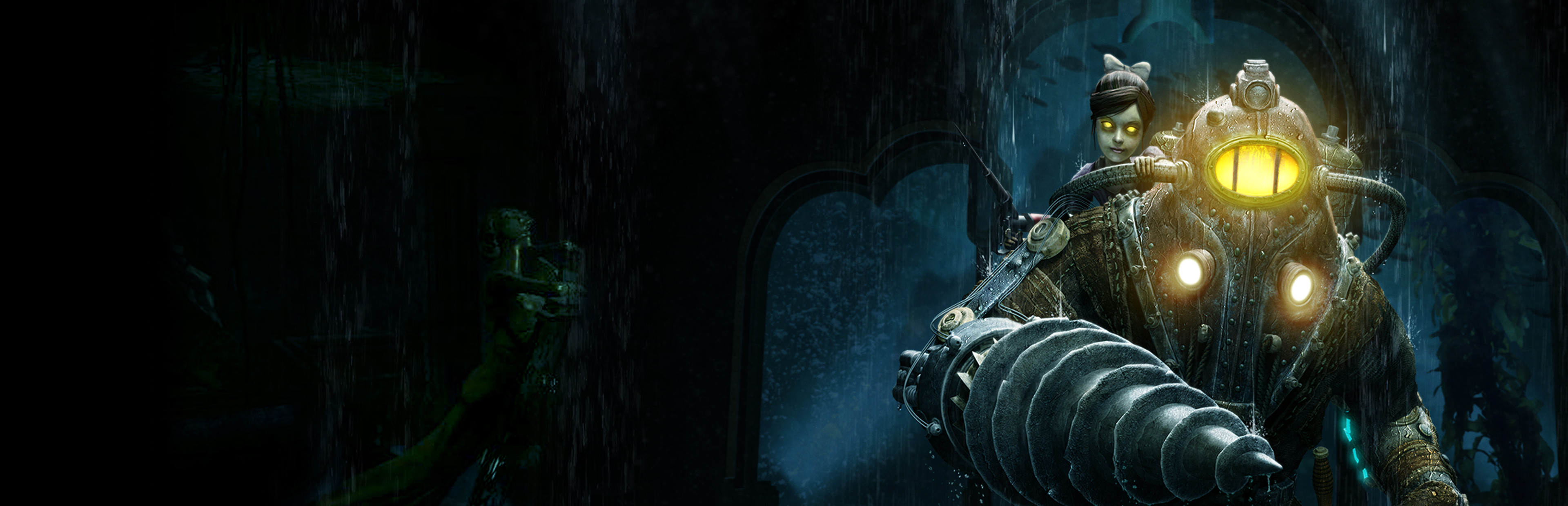
Is a man not entitled to the sweat on his brow? Well, I don’t know honestly. That would be what Andrew Ryan would say, but he’s gone. Several years after the fall of Ryan and Rapture, you awaken as the Big Daddy, Subject Delta, on a hunt to track down Eleanor Lamb. The new antagonist is trying to finish Ryan’s legacy and eliminate everything that was inside Rapture. Little Sisters play a bigger role in this game, as you are a Big Daddy now and need to protect them. BioShock 2 was never my favorite in the series. While I have the original Xbox 360 Collector’s Edition box sitting in a cabinet, as I adore the series anyways, there are some qualities to this game that I do prefer over the original. Sadly, the pacing and story aren’t one of them. BioShock 2 attempts to appeal to more casual action-oriented gamers of the time by including a multiplayer mode. This was 2K’s desperate attempt to make a Call of Duty out of the series, and it failed miserably. Many resources that could have gone to the campaign were wasted on multiplayer that no one played. The Remaster removes this feature, and it’s not missed.
While the beginning of the game starts out similar to the original with really good atmosphere and scripted story beats, the game quickly falls apart after that. Maybe “falls apart” is too strong, but it loses what made the original so well loved to begin. The slower-paced storytelling that takes its time and uses visual cues to tell the story is mostly absent. Instead we are bombarded with tons of exposition over our radio and bounce between Sinclair himself and Lamb. The sequel treads some too familiar ground by having a unique boss in each level that you must defeat. Each one has a personality quirk, but none are as memorable as the original.
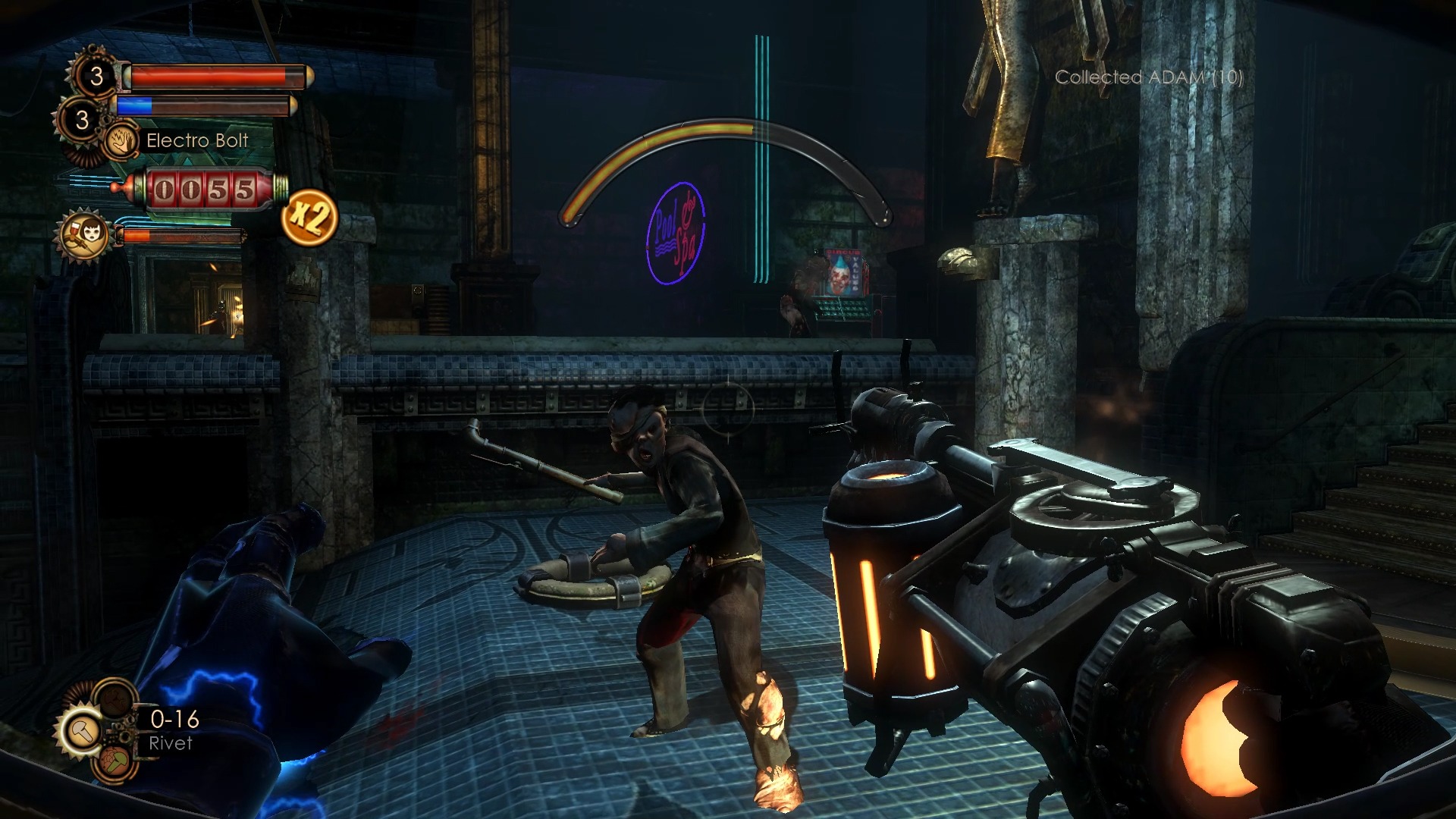
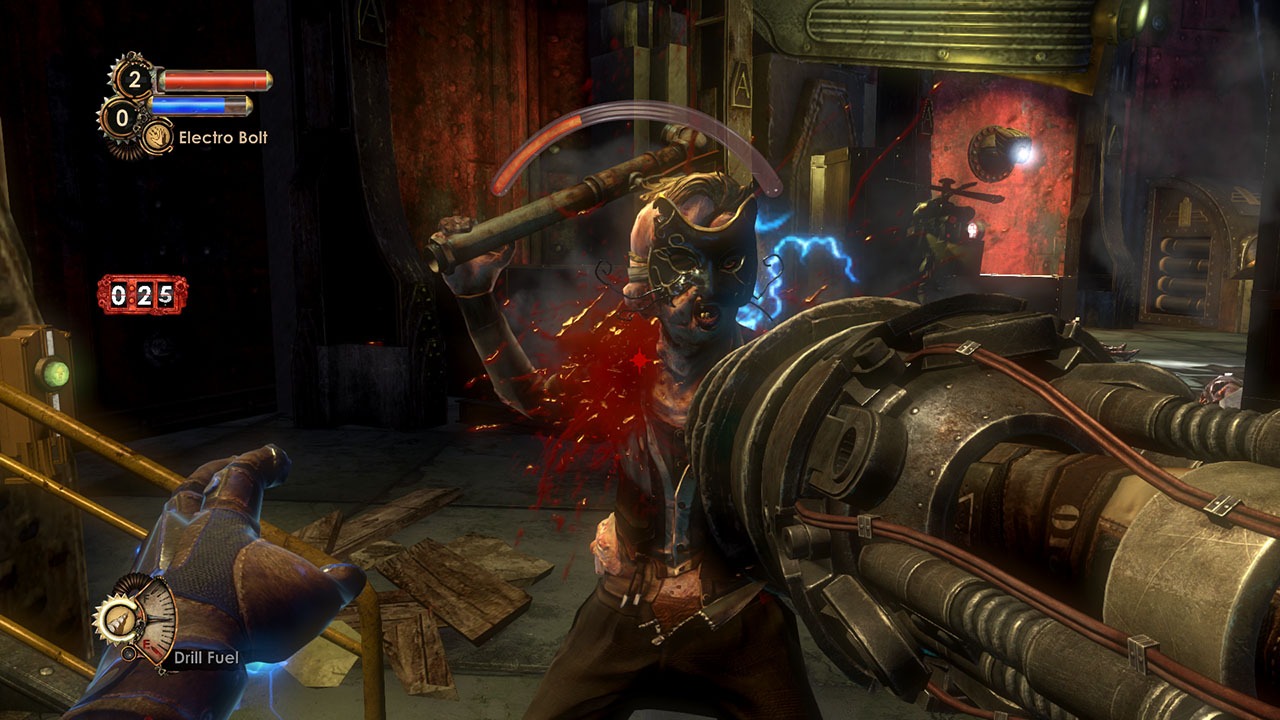
We get a whole new arsenal of weapons this time around, and they feel great. There are still three selectable ammo types, but the only gun that stayed was the grenade launcher. A quality of life improvement is the removed need to reload when selecting a new ammo type. There is a new minigun, hacking tool, rivet gun, double-barrel shotgun, speargun, and drill. The drill is your main melee weapon, but it uses fuel. It’s pretty powerful and can be augmented with tonics. The downside to this new arsenal is that it’s still not suited for the close quarters combat of Rapture. I found the speargun nearly useless, as there’s no long-range combat in this game that requires it. Towards the end of the game the rivet gun (even fully upgraded) starts to become less useful. I eventually stuck with the minigun and shotgun. Each weapon can now have three upgrades, but you can’t fully upgrade every weapon. There are 16 upgrades in total, but only 14 upgrade stations. It doesn’t make any sense. While the shooting feels a little quicker and better in this sequel, it still doesn’t solve the fundamental issue of the arsenal being correct for all of this close-quarters combat.
Hacking has been replaced with a simple meter now. You just press a button when the needle is over the green bars. It’s a huge quality of life improvement over the original’s full mini-game for each hack. Hacking can add a bonus sometimes if you press the blue bars. It can drop a free item or add cash to safe hacks. The hacking tool can also drop mini-turrets to help in battle, which is nice when covering Little Sisters. These are technically optional (outside of the first level). You can fight off another Big Daddy, take the Sister, and have her gather Adam at two different locations. You then get the choice to adopt them at a hidey-hole or harvest them. You can even choose to just harvest their Adam after fighting off the Big Daddy too. No need to gather, but you will be solely relying on your arsenal and limited plasmids, and that’s not recommended. Plasmids are easier to use this time around, and each one has two upgrades, but there are no new ones in this game. In fact, they took some away, such as Sonic Boom and Insect Swarm. Instead, we can now equip up to 20 gene tonics, which seems a bit overkill. These are also mostly all the same, with a few new additions in regard to hacking.
The research camera is back and probably more annoying. You now record video, and how you defeat the enemy determines the points. You are required to change things up and not kill an enemy in the exact same way too many times, or points are reduced. The problem is you need to keep re-equipping the camera for every enemy, and it gets quite old. I wish this feature was removed entirely. You get damage bonuses for complete research, but it’s only necessary on the highest difficulty. The game overall is much easier than the first game, offering little challenge. There are a couple of new enemies, such as Subject Alpha Big Daddy and Mutant, that are similar to what Frank turned into at the end of the first game. The splicers are all the same with no new additions, which is sad. I find the addition of two new bullet sponges to be kind of useless. While combat feels better in this game, it’s not evolved in any way at all. It does get kind of old by the end, especially if you played the original game. Ammo is too plentiful, and you’re no longer scrounging for ammo. You feel like an unstoppable war machine.
Story beats are also too similar to the first game. You go in, shoot some bad guys, press some switches, gather a few items, and then kill the boss. Plasmids’ tricks are also not changed up with oil, water, and explosive tanks everywhere. There isn’t even a lot of ice in this game. While the combat feels better, it’s been dumbed down a lot, and so has level design. These areas all look and feel the same. While Rapture does feel older and more aged, and it nails the look of this, the entire game just feels like one long level. Nothing is set apart, and it all feels too familiar. There’s a lot of exposition and interesting bits in the audio logs. There is also a new “morale” system that lets you either save or kill certain key characters in the game, but it doesn’t alter the ending that much. Gathering ADAM with Little Sisters isn’t as fun or exciting as it could be, and things only really get changed up towards the very end of the game in the last level.
Overall, BioShock 2 Remastered doesn’t really remaster much, like the first title, and the sequel in general is the weakest of the trilogy. While improving in some areas, others are sacrificed, such as a shorter campaign, retreading old ideas, and making combat feel better but less exciting. It’s interesting to play as a Big Daddy, and the first level in the game nails this perfectly. The pacing is nice, and the design is atmospheric, but nothing ever changes the pace or level design. Levels in general feel more cramped, and with the additions of larger enemies and more of them, the weapons you get still don’t fit the bill. If you played the original, then go for it. There are some questions that are answered. It really feels like an expansion pack rather than a true sequel.
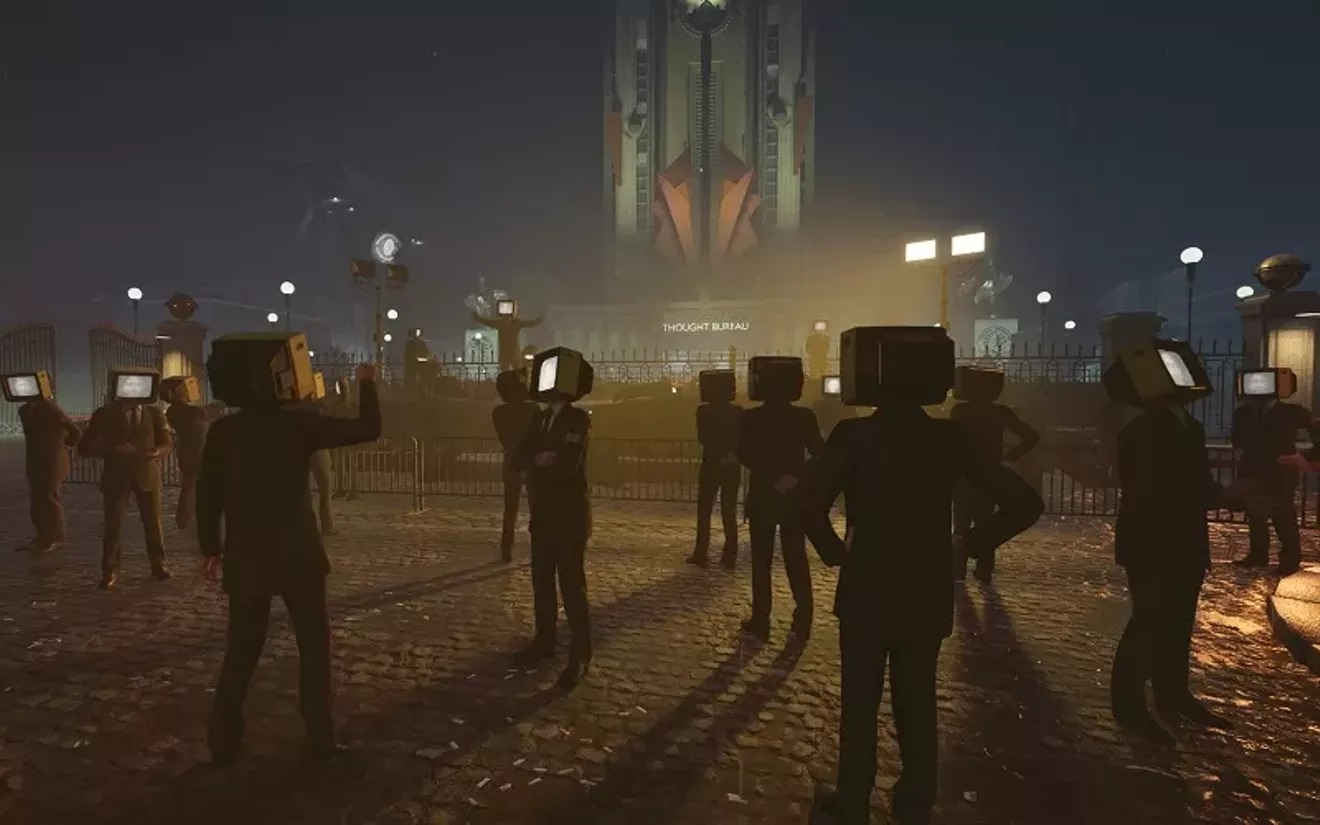
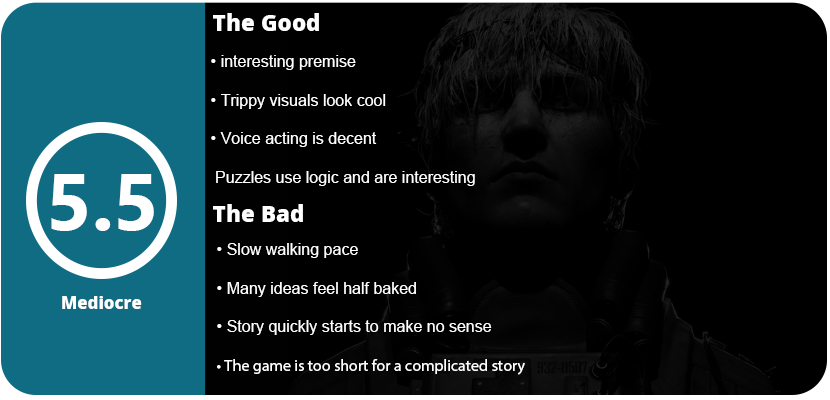
I don’t know how many times I can say this. Trippy visuals aren’t indicative of an interesting or enjoyable game. They can only take a game so far before you want something else. Karma is a game that solely relies on weird and abstract visuals because it feels like the developers had an interesting story idea but had no idea how to implement it or tell the story. You play as a Thought Bureau agent who is like a cop that dives into the minds of suspects to see the truth of what they did. The first chapter of the game is pretty grounded and is the best-paced part of the whole story. You get some trippy visuals in the beginning, and then we are back to what seems like reality with narration while we walk through a pretty interesting-looking town. People have CRT TVs for heads with their faces on the screens, and it feels like an oppressive dystopian world to be in.
This is a great first impression and first chapter. It was nailed perfectly. You wake up and walk around a bit, and nothing makes sense. You are in a lab or factory, it seems, that produces people. It’s very odd, and you are supposed to be confused and unsure as to what is going on. Once you strap yourself in a chair and move on, the game starts to make no sense anymore. This is where I feel the developers didn’t know how to finish this story. There is one scene in the beginning when you are investigating an office, and this felt fine. You solve a few puzzles to find four-digit codes to open drawers to move on. The puzzles are pretty decent in this game, and I was able to figure out most of them by just deducing what I had on screen and trying logical things.
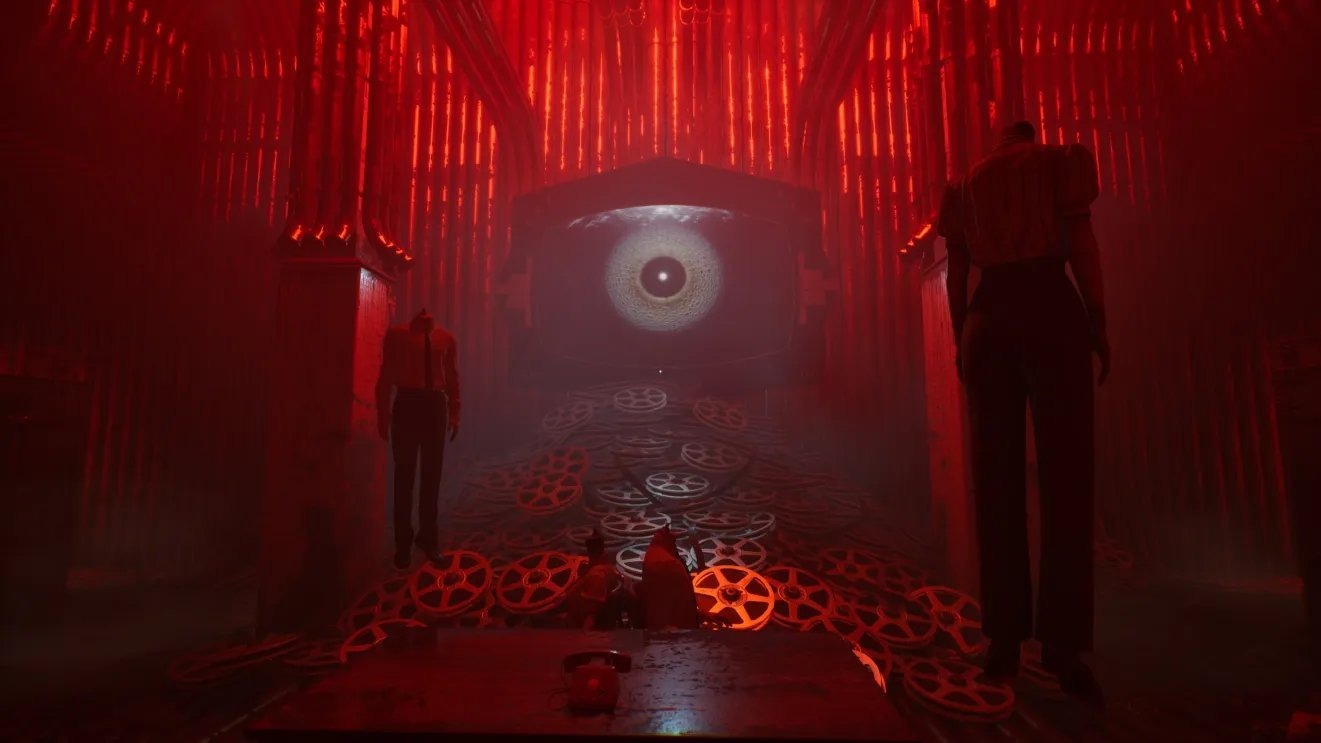
This is another game that can’t tell its overcomplicated story in just 4 short hours. Instead, we have just a walking simulator with a few puzzles and other half-baked ideas. You get a camera at one point and must use it to take pictures of eyeballs to open doors, but this feels half-baked. The areas are super tiny. One single area has you leading a creature around a specific path to get it to stop so you can take a photo of its face to kill it. This all feels half-baked, like they were neat ideas that had to be quickly shoved into a single scene. Once you get past the 5-10 minutes of gameplay, you endure the sluggish walking pace of more trippy visuals, such as flying through space, moving a cube through simulated cyberspace, walking through offices full of piles of CRTs, etc. The weird scenes are incredibly artistic and interesting, but in the end they don’t add any value to the story.
I wanted Karma to be so much better. There’s an interesting premise here. One of my favorite scenes involves one of the suspects showing us how this dystopian oppressive world works. Office workers sit and stamp things for dozens of hours and drink a company-made “energy drink” to keep them awake while propaganda plays on a giant projector in front of them. You then read an email about how all of your breaks are now taken away to “help the company growth” these types of scenes have a lot of impact, but they are so few and so brief that they left me wanting more. Many other scenes just don’t add value, such as the “hub” area of each suspect you dive into. In front of you is a giant monolith in a vast ocean, and you walk up to a podium with an important object on it, then warp to another scene. What’s the point of this area?
As you can see, Karma is an interesting game to look at, but not one to experience and especially play. The puzzles are interesting, and it leaves you wanting more when the game jerks this away from you and forces an hour of trippy visuals and story that doesn’t make any sense. Even at the end of the game I barely understood what was going on. Characters are bawling their eyes out, and there’s a lot of dialogue that feels abstract and doesn’t make sense. I was sitting there just thinking, “What the hell is happening, and why is this happening?” That’s not a good thing to think at the end of a game. Overall, play Karma if you want an interesting night of confusion and trippy visuals. It’s a shame the curious dystopian world isn’t explored more.
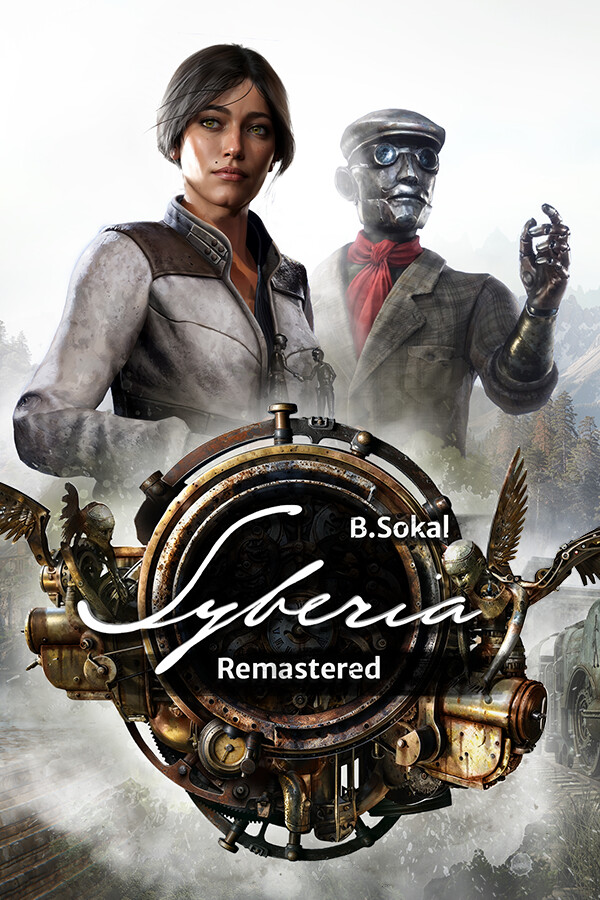
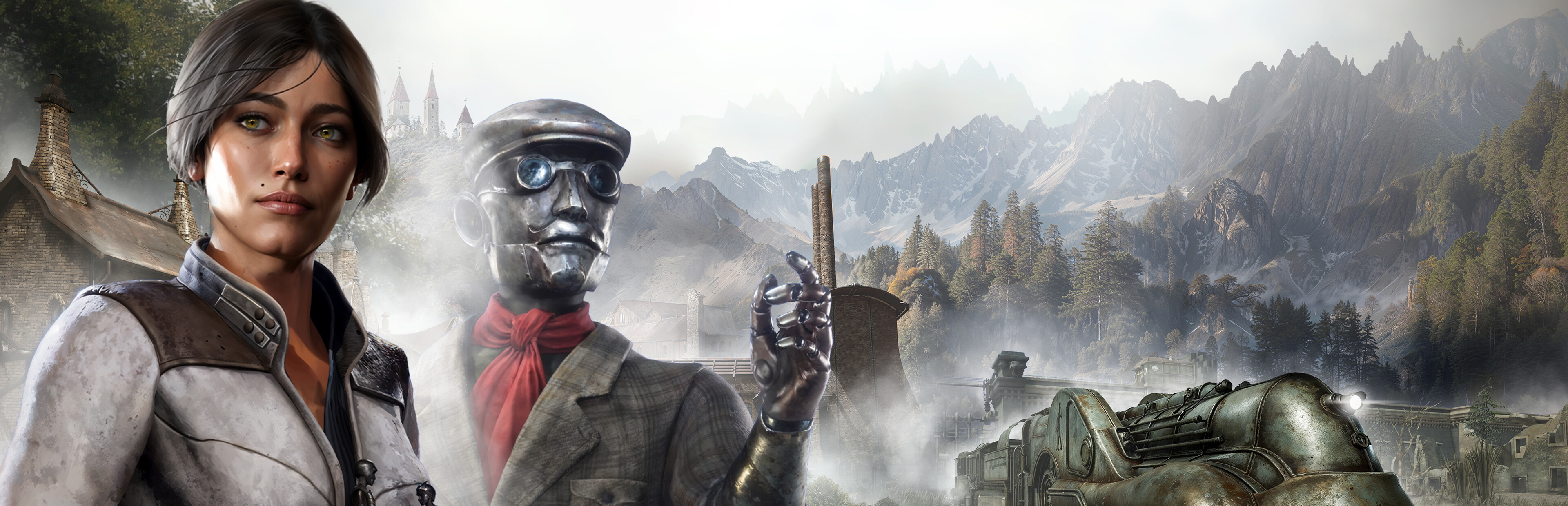
The late Benoit Sokal’s vision is something I have yet to experience. Syberia is considered one of the best point-and-click adventures of all time despite its flaws. Like other games in the genre, such as Sanitarium and The Longest Journey, Syberia gave PC gamers beautiful visuals, intriguing characters, and rich worlds to explore. This remastered classic does just that by giving new gamers a fresh take on an older classic, flaws and all. The series is now a four-part saga that starts here with its humble beginnings.
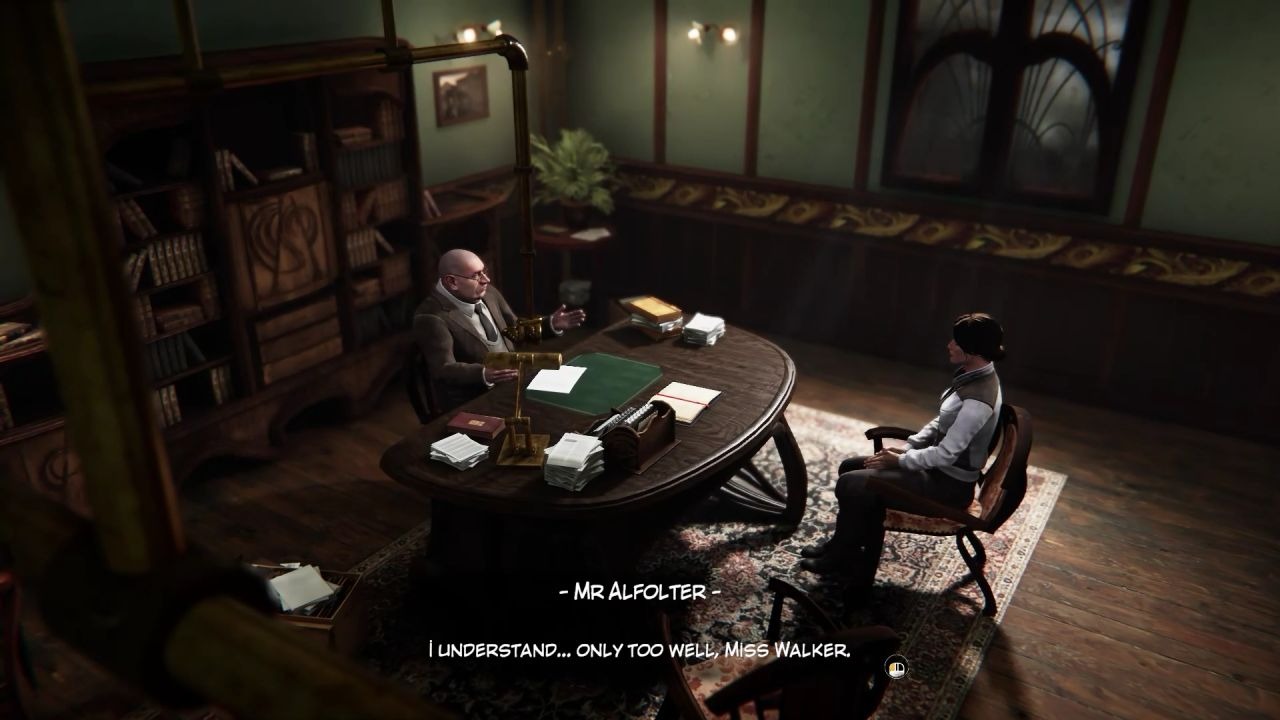
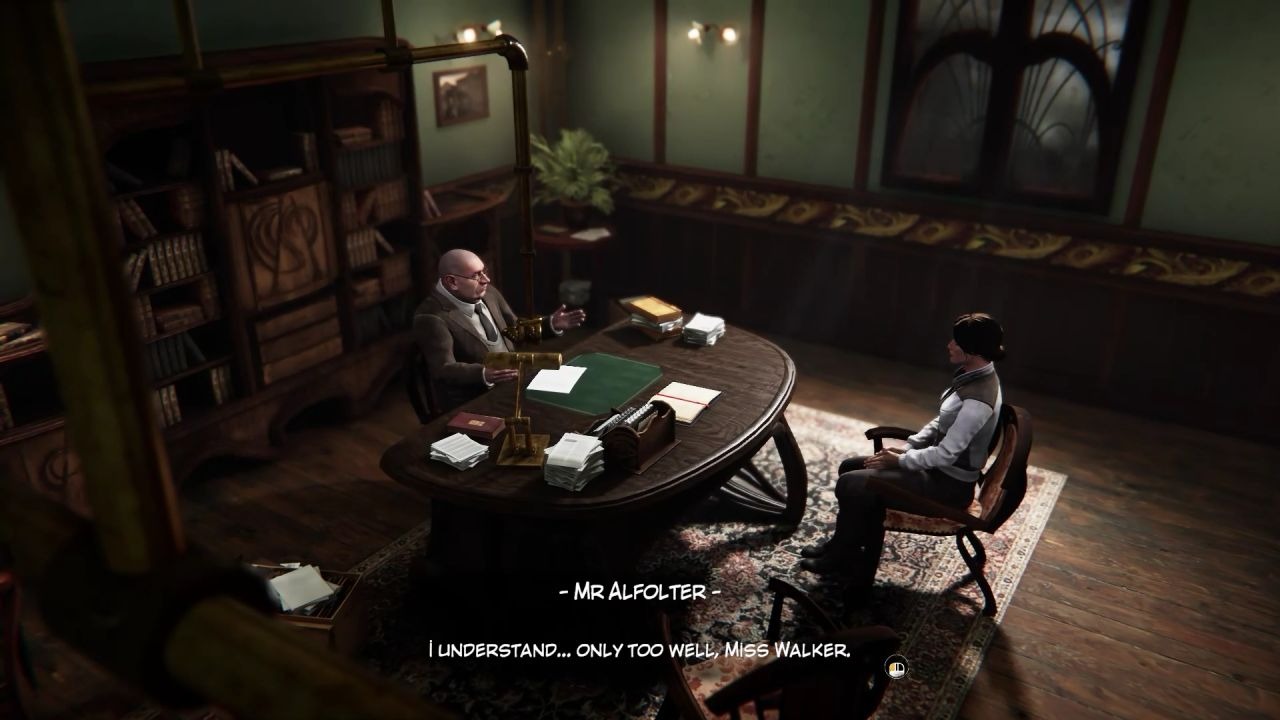
You play as an American attorney. Kate Walker is tasked by her agency to get an automaton factory signed over to a new toy company. You must seek out its owner, and this leads you on an epic journey through various towns with interesting people. Kate eventually awakens an automaton engineer who is able to drive a wind-up train to where she needs to go. The train needs constant winding, so it conveniently stops in these towns. The towns usually have mini mysteries to solve or predicaments to correct so Kate can move on with her journey. She either needs more info on where to find Hans Voralberg, who is the living descendant of the factory owner. There’s a lot of humanity in this game. From the strange university with its weird Stoker council to the obsessed automaton in the mines who wants to desperately reimagine an opera he saw long ago. The dystopian Soviet Russia vibes also add to the atmosphere here. The game feels sterile and falsely joyful. Remnants of this sadness litter the environment, akin to soldiers dispatched to abandoned facilities to await their demise.
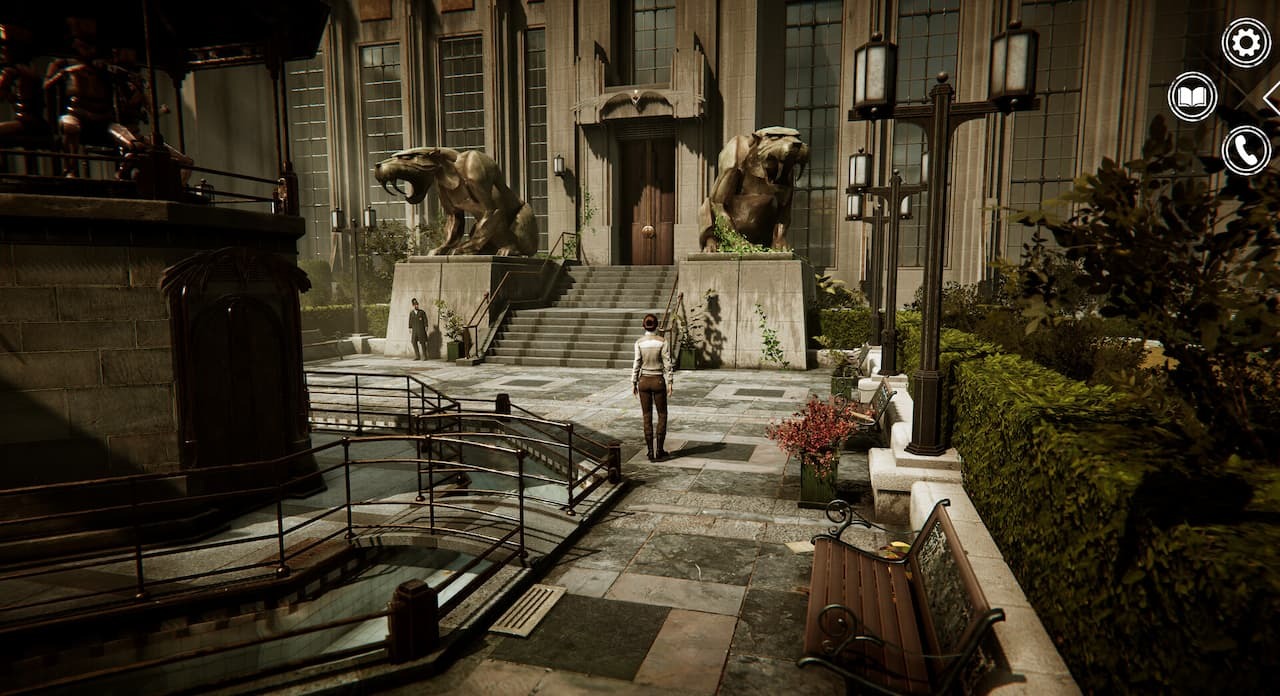
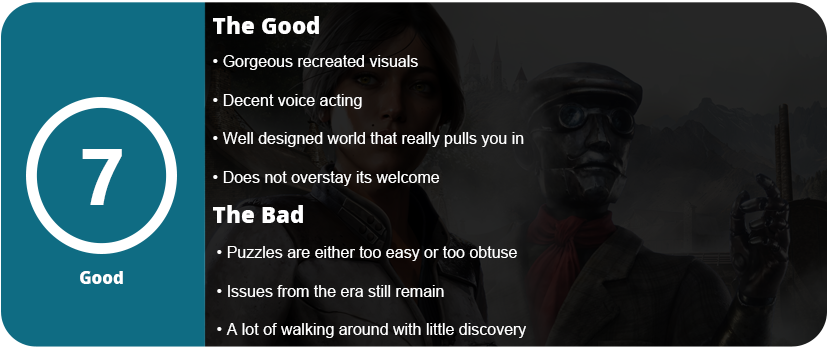
Syberia does a fantastic job feeling like an actual adventure. However, the puzzles are few and far between, and a couple can be rather obtuse, while the majority have no challenge. There’s a lot of backtracking in the main “hub” areas of each town and just a lot of walking. Talking consists of selecting questions, and that’s it. The pre-rendered cutscenes were not redone, looking incredibly dated. These are in full widescreen with a proper aspect ratio but should have been redone or just done in engine. The remade visuals look fantastic with beautiful sweeping vistas, great lighting, and good-looking textures. There are some quirks left over from the era, such as needing to have animations finish before doing something else, some graphics glitches, and object hunting. Most objects will have a circle appear over them if you get close, but these can be missed sometimes, leading to a lot of wandering around.
You can platinum this game in one go, and it can be finished in about 4-5 hours with a guide. Once you complete the game, there’s no reason to really revisit unless you have nostalgia for the original. The remaster adds some interesting DualSense features, like having Kate’s phone conversation play through the controller speaker, but there’s not much else to this game. If you love adventure games, then give this a try. Here’s to hoping the second game will get remade as well.
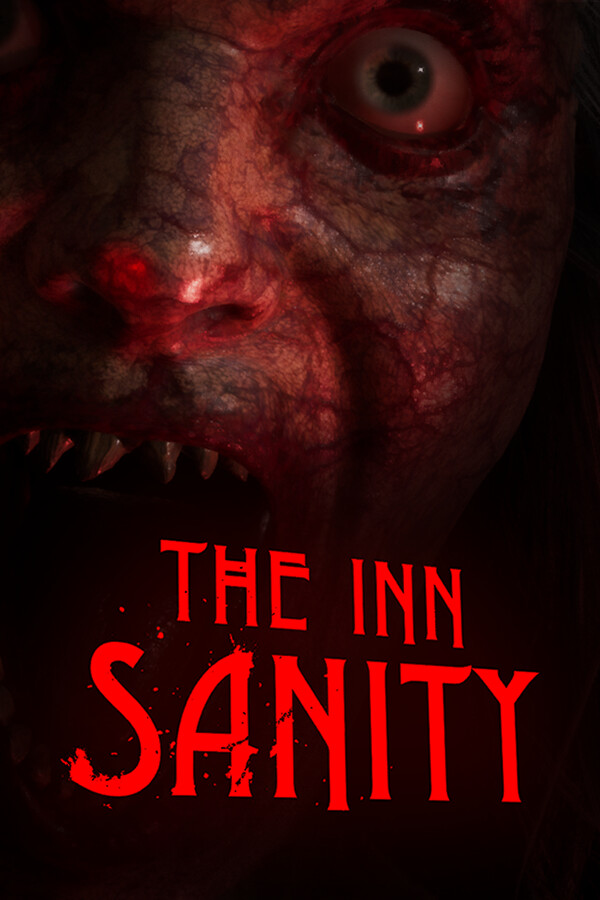
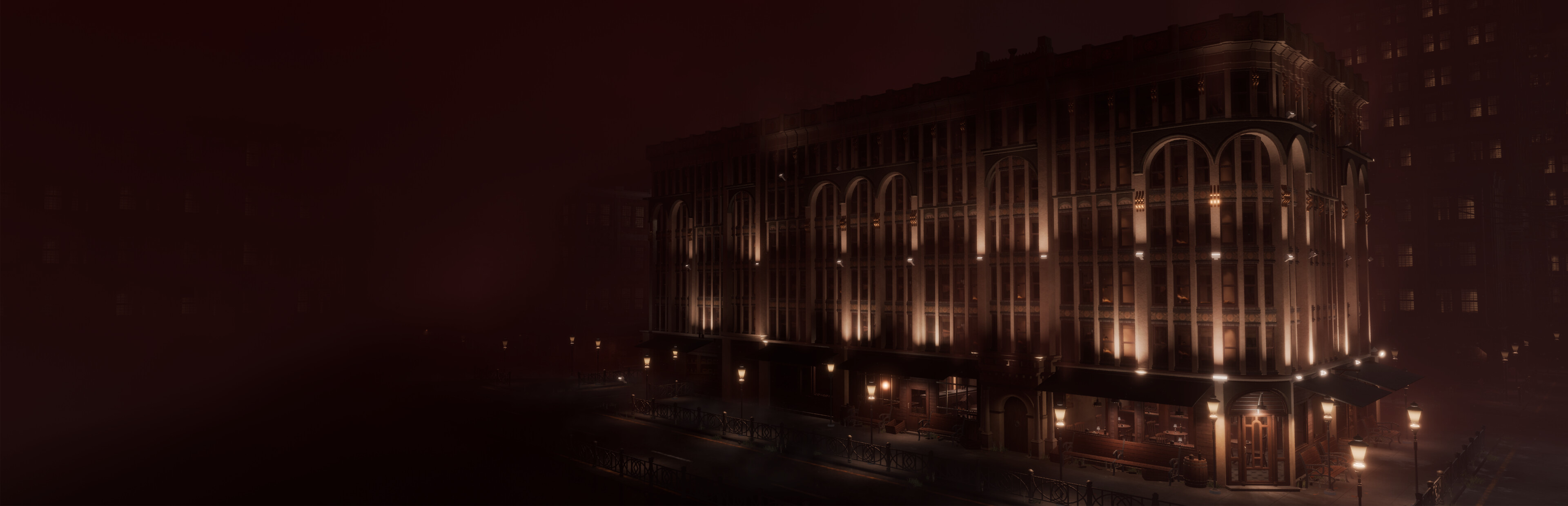
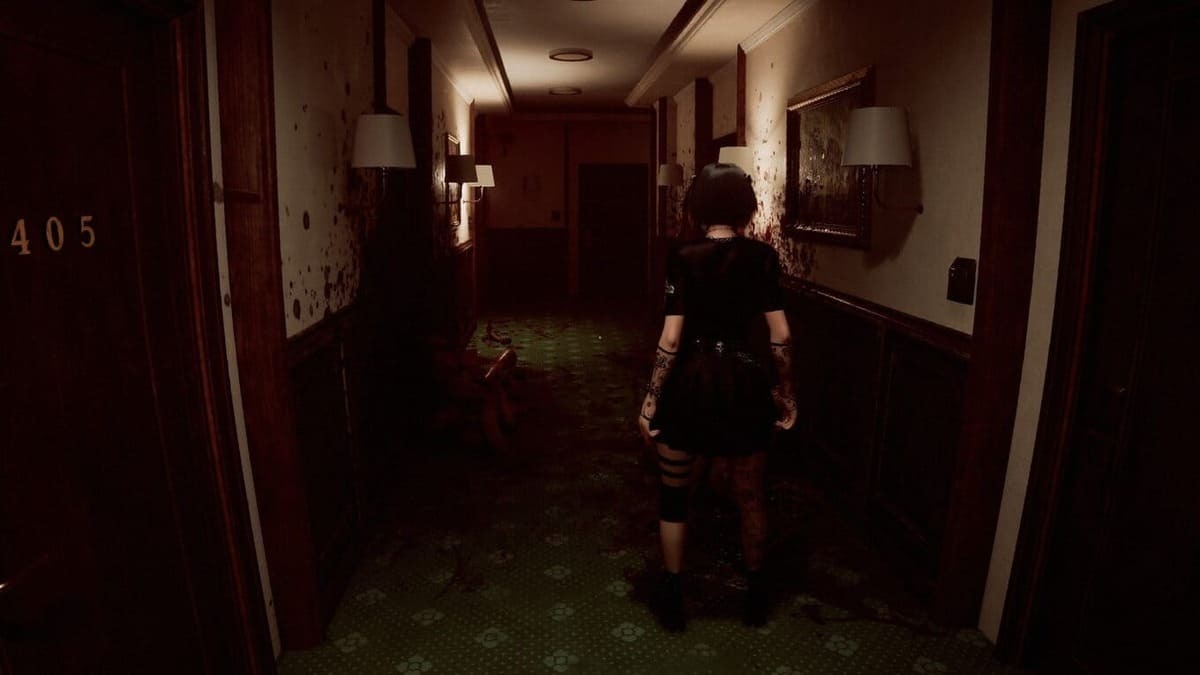
Indie horror games are not always great. In fact, most are pretty bad. There appears to be a trend of focusing on going viral instead of earning positive word-of-mouth through genuine quality. Either relying on tropes such as the “meme monster,” like Poppy Playtime, or having convoluted lore, like with the SCP series. The Inn-Sanity tries to be a self-contained horror title only trying to be good. It’s one of the better “Unreal Jank” horror titles I have played with the, probably by now, overused PS1 graphics aesthetic that mostly misses the point of them. You play as someone who visits an Inn (Sanity Inn…get it? Ha, ha). During the night there seems to be a Cthulhu mythos-style end-of-the-world scenario. You end up meeting a goth girl, who has the only voiced lines in the game, as you both try to survive the hotel and get to the roof while working with a security guard who is always hiding in the security room in the lobby. You only get phone calls from him. There’s also a monster lurking in the hotel, murdering everyone.
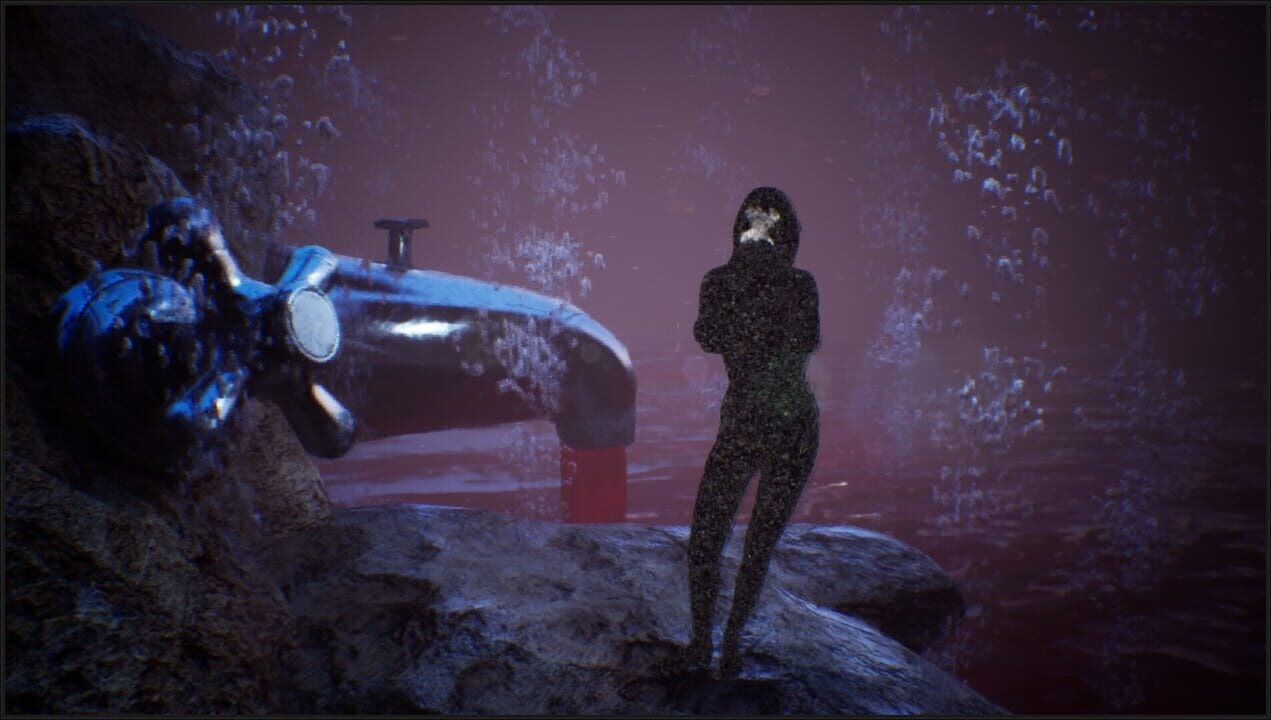
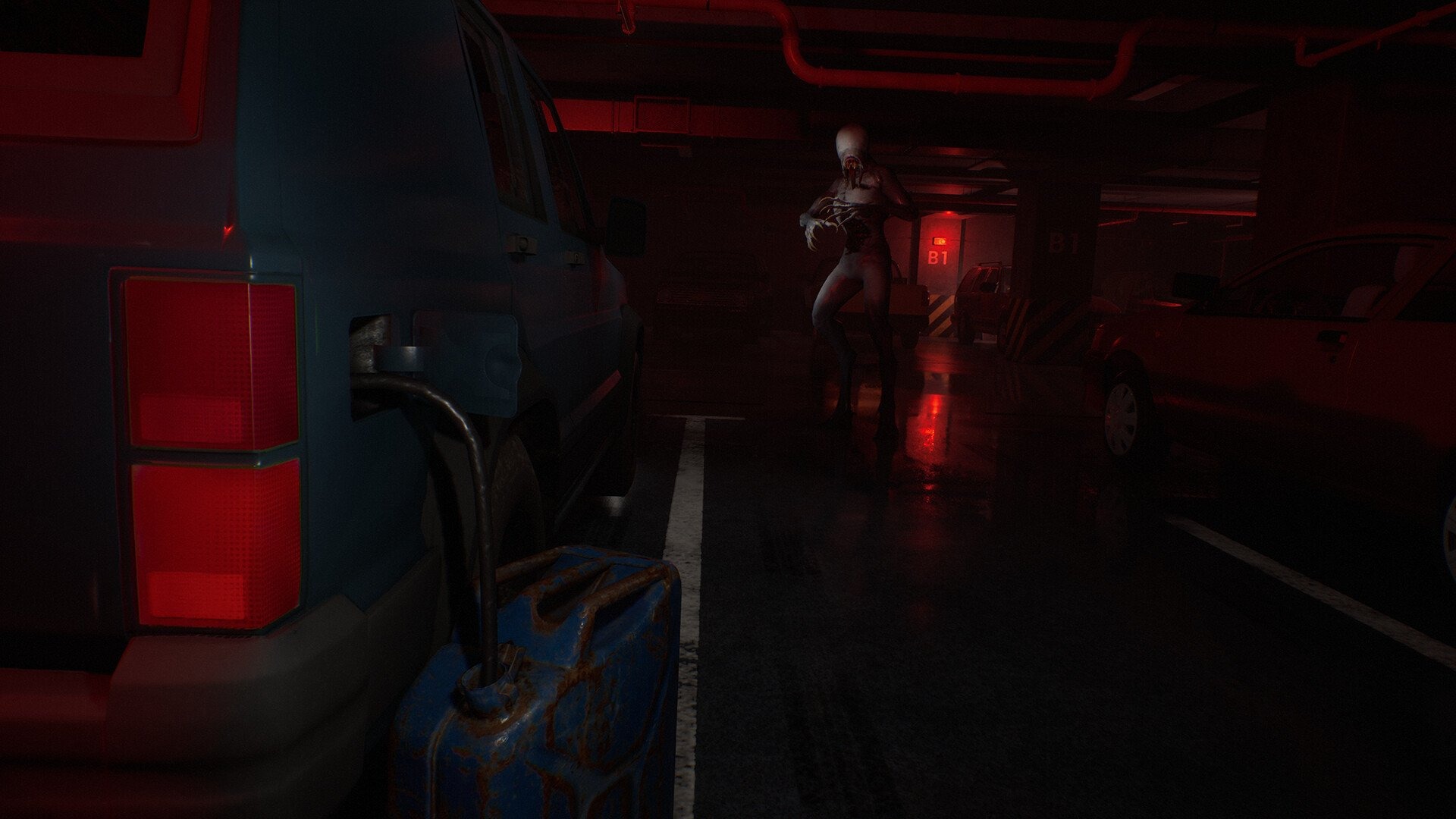
It’s a pretty cool setup, and the pacing of the story is surprisingly good. I played the game all the way through in one sitting because I wanted to see it to the end. The monster is pretty cool and scary-looking, and the scenarios you are put in are easy to deal with but still intense. There’s also a mad murdering priest wandering the hotel, killing anyone who he thinks is infected and not “pure.” The stealth sections involving the monster aren’t hard. The AI is pretty dumb, and one scene had me gathering gas in the parking garage, but the monster wound up always staying at the opposite end where there aren’t any cars. It was a breeze. Every mission will require you to go out into the halls and either up or down stairs to find someone or a supply. One puzzle has you following colored pipes to their proper PSI number to turn on the water to the hotel. It was a fun puzzle and had some intense moments.
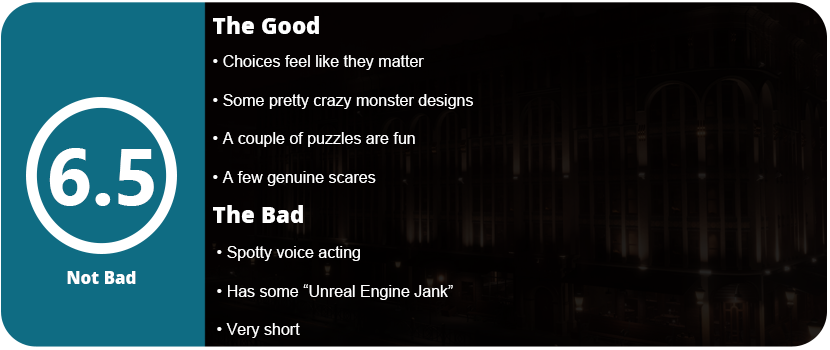
There are some intriguing elements thrown in, like being able to call various numbers on the hotel room phone to get some lore in the game. You can turn on the radio every day and hear what’s going on with the outside world. Small things like this that could be expanded upon make for a great way to make a small enclosed area more interesting. We want to know what’s going on outside and how other people are doing too. There’s enough of a world built here to convince you to investigate more, and that’s really hard to pull off in such a short run time. The girl’s voice acting is spotty. It follows the typical “cutesy anime girl” voice trope and I honestly do not like that at all. Some may be okay with it. Some lines are delivered pretty well while others are completely off in tone and intensity. She is supposed to be a beacon of light and the only human thing in this entire world and she just doesn’t feel serious enough for this.
Once you get back to your room, you are advancing the story between the girl and yourself. You keep passing out and waking up in the bathroom, not knowing why. You have strange dreams, and some choices will affect what ending you get with the girl. The story is always moving and changing, and you never get bored or feel stuck anywhere. There are some downsides to this game being very low budget. The animations are pretty bad; everything is a weird mix of high and low poly, so it has an inconsistent look. The game is also rather short, ending at around 3 hours. While I enjoyed my time with the game, I feel that these good puzzles, branching dialogue trees, and choices could be put to more use. The developers are talented and know how to make a great horror game. With a bigger budget I feel they could do something really great. This is easily one of the better super cheap indie horror titles on Steam and will get you genuine scares and entertain you the entire way through.
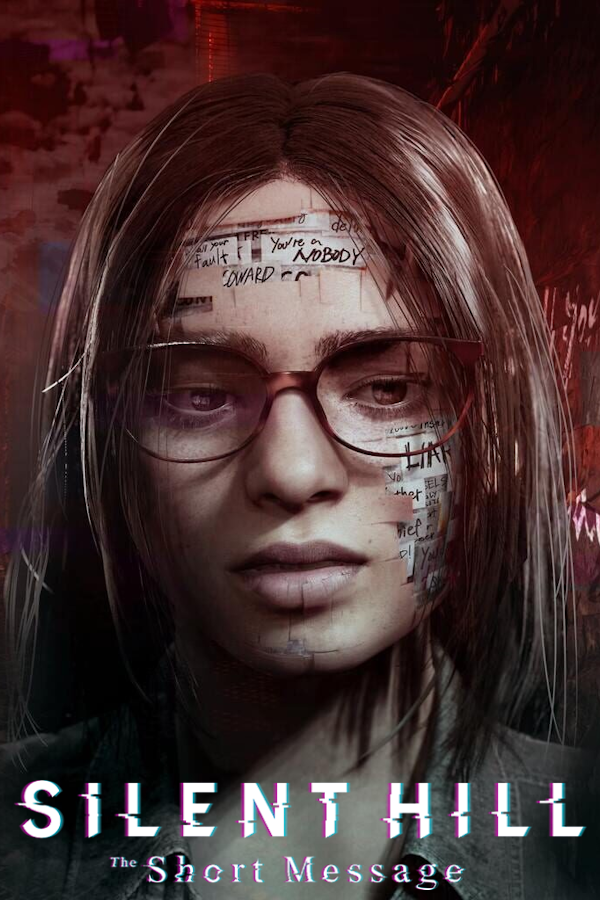
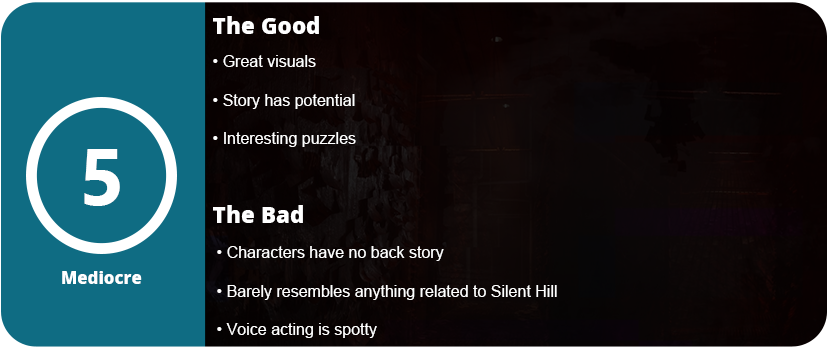
Short stories in the Silent Hill universe aren’t unheard of. Many people are unaware of their existence, except for the most dedicated fans. The comics and graphic novels on Game Boy Advance and PSP are not quite there, but they are interesting side stories. Silent Hill is more than just a town. It’s an experience. This version is set in Germany. You play as a teen named Anita who is inside an abandoned apartment complex exploring her past and trying to find her friend Maya. Silent Hill games usually explore the real world and then the “Otherworld.” In this game, if you can even call it that, there are clear inspirations taken from Silent Hill: Shattered Memories. This is the first SH game to be set in first person and the second to use a smartphone as a main gameplay device.
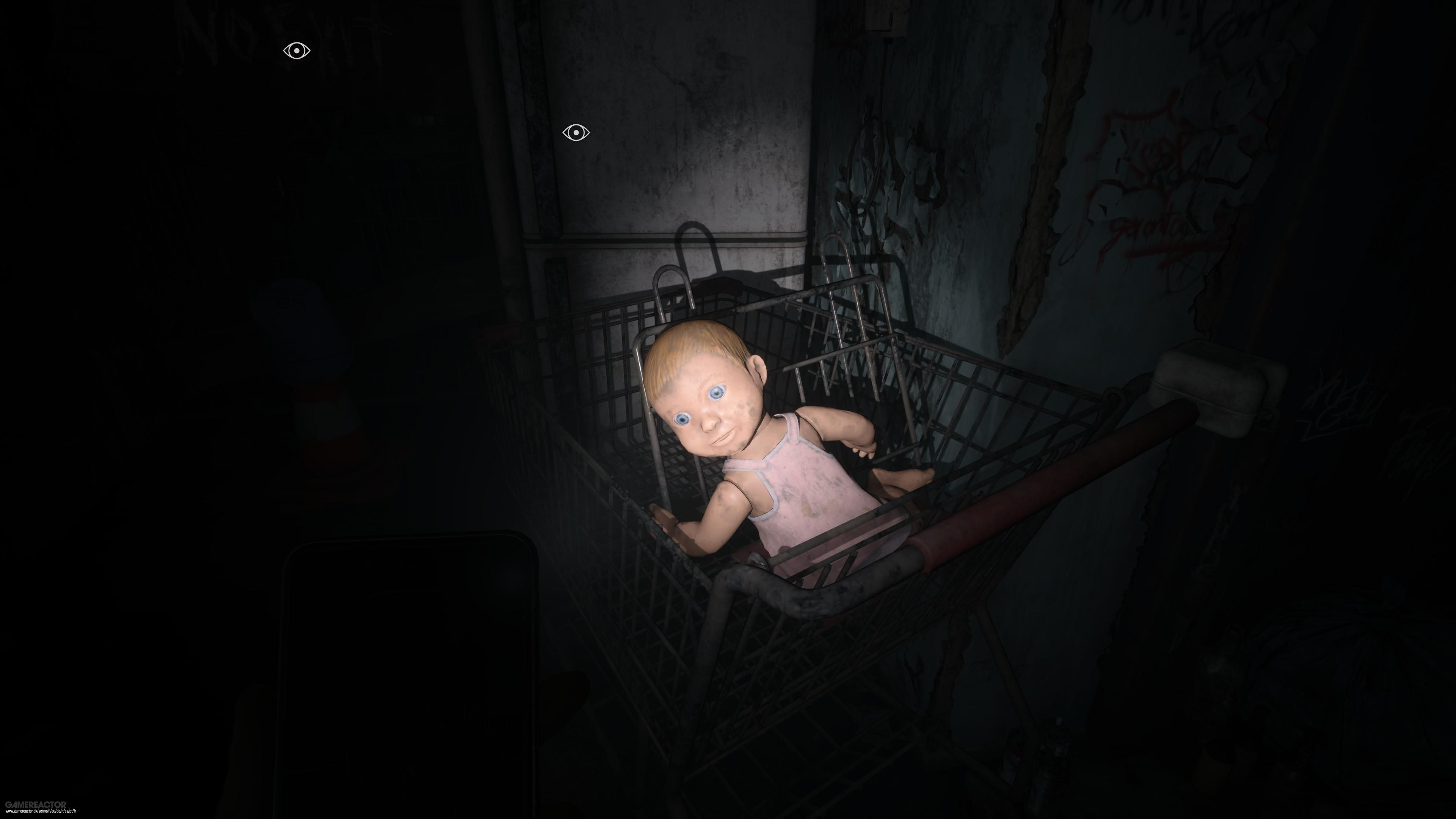
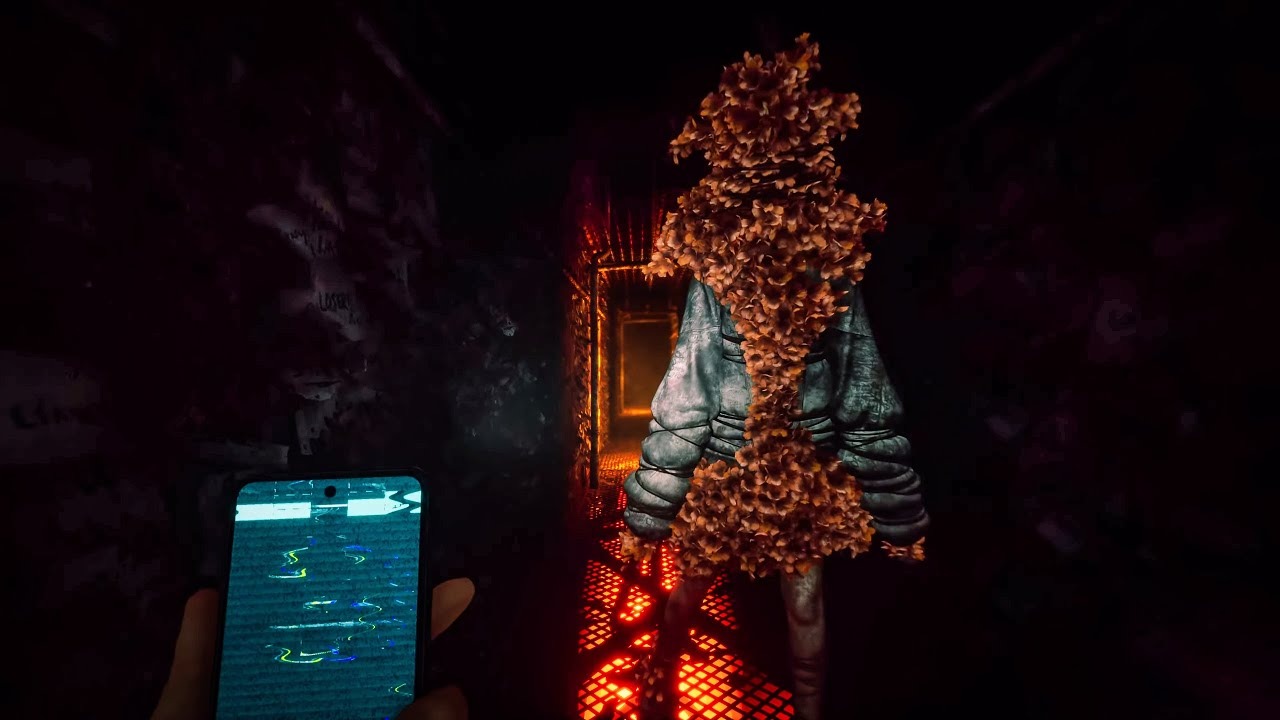
Your phone is used for its flashlight. It’s not as extensive as Shattered Memories with apps and features. Every so often your friends will text you, and you just press X to reply. The game is incredibly linear with only one clear path forward. The apartment complex is dark and dirty and does a good job of creating a horror atmosphere, but this isn’t Silent Hill. The series is never stuck inside of a building through the entire game. In fact, the only “outside” you encounter is going onto the roof and balcony a few times. This is by far the least interactive game in the series outside of the graphic novels. You will walk around examining objects, triggering cut scenes, and then entering the “Otherworld” apartment complex, which involves an annoying chase sequence from a monster. The only way you would know that the game is connected to Silent Hill is the monster track in the background and the orange hellish metal design everywhere during the chase scenes, and a single mention of the game in a note on a table. You need to run through a maze of doors and hallways to escape. They aren’t fun and have no combat.
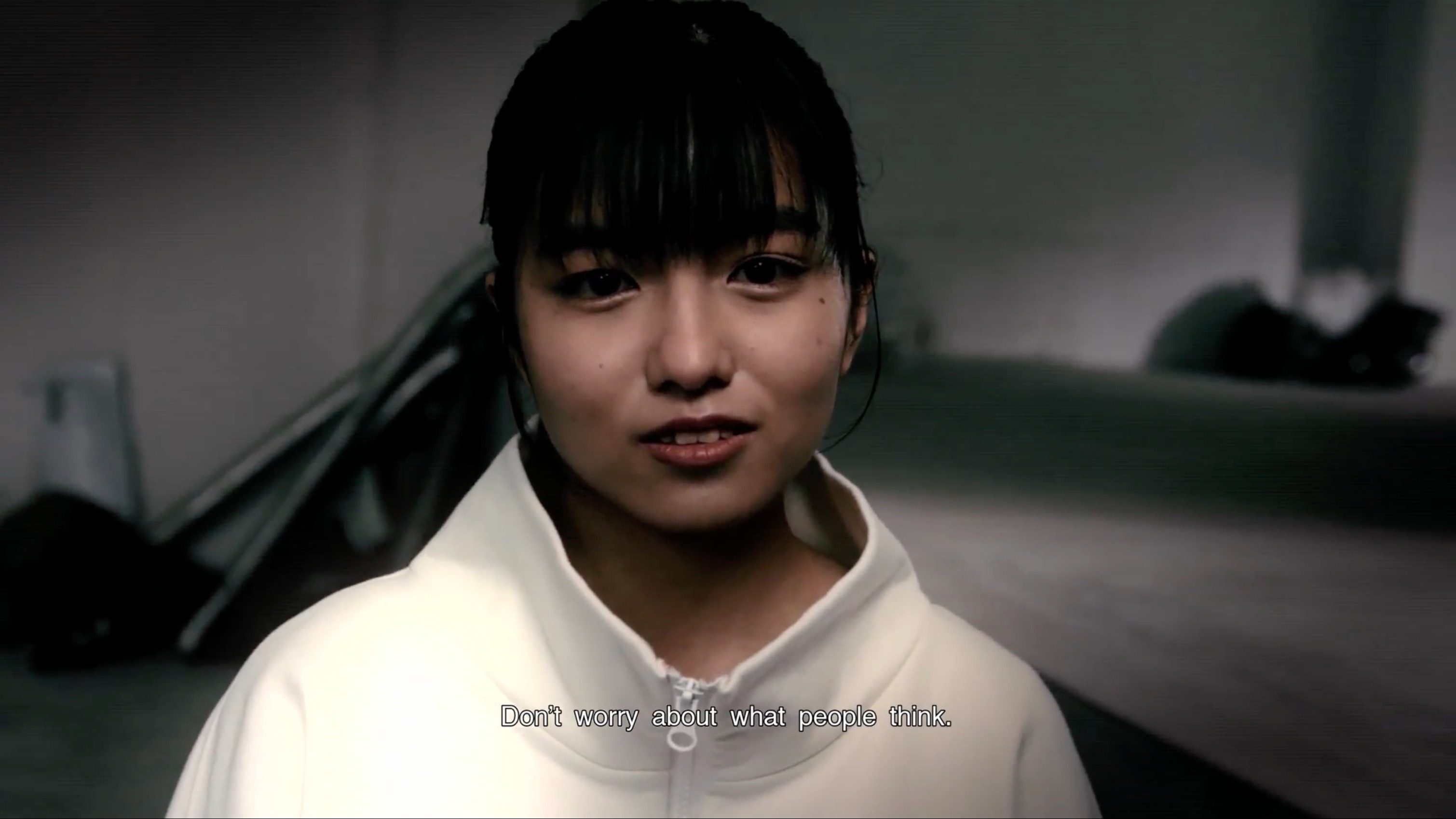
There are a couple of puzzles in the game that are actually pretty good, but it’s the only gameplay in the entire game that’s interactive. The most jarring element here is the inconsistent visual design. Anita’s model is incredibly rough and ugly. She looks worse than the rest of the game, and then there are the live-action cut scenes of a Japanese girl (Maya) talking to you in flashbacks. Sadly, the scenes were obviously shot in Japanese, but there’s only an English dub available. The actual story and message of suicide and bullying are interesting. There’s something here. Anita will walk through rooms full of sticky notes everywhere that have hateful words. We get flashbacks of her cutting her wrists, etc. These darker elements are what make Silent Hill so great. The exploration of the darkest parts of the human psyche, but instead of going with that, The Short Message drops the ball every time it picks it up. Exploring the apartment complex doesn’t bring about any scares. Lights turn off, bulbs pop, there’s weird noises, and that’s about it. The monster chasing you is the only monster in the entire game and you rarely get to see it.
What’s left is a three-hour slog through what feels like a tech demo or proof of concept. Clearly Konami didn’t like it enough to make it into a full game. Hexadrive has some good ideas here, and I wouldn’t mind seeing that they could do with a full Silent Hill game. With the series making a full return, we need more developers on board now that Team Silent has been disbanded. I recommend playing this only if you’re a Silent Hill completionist and hardcore fan, but otherwise there’s not much here for anyone else.
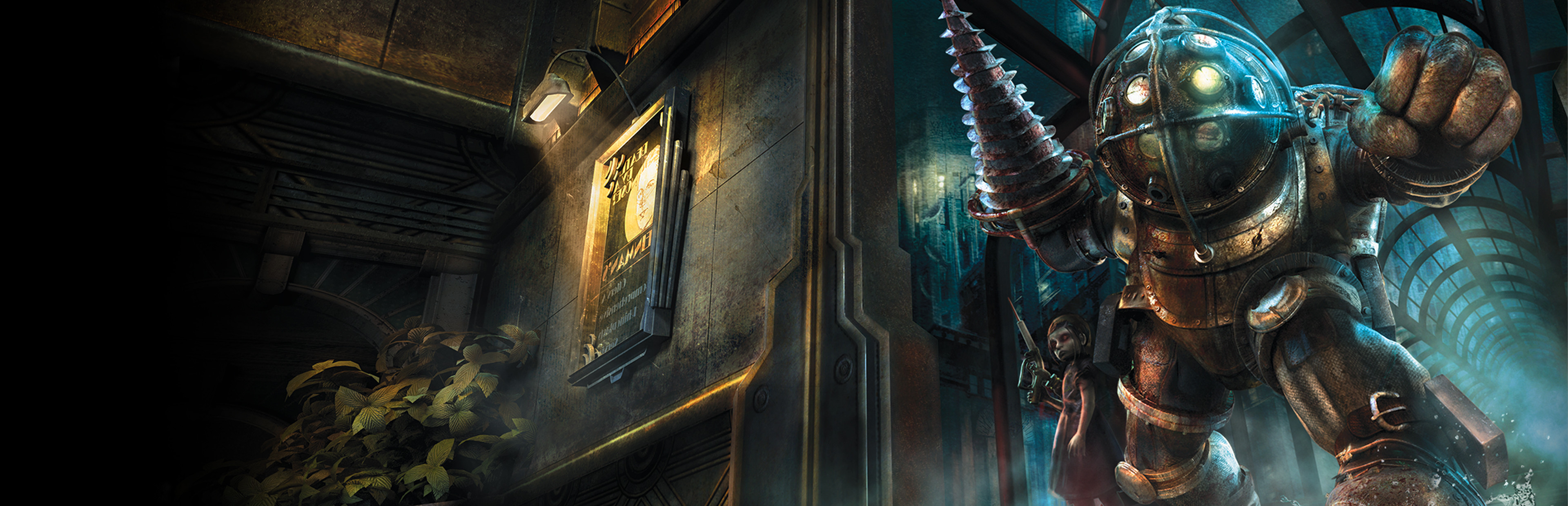
War. War never changes. Oh wait, wrong game. Clears throat Is a man entitled to the sweat on his brow? A famous quote from Andrew Ryan. The creator of Rapture. An underground utopia, or dystopia, that’s a playground for the rich. Using Adam and Eve to alter your genes and add power like fire, ice, shock, and bees. You arrive serendipitously via plane crash over the Atlantic ocean. You work your way through Rapture while being guided by a man named Atlas. There are Little Sisters, children who harvest Adam from dead Splicers, and Big Daddies that protect them. There’s quite a bit going on, and while this is a spiritual successor to System Shock, it was revolutionary for its time. Sadly, many younger gamers, like myself, had never heard of System Shock as it wasn’t a blockbuster seller.
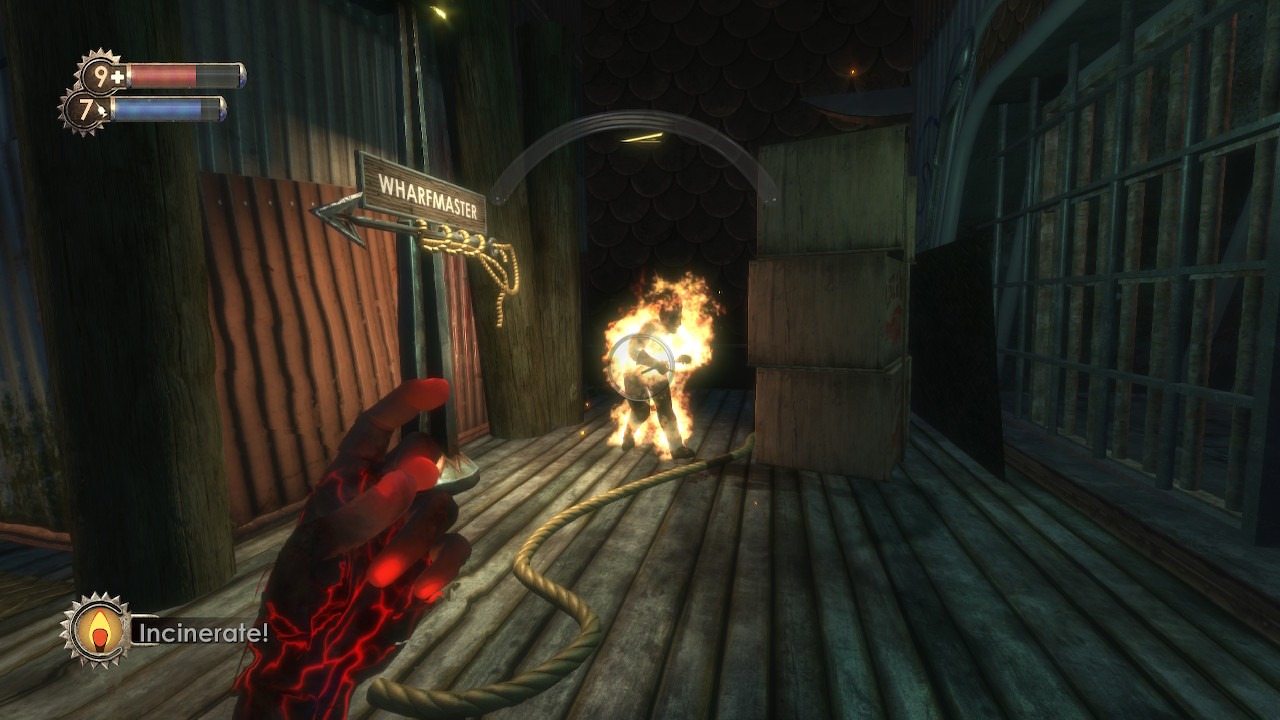
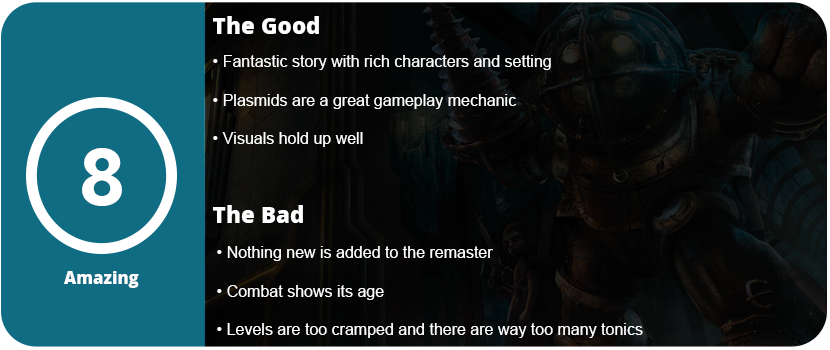
Sadly, the remaster does the bare minimum. Only making the game playable exactly as is, just in a higher resolution and frame rate. 2K Games took the PC version with the updated DirectX 10 lighting and shadows and threw it on consoles. We get developer commentary and some combat trials, but the age of the game is also present. A full remake would have been better. While the story is well known amongst gamers of the HD era, the gameplay hasn’t aged quite as well. There are many quality of life improvements that could have been made. For example, the combat isn’t the best. The reticle is a massive circle, and while guns feel pretty decent, the Plasmids are frustrating to aim. Plasmids like Shock Bolt and Incinerate converge on a pinpoint, and you waste so much Eve trying to hit enemies. There are also an awful lot of passive and combat tonics that feel mostly useless for such a short game.
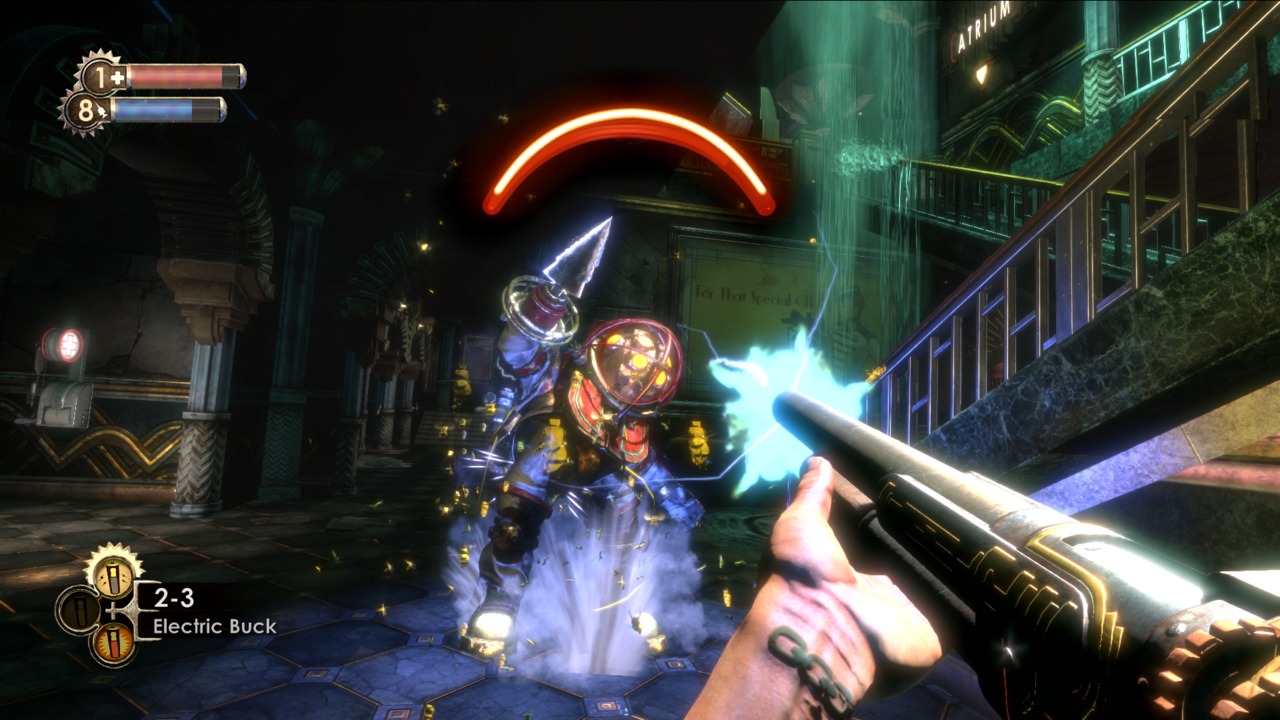
While the 17 year old me didn’t really notice any of this when I played it on launch day for my Xbox 360 at the time, the game’s near perfection at the time is showing some cracks. The levels are cramped and incredibly linear, making combat hard. Many of the areas are way too dark, making it hard to see enemies and hit them at the speed they move at. It’s not the worst ever, but it’s annoying, and a remake could have remedied this. You get six guns in the game, but not all of them are useful. The Napalm launcher is something I rarely used, and the same goes for the grenade launcher. The areas are too cramped for these destructive weapons, and you end up taking a lot of damage. You will switch between the shotgun, revolver, and Tommy gun the most as your main weapons. The crossbow is the closest to a sniper rifle that you will get. Each weapon has three different ammo types. There are explosive, shock, anti-personnel (good against humans), and armor-piercing (used against Big Daddies). The combat system is fine but pretty flawed. You can upgrade each weapon twice to add things like damage and recoil reduction.
You can change your equipped plasmids and tonics at Gene Banks. You use Adam taken from Little Sisters at Adam machines to buy these. There are just too many. I used the Research one for taking photos of enemies to increase damage dealt to them. Once I get everyone researched, this tonic is useless to me. There are tonics to reduce security timers, making hacking easier, reducing the cost of vendors, etc. You can only get five slots for each track. Then there are up to three levels for each tonic. There’s too much. I felt for the short length maybe half the amount of plasmids and tonics would have been fine. You will find your favorites and pretty much stick with those through the entire game. You can finish the game in about 6 hours or less. Other vendors are for ammo and items for healing and such. There are many different healing items, from snacks to first aid kits and seemingly useless alcohol. Hey, there’s a tonic to reduce the drunkeness effect of those as they restore Eve. It’s an excuse to look around. Every container has something. Eventually you will unlock crafting at the U-Invent station to make ammo and some tonics that can’t be bought or found. Looting can be fun, but it distracts from the main story and gameplay loop.
There are just too many systems at play here for such a short game. These are all good ideas, and they work fine, but do we need five plasmid tracks (you can equip up to 15 passive tonics and five for combat) and a crafting ability? Ammo is scarce and becomes a pain to find on harder difficulties. You will need to loot every enemy and container to scrounge. This is fine, but is this now a survival horror game? The best parts of the game are the scripted events. There are few boss fights outside of the disappointing one at the end. The Big Daddys act as mini bosses themselves. They won’t attack you until you attack first. There are Bouncer and Rosie types, each with different types of attacks. Finding the 122 audiotapes throughout the game gives you backstory and fills in lore since there’s a lack of NPCs to talk to. These are logs of residents from before the city fell apart. Each level is themed after someone who ran that area, such as Cohen, who is all about theater. There’s the casino, the outdoors simulation area of Arcadia, the central core area of Hephaestus, etc. The areas are all distinct and interesting to look at despite being very cramped and their design feeling more like a video game than an actual city. It’s obvious no one could actually live in this place; it just doesn’t make any sense.
Despite not being ported over to a new Unreal Engine, the UE3 assets hold up surprisingly well thanks to the fantastic Art Deco style the game went for and have become iconic. The visuals were state of the art at release, but just increasing the resolution doesn’t do much here. The hacking mini-game gets old fast (assemble pipes) and could have been changed or removed. The enemies and characters are also well designed and iconic, but the game has definitely aged. Some areas are not so graceful, such as the combat, level design, and RPG elements. Enjoy the game for a fun evening that’s a great roller coaster ride and explore. Don’t focus too much on collecting, and just enjoy this as a stylish shooter.









































 thebinarymessiah.com
Try multiplayer. A lot of fun !