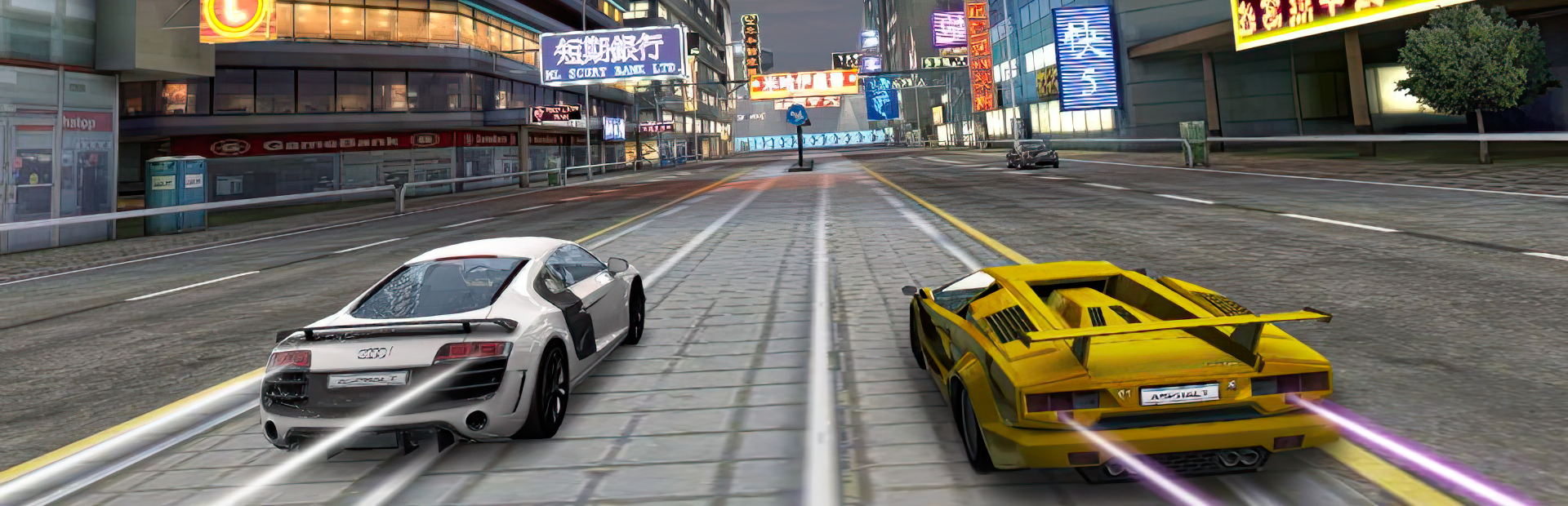
Gameloft and I don’t really get along. They used to release good Java mobile games back in the day, but after smartphones took off, they released nothing but free-to-play or pay-to-win garbage. Sadly, this leaked over to handhelds a few times, and the Vita was no exception. Injection is a dumbed-down port of Asphalt 6: Adrenaline for mobile phones. A mobile game directly ported to a handheld isn’t the best of ideas, and this game proves why.
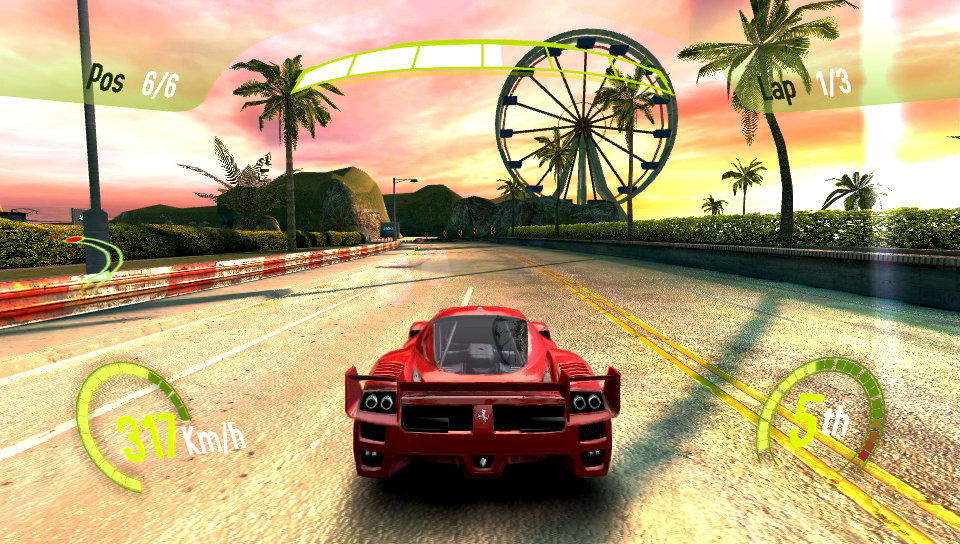
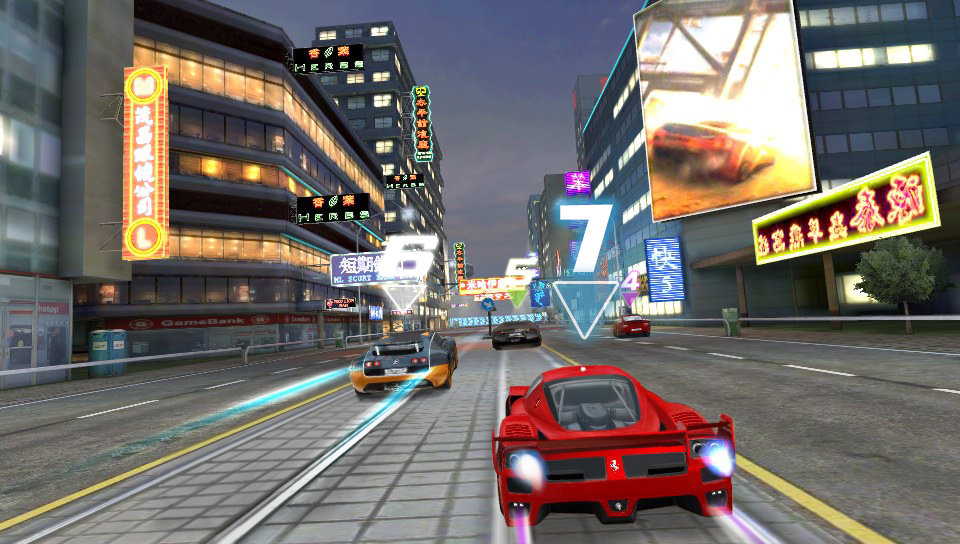
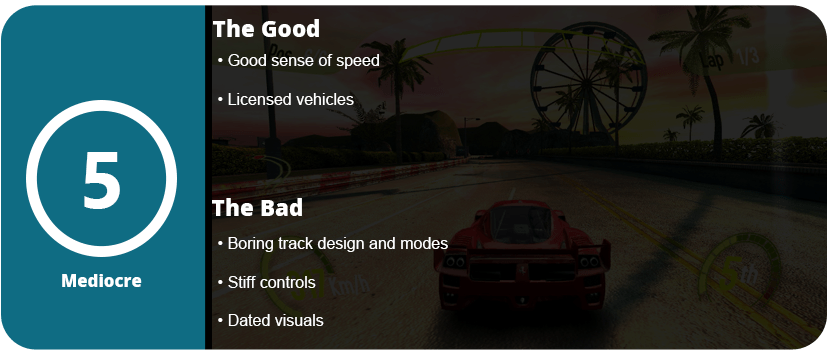
With all of the pay-to-win aspects taken out of Asphalt, this is a rare opportunity to see how the game would play if all microtransactions and other cancer-riddled stuff were stripped out. On the surface, it’s a reasonably accessible and playable racing game with licensed cars, more like a low-budget PS2 title. The tracks are boring but work, with boost icons and jumps. The purpose of the game is to boost your way through the track as much as you can and take shortcuts. Once you fill your boost meter, you can go into adrenaline mode, which allows you to easily knock cars off the road in Burnout style and zoom ahead. I found the cars to all pretty much handle the same; drifting is awful, and the whole game feels stiff and poorly made.
That’s not to say there’s zero fun in the game; it does work and is a nice mindless racer for fans of the series or anyone wanting a bargain bin racer on the Vita. Gameloft is not a genius when it comes to handhelds, as they don’t work like mobile phones. Outside of career mode, you can race with other people (no one was even playing during launch, don’t worry), and there are typical event types to participate in, such as elimination, time trials, and various others that have been done to death.
Injection is ugly, stiff, boring, and a slightly upgraded port of a mobile game that was already over a year old before the Vita was released. If you have exhausted all your other racing options on Vita, then go for this dead last.
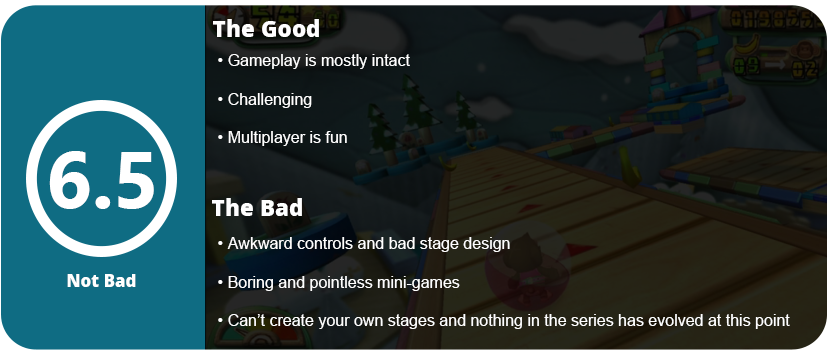
I love Super Monkey Ball. I remember playing this back on the PS2 and having a blast being OCD about collecting every banana in every stage. The GameBoy Advance version was probably my favorite of them all, but when I found out there was one for Vita, I was quite intrigued.
Sadly, the fun didn’t last long. For starters, the game hasn’t evolved one bit, with the same tiled, textured levels and blurry backgrounds. While the game looks decent on Vita, it looks quite boring and bland. Outside of that, the controls feel somewhat off, and the gyroscope and thumbstick controls just don’t feel right. Even though the D-Pad controls on Super Monkey Ball Jr. worked well on a 16-bit handheld system, what happened? When using the thumbstick, the levels move around so fast and are so jumpy that it was nauseating just to get through a level. On top of that, the levels may seem challenging, but they just aren’t that well designed. It almost feels as if they were randomly generated and slapped into the game. You get 60 seconds to complete each level and get higher scores by collecting all the bananas, or you can be brave and find a shortcut on some levels and jump down to the goal.
On top of all this, the mini-games are bland and boring and make no sense, and then the course editor doesn’t actually let you save courses and create your own from scratch, so it feels pointless. Multiplayer is fun as always, but playing by yourself should always be enjoyable. I’m not sure if I’m just burned out on SMB’s overall design, which has stayed the same for nearly 2 decades, or if this is just a not-so-great version.
Banana Splitz could have been a definitive version of the series, culminating nearly two decades of SMB into one fantastic game or rebooting the series into something different. The game is somewhat enjoyable, but it always feels like something is missing or wrong with the game. The series is really stale at this point, and unless something drastically changes, I won’t be rolling around Sega’s classic series again.
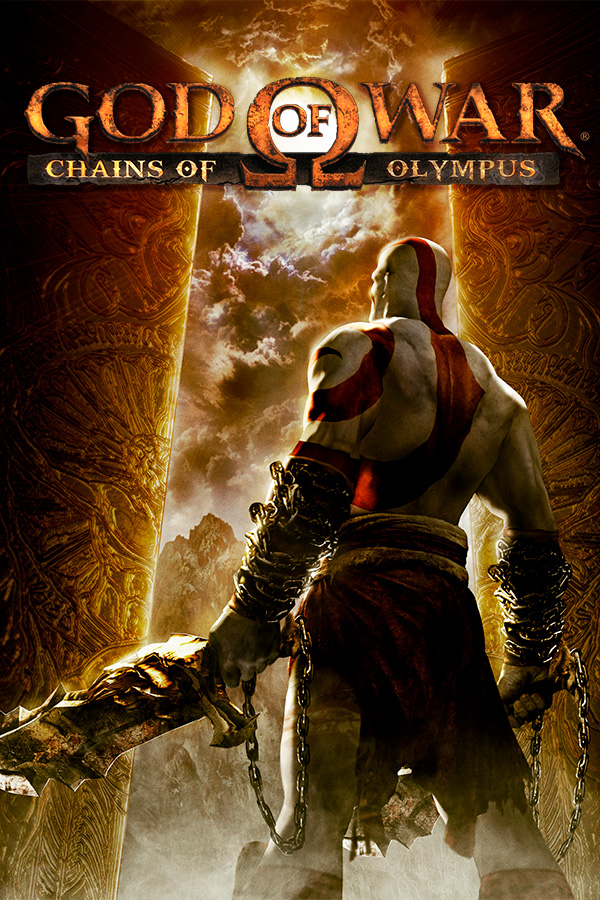
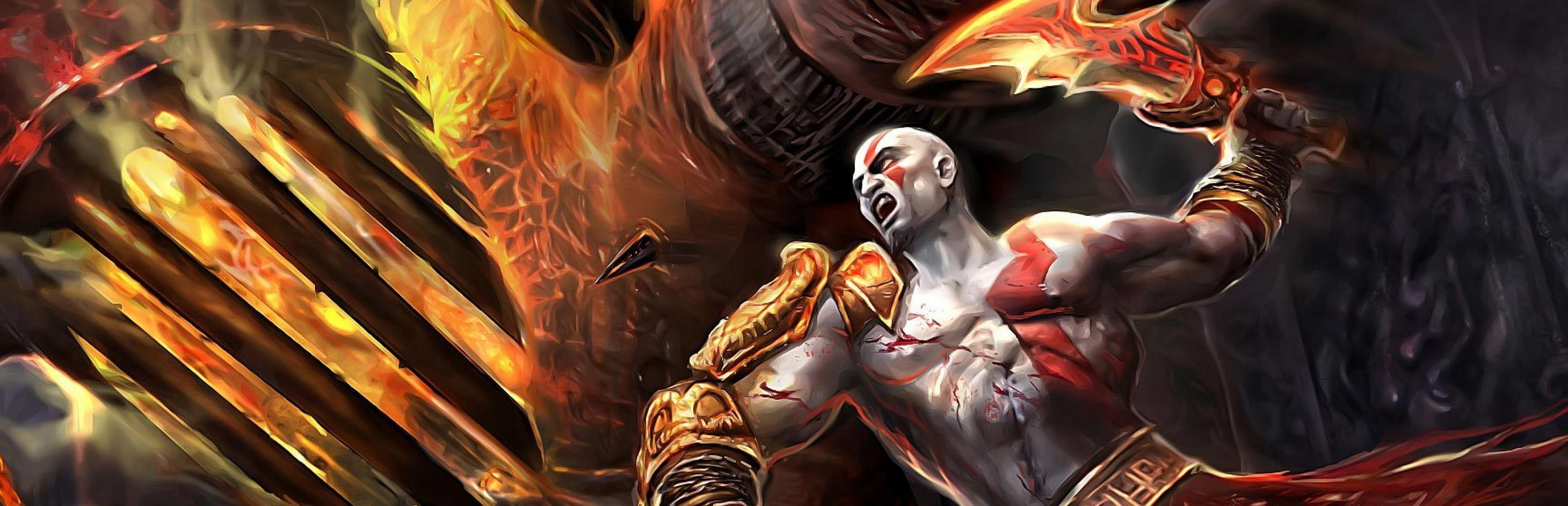
Chains of Olympus was probably the single biggest PSP release during the entire console’s life cycle. It was one of the first games everyone wanted for the system, and Ready at Dawn delivered a God of War experience just like the console version, with no cut corners.
The game takes place between the first two games, with Kratos continuing his journey to rid every god of Olympus and his quest to kill Zeus. He finds himself discovering more nightmares of his past, his daughter, and various new gods not seen in previous games. The story is just fine and feels just like a God of War game, but it’s very short and can be finished in less than 4 hours.
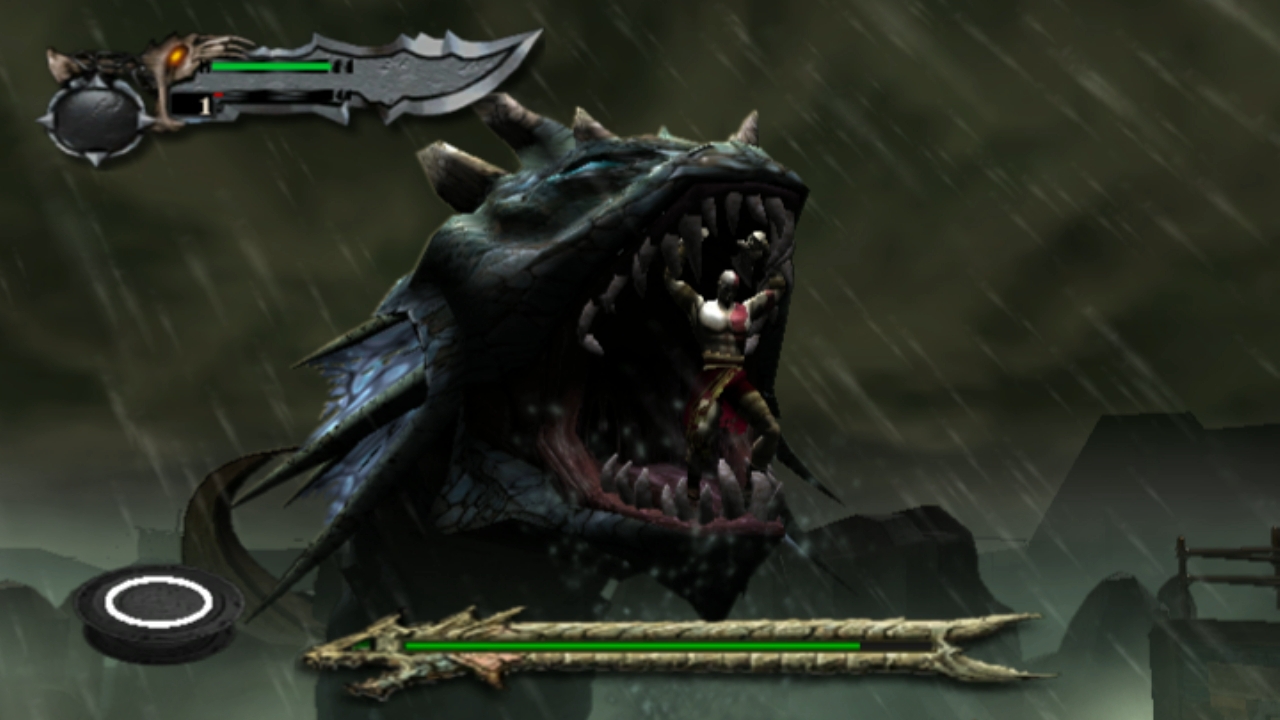
I remember starting up this game for the first time and seeing half of Kratos’ face in the main menu, just like in previous games, and pressing that new game button. The game starts with you at the Battle of Attica, fighting off a giant basilisk sent to destroy the city by the Persians. I knew the game would have an epic first boss fight and a giant city to fight in, as the previous games did as well. You also have to remember that this was released two years after God of War II, so there wasn’t much else to go off of at the time. Thankfully, this game carved its own path in the God of War series, and later games actually borrowed things from this game.
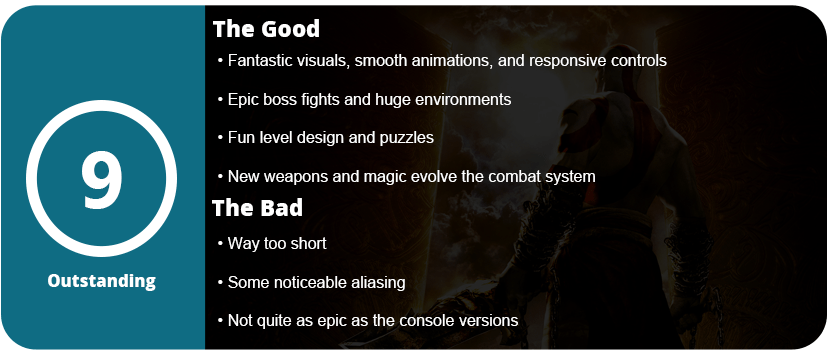
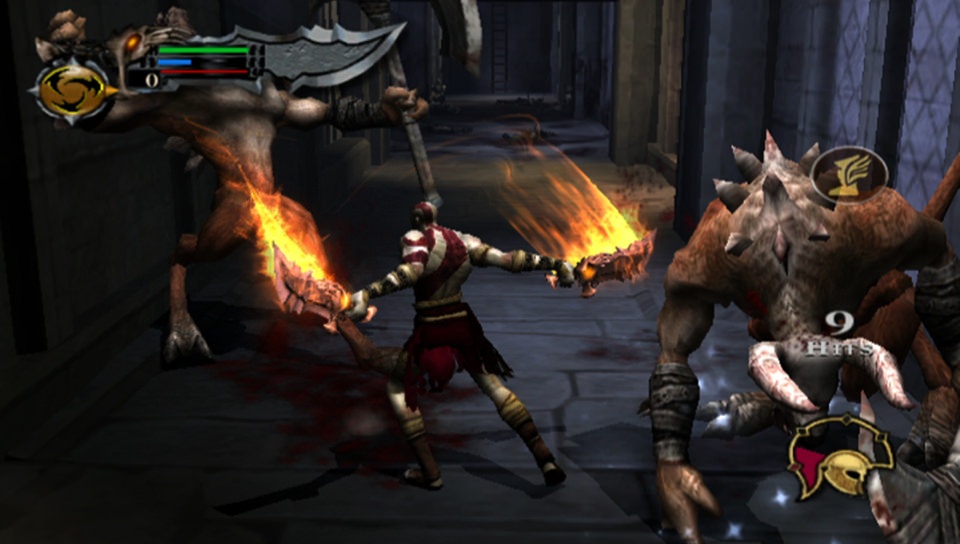
Surprisingly, the controls work out just fine with the handheld version. Pressing the shoulder buttons and moving the analog nub allow you to dodge. The combat and animations are gorgeous, and the game runs at 30FPS most of the time. Very rarely did it ever drop below that, and sometimes it even went up to 60 FPS in smaller areas. Everything about this game is so familiar yet somehow slightly evolved from GoWII. The moves are more fluid, and upgrades are a bit different as well. New magic items and a brand new weapon are introduced as well.
The Gauntlet of Zeus is a giant fist that brings slower, more powerful hits; sadly, due to its short length, only one extra weapon was introduced. Efreet is the new AOE magic attack that uses fire damage; Light of Dawn is a long-range magic attack; and Charon’s Wrath stuns enemies. Kratos also gets a shield in the game, allowing new counter-attacks and throwing back projectiles at enemies. The whole combat system as a whole feels new and enhanced enough to make this feel like a sequel rather than a spin-off.
Just like in previous games, you can upgrade your magic and health with hidden Phoenix Feather and Gorgon Eye chests, as well as using red orbs to upgrade items. Most of the hidden chests are easy to find if you explore all areas and pay attention to breakable walls and side paths. The best part about this game is the new enemies and bosses, which is what makes God of War so epic to begin with.
After beating the Basilisk, you will come across a few other bosses, but they aren’t large epic enemies like previous games; they are smaller and more challenging combat-wise, which is fine for the story that it delivers. I don’t want to spoil the game and tell you all the bosses right here, but the final boss proved quite a challenge and will test your reflexes for sure.
The environments are also amazing, as with any God of War game, with huge set pieces, massive buildings, giant statues, and various background stuff going on. Chains of Olympus was the best-looking handheld game ever released at the time and stunned everyone. It sold more PSP systems, which was good and was the main reason why most people bought a PSP. The lighting effects and textures look great and are a step up from God of War II. There is some noticeable aliasing and audio compression, but overall, the game seems impossibly good on the small system. This was also the first PSP game to use the full 333 MHz of the CPU and required an update before playing.
Overall, Chains of Olympus is a milestone and a pinnacle game in the handheld market and shows just how much of a powerhouse Sony’s handheld was back in the day. Sadly, we never got a new God of War on Vita, but this game is playable on that system as a PSP download.
Kratos and God of War are PlayStation icons and symbols of what the system can offer. This game was the biggest hit in 2005, and I went nuts for it like everyone else. It reinvented the action-adventure genre like no one else had with epic boss fights, cinematic combat, and insane-level design. We finally get all of this in portable form on the Vita. While it isn’t the most ideal version, it’s still plenty of fun.
God of War is really starting to show its age and flaws these days; that is really clear. It was a new idea, however well executed, but still had some issues. The game isn’t quite as epic as I remember, thanks to the newer games in the series being insanely huge. There are only two big boss fights in this game, and I could swear there were more. The game is brutal in spots but still rewarding, with many secrets and areas to explore.
You play as Kratos, a Spartan general who cried out for Ares to save him and defeat his enemies, but this all came at a huge price. I won’t spoil more of the story if you have never played this series, but longtime fans know it already. The game has amazing combat, which is what was praised so much 13 years ago. Using the Blades of Chaos, Kratos can swing and spin them around with amazing animations and kill hordes of enemies. I’m not kidding about hordes; there are some scenes where you must defeat nearly a hundred enemies, which is brutal.
The enemy variety is also great, as there are small, easy enemies to huge, lumbering cyclops that take many hits to kill. God of War is famous for quick-time event kills. After so much damage is taken, the enemies will display the circle button above their heads. This initiates a quick-time button pressing, which will give you health orbs. Each enemy has its own unique animation. Each enemy is also a challenge on their own, as some are dangerous on hordes while others are not so much alone. The level design is fantastic, and the enemy placement is cleverly laid out to offer a challenge every step of the way.
The series is also famous for the magic powers you acquire that are different with every game. You get four, which become very useful for various enemies. Poseidon’s Rage is great for clearing hordes of weaker enemies, as it’s an AOE attack. Zeus’ Fury is the only long-range weapon you get for picking off ranged enemies. Souls of Hades is like a shield, and Medusa’s Gaze is great for larger single enemies to turn them to stone. On top of the Blades of Chaos, you also get Artemis’ Blade, which is a powerful short-range heavy weapon, but once the Blades were fully upgraded, I honestly never really used it.
Outside of combat, there are puzzles that will sometimes slow you down. Most consist of pressing switches in order, climbing puzzles, or jigsaws. Pandora’s Temple is a giant puzzle within itself that takes up a third of the game near the middle. I just can’t stress enough how hard this game can be. Some spots had me restarting dozens of times until I got it right, and this included platforming sections. The first game’s Hell area is notorious for being brutally difficult. Having to balance on long spinning logs covered in blades and then climb spinning spiked towers that stretch on forever is daunting, but rewarding when you do complete it.
Overall, God of War is still a blast to play 13 years later and is as polished as I remember. Outside of hardware limitations at the time, Sony did an amazing job creating what they did. There are some cheap deaths, unbalanced difficulty in spots, and the quick-time events do get repetitive, but it’s minor issues that can’t really bring the game down even today.
The Vita version is the only way to play this game in portable form, and it’s not the most ideal version. The PS3 version runs at a smooth 60FPS, but the Vita cleans up the visuals a little and does have some FPS drops when a lot of enemies are on screen, but it’s not often. I’m sad to see this game doesn’t hit 60FPS, which it does even on PS2 sometimes, which keeps this game from getting a perfect score.
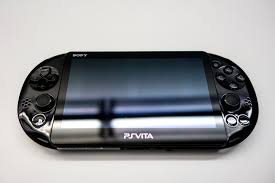
It’s sad to say that the Vita was a mostly commercial flop as Sony got scared with the first sign of trouble. The Vita still continues to release JRPGs and visual novels today, but first- and third-party support has been long gone. The Slim Vita was released right at the beginning of all this, but there’s still a huge library to play on for anyone who hasn’t picked up a Vita yet. While the launch system was a fantastic piece of hardware, the slim version is as well.
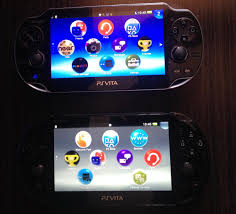
While I won’t get into technical details about the hardware, the Slim Vita is virtually the same system, just slimmer, more ergonomic, lighter, and with much better buttons and placement. The awkward oval start, select, and home buttons are gone with new circle buttons that are firm and less mushy. Everything just has a more satisfying click and less of a mushy feeling to it, which is nice. The downside to being lighter and slimmer is a cheaper feeling, but it still feels good in the hands.
The home button no longer lights up, so those LEDs were moved to the top next to the power button as small bars, which look sleek and minimal. The Vita also uses a standard micro-USB cable, which is nice and ditches the proprietary charger; it’s just too bad they didn’t do that with storage. 1GB of internal memory is included for tiny games and saves, but you can’t use it concurrently with the outrageously expensive memory card.
The biggest change of all is the LCD screen, which is no longer OLED. The Vita was touted as having a fantastic-looking screen, and while the LCD is nothing to scoff at, it doesn’t pop like the OLED did, but you wouldn’t notice unless they were side by side. This change always has more battery life as well. Also noted is the exclusion of 3G models, as AT&T killed the Vita plans less than a year after launch.
Overall, the Slim Vita is the best version to get due to all the improvements. Griping about the OLED screen isn’t enough to justify not wanting this version. We won’t get another iteration, so this is the best you can find.
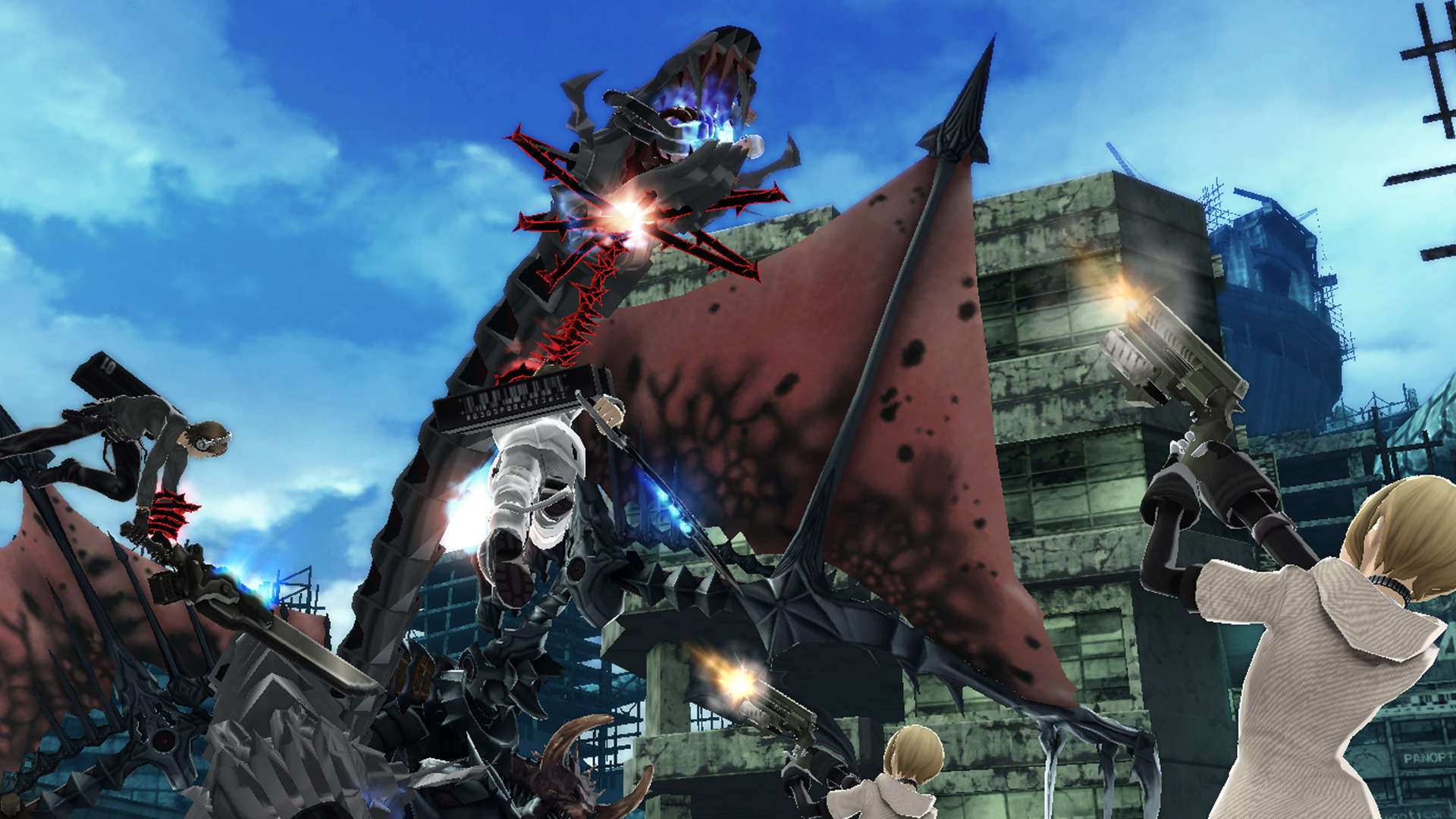
The Vita is a strange system, as several developers tried to make various genres stable on the system. With Monster Hunter clone Soul Sacrifice not exactly bringing about that feat, Freedom Wars is the next game to make the Vita a blockbuster hit for co-op monster-slaying fun. Freedom Wars starts out a little strange, just like Soul Sacrifice. I didn’t understand the game for a while, and it seemed like there was something missing throughout the whole adventure.
Freedom Wars tries to bring about an interesting anime-style post-apocalyptic adventure in which people are all prisoners and sentenced to fight monsters that will destroy settlements unless they have some sort of trait that the government can benefit from. Everyone starts off with a lifetime sentence, but it can get reduced based on various accomplishments such as donating loot from battles to “the cause,” fighting monsters, taking part in more missions, and behaving. This is ingrained into the player’s head from the start, as you are sentenced to 1,000 years for walking for too long. Yeah, it’s crazy, and I loved it. If you run for too long, you get your sentence lengthened, so you have to buy an upgrade that allows you to run, talk to other people, and do various other things, which are actually quite cool.
Once you read your sentence, you put your thumbprint on it, and off you go. Now, the game is very slow to start, and this is a huge downfall for these types of games, as Soul Sacrifice suffered the same problem. There’s a bunch of dialog and backstory to get through, a lengthy tutorial—not just for combat—and then getting used to controls and getting through missions. It takes over 5 hours just to get into the swing of things and start chipping away on missions, which is not a good thing. These anime-type games always do this, from monster slaying to JRPGs, and it drives me crazy.
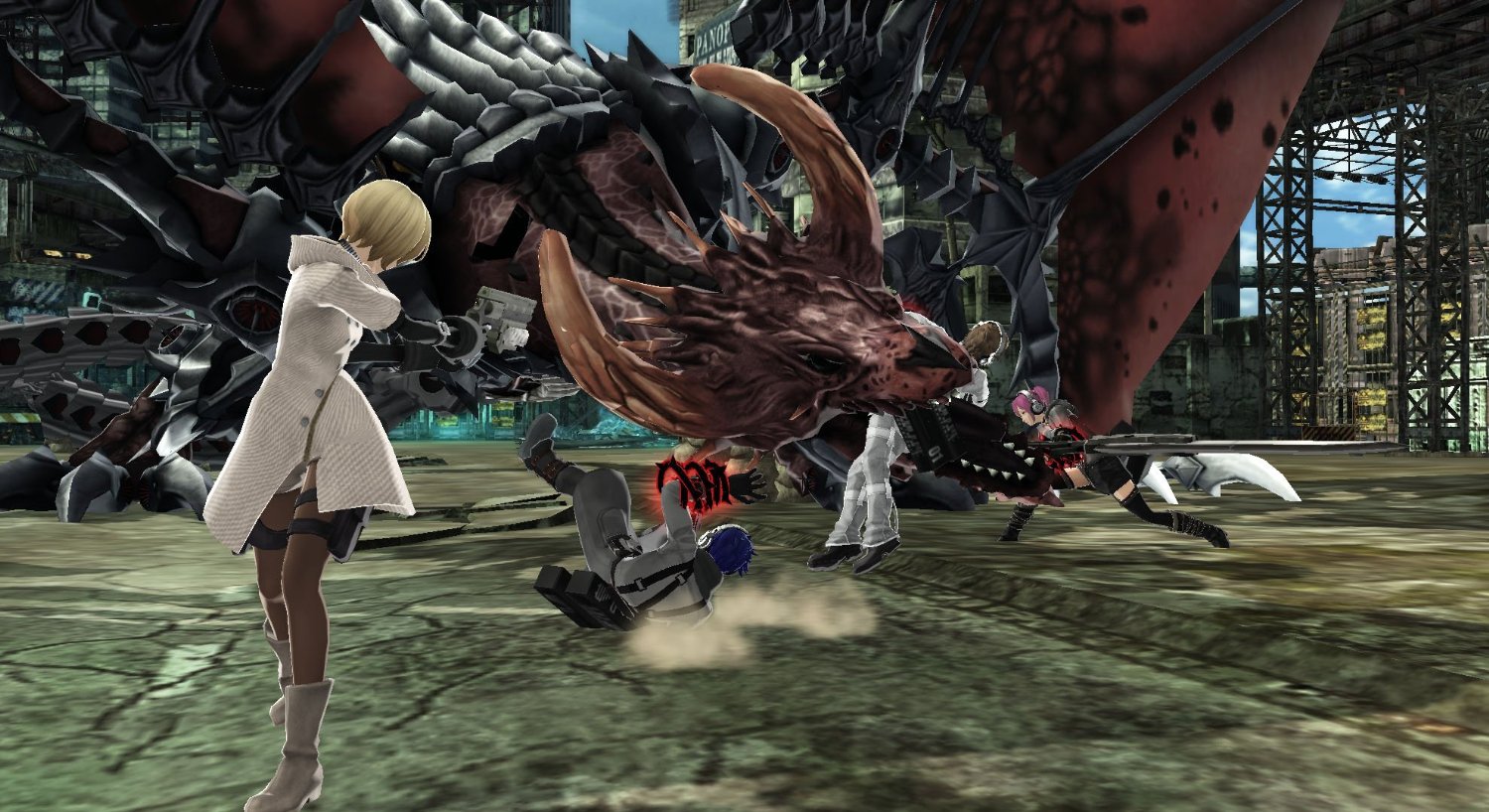
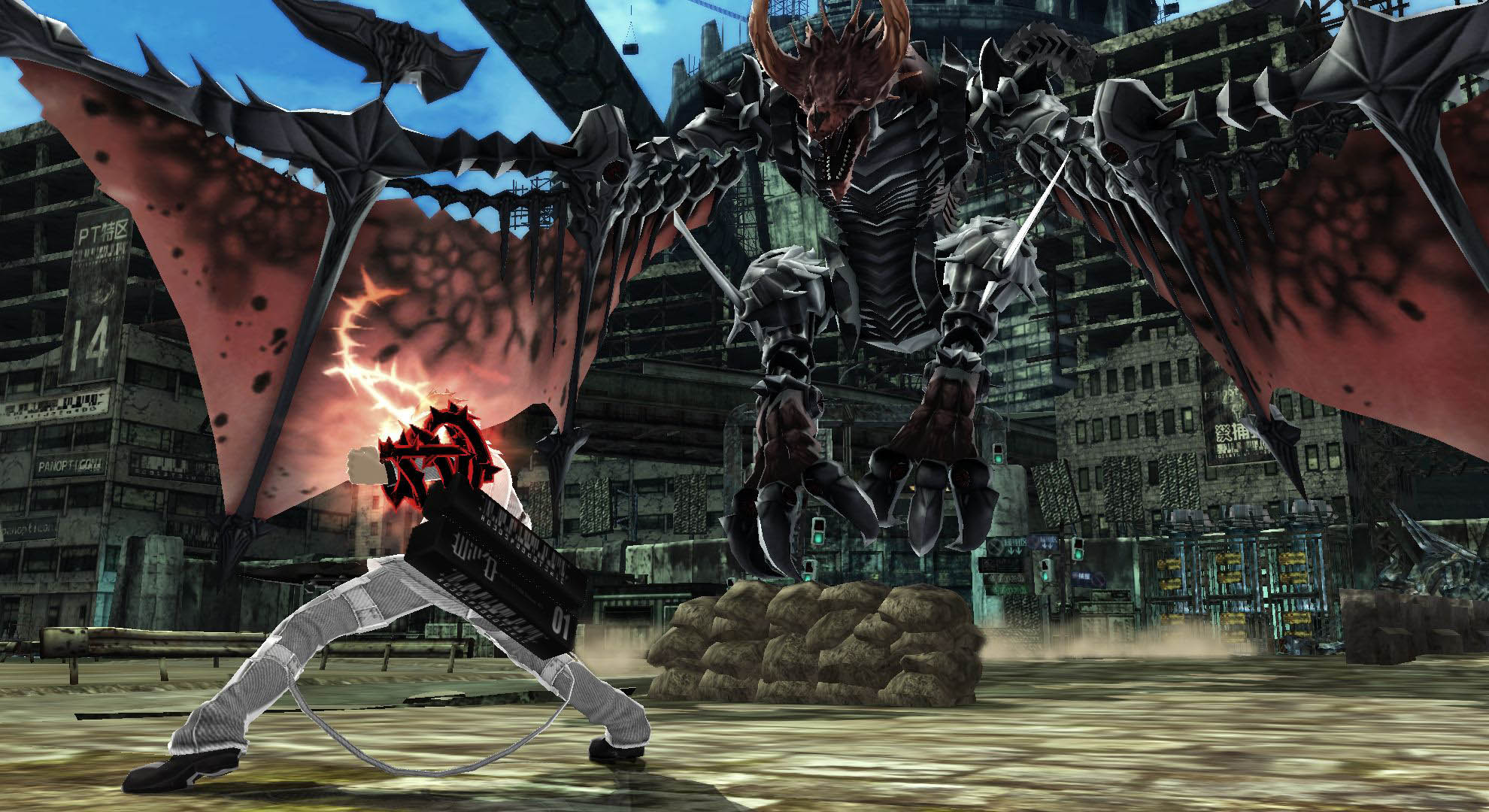
Once you do get into the field, you can switch between melee and ranged weapons. The goal is to lock on to enemies and hack away at a weak point, but your special weapon is your grapple, which can heal or do damage, among various other things. Once you grapple to a weak point, you can hack away at it, and then the monster falls, allowing all the bots and yourself to go to town. It only gets fun when you find momentum and your AI teammates are all getting along and doing their jobs. You also have an assistant bot that always looks out for you that you can customize and assign certain weapons to. Once you fall, you can be revived, but if it takes too long, you lose your life. If you lose all your lives, your sentence is lengthened, and your reward for the next turn is reduced, making this a tough game towards the end. I was able to whittle away at 4-5 star missions, and it started getting ridiculously difficult and repetitive.
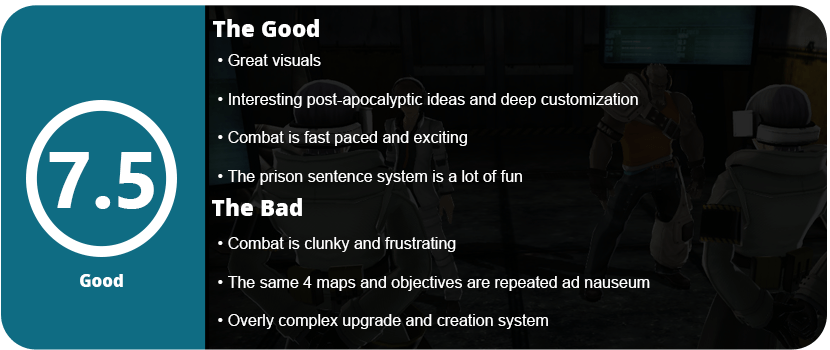
Without human teammates, the game becomes frustrating because you can fall in battle, and three bots are right next to you and won’t revive you. There are also issues with the same 3 or 4 maps being recycled over and over again and with the same mission goals. Save these VIPs, destroy all these monsters, etc. It gets really boring towards the 10th hour, and I just stopped playing after a while because I had no reason to go back.
Let’s talk about upgrading and creating weapons. This is so complicated and irritating, as most of the time you can only upgrade or create something with the components you have, and it takes quite a few missions to build up a little variety. See, you have to create and build workshops to assign the civilians you save in missions to reduce build time and create things like healing items, weapons, ammo, etc. You can upgrade these buildings sometimes, but in the end, it’s all just a bunch of filler and nonsense. Give me a workshop to upgrade and create, and leave me alone. It’s always so complex and unintuitive with these Japanese games. From JRPGs to action games, all the way to free-to-play mobile games, There are layers upon layers of unnecessary upgrade menus and fusing and defusing, etc. It hurts the game quite a bit, so I just rely on buying more powerful weapons and upgrading them; I completely skip creating new weapons entirely.
Customizing your character is quite deep, as you can buy new color packs, armor, and accessories in the game with points you earn in missions. I enjoyed it quite a bit, and there are a lot of things to customize here, so players won’t be disappointed. Overall, the game looks quite good with great lighting effects and textures; it’s probably one of the better-looking Vita games out there. There’s a lot of detail here and in the game; it’s just a mess and completely unorganized and unpolished. I feel the developers were trying several different things and couldn’t decide on just one. The gameplay is clunky, with repetitive missions, recycled maps, and annoying AI bots. The story is nearly non-existent, as it takes forever to unfold as you slog through missions after missions just to get a text-cut scene. I would love to see a sequel, but seeing as the Vita is slowly dying, I doubt that will happen.
Freedom Wars is only for people who love Soul Sacrifice, Monster Hunter, or are really patient and don’t mind repetitive combat to get to an ultimate goal. Playing with friends helps, but it doesn’t hide the mess and unpolish in this game.
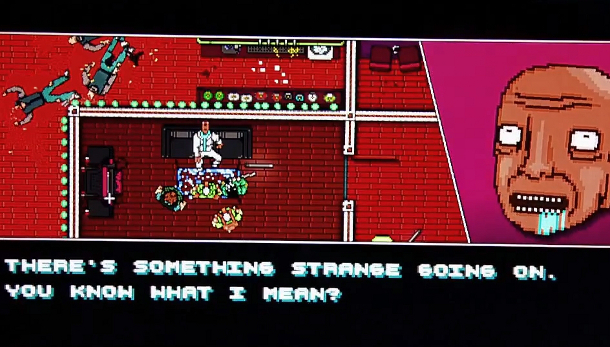
Hotline Miami was one of my favorite games in 2013. It was violent, fast-paced, had tight controls, and rocked a retro 8-bit art style like no other game has. The music was fantastic as well, but the best part was the “just one more level” appeal. Hotline Miami 2 brings back epic music, great art, violence, and, well, some other things we didn’t really want.
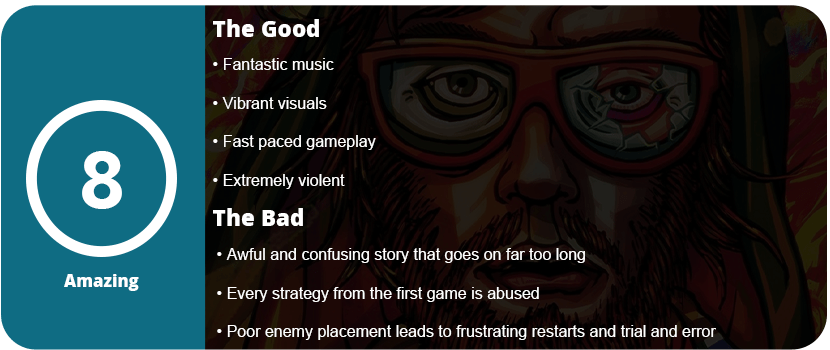
Wrong Number starts out by giving us some backstory. Well, it tries and miserably fails at it. The story does not make one lick of sense because you are being flip-flopped between time periods and so many different characters. Each level just starts, and the story is just there. There’s some dialog with no connection to the previous scene. It’s frustrating and makes you want the storyless original back. However, and it pains me to say this, the story isn’t the worst thing in Miami 2. The game is excruciatingly difficult. Miami 1 was hard, but satisfying. It had great replay value because it was the perfect challenge. Miami 2 is a near-frustrating mess of endless restarts and trial-and-error.
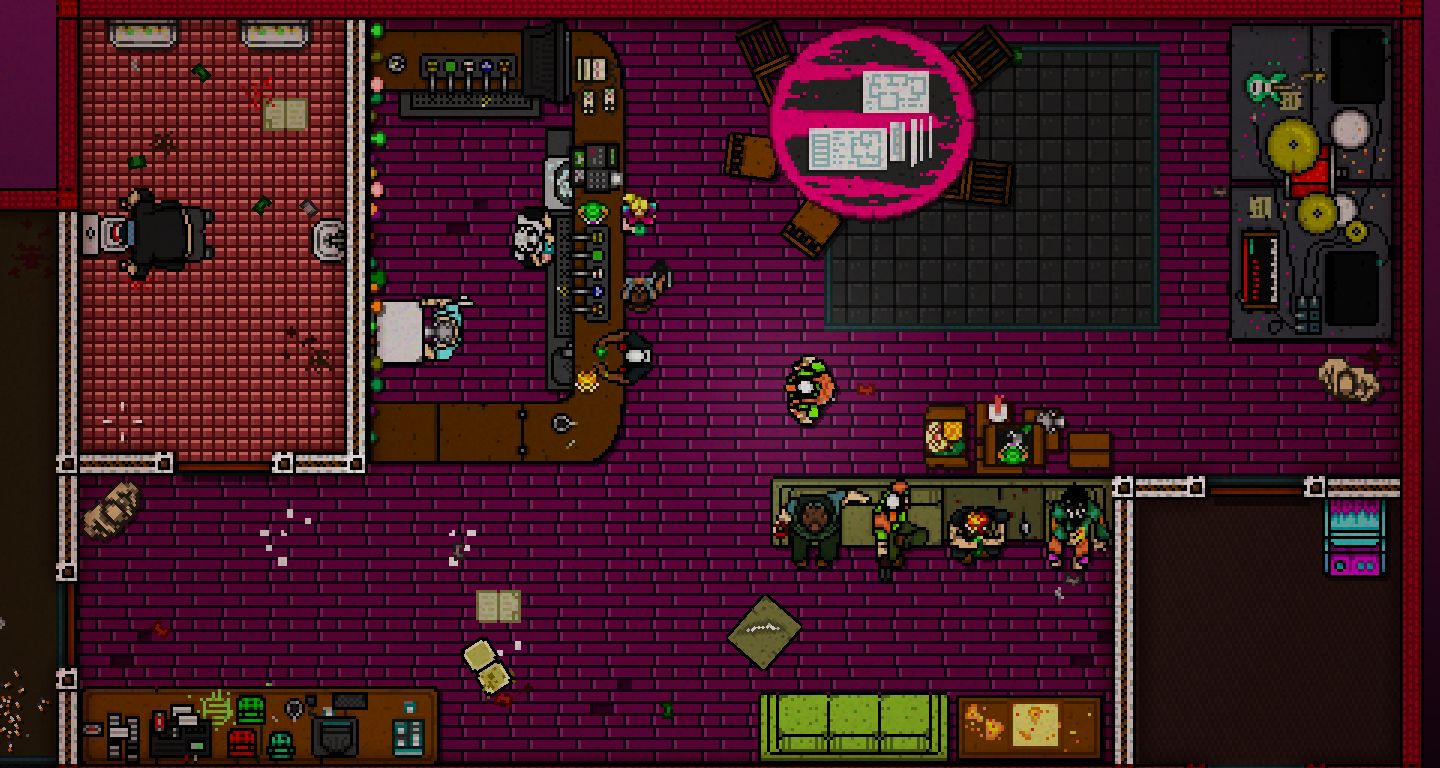
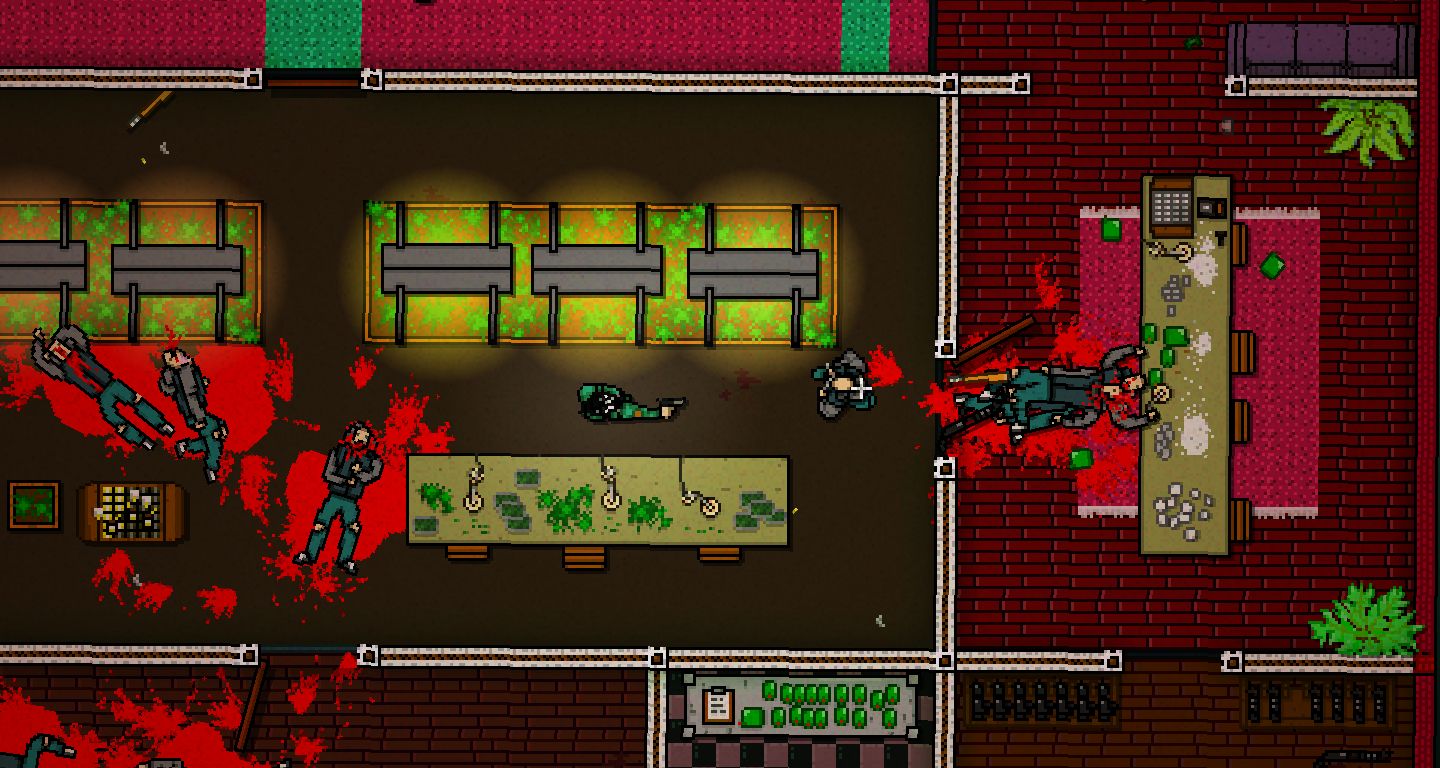
You could say it’s a worse-level design, but that’s not the case; I feel it’s more like poor enemy placement. There are so many enemies in each level, and I mean tons. They all have a variety of guns and melee weapons, and a few can only be taken down with certain weapons. I feel the placement is haphazard; we used strategies in the last game that were way overused here and ended up being used to exploit the game to advance, which is not fun at all. Enemies will see you if you can see them; this is how Hotline Miami works. If you can pan the camera further away, you can get a quick sniper shot at them and a free hit, but for fewer points. One good strategy is to move in and out of a doorway really quickly, let some enemies see you, duck back into a corner, and slice everyone up as they enter the doorway or around a corner. That was an infrequent strategy in Miami 1, but in Miami 2, this has to be done to just get partway through one area. Miami 2 is also full of long-winded levels that seem to never end.
Abusing Miami’s strategies is a crying shame here since this game could have had so much potential for more enemies and new strategies. After halfway through the game, the levels become large and hard to navigate with traditional Hotline Miami controls and gameplay. It’s almost like the game tried to go in a new direction but didn’t evolve its gameplay for it. Miami 2 is also twice as long as the first game, but it overstays its welcome after the second act. I literally felt like the game had become a chore and just wanted it to end.
However, that’s not to say the whole “one more level” thing is gone. I was hooked, and the constant trial and error had me restarting levels dozens and dozens of times to try a new strategy, but it wasn’t really an enjoyable “one more level” feeling. A lot of times I had to exploit the enemy AI. Only certain levels can really be completed one way, and if you start a level with the wrong weapon, kill the wrong guy first, or even kill all the enemies in the wrong order, you’re pretty much screwed. More often than not, I was restarting a level not because my strategy wasn’t sound, but because the enemy AI screwed everything up because he wasn’t patrolling the correct corridor or left a room he’s normally in and blindsided me when I least expected it. Usually, this is a good thing, but not when you’re forced to kill enemies in a certain way due to poor enemy placement being overwhelming.
With that said, I hate to say that there’s really no reason to come back to this game after you finish. Do I want to spend an entire week restarting level after level again and again? Of course not. I’d rather re-download the first game and enjoy the excellent Miami-ness without all the hair-pulling. All in all, Miami 2 is not really a must-play, even for fans. If you end up never playing this, you’re probably better off sticking with the first game.
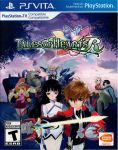
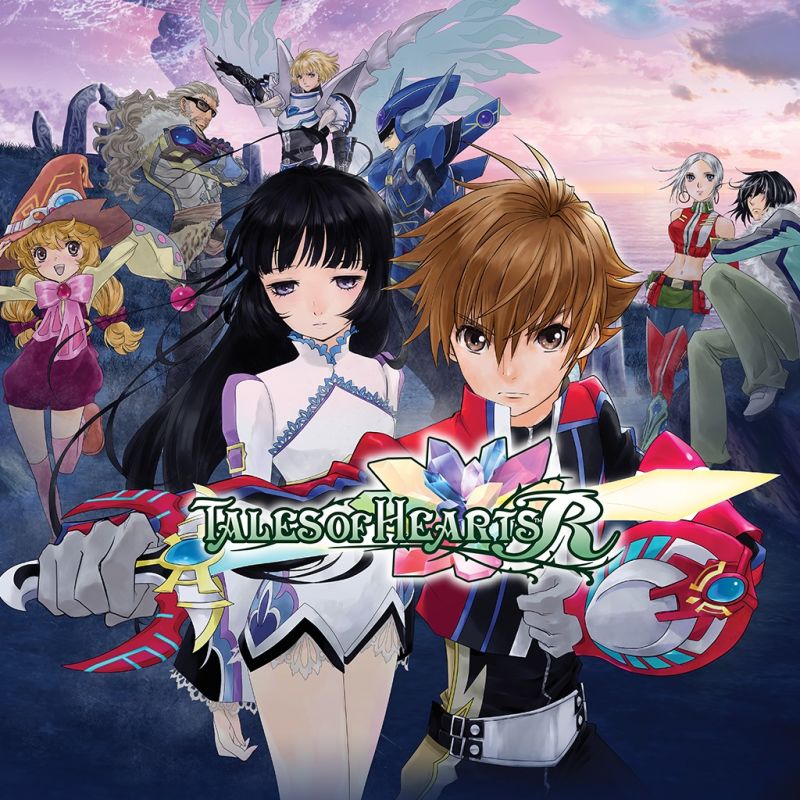
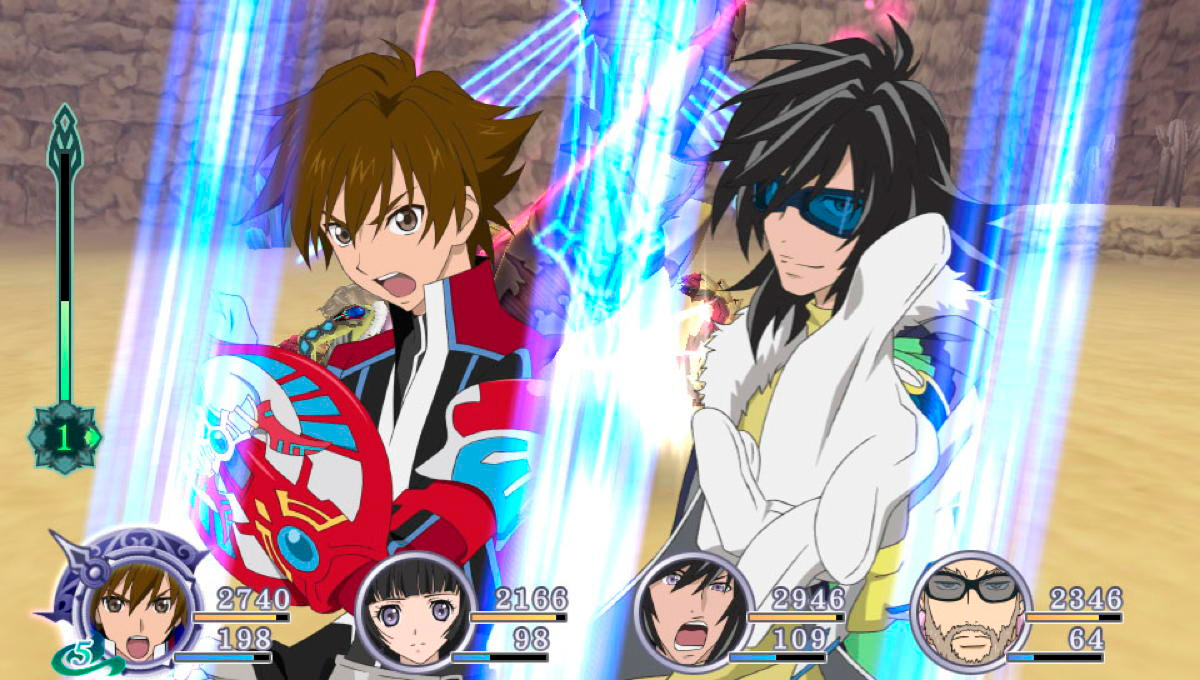
If you have been following this site for a while, you will know by now that I don’t have much patience for JRPGs. They are usually extremely long, random battles get tedious to the point of me wanting to quit the game completely, and sometimes the stories and battle systems can be boring, convoluted, or both. Tales of Hearts R just so happened to be one of the few JRPGs available on Vita, so I thought I would give it a try. I was in for a strange surprise.
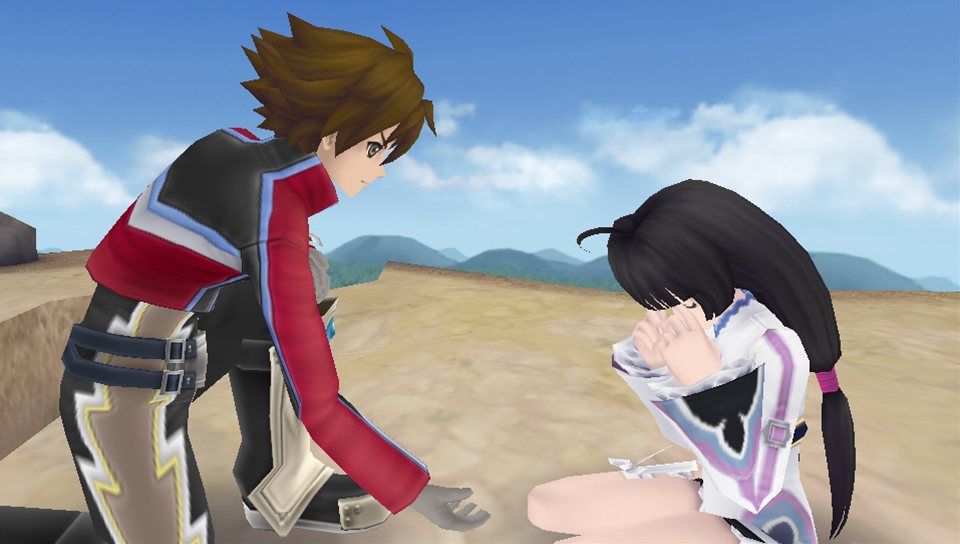
The story itself is actually pretty decent and actually makes sense, despite how involved it is. You play as a young hero named Kor Metor who is traveling the world to help save a girl named Kohaku along with her brother. There are links within people called Spirias. This is kind of like their soul. Somatics has weapons that are formed from this spiria, and Kor discovers he is one after watching his grandfather die at the hands of a woman named Incarose. There is a “Spiria disease” called xeroms that can cause dispiration within people, meaning part of their Spiria Core is missing or corrupted. Kor and his friends “link” with people to fight off this corruption. Kor does this to Kohaku and shatters her core, sending the shards into eight pieces across the globe. However, what threw me for a loop was that this whole adventure was only the first half of the game. The second half involves another huge plot with an entire ancient planet that can suck out these Spirias. Of course, your new goal is to stop this new evil madman.
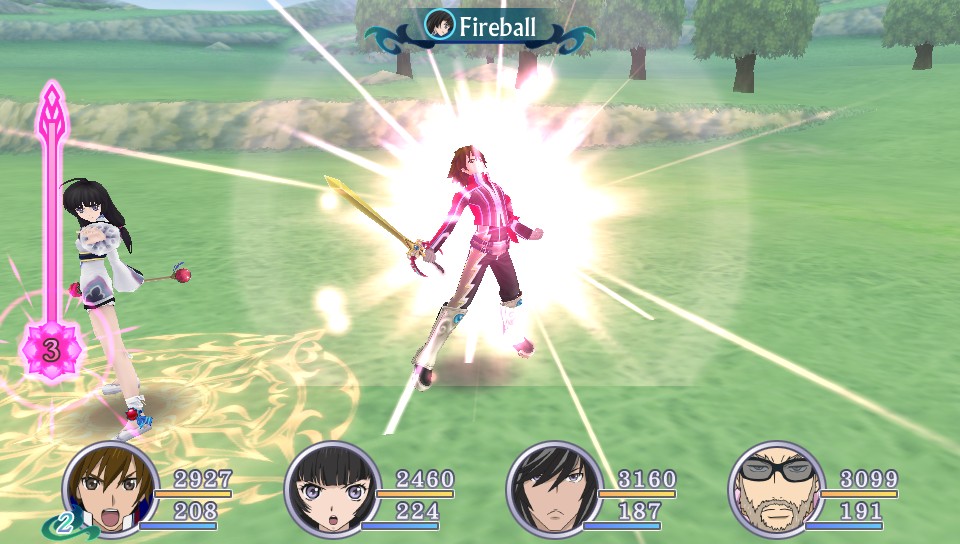
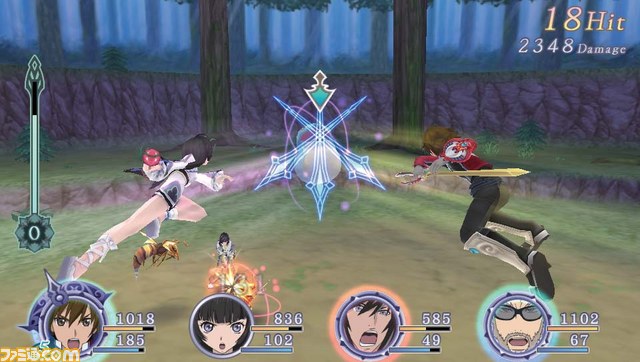
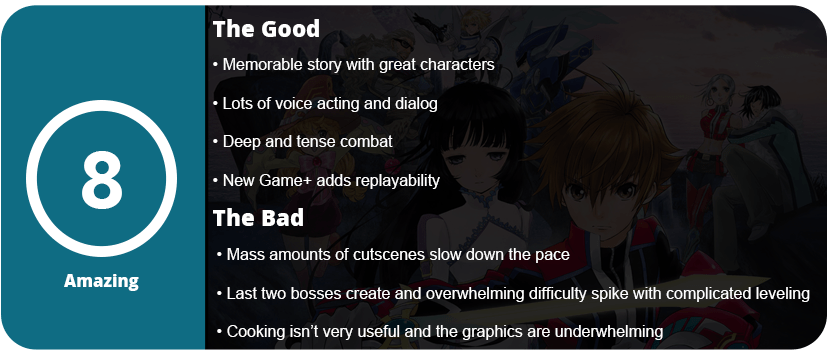
Holy crap… I can’t believe I remember all that! With that said, the story consists of endless cut scenes—I mean, endless. There are probably hundreds of cutscenes in this game, but 90% of them are spoken Japanese dialog, which is nice. There are a few anime cutscenes that are beautiful, but I wish there were more. I know most people like cut scenes, but I honestly felt it held up the game too much, but that’s just personal preference. Aside from the story, the combat is actually pretty intense and deep. You can control four different party members in real-time in an arena. The attack buttons are completely customizable, allowing you to assign new skills and “arts” to Circle and X. While you hack away at enemies, a meter will charge that allows you to go into a “hyperdrive” mode to deal more damage and take less. All while this is going on, you can also assign other members’ skills to the touch screen by flicking their icon, which I thought was a nice touch. I had one party member heal at my beck and call exactly how I wanted him to instead of relying on his AI, which would usually wait until everyone’s HP was in the red.
Secondly, you level up in this game very oddly, and it took me a while to figure it out. You don’t buy weapons in shops, only armor. Weapons are acquired by leveling up your members through their Somas. There’s some sort of complicated line chart in the form of a star, but thankfully the auto-level button just lets you choose what type of fighting style you want for that character, and it will assign the points accordingly. Along with this, there are also cooking items that give you boosts during battles, but I never really got into this much. It did come in handy at times, but thankfully you level up fairly quickly while only hitting a difficulty spike on the last two bosses of the game. This required me to level grind for over a day just to raise my members up to about 12 levels to get an edge over the bosses.
Lastly, there’s a lot of side content in this game and a New Game+, which is usually unheard of in JRPGs as they are linear and follow a set pattern and path. There are other difficulty levels that also raise the level cap (200), as well as a few side quests for people interested in some more side stories (I usually hate side quests in JRPGs). With all that said, it’s optional.
After the credits rolled and I logged 30 hours into this game, I felt satisfied. The ending had closure, the final boss was rewarding to fight, and I felt myself feeling relieved that the game was just the right amount of challenge throughout and did not require constant bouts of level grinding. Graphically, the game is average. It’s not very ugly, but it also doesn’t push the Vita to its limits. The music is monotonous and typical of a JRPG, but at least the voice acting is great. If you own a Vita, this is probably the best JRPG you can plan outside of all those PS1 classics.
The Vita was a little weaker this year, but overall those games that were released were solid. The Vita has lost steam since last year, but here’s hoping 2015 is the year of the Vita.
Freedom Wars took the monster hunting formula that Monster Hunter did so well and made it better. With the addition of weapons and the unique Thorn weapon, Freedom Wars shot players into massive hunts with other players or AI controller characters. The insanely deep customization options and fantastic visuals were a treat as well. Not to mention widdling a 1 million year sentence to zero is quite the challenge.
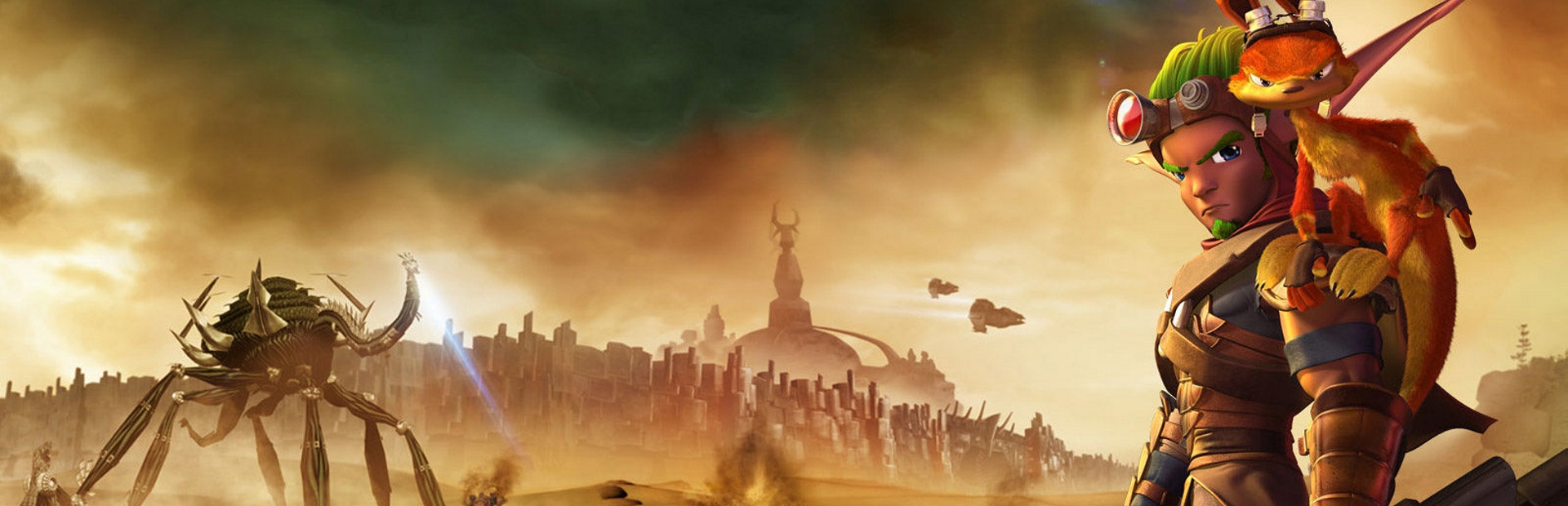
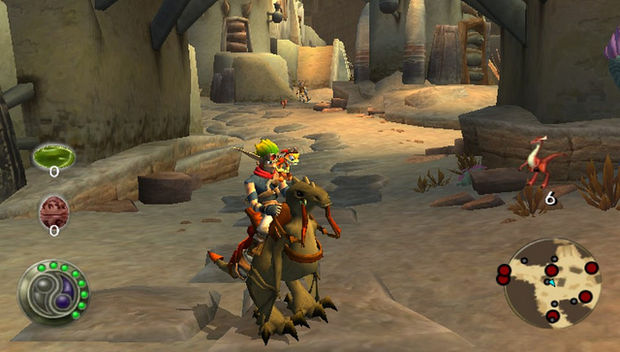
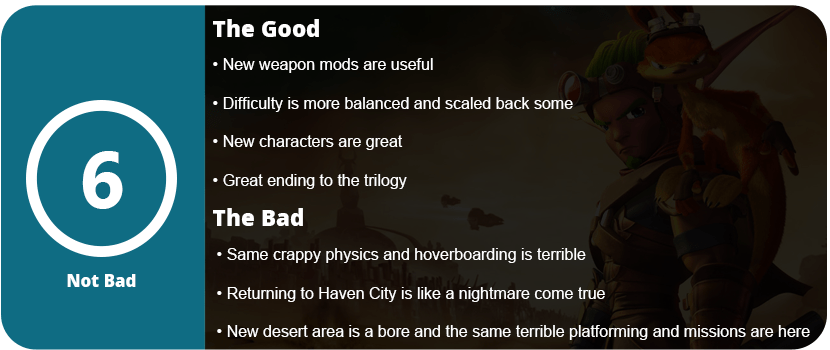
Well, I finally did it. I have played the entire Jak and Daxter trilogy, and I have to say it is one of the most overhyped and overrated game series ever made. While the characters and charm are memorable, everything else is sub-par and less than mediocre. I thought that three times in Naughty Dog would have nailed the gameplay and fixed everything from Jak II, but I was wrong. Instead, we get to revisit that crap fest with just some updated areas of Haven City and an entirely new, boring open desert we can drive cars in that has awful physics.
Jak and Daxter must stop Errol, who is a half-cyborg, from getting to the Death Star. The only worthwhile part of the game is at the very end, when we finally get to know what the precursors are, and I was very satisfied when I found out. Everything else is slightly smelly crap, but complete crap nonetheless. We’re stuck with the same linear level design, repeated mission areas, hard as hell difficulty, wonky platforming, extremely wacky physics, and too much traveling between missions. I loved the new characters, but that’s all this game really had to go for it.
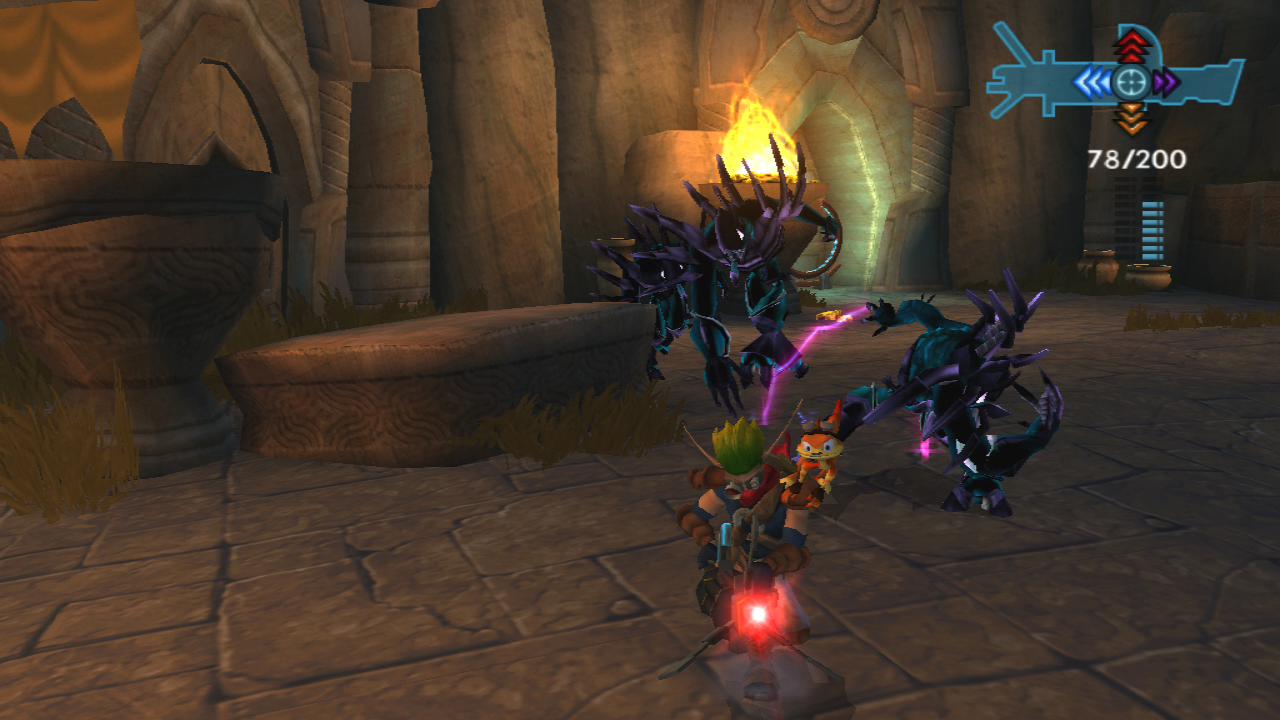
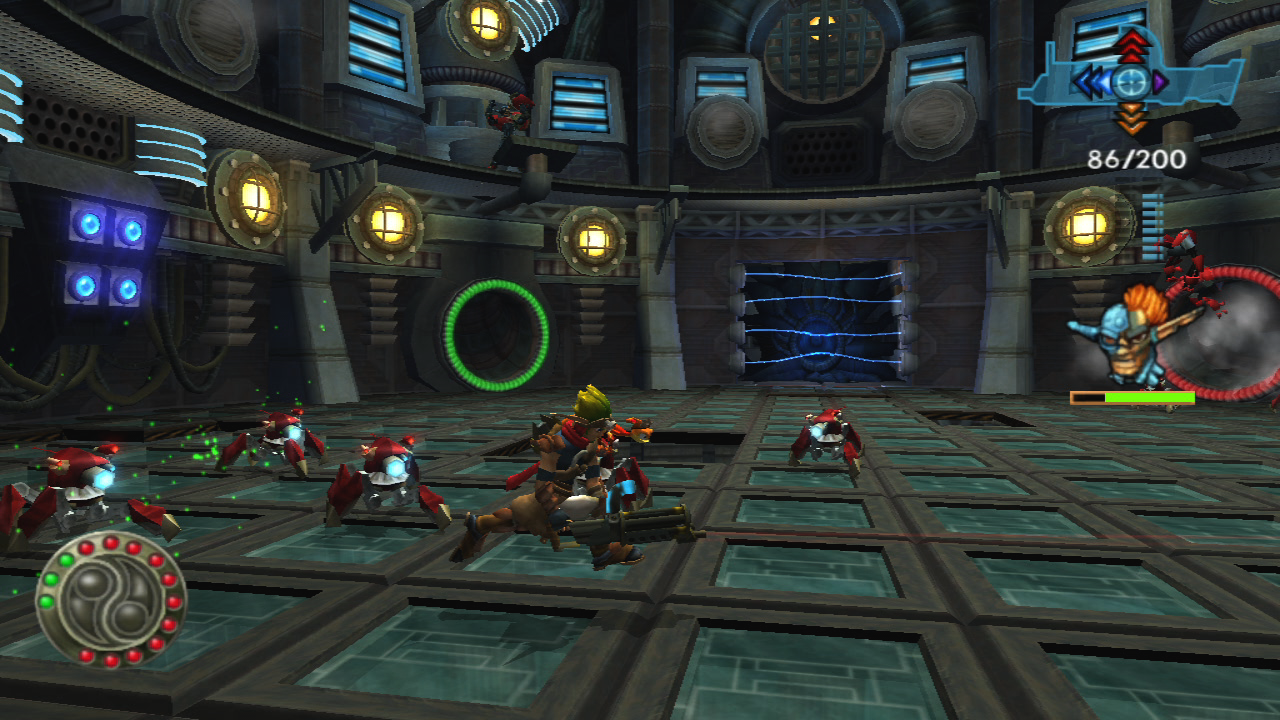
All the new content doesn’t really feel new. Sure, the missions weren’t as difficult as in Jak II, but they were still annoying and boring. This felt like Jak 2.5 rather than a true sequel. The new open desert area is a complete bore to drive in, and bandits will constantly spawn to attack you relentlessly. You are given several buggies, but they all drive like crap. The only helpful addition were the new weapon mods. There are three for each weapon we had in the last game, but they are all really useful, and I relied on them a lot throughout the game. However, the auto lock-on system is still just as crappy, and you waste a lot of ammo just trying to aim in the general direction of the enemy.
Let’s talk about Haven City. I thought I would never have to see that awful city again, but here we are. Each section has been more…updated due to the ongoing war with the Metal Heads and Krimson Guard. The areas are a tad more wide open, and the same vehicles drive a tiny bit better, but not much. There is a new camera angle that puts you right behind Jak, but it just made me noxious due to the awful physics. I really just wanted the game to end, and it felt like a chore, just like the last two games.
With that said, if you played Jak II, you won’t need to expect much from Jak 3. I’m not sure if I’m more disappointed with Jak II than this game, but I honestly can’t recommend this one either. The entire series feels like a complete bust to me, and that’s a crying shame.










































 thebinarymessiah.com
Try multiplayer. A lot of fun !