

Publisher: EA
Developer: Bioware
Release Date: 05/14/2021
Available On




Mass Effect
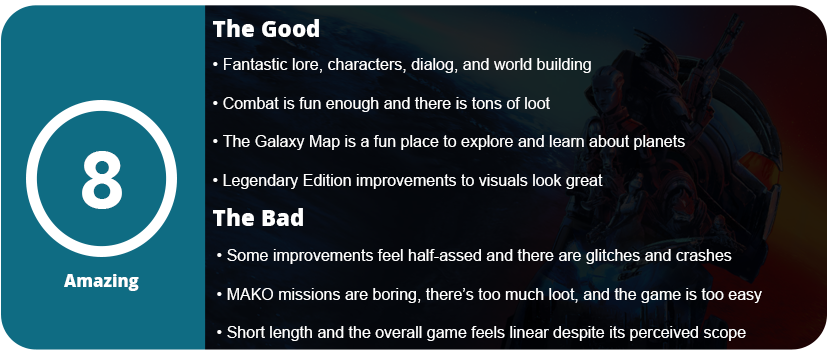
Mass Effect was a big part of my teen years growing up. It was a massive sci-fi odyssey that let you explore planets, and BioWare created a giant world with lore that could rival Star Wars. Alien species with in-depth military and political backgrounds, and the amount of detail spread across the whole game that fully incorporated the lore and detail. Being able to talk to numerous species such as the Elcor, Hanar, Volus, or Asari about their individual lives or more galactic issues. It was fascinating and ground-breaking for the time. The facial animations, the graphics, and the sheer scope of the game were unheard of. Fast forward over a decade later and it’s still impressive, but video games have evolved and so have action RPGs. The flaws are big red scores on the game, but it’s still fun to play through.
The game starts out like any other BioWare or Western RPG. You create a character, and pick a class, and a background. Mass Effect’s character customization was never grand, and LE’s improved version helps a bit, but it’s still not very detailed. You can choose a pre-made character, but I chose to create from scratch. I picked a class that balances biotics and weapons and a female. Biotics are powers you can use in the game (and describes how humans become biotics in fascinating detail) and you’re off. You start out right off the bat learning that dialogue is a huge part of the game here. In fact, every choice you make shapes the ending and the outcomes of missions that carry across all three games. You can be Paragon or Renegade based on how you respond. There are usually three different levels. Nice, mean, and down the middle. One major complaint players had was the Renegade path was Shepard just being a complete asshole and nothing in between. It also doesn’t serve you to be neutral through the whole game either. This path can unlock dialogue options for either side that can change the tide of the entire game including making missions easier or harder.

Once you learn the ropes and get into your first mission you will learn how to play with the combat and shooting in the game. Mass Effect never had amazing combat, but the shooting here is slightly improved and is more enjoyable than it was before. You can move into cover, peek around ledges, sprint, and throw grenades. You can carry four weapons. Assault rifles, pistols, shotguns, and sniper rifles. Throughout the game, you can acquire crap tons of loot that allow you to mod the weapons in various ways as well as acquire new weapons and armor. This is essential to staying alive and you also need to manage your crew’s armament as well. Over the course of the game, you will meet various characters such as Wrex the Krogan, Liara the Asari, and Garrus the Turian. These characters are quite memorable and some even offer missions. I didn’t particularly care for Kaiden or Ashley as they were just boring humans honestly, and there is nothing exciting about their personalities and you only learn about their past through optional dialogue when visiting them on the Normandy (your ship) after each main story mission.
One of the major hub areas of the game is the Citadel. A giant spacecraft that trillions of aliens live on. There are various parts you can visit and can easily get around through a fast travel system. There are about a dozen missions to complete on the Citadel as well as vendors to visit. Some missions are given to you here to complete in space, but overall the Citadel isn’t a very enjoyable place to explore. Most of Mass Effect suffers from slow exploration, linear corridors, and various other problems. It’s a flaw of the times as the Xbox 360 wasn’t powerful enough for the vast open worlds we have now and there were also time constraints for development. Honestly, exploring in Mass Effect just isn’t very enjoyable. I only really liked the main story missions. Side missions are a bore fest with nothing truly gained outside of cash and loot and there’s too much of it. The game is so short that you will end up with millions of credits with nothing to spend it on. About halfway through I acquired the best gear just by completing missions and opening crates.
It’s a very unbalanced game difficulty-wise. I found the game very easy early on as acquiring loot so fast and quickly means you can kill everything in a couple of shots. This also led to me never really venturing outside of my pistol as my class specialized in that weapon. I nearly maxed out my level by the end of the game and there are so many different things to put points into that it feels unnecessary due to the short length of the game. All these biotic powers, weapons, mods, and classes for a game that can be finished in less than 20 hours? I wound up finishing everything in the game in about 33 hours. While this sounds strange that there would be so much RPG stuff in a short RPG, the game mostly just runs itself. I micromanaged my inventory a lot, but the game is so easy that I never worried about trying to find the best stuff. It basically falls into your lap.
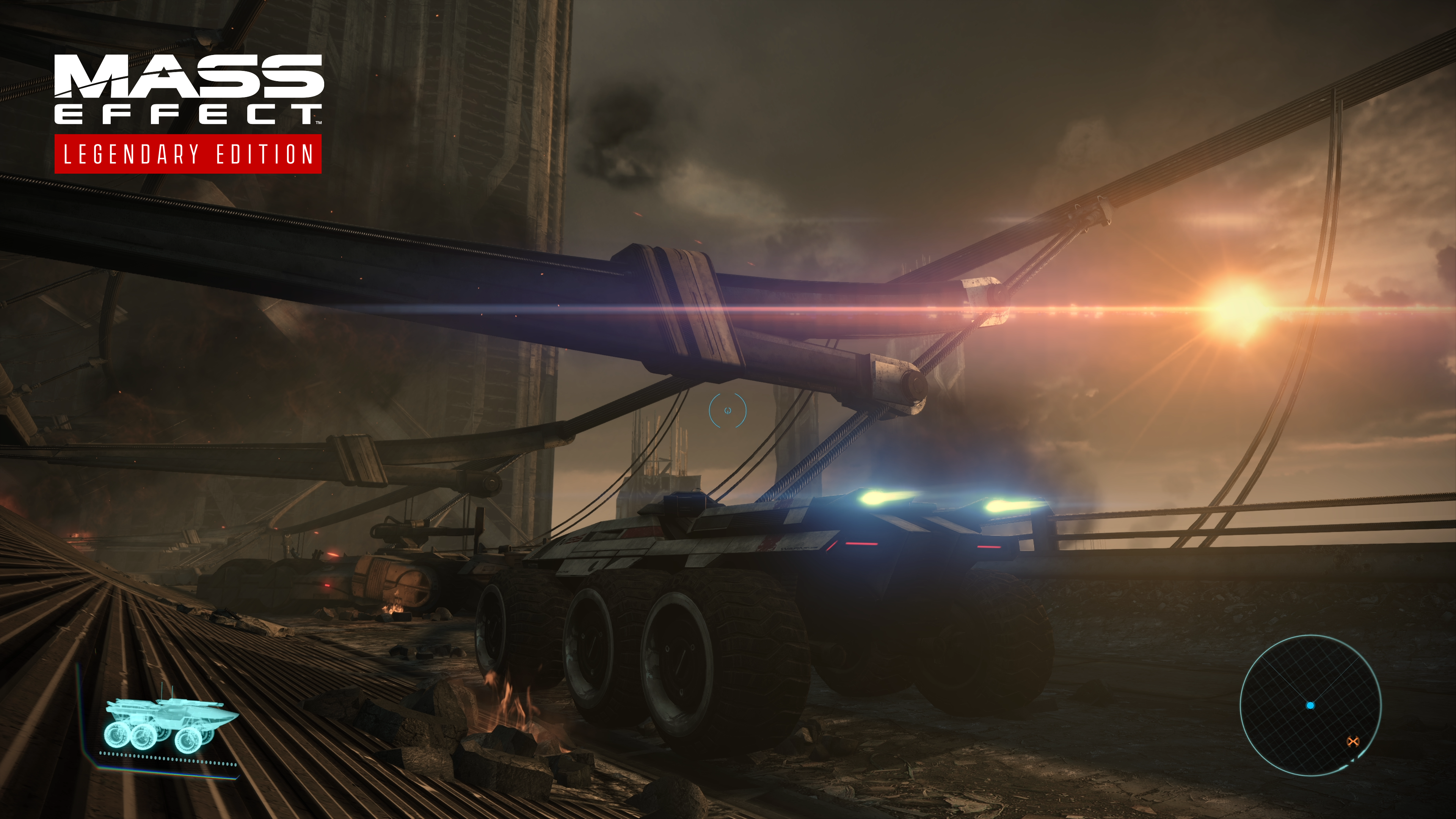
That’s also not the weirdest thing about the game. The MAKO driving sections are a notorious and infamous chore and bore-fest. The vehicle has a mounted turret and shoots grenades, but there’s not much reason to use it outside of main missions. The vehicle is floaty and the worlds you drive on are insanely difficult to navigate. The terrain feels like it was made by a child who was given a terrain deformation editor and they went nuts. Nothing makes sense, there’s no logic. Just cheer cliffs and mountains on every single planet that are a pain to drive on. You can go around and discover hidden anomalies and metal deposits (these are for credits), but it’s such a chore and it’s boring. The first few planets are interesting, and it’s fun to feel like you’re exploring planets in space, but they’re completely empty. There are no other colonies or cities to visit outside of the Citadel itself. Just hours of empty driving and getting out to do a stupid puzzle to complete a few fetch quests.
Most side missions are given once you enter a new cluster on the Galaxy Map. You are looking at a solar system and can click on planets and you get a zoomed-in view of them. These are actually quite awesome and they are all different. You get info sheets on what type of planet it is and that part is really more fun to explore than actually landing on planets. Most clusters have one planet you can land on, and once you enter a cluster that has a side mission you will get an incoming message. Then you land, explore, find anomalies to complete the fetch quests, find deposits for credits, then you go into the same three generic interior buildings that are rotated to shoot something dead to complete the side mission. Maybe there’s one that involves dialogue to complete the mission. These interior levels are boring with just a few hallways and open rooms.

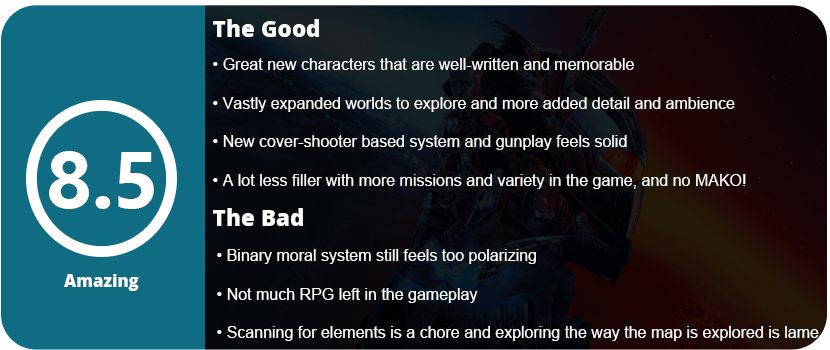
With that said, what’s the point of completing side missions then? Maybe completionists will want to for achievements, but it’s not needed to get the credits to buy weapons and armor. You end up getting all that stuff organically as you play anyways. The most enjoyable moments are the dialogue sections though and combat is fun for the most part. It’s just clunky and most everything feels underutilized. However the story is fantastic and the majority of characters are memorable, and that’s Mass Effect’s strongest point. The world-building, the lore, the characters, the story, the writing, and everything involved in that.
The game looks good and the LE upgrade is definitely several steps up visually from the Xbox 360 original. There’s better lighting, higher resolution textures, more detailed models, and everything in between. The music in the series is also fantastic, and the PC graphics options are decent. There’s ultrawide screen support which is a huge plus in my book as well. Overall, Mass Effect 1 Legendary Edition improves mostly on the visuals and that’s it. You can’t fix the core gameplay too much. They tried to add sprinting, but it’s only for three seconds, so why bother? You can skip elevator rides, but only some of them, and interesting dialog takes place here, so again, what’s the point there? I also had physics issues, stuttering, slow down, and the game would randomly crash sometimes. Hopefully, this gets patched at some point.
If you can look past the awful MAKO missions, the clunky combat, overly easy difficulty, and the unbalanced loot system, the game is worth playing. The main story is short, and the side missions aren’t worth investing time into unless you want to complete everything. The story, lore, characters, and dialogue are what make the game so great, but it really hasn’t aged well over the years and feels like a time capsule of two generations ago.
Mass Effect 2
Mass Effect had a lot of issues when it was released and many things needed to be balanced, tweaked, and changed, and BioWare listened with Mass Effect 2. You can immediately see many improvements, especially right after playing the first game, but some issues were fixed in the wrong way or weren’t quite realized enough. As a sequel, the game is bigger, more in-depth, more fun, and definitely a much tighter experience overall.
One of the first things you will notice right away is the game plays more like a traditional cover-based third-person shooter. The shooting is tighter, the weapons are more satisfying to shoot, and the cover system is a lot better. One of the first major changes in the implementation of ammo was in form of thermal clips. I know in Mass Effect 1 it was said that the weapons shave off pieces of metal and each gun has a small mass effect drive, but for some reason, thermal clips are now needed. You can pick thermal clips off of dead enemies or around the levels, but you also now have more limited use of weapons in your class. Each class can use specific weapon types. The game also ditched the traditional loot system in favor of set upgrades that you acquire throughout the game for everything. Each weapon has 5 levels of damage you can upgrade to, there are biotic upgrades, but your biotic powers are now set in stone based on class. Once you pick your class your weapons, biotic powers, and even ammo type you can use are all permanent. Some people didn’t like this and felt it was the opposite direction of endless, mostly useless, loot.

I actually felt this was an improvement as BioWare went with a more traditional cover shooter system so they took out most of the RPG elements outside of adding stat points to one of your four or more powers based on your level. I chose to use any weapon type, but I couldn’t use sub-machine guns. I also had access to all ammo types, of which there are four. This actually came in handy when dealing with certain enemy types, as there are a wider variety of them. I used incendiary ammo for organic enemies, and for Geth and mechs, I used a disruptor ammo type. I felt the cryo was a bit useless, but I also had access to my two teammates’ powers, and I could command them to use them at will. You can acquire new weapons by discovering them around areas, as mission rewards, or sometimes at shops. There aren’t many weapons in the game, so just be aware of that. At least they feel more unique instead of just a statistic change in a massive pile of crap. Shepard also moves faster in this game, and the entire pace of the main missions and side missions is even faster and more streamlined.
Another huge change is the level design. In the first game, the only unique areas were during the story missions and side missions were a boring hodgepodge of empty hallways that led to empty square rooms. At least in this game, there are more worlds to land on, about three times as many, and there are about twice as many teammates to acquire so that means more unique areas as well. Each teammate is a mission in itself to acquire them and then they each have their own mission to gain their loyalty and this is used to advance your romantic relationship with them. There just aren’t more worlds, but they feel more lived in. Sure, they’re still small and linear and cramped, but the Citadel is what it was in ME1. You’re now just on three levels of the wards and the shops. There are aliens everywhere; the backdrops look gorgeous; there are more ambient sound effects; and it feels great—for the first visit. The game is still very static, and I wish alien positions would switch up or more random events would happen. Nothing ever changes, and every NPC is glued to that spot forever. It still feels good to be in these areas, and the extra detail everywhere is really noticeable.

Side missions are now acquired during main missions or other side missions. You might find a datapad that has a mission, or you will find messages on your personal terminal. The navigation of the galaxy map has greatly improved as well. All missions are now shown on the galaxy map, and there are bubbles on each nebula or cluster with the name of the mission. You can now directly control the ship on the map, but it’s honestly pointless and feels half-baked. You have fuel and probes now, and fuel is used to get across solar systems in a galaxy. You still need to use a mass relay to jump around the major clusters in the galaxy. The fuel feels stupid, as that’s all it’s used for, and probes are the answer to taking away the MAKO and finding resources.
Yes, the MAKO is gone! Hallelujah!, but now you are stuck with another mundane chore: scanning planets for resources. There are five resources needed for upgrades, with Element Zero being the rarest. Most of your Eezo is acquired on missions in containers rather than planets. What you have to do is hold down a button to scan the planet, and a bar graph will spike high when there’s a strong amount of an element in that spot. It’s incredibly tedious and feels like a chore, and there’s zero fun in it. Sure, you can acquire a better scanner later, as each crew member you recruit has a major upgrade to offer the Normandy, but it doesn’t make things better. What’s more annoying are the limited probes. Why? I can only get more at a fuel depot, and those are only near mass relays. So, if I’m in a system that has no depot, I have to travel back on the map and fuel up. Just give me unlimited fuel and probes! This limit makes no sense. I also don’t like how there’s no zoomed-in view of each planet like there was in the first game. It’s just a small ball on a screen. At least each planet has a unique description.
While the galaxy map is slightly improved, it introduces new issues, and the dialogue system hasn’t changed a bit. Shepard is a little less of an ass in the Renegade options, but the binary moral system is really crippling as the game tries so hard to be extreme on either end. There are now some quick-time events during certain scenes that allow you to perform a Paragon or Renegade action that can boost that meter, but at least the smaller choices in conversations now add a little bit too. The top, middle, and bottom responses are good to evil in their respective order, and you will get maybe two points for responding nicely even in parts of the conversations that don’t matter. Sometimes you can win an entire dialog-driven scene by having your morals polarized more on one side, but I will give BioWare credit for its continuity. Every action you take in the first game reflects whether it’s a crew member who died on a small side mission and you just get a message about it later. I noticed every action I took in the first game unfold and take hold here, and these actions also had dire consequences.

The main story is still really short, with only maybe half a dozen missions or so. The last three crew members are optional, and there are a couple of crew members attached to DLC. Sadly, these crew members don’t have any dialog trees, and their characters aren’t expanded upon enough. With that said, the new characters are really likable, memorable, and well-written. The expanded lore and world feel grand despite the game’s actual limited scope. I felt I had more control over the dialog, but the binary moral system is constricting in itself and is one of the main issues I have with the whole series. The game is about as long as the first, but it feels more satisfying as you aren’t spending 10+ hours driving around in a boring MAKO. I finished almost everything in about 35 hours, and it feels solid and thorough. Less filler was scrapped for more actual content.
The Legendary Edition upgrades are mostly visual, and they look great. The game is several steps up from the first game visually, and the voice acting has improved a bit. There are more scripted events, cut-scenes, and animations. But the same 3-second sprint still exists, which is annoying. Overall, Mass Effect 2 is so much better than the first in every way. The story feels grander, and the Collector’s are a new formidable enemy. More questions are answered that you actually care about, but also more questions are raised, and the game ends on a cliffhanger. I liked having to choose teammates to do certain things on the final suicide mission, as some might die, but you don’t know in what situation or how. Sometimes it’s not even the team member you actually pick who might die, but yes, team members die at the end, no matter what you do; it’s just a matter of who. I loved every minute I was in the game and couldn’t put it down.
Mass Effect 3
Here it is. The finale to one of the largest video game sci-fi epics ever created. It’s a huge undertaking, and when Mass Effect 3 first launched, it became infamous for its disappointing ending, which basically had to be rewritten and patched back in. This is it. The final push against the reapers and any other enemies that stand in Shepard’s way. The game focuses heavily on shooting and veers more away from a traditional RPG, but it also has a more focused mission structure with a lot of writing and dialog with choices that mean even more than they ever did before.
The main focus of the game is to now gain war assets towards defeating the reapers. This is your main goal and what all your main and side missions will give you in the end. You have a minimum meter and can’t engage in the final mission until you’ve met this bar. This is all based on a score, and it’s broken down based on what you have done. All main missions give you the largest chunk, as your next big goal is to basically figure out what to do with each species that we have learned about up until now. The krogan and turian conflict, the krogan genophage, the quarians, the rachni, and the geth. All questions are answered, and each main mission focuses on the main characters that either survived during Mass Effect 2 or just in general. Dealing with each and every major issue with all species is pretty incredible and cool. It feels right that everything led up to these huge decisions.

One of the first noticeable things is the improved combat. It’s more cinematic and feels closer to something akin to Gears of War. Infinite sprint, finally, with snappier cover mechanics and dodge and roll mechanics, and the guns feel more tweaked, unique, and satisfying to shoot. This feels like a proper third-person shooter now, with some RPG stats tacked on. However, despite the more unique weapons, which include a loadout bench, and the fact that each weapon can have two mods attached, the game is still too easy. I rarely ever died, and when you fully upgrade a weapon to level five, everything dies in a couple of bullets. I wound up finding preferences for how the gun feels over how much damage it can do. I feel there are way too many weapons for such an easy system, and every enemy feels like cannon fodder. While there are now only Reaper enemies and Cerberus enemies, they repeat often and get boring to shoot. I was never afraid of any situation, and I could even stand out in the open most of the time and just mow everything down without a scratch. While the combat feels great, it’s not challenging, and all the effort feels almost wasted.
Once again you command the Normandy ship and its layout has changed once again. It’s lost more streamlined and you no longer have to walk around talking to everyone hoping to unlock the next relationship stage. You only acquire five squadmates this time and most of you already have met before. I really felt no need to walk around the ship anymore except to invite people to my cabin to advance a relationship. You are informed when someone wants an invite so the whole relationship thing is better and streamlined. The game switched focus from a lot of planets to visit for side missions to just very unique and cinematic main missions with a few side missions here and there. There really aren’t many. There are a ton of main missions and it keeps the pace going. Most side missions for acquiring war assets come in the form of probing planets. Don’t worry, it’s not as tedious as ME2, but this time you just probe the flashing spot on the planet and get your asset. And very rarely do you ever land on a planet for something. This allows you to solely focus on main missions and map exploration, which is pretty much the same as in ME2.

The map removes the need for probes and just has fuel, which I still don’t really get. Now that the Reaper threat is imminent, you can scan the map as you fly around to find hidden assets. Sometimes this will alert the reapers, and they will swarm you on the map, and you usually have to escape and come back. So, once again, the map is improved in some ways and hindered in others. Never did BioWare really get this system down working flawlessly. The only place you can now visit off-world is the Citadel, and nowhere else. It’s also been streamlined as you visit different areas again. There’s a central elevator that takes you around to the five different levels, and it’s mostly used for war asset acquisition. You overhear people talking, and you then need to go to that system on the map and probe a planet for the thing they’re looking for. Sometimes it’s something you pick up on the main mission, but sadly, these can be easily missed, and there’s no way to go back if you do.
I found the binary moral system hindering once again, as it matters here more than ever. It still unlocks certain actions during scenes and dialog options during important scenes, but I don’t like being either really nice or really mean. There’s no in-between, and after going through three games like this, it’s really annoying and holds things back. It feels so black-and-white here that I almost predicted what outcome would happen if I chose a certain response. Other than that, the ending itself was satisfying, and you can replay the final scene and go through your options to see different outcomes. I didn’t like how I couldn’t get a detailed epilogue of what happened to each surviving crewmate and my romantic partners. You get concept art stills and Hackett giving a speech at the end (which doesn’t spoil anything), and it felt pretty generic in the end. Like a fizzle and hiss rather than a huge emotional finale.

The visuals in ME3 are better than ever, with insane details in the backgrounds and overall detail of the game. I found zero crashes and glitches with this game, as with ME1 and ME2. I did actually find one glitch where I fell through a floor, but I think it was my own fault that time. I did also find the DLC in ME3 kind of weird. There’s one DLC that’s all about comedy and stopping a clone of Shepard. You get an apartment that you can deck out? Why? It’s not like this is a game I want to spend time in a player’s home. I can buy furniture and stuff, which is not very exciting and completely useless. This DLC also has more mini-games in the form of an arcade and is basically an entertainment strip mall. While I enjoyed the funny one-liners and overall humor that the main game lacked, this added feature was super strange.
Overall, Mass Effect 3 improves by giving you more cinematic story missions, less filler, improved combat, and bigger choices than ever before. You really feel like all of your actions from the past have caught up with you, for better or worse. While BioWare still can’t seem to nail down combat and the galaxy map well enough, it works. Combat feels great, but it’s way too easy, and thus the time and effort spent on creating so many unique weapons and mods is a complete waste. Why bother when I can stand there and mow down every enemy with the same weapon through the whole game? There’s no incentive to mix up the weapons and experiment. With the ending being iffy and the DLC being kind of weird, I enjoyed my time with ME3 but also felt the flaws were glaringly obvious. It’s still a great ending to one of the greatest video game franchises ever made.
Legendary Edition Changes
The changes made for this release are nice, but a lot of effort felt only half-baked. You can now sprint anywhere in Mass Effect 1 and 2, but only for a few seconds, so why bother at all? The visuals are greatly improved in all three games, but a total remake would have been better. Why not take what Mass Effect 3 improves on and change these over to the other two games? Get rid of the MAKO levels entirely in ME1 and just drop me down into the side missions from the planet. Allow me to collect resources from others, as they’re only used to gain credits anyway. The Galaxy Map should have also been changed in ME1. While driving around the map wouldn’t benefit much, it would at least fit into the rest of the game. Some might say it doesn’t leave the game as original as possible, but these features are widely disliked by fans.
Combat could have also been changed from Mass Effect 3 in both games. While ME1 is more of a traditional RPG in terms of loot, why not scrap it entirely? There are a lot of design questions about this game, as it mostly feels like just a visual overhaul, and that’s it. At least the game runs well on modern systems and consoles, and that’s what mostly counts. This would also have given the developers an opportunity to redo the ending of the series completely. Take the fan feedback from the last decade and use that to rebuild a better ending.

Reviewed On

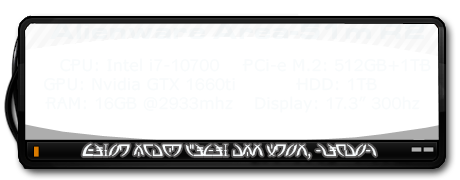
Keyboard & Mouse
































 thebinarymessiah.com
Try multiplayer. A lot of fun !