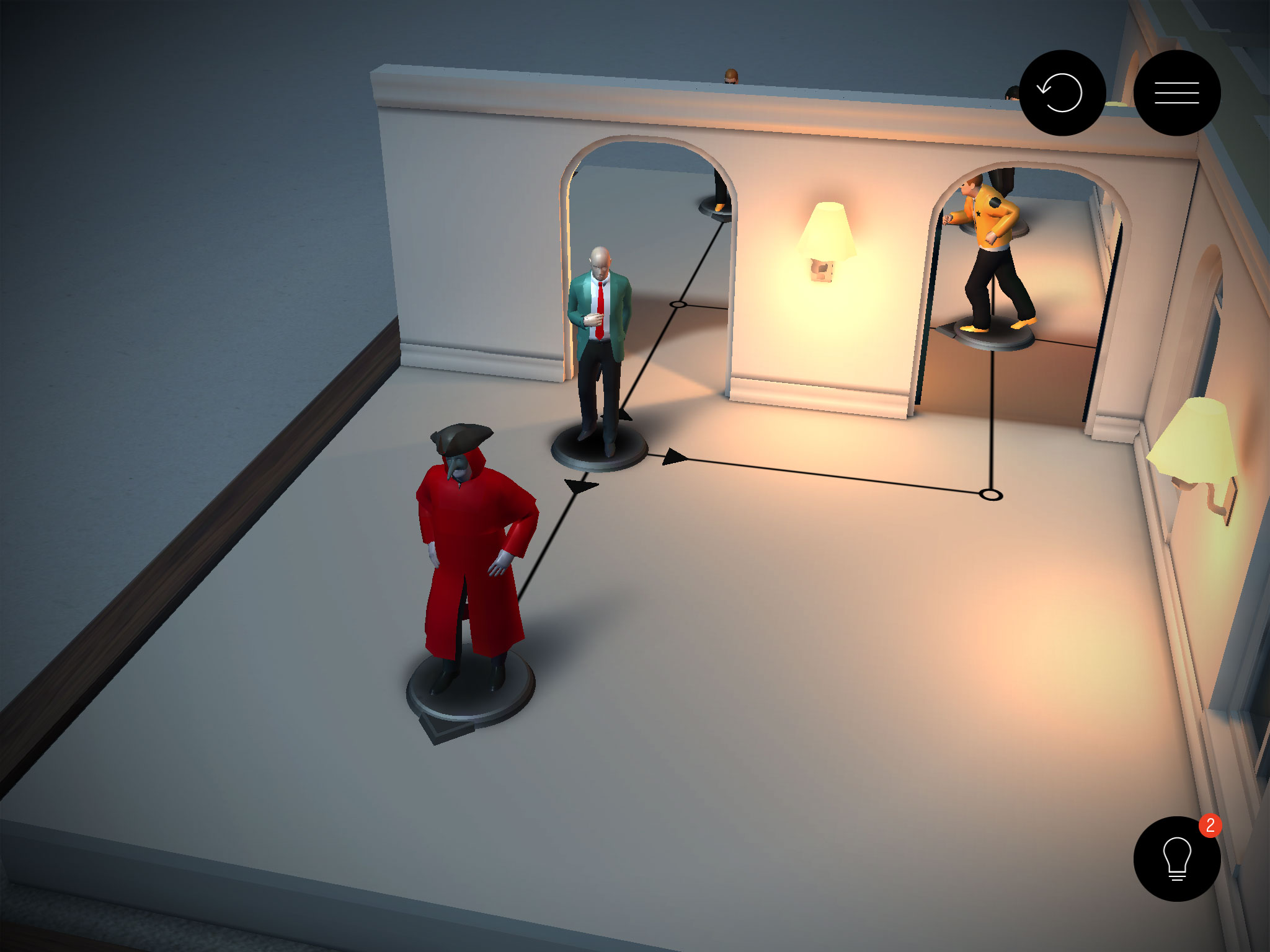
When you think of Hitman, you don’t exactly think of a board game. Hitman GO has Agent 47 sliding around various levels, trying to find the best way to the end, or his target, without getting caught. The enemies vary, with some who follow a path and will move one space when you do; other enemies will catch you if you land on the space they are facing (but they don’t move). The game is more of a puzzle than anything else. Some levels have briefcases you need to get to, while others want you to finish in a certain number of moves. There are other elements introduced later on, such as trap doors, items you can throw to distract enemies, and so on.
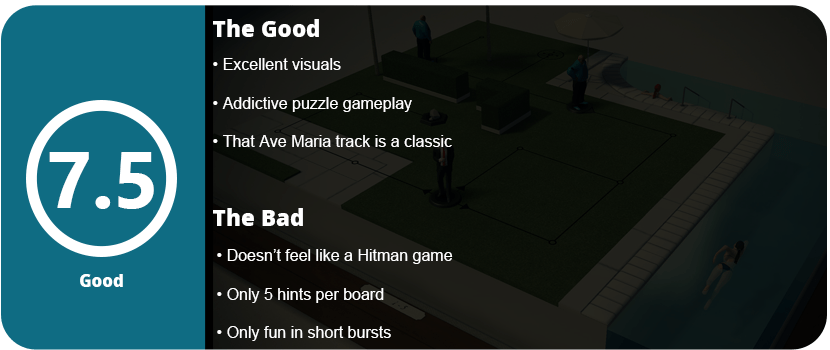
The game is highly addictive since levels have that (I get it now!) appeal where you just want to do one more level. I especially love when you have an assassination level and the Ave Maria theme plays from Hitman: Blood Money (composed by the oh-so-excellent Jasper Kyd of Assassin’s Creed II soundtrack fame). I also love the graphics, which look very good for a simple puzzle game.
However, this game just doesn’t feel like Hitman, and that’s the issue. Sure, you’re sneaking around, but there’s no violence, no gruesome death scenes, and no nudity. There’s zero plot (which is really fine for this kind of game), but many Hitman fans will scratch their heads wondering why this game even exists.
That’s not to say the game is bad. But even with faceless woodblocks, the game would have been just as good. At least non-Hitman fans can enjoy this game. Anyone who loves puzzles or board games, in fact.
Racing simulators were not something you’d think of on a phone outside of looking like something from the Atari days. Now that phones are nearly as powerful as home computers, racing simulators can have all the processor-demanding traits to bring a great experience to your phone or tablet. Real Racing 3 is probably the best mobile racing game out there, and for many reasons.
Let’s just get this out of the way. Yes, the game is free-to-play, and yes, the game is always tempting you to pay for more R$ or gold coins. If you’re patient enough to wait for upgrades, repairs, etc., then you will have a great time. Jump in for about 20 minutes, do a few races, buy and upgrade, and go about your business until it’s done. If you want to just cram away at races for hours, you will either need to cheat (by altering your save data on the Android version to give you unlimited money) or you will completely hate this game.
Before you go about hating it, give it a chance. There are hundreds of races, plenty of real-world tracks, and a lot of great-looking real-world cars. Once you jump into a race, you will notice how fantastic the controls are and just how real the game can feel. As you rumble across strips on turns, you will feel your phone vibrate accordingly. Using the accelerometer makes the game feel smooth and realistic. All you need is the gas on your right and the brakes on your left. Each car has its own characteristic feeling to it, just like any console simulator.
Once you finish a race, you will work your way around achievements, unlocking new events and cars, and also trying to upgrade your car as fast as you can. You can even customize your vehicle a little with ride height, rims, paint, and decals. This all may come at a huge cost of grinding and waiting, but it’s well worth it once you can finally beat that race you couldn’t before thanks to your new upgrade. However, people who don’t have the patience will quickly uninstall this game and give it a 1 star on the app store, which isn’t quite fair.
Outside of the tense races and many race types, the graphics are fantastic. The cars look great, and the dust kicking up behind opponents’ tires makes you forget you are on a phone. The only issue I had graphics-wise was the massive amount of slowdown when 22 cars were on screen. Even on a Samsung Galaxy S4, with some of the best mobile hardware out there, I received a slowdown. Apart from this, you also get slick menus and some nice music to go along with all this.
If I were to rate this game based on the free-to-play model, I would give it a 4/10. Simply because some of the wait times are really long, earning enough cash to upgrade can be a bit of a grind. On the flip side, those kinds of people will see a wonderfully crafted racing simulator that’s one of a kind right now on the mobile market.
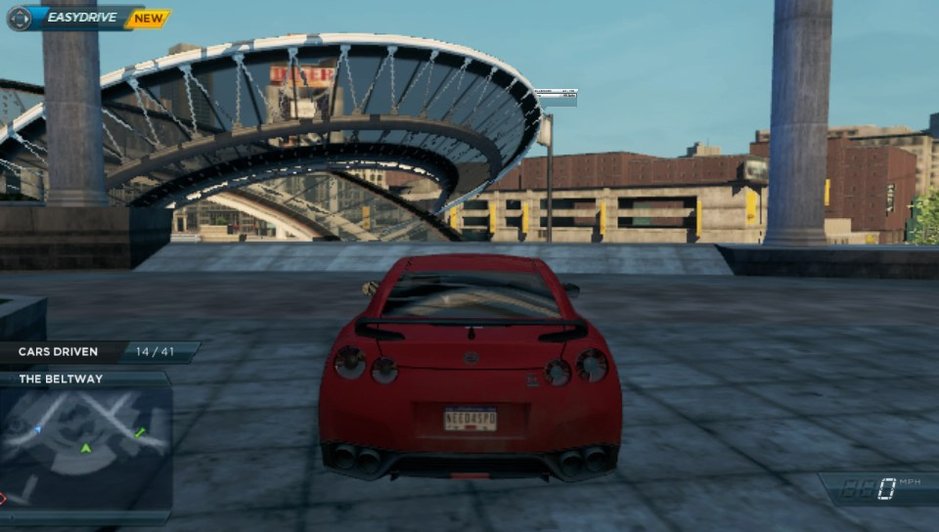
Need for Speed has had a great comeback over the last few years, and Most Wanted seems to have topped it. Being a remake of 2005’s excellent Most Wanted, this version is a whole new beast. The streamlined menus, AutoLog, the massive amount of real-world cars, and the huge world to drive in are something to get excited about.
My favorite feature has to be the new navigation menu. Being able to select races, customize your car, and jump to various cards with just the D-pad is great. There’s not even a need for a map. Select the race you want, and it will put the GPS line on your mini-map. Want to drive a different car? 3 D-pad clicks, and you’re there. This just seems nearly revolutionary for the racing genre, as they have been plagued with nasty menus for years. Outside of the menu are excellent racing moments and various types of races to do.
Sprints, circuits, fastest speed, and losing the cops the fastest are just a few types of races in Most Wanted. The whole goal is to find all the jump areas where cars are hidden throughout the entire world. Win first in each race for each car, and you will win part upgrades to make your car faster and better to drive. Some parts are better for certain areas, like offroad, but will slow you down on the asphalt. There are also various parts to help the cops, like re-inflating tires if you hit a spike strip or a stronger chassis for ramming through roadblocks. Like previous Need for Speed games (and any criterion racer), you can take down vehicles for more points to work your way to the number one most wanted.
A fun feature here (and it threw me for a loop) was having to take down a most wanted car to win their car. Sure, you can beat them in a race, but what about taking them down? It adds a greater challenge, but if you miss them, you can always summon the car back via the navigation menu. It’s not hard to work your way up to the top if you try to get first in every race. Even after you beat the most wanted vehicle, you can earn parts and find every hidden vehicle in the city.
If that’s not enough, try the AutoLog recommended objectives or try to find and hit every billboard in the game. There’s a lot to do in this game, and even though it can feel repetitive after a while, there’s just a great sense of accomplishment from getting first in every race. Let’s talk about graphics. Most Wanted is one of the best-looking games on the Vita. The sense of speed is great, and the controls are amazing. It doesn’t look like the game took much of a hit from being downgraded graphically, but it was hand-tailored to the system. The game even sounds great, and I spent hours just racing around, completing races without ever getting bored. Is there anything bad about Most Wanted? Mainly how repetitive the races can get overall, but the variety of cars keeps this played down a bit. Crashing every 5 seconds can get annoying, but that’s expected. Most Wanted is a must-have racer for any system you can own it on.
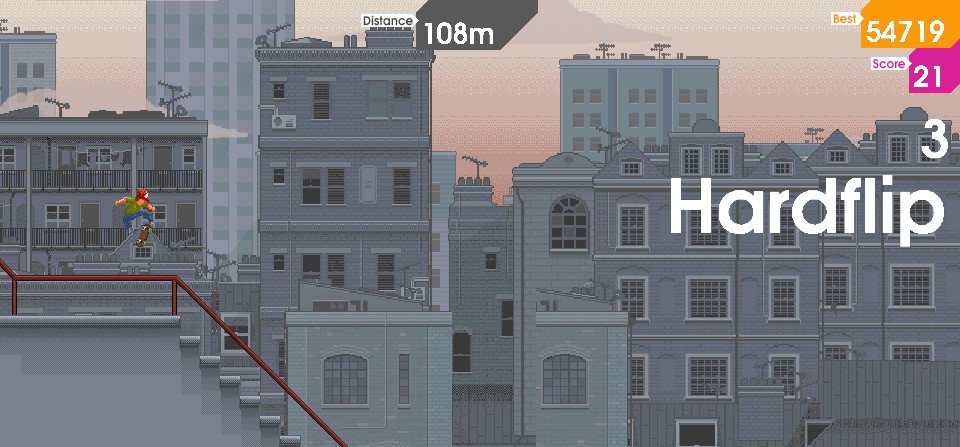
Skateboarding games have kind of died out over the past 5 years. With the last decent one being Skate 3, everyone yearns for the days of classic Tony Hawk’s Pro Skater. OlliOlli brings back those arcade-like twitch reflexes on a 2D plane. There’s no story to speak of, and there shouldn’t be. It’s just you, the ground, and your board.
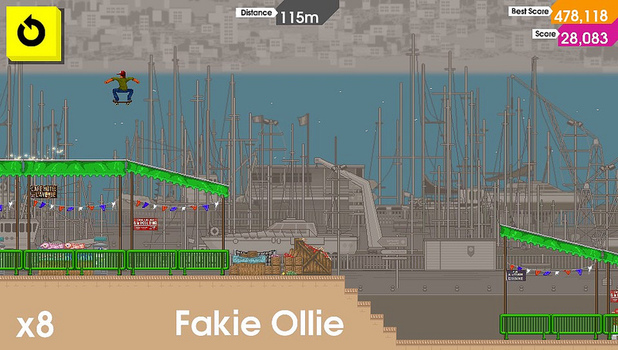
OlliOlli features a trick stick similar to EA’s Skate series, but it’s better (yes, a 2D indie skateboarding game does a multi-million dollar game’s trick system better). You use the left stick to do all the tricks, and there’s no ollie button. Pressing down and up will make your ollie, while pressing X just before you land will give you a perfect landing. This rearranging of buttons is perfect and exactly what this genre needs. Grinding is as simple as just ollieing on top of a rail; there is no need for extra buttons. The trick stick consists of grinds and flip tricks only; there are no grabs here because the game is all about completing goals on a short course with the highest possible score. On a 2D plane, grab tricks would just get in the way. A great change that’s small but big is keeping your speed by landing everything perfectly. You will eventually start slowing down, like in all skateboarding games, but perfect landings will give you speed boosts, allowing you to trick across an entire level if you are good enough.
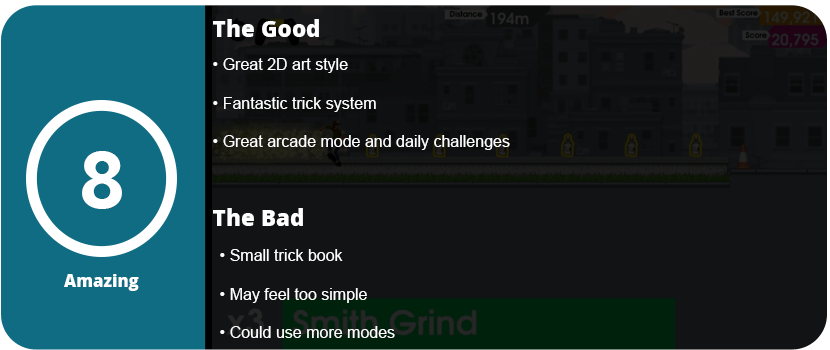
There are quite a few levels, and each stage is completely different. The only major downside to this game is the constant trial and error because some goals require perfection. The game is very challenging and will push your skills to the limit. Thanks to the great animations and silky smooth controls, it can be somewhat forgiving in that aspect. Outside of the career mode, you can partake in daily challenges where you get to practice a run as many times as you want, and once you go for the real thing, you get one try only. If you fall within the first 10 meters, that’s too bad. This makes things super intense and really makes that one perfect run feel amazing.
OlliOlli may have a small trick book, but the way you pull these off is nearly revolutionary for the genre, and the accompaniment of smooth controls and animations just makes it that much better. The various goals, score attacks, and collecting of items can be downright tricky, but arcade skateboarding enthusiasts will have no problem pressing that restart button for the 25th time, knowing this time they will get it.
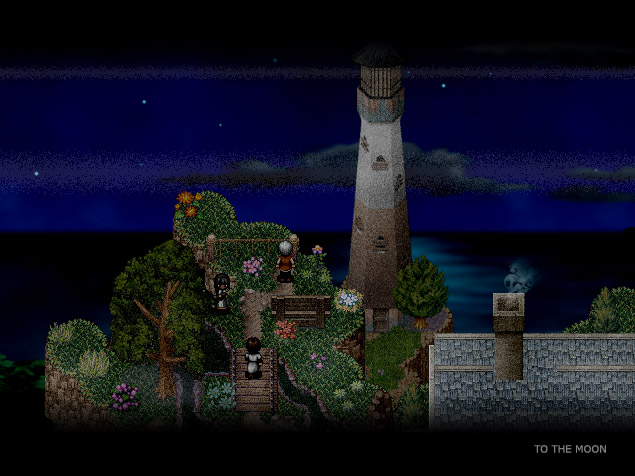
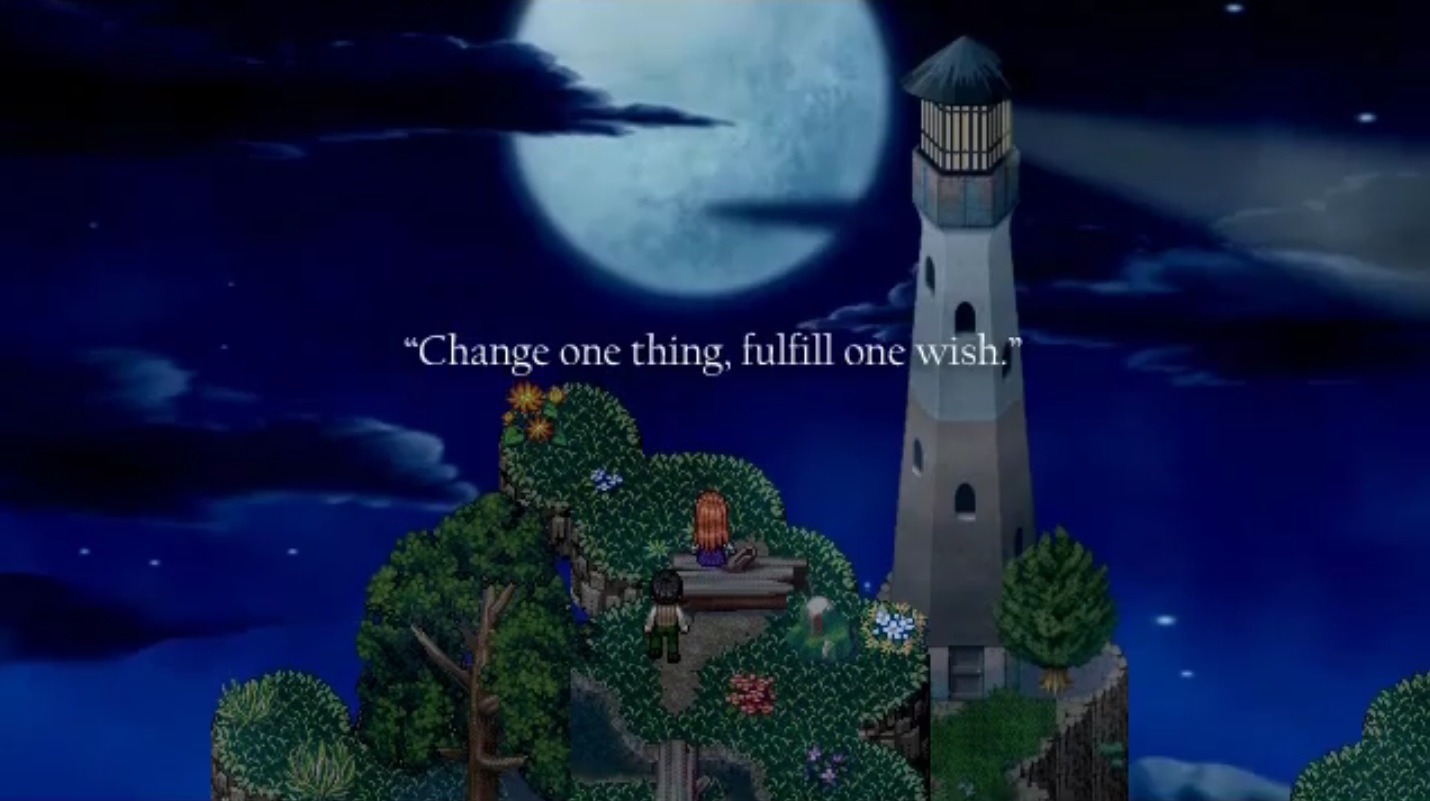
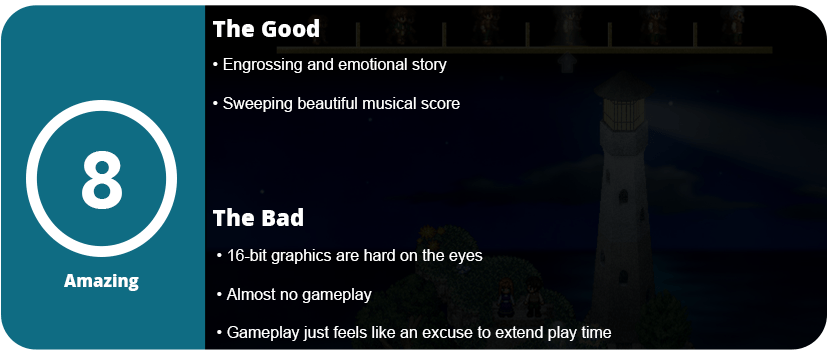
To the Moon is a 2D, 16-bit adventure game that follows two scientists who are fulfilling a dying man’s last wish. They use a strange computer to go into his memories to find the link that will allow him to go to the moon. To the Moon has a heartwarming story with a beautiful, sweeping musical score, but lacks any type of real gameplay.
The game is broken up into three acts, and during the first two, you are walking around John’s memories and have to find five memory links to unlock the shield surrounding time-jumping mementos. As you go further into John’s past, you find out why he doesn’t know why he wants to go to the moon. There is some memory block, and you have to find out what it is and remove it. Finding these memory links only takes a few seconds because you just click on the few items in the small area. Once you remove the shield, you play a little puzzle game, then move on to the next memory. This all just seems like an excuse to add gameplay to an otherwise visual-only adventure.
Through Act 2, you get to interact with two different mini-games, which are Whac-a-Mole and a zombie shooting section, and each is uninspired and pretty lame. The visuals are, like I said, 16-bit and pretty average. There’s nothing special here, visual-wise, and don’t even expect voice acting. The second-best thing about the story is the sweeping musical score. This score is beautiful and one of the best ones I have ever heard. I really wish that this game could have been more, but I understand most indie developers have small budgets.
Overall, To the Moon has a story that will tug at your heartstrings, as well as the music, but the gameplay feels like an excuse to extend the 1-hour story to barely four hours. If the gameplay was a little more engaging, I wouldn’t complain about it so much, but as it is, stay for the story and you will be entertained.
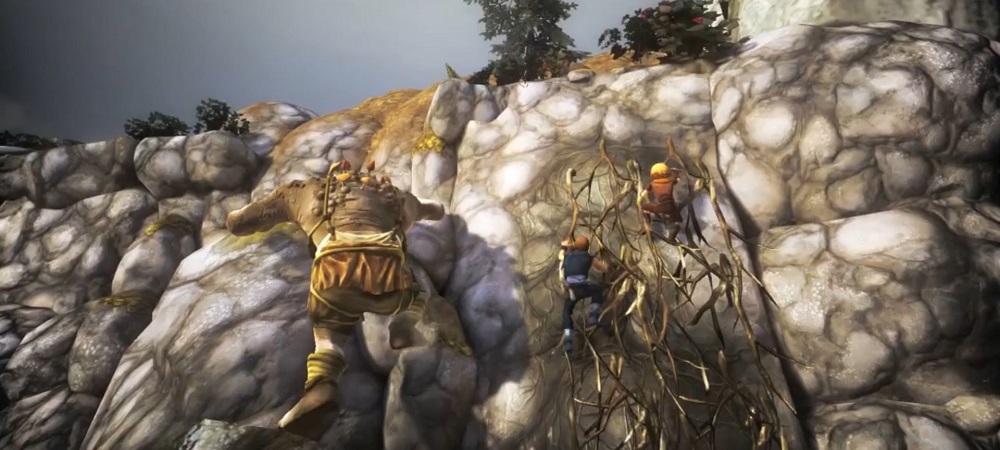
Brothers is about two boys who travel across their land to find a magic sap from a very special tree. They need this sap to heal their father, who has come down with a life-threatening illness. That’s pretty much all there is to the story. However, that’s not the touching part. Brothers don’t really start hitting your feelings until the end. Brothers have a unique gameplay mechanic where you control each brother with an analog stick. It takes some getting used to, and you never completely get used to it, but using both brothers at the same time is a unique way to play a game.
The game consists of simple puzzles. They aren’t complicated and don’t take much thinking to figure out. Some puzzles only certain brothers can solve. There may be a gate that the smaller brother can squeeze through so he can lower a bridge for the bigger brother. Sometimes they have to work side by side, such as in the water. The smaller brother can’t swim, so he needs to hold onto the older brother. The only other buttons you use are the triggers. One was assigned to each brother for grabbing stuff.
There are some boss fights in the game that are a lot of fun. One early on consists of fighting a troll. The little brother needs to lure him into a cage while the older brother closes it with a lever nearby. There’s only one way in, so the little brother has to slip through bars to escape. It’s moments like this that make Brothers shine and make you smile. Later on, in the game, it gets darker and grimmer. Puzzles involve dismembering the dead corpses of giants. The gameplay ideas change throughout the game, like when they have a rope tied to each other and you use it to swing each other around cliffs. The game feels like a grand adventure, but it’s short-lived. You can beat it in 4 short hours, wanting so much more.
The game looks really good; while not technically impressive, the art style is great, and the game has many beautiful vistas. The story lacks any depth, but it’s the adventure that counts here. If you have a free evening of gaming, Brothers is one of the best indie games you can buy this year.
I’m not sure what it is with the Spider-Man series, but the movie-based versions are always the best. This is usually the opposite with video games, but it doesn’t deny this strange truth with Spider-Man. The best Spidey game, in my opinion, was Spider-Man 2, based on the Sam Raimi movie. The huge open world was unheard of in a game like this back then, and the graphics, at the time, were astounding. It felt high-budget, and despite copying the movie, it was really amazing. TASM follows suit as well, with some tricks up its sleeve.
This game is actually a sequel to the recent movie and is highly entertaining. You play as Spidey and are trying to take down the cross-species that Oscorp created. The bad guy here is Alistair Smythe, who runs this place, and this is how the movie ties in. Spidey needs Doctor Connors to create a cure, but he’s locked up in an asylum after the events in the movie. The story is entertaining, but none of the actors from the movie take it apart here, which is probably good. The characters resemble the movie characters but look a little different. This is how you do a movie-based game, right?
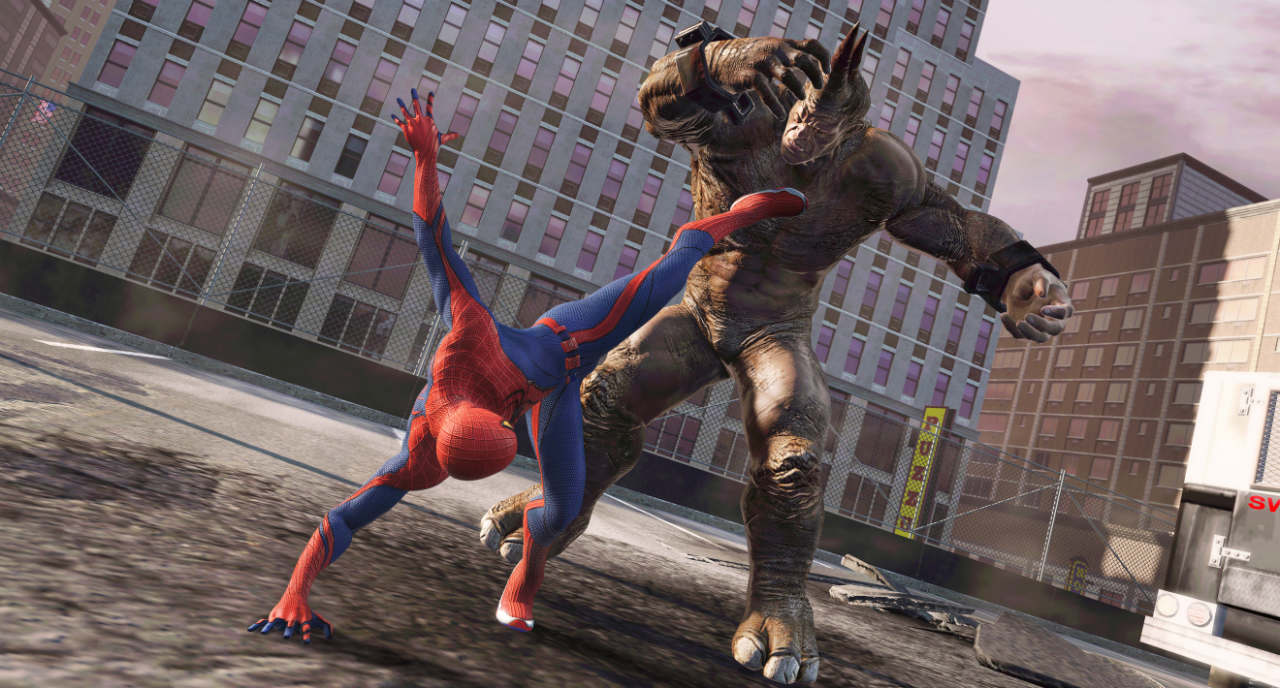
The game is more cinematic than previous entries just by the way the camera is angled. The combat is pretty satisfying with just one attack button, but the animations are so fluid and entertaining that you won’t care. Spider-Man doesn’t have a health bar but regenerates health. When you take too many hits (he can only take a few), you have to use the retreat feature, which has Spidey flying off into a corner away from enemies to heal. Use Web Strike to immediately go right back into the fight, which is awesome. Once enemies are stunned, you can use special moves, and all these moves are upgraded by finding tech pieces throughout the game. One of my favorite things is the stealth mechanic, which is done right for the first time in a Spider-Man game. Crawling on the ceiling shows a purple web radius under you, and when guards are on it, Spidey will drop down, wrap them up, and hang them from the ceiling. The health system makes you use this feature because you can’t dodge enemies with guns. Your spy sense will turn red, and this means the attack isn’t dodgeable. Use a quick web retreat and try the stealth again. Very satisfying and well done.
Of course, this wouldn’t be a complete Spidey experience without a huge open Manhattan to explore with side quests. Like Spider-Man 2, there are many missions like saving citizens from crimes, various timed side quests, collecting comic pages, police chases, and various others. They are a lot of fun at first but grow repetitive towards the end. Swinging around as Spidey is just so much fun, and the well-done animations help this a lot.
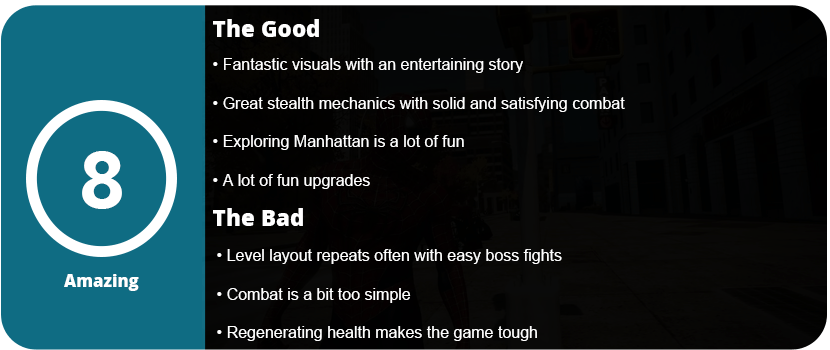
The only big issue is that the layout of levels repeats often. Disable this lock, take down these turrets, beat up these enemies, and turn this valve. It’s all very mundane, and even the boss fights are really easy with little challenge. Thanks to all the other elements being very solid, you can look past this enough to get through the game. At least the graphics are fantastic, especially on PC. Beenox took the time to give PC users higher-resolution textures and better-looking everything. This is rare in a movie-based game to see such attention to detail. There are some game-breaking bugs and glitches that were never addressed on PC, and that is a real shame.
Overall, TASM is a solid Spider-Man game and probably one of the best yet. This is how you do movie-based games, right? The story is entertaining, the combat is solid and fun, and exploring Manhattan is a lot of fun. The graphics are amazing, but I can’t help but feel annoyed by the repetitive level layout and easy boss fights. This is well worth a purchase, and even if you don’t like the movie, you will enjoy it.
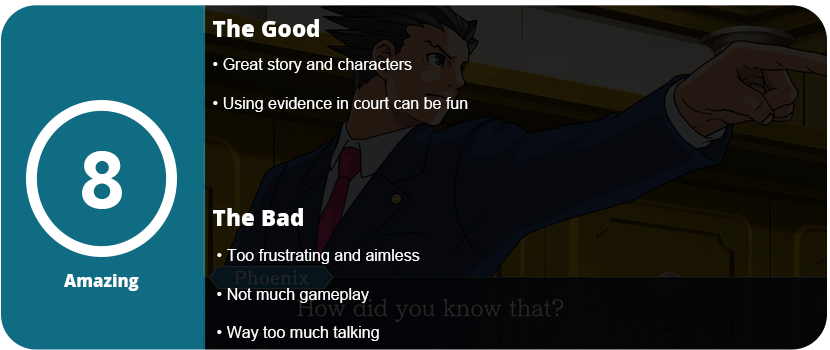
For almost 10 years, I have been dodging Phoenix Wright, but I can’t fight it any longer. I know all about the characters and what the game is like, but I had no clue that the story was this deep and interesting. Honestly, Phoenix Wright’s biggest flaw is the lack of gameplay, frustrating puzzles, and sometimes no clues on what to do. Despite that, you are going to play this mainly for the story and characters.
Phoenix Wright is a new attorney straight out of law school. You start out with your first trial and get the trial contradiction puzzles nailed down first. You are presented with a court record that keeps track of all the evidence. Witnesses will take the stand, and you need to press each sentence in their testimony to point out inaccuracies. Wright and the prosecutor will go back and forth with the judge, and once you’ve pressed every statement, you need to find the contradictions. This is where things get frustrating. Sometimes it’s pretty obvious, and it feels good to nail their false statements, but 60% of the time I had no idea what to do. Most of the statements would be very vague and do not give you many clues as to what evidence can catch them in their lies. However, each case and witness vary. Sometimes testimonies will be restarted, and you need to find new contradictions. It sounds confusing, but it is both fun and frustrating at the same time.
Once you finish a trial or are on a new day, you need to investigate. This is the other half of the game. You go from place to place, examining the area for clues, talking to witnesses, and sometimes showing them stuff to get things out of them. This can also be frustrating because you won’t have any idea where to go or what to show. On top of all this aimless frustration, there’s hardly any gameplay. You are reading about 80% of the time, and the gameplay just consists of selecting things. Later on, you use the mic a bit, but other than that, it’s mainly just a point-and-click adventure at heart.
That’s not to say any of the games aren’t fun. The story and characters are gripping, and the five cases you end up solving are very interesting. Each case will take about 2–3 hours to complete, so there’s quite a bit of playtime here. I just wish they weren’t all played out the same way. Do a trial, investigate, do a trial, investigate, talk, talk, talk, examine, show some evidence, and talk some more. Point-and-click adventure fans will love this game, but if you want action, you’re out of luck. The trials tend to get heated, and it’s pretty fun to watch everything unfold. The stories have twisting endings and will leave you hanging all the time, but you won’t want to stop playing.
Ace Attorney is a fun adventure game with great characters and stories, but there’s very little gameplay. What’s here is the frustrating puzzle of finding contradictions between witnesses’ testimonies and your evidence. Outside of that, you will wander aimlessly during investigations, trying to figure out what to do and where to go. Phoenix Wright is a great step in the right direction for the DS, but it needs more to make it truly amazing.
The last great game I remember playing where you were a ghost was Geist for GameCube. Ghost Trick may not be an action-packed shooter, but it does have an interesting story with whacky characters and fun mechanics. You are trying to solve a murder mystery for yourself. You wake up as a ghost out of your body and need to find out who killed you and why. As you play through the 17 chapters, the story unfolds more and more and starts out as a gripping story until the very end, where it just falls apart and becomes hard to follow. Despite that, the game has great art and animation and is worth a playthrough.
The main mechanic is playing as a ghost and being able to rewind time, change people’s fates, and manipulate objects. When someone dies, you can talk to their core, where you find out a little about them. You can then rewind time to 4 minutes before their death. Once you see the clip, it plays out again, but you must manipulate objects to prevent their deaths. This is a really neat mechanic and very original. These are all puzzles, and they get harder as the game moves on. One person may end up dying from a trap that was set up, and you have to stop one part of that trap before the person is killed. When you are in the ghost world, time stops, and you can see all the objects you can hop to. However, you have a limited reach, so you need to manipulate other objects to get closer, such as knocking stuff down, opening things, and various situations like that. The puzzles end up becoming multiple screens, and you sometimes have to travel to whole new areas mid-puzzle. You can travel around via telephone lines, but you must be on the phone when someone calls at a critical time to trace the call. This is all really neat and fun, but after a while, it kind of gets stale.
I hate to say this because this is a one-of-a-kind game on the DS. It uses the touchscreen in a unique way, but all you do is solve these ghost puzzles. There’s more talking than gameplay, which will bore impatient people. Some cutscenes can go on for nearly 20 minutes. When you do start playing, you are constantly interrupted with overly drawn-out dialogue to tell you what to do. A lot of the time, the puzzles can be nearly impossible to figure out or require constant trial and error. The occasional puzzle is thrown out there that is different—some are timed and some aren’t. Towards the end, you get to play as two different ghosts; one has the ability to swap objects. This adds another layer of depth and difficulty to puzzles, but most can be figured out after a few tries.
I actually got really attached to the characters, which is surprising. For the long length of the game (nearly 20 hours), the characters were well developed, but the big flaw was revealing everything in the final 3 chapters and then adding another complete twist at the very end to overcomplicate the story. It all flows perfectly fine until the end, when it just falls apart. It gets so confusing with all the characters and details you have to remember; they should have spread it out more. Despite this major flaw, this remains one of the most story-rich games on the DS. There are many puzzles in the game, and it is well worth a purchase, but the impatient may not like it.
Overall, Ghost Trick is a unique game with original game mechanics that are repeated way too often. The story and characters are great and memorable, but the story falls apart towards the end and gets convoluted. There is also zero replay value because there’s no collecting and no extra endings. Once you beat the game, you are done for good. I also didn’t like the poor balancing of puzzle difficulty and the high level of trial and error. If you can look past all this, you are in for one of the best games the DS has to offer.
I honestly went into this game not expecting much. It is an 8-bit-style game where you stamp papers for people. Sounds boring, right? Far from it, and I mean very far. This is one of the most addictive and fun indie games I have ever played. This game kept me away from Skyrim, Splinter Cell Blacklist, and Saints Row IV. How can a $10 game keep me away from such high-budget splendor? It’s unique and so much fun. I honestly don’t even know if it’s a puzzle game, an adventure game, or something. It’s something, but so original that it creates a new category all on its own. You play as a Russian citizen who gets his name drawn in a labor lottery to work the customs booth at a border check. The story isn’t exactly deep, but the atmosphere is tense and gritty.
You start out every day by reading the headlines in the paper and walking to work (you don’t actually do the walking). The top half of the screen is the line at the border, and everything is going on. Guards are patrolling, cars are passing by, and you will occasionally witness terrorist attacks. The bottom part of the screen is split into two parts. On the left side are your counter and window. This is where you receive everyone’s passports and various papers, as well as your rule book and bulletin for the day. You must make sure everyone’s credentials match before you stamp their approval. You start out with the simple task of just making sure the issuing city matches the right province. You check this in your rule book. If this doesn’t match up, you go into inspection mode and click on the information you see wrong with the corresponding contradictory information. This gives you a personal touch to the game and makes you feel like you are in control of these people’s lives.
Before you roll your eyes, this isn’t some sort of Burger Builder or any other type of mobile game. You get more and more papers to check as the game progresses. You get special assignments such as confiscating certain citizens’ passports, stamping the reason for denial, cross-checking shot records, matching up ID numbers, height, weight, birthday, and expiration date, and you need to do all this fairly quickly. You’re not in real time, but the more you process, the more you get paid. This just gets so fun and addictive because of all the hands-on stuff you get to do. Sometimes people will try to bribe you or ask you to deny or pass certain people, and guards will bribe you if you detain more people. Later on, you get to even scan them for contraband and fingerprint them. There’s a lot involved, but it’s doled out slowly so you aren’t overwhelmed.
If you mess up, you get penalized; this goes against your 10-day inspection. You get plaques you can hang on the wall, but if you are caught with anything else on the wall, you get docked pay. If you are involved with the terrorist group EZIC, you get fired. It’s up to you to be loyal to your country or betray them behind your back. There are 20 different endings to get for different choices. Thankfully, the game saves before the start of each day, so you can change your choice. Things, like accepting certain bribes and spending that money, will trigger an audit, leading to an ending. You can burn the money and continue to save, but it’s all up to you. By the end of the day, you need to help your family with food, heat, and various other things using your pay. You need to be very careful and only get them what they need, or you will end up with a game over and your family dying.
The constant lash and tension between countries are tense, and you get the full brunt if you let known murderers in. Sometimes being the good guy will get you lots of penalties. Too many will lead to a game-overcoming inspection every 10 days. The game is just so much fun with a lot of replay value, and there’s a lot of content here. I honestly don’t have too much to say that’s bad except I wish the game was longer and you didn’t get all these endings and have to restart whole levels as a result.
Papers, Please is one of the most unique games ever made, period. I normally don’t care for these indie games since they are a dime a dozen, but when games like Fez, Braid, Limbo, and Papers, Please come up, they get my attention. Any gamer can play this since it really isn’t designed for a set crowd. This will be the best $10 you will spend on a game.
Yeah, it's pretty damn awful. Notoriously one of the worst games on the PSP. A 4 was actually being generous.…