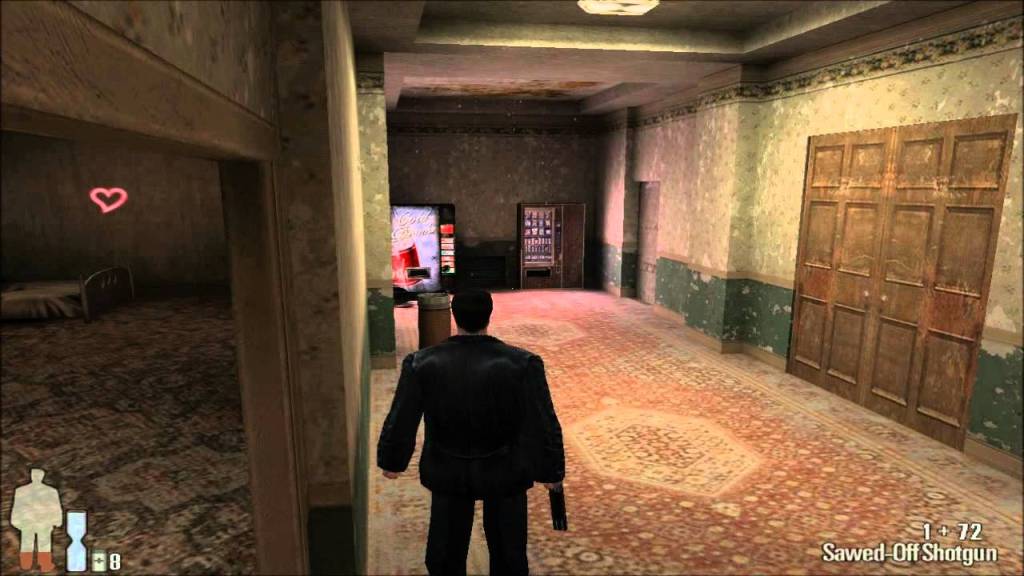
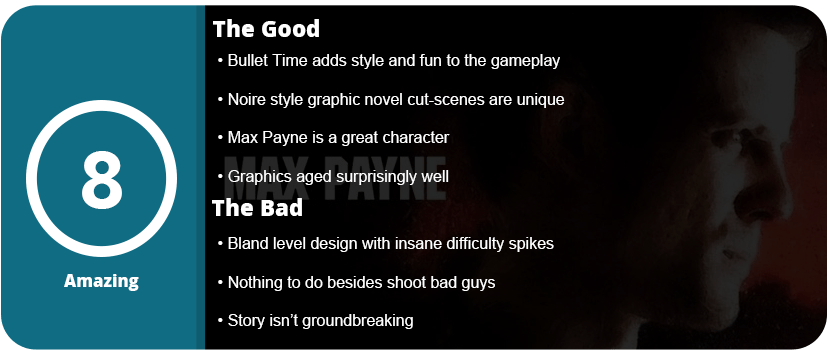
Bullet time. While The Matrix made it popular in pop culture, Max Payne started it all in the video game realm. You play a cop, Max Payne, who is framed for the murder of another NYPD cop. Your wife and newborn child were also murdered, and you are trying to get revenge on the people who did it. The story isn’t anything amazing, but Max Payne’s voice actor and the well-done writing keep you hooked long enough to find out what happened behind the scenes. The game is told in a comic noir graphic-novel style, and it suits the game well. The cut scenes are imaginative and different, and they don’t look cheap or like the developers were trying to take shortcuts.
Outside of the story, the gameplay is all about shooting, because that’s literally it. Max runs around with various weapons, such as Barrettas, Ingrams, shotguns, grenade launchers, Molotov cocktails, grenades, and assault rifles, to mow down the Mafia and corrupt cops. Bullet time is the main gameplay element here, and when activated, Max does a jump dodge in the direction you move, and you can see him dodging bullets in real-time. This is actually a mechanic you must master, as most situations require you to use it to stay alive. You can’t stand in one spot, or you will be dead in a few hits, and there’s no cover system. I had to quicksave every 2-3 minutes as well because the game is so difficult. It’s cool to jump dodge around a corner, but once Max lands, there’s a delay in him getting up, and you are completely vulnerable to gunfire. I had to make sure I jump dodged behind cover or across a hallway so I wouldn’t die the second the bullet time finished. You can also activate bullet time and just run your meter down so you can run and gun with it too.
There are very few scenarios in which you do more than press buttons. One scene has Max driving a crate crane around an area, but it’s nothing special, and there are some interactive objects that trigger comic-cut scenes, but 95% of the game is just shooting. The weapons themselves feel good, and I felt I had to switch up weapons depending on the situation to make my life easier. The locales are varied, but they are a bit too stale and boring for my taste. They don’t quite capture the noir feeling of the comic-cut scenes, but there is one level early on called Ragna Rock, which was a gothic cult house that reminded me a lot of Vampire: The Masquerade: Bloodlines, so that’s a good thing. The game really does feel like a first-generation PS2/Xbox game, but it’s very polished. The game flows nicely, but the difficulty is all over the place; you will die dozens and dozens of times in this game.
The visuals are clean and look nice even 20 years later. I installed a texture upgrade patch and some other things to make the game upscale to 4K nicely and play on modern hardware, and it looks pretty good. Even in the original, the facial textures are nice and very realistic, and the aesthetic of the game stands out over most shooters of its time. The voice acting is great, and I finished the game in about 7 hours. After you finish it, there’s literally nothing else to do, as the multiplayer mode was scrapped. It’s a fantastic single-player game that holds up well even today, despite its insane difficulty and unbalanced gameplay. The story isn’t anything special, but Max is a great character to dive into, and it makes for a fun evening.
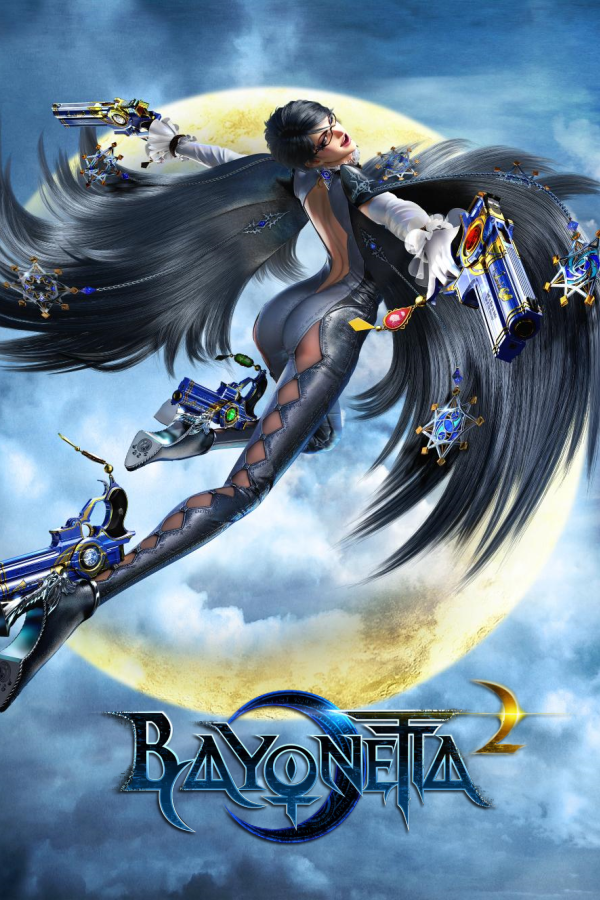
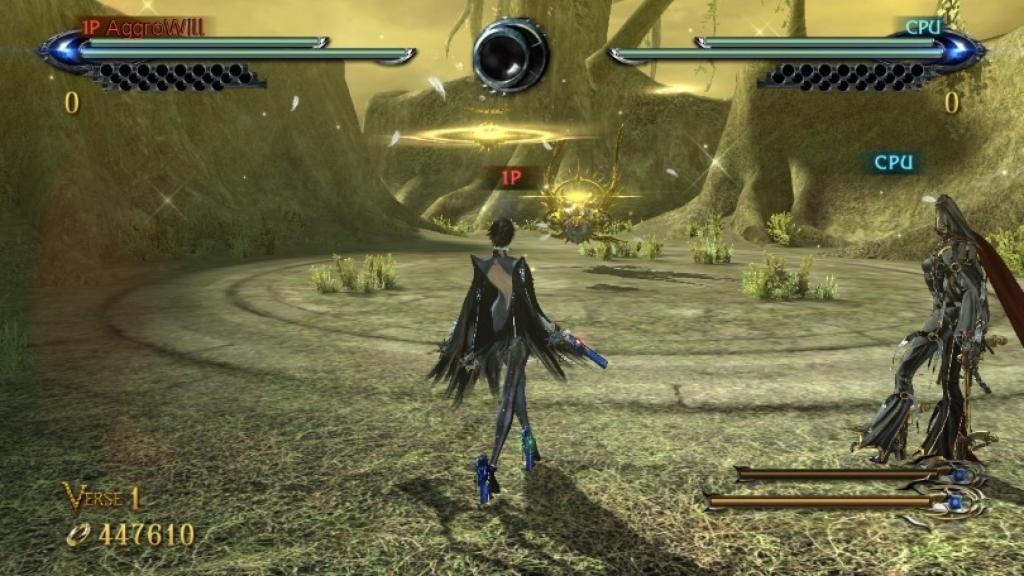
It was strange that Nintendo would pick up an M-rated property, especially one that is as sexualized and gory as Bayonetta. The original game put Platinum Games on the map as a great hack and slash developer. The game was bombastic, fun, hard, fast-paced, and very memorable. The flashy combat and memorable personality and style of Bayonetta herself made her one of the most popular and well-known characters of the last generation.
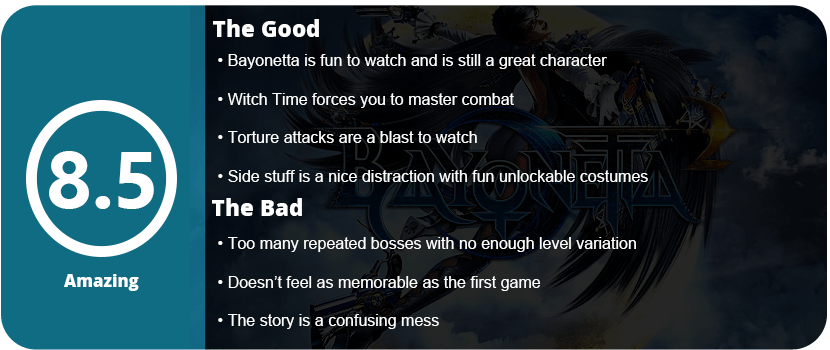
Bayonetta 2 tries to capitalize on that, but on Nintendo’s home consoles. Thankfully, none of the sex appeal or gore has been toned down, which is a huge shock and was what most people were expecting—more of a teen-rated experience or heavily censored. What we get is the same sexiness, blood, and guts as the original. Now, I was never a huge fan of Bayonetta’s story, which is a bit convoluted. I didn’t quite understand the story until towards the end, but Bayonetta is an Umbran Witch who is the Left Eye of God, and the Right Eyes (Lunar Witches) are part of some sort of prophecy. The Aesir God is trying to destroy humans (it’s heavily Norse-based), and Bayonetta is trying to stop said God from doing so. There are a couple of new characters thrown in, but I didn’t care much for the story. It’s a confusing mess, honestly.
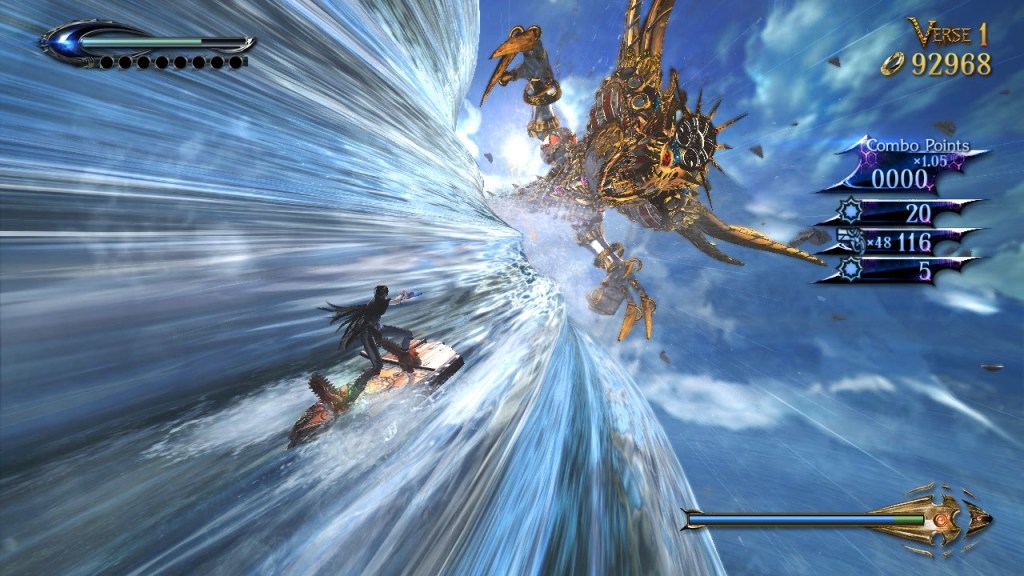
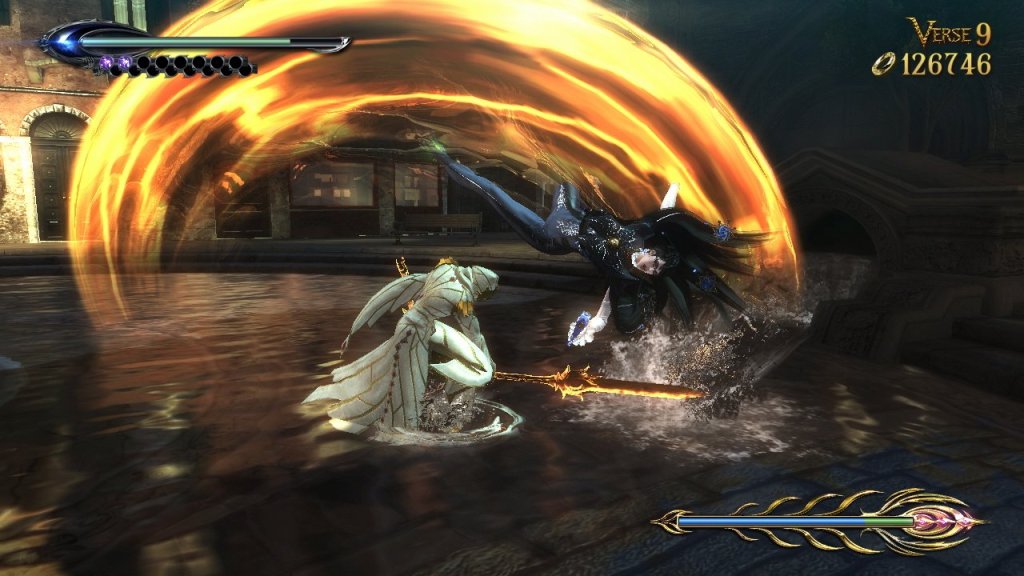
What’s great, though, is the combat, and there’s plenty of it. Light and heavy attacks combined with a ranged attack make for some of the best combat on this side of Devil May Cry. Bayonetta is so agile and looks so good bouncing around on the screen, and the controls are incredibly responsive. The key to the battles is the Witch Time dodge mechanic that’s used right before enemies strike. It’s so satisfying to get into a rhythm of slowing down for a couple of seconds and attacking. Each enemy has its own attack pattern, and you quickly learn when to dodge and slow downtime to build up your witch time, which is then triggered to unleash heavy attacks. This tight combat system isn’t very deep, but it’s hard to master, especially with new moves to purchase. I found myself noticing that you must master this dodge technique or you won’t get very far. It’s the only way to really dodge attacks., but because you have to heavily rely on it, that forces you to master it, which can make it a core part of the combat system.
The combat goes a little further with torture attacks that are optional instead of unleashing your Umbran attack. These are small, quick-time events and awesomely brutal death scenes for the demons and angels. Bosses have their own unique torture attack that triggers at the end of battles. Speaking of bosses, I have to say I think there are too many here. Almost every level is either a boss only or consists of multiple bosses, from main to mini-bosses. I also think that for the short length of the game, there are too many enemies here. A new enemy is introduced at nearly every level, and they don’t really mix them up much. With so many new enemies, you just start to learn their attack patterns, and you may never see them again outside of the mini-bosses.
Outside of combat, Bayonetta doesn’t do much. The levels are highly linear, with only one way to really go. You can explore a couple of side paths for hidden items that unlock costumes, weapons, and more. There are Muspelheim missions, which are challenges spread throughout the game that grant Moon Pearls (Witch Time upgrades) and hearts (life upgrades). There are memory challenges that require you to gather pieces of a chest before time runs out, and these are nice little distractions. There are a couple of levels that have you power a mech and fly a plane, but they are short and not sprinkled in enough. The game doesn’t feel as varied as the first one, and I quickly found myself just mowing down boss after boss, waiting for something new to happen.
I loved unlocking Nintendo-themed costumes, mixing up my weapons to create a unique playstyle, and watching Bayonetta never gets dull, but it just didn’t feel as memorable as the first game; something felt off. It somehow felt too repetitive towards the end, and I became exhausted with the onslaught of bosses, with some repeating multiple times throughout the game. There are co-op Witch Trials, which are nice and all, but the core game just doesn’t feel as memorable despite how great it is.
The game looks amazing, though, and is still one of the best-looking Switch games to date. The framerate is up there at 60 or close to it with no slowdowns. Textures and models look fantastic, and the art style is just beautiful and really makes Bayonetta stand out on its own artistically. I did feel some environments kind of blurred together, but overall, it’s a treat to look at. Bayonetta 2 remains one of the best games on Switch, and hack and slash games of this caliber are far and few.
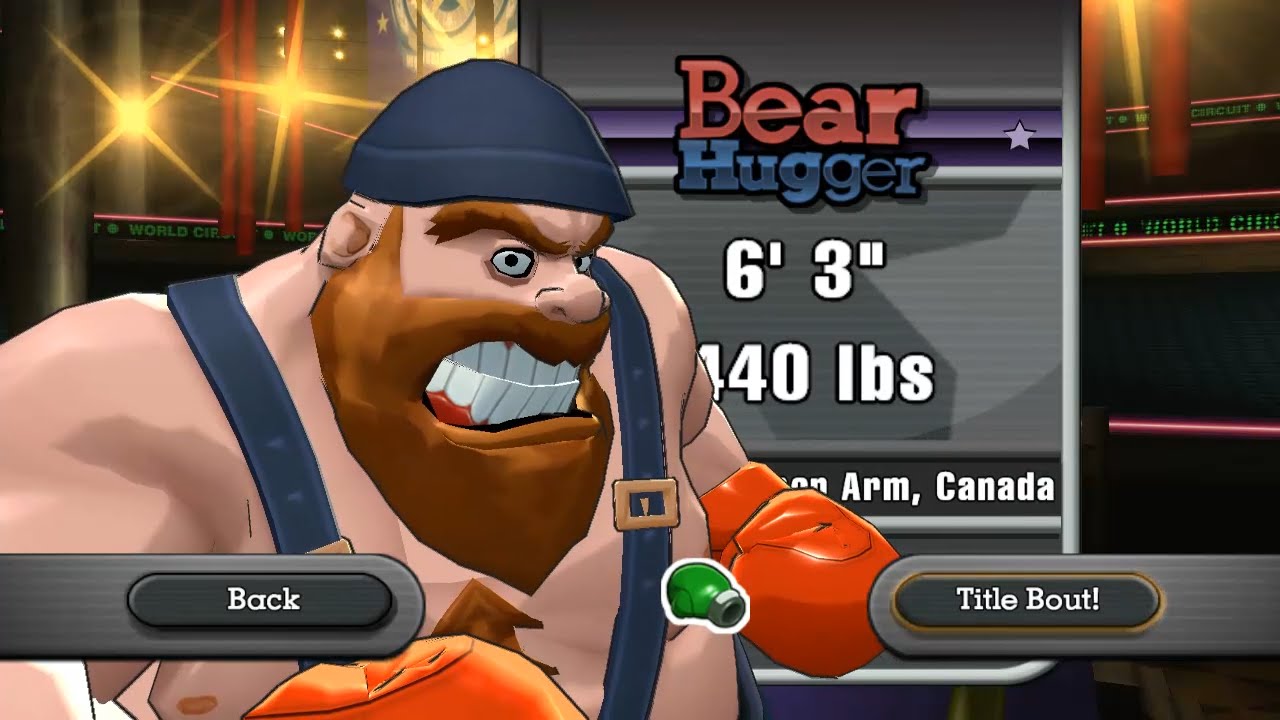
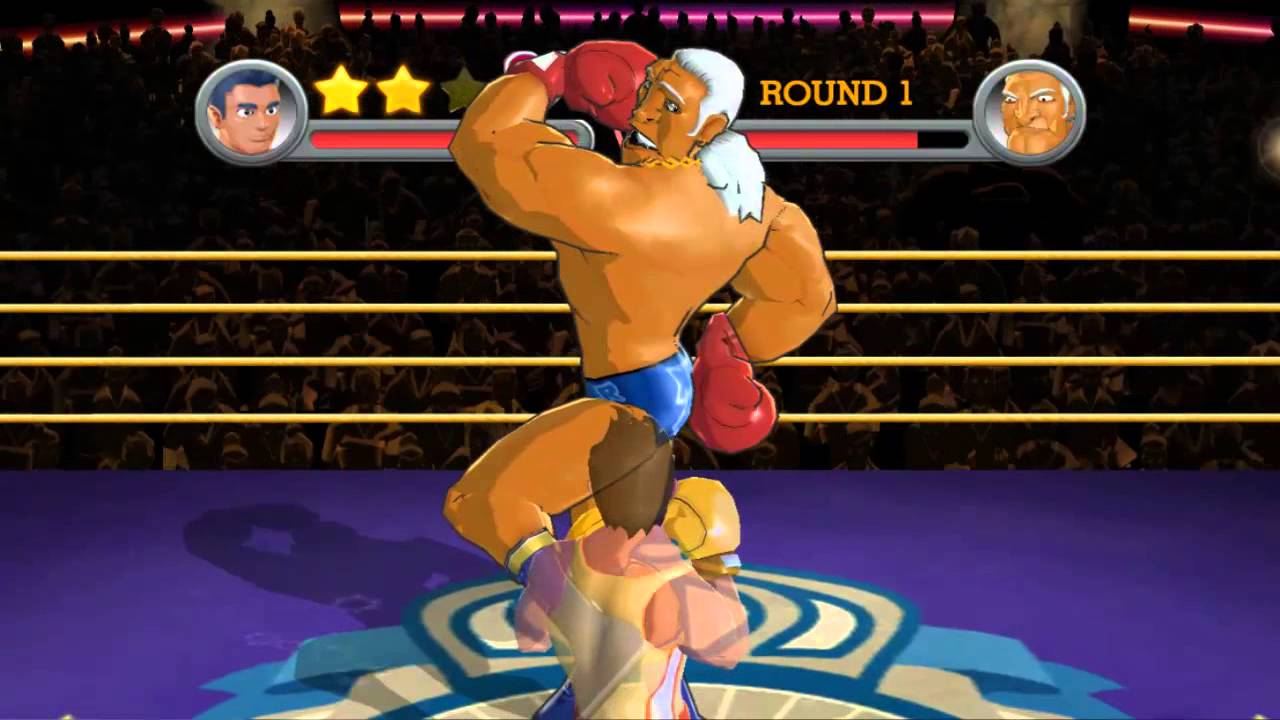
Punch-Out!! is a Nintendo staple as it was one of the first established exclusives of the NES. Playing as Little Mac, you run through a gauntlet of characters with varying difficulty to put your reflexes to the test. Punch-Out!! is a remake of that game and utilizes the Wii motion controls.
Let’s get down to the dirty business of this game. In essence, this is an arcade game you must perfect to the T without missing a beat. Your reflexes are required to be lightning-fast to get very far in this game. Each character has a unique set of 5 moves that require memorization and pattern recognition, or you will simply never get past the Title Bout of the Minor Circuit, which is when the game gets really hard. The first three characters aren’t very difficult and are just warm-ups for what’s to come. You can duck, dodge left or right, and block, but blocking is rarely used as most attacks can’t be blocked. You can then jab and hook left or right. The controls are the same as the NES version, and this makes the game overly simple for some or just enough for others. Newcomers may find this game too shallow, while veterans will feel right at home.
That’s where the motion controls come in. For a game that requires response time in the milliseconds’ motion controls, just don’t cut it. I got through the first two circuits with them, but after so long, I had to switch to the buttons on the Wii remote as I needed to be that much quicker. Using the nunchuck and remote, you can jab left or right and then dodge with the C-stick. I found this to be more complicated than it needed to be for me, and punching with the motion controls just doesn’t feel like punching but more like mindless shaking. The Wii remote on its side is the best way to go here, or even the classic controller.
That’s the essence of Punch-Out!!. Soda Popinski took me 90 minutes to beat and maybe two dozen restarts, as you have to learn his patterns and when to dodge his moves. He also drinks soda to refill his health, and you only get a split second to knock it out of his hand. There are also taunts that some characters do that can earn you stars for star punches that do extra damage, but these are rare and hard to get. Outside of the main career mode, there is Exhibition and a two-player mode, so it’s definitely light on modes and things to do. This game is not for casual players, despite seeming like it is. This is for hardcore arcade goers or veterans of the original. I thought I was going to blow through this game in a couple of hours, but I spent that one on a few characters alone.
It does get incredibly frustrating to need to have such perfect timing and reflexes, and it almost seems unnecessary. Sadly, there are no difficult changes, but there are a few hidden secrets that can give you an edge. When the ref is counting down, you can rapidly tap 1 and 2 to regain health. At the end of each round, you can press and hear a chime, and you will refill your health. This only works twice, though. This leads to my biggest complaint of the game: You never do more than a smidge of damage to each character, and there’s no way to level up and get more powerful. I had to widdle away at the health when a character could knock me out in two hits. I found this heavily unbalanced and unfair. Shouldn’t Little Mac get stronger as he fights, and shouldn’t there be a training mode with mini-games to level up? It just makes sense. This game is too similar to the NES version and carries over all of its flaws.
As it stands, Punch-Out!! is a really fun game of reflexes and timing with interesting and funny characters, but it lacks modes and a way to get stronger, and restarting matches two to three dozen times just isn’t fun after a while. The motion controls also just don’t work for this kind of game that requires precise movements and response times. I also wish there were some original characters and maybe not rely on this being a remake of a 25-year-old game. At the end of the day, this would have been a good rental, but for $50, there’s just not enough meat here to justify that cost.
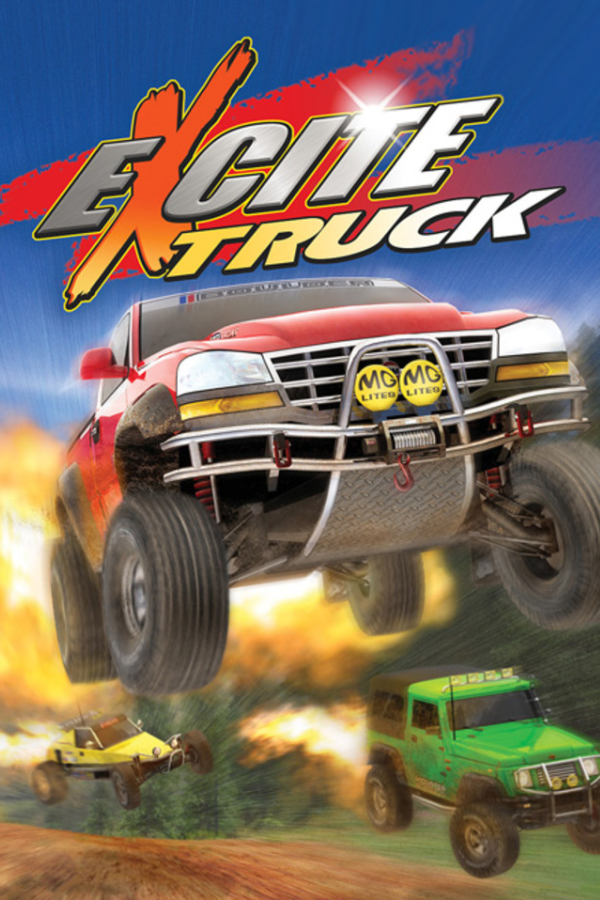
Most people think of Excite Bike on the NES when they hear the word Excite from Nintendo, but a truck series? It intrigued people and had the potential to be as addictive as Excite Bike all those years ago. Being a launch title on the Wii, just like Excite Bike was for the NES, it got a lot of hardcore Nintendo fans excited. Insane speeds, jumps, stunts, smashing? Was this Excite Bike evolved for the next generation?
The short answer is no, and the long answer is God, no, but it does have some good merits. While not really resembling anything Excite Bike-related, not even a track editor, it has its own name. Excite Truck pits generic monster trucks against each other and equally generic tracks, turboing and drifting around corners, to rack up as many stars as you can. This includes jumping through rings, morphing terrain, and getting invincibility power-ups. Sounds exciting, and it is quite thrilling, but it’s all flash and no substance.
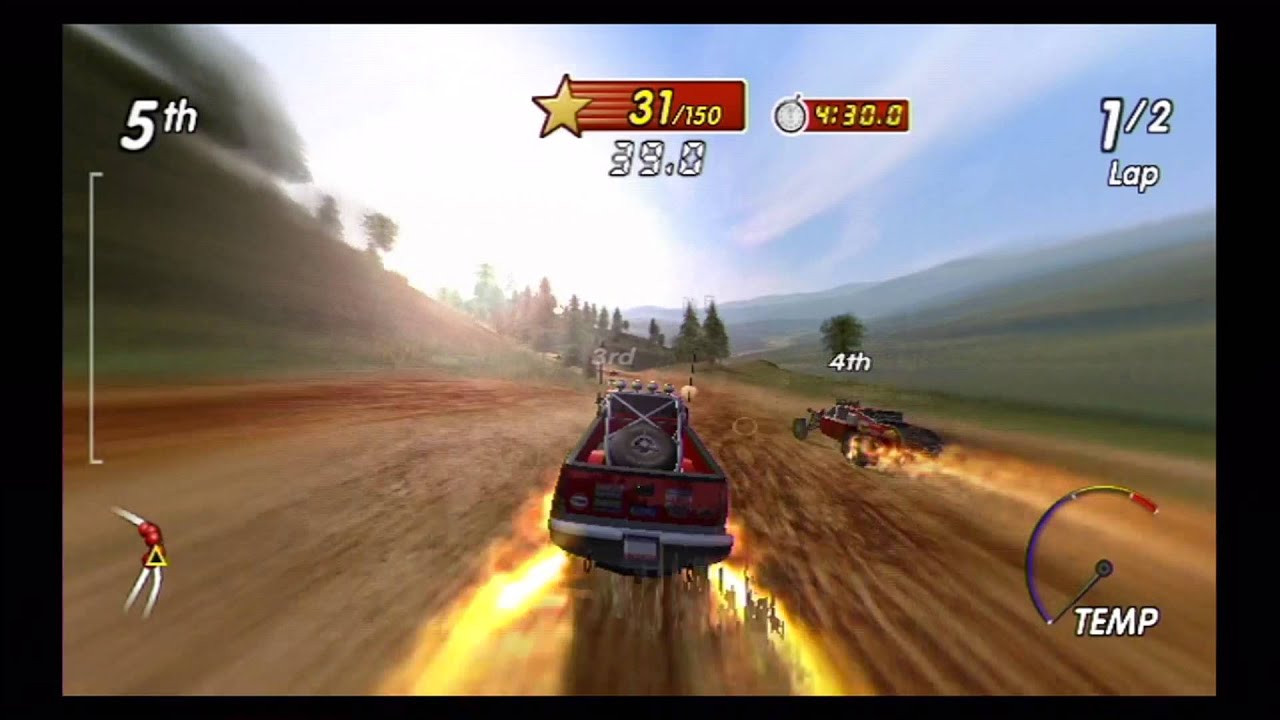
The entire game is controlled with just the Wii remote on its side, and you steer by turning the remote. The controls right off the bat are way too sensitive, and this is especially noticeable once you are going at mach speeds and on cars that don’t have a high grip rating. I crashed into trees and went off course numerous times, but thankfully if you mash the 2 buttons fast enough you can hop back on track with a boost. Another underlying issue is that the track design isn’t built for these insane speeds. It’s like they finished building the tracks and then decided to make the cars faster. A lot of times I would be top speed-boosting through jumps only to jump farther than the turn or overshoot things. When you’re going this fast, you shouldn’t have to hold back on the boost; it defeats the purpose. I’m not going to strategically manage my boost, as most arcade games don’t do this. It feels like they were trying to make the player compensate for their mistake by letting you go too fast.
The speed and squirreling of the cars lead to missed pick-up items such as the terrain morphs (they add a jump in front of you or lower you down to the water to cool your boost meter) or the invincibility pick-up, which are too small to hit when going at insane speeds. It just feels so unbalanced and not playtested enough. I constantly missed these things unless I slowed down to a crawl, and thankfully the AI is brain dead and incredibly easy, as even in my worst races I still made it first. There’s just too much to do in this game on the track at these speeds. I don’t want to do 360s in the air; I don’t want to morph the terrain. I want well-built, memorable tracks with insane jumps and better physics.
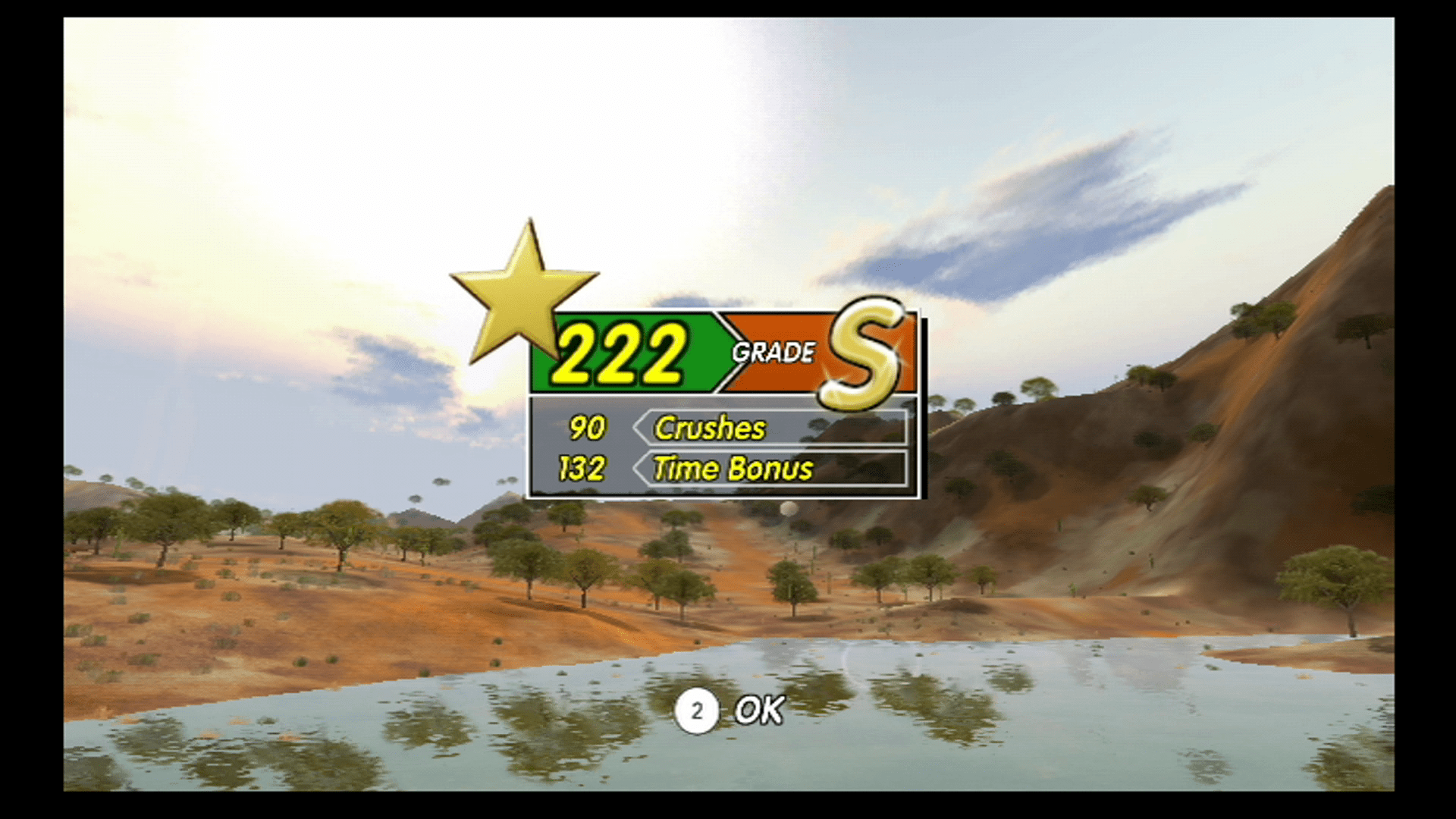
This leads to more problems. The lack of content and just the overall meh feeling of everything. The tracks are some of the most generic I have ever seen. Just random turns and jumps with dirt and trees splattered around. I can’t tell one track from the next, and the visuals are so bad (even for Wii standards) that you won’t care. Awful aliasing and flat textures are just everywhere. Outside of the 25 races in the main event, there are challenges that have you racing through gates or flying through rings. It’s not very exciting, honestly. After the first cup was finished, I saw all there was that this game offered, and it wasn’t much. This is one of the most generic and plain racers on the Wii, and it shouldn’t carry the Excite name at all.
Overall, Excite Truck is a game with an awesome sense of speed, and after about 10 races, it all wears off. Horrible track design, generic presentation, lack of content, and just too much speed for tracks not designed for it. I never felt completely in control of a race or my car, no matter how good I was at it. A track editor would have been nice to make better ones than the developers provided, and there’s no online play. At best, it’s a filler launch title that I would have been mad to pay $50 for. It’s just like eating a small bag of potato chips. It’s fun during the 10 minutes it takes to eat them, then you toss the bag and forget all about it.
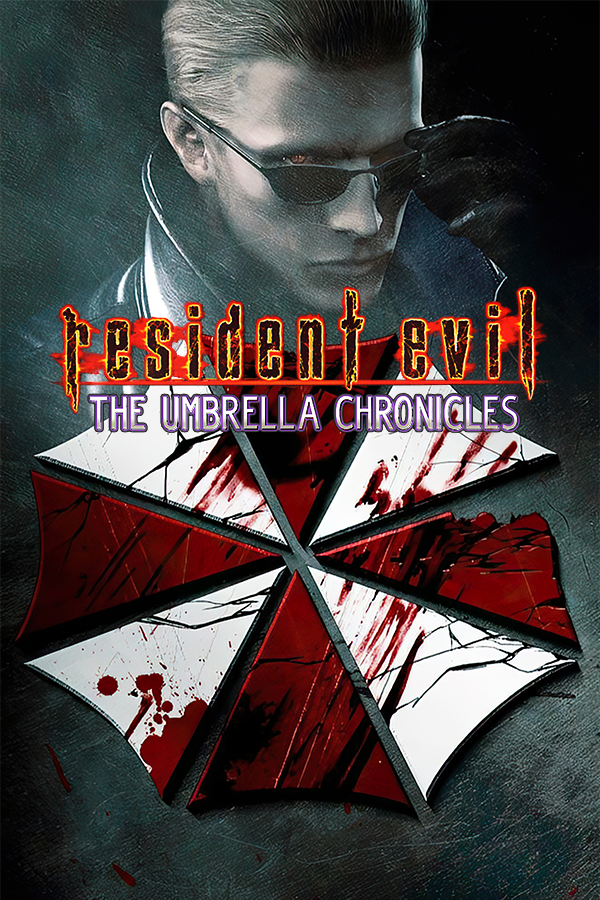
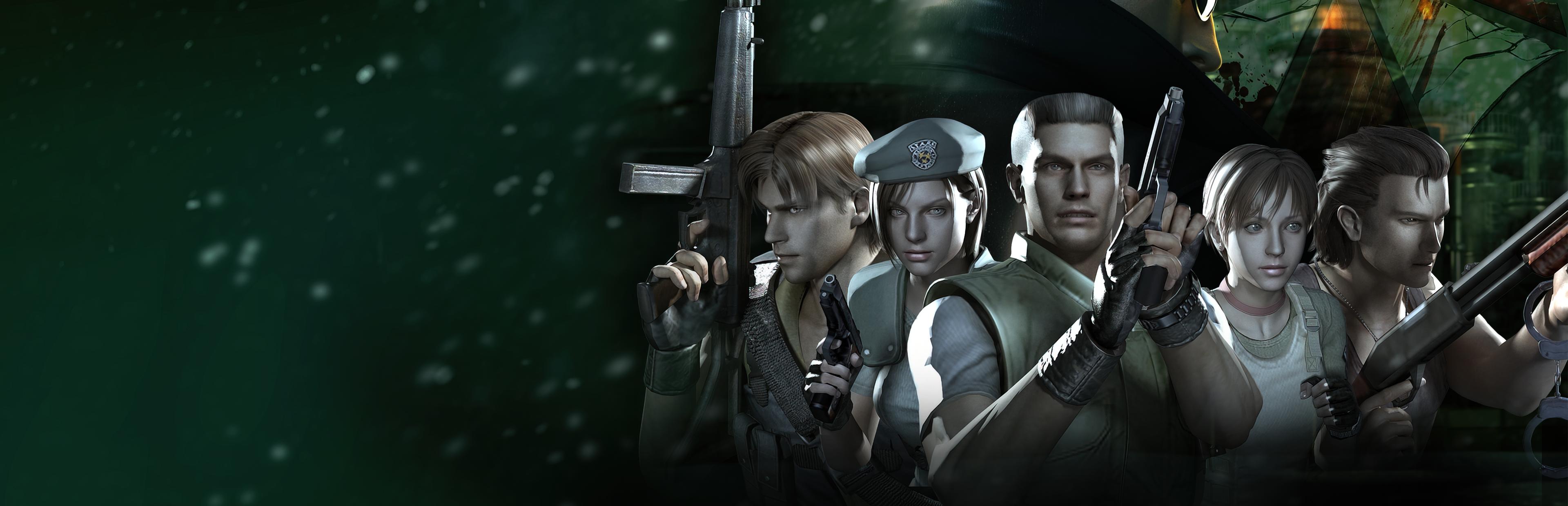
Resident Evil is less known for its light-gun arcade games, as these are held in public places that are niche hangout spots. The Wii with its remote and Zapper attachment is just begging to be used as a light-gun, and many of these games followed, and Capcom jumped on the bandwagon. Umbrella Chronicles is one of the more solid light-gun games on Wii, but it must be played co-op or you’re not going to have a good time.
The game has four chapters, with each one following bits and pieces from Resident Evil 0, 1, and 3:Nemesis, respectively, with the final chapter being an exclusively unique section just for this game. Each chapter has three or four sub-chapters and a few side chapters that are shorter and feature an alternate perspective featuring Ada Wong, Albert Wesker, and one Umbrella operative, Hunk. Story-wise, don’t expect to get a comprehensive telling of the Resident Evil series, as the pre-rendered cutscenes are chopped up and it’s not very cohesive or easy to understand. This is more for people who have played the older games before.
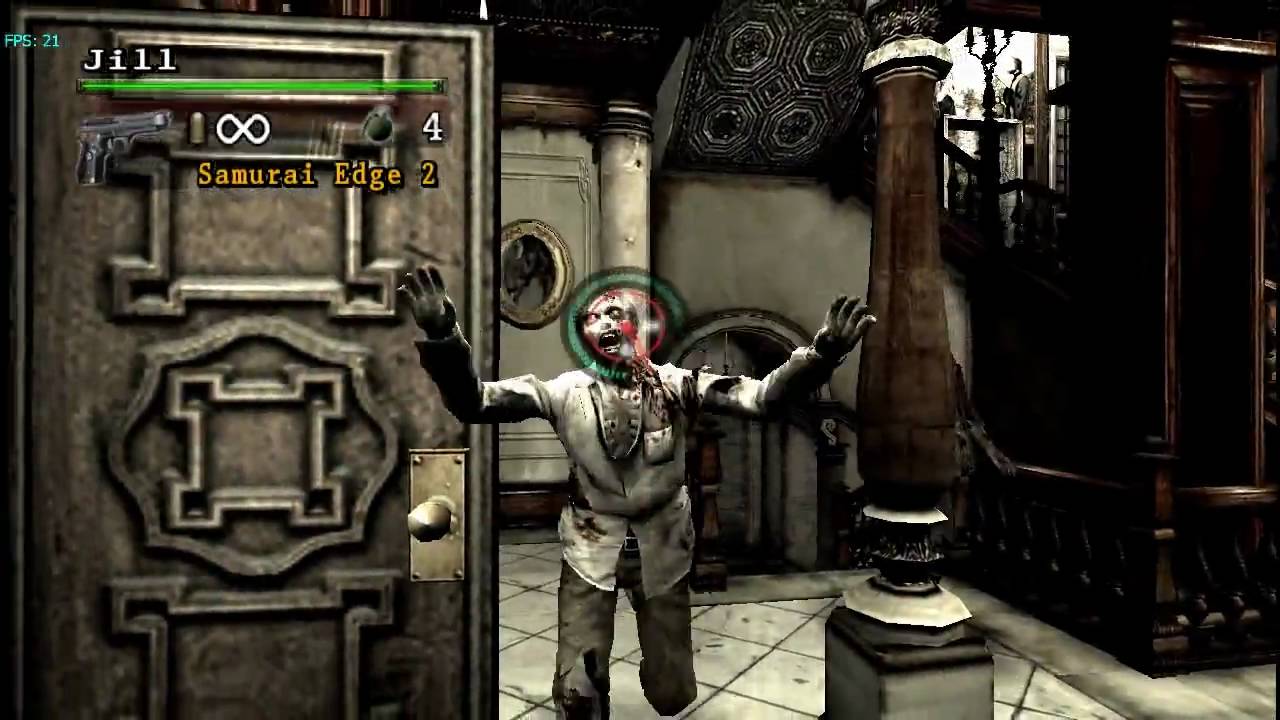
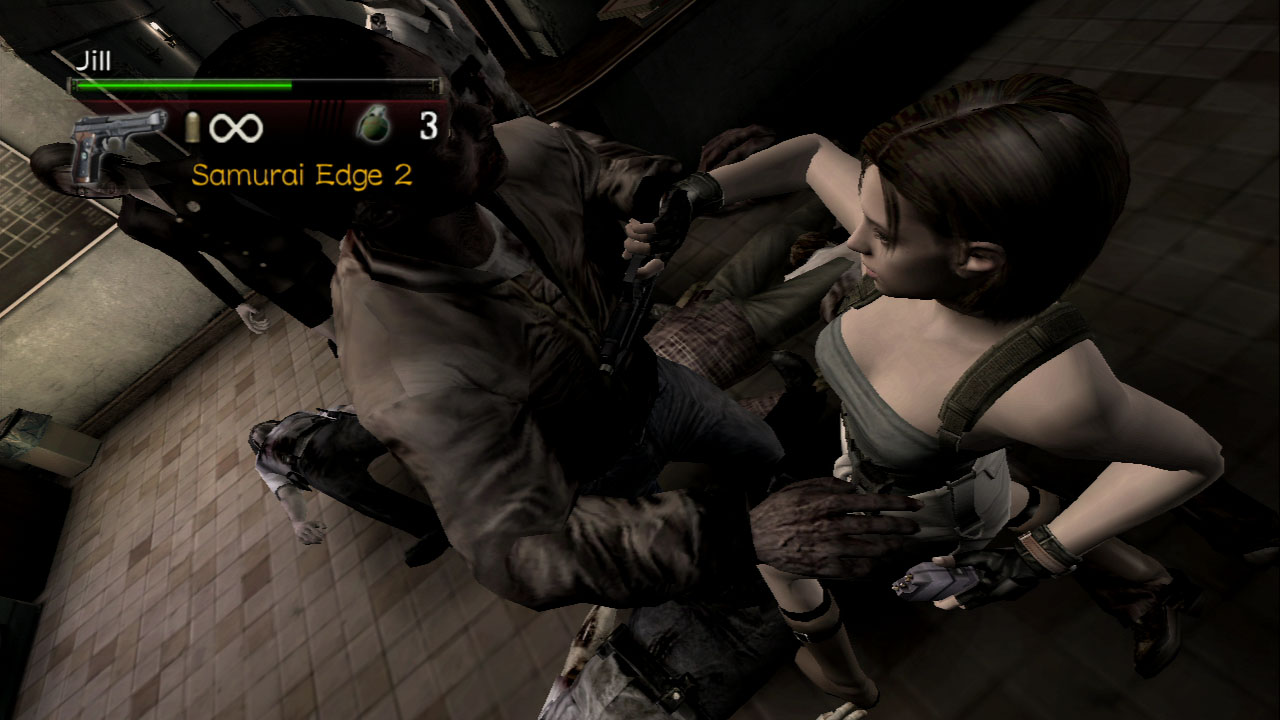
Outside of that, the shooting itself is rather solid. There are over a dozen weapons in the game, with your side pistol having unlimited ammo and various other guns like submachines, shotguns, rocket launchers, and handcannons making up the majority of the arsenal, but the ammo for these guns is extremely limited, and that’s the first downfall of this game. Why make an action game based on survival horror and keep the ammo count low? The pistol does very little damage, and you just forget about beating a boss with it. Ammo is incredibly scarce and requires you to have a partner, as some scenarios and waves just can’t be defeated with only the pistol. Hordes of enemies, sometimes over a dozen, will spawn in front of you, and popping them with 8–10 shots each with a pistol is just not feasible. With a second player, it’s possible, but solo is not. After chapter 3, I had to resort to a partner because it just gets too hard and too demanding for one player.
There are a good variety of enemies in the game, with some not appearing until the final chapter, and the bosses are all unique and incredibly challenging and require great reflexes, aim, and actual skill. Bosses are recycled from previous games, but fighting them in a 3D environment is pretty awesome. Some bosses have multiple stages, but these repeat in a cycle and can even include quick-time events that require button presses or a quick waggle. Quick-time events are peppered throughout the game and thankfully not abused, but they don’t appear on-screen long enough, and the waggle ones won’t trigger unless you start waggling the second they appear on the screen. This can lead to frustrating deaths.
Speaking of deaths, if you find a health spray, this acts as an extra life and can resurrect you on the spot, but without one, you start at the last checkpoint. There are herbs lying around for health, ammo, grenades, and barrels just begging to be blown up to take out large groups. This is one of the most difficult light-gun games I have ever played, and sadly, it’s impossible to finish solo without having unlocked the infinite ammo. The first two chapters have a nice difficulty scale, and it just ramps up way too hard on chapters 3 and 4. There’s also an issue with the game feeling too repetitive and not having enough variety, like vehicle scenes similar to other light-gun games. It relies too much on just shooting the same enemies ad nauseum.
Let’s talk about production values. Capcom is never one to skimp on a Resident Evil game, usually, and while Umbrella Chronicles looks fine, it shows it doesn’t push the Wii in the right direction. It looks like a GameCube game at best, with muddy low-resolution textures, but somehow there’s still a slowdown when too much is going on. It really could have looked better, even on the Wii, as there are better-looking games on the system, but what’s here is fine. The menus are pretty ugly, with not much going on, and everything looks so blurry and low-res. I need to redact my GameCube comparison from earlier; it’s more like a Dreamcast port, to be honest.
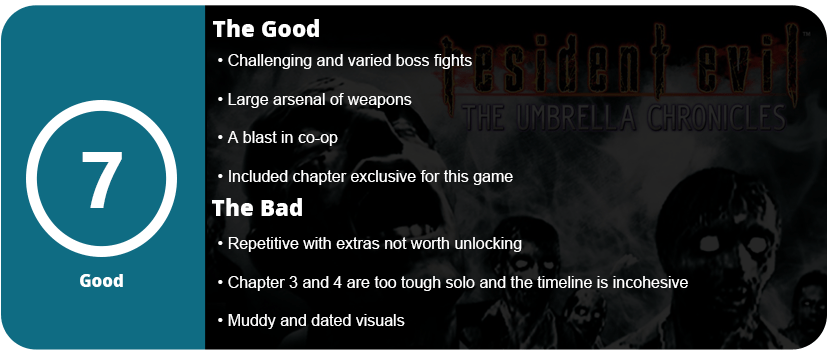
Overall, Umbrella Chronicles is a decent light-gun game that requires a second player or you won’t get very far. The boss fights are bombastic and fun, and each is unique, but the same enemies repeat over and over, and the scenarios don’t change. You’re just running down hallways or open areas and blasting enemies. The game goes on way longer than it needs to, with each chapter taking about 30-45 minutes to complete if you include the bonus missions. There is a lack of variety when it comes to other stuff to do to make this game even more exciting to play. The extras aren’t worth unlocking as they require S ranks in each chapter, most of the time, and after finishing this game once, there’s no real reason to go back.
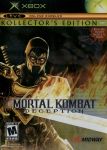
It was the very first game I ever pre-ordered. I have never been more excited about a game in my life. Watching gameplay trailers on a PC from 1997 on a 19″ CRT monitor while I stash away allowance bit by bit to get the Premium Pack for PS2. 2004 was an exciting year for gaming and for Mortal Kombat. With Deadly Alliance receiving mostly positive reviews but a lot of criticism from reviewers, Deception turned everything to 11 and added interactive arenas, more game modes, and online fighting. Yes, the online part was the biggest selling point of Deception.
This is the direct sequel to Deadly Alliance. Quan Chi and Shang Tsung have failed to take over, and Onaga, the Dragon King, has decided to rise from the Outworld and claim everything as his. A man named Shujinko is now the game’s lead (the first of many to come in later games) and must stop the Dragon King and reverse the actions he took during the Konquest mode that helped give Onaga his power.
Let’s talk about Konquest mode first, as most people will dive into it right away. It’s awful and should never have existed. It’s an expansion on Konquest from Deadly Alliance in which Raiden just walks along a path, and each “level” is a training tutorial for all the characters. This is an adventure mode where you get quests, find the treasure for the Krypt, find hidden secrets, and find out the back story to Deception, as well as meet many MK fighters and surprises. It sounds great on paper, right? Well, it’s horribly executed as one of the worst attempts at a free-roaming RPG/adventure hybrid I’ve ever seen. Shujinko runs around in supersonic, fast-forward motion; the realms are void of any life; they are terribly laid out; and the worlds rely on a grid system to figure out where every secret and item is. The problem is that the map is useless with no actual grid on it, so you run around for 10 minutes trying to find D2 or H8 only to realize it’s locked away and you can’t go there until you complete the Konquest.
That’s the main downfall of Konquest. Quests aren’t logged, and the entire game has to be played with a guide. It would take dozens and dozens of hours to figure everything out yourself, as locations to solve quests and even chests are incredibly cryptic or specific. Some chests with Krypt keys only appear on certain days of the month and times, and you would never know without a guide. You can meditate to make time move by faster, but this whole entire game mode is just frustrating, messy, and irritating. Doing the actual main quests is fine, as there’s always a large green pillar of light pointing where to go, but talking to a random character and getting a one-sentence quest saying to find a gem is not how quests should be done.
On top of all this, the world is terribly laid out. They try to force a look at each realm, such as Chaosrealm, which has magic portals that project to you various little floating islands that are “chaotically” made up and don’t make sense. Orderrealm is just a giant circle floating in the sky with “order” in the layout, and it looks nice and dystopian. It’s a little corny with the way the worlds are represented, but it’s kind of cool to finally explore these areas despite there being nothing to do in them. The visuals are also abysmal, as this looks like an early PS2 game that launched, even a little worse than that. Horrendous textures and models, awful voice acting, and laughable animations. It looks like an amateur game developer made this over the weekend.
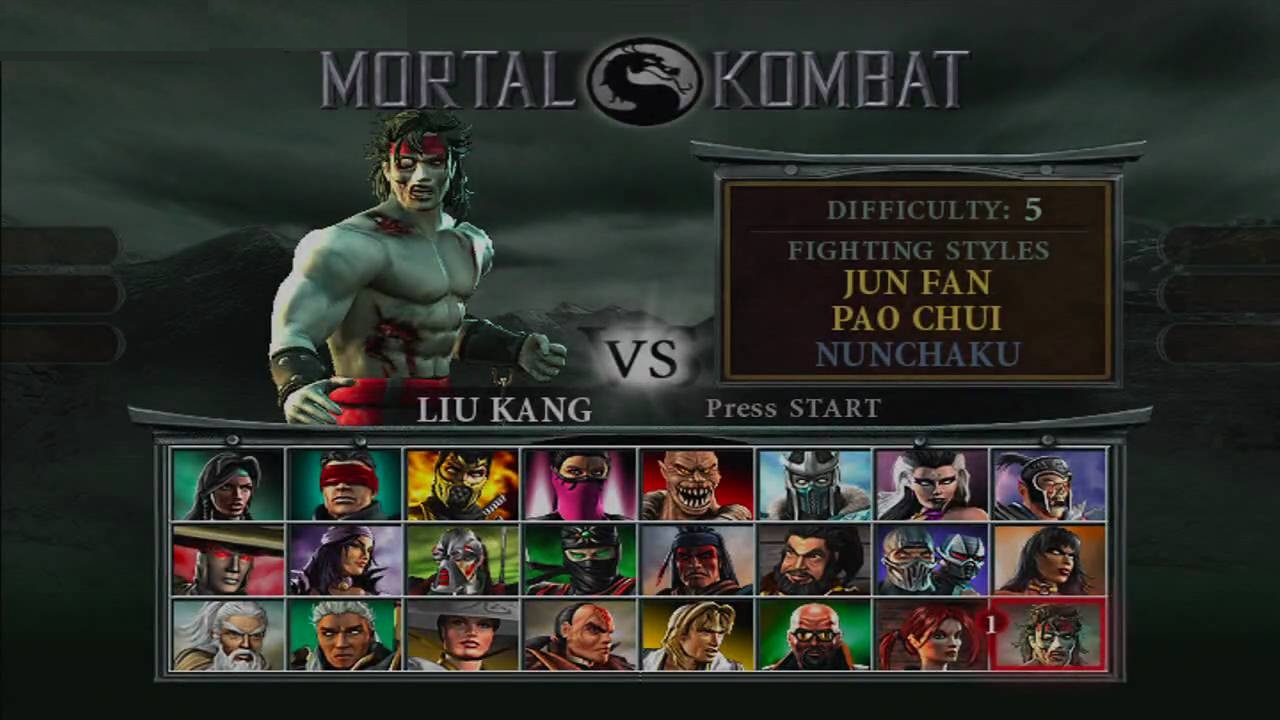
Outside of Konquest, things are much better when you actually get to fighting. If any game were to use realistic martial arts, it’s Mortal Kombat. This fighting system and this era of games aren’t most people’s favorites. The realism is nice, with some good animations, and each character has two martial arts and a weapon style. You can branch into these styles with long combo strings, but that’s where the issue lies. This realistic, slower fighting style is in contrast to the fast-paced action of the 2D games. The characters look like stiff plastic dolls, and the combat is all about memorized combos. It’s fun, and it works with Mortal Kombat, but it’s also not the best way to play these games. The slower fighting pace means more strategy is involved, and a new breaker system has been added to quickly get out of combos.
Interactive environments are some of the coolest features of Deception, as they are basically fatalities within a stage. There are yellow lines that indicate when a player can get knocked out and take damage to a new tier, and red lines that will kill the player. The arenas are large enough that a game of tug-of-war always ensues, which makes playing tenser, especially online. Do you just knock them into the trap or play with them so you can cause a fatality? Speaking of fatalities, each character has two unique ones; some are great and some are lame. Li Mei, for example, has two fatalities that are just boring. Super punches to the chest, and you explode? Yawn. Kick your head off. I saw it before. Some others are rather runny and unique, but there are also Hara Kiris that allow the loser to do a fatality on themselves, taking the glory away from the opponent. Whoever inputs their code first gets to have fun.
Outside of combat, you can play Puzzle Kombat, which is just Street Fighter Puzzle with MK characters. At the end of each round, there is a fatality unique to the player, but getting your power level up means you can perform a special move that each character has. It can be played online as well, is super addicting, and can be a game on its own. The last mode is Chess Kombat, which is one of the most unique modes to ever grace a fighting game. Just like a game of chess, you can pick which character is what piece, and you play chess, but instead of just knocking a piece over, you fight it out MK style. Each piece gets a certain amount of health, so pawns get the least amount of health. It’s a great twist that adds more skill to the game and can also be played online. It’s a ton of fun, and I hope this mode returns to future games.
Besides the Krypt, where you can unlock various stuff for fans like promo videos, behind-the-scenes art, and various goodies, there’s not much else. Online play is incredibly smooth, with a full lobby where you can talk to other players, challenge players, and have a win/loss ratio next to your name. I never had any connection drops and playing online extends the longevity of the game tenfold.
I also want to talk about the new characters. Since MK4, Midway has had trouble adding interesting new characters, and that trend continues for the third time. Dairou and Havik are just boring, awful characters that don’t have any personality or soul. They feel forced, and I’d rather have a classic character put in than these two.
Overall, MK: Deception is a fantastic fighting game that is only hampered by slower combat and a horrible Konquest mode that must be played to unlock half the game’s roster and extra costumes. Puzzle and Chess Kombat are excellent modes that add dozens of hours of fun, and online play is always welcome.
Note: As of May 31, 2014, you can no longer play Deception online due to GameSpy servers being shut down. Even then, not a single person played this online game between 2006 and 2007. As Armageddon and other fighters came out, Deception’s user base quickly fell after the first 18 months and never went back up. Get a buddy to play next to you instead.
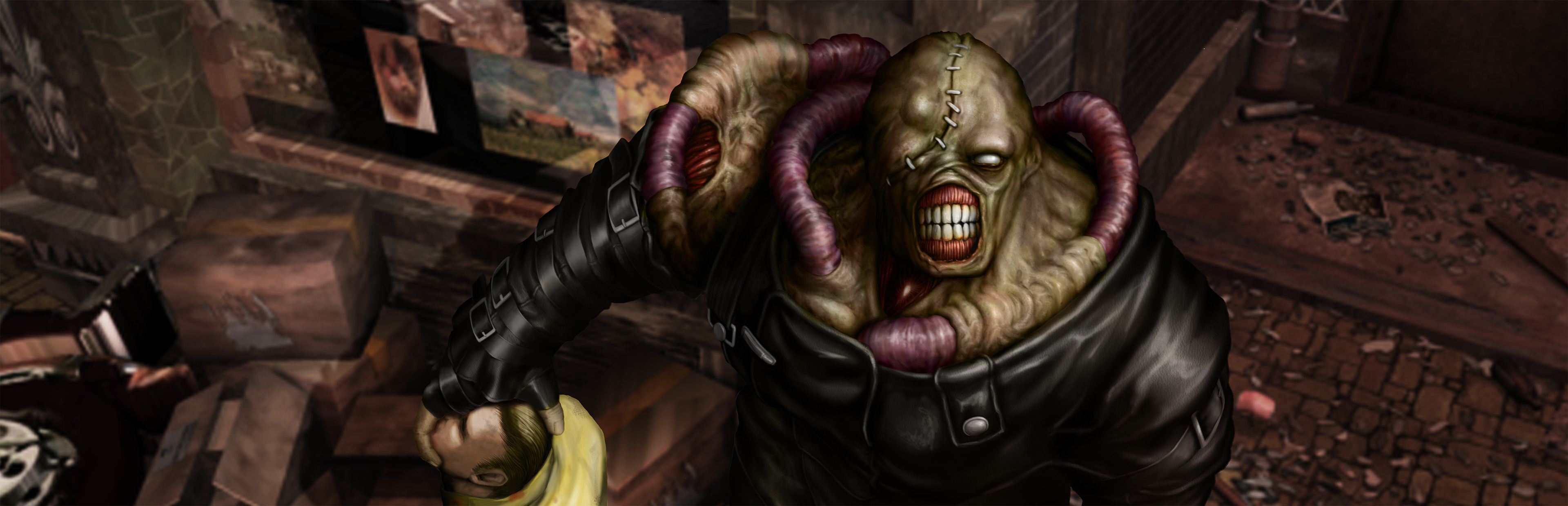
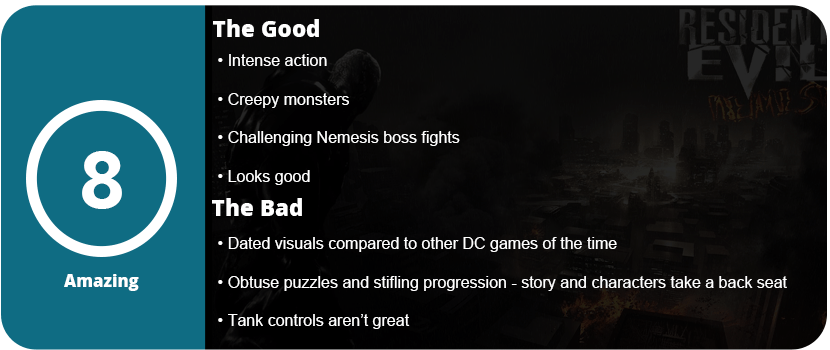
Resident Evil has been more about tense action, inventory management, and puzzles than horror. RE3 polishes up the already not-so-smooth gameplay of Resident Evil and ports it over to the Dreamcast to make another buck off of it. RE3 doesn’t really have much of a story, but the tense action, puzzle-solving, and always-looming Nemesis boss make this one of the tensest games of the era.
You play as Jill Valentine (the star of the first game) and are back in Racoon City this time to try and find out what happened during the outbreak. Being a direct sequel to the second game, you visit a few familiar areas, and some Easter eggs are tossed in. Outside of running around collecting ammo, healing items, documents, and various things of that nature, you solve puzzles and mow down armies of the undead and genetically modified. New enemies crop up that are freaky and challenging, and the only boss in the game is Nemesis, who is a tough monster, and choices are thrown into the game depending on where the story goes. These choices impact where you start in locations and how you approach fighting the Nemesis. One choice kept the Nemesis from chasing me around town, but I was going to have to fight him early on. You can totally avoid fighting him in most cases, but he becomes stronger the less you fight him.
I honestly recommend playing this game in easy mode the first time, as you get tons of healing items and weapons at the start, as well as infinite save ribbons. This mode should be used first for another reason, and that’s to learn the layout of the game. Resident Evil is a game where enemy location, map layout, and puzzle-solving are a must before attempting harder modes. Now with all that said, I do find earlier Resident Evil games tough outside of just combat, as without a guide you can get lost and frustrated quickly as puzzles are obtuse, and there might be objects you saw hours ago that you have to go back and get, such as the Downtown/Uptown maps in this game. It’s imperative to write things down if you don’t have a guide, as you will run around for hours trying to find that one item that you can’t remember.
The story and characters are nothing special, but the voice acting is surprisingly decent for its time. We don’t learn much about Umbrella outside of someone going in and trying to pop off the supervisors throughout the city and cover up the T-virus outbreak. There’s no character development or anything like that, so you’re mostly paying for the action. The visuals are rather nice, but at this point, the pre-rendered backgrounds were getting tiring. The Dreamcast version is a slightly smoother PlayStation version, but there’s not much of a difference. I would have liked to have seen more modes, better visuals, and new content for a new $50 release, but what we get is mainly for newcomers.
I highly recommend RE3 on the Dreamcast. At this point, this is the definitive version of the game and the best the series has to offer up until this point. Don’t expect a deep story; have a guide ready, and you’ll be in for a good 8–10 hours of intense action and fun.
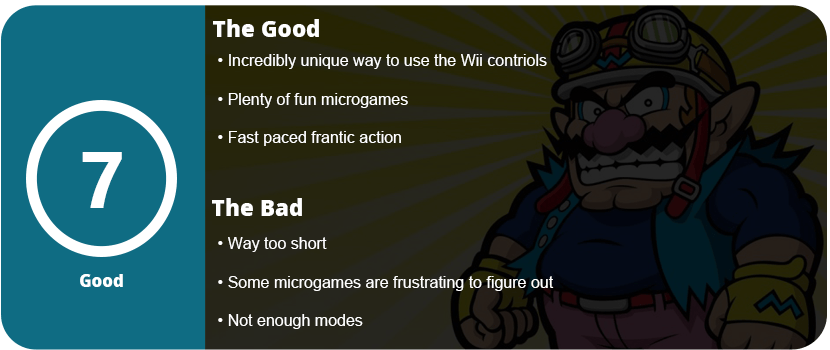
WarioWare has always been about showing off the capabilities of Nintendo’s systems, usually in the controls department. Each iteration has been 100% unique to that system, starting back on the GameBoy Advance. Smooth Moves uses the Wii Remote and Nunchuck in really unique and fun ways, but just like too much fun, it only lasts as long as a snack.
Just like every other WarioWare game, you play small microgames that last 5 seconds each and are only given a single-word clue on how to complete that mini-game. It goes by in a flash and requires quick reflexes to complete. The main map of the game consists of 8 different mini-game stories that are just little hand-drawn cut scenes to make some sense of the crazy sense of humor. Games range from opening a door to weird men, picking a nose, shaving a beard, and whacking people with bats. There are probably 30 odd mini-games here, but sadly, you can go through all of them in less than an hour.
That’s about how long this game lasts, fun-wise as well. There are some side games like can shooter, stack the blocks, and a few others, but they get boring quickly. Honestly, this is a good entry game for new Wii system owners, as you have to hold the Wii Remote in certain ways, such as on top of your head, on your nose, or like a steering wheel. There are various “positions” that flash before each microgame on how to hold the Wii Remote, making this probably the most unique WarioWare game ever made. It’s super silly and incredibly funny, but also frustrating.
Some mini-games take several tries to understand what you’re supposed to do, and I got a game over many times because I just couldn’t figure out the microgame fast enough. It’s not a big deal because each “story” only lasts about 3 minutes, and you quickly go through all 15 microgames to reach a “boss.” This boss fight lasts 10 seconds and is just an extended version of the microgames. This includes driving around corners without hitting anything, playing the original StarFox, and playing a dancing mini-game.
I honestly would have been made to pay $50 for this game when it was released, as it’s easily a $20 game at best. It feels like a budget game, but it isn’t bad at all; it is just incredibly short and more fun to play with people around. I would have liked a party mode where other players have to jump after each microgame to make things crazy, or even some two-person mini-games. There’s a lot of missed potential here, but what we get is a lot of fun.
Overall, Smooth Moves lasts about as long as a large bucket of popcorn, and it’s all over, leaving you wanting more. It shows you how unique the Wii controls are, but doesn’t offer anything meaty to satisfy this unique playset.
You’re a mercenary who wants to become a knight in a far-off land with two races at war with each other. On top of that, you accidentally fall in love with the princess and end up in a political war and the savior of the world. It sounds like a typical JRPG, doesn’t it? Well, it kind of is, but the story is incredibly engaging, and I can’t give more away without spoiling it. It takes a little while to pick up, but there were some unexpected plot twists and turns in the story that had me blowing through this game in 3 days. That’s how engaging this game is. I wanted to play more and keep going further because I cared about the characters and what they were going to do next.
The Last Story plays a lot different than any other JRPG out there, so much so that I have yet to play one that is like it. The combat system is both real-time and pause-based, with deeper strategies slowly unlocking as you progress through the game. What’s great is that the game starts off super easy and simple, and I honestly didn’t really get a game over until two-thirds through the game, but then it got really tough and challenging, but just enough to make me think a little and really decide my next decision rather than hacking away blindly. The main mechanic in all of the combat is Zael’s gathering ability, which makes all enemies go towards him. This is needed for strategic reasons, as you have magic party members that cast spells on a timer. If they get hit, that timer resets, so you need to have all the enemies come towards you and your other melee fighters. This seems like instant death, but their movement slows down and the magic fighters’ cast speed increases double, so there are benefits to this. You can also use your gathering as a burst weapon if you get hit enough times.
You can also snap to walls and take cover, as well as peak out and hit enemies with your crossbow. This also lets you see enemies’ weaknesses, which are mandatory later on when trying to figure out how to kill enemies. Sadly, this isn’t as smooth as it sounds. The controls are really sticky, so if you don’t face the wall exactly head-on, you won’t get the prompt, and this includes using the wall-run move, which is hindered by the camera and is uncontrollable. I also had issues when attacking an enemy; by just pressing forward on the C-stick, I couldn’t quickly back out or dodge. I would snap the stick back, and I would still be attacking, and this was usually the main reason why I would die. Speaking of dying, you get 5 lives, and then it’s game over. This sounds like it’s easy, but it works well with this combat system, and there were plenty of times I ran out of all five lives pretty quickly. You can get more lives during combat with a revive skill or an item.
Outside of whacking enemies, you can pause the battle by pressing up on the D-pad and choosing your main skill, regular skill, retreat to a healing circle, or guard. Your main skill requires a meter to fill up before using it, and to command your party members, your command bar must have all bars filled so you can’t abuse it. You can also use these bar segments to use your Gale move, which lets you dash around the battlefield, knocking enemies over. It’s a very interesting and intricate combat system that you end up mastering by the end of the game, or you won’t pass the tough bosses in the last few chapters. They require all of your knowledge of the combat system and learning each party member’s moves and all their strengths.
Every so often, the game does change things up by throwing an enemy at you that can only be killed on dry land and heals in water. There are throwables scattered sometimes and destructible environments to make killing groups a little easier. Once a battle is over you level up and can collect items. These items randomize as you approach them with a slot machine-style spin and range from weapons, armor, and crafting items.
Weapons and armor work a little differently here, as you won’t really buy weapons after the first 10 chapters and instead just upgrade the weapons you pick up, and the same goes for armor. I always found a more powerful weapon from a boss or tough enemy and never had issues with that. Thankfully, there’s an auto-equip feature, which I love in JRPGs, and it does a good job making sure everyone gets what makes them the strongest. I never really had to manually equip anything.
Outside of combat, there are some optional chapters you can complete, but honestly, they’re a complete waste of time as the items you get aren’t much better than what you will get during the story, and there are no extra plot paths or anything like that. It’s literally just to level up a little bit, but even ground isn’t needed in this game as you level up so quickly during the story. Most of the story is progressed by entering rooms, talking to people, or leaving and coming back to the main castle. Most NPCs give you clues as to where to go, so that was never a huge problem. There really isn’t much to explore here, as many areas repeat themselves a few times, and the castle area is rather small, equal to the size of a market center in most games. I wish I could have traveled around more, but the story explains why you don’t really go anywhere, and it makes sense.
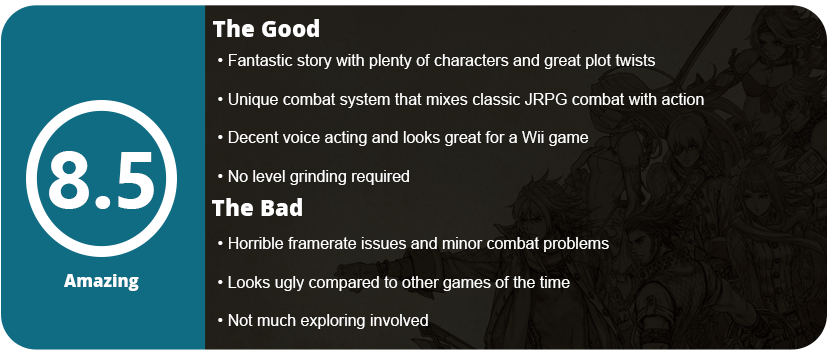
Let’s talk about the production values a bit. The game looks fantastic for a Wii game, with lots of detail, good lighting effects, and huge vistas, but it comes at a huge price. The game slows down to single-digit frames constantly whenever the camera pans out too far or you get a vista shot. Even during combat, when there are a lot of effects on screen, the game crawls, which makes things frustrating as the controls don’t respond during these times. There’s tons of horrible aliasing, and the textures are muddy because Mistwalker tried pushing the system way too far. It still looks great but also looks bad because you can see the Wii struggle so hard just to render a single face on the screen and it looks like a GameCube game at best. The voice acting is actually pretty decent for a localized JRPG, and like I said earlier, the story is just amazing and memorable.
Overall, The Last Story is a must-play for any Wii owner. It strays far enough away from JRPG tropes to be unique and has enough action gameplay to keep people from getting bored. The lack of grinding needed, engaging story, great characters, and interesting combat are enough to get you through the 20–25-hour story. You do have to forgive the visuals and some minor control issues.
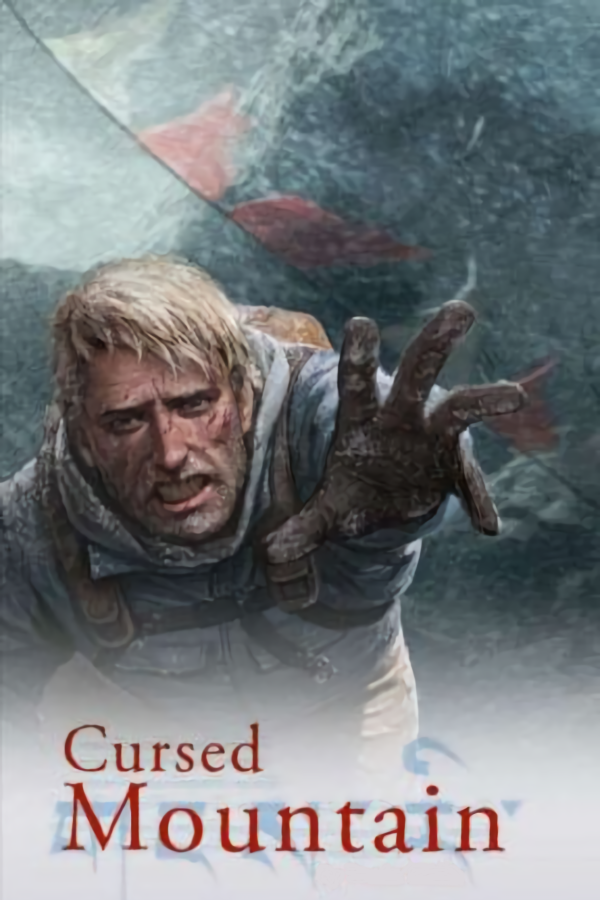
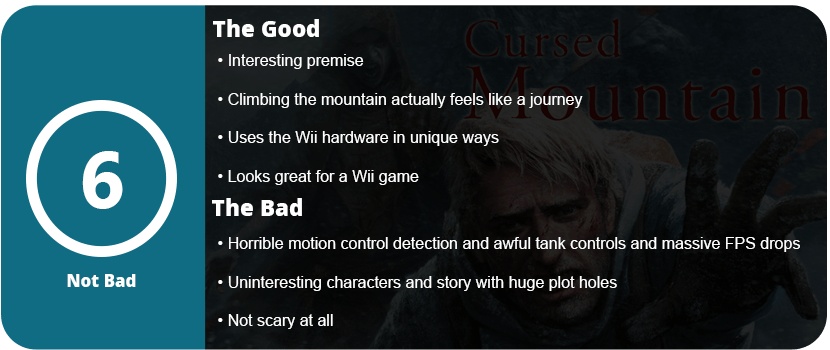
Climbing a mountain can be tough, but climbing one of the highest and most remote is even tougher. You play as a man named Eric, who is destined to find his brother after he went missing during a mountain climb to find a secret Tibetan treasure. What he finds along his journey is a dark past and strange company, but he mainly finds the strength within himself to complete his journey.
The story is decent at best but has many plot holes, awful storyboard cut scenes, and terrible voice acting, but still enough to keep you trucking along. The game plays a lot with the supernatural and Tibetan history and lore, which is nice, but it’s easily forgettable. You never know what the secret treasure is ultimately for, who the expedition company is that’s involved, and many other questions that are never answered.
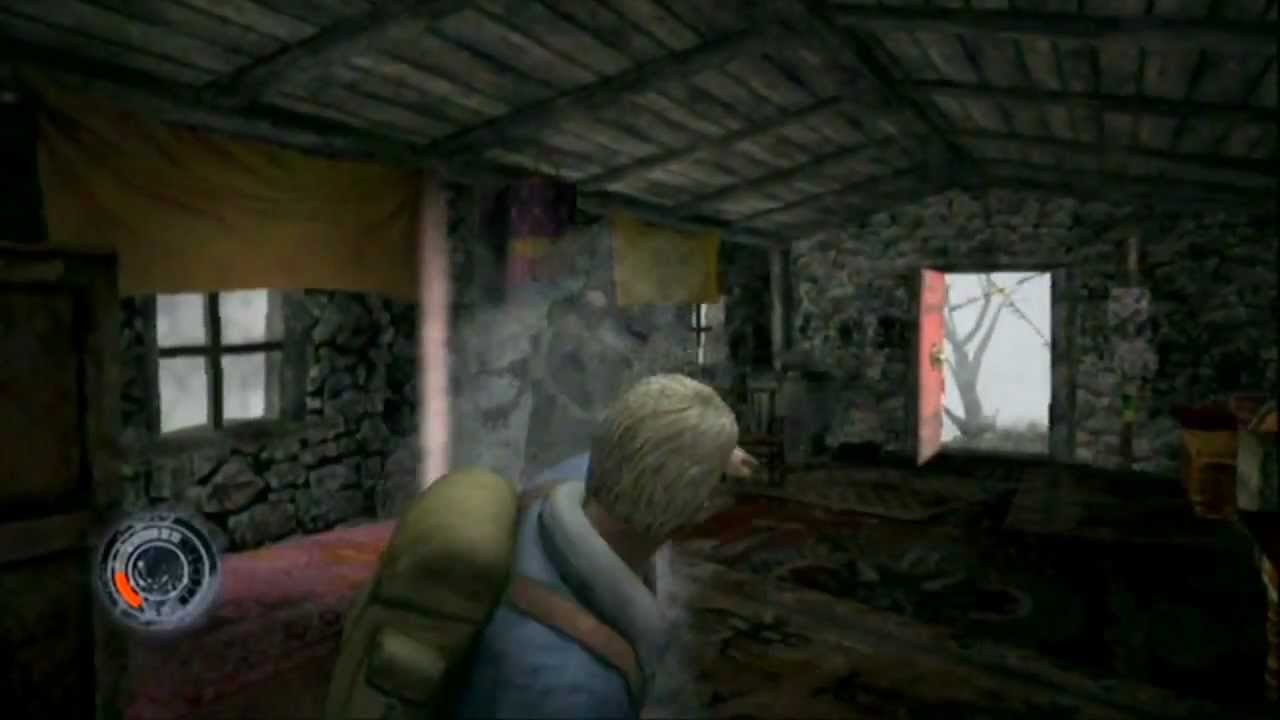
Nevertheless, you basically walk around various buildings and ruins as you slowly climb this giant mountain. The game changes slowly as you reach the peak with different gameplay elements tossed in, and I have to give the game some credit for mixing things up, but it doesn’t do any of these things very well. Let’s start with simply moving. Eric moves like he’s constipated, and the controls are pretty bad. If you bump into a wall and he sticks to it, the camera will get stuck behind objects as you can’t control it, and combat is pretty bad as well.
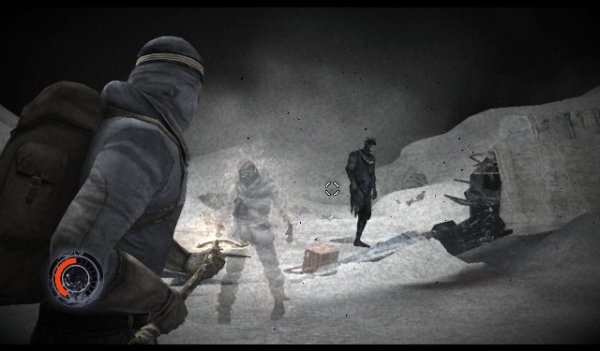
You have a pickaxe that has ancient items attached to it with powers that allow you to access your “third eye” and see ghosts so you can kill them. Each encounter is arena-based, so you’re stuck in a small room with these things. Holding down C allows you to enter this mode, but you can’t move, and Eric’s shoulder blocks the entire left half of the screen as the FOV is too low and it’s hard to see. You can see the reticle through Eric, but not the enemies. The ghosts have various attacks and powers, but overall they mainly mob you and attack you the same. The goal is to shoot the projectiles from the pick to weaken the enemies enough to enter a quick-time event of aimlessly flailing the Wii Remote around to kill them. Miss the event, and you have to attack them one more time to make the prompt appear. This is by far some of the worst Wii controls I’ve experienced, as the prompts require punching and swinging action, but no matter how well I did them—either fast or slow—it would only register half the time. To make matters worse, this is the reason why I died half the time. Then there’s the fact that you can’t move while aiming, so these are 1997 tank controls in a modern game. There isn’t even a quick-turn button, so I can quickly run away and swing back around. I have to aim and fully turn all the way around, and then the enemy is back on me again. It’s the worst.
Let’s also mention the two areas where you have to meditate and swing the Wii Remote around. I spent 10 minutes just trying to find the spot where the game wanted me to be, then holding that position and keeping swinging until the screen faded. I’ve never experienced such unresponsiveness and inaccuracy in the controls. Were these even tested? As you progress further into the game, the enemies get harder, and there are more of them. You fight probably 100 ghosts just in the second half of the game. That’s a lot of unresponsive Wii flinging.
With all of that aside, the game is poorly paced, with minutes of endless walking and climbing that are slow and tedious, and the checkpoints are placed poorly. I would die during a boss fight just to fight the ghosts leading up to the boss again instead of the checkpoint right before the boss. Dying isn’t really an issue if you’re quick, as killing an enemy gives you health, but there is incense you can pick up to use at healing stations if you need it.
Outside of this, the visuals are pretty decent, but while pushing the Wii way too hard with the slowdown that is frequent and runs in the single digits, it still looks decent. The audio sounds like a PS2 game, with the same footstep sound throughout the whole game and low-quality audio bites. I honestly feel like this was developed for the GameCube and was pushed to the Wii at the last minute.
Overall, is Cursed Mountain worth playing? Yes and no, for many reasons. If you are running out of games to play on your Wii, then go for it, or if you’re just getting into the Wii, then it’s a good pick-up, but what experience do you get out of it? Just to kill time, really. The story isn’t memorable, it’s not scary, and the controls stink, so mainly get it just because you need another Wii game to play.

















































 thebinarymessiah.com
Try multiplayer. A lot of fun !