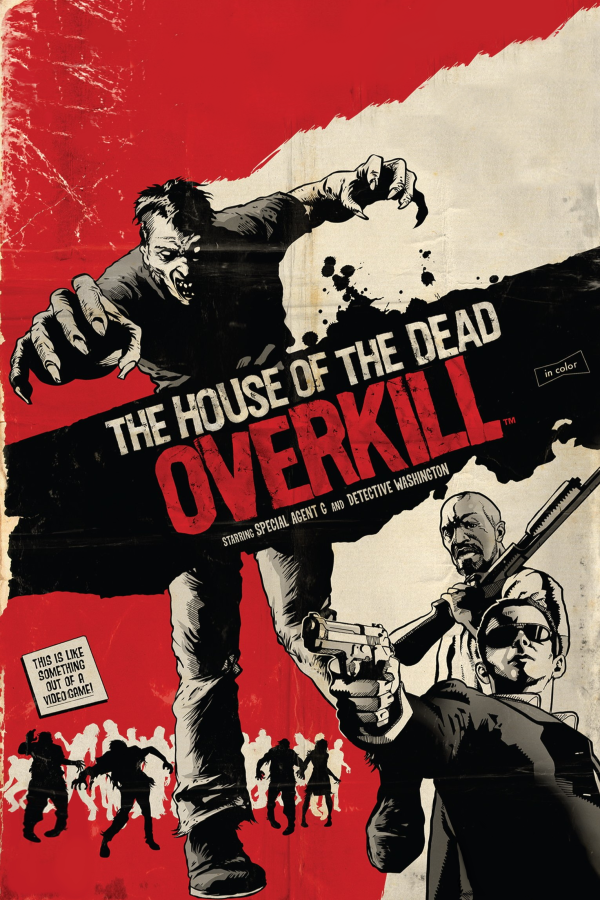
claps Yessss, thank you, Sega, for making one of the few mature-rated games for us adults out there. Thank you. House of the Dead: Overkill plays more on the great HotD series that started back in the early 90s in the arcades. You play Agent G with his foul-mouthed partner Isaac Washington (yes, he’s black!) as you figure out why zombies are plaguing the US. While the story is hilarious, vulgar, rude, and completely dirty, there are tons of funny voice acting and dialog to enjoy. The characters are played out very well, and you get pretty attached early on (there are only about 8 levels or so), along with the major hottie, Varla Gunns.
The game plays like a typical on-rails FPS where the game controls where you move and you just worry about the shooting. The game has many locales, from jails to hospitals to swamps to theme parks, so you won’t get bored one little bit. There are many guns to buy and upgrade, along with some great unlockables for beating the game. While you wander through levels, there are a few temperature upgrades you can shoot (I wish there were more), such as health, grenades, green blobs that slow downtime for a little while, and gold braids. Yes, collect all these brains, and you unlock artwork, videos, etc. Now upgrading your weapons is mandatory, such as less recoil, clip size, damage, and the whole nine yards. You can have up to two weapons equipped, and switching back and forth between these two is a great strategy when you have too many zombies to deal with. You start off the game with a pistol, and if you save up your money (more on how later), you can buy more weapons. Buying a shotgun first is great since you use all your rounds to clear most of the zombies out and then switch to your pistol to finish off stubborn stragglers.
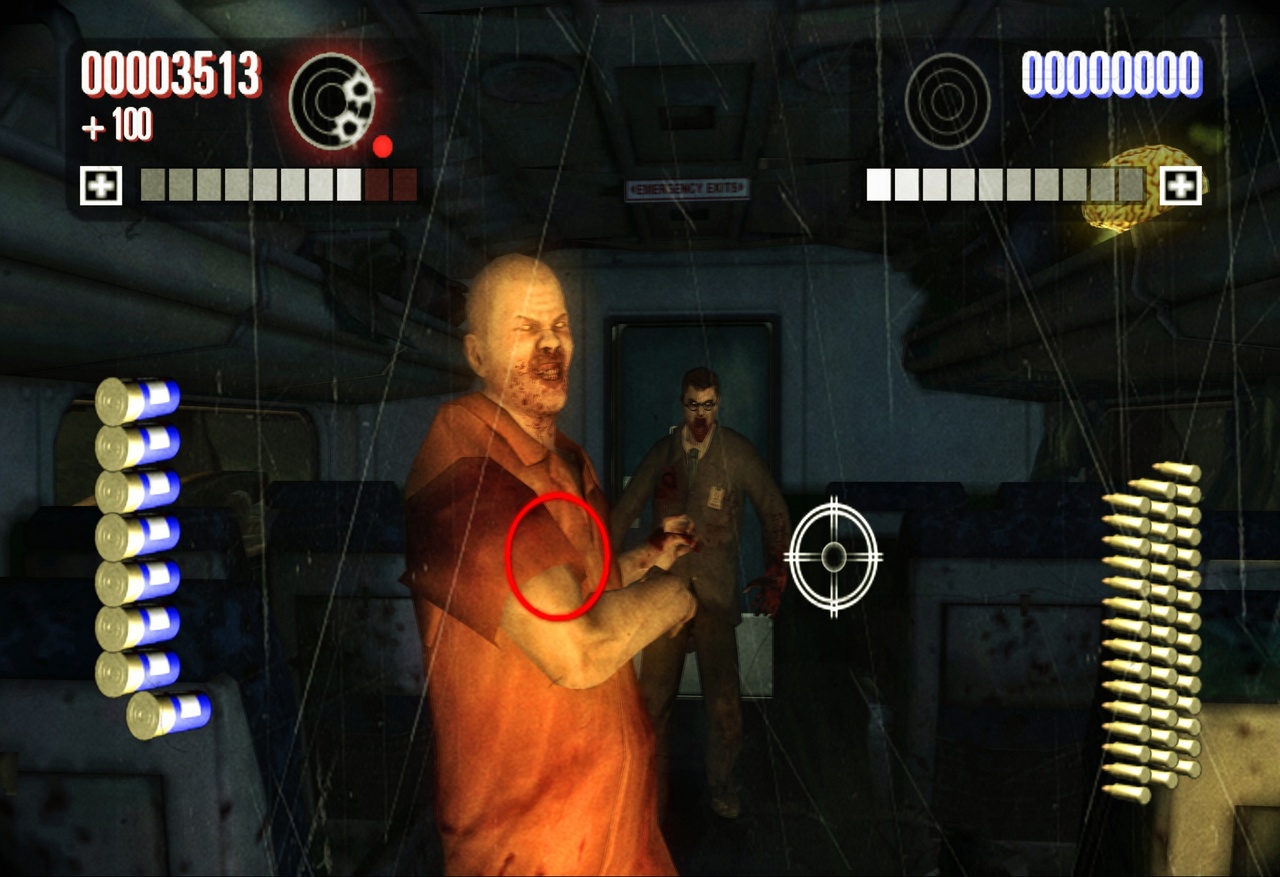
One great thing about OK is that it never gets too frustrating. When you die, you start off right where you were with no continues. Of course, you take a score hit, but people who don’t care about this won’t break their Wiimotes in anger. The levels are just the right length, taking about 10–15 minutes to complete with super-fun boss fights. Each boss will have their weak point circled in red, and all you have to do is shoot whatever projectile they fire at you and keep on them. The bosses are disgusting, grotesque, and very funny-looking. You’re probably all great, but there’s more!
MULTIPLAYER MAN!! That’s the best ever. While it’s the same as a single player, having someone help you can always be fun. Now, if you beat the game, you get the director’s cut (I won’t say what it is!!). Along with being able to dual-wield weapons, yes, it’s sweet, super fun, and adds lots of replay value. Wouldn’t that make the game too easy, you say? Well, use the “Extra Mutants” tweak before each level, and you have an extra challenge. Sadly, there is no online play, but hopefully, a future HotD will have it. I HIGHLY recommend this super fun game to any adult who has dust collecting on their Wii.
Afro-Samurai is just one of those comics or cartoons that you never really hear of until it’s a video game. Afro Samurai is about a samurai named Afro who is trying to find the #1 headband from the person who killed his father. Anyone who holds the #1 headband becomes a god, and only the #2 bearer can challenge #1. While the story has interesting developments and great characters, the game is mainly focused on combat. Afro and Ninja Ninja are voiced by Samual L. Jackson (you may have heard him as Officer Tenpenny in Grand Theft Auto: San Andreas), along with Justice, voiced by Ron Perlman (of Hellboy fame).
There are a lot of elements to the combat in AS, but the whole thing becomes very monotonous after a few levels. You have three basic attacks: light, heavy, and kick (along with jumping). You also have focus attacks (which slow downtime), and if you hold either heavy or light, you instantly slice the enemy to bits. Not all enemies can easily succumb to the focus, so some will have to be weakened before using it. There is also a parry technique in which you can “mount” an enemy and slice their head off. Parry is essential to most boss fights (more on those later) and to staying alive.
While the combat is very satisfying only because of the sheer amounts of gore that are spilled, it does become very repetitive. There are combos you can learn, but they aren’t really necessary since you can just button-mash most of the time. I particularly loved the gore since it isn’t canned and any part you slice off will come off. If you slice just the toe that comes off, slice a piece of a guy’s skin, it comes off. The whole theme is very mature, with lots of cursing, sexual innuendos, and nude polecats. Yes, nude female samurais—nothing’s hotter than that. Anyways, there are some platforming sections, but this part of the game is somewhat flawed since Afro likes to stick to things a lot, and the controls for this can be somewhat unresponsive. Controls for combat are spot on, but they seem to become sluggish and sticky when you’re platforming.
Another great aspect (that I’m glad more developers are doing) is that there is no HUD. Just like in games such as Dead Space, everything depends on your main character to tell what’s going on. The more Afro glows red, the closer you are to dying when your focus is charged up. Afro’s pendant sparkles, and that’s pretty much all you need. You do level up and learn new focus moves such as bullet slice (reflect and slice bullets in slow-mo), mounting, etc. There are some different enemy types, but there could have been more. You’ll see a lot of the same ones halfway through the game, and it tends to add to the monotony.
Enemy AI is actually pretty good, and you will have a challenge fighting off enemies by the dozens. Thankfully, Afro is fully equipped to take on all these baddies. Combat doesn’t tend to get too frustrating until you get to bosses, since the windows for attacking are so small that it takes so much patience to kill them. While your character does level up, it doesn’t really make a difference since it’s all set on auto. The game is fairly short, clocking in at about 4-6 hours, depending on how you play the game and your skill level. There is zero replay value since there are no extra modes you unlock or anything. I just highly recommend Afro Samurai as a fun weekend rental.
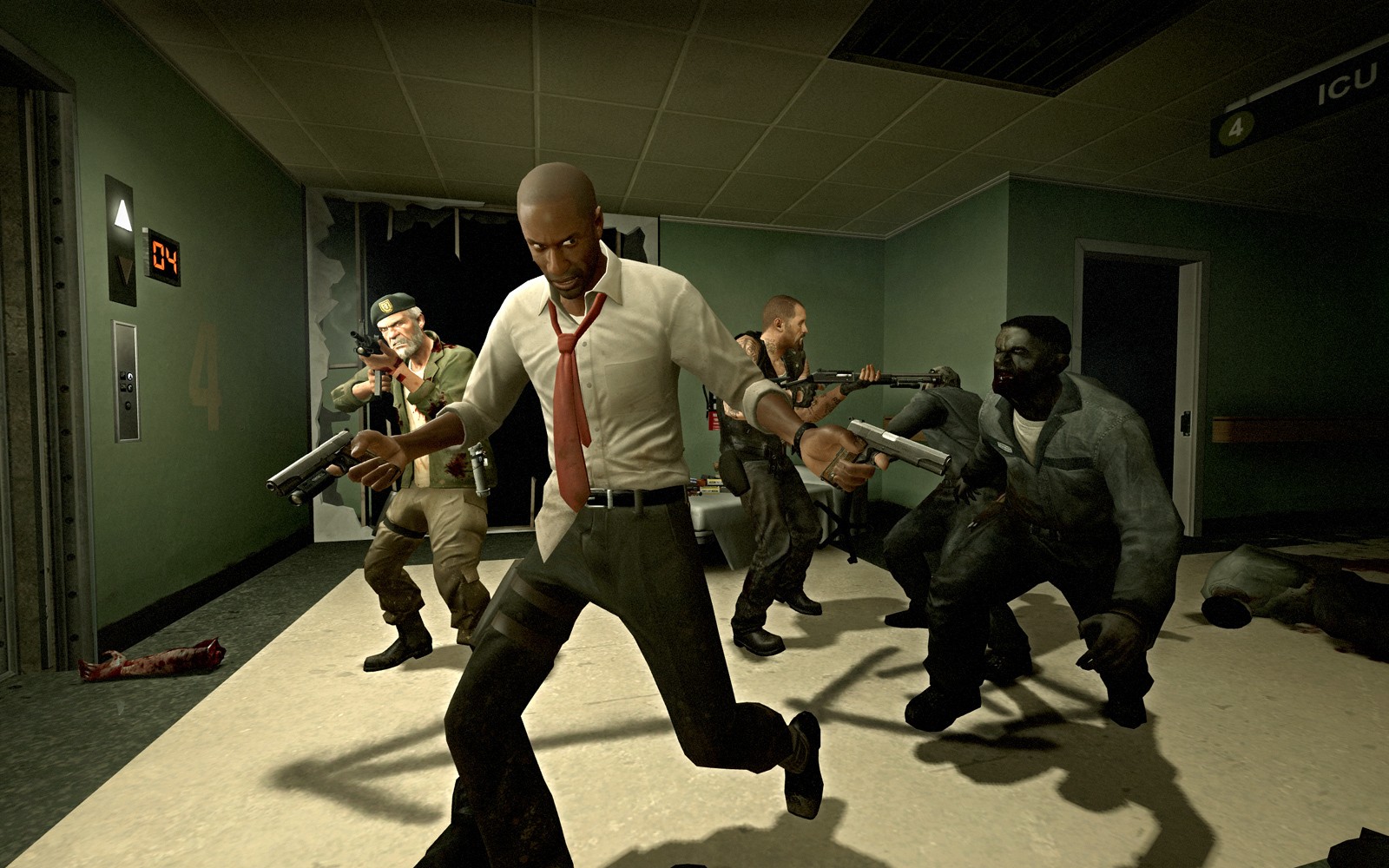
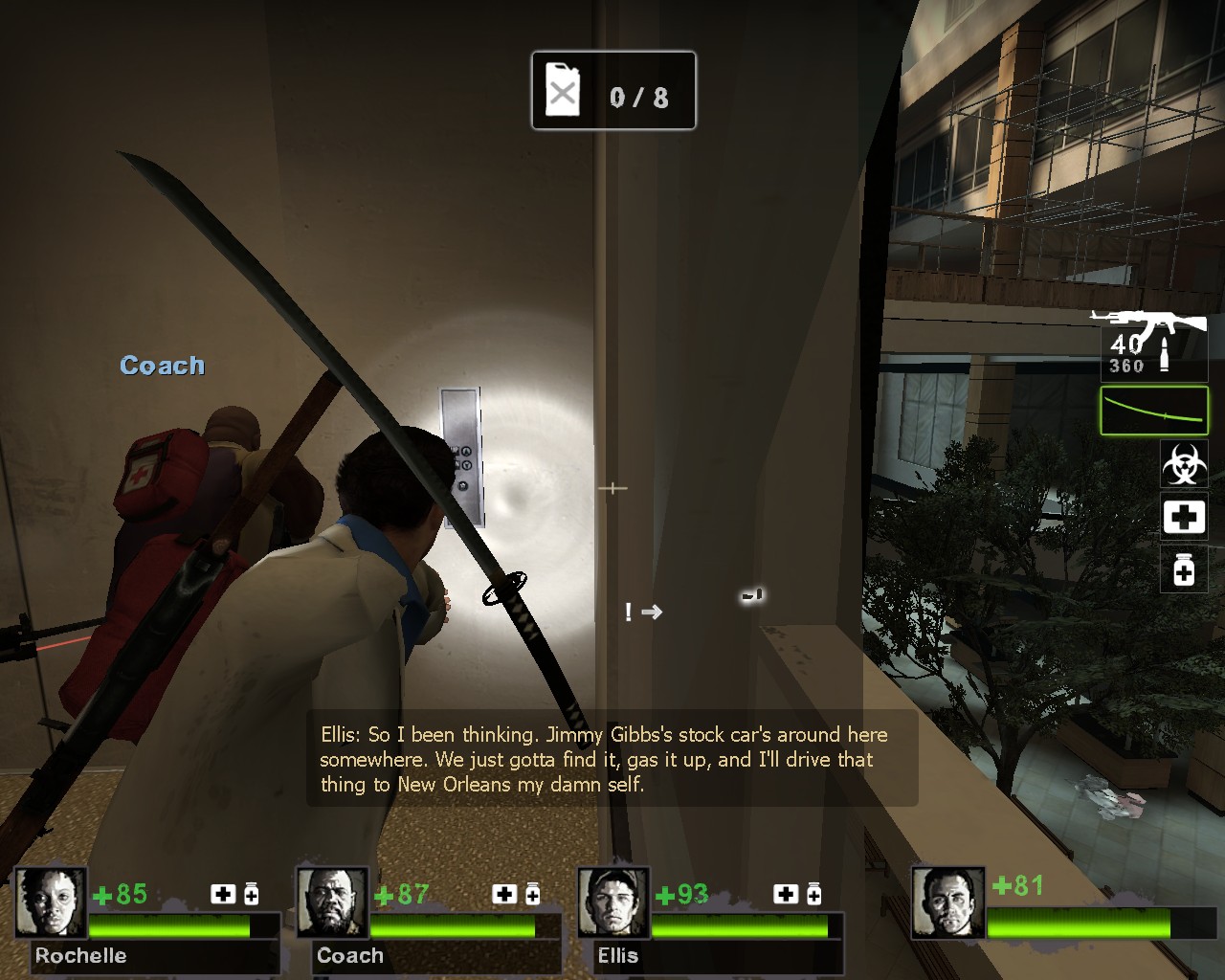
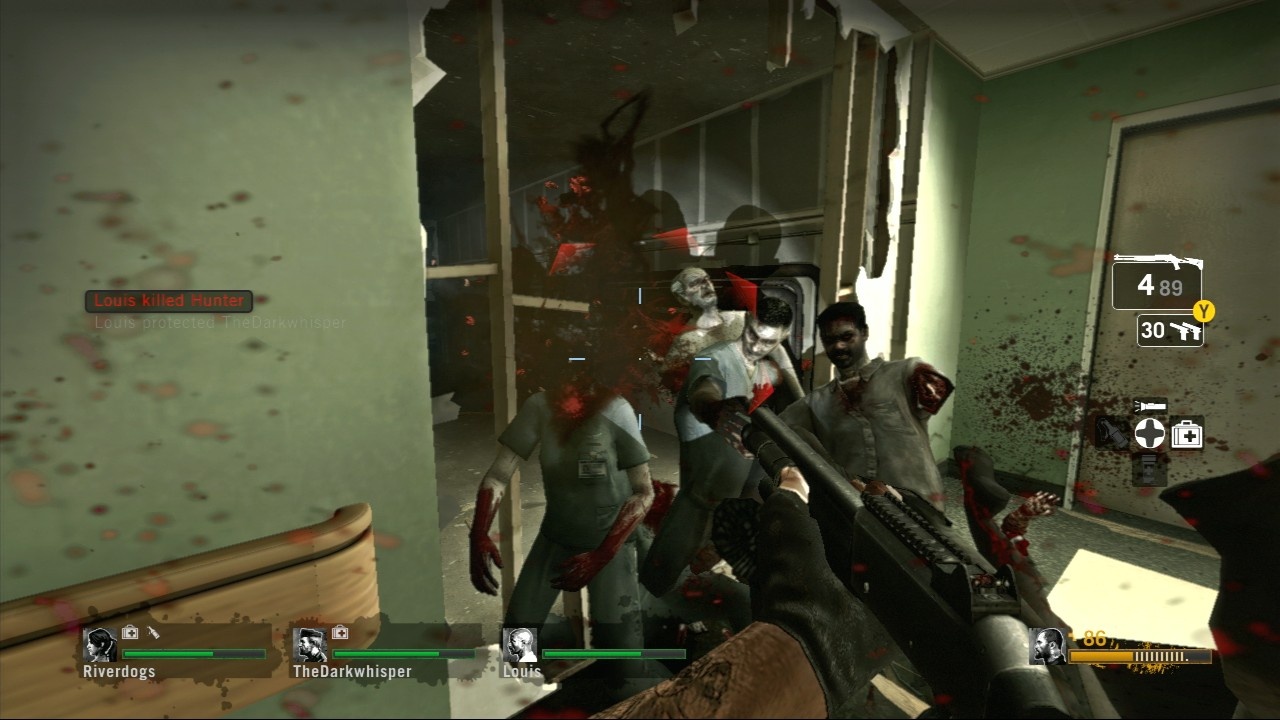
Once again, Valve brings us another great game using their source engine that brings all the elements of Left 4 Dead to life (or death???) The first thing you’ll notice (mainly Valve fans) is that the Source engine has had a next-gen upgrade (even more so than Portal), and everything looks amazing. While HL2 fans will notice some sounds and elements of the engine from those games, it doesn’t really bother you. The game looks stunning with excellent lighting effects, awesome AI (enemy and friendly), great character models, high-res textures, and just everything you’d expect out of the source engine. L4D, however, isn’t really a single-player-only experience; in fact, you won’t even see the full potential of this four-player game unless you play online.
The game is comprised of four campaigns, and each campaign has five levels. Each level gets longer and more and more difficult, with a final level where you have to face off hundreds of zombies until your rescue transport arrives. At the start of each campaign, you get to choose the four characters (each character just starts out with a different weapon). Speaking of weapons, I was disappointed in the small selection that there was (just pistols, shotguns, machine guns, and a sniper rifle, along with bombs and Molotov). The basic idea is that these four characters have to cover each other’s butts through these levels while you face off massive hordes of zombies. The whole idea is a bit more in-depth, with some gameplay elements thrown in there. For example, zombies are attracted to noise and light, so if you keep your flashlight on near zombies, they’ll charge you. Shoot a car that has its headlights on, and you’ll have to face off with dozens of zombies charging at you because you set off the car alarm. Killing these zombies is fairly easy since a few shots will bring them down, but it’s sheer numbers that make up for this.
There are over 150 different zombie types, but there are a few “special” zombies that are harder to take down. These are the Tanks (massive zombies that will take all four people to bring down), Smokers (these guys have super long tongues that snatch you up), Boomers (no, not like in Gears of War, if these guys vomit on you, they attract more zombies, and the same if you blow them up if they’re too close to you), Witches (you hear them cry through levels, and if you disturb them, they’ll take you down and you are down until someone revives you), and Hunters (which are super fast-moving zombies that pounce on you and eat you until someone saves you). This changes the gameplay up, along with certain sections requiring you to do something, such as hit this switch to move this, and while this is happening, you have to fend off hordes of zombies. The game is probably the only “zombie simulator” out there because they just act and look so real, and you really do feel helpless in the middle of nowhere with hundreds of zombies around you.
Of course, you’ll blow through the four campaigns in about 3–4 hours, but it’s the great online play that extends the replay value. The way levels are played out is very original as well since you have to get everyone into a “safe room” at the end of the level (look for the red door) and close it, thus the next level loads and you get to restock on health and ammo. Throughout the levels, you may find rare ammo stocks, pipe bombs, etc. It’s the final levels that really are hard since you have to fend off so many zombies, and this can be hard for a single player since the AI won’t go anywhere unless you do. When your transport arrives, you must start heading towards it before it gets to you, because if you’re surrounded by dozens of zombies, you’re dead. If your teammates die, they tend to respawn in closets or behind closed doors. Once you run out of health, you can be healed by other teammates or take pills to temporarily fill your void. L4D is a wonderful game, but it’s tight on content and lacks more maps that we need (Valve sucks when it comes to DLC). I highly recommend this game as a great online multiplayer game.
We all know what to expect from games that are launched alongside brand new consoles, and that isn’t very much. Launch titles are usually just a handful of games that kind of give us a taste of what the new console is capable of and nothing more. Kameo was just one of those games with beautiful graphics (for its time, even) and fun gameplay, and well, that’s about it. Kameo fails to develop a really good story and characters to be in that story, but what there is works, and it’s enough to keep you hooked for the 5–6 hours you spend playing this.
Kameo is an elf (they can fly now?) whose sister betrayed their kingdom and woke an evil troll named Thorn. The whole game is about you setting elements free and using them to work your way to Thorn. There are 10 elements altogether, and each of them is well designed and very unique in its own rights. Kameo is a platformer developed by Rare, so you kind of know what to expect here. Surprisingly (for a rare game), Kameo is fairly easy, and the only frustrating moments are bugs or design flaws rather than mechanical issues with controls or cameras. The game is peppered with collision detection issues and just overall errors. These don’t hinder the play but tend to make you more frustrated than you should be. Anyway, most of the game consists of you switching between these elemental creatures and using them to kill enemies and solve simple puzzles. For example, the first elemental you’ll get is pummelweed, which is a plant that can go underground, uppercut, and do jabs. You may need him to get under low-hanging doors or walls or use him against specific enemies. A second creature you get is Ash; he is a dragon that shoots balls of fire, and you can use him as a flamethrower.
Some enemies are weaker against him than others, so there is a strategy that comes into play here. Elementals can be changed on the fly via the four face buttons, and attacks are done with the triggers. You can go into your Wotnot (book) and assign different creatures to your buttons. Of course, you have to catch these creatures by finding shadow trolls and defeating them in the manner of throwing light trolls at them. Once the troll is defeated, you absorb your elemental (and get an achievement!). Your main goal is to rescue your family members, and this is down to epic boss fights (that can be TOO tough). At the end of each level, you get to fight a huge boss that involves using certain elementals (usually the ones you’ve most recently captured).
Now you can upgrade your creature’s powers by finding fruits around the world or buying them with coins. These powers are needed to become more powerful and help you through the entire game. Of course, finding all these fruits is nonsense, knowing they are rare, so just finding the ones you come across is sufficient. The game also sports a co-op mode, so you and a buddy can have fun with the baddies in this game, or you can do a time trial mode or a “level-by-level” mode where enemies get increasingly harder. I find all these modes uninteresting since once you beat the main game, you’ll be pretty sick of this game to begin with anyway. The game is very repetitive, even though there are multiple creatures to play, as they all end up being the same in the end.
The only really awesome part is mowing down thousands of trolls with a charging horse in the Badlands (between levels, you do this to save shield generators), which really showed off how many enemies can be shown on-screen at the same time. I have to admit that the enemy AI is pretty decent, so don’t get the game wrong there. There are some downloadable costumes for Kameo, but for some reason, the game never recognized them. I have no idea why. If you skipped out on this launch title, I suggest you go pick it up for less than $10 pretty much anymore.
Fable II is another Western RPG that really tries to use a lot of action mixed with RPG elements and tag a good story in it. Fable was a big deal when it came out because it was one of the few games that let you choose to be good or evil with every single task they threw at you. Everything you did affected how the game turned out, and these included things from terrorizing towns with crude expressions to giving money to a church. Fable II continues: There are tons of things for you to do and tons of ways to go about doing so. When you start the game, you are introduced to the story, and you get to choose your main character. Whether it be a boy or a girl, it is your choice. As a child, you go about performing small tasks to get used to the idea of how to play the game. These range from finding things for people to helping children fend off bullies. This is also a crucial point in the game for heading down your good or evil path. You can choose to give arrest warrants that you find to the sheriff or give them to the criminals for a reward.
The whole game evolves like this, and it really makes an impact later on. Once you get the hang of the game, you can equip better weapons, buy food, potions, etc. One great thing about Fable II is that you get a dog by your side, and he helps you hunt out treasure chests and places to dig. You can upgrade him by finding or buying books that will upgrade his hunting abilities. Your dog also helps you in battle, and if he gets too hurt, you can heal him; also, mind you, he can play a part in expressions (more on those later). Surprisingly, the AI for the dog is done very well, and he looks, sounds, and acts like a real dog. Rarely did he get in the way or couldn’t find his way around an obstacle, and the same goes for enemies as well. While you can buy more powerful weapons (blunt, slashing, stabbing, you know the type) to kill enemies, there is no armor for you to buy.
All you can do is buy clothes, and these just add to your looks, which affect other things in the game (more on socializing later). The game consists of three different elements to upgrade with: skill (ranged weapons), will (magic), and strength (melee). You upgrade yourself by absorbing the appropriate orbs after defeating an enemy or using the appropriate potion. It takes a while to start getting the higher-level stuff, but once you get further into the game, you earn experience more quickly. You can customize your character a lot by buying tattoos, getting makeup done, etc. You can also even dye your clothes now, which is cool.
Combat in the game is pretty simple yet satisfying. You use X to attack, Y for range, and B for magic. Melee attacks can be charged, while ranged weapons have other abilities like a TPS (third-person shooter) mode, lock-on, etc. Magic is a bit different this time around since you have a “Magic Tree” that you access by holding down the RT, and this brings up a series of bubbles. Each bubble is a higher level, and you just equip which spell you want in each bubble. For example, if you have a level 1 shock, level 2 blades, and level 3 wind, you hold down the B button and let go when you get to the spell you want. This is really easy to use, and I found it very useful. While combat is a large portion of the game, socializing has always been a huge part of Fable, and Fable II expands on this quite a bit. You can now get jobs, and these range from blacksmithing to bartending. While these jobs are tedious, they are almost required to earn a lot of gold to buy better items. These jobs are timing mini-games and can be pretty difficult to master. Each job has five different levels, and you have to earn a certain amount of gold on each level before moving on. One important thing to note is that you can never die! When you “die,” you just lose all the experience that’s lying around on the ground. This can either be great or bad for you, depending on your playing style.
Now Fable II has a whole marriage, child, and sex thing, and it’s very useful if you want it. You have expressions you learn in the game by becoming more renowned in the world by completing tasks. Certain expressions can be used to flirt, be rude, make people laugh, etc. When you use these expressions, you’ll attract people, and eventually someone might start liking you so much that they’ll offer gifts and even fall in love with you. When they do, you offer them a wedding ring and set your home (more on buying a property later) as the marital home, and you’re married. You have to go back sometime and visit your spouse, or they will start hating you and eventually divorce you. You can have sex (yes, it’s blacked out, you pervs!) either protected or unprotected, and this can lead to childbirth. Sometimes having unprotected sex with prostitutes can lead to STDs, and you don’t want to get those. Often, you must come back and give your child a gift and use good expressions on them to keep them happy.
Expressions are really a good way to scare people during combat or to get your way in towns. You can also buy property, houses, and even furniture and furnish them to your liking. If you don’t want to move into one, you can rent it out. The same goes with stores, and you just accumulate income as time goes on. If you want, you can set a budget limit for your family to keep them happy so you can visit them less. This is great once you start buying a lot of property around the world. While the world is huge with lots of areas to visit, they are all broken up with fairly long load times (even when the game is ripped to the HDD). There is a lot to do in the world of Albion, such as solve Demon Door quests, hunt for treasure, finish jobs and side quests, etc.
You really never run out of things to do; it’s just that when you decide the game is over, that’s all up to you. The game looks absolutely amazing, and you often stop and look at the scenery and take it all in. Fable II is one of the best-looking games right now, and the sound is even more marvelous. Fable II is just such a charming game (the pub games are confusing, though!) with a few minor flaws that can be overlooked. Often, combat feels tedious after a while, and the main story is still pretty short. While there’s a lot more to do, it’s all repetitive quests and other things to do. If you get too bored, you can join in the co-op play, but even then, you’ll get bored after about 20 hours or so.
The Sands of Time trilogy was probably one of the best game series ever made, let alone a few diverse series, with each game completely evolving from the other. When the series started with The Sands of Time, everyone completely freaked out on their consoles with the game’s great acrobatic moves, enticing story, and beautiful graphics. The game just felt so good and played so well that the controller almost melted in your hand. The return of Warrior Within the Prince kind of went to the dark side with a grungy, heavy metal, gory sequel that was either hate or love it type thing. I, however, considered that one my favorite, but fans were pleased again with Two Thrones when the Prince actually got a dark side and went back to the style of the first game. If you loved this game, you should go back and play the previous trilogy, because I promise you’ll fall in love with it.
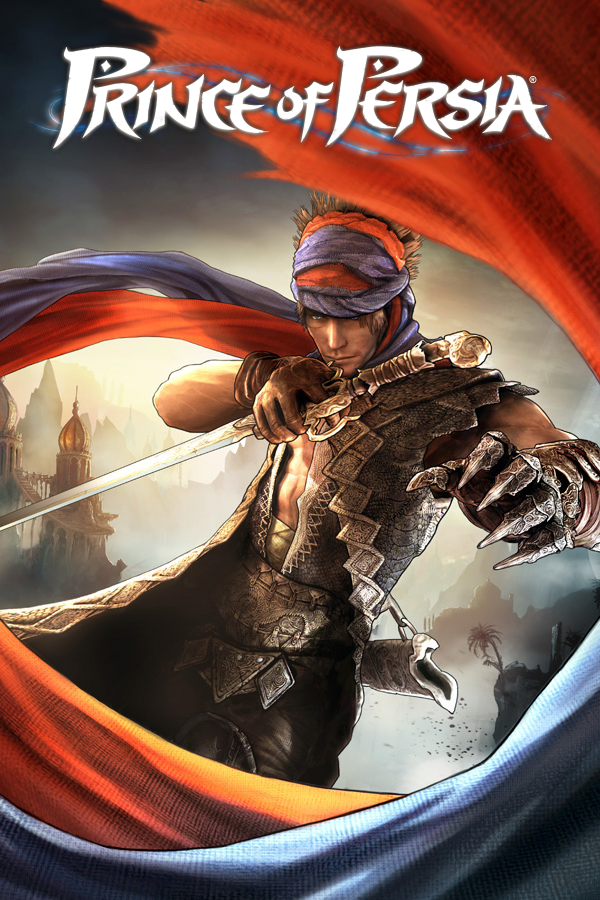
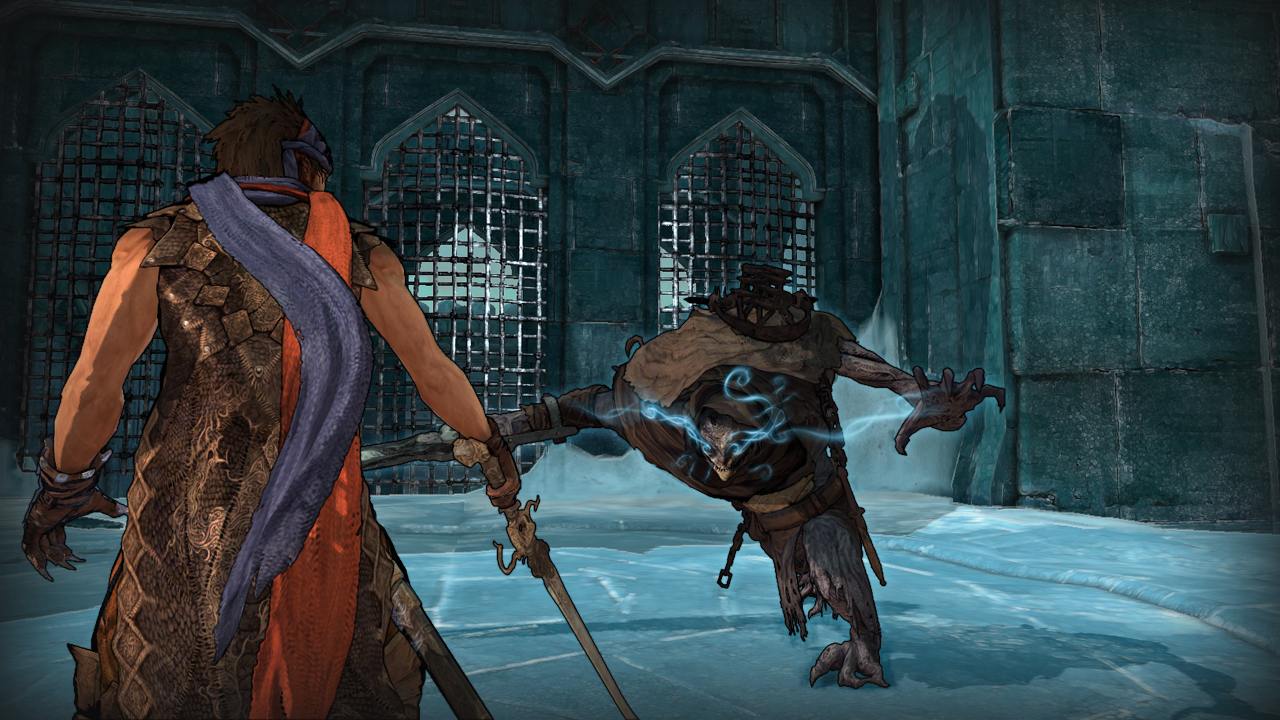
The PoP we are playing has a completely different story, and hell, the Prince isn’t even a prince; he’s a thief who wound up in the wrong place at the wrong time whilst running into Princess Elika. The Prince and Elika play major roles in this wonderfully made game, and it all actually works. The first thing I need to explain is that the core of the gameplay is like the previous PoP games, with the whole acrobatic aspect still intact. However, the prince now has a gauge that he uses to help him with all of this. The controls have been simplified so that everything is just one button press. Yes, let go of that analog stick because you just use it to point the Prince where you want to go, not guide him. He can run across walls, run up walls, swing around poles, climb on vines, shimmy across ledges, etc. The game controls so incredibly well, and with a few minor issues, you really won’t hate the controls. Another major change is that the game is open-world, so you can go anywhere you want in this huge world.
The point of the game is to stop Arihman from destroying the world with corruption and, in turn, save Elika’s father, Ormazd. While there are over 30 areas to explore, you can go to them however you want using the acrobatic moves. Yes, this can get tedious after a while because once you discover everything, you’ll have to backtrack to the temple to acquire new powers. These are four powers that are activated on various colored power plates on walls, and they are key to accessing new Fertile Grounds. Each section is a “mini-level” with various obstacles to cross, and just before fertile ground is a boss fight. Navigating the world can be a bit confusing in the beginning since you’ll be relying on a “compass” that’ll guide you to where you want to go depending on what area you select on your map. The point of healing for each area is to rid itself of the corruption killing that piece of land. Of course, you can’t touch this corruption, or, well, you don’t die in this game. Elika saves you if you fall off a ledge, so consider any flat ground a checkpoint.
During combat, you cannot die either, and you may think this is absurd, but it is a blessing. Trying to find light seeds (after you heal a ground, you go back and collect these to gain new powers) can be kind of hard, so you jump off a cliff to reach one, and if you fail, no big deal. This is better than restarting a level, but of course, if it’s open-world, you can’t technically restart a level. Elika is also a big part of your acrobatics because if you can’t reach a ledge, you press Y when you jump, and she’ll give you a boost. This is also true in combat, where she is basically your “magic” attack. Moving through the levels is fairly easy, and I didn’t once have to resort to an FAQ of any kind. The compass is a great way to find out where to go since it’s a little light that kind of goes along a path, and you can follow it. Of course, finding all 1001 light seeds isn’t necessary since you’ll find plenty to acquire all powers without having to hunt and search for each seed.
Now, when it comes to combat, you’re in for quite a treat since combat is very cinematic. Everything is “one-on-one,” and each enemy has a life bar that you may deplete. You have four major attacks: magic, acrobatics, grab, and sword. You can combine any four of these to make huge combos. Of course, corruption plays a huge role, so if the enemy changes status, you can only use a certain attack to break through it. While each character technically plays the same, you have to use time-button presses to fend off their attacks. This can make things fun and challenging at the same time. The combat is very rewarding with the dramatic sweeping camera angles and beautifully scored music. Of course, after a while, it starts feeling really old, but not enough to really bore you since it always keeps you on your toes.
If you want to talk about cosmetics, PoP is probably one of the best-looking games ever made so far. The game is just stunningly beautiful, and there are high perches you can stand on and just look out to this beautiful vista that is amazingly rendered in real-time. I don’t know how Ubi did it, but they pulled off some amazing stuff to get the game to look the way it does. The soundtrack is really stunning as well (even though there’s not much of it), and the voice acting is top-notch. You are really in love with these two characters, and they struggle with the world around them and with each other. The Prince tends to be a sarcastic, hot-headed wannabe hero, and Elika is a confused woman/goodie-two-shoes who is always putting the Prince’s fire out. There are so many amazing elements to PoP; you just have to play it to really know it all. With a great cliffhanger ending, a great way to control the ending, great controls, cinematic combat, and beautiful graphics, you will spend a good 10 to 12 hours exploring this world.
Everybody knows and loves Lara Croft from way way back in 1996, when she starred on the PlayStation as the busty, sexy British female adventurer that everyone has grown to love over the past decade. Tomb Raider: Underworld really expands off the recent TR games with better environments, more brain-bending puzzles, less linearity, and more moves than you can count. Tomb Raider has always been about exploration and finding the best route using the environment, and this is still the core gameplay element used. The story of Underworld picks off where Legend (read my review for that) ends with Amanda on the loose and Lara trying to find her way into Atlantis to find her dead mother. While most of the story doesn’t pick up until the very end, there is enough incentive to keep you playing and motivated to press on.
The main element I need to talk about is just how much more detailed this game is. While most of the problems still exist, they can easily be overlooked with all the new features and elements added to the game. The first thing you’ll notice is how much more real Lara looks, feels, and moves around in the game. It’s just amazing to see Lara push brush out of her way, move to and fro in 360-degree motion with her stopping and starting really quick, the way she climbs, the way she places her hands and feet while climbing—it all just looks so damn good and real. The best thing about this is that the controls are still responsive and, most of the time, will do what you want. When you are swinging around poles, climbing walls, or hanging from ledges, you can pretty much get where you need to go with minute problems from the camera and some iffy collision detection issues. A lot of times Lara will jump in the wrong direction because of the finicky camera; she’ll fall off an edge you know you didn’t slip from, but all these are easily overlooked.
Now that all the climbing action is still the same and hasn’t changed much, the new animations, better controls, and sheer freedom you have really make it feel fresh again. Still staying in the action, the combat is exactly the same as before, and this is disappointing. The developers seemed to have taken the slo-mo headshot element from Anniversary and mixed it with Legend’s combat, and you get what you get: Simple lock-on combat with dodges and flips that don’t really do much. While the camera keeps up with the action, there’s nothing much to do but shoot your heart out. You can, however, throw grenades, and this really helps in tight situations. With all of that out of the way, let’s talk cosmetics.
Yes, the game looks absolutely stunning and is one of the better next-gen games as of yet. Everything is just huge and detailed. The sheer scope of the levels will make your jaw drop and make you think, “How the hell am I going to get up there?” This doesn’t just include land; it is also underwater. You will partake in two levels where you are hundreds of feet under the ocean, and it will take a good 4-5 minutes just to swim everywhere. The game really leads away from linearity with massive scope in the levels, and this usually leads to treasure hunting. Throughout the levels, you’ll find silver vases or just objects lying around as treasures for you to pick up. These will unlock extra content when you beat the game, so you must keep an eye out for them. Thankfully, they are easier to get to and easier to spot than in previous TR games, so you can relax. There’s just something great about this game that makes it different from other TR games, and the only thing I can think of is its pure epicness. Running around (yes, they added a run button!) in a sinking boat with a beautiful, sweeping orchestral soundtrack playing in the background just wows you every single time.
The game really does a good job mixing up exploration with action, and it also helps build upon Lara’s character. She is wiser, knows more, is a lot older with bitterness in her heart, and is holding onto all she can to keep from becoming corrupted like the enemies of her past. You really see this and how calloused her personality has become since she is no longer cheerful and happy but bitter and angry, with powerful rage flowing through her veins. The game just becomes so epic and amazing in the end that you wind up forgetting about all the gameplay flaws, and you feel very satisfied in the end. The main reason for this is that puzzles really bend your mind in just the right way to make you smile every time you solve a puzzle that expands an entire level.
Underworld requires you to take everything in and divide it into chunks instead of just looking and solving. Most levels will have you going from room to room to find pieces of a bigger puzzle, and this is actually better in the end. A small feature added is the ability to choose your weapons at the beginning of each level and your outfit. This is really useful and lets you mix things up for multiple playthroughs. There are other elements added to the game, such as your Gauntlets, which let you move certain heavier objects around rooms, Thor’s hammer (which you get toward the end), which is a one-hit kill scenario, and not to mention all the cool gadgets such as better binoculars (it’s actually a DV camera), your grapple hook, etc. You also get your bike back, but this time you get to control where you want to go. In Legend, you just drove straight, avoiding things along a linear path, but this time you drove it around and even used it to solve a few puzzles.
Underworld really is for hardcore Tomb Raider fans, and newbies really won’t like this much unless they get hooked on previous games. With gorgeous graphics, a great ending to a great story, our favorite female protagonist, and a few gameplay flaws, you will have a blast with Underworld.
Legendary is yet another game this year that has been released and has totally let all of us FPS fans down, but what a surprise, right? FPS games are probably the most prone to failing terribly due to lazy level design, bad stories, bad physics, and anything else you put in an FPS. Unfortunately, Legendary does almost everything wrong and hardly anything right, but you can still squeeze a few drops of fun out of this weekend rental. Legendary puts you up against Pandora’s Box’s creatures that start taking over and destroying the world while trying to be controlled by the evil LeFey.
While the plot sounds semi-interesting, it takes a face dive right into a mud pit once you start playing since you don’t really give a crap after about thirty minutes. If playing the game is hard enough as it is, the mechanics the game is built around are totally slapped together and not very well done. Even when I saw videos of this game, I knew it didn’t look complete, and they actually shipped the game unfinished. First and foremost, the main culprit is the Unreal 3 engine. Now, I’m not bashing the engine at all; it’s just that many developers tend to think U3 will make the game for them, and they just have to tell it what to do, which is not the case. There are a lot of similarities to BioShock, in fact, from the animus powers shooting out of your hand (with almost exact animations) to the same glowy look on everything you interact with. While the game looks halfway decent, everything looks like it was copied and pasted into the game instead of built there. You’re wandering around a war-torn London and New York, and you don’t even feel like you’re there since the game doesn’t replicate the cities at all, not even famous landscapes for Christ’s sake! On top of this, the physics are way off, and everything seems to stick like glue or something, and it’s just really weird. There’s terrible collision detection where enemies will go through walls, stick there, and start flopping around.
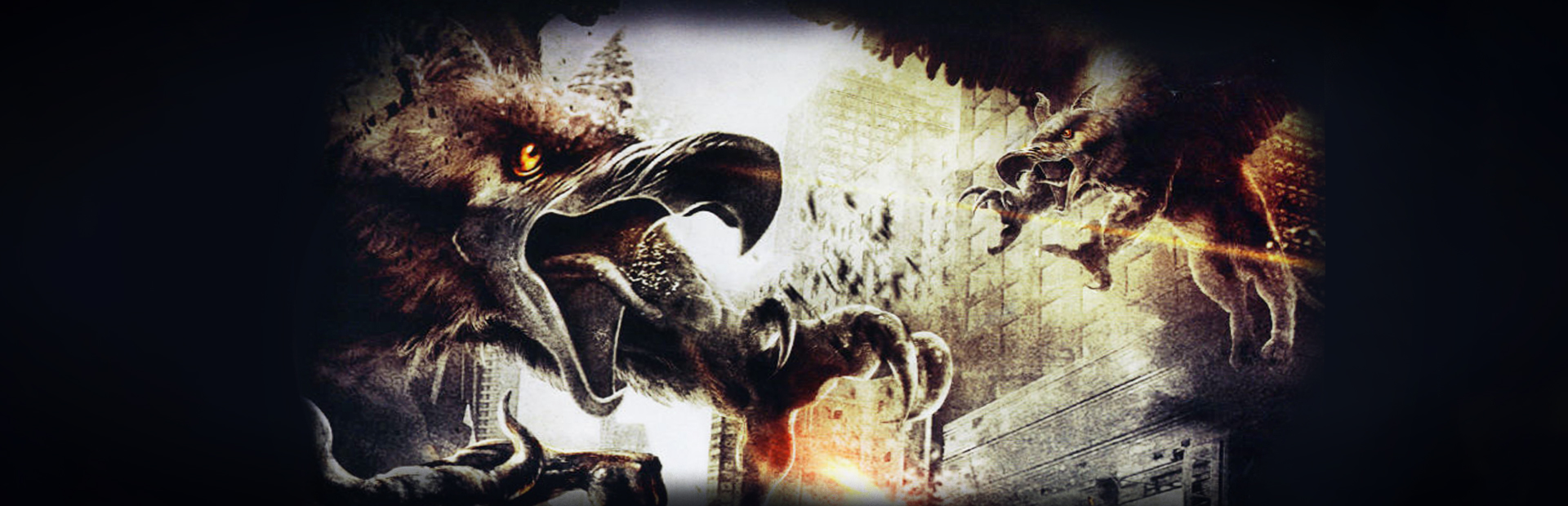
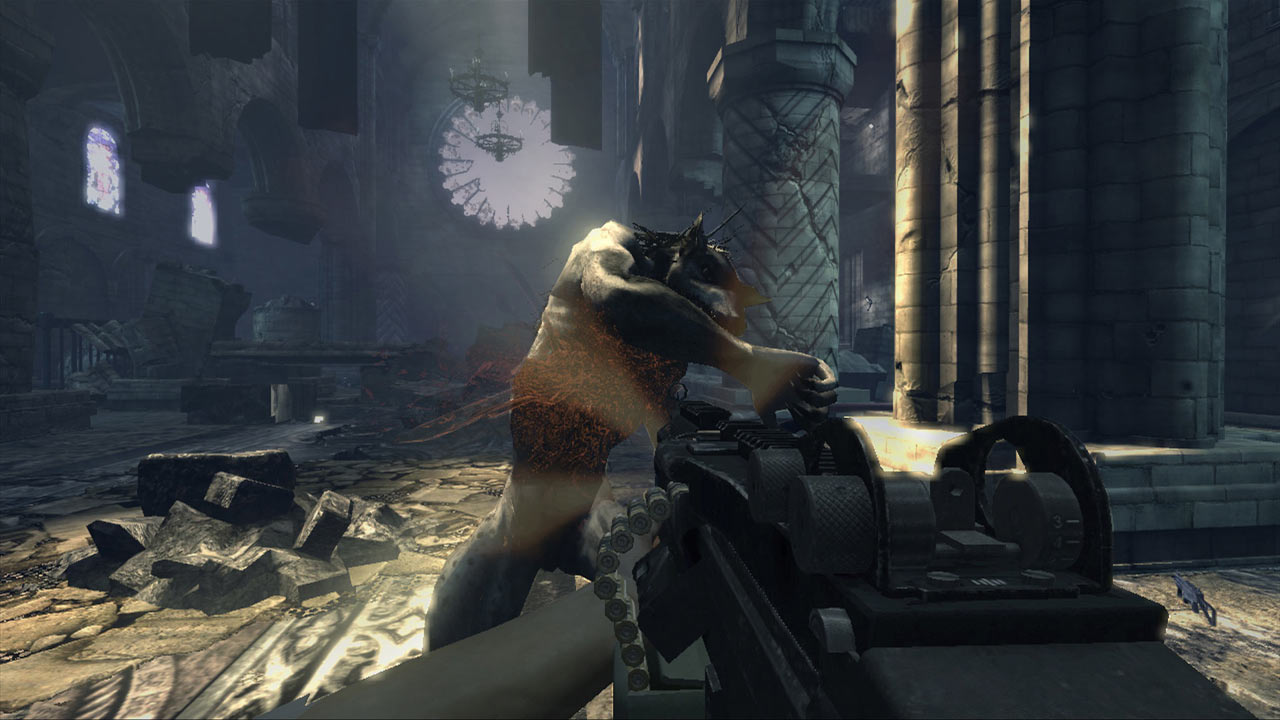
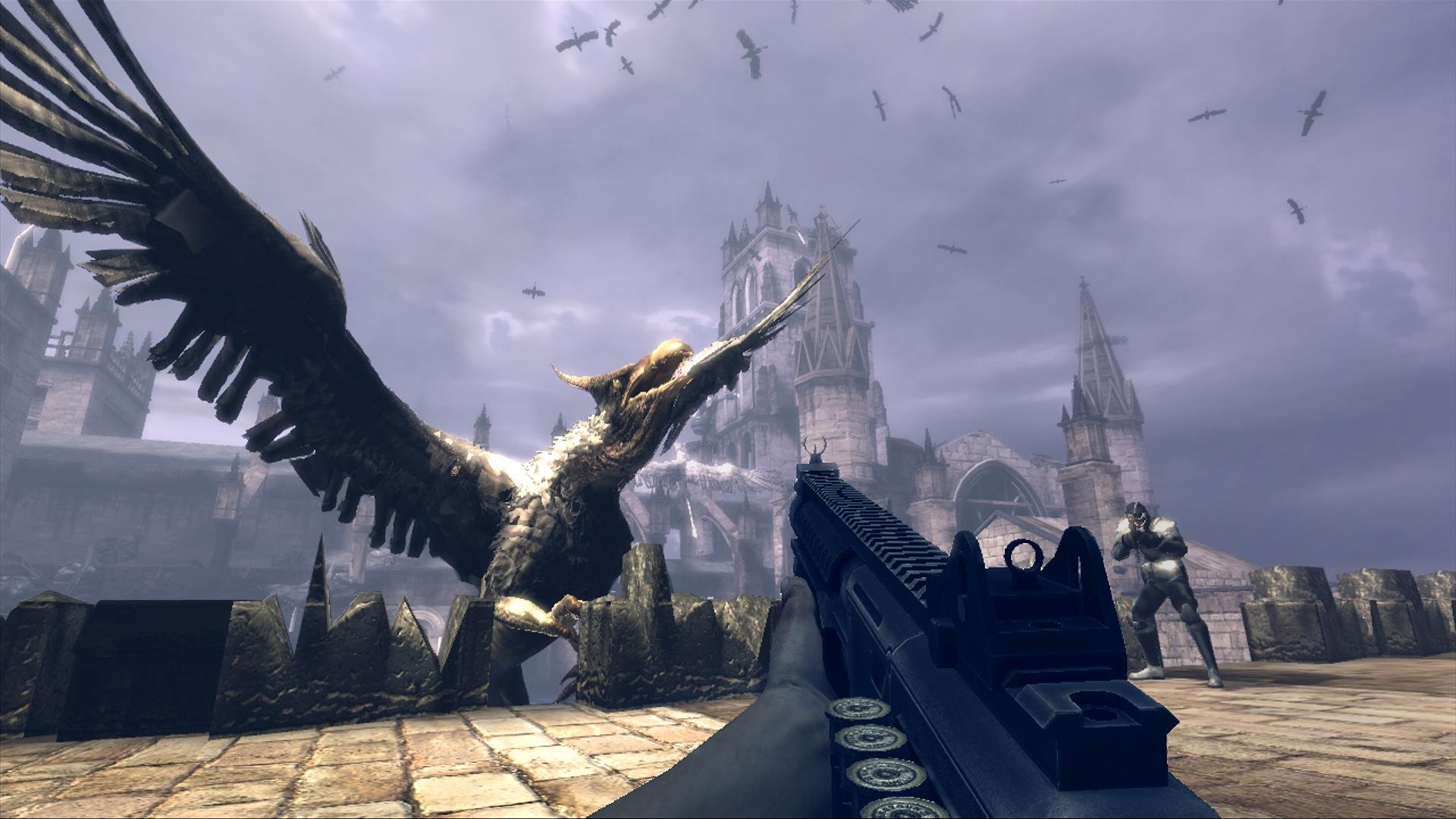
This is also coupled with cramped levels and linear levels, and everything just looks the same. Turn this wheel here, kill these creatures here, shoot these wire suspensions here, and bypass this keypad here. The game is very tedious, completely retarded, and put together so poorly. Even moving your character is a pain since when you get hit on one side, you stop moving that way for some strange reason, and I have no idea why. You’ll be strafing left and then get attacked by your left, but you just stop dead in your tracks, and you have to jam the stick left a few times before even moving again. The guns don’t feel powerful at all and are just completely retarded with almost no recoil; they are all standard, such as shotguns, machine guns, rocket launchers, and a weak pistol that does NOTHING. The most original weapon is probably an axe, but even the more powerful weapons take a while to tear down foes coming after you. The enemies are just absurdly difficult to bring down, even in the easiest setting. For some unknown reason, the weakest enemy (blood spiders) just swarms after you, and you have to find the sac holding them. Getting there can be a pain since this leads into the lame healing system. Other enemies range from werewolves, minotaurs, and griffons—you name it.
These are cool enemies and shouldn’t have anything go wrong, but it does anyway! They throw so many enemies at you, and you never feel powerful enough to take them down, so you’re constantly scrounging your health with the difficult healing system. You have this power from your hand called Animus, so you take Animus Clouds from dead creatures, and you use this for health. You hold down Y to take it, but it takes so long to absorb it all, and this is not good when you have a ton of guys shooting at you or creatures clawing at you. You hold down Y again to heal yourself, but as you can see, using the same button to heal and absorb is not going to work very well. When you’re near clouds, you absorb them instead of healing, and vice versa. If you double-tap Y (why are we double-tapping with so many buttons?) you can do an animus push to stun enemies, and this does absolutely nothing. Now, when it comes back to combat, you can’t use any melee attacks; there is no cover system. NOTHING, ZERO, ZILCH, SQUAT! You have to hide behind everything and peek out like a stupid old PlayStation game from six years ago. This makes things ridiculously annoying during the unbalanced levels that are badly designed.
This game just has so many things wrong that you wonder what there is to like. Well, it’s for the sheer epicness that the game seems to pull off with a 300-foot Golem, a HUGE Kraken you fight in London, and even the giant Griffons are cool to kill. If you can bear through this 6-7-hour campaign, you can find some fun in this game. With a different story, decent graphics, cool enemies, and lots of big bosses, you can have fun all at once. Legendary, this definitely is not.
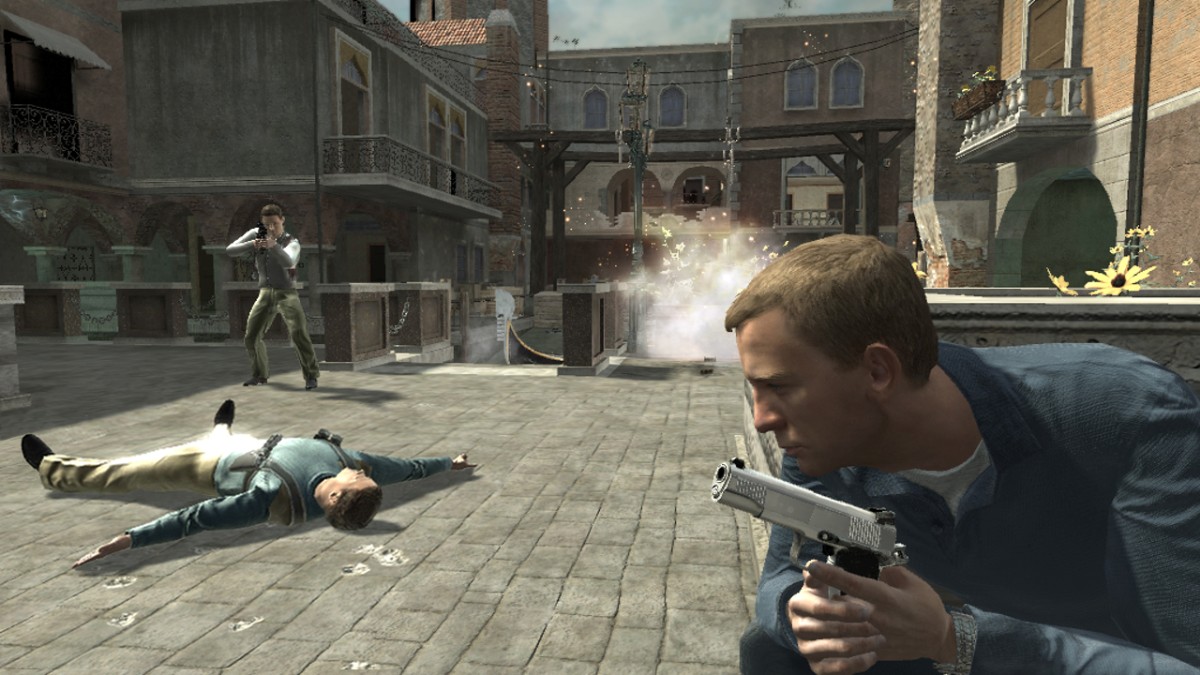
Well, here we are again sitting around the Bond fire (LAWL!), but seriously, who still likes James Bond after five different actors and twenty different movies? Does Bond ever age? Does he ever get a vacation without it turning into a firefight? How many mysterious foreign chicks does he need to bang before he realizes he should retire and get married already? Seriously, no one will be as good as Sean Connery, and Daniel Craig can’t even pull off Bond to save his life. This dude is a serious joke, but thankfully you won’t even care when you play this stupid yet fun game. This is one of those sleeper hits that has a retarded story and gameplay, yet you still finish the whole thing because it’s just stupid fun. Kind of like bathroom jokes; they don’t do any harm or good, yet they are still fun to say and laugh about over and over again. Quantum of Solace is like the bathroom joke of a sleeper hit FPS; you have your basic follow-up, and the punchline is what keeps you laughing. While you can completely forget about the retarded story about Bond and some terrorist dudes who are doing this and that I have no freaking clue and I don’t care, Daniel Craig has bits of his voice in the game, and his model has one expression that never seems to change.
While this game is seriously flawed, there are a lot of good things to keep you playing (rent it only!). The game looks really good; while not superb, it can pass off as an above-average next-gen game, which is a plus. Secondly, the game has super awesome guns, and they all feel really powerful. While they have more acronyms than a NASA space launch, you have your pistols, silenced pistols, submachine guns, sniper rifles, etc. While they aren’t anything new, they look cool, feel powerful, and sound cool, and they all go BOOM! You also have grenades, which are kind of retarded since you only get to carry one grenade at a time! The game actually has a semi-useful cover system that is both great and flawed at the same time. While you can sprint around and stuff, you can hit A to dash into cover (think Gears of War), and you have your typical blind firing and all that covering crap. The flawed part is that when you get hit by a grenade, you suddenly stand up. If you aim too far to your sides, Bond tends to stick his head out, and you can easily get killed this way.
Basically, the gunplay is your typical standard FPS stuff with retarded AI to boot. You’ll have swarms of guys coming after you, and they just stand there and let you blow them apart. Speaking of blowing apart, the game has an “environmental damage” system where you can shoot flashing objects to damage enemies (like we haven’t seen that before!). This actually does help when you have seven guys under a wooden platform full of explosive barrels. Shooting those support beams is just oh-so-awesome. The game is full of adrenaline-pumping sequences like your OMG!! button-pressing cutscenes (which are actually fun), and this is where you really feel like Bond, so that’s always a plus on the cinematic side. Since this is a Bond game, you can use stealth in a lot of the levels, but it’s very shallow and not implemented well. It really feels like an old PlayStation or an N64 game where you just hide behind a wall, dodge this camera’s spotlight, disable that camera, and shoot that guard. The cameras don’t even notice when you pop some lead into a guy’s head right in the camera’s view. I don’t know what the developers were trying to prove except for the fact that using old mechanics in 2008 doesn’t work too well.
A lot of times you’ll not know what to do, and you’ll blow your cover due to trial and error (again, a 10-year-old thing), and you have to restart all over again (if you want to stay stealthy). So, you can sneak around, but it feels really old and doesn’t really work out too well. Of course, you have to have some Bond moves to perform, and this is done by pressing the L stick and pushing the on-screen button and watching a 2-3 hit instant kill! While this is cool, the animations get repetitive. When the camera pulls back into first-person mode, you get disoriented since sometimes the game will flip you around, and it’s too easy to do. It’s cool sneaking up behind a guy and pulling off a Bond movie, but after about twenty times, you’ll get sick of it. Another thing I didn’t like was that there were no driving sequences. What’s a Bond game with no driving?! There is, however, a cool train sequence that is pretty cool, with you decoupling cars, jumping from decoupled cars, and just all that cool Bond stuff. While that’s the basic gameplay, you can see there is a lot missing that should have been in here.
With the mechanics feeling about 10 years old, this really drags the experience down, and after a while, the game feels more like a chore that you’re forced to play. Thankfully, the game isn’t very long at all since you can beat it in about 6–7 hours. The multiplayer is OK, but nothing super special—just your standard FPS online action—and you won’t be coming back for this often since the mechanics are somewhat flawed. I really loved this game, though, since there were a lot of explosions, shooting, sneaking, Bond moves, and cool locales. If you want an awesome weekend rental, pick this up, and you’ll have a blast.
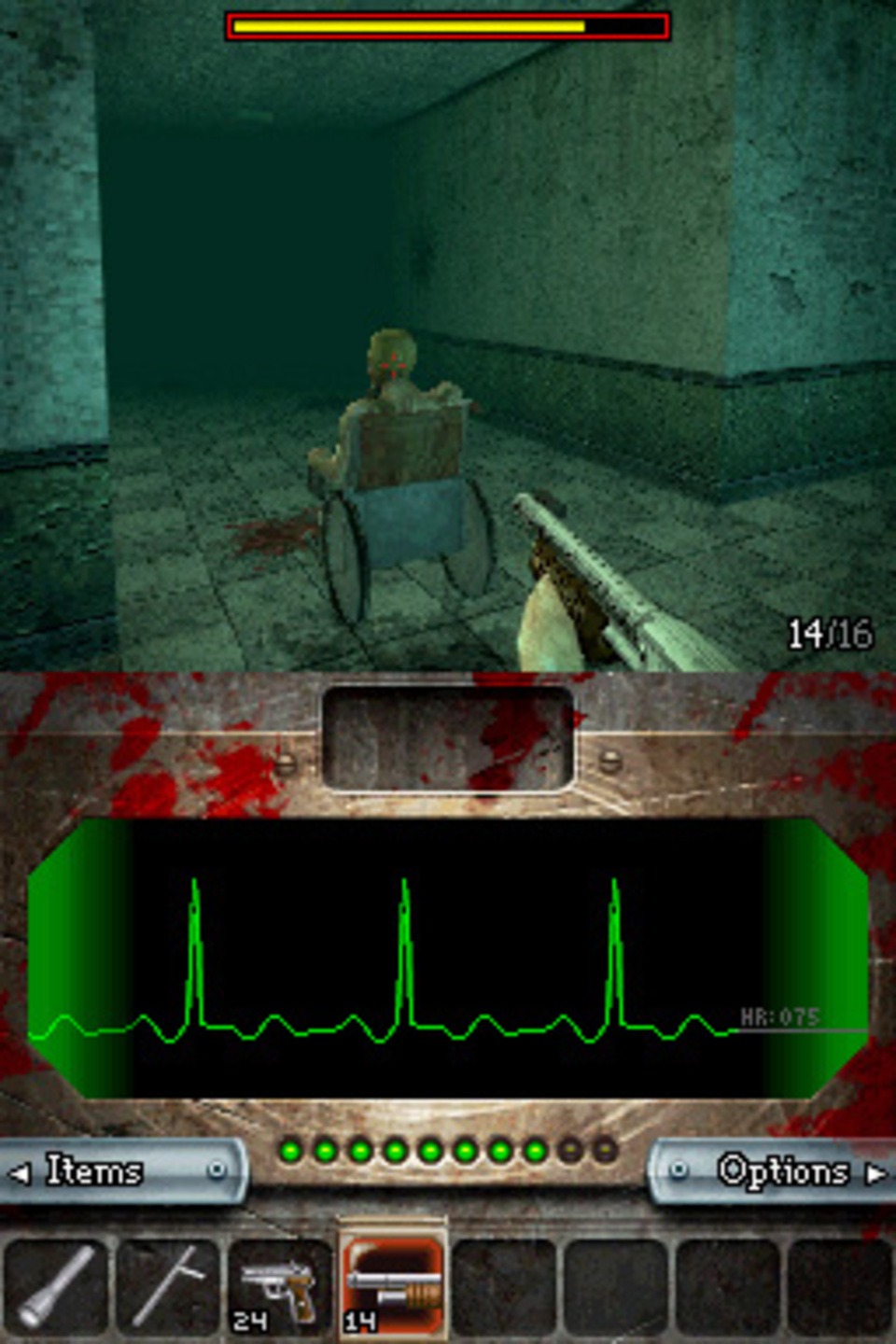
Boy, do I love this game? Actually, I hate this game and love it at the same time. This is probably one of the best-looking DS games out there right now. With this FPS survival horror running at 60 FPS, it’s fast, smooth, and very creepy. Yes, the game is actually creepy, kind of like Silent Hill creepy. The game is full of weird monsters, mind-boggling puzzles, and a creepy atmosphere and ambiance.
The game controls really well, but the actual size of the DS makes your wrists cramp up and go numb all the time. If you’ve played Metroid Prime: Hunters, then you know the whole setup, but if you haven’t, then I’ll tell you. You move your reticule around with the stylus, so this feels real and also makes things a lot easier (yeah, PSP!) while you move around with the A, B, X, and Y (if you’re left-handed) or the D-pad (if you’re right-handed). You have your inventory right under your health bar (which is your heart monitor), so you can just touch the weapons you want on the fly, and this makes combat easy and fast.
While the gameplay is pretty straightforward (double tap B or Up to run), you just run around shooting the weird monsters and solving the annoying puzzles. Yes, I said annoying because the hallways all look the same, and it’s easy to get lost in the labyrinthine buildings and hallways with a terrible map and no sense of direction. This is not good since your wrists are cramping and going numb while you hold them in 20 different positions. The map is just a bunch of lines with yellow dots for doors, and there’s no way to tell where you have been. You can write on your notepad and leave notes, but this proves useless for the map and only good for jotting down clues and codes for keypads.
The whole level design is just stupidly annoying, with fallen-over vending machines, desks, chairs, and anything else a hospital has blocking hallways and doors, so you have to find your way around everything. Since you lose track of where you were last, you’ll tear your hair out because of the retarded save system, and this kills the whole game. You’ll spend a good 20 minutes on one level and then die because there are 10 enemies coming after you and you only have 3 bullets. Dying forces you to restart the entire chapter all over again, even when you and the boss fight at the end of the chapter. I really tried loving this game since I absolutely adore survival horror games and I’m very forgiving with them (read my Alone in the Dark review), so I suffered through 5/16 chapters. The thing is, it wasn’t so bad until I picked up the game again four months later and realized why I stopped playing—the retarded save system.
I also really hate how ammo is so scarce in the game when there are so many enemies to fight off; this and the fact that enemies respawn when you re-enter a room means all the ammo you saved up for the boss is now spent on enemies you killed four times already. I don’t know what Gamecock was thinking, but they must not play survival horror games much. Survival horror games need to have really good maps, a way to save clues, no respawning enemies, and a good save system. The whole point is to “survive,” so you have to scrounge what you have around you. This game really shows how to NOT make a survival horror game, so please just consider this before even renting this game.
What made me actually want to like the game is that it looks so amazing and plays so damn well. The game is very creepy, with eerie music and spooky sound effects such as babies crying, water dripping, doors creaking, lightning, thunder, and rain pounding on roofs. The game is also very dark, so you need your trusty flashlight, and this is where the “Doom 3 meets Silent Hill” aspect comes in since you can only either use your flashlight or your gun. Since the DS isn’t very powerful, there’s a black “fog of war” all around you, so when you turn your flashlight off for some reason, you can only see two steps in front of you, but your flashlight can illuminate a 30-foot hall. This is actually a hardware fault and nothing on the developerspart, but you really don’t even notice it. The game’s monsters are very creepy, with zombies that have their chests open up and shoot poison at you, weird creepy things that crawl around the ceilings, nasty slugs that give out high-pitched sonic screams, and really freaky bosses that I can’t even begin to describe. There’s blood all over the walls, broken windows, papers, books, and whatever you can think of thrown everywhere, so the whole place feels deserted and you feel like you’re all alone.
I don’t remember much about the story, but I do remember that you wake up in a hospital and you are trying to find your way out, so it has a Silent Hill feel there. The game also has highly detailed textures and great lighting effects (as I’ve described), like lights (and your flashlight) flickering on and off, and there’s lots of detail in everything. Puzzles are solved by finding papers and clues as to where to find keys and codes, and even by solving certain random puzzles to open boxes, doors, etc. If you want an idea of what the puzzles are like they are exactly like the Silent Hill puzzles we have all grown to hate so you know what to expect. Overall, the game looks and plays great, but the punishing saves system, scarce ammo and health, maze-like hallways, and terrible map ruin this otherwise great survival horror experience.





































 thebinarymessiah.com
Try multiplayer. A lot of fun !