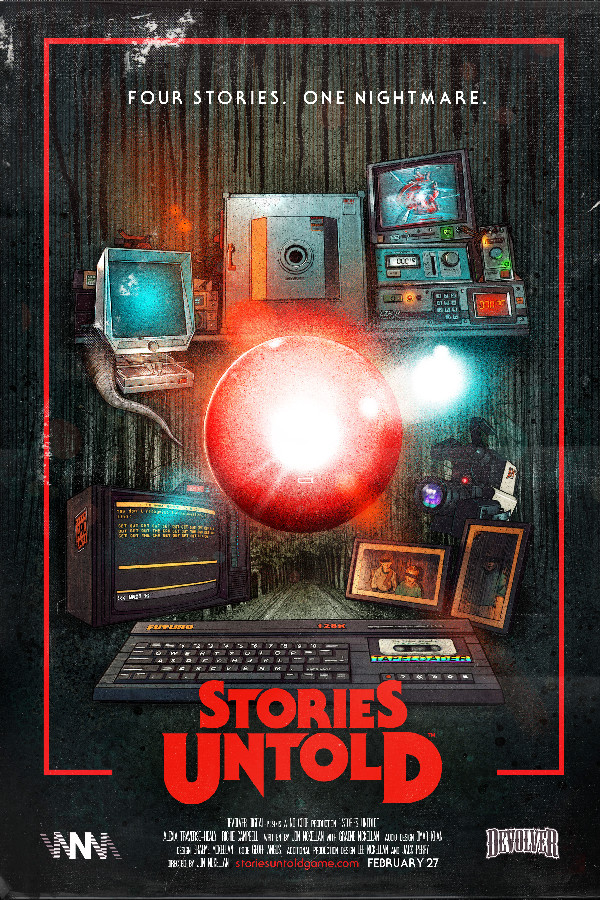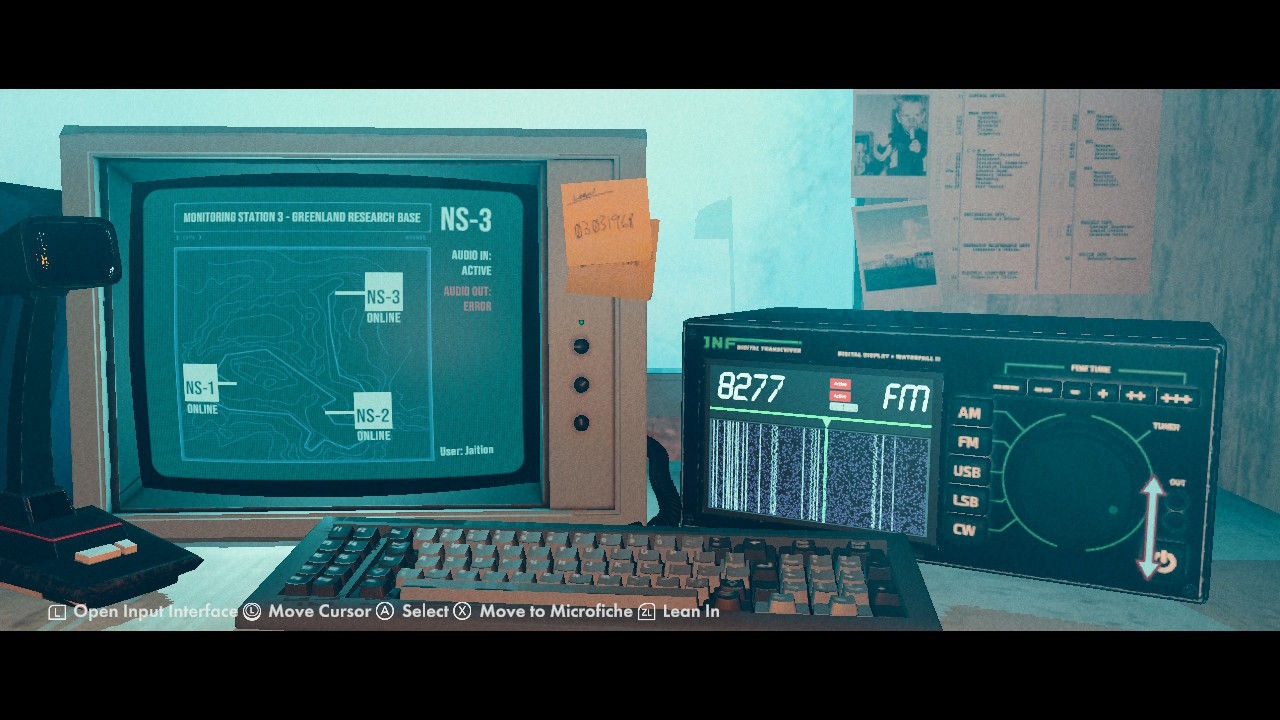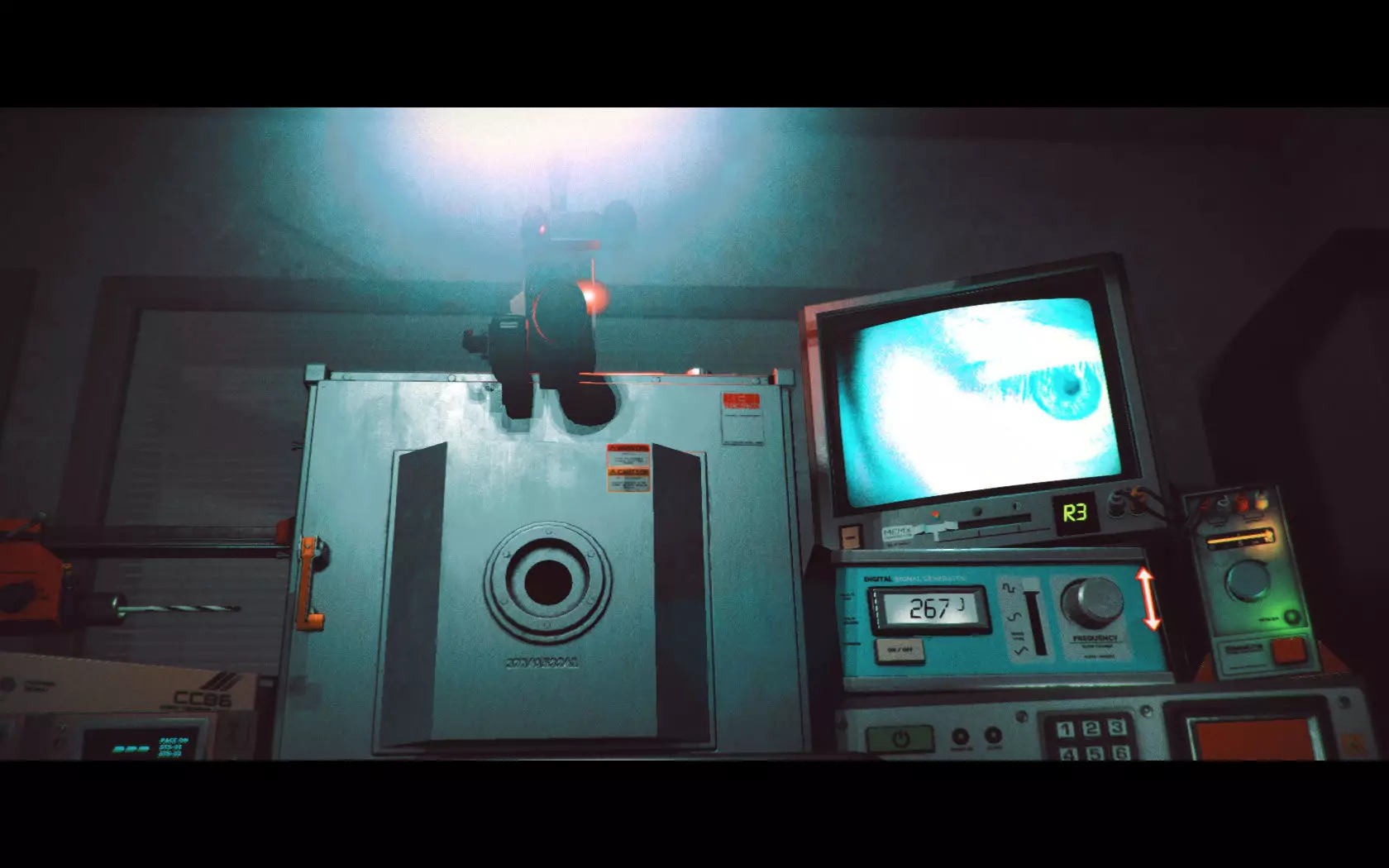
Adventure games, specifically text adventures, were some of the first video games ever made. These were similar to choose-your-own-adventure books, but you had a set of common commands you could type, such as “Go To,” “Open,” and “Go Back.” Some games were super strict with these commands, while others were more loose. You could pick specific objects in the current text on screen to interact with. These can be very fun, as they are as much a puzzle game as an adventure game. Stories Untold starts off this way, but with a twist. I’m hesitant to reveal the game’s premise as it could potentially spoil the entire experience. All I can say is that there are four short chapters, and they all involve interacting with older 80’s equipment.
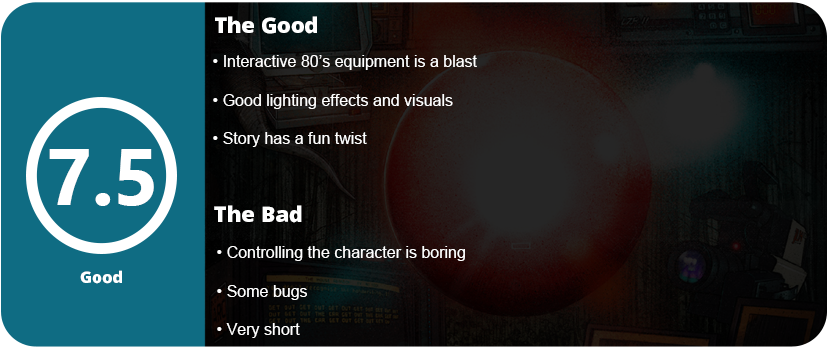
The game isn’t really a horror title, despite seeming so on the surface. It can be a bit unsettling, but there are no jump scares or ghosts. The game is full of puzzles to solve, but everything you need is right in front of you. You must tune radios, use scientific equipment, read the manuals for these devices, and follow the on-screen instructions. It’s amazing, and I had a lot of fun with these interactive pieces. I did find it a bit annoying when you didn’t exactly know what buttons you could interact with. In the second chapter, with all the science equipment, I encountered a bug that prevented me from turning on one of the boxes, forcing me to restart the game. Outside of these minor issues, the game has some decent voice acting and visuals, with some great lighting effects.
The first chapter’s 8-bit computer is quite convincing, allowing your typing to translate 1:1 with the sounds of a real 8-bit keyboard. Some will remember the CRT glow and the dark corner full of wood furniture. I never grew up with 8-bit computers as they were before my time (I started out with Windows 3.1), but for those who have, they would get a real kick out of this. My least favorite parts were when you did control the main character in real-time. There are two sections in which you do this, and it’s very slow, plodding, and uninteresting. I found the stationary parts to be more entertaining.
Overall, Stories Untold has four short chapters, and you can finish the game in about 3 hours, but it’s a lot of fun. I found the overall story and ending to be quite intriguing, and the development of the entire experience was commendable. The interactive objects and puzzles are clever and fun, but when you take control of the character itself, the game slows down too much.
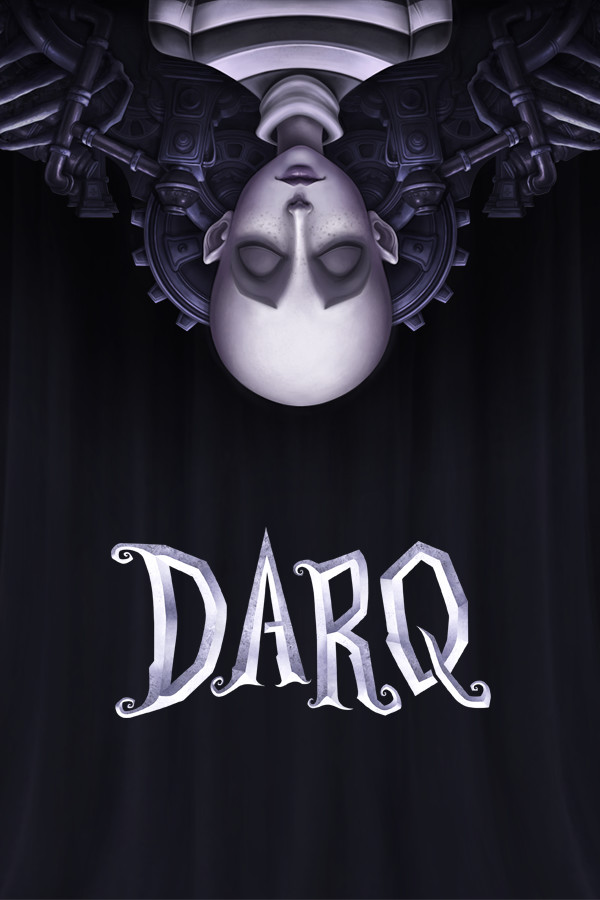
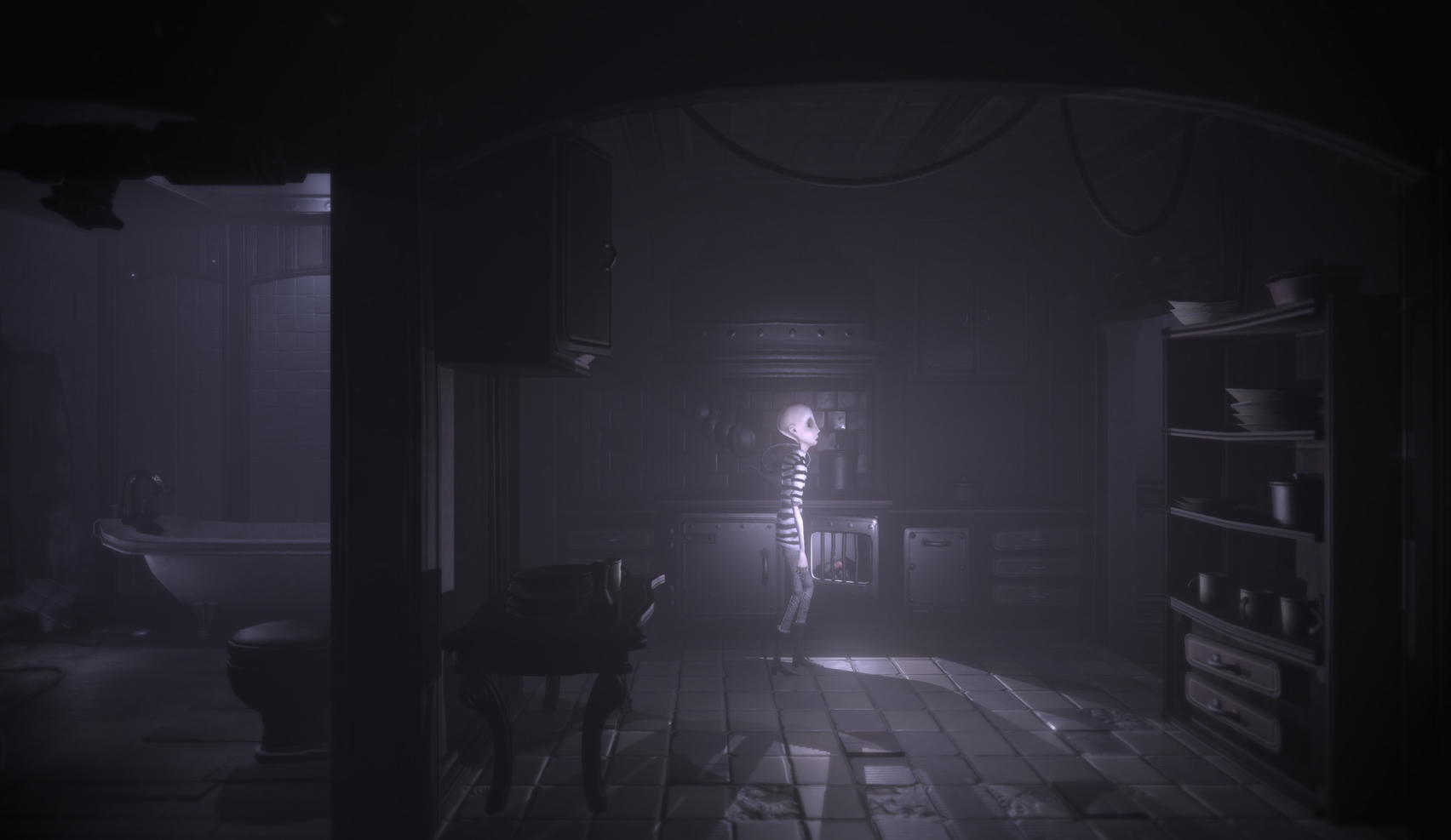
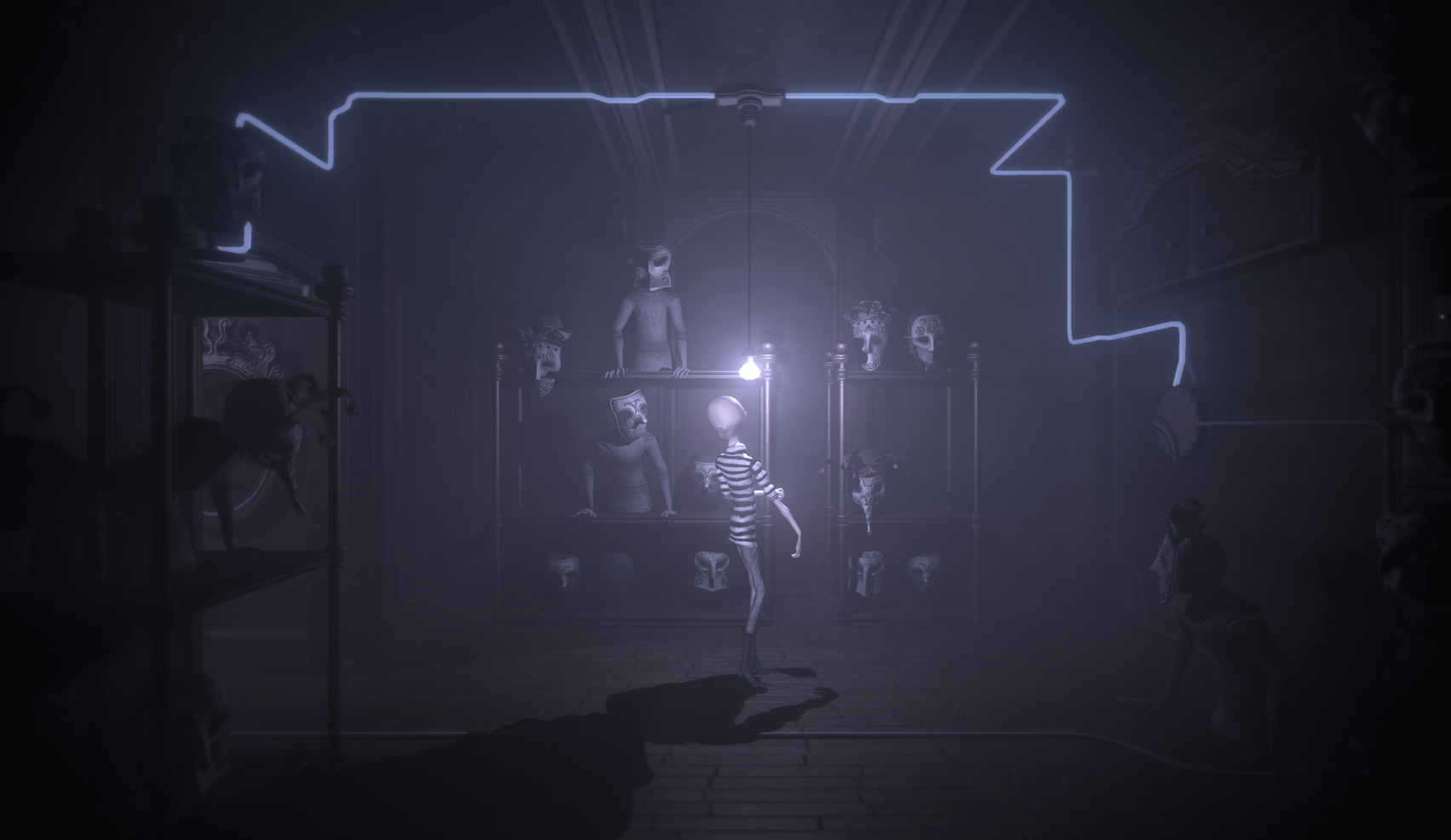
Minimalistic indie puzzle/platformer games are something I really adore. Limbo, Inside, Little Nightmares, Unraveled, and many others like it are just full of atmosphere, clever puzzle design, and great platforming. The issue with all of these games is the story. It’s nice to be minimalistic with no tutorials, simple controls, no cut-scenes, etc., but please guys, start making stories we can care about. Darq falls under the same problems as these before, with interesting character designs but no context. Why am I running around themed levels solving puzzles and running away from creatures with lamps as heads, creepy women in wheelchairs, and a guy in a wheelchair with a tuba as a head? Why am I placing severed legs into sockets to solve puzzles? What does this all mean?
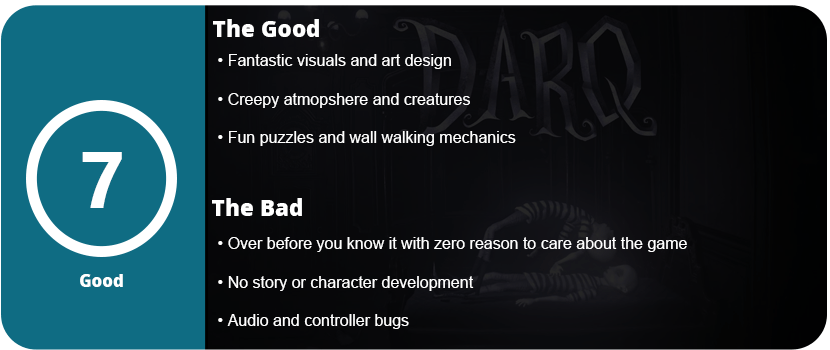
I feel like the meaning of the game would mean more than the game itself. Darq is only an hour long, probably the shortest of these minimalistic platformers I’ve ever played, and yet there’s no purpose to any of it. Sure, the concept of walking on walls, flipping and switching to shooting you between areas, and all the other puzzles are done very well and are quite clever, but why am I doing it? I don’t even know my character’s name; there’s not a single piece of written dialog, and all I know is that I’m waking up in a dream to solve these puzzles.
There are 7 levels, with one being a scripted running level, and they get progressively longer and more complex. By complex, I mean the game consists of “where does this piece go?” type of puzzling, and once you figure out where it goes, the actual puzzle is fun and not very hard. I had more trouble finding the pieces than solving the puzzles, and there was an occasional section in which I had to hide from an enemy, but it was only a single section of the level. Puzzles range from switch flipping, lining things up properly, twisting things, etc. Nothing Myst-level or extremely vague. You can mow through the game in 60–90 minutes and be done, but I honestly wanted more—now only more if there was a story or something.
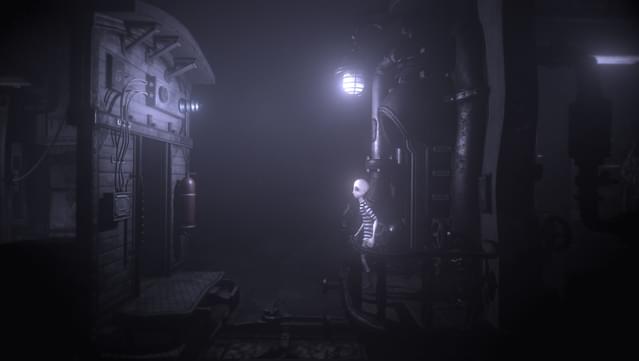
I found the atmosphere and art design to be rather fantastic. The main character looks like something from a Tim Burton movie, with everything in black and white and creatures that could fit into Silent Hill. The levels themselves range from a hospital, train, subway station, and four-way street in a neighborhood to a mine. Each level was unique and memorable, and I loved how you can walk on walls, as this game just worked your brain and really made you think, but everything made sense. There are no vague hints here; if you think it works, then it probably works. Each level can take about 10-20 minutes to solve depending on how stuck you get. I found the final level the most challenging, which is expected.
Again, the visuals are amazing, the art style is very unique, there are great monster designs, and the puzzles are well designed too, but why am I doing all of this? I’m tired of these indie developers thinking no story is some niche thing. Are developers catering to some pseudointellectual niche audience who think they “understand” these games or something, or are they just too lazy to design a story? Whatever the case may be, the flak “walking simulators” and other indie games that focus on gameplay and “story” over AAA bombastic scenes need to grow a little and maybe add a story and characters that we can care about.
I’m starting to see more and more games use Norse mythology and ditch Greek mythology. With games like God of War, Greek mythology was pretty much beaten to death in gaming, and ironically, with the new God of War, Norse mythology has made a comeback, and I also believe this has a lot to do with the Marvel Avengers movies. You play as a person who belongs in this Norse realm resurrected by a scientist, and you end up running around finding RFID keys, skulls, and upgrades for your arm.
Apsulov is a first-person horror adventure with a little bit of first-person action tossed in. This scientific base created around the World Tree is your main area, and all you know is that you’re supposed to gather these things for a scientist named Henrick. The RFID keys allow you to access new areas of the base, and sometimes you will travel through the roots of the tree to other realms. These few levels consist of mostly action as you run around, avoiding ice giants, to gather the keys to lock the gate to Helheim. Some areas require stealth as you have to avoid creepy enemies, and then when you get your arm, you can shoot them with a charged shot, but upgrades are needed to add more charge. This isn’t very useful at first, but later in the game, it becomes essential and then part of the actual story.
The atmosphere in Apsulov is pretty intense and scary, with fantastically done ambient sounds of people screaming, squishing, torture, and creature sound designs. I wasn’t so creeped out, but I was incredibly tense through most sequences. The base does become a bit disorienting after a while, as you actually do a lot of backtracking after the first half of the game is over, and you will need to enter areas multiple times. Towards the end, this gets really annoying, as you know you just went through this area and it’s either slightly altered or you have to creep past the same enemies again. I also didn’t like that when you die, you are brought to some room where you must insert two orbs into a socket to open a portal. The problem is that Loki is running around here, ready to get you, and once you pick up an orb, you can’t run. You have to sneak around trying to get these things, and if Loki gets you, it’s back to the last save point. If you get both orbs in, then you can pick up right where you died. It was a really strange system for sure, and I didn’t like it at all. Most of the time, I just opted to restart from the save.
There aren’t any boss fights except for the final boss, which is actually pretty fun and makes good use of the arm. I did feel more powerful toward the end of the game, and it made the ending pretty satisfying with an obvious hint at a possible sequel. I also didn’t quite understand the story until the last 30 minutes, when everything came together. The game is really bad at delivering pieces of the story until this point, and it makes playing seem somewhat pointless as audio logs tell you what’s happening around you but not what your purpose is. I wish this could have been spread out more, as the game only lasts 4-5 hours. I also felt the arm upgrades were useless as the ending changes the way your arm is used and all the upgrades are meaningless. Even if you got all the upgrades (I was short 2), it only allows one extra charged shot, and you still can’t take down more than that as you must find a charging station or charging pods to refill your arm.
Outside of these minor issues, Apsulov is an interesting adventure game that really uses Norse mythology well. I just wish it didn’t only matter in the final moments of the game, as the previous 4 hours felt pointless. I also never connected to any of the characters, as they just weren’t written very well, especially myself. The dialog is just a little sterile, and when the game ended, I knew I would quickly forget about this game in a few days. The story isn’t even all that great, despite making sense towards the end. With constant backtracking and a shooting mechanic that just doesn’t feel right, Apsulov falls a bit short of becoming a sleeper hit or even game of the year material, but adventure game fans will love this.
Publisher: Remedy Entertainment/Microsoft Game Studios
Developer: Remedy Entertainment/Nordic Studios
Release Date: 02/16/2012 (PC), 05/18/2010 (X360)
Available On
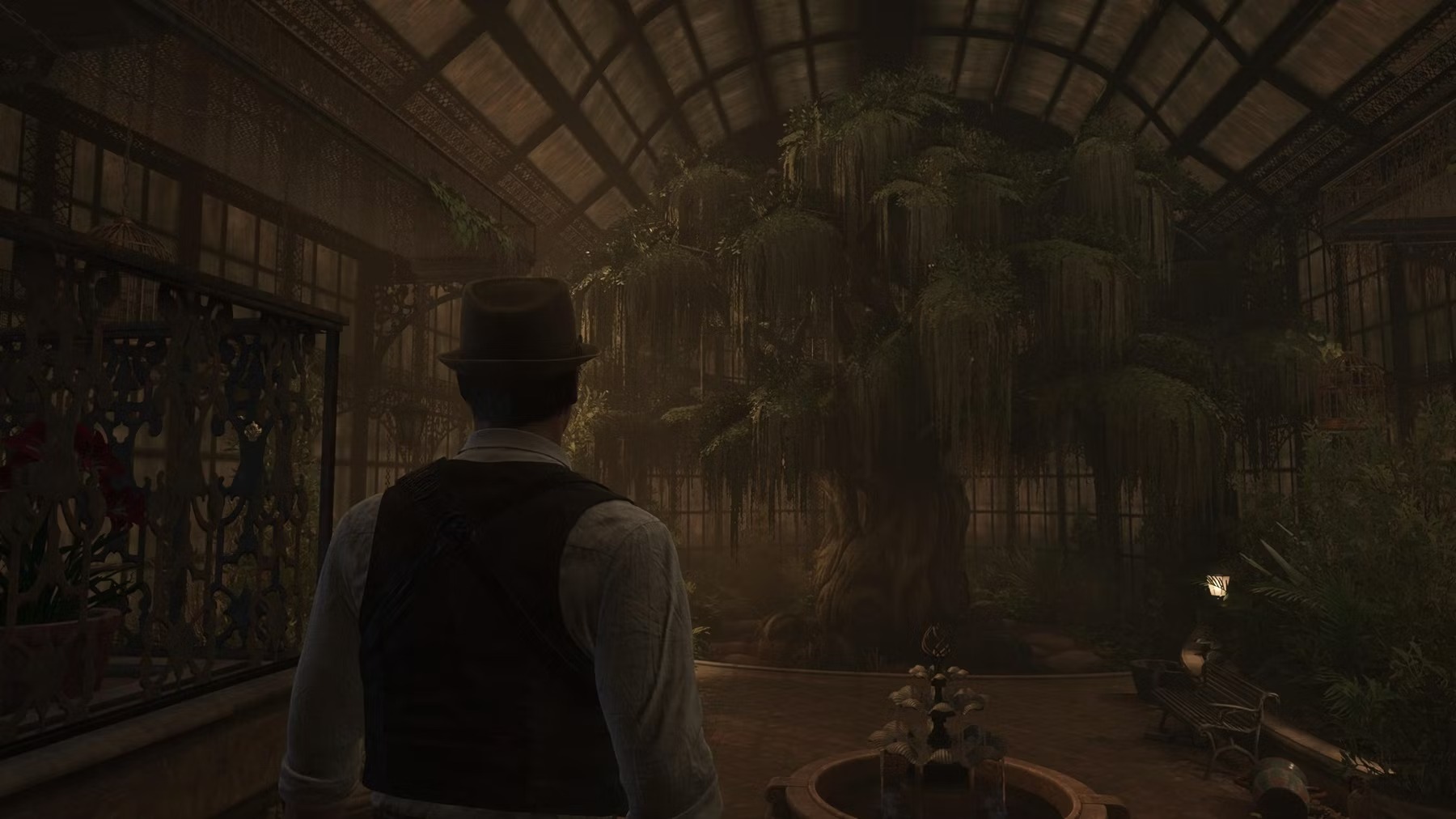
I always come back to Alan Wake every few years because it’s just such a good game. Great combat, storytelling, varied gameplay, well-written characters, and an overall solid experience. Almost a decade after the original release, I went ahead and played through the PC version again, and it’s held up surprisingly well. Despite its graphical age, it feels like it could have been released yesterday.
You play Alan Wake, who is a writer who takes a vacation to the Pacific Northwest in Washington and stays at a cabin in Cauldron Lake. Alan has a scuffle with his wife and wakes up—not really himself or anything around him for that matter. Without spoiling too much, the story revolves around darkness and always wondering whether what’s happening to Alan is real or if it’s all in his head, as you will see major story landings in which this question comes up. Even at the end of the game, this is never really answered, and maybe it’s best to leave the player guessing a little.
The story is well told and might take a couple of playthroughs to get everything, but it does keep you pushing through the 6-hour story until the end. Characters such as Barry, Alice, Sheriff Wheeler, and even the doctors and radio station host are all just so well written and memorable. Other story tidbits include finding manuscript pages, watching live-action episodes of “Night Springs,” clearly inspired by “The Twilight Zone,” and finding radio station bits by finding radios. It’s nice to see the story unfold outside of cutscenes, and it really gives you an insight into what’s going on in Bright Falls outside of what Alan is doing. The whole premise of Alan Wake feels special to me, as I originally played it while living in Southern California and not really caring where it was set. Almost ten years later I now live in the PNW just outside Snoqualiamie, WA where the setting was inspired. It’s awesome to personally experience this setting and then come back to the game; I appreciated it so much more.
The main gameplay elements here are your flashlight and guns. Light plays a huge role in this game, as the story is centered around it, and your flashlight is a weapon. You can boost the flashlight beam, and a circle will get smaller on enemies, and once the circle is gone and you beam away from the darkness, they become vulnerable and can be shot with the gun. There are easy and hard enemies, a few fast ones, and inanimate objects that become enemies later on in the game, such as boss fights with harvesters, cranes, trucks, and barrels. It’s interesting how the combat is designed, and you have to be afraid of everything around you, even birds! The use of the flashlight and guns is just so well done, with great controls, and the guns feel satisfying to shoot. You always have to be on your toes, and every gunfight is never the same with limited ammo, no flashlight, and sometimes tons of ammo to make you feel powerful. There are even lights in the environment you can use to take the car down, such as spotlights, floodlights, and headlights on cars in the few driving sequences.
The game, however, is extremely linear, and you rarely get to stray off the beaten path. These are only seen in the car sequences, where you can stop at a house or two to find collectibles and then continue on. Despite this, the heavily scripted events are fun, there’s so much variety, and the pacing is spot on. Going from chaotic dark forests to a New York apartment and then to the psych ward and even a cafe is a nice touch. It lets you breathe.
Overall, Alan Wake is one of the best games of the Xbox 360 generation, with fantastic character dialogue, an interesting story, and fun gunplay with variety in level design and great pacing. The PC version adds DirectX 10 lighting and features such as ultra-widescreen support, a FOV slider, slightly better textures, and character models. Overall though, the textures still look really muddy, even during its release, and there are obvious LOD and draw distance issues with pop-in that the PC didn’t need to experience.
I love horror games set in space, as it’s probably the most unknown part of life that we know, the most isolated, and can be quite scary. Observation forgoes the aliens, monsters, and ghosts and literally gives us an enemy that is the unknown incarnate. You play as the AI of the space station observation, and you help out crew members trying to unravel the mystery as to why their space station broke down.
Playing as the AI itself is rather cool and something completely different in an adventure game like this. You control cameras in a couple dozen sectors of the station as well as a sphere that you can move around in freely. The sphere is not where you spend most of your time in the game, but rather flipping through cameras, downloading data, and solving puzzles. It sounds odd and confusing, but the game really opens up with fun puzzles and an incredibly tense atmosphere.
The entire goal of the game is to follow the objectives the humans give you, which can range from scanning systems to locking down hatches. You can download audio logs and scan documents found on walls throughout the ship for extra story insight, but it’s not as easy as that. Each module in the station has 2–3 cameras, and they have a limited viewing range. Most stuff comes from laptops, which require you to add them to your link list by pressing three random buttons that come up or turning on the power socket near them. These contain schematics to open doors, audio logs, and sometimes hints. Your SAMOS has a map of every module, and you can switch between cameras here as well as check various systems throughout the ship when an objective allows it.
It seems kind of lame on paper, but the execution of making what you can do as limited as the AI or a computer can be is just so fascinating to play with and explore. Being an AI that can see what goes on with these humans and you can’t do anything for them makes for some great tension and puts the entire story into another perspective that really hasn’t been explored all that much. I feel if this game were played normally as a human, it would have been boring, but whole new mechanics open up and require you to think differently. While the objectives change frequently and most things are only done once, they are fun puzzles that require a little bit of thinking and reflex. One of my favorite things was going out into the sphere and exploring the space station in space. It was such a cool moment to see that, as most games put you in a fighter jet, space just doesn’t look so big and empty. There’s very soft music and little ambiance, so it’s just you and the station in this big empty void with a planet below you. Subtle things like this can really boost a game’s cool factor.
The visuals are pretty good, but the animations are really awkward, animatronic-like, and kind of creepy. The voice acting is spot-on, as I felt the character’s pain and sadness through their voice, so it really hits home. My only big complaint is that the game is 4 hours long and the story has too much of a cliffhanger. The story itself has a lot of plot holes because we never know why the station was attacked, what these beings are, or why they want the people in the station. Without spoiling the story, the ending is just a big, “And that’s it?” but it does leave room for a possible sequel…maybe.
Overall, Observation is one of the standout games this year due to its tense atmosphere, great voice acting, and overall unique gameplay mechanics that really feel fresh. I wanted it to last longer and I wanted the story to be more fleshed out, but what we get is something really memorable and unique, but sadly, most people won’t play this because it’s an indie game and these don’t get pushed like they should.
The plague was a devastating disease that wiped out millions in the medieval era. It’s uncommon to see a disease revolve around a game’s story, but A Plague Tale does it wonderfully. Full of adventure, sadness, excitement, and little hope, Innocence does an amazing job of making you care about its characters and world.
You play Amecia de’ Rune, who is a girl of royalty. She goes on a walk with her dog and father in the woods, and, well, I don’t want to spoil a thing here; bad things happen, and she must suddenly flee her home. The entire game revolves around trying to find a cure for the plague and her brother, who has a mysterious disease that may or may not be tied to the plague itself. Amecia and her brother Hugo are fantastic characters and I was glued to my screen and played through the entire game in one day. I wanted to know what was next, and the great stealth combat is some of the best I’ve played in the last decade.
The game is a mix of stealth combat and cut scenes with just some exploring. The game is highly linear, but the combat areas become more open later on in the game, with multiple ways to get through enemies. The main focus of combat is fire and your slingshot. This sling can be used to whip rocks at enemies’ heads to kill them, but doing so around other guards will alert them. At the beginning of the game, you will just toss rocks at metal to distract guards and use pots to lure them away. You aren’t killing too much during the first few chapters of the game, and this is okay. The game slowly adds new ammo types, various ways to combat rats, and new ways to use fire.
Soldiers and rats are your enemies in this game, and the rats are the most deadly. Outside of hiding and working your way around enemy soldiers, the rats are completely afraid of fire and light, as it kills them instantly. The game has some sort of “rat” engine as thousands appear to scream and swarm around like bugs, and it’s rather disturbing to see at first. Various forms of fire will light your paths, such as sticks that burn quickly and are used to solve puzzles, haystacks, torches, braziers, and various light sources. Some areas are puzzles that require you to light your path through rats, and towards the end of the game, you can use the rats against soldiers since your ammo allows you to put out fires and not just start them. I won’t give away the combat types in the last 4 chapters, as this will spoil a lot of the story.
What makes the game so great is not just the story, amazing voice acting, and characters, but the combat unfolds so slowly throughout the game, and each combat scenario is different from the rest, that you want to keep playing. The game never gets boring, and the environments are constantly changing. You also get to upgrade your sling with more ammo and faster reloading and aiming, and this is done by looting materials throughout the world. You can find workstations, and later on, you can acquire an upgrade that allows you to do the upgrades without a station. You can also craft ammo types, which are essential for getting through the game. Towards the end of the game, you must think and really know your arsenal and various ways to get through combat areas are available that allow you to sneak or fight.
The game also looks amazing, with gorgeous vistas, amazing models and textures, and superb lighting effects. For an indie game, this is one of the best-looking games this year and even has great controls and a good camera. Even having to have Hugo tag along with you all the time doesn’t get in the way. He’s always holding Amecia’s hand; you never have to leave him to go do stuff and make him come back like in other escort-style games.
Overall, A Plague Tale is one of the best games released this year and has everything going for it. It never got boring and was just so much fun to play through and I always wanted to know what was coming next and see Amecia, Hugo, and their friends make it through to the end. Sadly, with this being an indie game, a lot of people are not going to play it, and I really hope to see more from this studio.
Resident Evil has been more about tense action, inventory management, and puzzles than horror. RE3 polishes up the already not-so-smooth gameplay of Resident Evil and ports it over to the Dreamcast to make another buck off of it. RE3 doesn’t really have much of a story, but the tense action, puzzle-solving, and always-looming Nemesis boss make this one of the tensest games of the era.
You play as Jill Valentine (the star of the first game) and are back in Racoon City this time to try and find out what happened during the outbreak. Being a direct sequel to the second game, you visit a few familiar areas, and some Easter eggs are tossed in. Outside of running around collecting ammo, healing items, documents, and various things of that nature, you solve puzzles and mow down armies of the undead and genetically modified. New enemies crop up that are freaky and challenging, and the only boss in the game is Nemesis, who is a tough monster, and choices are thrown into the game depending on where the story goes. These choices impact where you start in locations and how you approach fighting the Nemesis. One choice kept the Nemesis from chasing me around town, but I was going to have to fight him early on. You can totally avoid fighting him in most cases, but he becomes stronger the less you fight him.
I honestly recommend playing this game in easy mode the first time, as you get tons of healing items and weapons at the start, as well as infinite save ribbons. This mode should be used first for another reason, and that’s to learn the layout of the game. Resident Evil is a game where enemy location, map layout, and puzzle-solving are a must before attempting harder modes. Now with all that said, I do find earlier Resident Evil games tough outside of just combat, as without a guide you can get lost and frustrated quickly as puzzles are obtuse, and there might be objects you saw hours ago that you have to go back and get, such as the Downtown/Uptown maps in this game. It’s imperative to write things down if you don’t have a guide, as you will run around for hours trying to find that one item that you can’t remember.
The story and characters are nothing special, but the voice acting is surprisingly decent for its time. We don’t learn much about Umbrella outside of someone going in and trying to pop off the supervisors throughout the city and cover up the T-virus outbreak. There’s no character development or anything like that, so you’re mostly paying for the action. The visuals are rather nice, but at this point, the pre-rendered backgrounds were getting tiring. The Dreamcast version is a slightly smoother PlayStation version, but there’s not much of a difference. I would have liked to have seen more modes, better visuals, and new content for a new $50 release, but what we get is mainly for newcomers.
I highly recommend RE3 on the Dreamcast. At this point, this is the definitive version of the game and the best the series has to offer up until this point. Don’t expect a deep story; have a guide ready, and you’ll be in for a good 8–10 hours of intense action and fun.
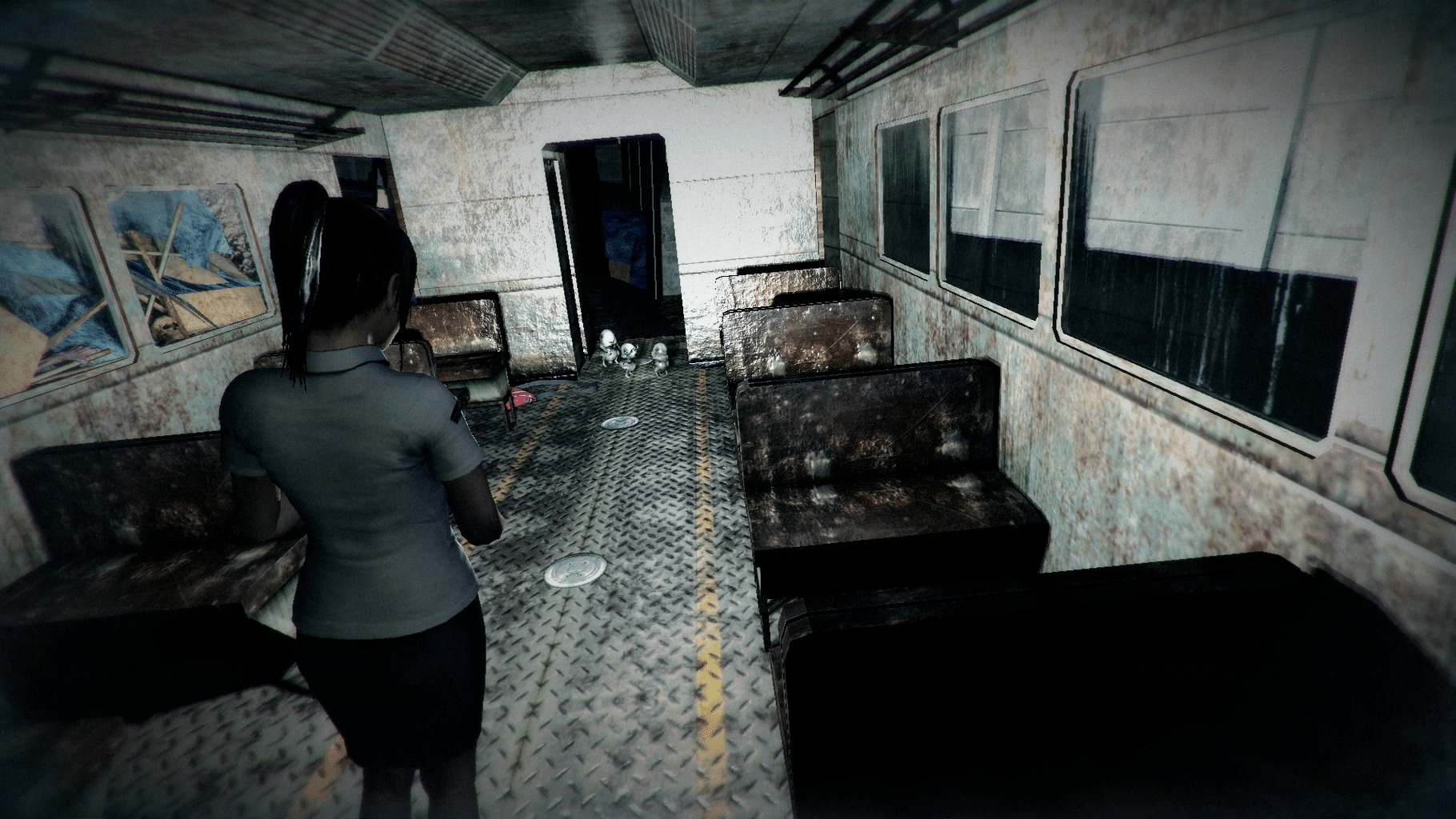
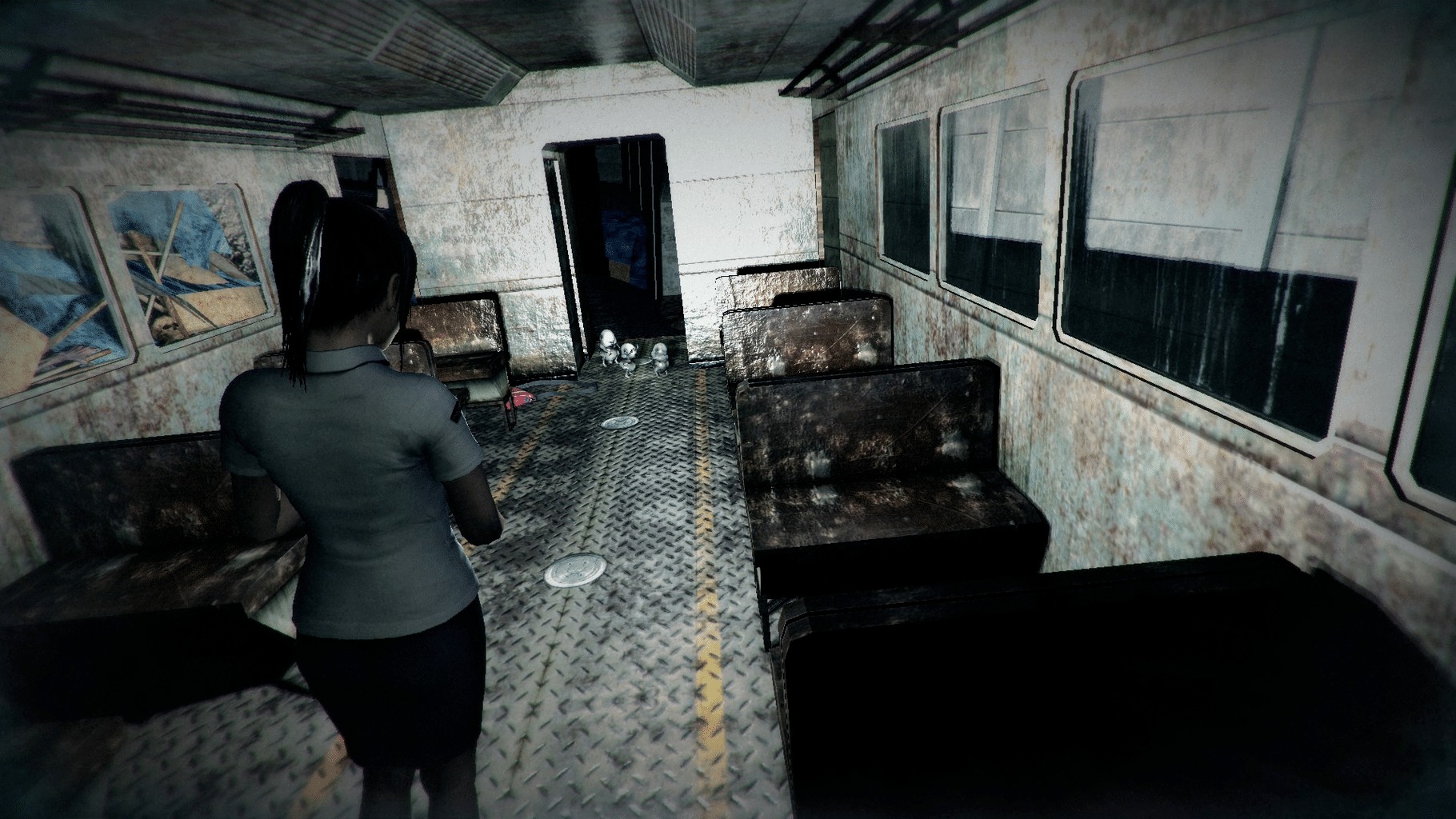
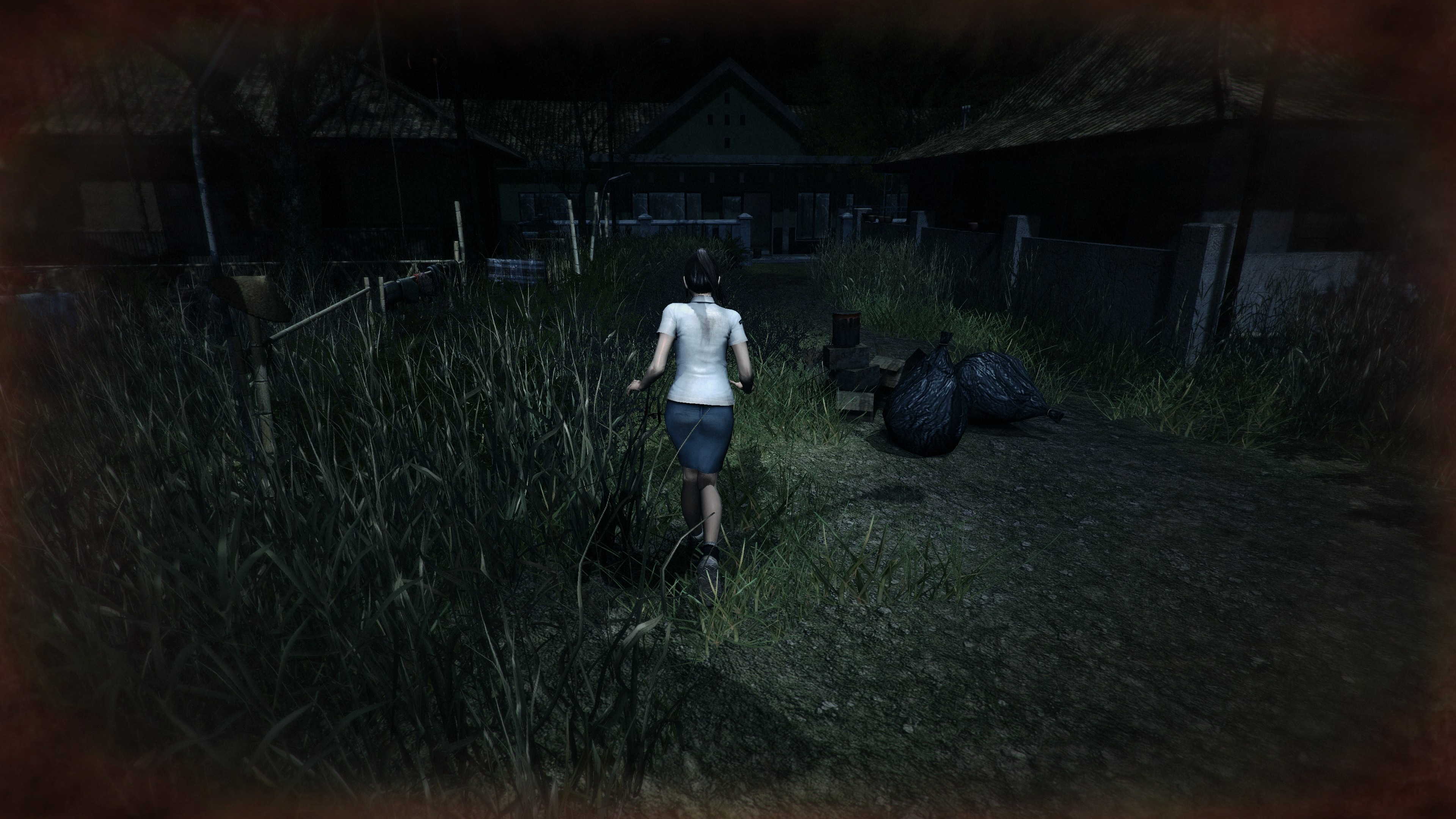
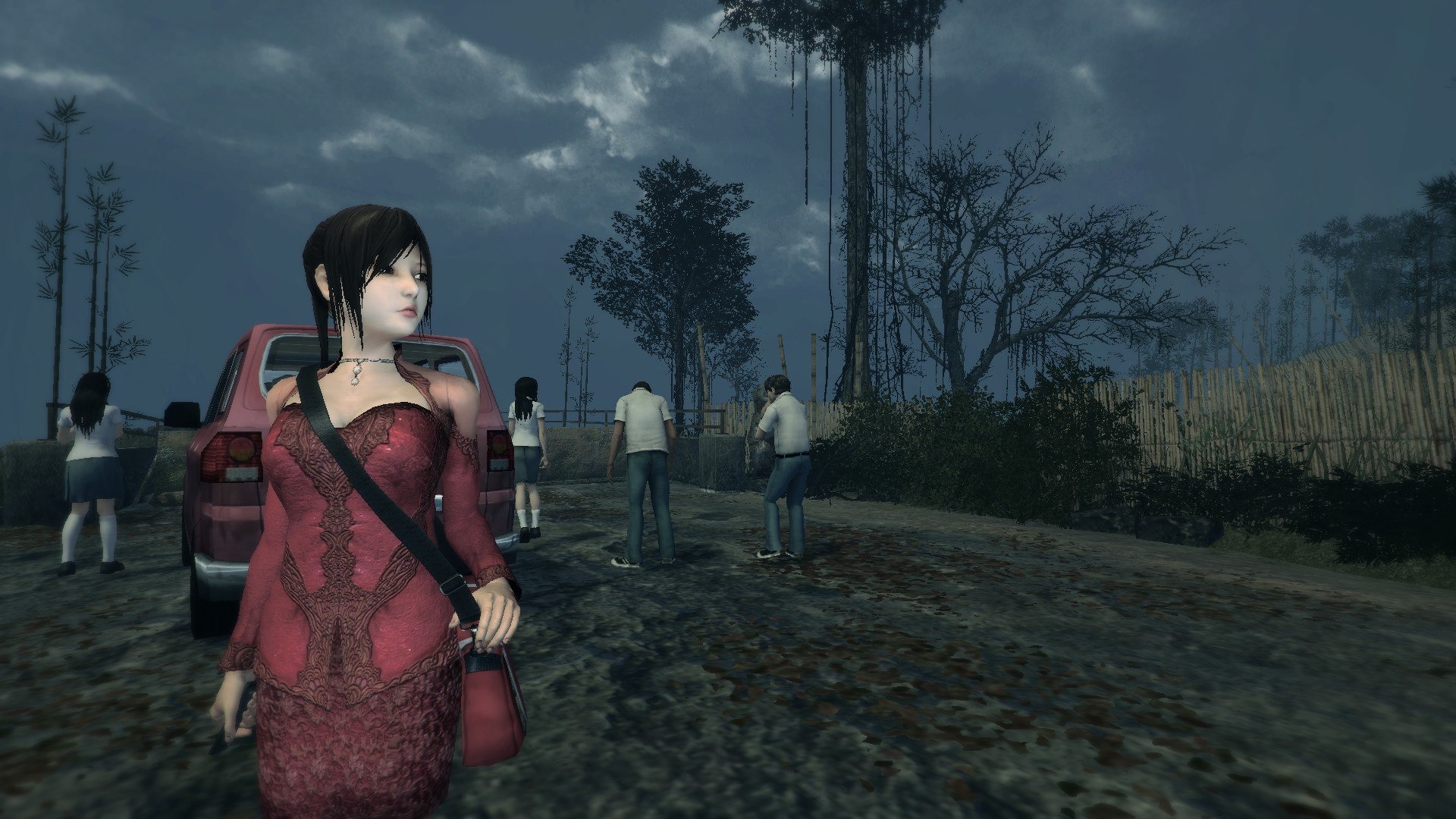
D was a strange FMV-based game for PlayStation that didn’t get much attention or very good reviews. D-2 is a spiritual successor to that game with more gameplay and stunning visuals, but it still has its fair share of issues. This is by far one of the strangest games I have ever played, and being my first Dreamcast game, it helped put the system into perspective.
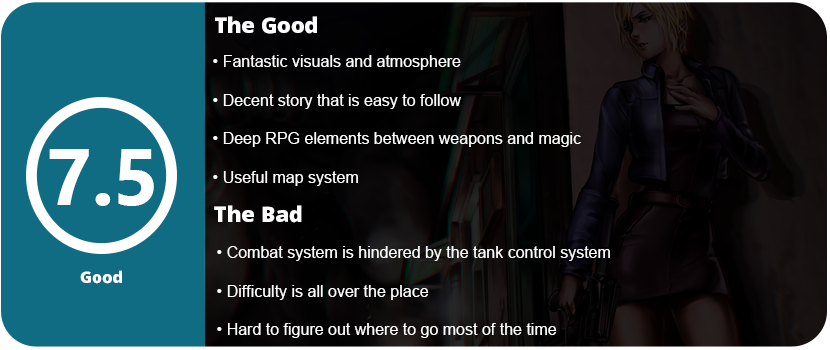
You play as a woman named Laura Parton, who is a flight attendant and is on a plane that crashes in northern Canada in a remote area. She wakes up in a cabin to discover strange creatures that “blossom” and use humans as hosts. The game’s intro is well done, with combat and navigation being introduced as a tutorial, which was kind of rare back in the day (we had manuals back then). The game is a first-person light gun shooter mixed with a first-person adventure game and a third-person tank game like Resident Evil. I wouldn’t really call his survival horror as it didn’t feel like it. When you’re inside buildings, you can only turn to objects you can interact with, like adventure games back in the late ’80s and early ’90s on PC. When you’re shooting enemies, you can turn in a square pattern using the face buttons and aim with the analog stick. It’s really strange, but I have to commend WARP for trying to use the Dreamcast’s weaknesses in its favor and making this game work control-wise.
The third-person adventure part is the weakest part of the game, as it’s literally just a mode of transportation between random JRPG-style battles and buildings. There’s a lot of boring walking along just white, endless tundra. You can use a rifle to hunt animals and use them for health so you don’t use up your first aid sprays, but hunting is a real pain, and only the hares are worth shooting as they give you two meats. The scope is incredibly shaky, and most of the time I always miss it. Outside of the hunting, I just ran back and forth between cut scenes, as that’s really all you’re doing. There are probably a good 2–3 hours of cut scenes in this game, so it’s only for the most patient gamers.
Combat consists of shooting a gun at these creatures that can attack you as many as three at a time. They start out easy, but towards the end of the game, I died a lot. Part of this was the strange design of the combat system. Face buttons flash on-screen when an enemy is nearby, and pressing that button makes Laura turn towards the enemy, and the analog stick is used to aim. The aiming is really sensitive, and there’s no way to dodge or block, so you take damage no matter how fast you are swinging around trying to kill everything. I had to strategize filling up my health by leveling up versus wasting health items. You gain experience from combat, but it only increases your health, and that’s literally it. You also have unlimited ammo for your machine guns, but your handgun and shotgun are limited. The handgun is literally limited to six bullets in the entire game, as far as I could see. I used the gun once, and it was done. The shotgun ammo is hard to find, and I saved it for bosses, but bosses are usually only beatable with machine guns, as you need rapid-fire to shoot everything they throw at you. The same goes for grenades, which are useless against bosses because they move around so much.
Outside of combat, the story just makes zero sense. Each disc feels like its own story, with one of the weirdest endings to a game I’ve ever seen. So, there’s an apocalypse coming as the game is playing off the Y2K scare, and it’s supposed to be the same one that wiped out the dinosaurs. There are so many plot holes that you can literally separate each part of the story and just ask yourself, “What?” There’s a man named David that is never explained, and he whispers to Laura at the end of each disc. There’s this plant parasite thing that is explained in disc 3 and makes a little sense, but then there’s a weird priest that randomly has the power of the apocalypse. Then there’s Jannie, who is a little girl, and we have no idea what her connection to anyone is, and she is a pointless character. You then can be resurrected every time you die, as you’re some sort of “chosen one,” and that is also never explained. Then, at the end of the game, time rewinds back to 1999 and you meet David, and then there are 10 minutes of white text on a black screen of statistics about various issues the planet is facing from the late ’90s, and before that was footage of wars and various world events. What does that have to do with the rest of the game?! It made no sense, and thankfully, the game was only about 6–8 hours long.
Various elements of the game just slow everything down, such as a cutscene for picking up items, a cutscene for opening and closing a door, laying down in bed, and examining simple objects; all of this adds up to maybe 30 minutes of time just being burned, and the constant backtracking to pick up a key at this house, walk all the way across the map to this house to talk to this person, walk all the way back across the map to then trigger another event, and in between all of this, there are dozens of random battles that also slow down the game. After the first hour, combat just isn’t enjoyable and becomes a nuisance. I have to give WARP credit for the amazing monster designs and some incredibly disturbing images that weren’t really common on the Dreamcast or anywhere back then outside of Silent Hill. The animations are well done, and the bosses are the best part of the game combat-wise, as they make the most sense with this combat system in place.
The game itself looks amazing with great lighting effects, and everything is rendered in real-time instead of pre-rendered backgrounds like Resident Evil. The voice acting is even passable without being really cringy and laughable. Overall, the game has a lot of good elements that are just not tied very well together. It’s playable and aged fairly well, but it’s incredibly slow and cut-scene-heavy with flawed combat and a story that makes zero sense. It’s an obscure title that shows how unique the Dreamcast was, and it is one of the rarest games to find for the system, but if you have the patience, give it a chance.
Climbing a mountain can be tough, but climbing one of the highest and most remote is even tougher. You play as a man named Eric, who is destined to find his brother after he went missing during a mountain climb to find a secret Tibetan treasure. What he finds along his journey is a dark past and strange company, but he mainly finds the strength within himself to complete his journey.
The story is decent at best but has many plot holes, awful storyboard cut scenes, and terrible voice acting, but still enough to keep you trucking along. The game plays a lot with the supernatural and Tibetan history and lore, which is nice, but it’s easily forgettable. You never know what the secret treasure is ultimately for, who the expedition company is that’s involved, and many other questions that are never answered.
Nevertheless, you basically walk around various buildings and ruins as you slowly climb this giant mountain. The game changes slowly as you reach the peak with different gameplay elements tossed in, and I have to give the game some credit for mixing things up, but it doesn’t do any of these things very well. Let’s start with simply moving. Eric moves like he’s constipated, and the controls are pretty bad. If you bump into a wall and he sticks to it, the camera will get stuck behind objects as you can’t control it, and combat is pretty bad as well.
You have a pickaxe that has ancient items attached to it with powers that allow you to access your “third eye” and see ghosts so you can kill them. Each encounter is arena-based, so you’re stuck in a small room with these things. Holding down C allows you to enter this mode, but you can’t move, and Eric’s shoulder blocks the entire left half of the screen as the FOV is too low and it’s hard to see. You can see the reticle through Eric, but not the enemies. The ghosts have various attacks and powers, but overall they mainly mob you and attack you the same. The goal is to shoot the projectiles from the pick to weaken the enemies enough to enter a quick-time event of aimlessly flailing the Wii Remote around to kill them. Miss the event, and you have to attack them one more time to make the prompt appear. This is by far some of the worst Wii controls I’ve experienced, as the prompts require punching and swinging action, but no matter how well I did them—either fast or slow—it would only register half the time. To make matters worse, this is the reason why I died half the time. Then there’s the fact that you can’t move while aiming, so these are 1997 tank controls in a modern game. There isn’t even a quick-turn button, so I can quickly run away and swing back around. I have to aim and fully turn all the way around, and then the enemy is back on me again. It’s the worst.
Let’s also mention the two areas where you have to meditate and swing the Wii Remote around. I spent 10 minutes just trying to find the spot where the game wanted me to be, then holding that position and keeping swinging until the screen faded. I’ve never experienced such unresponsiveness and inaccuracy in the controls. Were these even tested? As you progress further into the game, the enemies get harder, and there are more of them. You fight probably 100 ghosts just in the second half of the game. That’s a lot of unresponsive Wii flinging.
With all of that aside, the game is poorly paced, with minutes of endless walking and climbing that are slow and tedious, and the checkpoints are placed poorly. I would die during a boss fight just to fight the ghosts leading up to the boss again instead of the checkpoint right before the boss. Dying isn’t really an issue if you’re quick, as killing an enemy gives you health, but there is incense you can pick up to use at healing stations if you need it.
Outside of this, the visuals are pretty decent, but while pushing the Wii way too hard with the slowdown that is frequent and runs in the single digits, it still looks decent. The audio sounds like a PS2 game, with the same footstep sound throughout the whole game and low-quality audio bites. I honestly feel like this was developed for the GameCube and was pushed to the Wii at the last minute.
Overall, is Cursed Mountain worth playing? Yes and no, for many reasons. If you are running out of games to play on your Wii, then go for it, or if you’re just getting into the Wii, then it’s a good pick-up, but what experience do you get out of it? Just to kill time, really. The story isn’t memorable, it’s not scary, and the controls stink, so mainly get it just because you need another Wii game to play.
The Metro series is one of my favorites and is on my top 10 first-person shooter lists. It has a lot of flaws, but there’s a lot of heart and love that went into this series, and it showed with each game and even the Redux games. Exodus has been in development for about 5 years now, and I expected a lot from this game. What we got was a lot, but not how I really imagined it would be.
Exodus takes off right after the end of Last Light, with Artyom and Miller and the gang setting out from the metropolis of Moscow to find a clean place to live free of radiation and monsters. The main hub in this game is a train called the Aurora, and instead of being confined to a small linear metro tunnel, there are a few large maps you can freely explore, and the game is much longer than previous ones. The story itself is actually quite good, and the atmosphere plays a big role here, just like in previous entries. The funny thing is that the game almost feels like three parts put into one. The first two large maps are fully explorable with hidden items and side objectives, while the third map seems large and open, but there are no side objectives or things to really find. The last map ends up being a linear tunnel that harkens back to the first two games, with mostly atmospheric storytelling during the last 30 minutes. It’s got great pacing, and this constant change of gameplay kept me interested.
One of the major changes in the crafting system is that it allows you to collect chemicals and scrap metal to craft anything from medicine syringes to filters to certain ammo types. When you finally get a workbench, you can use it to clean your weapons, masks, and craft ammo, as well as equip new pack items such as a compass, motion detector, and even a better charger. Metro is all about survival, so the only thing you can do with your pack on the field is craft medicines, filters, smaller ammo, and throwables, as well as change out your weapon parts. The crafting system is decent enough, and I stuck with one loadout through most of the game, as once you get better parts, there’s no reason to equip weaker ones. There is a large variety of weapon types, and the more you use them, the more they jam up and misfire, just like in previous games.
The shooting is spot on here, and the weapons feel heavy and cumbersome like any junked-together gun would. From pistols to Gatling guns, the weapons are rather unique for the series, and I’m glad the weapon system got a lot of attention here. My first issue occurred with the stealth, though. Just like in previous games, nothing was really fixed. Sometimes I could sneak through an entire compound and kill everyone, and other times the enemies were placed in such odd positions that I got spotted no matter what. I also don’t like how silent weapons and stealth kills can be heard if you’re too close to another enemy. There were several dozen checkpoint restarts made throughout the game to get it right, but thankfully you can quicksave anywhere. Most of the time, sneaking missions turn into shootouts, and dying is quite easy here. A few bullets, and you’re pretty much dead, so keep medicine syringes handy at all times.
I do want to talk about the atmosphere a little. The game is incredibly foreboding, from the empty tundra to the dry desert and lush forests. The game feels empty and alone, and you’re always feeling afraid. Of course, the tensest moments are towards the end when you’re in the tunnels, and when you finally get back on the train or even a safe house, the respite is so relieving. I never played a game where a single light, a rest spot, or another person would feel so nice. You’re constantly on the edge of your seat, whether it’s hiding from monsters, tense shootouts, or sneaking around a bandit camp.
The visuals in Exodus are absolutely fantastic. Some of the best graphics this generation has seen. While I don’t recommend playing this on the original Xbox One or PS4 hardware it looks amazing on my Xbox One X I gave it a whirl on PC with Ray-Tracing enabled and it looks out of this world good. Of course, you need a 2080 or higher to get good frames with RTX on, and sadly, the DLSS is completely broken in this game. The entire game looks blurry and slightly out of focus, which is sad because I got a good 15-20 FPS just from DLSS alone. On Xbox One X, the game looks amazing, and there are only slight differences between it and the PC outside of RTX and some draw distance settings. Of course, the game never reached 60FPS on the One X or PS4 Pro (which the game runs slightly rougher on), but it all plays well. There were some glitches with the game crashing my Xbox and scripted events not activating, causing me to restart at a checkpoint as well.


Overall, Exodus is a fantastic game that is somehow still rough around the edges but still evolves the series with large open maps, varied environments, and mixed-up gameplay ideas, as well as the best story in the series with good characters, but sadly, they aren’t exactly memorable but good enough to push you through it.
Yep! The fact that I forgot about this game until you made a comment proves that.