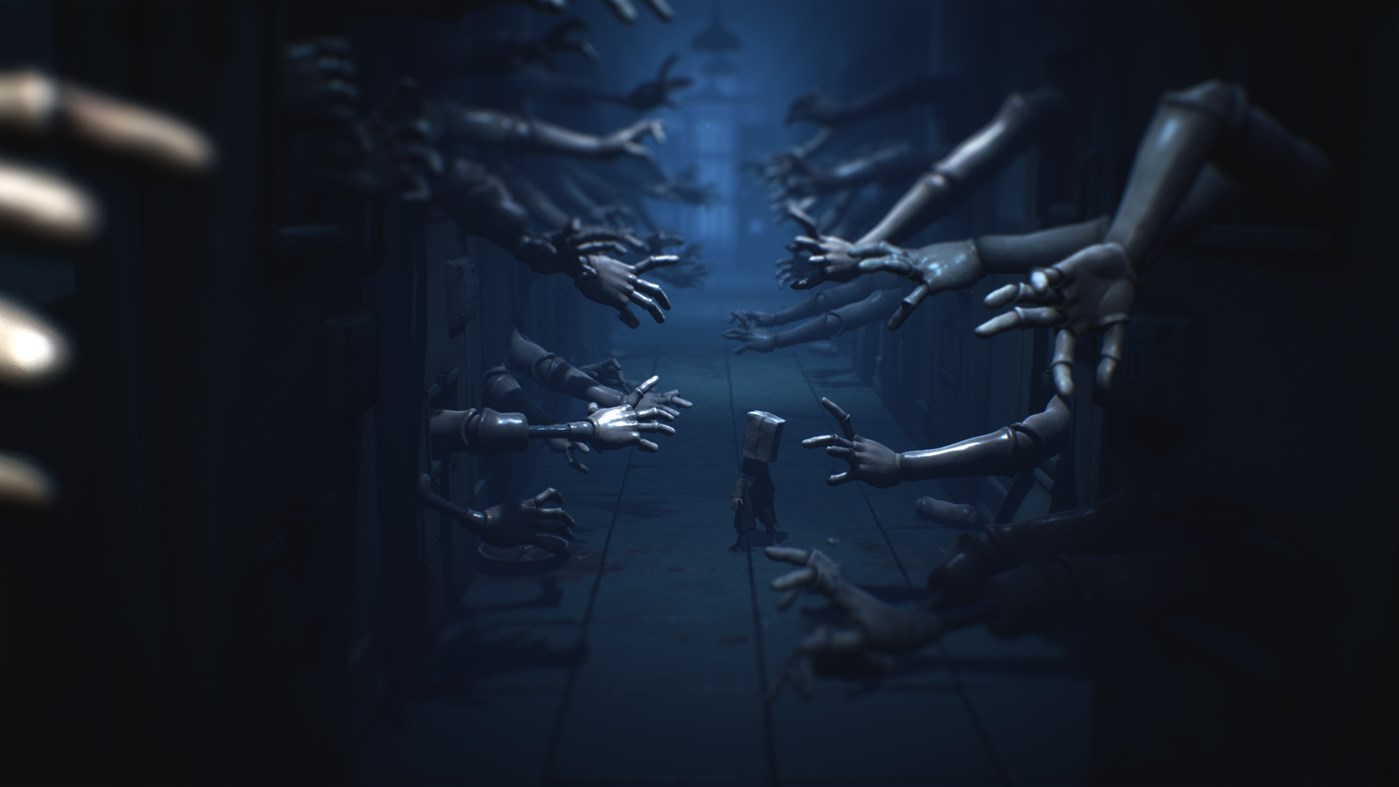
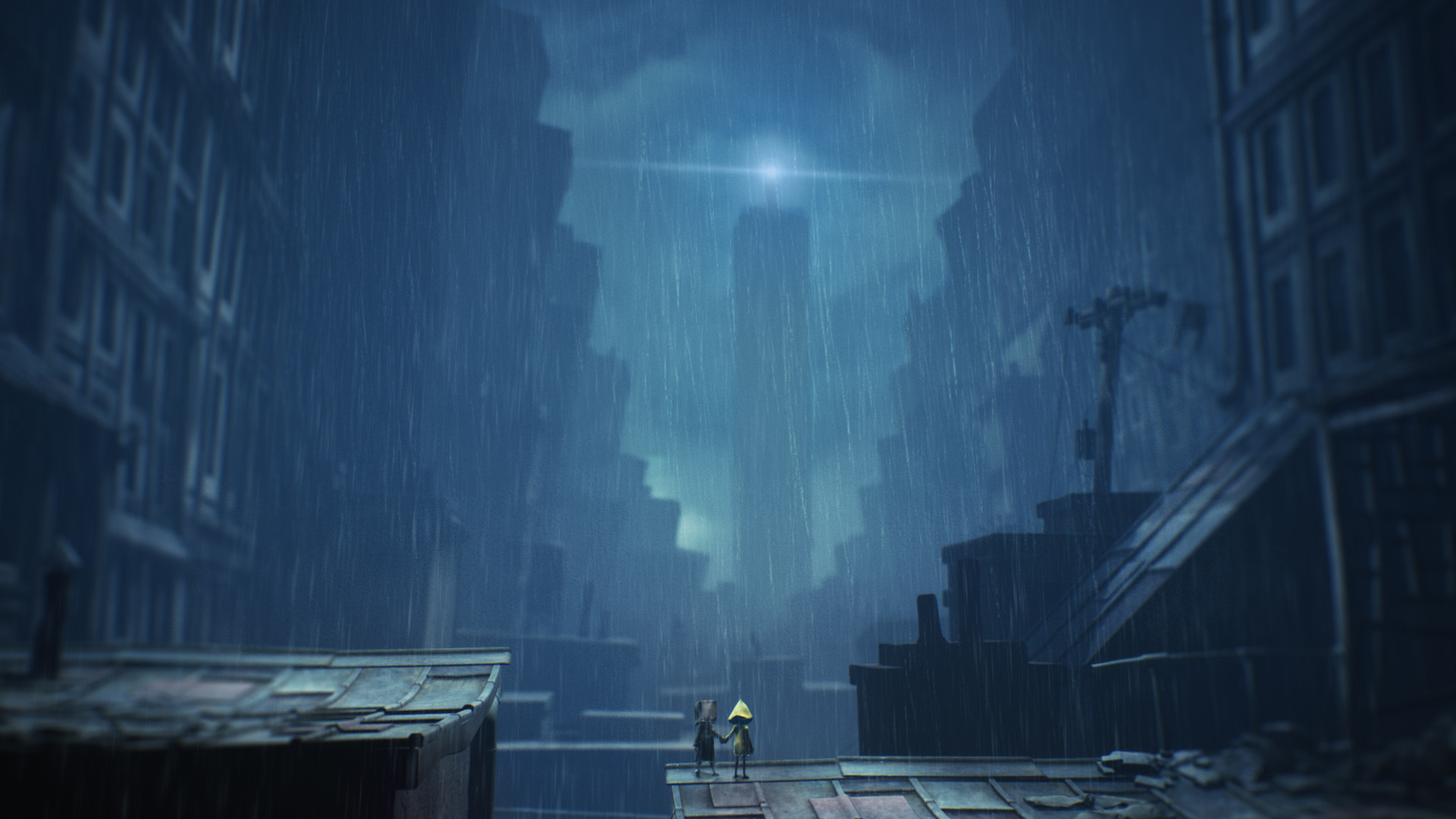
Little Nightmares was a creepy platformer with a minimal story and narrative. The game was mostly all about atmosphere and puzzle-solving. These games cropped up after Limbo was a smash hit, and games like Inside also followed. The only downside to these games is that they tend to not shape any kind of narrative or world-building. There are a lot of interesting things to look at, and clearly, the setting you are in is a curious thing to want to know about. Little Nightmares II puts you in the shoes of a paper bag-wearing kid who is running from something, but you never know what. Throughout the entire game, you go from location to location, not knowing what your end goal is, and even after finishing the game, I wasn’t quite sure what to make of everything.
The game starts out by giving you simple controls such as jumping and picking up objects using the physics engine. You won’t be doing this very often except to use weapons occasionally and throw an object at a button to open a door. The atmosphere sets in right away with your character running through a forest, trying to avoid bear traps, and traversing fallen bridges. Once you get to a certain area, you meet your first main monster, and then you are introduced to combat. I really don’t want to call it that, as all you do is pick up an ax and swing it, but it’s completely based on physics. Usually, you will use an ax to break down walls, but you will use it to fight enemies at the school level, and it’s all about timing. The ax is very heavy, and your character can’t move it very fast, but it works.
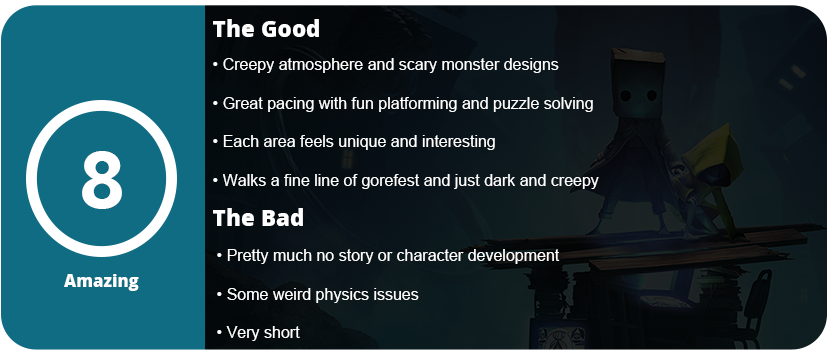
The first area is rather short but pretty cinematic, and things will slow down greatly as the game goes on. After a few areas, you will notice the game adds a lot of puzzle-solving, most of which don’t require much thinking. There are a few physics-based puzzles, and halfway through, you meet a companion that requires some puzzle-solving with two people, but the ease of the puzzles is to keep the pace going. You don’t want to spend too long in any one area. I felt the chase from enemies and puzzle-solving were well balanced. Several screens will go by of just platforming, maybe just empty screens of scene-setting, but I do want to talk about these monsters. The game is very creepy, and the main monsters basically chase you throughout the entire area you are in. The school has a teacher that can stretch her neck out and chase you through vents and under tables. The hospital has a doctor who can walk on ceilings. They show up in some scenes, but not every area has you killing this main villain; the most important part for you is escaping.
There is some frustration with the game, and that’s a lot of trial and error. Some scenes wanted to get across the screen via a certain path, but I got caught by the villain numerous times before figuring out how to do it. There were also control issues with climbing things in which my character got stuck, or I didn’t understand that jumping across a ravine to hang on to my character’s hand was going to be an issue. In several areas, I had to restart the screen over and over until I walked across that beam just right or didn’t get caught. Thankfully, you just restarted that screen, and it helps keep the pace going. I just wish there was more story to be told or something else to hold on to rather than the next creepy monster or setting.
The game looks great visually, with a lot of nice art, but technically, it’s not super impressive. Textures look muddy up close, and some objects don’t have the highest poly count. The animations are great, however, and the controls are good; there’s just that annoyance with the game’s physics. It’s also pretty short, as it can be finished in about 5 hours, and I honestly wanted more. The creature designs are so fantastically creepy and unique, and the game skims the line between gory and just plain dark and creepy. It’s never a gorefest, but it feels like it could be. There are animal guts, but not humans; there are body parts everywhere, but they’re mannequins. It’s a fun line to walk down, and it’s done just right here.
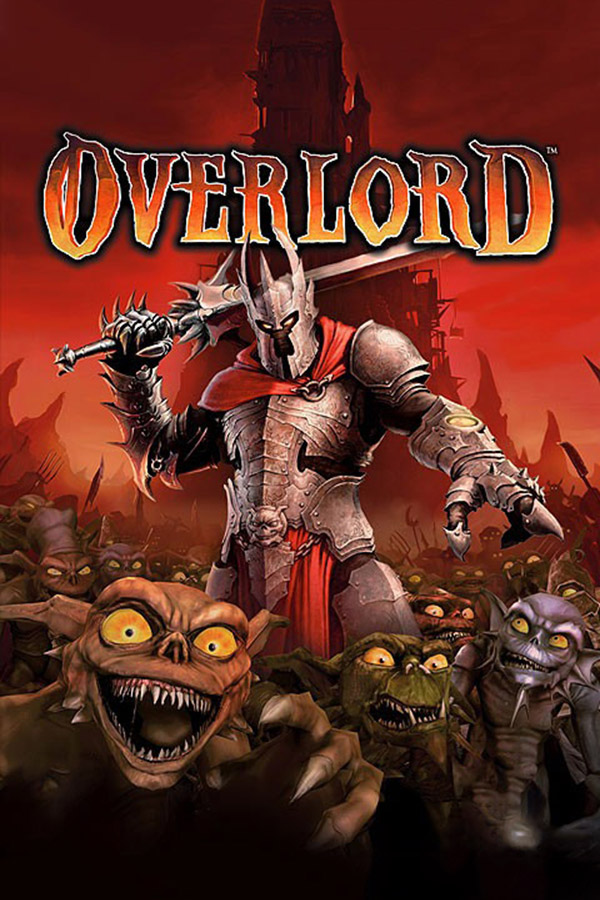
This is actually my third time trying to finish Overlord, believe it or not. I rented this game back when it came out on Xbox 360 and didn’t get very far. A second time on PC, and now my third on PC. This is the furthest I’ve gotten in the game, about 2/3 of the way, but as time goes on, the game ages more poorly than the last time I remember it. It was an early next-gen game for Xbox 360, so all eyes were on it, and it was graphically impressive. It still looks great today and, surprisingly, runs amazingly well on PC without needing any fixes, but the game has a lot of issues.
Firstly, the game is incredibly tedious, and the game has some very poor level design. There’s no map, no objective marker, and the levels are very linear, so even one of these things would have been so helpful. You blindly wander around these areas that all start to look the same, trying to finish objectives. Now, the objectives can all be completed in any order for any area. Your main hub is a tower that you can customize and upgrade over time as you complete the game, and from here you can fast-travel to any level you have visited. The main gameplay mechanic is using the right analog stick and controlling your horde of minions to do your deeds for you, such as carrying items around and combating. You’re very weak comparatively, so entering combat isn’t suggested unless you really need it. Again, not the worst problem.
What really starts to bore me is that sweeping your minions around works well enough, minus some control issues when you have a straggler. The game favors the majority of the horde you end up controlling, and stragglers sometimes won’t join their brethren, making things frustrating. You end up controlling four different minions. Reds, Blues, Greens, and Browns. Browns are your main grunt, do the most combat damage, and have the most defense. Blues can enter the water but can also revive minions. Reds can throw fireballs at a distance and put out fires. Greens can be sneaky and climb up larger enemies, and they are also immune to gases and poisons. You end up spending almost half the game acquiring the three hives needed for the minions to open up new areas in each level. I constantly ran into roadblocks, requiring me to backtrack and wander around a level until I ran into a new area I hadn’t discovered. When I say the level design is bad, I mean piss poor. There are no memorable landmarks, just linear pathways that loop around, and turning around can literally look like two other directions you came from.
While navigation is a serious chore, the use of minions is limited. There are no puzzles to be solved; just destroy everything in their path, and make sure you use certain colors for certain enemies if need be. There are boss fights that are quite challenging, but then another major issue cropped up. You must horde and resource orbs to summon these minions; they aren’t free. Certain enemy types will give you different orbs, but browns are the most needed. I constantly had to go back to a level or two that had easy-to-mine sheep that gave me yellow orbs. I then had to exit the level and reload for the sheep to respawn, just to get enough Browns to defeat a boss. If you’re left in an area with no minions left, you’re pretty much screwed. You are never powerful enough to take out tough enemies alone, and some bosses can only be defeated by minions. There are mana and health fonts you can sacrifice minions into, but they are far and few between, so you really have to watch your health. Minions can loot stuff and find potions to help out a little, and this is the best way to acquire gold in the game to upgrade your weapons and armor.
Once you get used to the controls and gameplay loop, you will really start to see how much aimless wandering you do when you aren’t doing anything at all. I had to always keep a mental note of where a certain area was blocked and by what element, so I could go back and progress and complete another mission. Progressing was somewhat satisfying, but I spent 75% of my playtime wandering around these levels, trying to remember where to go and figure out what part I hadn’t discovered yet. Another issue I would run into is not having the right minions, so I would then need to backtrack back to a spawn hole and get the right minion, but it doesn’t end there. Let’s say you have 20 Browns but now need 5 Blues because an object is in water. I would backtrack to a blue spawn point, I remember, but you can’t send back Browns to a blue spawn point. I then had to go all the way back to the beginning of the area just to send the Browns back. This is stupid and tedious, and there are so many quality-of-life issues that could have improved the game. Let me send back any minion to any spawn point. Also, why spawn points? They’re so far and few between; let me just summon them from the ground, anywhere. I already have a limited amount based on the orbs I collect.
All said, the game might be worth a look if you really love the humor in games like Fable or from the mid-2000s fantasy era. I also felt that despite the game-toting being evil, I never felt truly evil. You can save people for rewards or kill them, but it doesn’t seem evil. The game never went above and beyond this, so I just felt like a misunderstood good guy the entire way. What? The visuals hold up, the control is cumbersome but doable, and the gameplay is unique, but the constant aimless wandering, lack of a map or compass, and poor level design lead to tedium and make the game just plain boring.
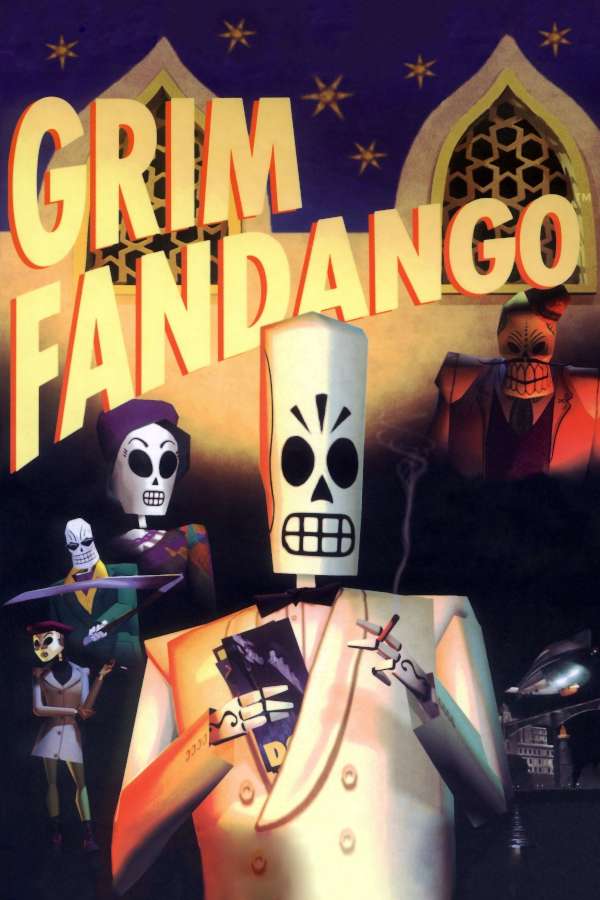
Tim Schaffer games are always hit or miss. He may be a great story writer or character creator, but he’s not a great game designer. I don’t want to come out swinging with everyone, thinking I hate Grim Fandango or all Schaffer-made games. A lot of his work is considered some of the best games ever made on PC, which I get, but they’re remembered for their story, atmosphere, and characters—not so much their gameplay.
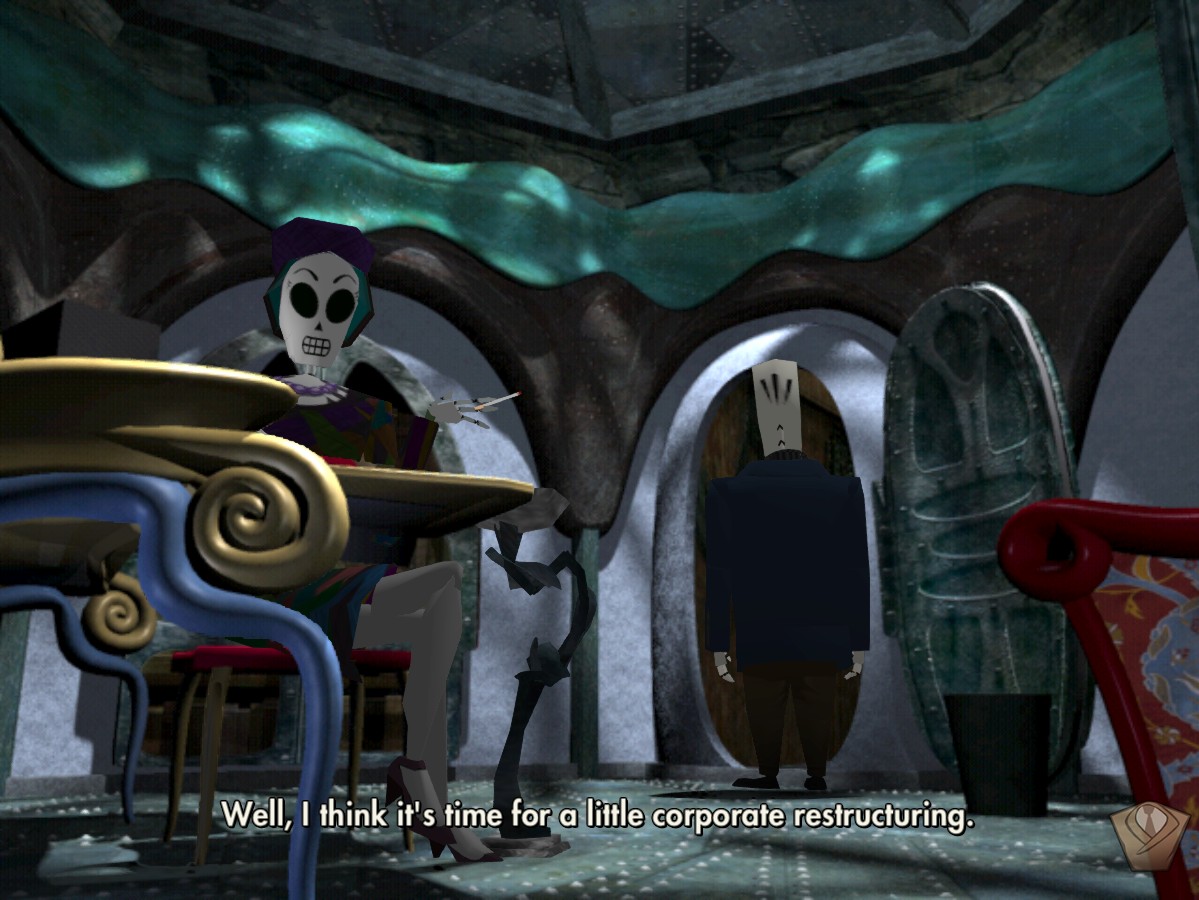
You play as Manual Calavera. A Mexican salesman of the dead gets wrapped up in a huge film noir-style story trying to save a mysterious girl, get back at his evil overlord of a boss, and also an evil co-worker. The game is split up into four years. It takes four years for people to travel by foot to the Ninth Level if they don’t qualify for an express train ticket. For some reason, Manny can’t get any good clients, yet his co-worker Domino can. You wind up uncovering a plot of fraud, sabotage, subterfuge, and love. I can’t go too far into story details, but they’re quite entertaining enough to keep you pushing on.
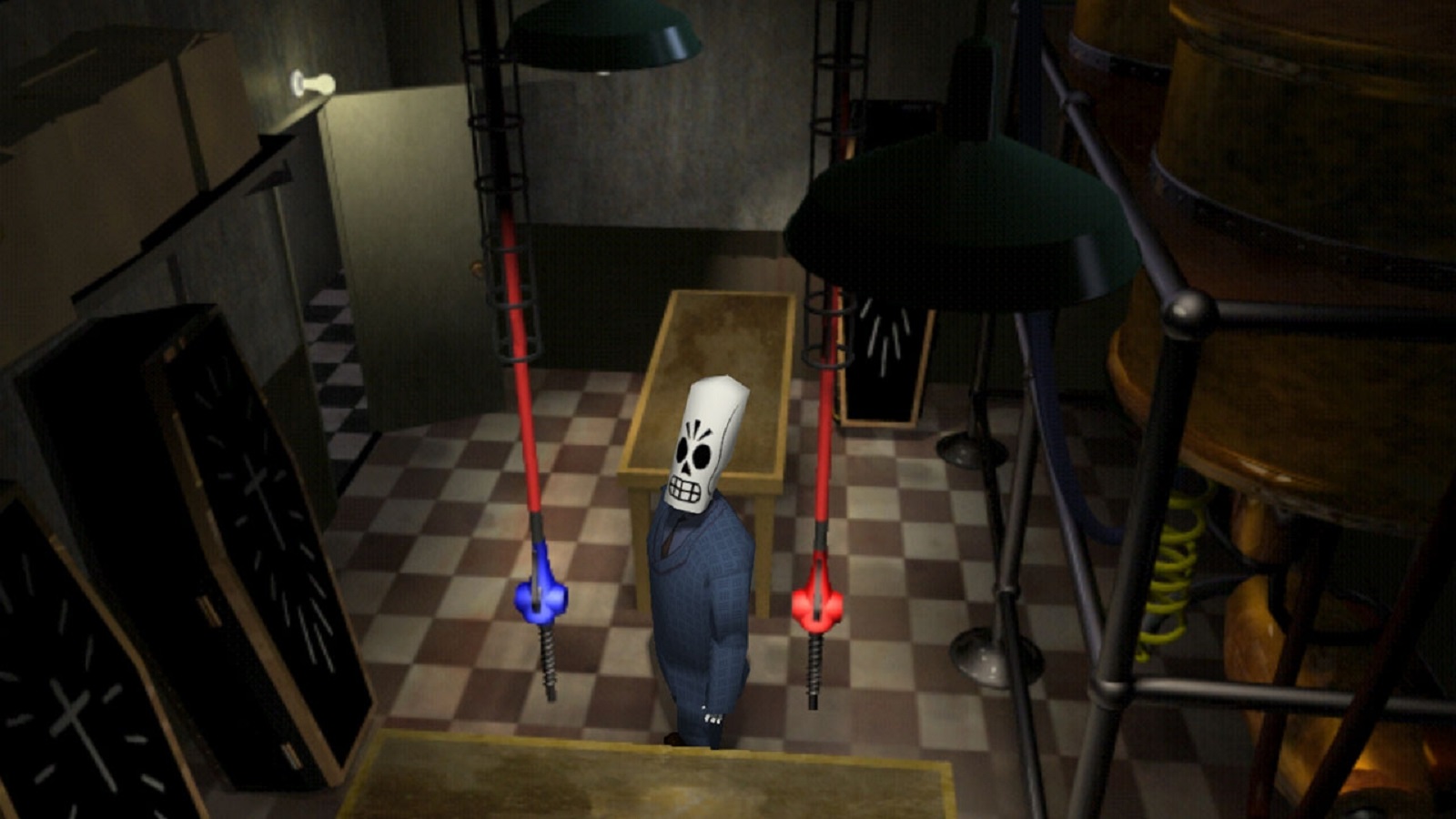
And pushing on will do. The game’s object-hunting obtuseness varies from minimal to I will never figure this out without a walkthrough. The way objects are used is very illogical at times, and you wonder how Schaffer thought gamers would think in these ways. It doesn’t help that the areas you explore are massive, with dozens of hallways and rooms, and you can easily miss something that needs picking up or completely bypass something that needs to be interacted with. LucasArts had a lot on their hands with this game, as it was the first 3D game they developed and the most sophisticated to date. There’s no object mixing, either. Manny stores everything in his cloak or jacket, and you must either try everything on every interactive object or simply think in odd, obscure ways.
One example early on requires Manny to gum up a pneumatic tube system and get the maintenance demon to open the door. That was fine and all, but the demon left, and I couldn’t get in the door. I then had to re-acquire all the items needed to gum up the system again by running down hallways and doing a ton of backtracking, all because I didn’t realize I had to throw the bolt to stop the door from closing. How was I supposed to guess that? You run into these situations every step of the way, and it gets exhausting and discouraging. Another scenario requires Manny to take a sign and use it to find a hidden doorway in part of a forest. This forest has doorways that loop back around to the same room and do nothing. How would you know to take that sign from the previous room and use it as a compass to find the hidden doorway in this room? The puzzles are insane and poorly designed, which leads to constant frustration. I felt my progress halted every five minutes.
With puzzle obscurity out of the way, there’s nothing else to this game. There are pretty environments to look at, great music and voice acting to listen to, and some great characters, although none of them are very memorable. You can unlock quite a few achievements by talking to certain people at certain points or looking at certain objects. I find this in tune with the puzzle’s obscurity. I also didn’t like how many areas are reused over and over again while, in new ways, they’re still the same. Things are just spread so far apart, and so many sub-plots and hints are given to you that you can’t make heads or tails of any of them. There’s no journal to keep track of what’s said or even what you’re really supposed to be doing next. It can become quite frustrating.
Thankfully, the game isn’t very long, especially if you use a walkthrough. My adventure was over in about 6 hours, and I enjoyed it while it lasted, but it’s not something I will be talking about for years to come. The gameplay time isn’t enough to really flesh out the characters more than you wanted, and it almost plays out like a Pixar movie. It’s a fun blast while you’re in it, but once the credits roll, you quickly move on to something else and probably won’t remember it a year down the road. Something about this whole game just didn’t stick with me, and I can’t put my finger on it. If the puzzles weren’t so obscure, I might be more inclined. At least there’s fun developer commentary all over the place, and the remastered upgrades are nice. Everything looks sharp and clean and is rendered in a much higher resolution. However, there are still many collision and animation bugs.
Overall, Grim Fandango is a fun story with some fun characters while you’re in it, but you will quickly move on to other things as something about this game doesn’t quite stick. It feels more like a Pixar cartoon with gameplay bits in between than a full-blown game. It looks good, sounds good, and the voice acting is excellent, but many won’t finish the game just due to how obscure getting through everything really is.
You play as Ichiban Kasuga. A naive young yakuza member who ends up in politics of his yakuza family and then later the entire country of Japan’s government. The story is incredibly well written and directed, and I was hooked from beginning to end, at least the story and characters. I love the characters here as they have tons of heart, soul, and personality that make you want to see them through to the end of their journey. The first three chapters of the game are pretty much story and character building. In fact, I didn’t really get to do anything outside of watching cut scenes for the first three hours of the game. I just ran to spots that triggered them and I watched this complex web of characters build their story up, and I wasn’t upset as I was glued to my screen the whole time.
This is the first time I’ve finished a Yakuza game and a rare completion of a JRPG. Usually, JRPGs have great stories and characters, but something within the game keeps me from finishing it. Be it unfair and insane difficulty, too much grinding or late-game issues pop up like needing to quest for something very specific and it makes the progression grind to a halt. Like a Dragon is the first in the series to play like a JRPG and not an action game. The story is fantastic and the characters are well written and memorable, but that’s probably the strongest thing going for the game, and it’s the reason why I slumped through the late game issues to see it through to the end.
Once you get past a certain point in the story, honestly I can’t say anything as every little detail could be a major spoiler, you finally get let loose in the world. However, with this being a JRPG let’s talk about combat first. The game is played in a turned-based style, but characters move around on their own in the arenas. Depending on your job you have various skills that can cause major damage, and this is super important and the core of the entire game. While base attacks are fine early on in the game, they don’t do much later on and you start relying on skills that all use MP whether they’re physical or magic-based. Each attack has a type such as magic, slashing, piercing (guns), bashing, or blunt (physical) attacks. Some attacks might have elemental attributes attached to them, but you really must balance your team. You need characters that can heal, do large AoE damage, and do lots of damage to single enemies. It’s important you have a class that can do one of each of those things as it’s key to winning battles.
Early on in the game, the difficulty feels perfect. There were some challenges, I had to use strategy, really focus on ranking up my character’s jobs, and learning enemy weaknesses. This is also a key point in the battle system. Like a Dragon mocks or makes fun of other games like Pokemon. Early on you come across someone similar to Professor Oak and the entire scene plays out like the beginning of every Pokemon game. It’s pretty funny. The point of this is you acquire a bestiary of each enemy type and when you fight in battle and discover a weakness it will appear over the character when you select that attack. This is vital to winning boss fights and harder battles late game or just in general.
Ranking up your job is more important than leveling up your character honestly. This determines your max health, how powerful your attacks are, and learning new attacks. You get more powerful attacks as you rank up, but the downside is that once you change jobs, you start from the bottom on that job. So you have to grind that job to level it up, and late-game this is incredibly tedious, but more on the late-game problems later. There are thankfully no random battles, but enemies walk around outside that can be avoided. When you fight enemies, the environment is also important, as smaller areas are great for attacks that do AoE damage, and it allows you to wipe out enemies faster in bigger groups.
Outside of combat, there are a ton of mini-games, like in every Yakuza game. Karaoke, classic Sega arcade games in Club Sega, crane games, driving ranges, go-karts, and many others. They’re fun at first, but there’s not really any reason to do these mini-games outside of acquiring items. Items are also an important part of combat, as the most powerful armor and weapons are almost unobtainable until you can start raking in serious cash at the Battle Arena in Chapter 12 and fighting the more powerful enemies late in the game. You can also upgrade Ichiban’s weapons (only his weapons can be upgraded) and craft new items, but honestly, this is only needed if you can’t afford to buy them. There are no unique weapons or armor that can be crafted exclusively, at least that I noticed, and once I started raking in serious cash in the millions, I just bought everything, and crafting became pointless towards the end of the game.
There are shops and restaurants scattered everywhere, and I didn’t pay attention to these too much until the late game. Restaurants can fully restore your health and MP, and bulking up on recovery items becomes super important late in the game as well. I didn’t really use many of these until then, as the game felt perfectly balanced, and the right strategies can keep you alive. There are a couple of pawnshops that allow you to sell items, and this is how you make most of your money early on in the game. You start out digging for yen under vending machines and eventually start earning a small amount of money to buy recovery items and cheap gear. There are also sub-stories, like in every Yakuza game, that are shown as chat icons on the map. These give you items and cash and are mostly pointless once you get the late game, and the stories aren’t interesting at all. You also have extra side missions that can get you larger amounts of cash, called Hero Quests. This is mostly for completionists in the end, but the entire reason this is a JRPG is that Ichiban can see enemies as monsters with different uniforms. It’s “in his head because he feels life is like Dragon Quest.” It’s super silly and a lame excuse to make a realistic game have a fantasy twist, but what other excuse were the developers going to use?
As you progress through the first eleven chapters, you hop around taxis to fast-travel to spots, unravel the story, rank up your jobs, level characters, acquire new armor and weapons and items, and all this sounds like a normal JRPG affair, but then chapter twelve comes and knocks you on your ass. This is when most people will probably quit the game, as it turns into a completely different beast and the way you play must change. This is the worst part of the game, and I don’t see how this was necessary. The game had a perfect flow and difficulty level leading up to this chapter. The first sign hits you when you must acquire 3 million yen for a specific reason in the story. By now, you probably have a couple hundred thousand yen at the most. How am I going to get this much money as street thugs don’t really payout and I can only sell so much? Well, the first stupid idea was that there are specific things you need to do to get this money, and they don’t tell you. First, you have a watch in your inventory that’s worth one million yen. You need to sell that, and then there is a specific Hero Quest you must complete that gives you two million yen. You need to take ten photos of a statue hidden throughout the city. What a serious pain in the ass! I knew right here that the game was going to be a chore from here on out. Then, to make matters worse, the last statue is hidden behind insanely difficult enemies out of nowhere. They were many 8 levels above me, but that wasn’t a problem before. I had to grind for a couple of hours just to beat them to take that photo. Such nonsense!
It just gets worse from here. Chapter seven had you complete one of the two long dungeons in the game. It was challenging, but not impossible. This dungeon is the only way to grind up until now. However, once you get to a new small city, you unlock the battle arena, and this is your main way to level grind by climbing floors and beating waves of enemies. You will be here for probably 6–8 hours minimum. At this point in chapter twelve, you come across a boss fight that cranks the difficulty up to nearly unfair and impossible. I had to grind 15 levels just to get a fair advantage. This boss just absorbs so much damage, and throwing all my powerful attacks at him still kicked my ass. I died and retried nearly a dozen times before I almost gave up. I’d grind five or six levels and try again until I could finally do it. I chewed through recovery items like crazy trying to get through this chokepoint in the game. Sadly, it never lets up after this. From here on out, every single boss is a serious chore and does massive damage, no matter what you do. This is what I have in JRPGs, which is why I rarely ever finish them.
So, you will then need to grind consistently before each major story point that you are warned about. You need to be at least level 65 by the final boss, and man, is it a serious pain? You shouldn’t have to want to quit a game because the developers decided the game needed more playtime by chapter twelve. Let’s make you do over a dozen hours of grinding just to finish the game. It’s stupid, insane, and completely unfair. They had the difficulty balanced out perfectly before, and I was happily enjoying the game. The only reason I kept going was because I wanted to see the ending and how everything came together. The story is that good, but if it weren’t, I would have quit at this point. You’re basically grinding the battle arena and the one dungeon, trying to acquire new gear and rank up your job to get more powerful attacks. I highly recommend being around level 70–75 before tackling the final boss, but at that point, you are 25 levels away from maxing out your character.
The game at least has amazing voice acting (in Japanese, of course), and the graphics are pretty good technically but pretty boring on an artistic level. These are hyper-realistic graphics, and the only artistic flair is the enemy designs. I enjoyed the music as well, but in the end, the last few chapters will test your patience. The mini-games are fun, the sub-stories are boring and repetitive, and the post-chapter twelve grinding is an absolute chore and really hurts the game. However, if you can prevail, get through the grinding, and learn the strategy of balancing your party’s jobs, you will get through an incredible and memorable story with great characters.
You play a woman named Marianne, who is a psychic medium. You start out the game in your foster father’s funeral home, and this is where the game introduces basic mechanics that you will use throughout the rest of the game. It starts out very confusing at first, and honestly, the story is just barely coherent enough to keep up with, but it constantly loses you in spots and then plays catch-up again. The game clearly relies more on characters and atmosphere than storytelling, as there’s no context to keep you engaged, no really long opening scene, just some dialogue that explains who Marianne is and what she can do. Within the first 10 minutes of the game, you will start to experience the scary stuff. Shadows on walls, strange sounds, and the “other side” look very reminiscent of Silent Hill in both concept and design.
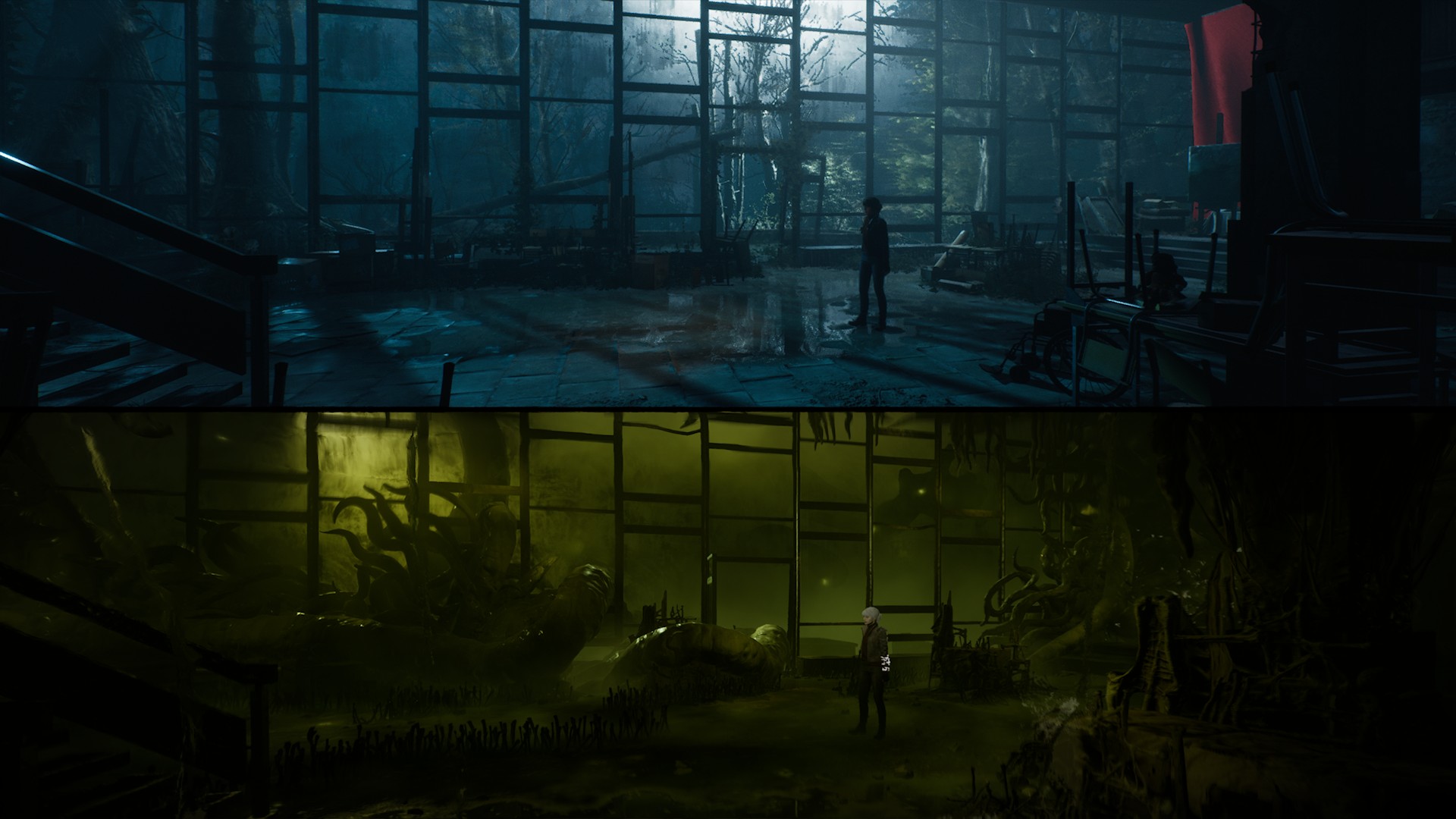
This is an adventure game with very little action. It’s mostly basic puzzle solving and object finding. You walk around areas, reading notes and signs, listening to spirit echos in objects, and picking up objects that will be used at a later point. Thankfully, none of this was overbearing or focused too much on. It all felt pretty balanced and was light enough that the exploration and atmosphere mostly stayed center stage. The various locales are fantastically designed and beautiful to look at. The “other side” was mostly created for puzzle-solving scenarios, as you end up going back and forth between the two at the same time. See, this is Bloober Team’s biggest project and something that’s been in development since 2012. They needed the hardware to render two worlds at once via split-screen. This really does tax your system, as frames can drop by almost half in some areas even with DLSS enabled.
As you play the game, these main elements are switched up constantly, and to be honest, it’s really well-paced and feels just right. Some areas I was mostly exploring in the real world, then I would split off into the other side, and then there are some areas that have mirrors that allow you to go back and forth at will. These areas are the most puzzle-intensive, but never difficult. With that being said, the game is very easy, and only one small section of the game has any form of combat. The horror elements in the game are well done, and I love the monster designs. There is a creature that does stalk you throughout the entire game in certain areas, and these result in having to sneak around areas with barriers and hold your breath. The voice acting is superb, and the performances are great. Everything in the game just sucks you in, and I honestly didn’t stop playing until I finished the game.
I also never got lost or couldn’t figure something out on my own. The game is very linear, and as long as you wander around, examining everything that has a white dot on it, you will find your way around. Since the game mostly focuses on the story, there are times I get confused, but you get caught up with the cryptic stuff during the main cutscenes, and in the end, the game was satisfying and had a nice conclusion. The game can be finished in about 6–8 hours, and there’s no replay value, sadly. Sure, there are items to collect throughout the game, but I found pretty much everything in my first run-through. There are also no multiple endings, so the game will end exactly the same no matter what you do.
The game really has to be praised in the sound department as well. There are a lot of creepy ambient sounds and noises, and the voice acting for the monsters is just amazing. Despite the game being just about exploration, object hunting, and basic puzzle-solving, I never felt bored or wished the game gave me more. If the story and characters weren’t so interesting, I’d probably complain about this, as I’d want more gameplay, but we don’t always need complicated combat systems or deep RPG elements in every game. Bloober Team’s games tend to be a bit rough around the edges, but The Medium is rock-solid and shows they can make AAA titles with the best of them. I wish the game was optimized a little better, but with a fantastic story and characters and gameplay that feels just right, as well as great pacing, I can’t complain much.
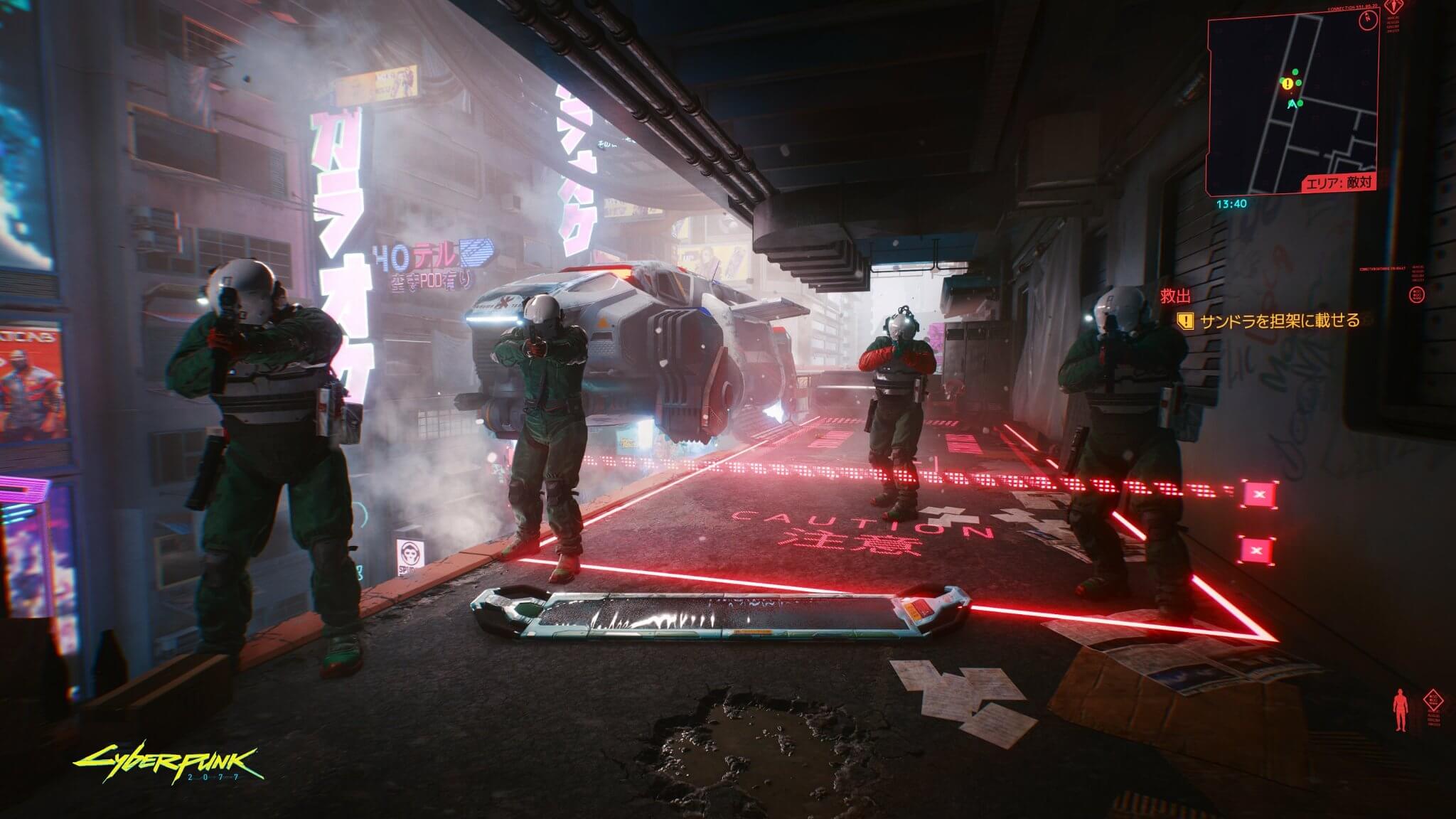
This is by far one of the most anticipated games in modern gaming history. I know I have been excited since its poorly chosen announcement date in 2012. Sadly, CDPR kind of dug its own grave from that date onward. The game is nothing like how it looked in its early concept videos, and a lot of content is cut. Even if you look past all the bugs and launch woes, this is what’s going to stay long after the game has been patched up to a more playable state than it currently is as of this review.
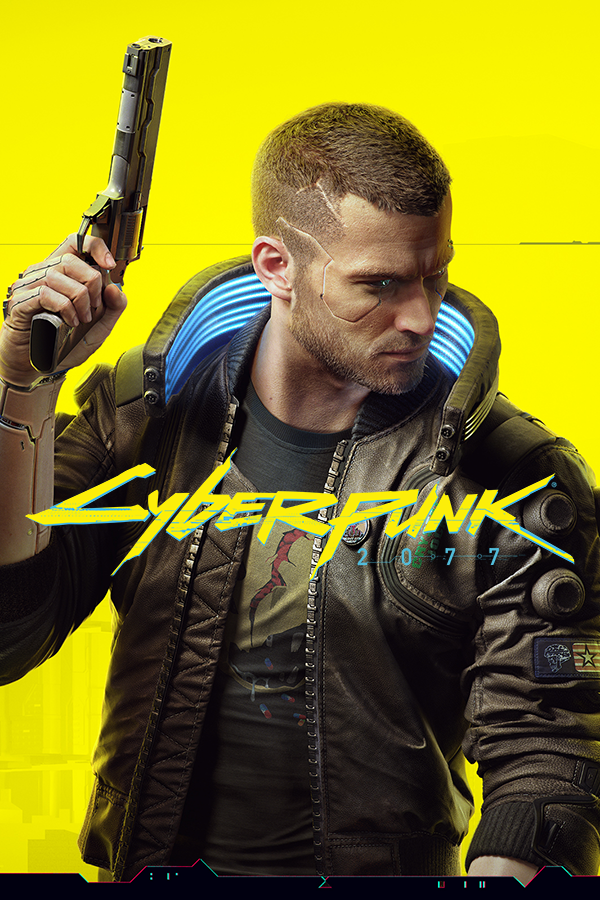
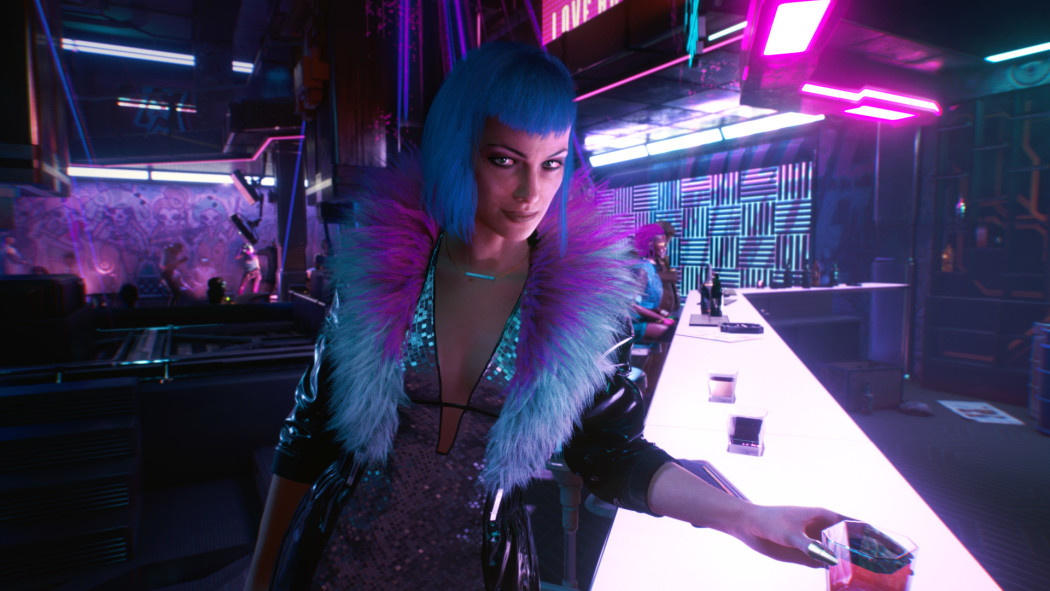
However, if you look underneath all the hype, hate, and sometimes unfair controversy, there’s a great game here. The story and the atmosphere are the main reasons why I stayed. You play as V. A vigilante or mercenary for hire who ends up in the wrong place at the wrong time and gets involved in a corporate terror plot that changes his or her life forever. The entire story revolves around a device you end up acquiring on a job, and this device is the key to immortality. This device also has Johnny Silverhands, played by Keanu Reeves, and one of the reasons why the game got so much hype is that he is a digital construct that is trying to take over your mind. I don’t want to spoil too much of the main story, but my favorite parts of the game were the side missions with the other characters like Panam, Judy, and Claire. These missions really develop a relationship and a strong personality and are one of the shining points in Cyberpunk.
One of the first problems that sets in early is character customization. Ignore all the sexist homophobes who were mad about being able to make your characters transgender. The anatomy is off, first off, and doesn’t look right, and what’s the point? You can only see the genitalia in the player menu; it’s censored in mirrors, and the “sex scenes” are awkward and pointless. One of the core gameplay elements of the game is Brain Dances, which are virtual scenes that you can manipulate during missions, or basically a half-assed detective mode. Some Brain Dances are “sex scenes,” but I just think these were added to add controversy. On top of all this, you can’t change your character’s looks after the initial start of the game. Just why?
The way to get around the game and various missions can be a bit messy, but the open world of Night City is gorgeous and has a fantastic atmosphere. There’s the main city itself, the outskirts, which are like a desert-type environment; there are suburbs; and various other locales to actually make it feel like Los Angeles. You can walk, run, hijack cars, and fast-travel at certain points once you discover them. Missions are found via random encounters on the street, phone calls, texts, and other means. I never got around to finishing all of them, as the ones revolving around the side characters are the most interesting, and the rest get kind of repetitive. Driving the actual cars is not my favorite, as before the 1.2 patch, they were just broken. They look absolutely amazing and have some insanely cool designs, but sadly, they just don’t drive very well.
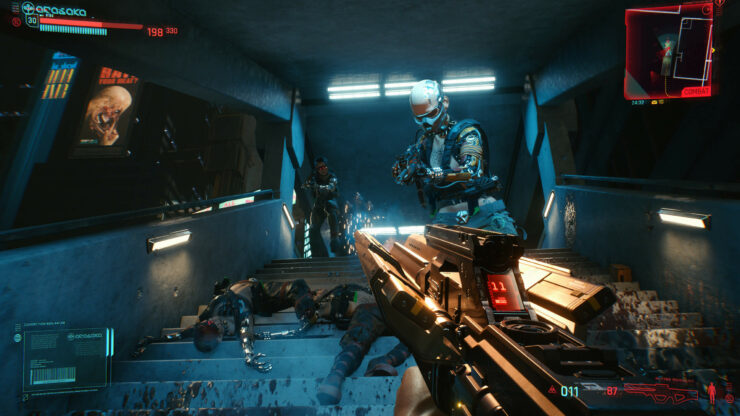
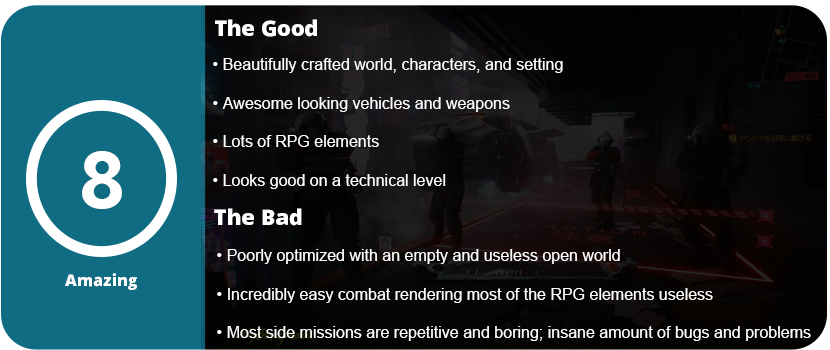
With this being a CDPR game, there are RPG elements involved. There’s a skill tree, cyberware implants, and stats on weapons and armor. It’s pretty detailed, especially with all the wearable armor parts on every part of your body, but it’s also one of the most flawed areas. The skill tree is nice, with many paths you can take, such as melee, various gun types, stealth, and so on, but I felt a lot of abilities were useless, and I just got them to unlock an area I needed. Skill trees tend to be very useless in many games these days, and sadly, they aren’t any better here. When it comes to weapons, they are incredibly unbalanced, with sniper rifles doing one-shot kills no matter where you hit the target early on in the game or at low levels. Then you will get a pistol that will barely do any damage at a much higher level, even if you have the skills that boost pistols. It’s improved in patches but still remains a problem. The bottom line is that Cyberpunk 2077 is incredibly easy. While stealth is fun and a good option for most missions, blasting through the game isn’t that hard. I rarely ever died, as health items are everywhere and so is ammo. While shooting is fun and satisfying, and the weapons feel good, the game is just way too easy.
You can then visit Ripper Docs to install implants that add bonuses and unique weapons to your body, but in the end, I rarely ever visited these and never filled all my slots. What’s the point? The game is so easy, I never really needed much. Just a shotgun, sniper rifle, and an assault rifle or sub-machine gun of some kind. You can add mods to these weapons like sights, silencers, and various others that modify the stats, but the combat is so unbalanced and easy that there’s really no point. Stealth missions mostly rely on your stealth skill tree stats, and you can also hack stuff, but I also found this rarely useful as the game is just so easy that you don’t need these small advantages that would turn the tide of a battle, like, say, Deus Ex. If I got busted, I could easily wipe everyone out with my one-shit kill sniper rifle and hold onto this gun through the entire game.
That brings me to the other side of Cyberpunk’s gameplay loop. After about 10 hours, you will have seen everything the game can do, and you will know whether you want to complete every single side mission and gig call or just plow through the storyline and call it a day. While I love Night City, there’s nothing to do inside of it. Sure, there are various shops you can visit, and you can look at dildos and sex toys inside of windows, but that’s it. There are no side activities like mini-games, no property you can purchase for player homes, or anything like that. I felt like this large, gorgeous city was wasted away, as it’s just a conduit between missions. This is not a cyberpunk playground like many of the early trailers suggested.
In the end, don’t go into this game expecting a true “next-gen” title that raises the bar and changes games for how we play them today. A lot of people went into this game expecting some unreal level of detail, not to mention the visuals. While the game looks amazing, it’s poorly optimized, even on the latest PC hardware. Ray-tracing is pretty much pointless; even on my 2080, the game would dip well below 30 FPS. The only saving grace for PC gamers is the DLSS option, or playing at 1080p resolutions. On my i7 10700 and 1660ti setup, the game played fine in 1080p, but I still got dips here and there. It’s one of the most poorly optimized games I have played in recent years, and while recent patches have made the game more stable, they don’t fix the crazy dips all over the game. It’s even worse on PS4 and Xbox One base models. So, go in expecting a fun story, fun, albeit easy, combat, interesting vehicles, and a cool cyberpunk city to run around in. Don’t go in expecting something revolutionary.
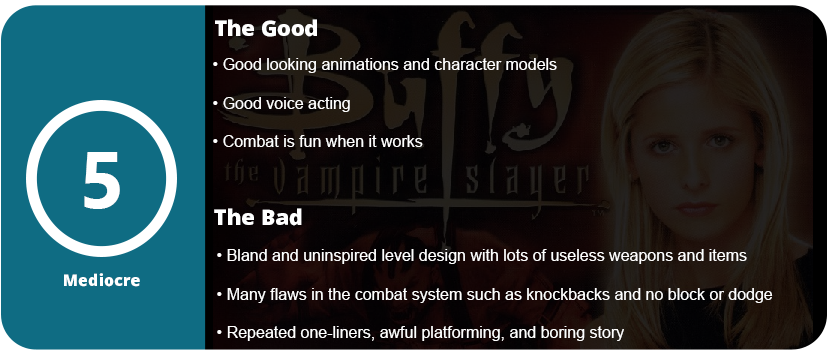
For starters, I’m not a Buffy buff. I never watched the show growing up, nor did I as an adult. That’s okay, though, as there are many great video games based on movies and TV shows that are fun without needing to watch the material they are based on. Buffy seemed like this kind of game at first. While it’s clearly geared toward fans of the show, I have no idea what’s going on in the story. You are basically trying to stop some evil vampire spirit from ending the world. That’s literally it. You chase him around as he possesses various characters from the show. It’s dull and rather uninteresting, and the game is also poorly written. Buffy’s one-liners get old as all five of them repeat constantly throughout the game, and so do the one-liners from the enemies.
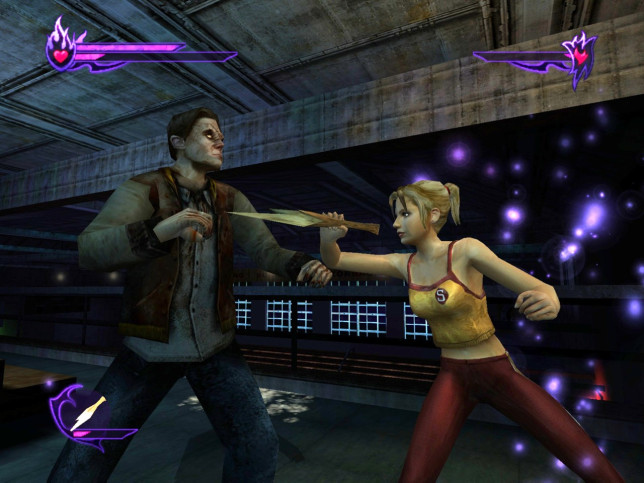
That’s just the beginning. Buffy has an array of acrobatic moves, and they are actually quite good for such an early 64-bit era game. The animations are well done, and the combat, when it does work, is pretty awesome. Buffy can punch, kick, and execute enemies with a wooden stake. She also has Slayer Power, which allows her to add on some powerful moves at the end of combo chains. This, again, seems great on paper, but it’s poorly executed. While the animations are nice, there’s constant knockback, and you can’t interrupt the enemies’ attacks. This is the key flaw in the entire combat system. There’s no dodge button, no parry, and no way to counter attacks at all. You just have to take it and fall down and get back up, but some enemies will stomp you, and then multiple enemies join in, and you end up dying and losing health over cheap gameplay mechanics. The game is just very cheap all around.
Another issue revolved around this is the terrible jumping and extreme distance you get knocked back at. This leads to cheap deaths off cliffs as some of the fighting areas are tiny and are not designed around how far Buffy can be thrown. I would make it to the end of a level and die just because I got picked up and thrown off a cliff due to the poor level design. It’s everywhere in this game, including platforming segments that shouldn’t exist here. I never finished the game due to the second-to-last level having so many cliffs of death, tiny arenas, and platforming woes that after the 7th time dying from a cheap death, I put the disc back in the box and shelved it. I’m not missing out on much anyway.
If that isn’t painful enough, the level design is boring and trite. You walk down boring brown or gray hallways, fight a few enemies, flip a switch, and move on. The level design is just bad, and every location is so uninteresting. A foundry, a high school, a sunken church—all just blandly designed. At least the character models look decent, and the voice acting is all right. This also leads to healing and other items, which leads to the biggest flaw this entire game has, and what I think completely breaks it. All these other things would be done if you didn’t have to execute every enemy with a stake. You can knock them down to no health, and they won’t die until you execute them. This leads to more cheap deaths, as instead of them dying when their health is down, you then have to break through their constant blocking, get knocked around more, and lose more health, just to get in an execution. They will not die unless you have a stake or a glaive. Enemies block every single move you make, making combat take way longer than necessary, and they also shouldn’t take so long to die. For a beat ’em up, enemies should have more balanced health bars.
There are also items like holy water, hellfire, and a super soaker that contains both. This is a completely useless tool as it depletes within seconds and requires fonts to replenish, and only a few levels have them. It’s mostly used to take down certain force fields. Seriously, what a waste of time and effort! And that’s pretty much all Buffy has to offer. Some decent combat and animations are all the game has to go for it, but it is horrendously broken with terrible gameplay mechanics throughout the entire game.
I honestly can’t recommend this to anyone unless you are a Buffy fan, and even then, you aren’t missing out on much at all. The story is boring, the level design is uninspired and bland, and the game is nearly broken thanks to poor design decisions.
PC cases are something you don’t change very often. Usually once in a while, you buy a new motherboard and CPU, but in my case, I wanted to just upgrade. My previous case was purchased due to what was available at my local Fry’s Electronics at the time, and I wasn’t impressed with the Thermaltake View 31 much. It didn’t have a PSU shroud, so all the ugly cables were just visible, and all the rear cable management was displayed behind glass, which was odd. It also had flimsy thumb screws, and the panels were a pain to put back on. My front USB ports were going out, and it didn’t support a USB 3.1 Thunderbolt. I was just tired of looking at the thing, despite the space it had.
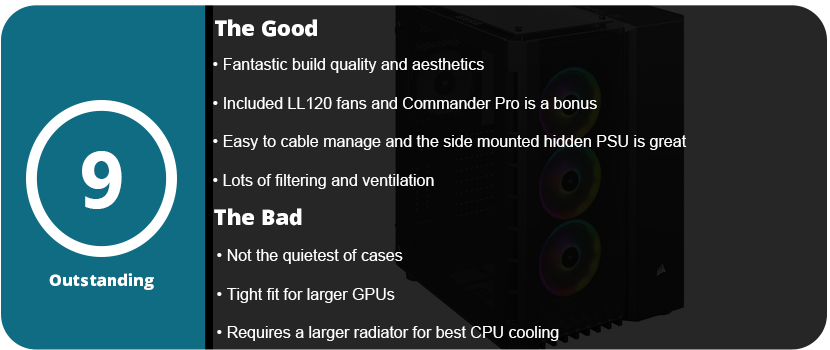
So, while switching to all Corsair RGB components, I decided to switch to a Corsair case. The only “smart” thing about the case is that it includes three LL120 fans and a Commander Pro, which was not in the description anywhere! I had no idea it included this, and it was a huge surprise. Corsair RGB fans are a pain to cable manage. Each fan has a PWM cable and an RGB cable. You then have to connect it to a Lighting Node Pro, which controls the fans. Then you have to connect the LED hub to the Node Pro. The lighting hub then connects to the internal USB, and the Node Pro connects to the internal SATA power. It’s a huge pain, but the fan hub eliminates the need for that LED hub.
The case itself was easy to build. The case comes with pre-installed standoffs, and the motherboard went in with no issue. The side glass panel is magnetically held closed, and then a single screw allows you to lift it off its hinge. The back panel is a solid sheet of aluminum with a filter for the PSU. The top glass is raised on rubber stand-offs, and you can insert an optional filter if you have a 240mm radiator you are installing on top. The rear has a slide-out filter panel, and so does the front. I love how the PSU is side-mounted in the back, and I had plenty of room for all the cables. There were also plenty of tie-offs and rubber slots in the back. The case also has a 3.5″ and 2.5″ drive cage. I chose to remove the 3.5″ cage, and the 2.5″ cage has four toolless slots that can be snapped apart. I then just screwed this back in to free up some room.
The case has an option to side-mount your GPU, but it’s pretty close to the glass, and these mounts are typically not recommended for high-end cards that get hot. My RTX 2080 barely fit in here as the GPU clearance is only 330mm and my card was 327mm, but MSI cards are usually on the larger side. The pointy end of the GPU shroud is mere millimeters away from a fan, so it was a tight fit. You could do a SLI setup in here, but it would be super tight. The case comes with four thermal sensor cables, which I chose not to use, at least not for now. It also came with four PWM fan cable extensions. The usual front panel cables were present, but I never plug in the front audio as most of these cables aren’t shielded properly and you get interference, and I just never use them. What is nice is that the front USB is only 3.0, but there are only two, which is limiting, but most PCs have plenty of USB ports on the rear. I only use it for my mouse dongle and a USB stick or phone.
When it comes to aesthetics, the case is gorgeous. The soft aluminum accompanied by the glass and that top raised panel are beautiful. It’s not the best when it comes to fan noise or even temps, probably mid-tier, but it’s good enough for most gamers. I wouldn’t recommend a SLI 3090 setup in here, but with a single card and a liquid-cooled CPU, you’re going to be able to drop your fan fairly low. At idle, my RTX 2080 stays at a cool 32°C, and at heavy load, it hovers around the mid- to high 50’s, which is better than my previous case. It might be due to my bottom intake fans blowing that cool air onto the GPU at closer proximity. My AIO-cooled Intel i7-8700 idles around 38 c, and at full load, the cores never go past the mid- to high 60s. That could be cooler if I had a 240mm rad instead of a 120mm, but it will do.
Overall, the Corsair 680X is pricey but worth the money. A lot of that cost is the three LL120 fans, which normally cost $130 alone, and the Commander Pro, which is another $80. It’s a premium case for those who love Corsair’s suite of RGB components, but if you aren’t an RGB person, then this case isn’t for you, and you should get a nonglass case.
Headsets are not something that is vital to my PC setup, but I do enjoy them. I have my own place, so I can enjoy loud, booming speakers (which I do have), but sometimes when people are sleeping or I want to block out the noise, I enjoy a good headset. I’ve ever had three in the past, with this being my fourth headset, and I have to say I’m quite impressed with these for various reasons.
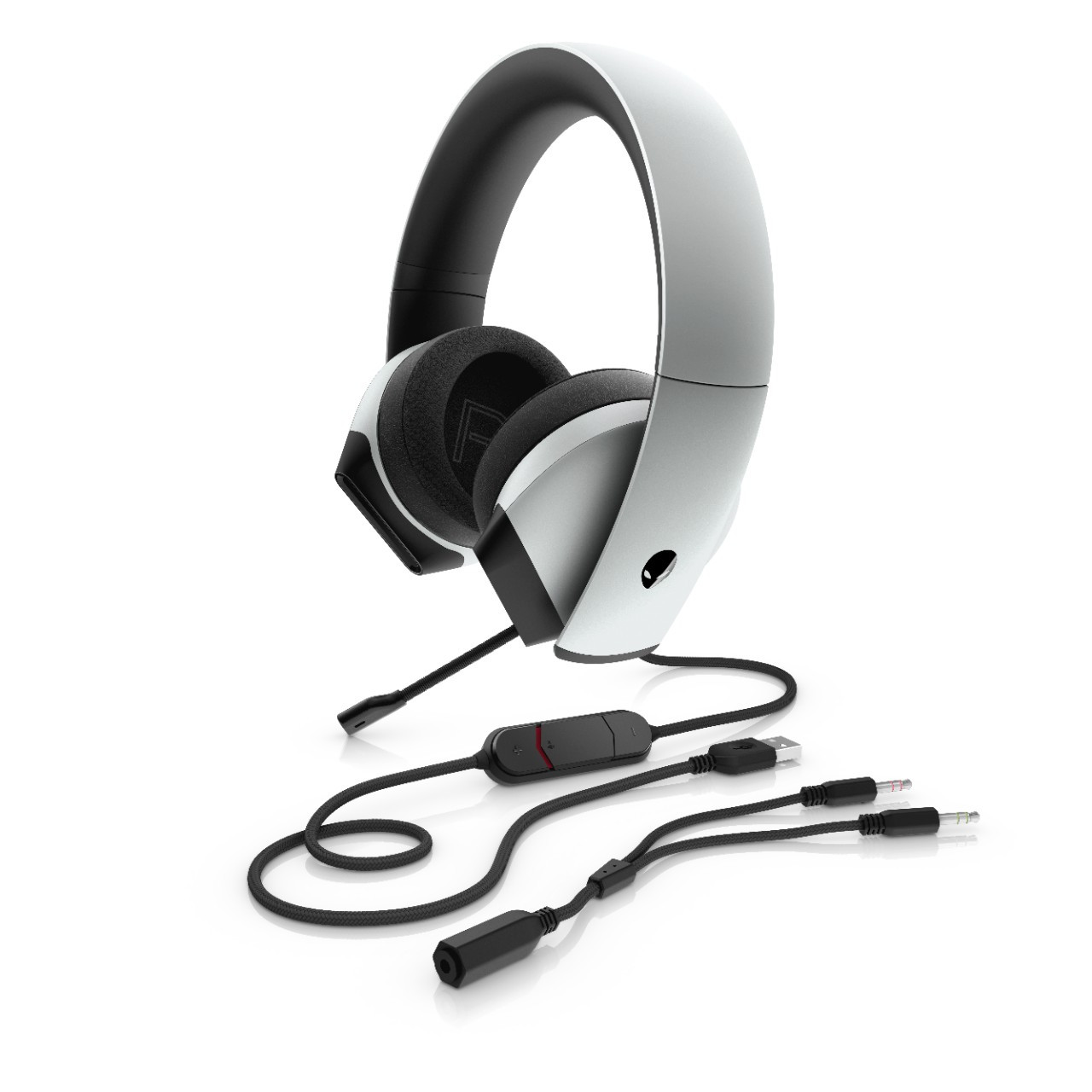
The unboxing experience is quite nice as the box is very large, and when you open it, the headphones are just laying there strapped in with velcro ties. Below it is a compartment that houses the cables, and that’s about it. The headphones are quite heavy and bulky, but for my large head, they felt fine. The strap cushion is rather nice and made of a soft silicone rubber-type material, and the ear cups are large, soft, and cushy. The earphones adjust inside the strap rather than lengthening it. I found this rather nice, and the cups always swing out 90 degrees, so they rest flat. There is a nice alien head logo on each ear cup and the name across the strap. They are very minimalist and sleek-looking. I picked the white ones to match my Lunar Light laptop and mouse.
You have the option of a USB DAC cable and a 3.5mm jack with a splitter for the mic. Obviously, when using a PC, you should use the included DAC cable, as it drives the audio better than just analog input. I installed the DAC software, and there wasn’t much tinkering after that. There’s no RGB, so they don’t show up in the Alienware Command Center, but you do use the audio section to set everything up to make it sound how you like. Once I installed the driver and restarted, I booted up some music, and it sounded absolutely fantastic, albeit a bit tinny. I had to turn on the treble enhancer to make the tinniness go away, but the bass booster was awesome. This is the largest bass I’ve heard in any headset to date.
Once I booted up a game, I picked Doom Eternal, and I was met with fantastic audio, including some that affected me physically. These are noise-canceling and create a suction when you have them on, and the audio works differently than standard headphones. There are plenty of YouTube videos that explain how noise-canceling works. When I moved my mouse around on the menu in Doom Eternal, I literally felt the sound in my skull, and it felt like a dentist’s drill. That sounds unpleasant, but it was actually quite awesome. The enemies surround you, and the guns boom and rock your ears, and you can’t hear a thing outside of the headphones. I felt fully immersed, and I now see why noise-canceling headphones are loved by audiophiles and how they actually immerse you in the sound more. The 7.1 Surround option in ACC seemed to have helped, and while this isn’t true 7.1, the simulation sounds great, and I enjoyed it quite a bit.
After a few months with this headset, I have to say I quite enjoy it. The physical build is holding up, it still sounds amazing, and it’s a perfect match for any Alienware PC. While most people wouldn’t reach for these if they didn’t have an Alienware system, for those who do have one, this goes great with the latest system aesthetics and is a great-sounding headset.
Well, well, well, here we are a year later with Treyarch’s installment of the series once again after a decent hiatus. Black Ops is back on the table with an entirely new reboot, just like Modern Warfare was last year, but does it make as big of an impact? Well, most people will jump straight into the campaign first, which is one of four modes that flesh out Cold War’s myriad of gameplay variations.
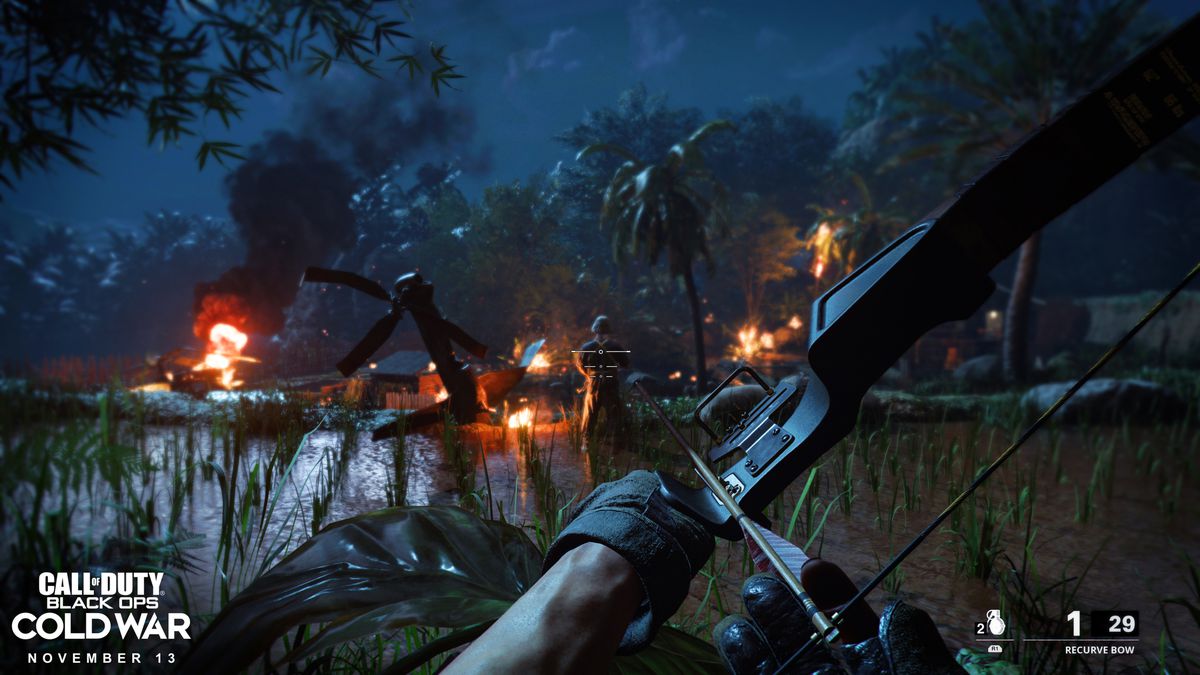
The campaign is set during the Cold War, as if the title hasn’t clued you in at all. The game is specifically set in the early ’80s, as you play as a band of special operatives ordered directly by U.S. President Ronald Reagan to stop a Russian terrorist from setting off a bunch of American nukes. The story is well-paced, and the characters have potential, but here’s the main problem with Cold War: the story is only a few hours long and is probably the shortest Call of Duty campaign to date. It was over way before I wanted it to be, as the slow burn was a nice pace over Modern Warfare’s fast-paced action, but that game had a much longer campaign and stronger characters that were, dare I say, pretty memorable and stood out. Cold War is set up differently and takes a different approach to the campaign in an almost 80’s spy type of way, and I enjoyed those brief moments. You walk about a hideout, and on the evidence board is your next mission, but two of them also require you to solve decoding puzzles, which were rather fun and neat. You need to find all the evidence pieces in the campaign to solve these, and they were quite challenging. Once you do, you get short side missions—nothing special—but those puzzles are one of many things that didn’t get enough time to mature.
There are bombastic scripted events like in every Call of Duty, but the quieter, more subtle moments are just as enjoyable. There’s an intense, open-ended level in a KGB base in Russia that has you playing as a double agent. It’s very tense, as you have to decide how to plant evidence to get access to a vault. You can do it in many ways by sneaking around restricted areas and planting things, opening things, and the various cat and mouse of everyone being on to you but not quite knowing it’s you yet. You have to stay one step ahead, and the script is well written for this. I loved this level, and that was the only one like it. The final level is a repetitive mess and feels too much like previous Black Ops campaigns that made no sense, but the campaign is enjoyable, albeit just way too short and underdeveloped.
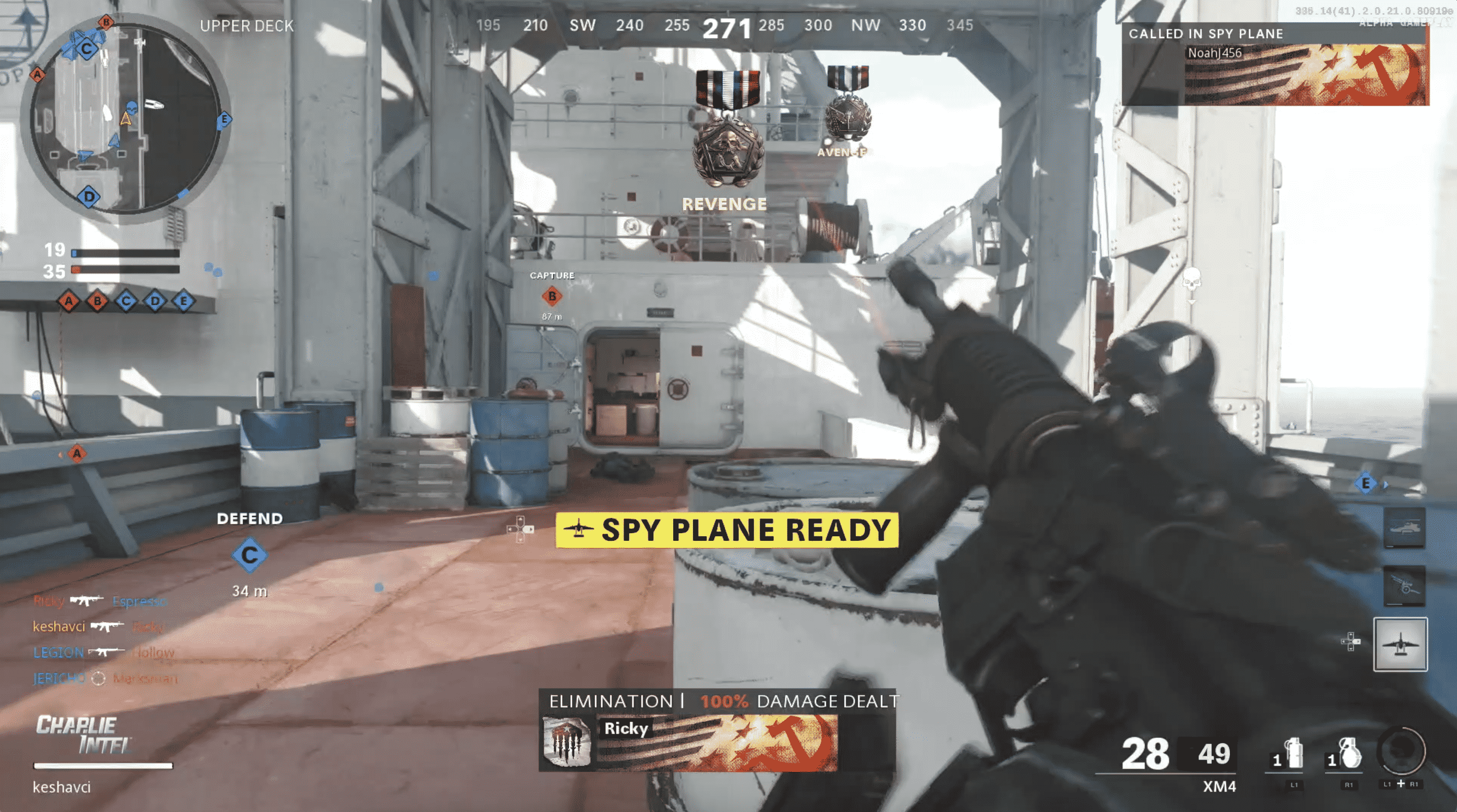
When it’s all said and done, you’re going to uninstall the campaign and move on to zombies and multiplayer. Let’s get into multiplayer first. I can’t stress enough that the Cold War is more arcadey than modern warfare. Even in the campaign, the guns don’t have the same realistic weight, quick scoping is faster, and everything feels like it’s fast-forward. The movement is about three times as fast, there are health bars above everyone’s heads, and there are scorestreaks instead of killstreaks. It seems like chaos is coming from Modern Warfare, but it’s a nice alternative to a more serious and realistic game. The UI and menu are pretty much identical to Modern Warfare, with a few tweaks, so you can jump right in without having to relearn where everything is. Blueprints, attachments, load-outs, and all that are still here. It just feels a bit more streamlined, and maybe some fat has been shaved off. Some will like it, and some will hate it.
The actual gameplay of the multiplayer is a standard Black Ops affair. The same modes from Modern Warfare carry over, like Team Deathmatch, Domination, Kill Confirmed, etc. The maps are also just as hit-or-miss as Modern Warfare and take some getting used to. Not everyone will be as fans of these maps as they were with Modern Warfare’s launch maps. The game is faster-paced and more arcade-like than Modern Warfare, with enemies darting across the map at an alarming and almost too-hard-to-target speed. Sliding is extended, shooting feels less weighty, and the overall scope of the game is just faster and lighter. This isn’t something I prefer. I like the more realistic physics and weight of Modern Warfare, as it makes the game a bit more tactical and slower-paced, but not necessarily easier, mind you. I do like the era-specific weapons like the M-16, M-79, M-60, and various other weapons that have been discontinued in today’s military practices.
Most people will probably come to Black Ops for its zombie mode, though. That’s the bread and butter of this series, and it doesn’t disappoint here. I won’t delve too far into this mode, but the newest features are larger maps and a weapon rarity system similar to RPGs. You’re allowed to bring in your multiplayer loadouts for the first time, and I liked the larger areas with the many hidden secrets. I feel like this mode needs to break off and expand into its own game, honestly. There is also the Dead Ops top-down shooter mode, which is a complete waste of time. It’s boring, repetitive, and feels half-baked. At this point, Black Ops is running into a ridiculous amount of modes and heading into Mortal Kombat territory for half-baked mini-games and too many ideas at once.
With that said, Cold War isn’t as good as modern warfare. It doesn’t feel as polished or well thought out, and honestly, it feels rushed. I think another year and the game could have been better, if not just as good, but as it stands, Modern Warfare is still the best game in the series to date. I love the faster-paced multiplayer; it was fun and exciting, but the maps are lackluster and left me wanting more. I also got bored of the multiplayer much faster than Modern Warfare. I honestly haven’t touched the game since the week of the game’s launch. I didn’t get that excited, addictive feeling of wanting more. The campaign was actually a lot of fun and really interesting, but it felt rushed and half-finished and just wasn’t long enough. There are a lot of good ideas here that didn’t get a chance to flourish, and that’s quite a shame.














































 thebinarymessiah.com
Try multiplayer. A lot of fun !