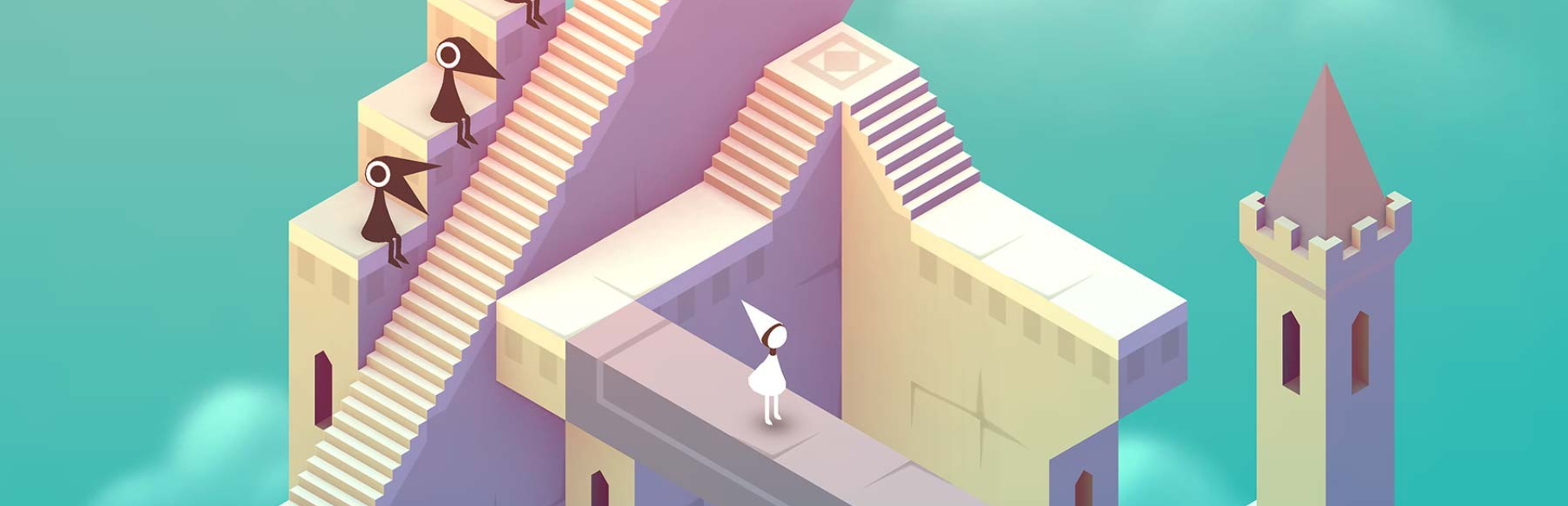
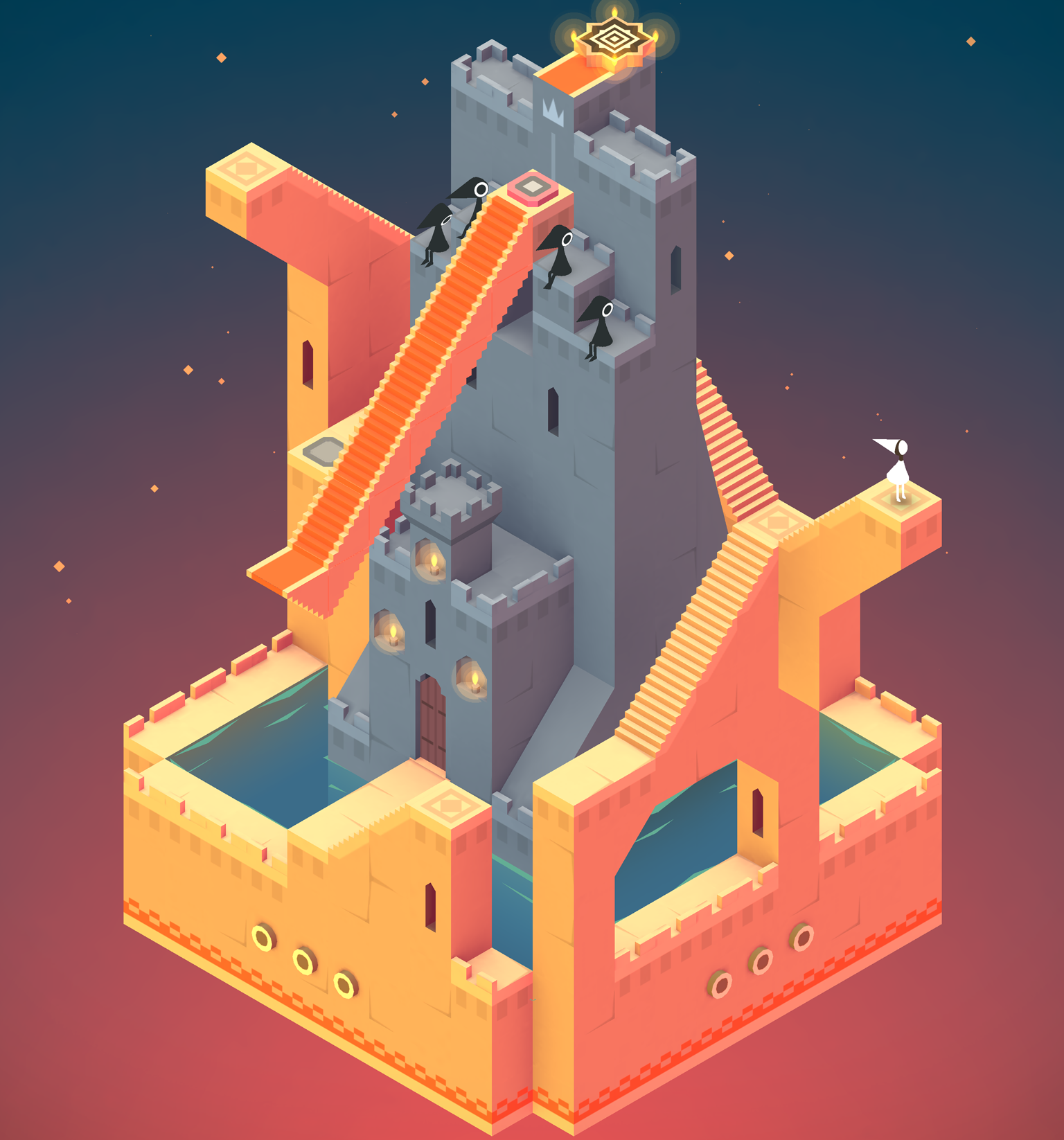
It’s very rare that a mobile game gets as artsy as an indie console or PC game. Monument Valley is where Journey meets Echochrome straight out of the gate. It has the aesthetics of Journey and the gameplay of Echochrome. Flipping levels to create illusions that create new pathways—that’s what Monument is all about. The game isn’t really all that hard; in fact, it’s a cakewalk, but it’s all about the experience.
There’s an underlying story here, and the ending is a bit touching. You’re a princess (that resembles a white cloak from Journey) who is trying to restore gems at the end of each level. If I say more, I will spoil the experience. New gameplay elements are slowly added in, like crows getting in your way that you must avoid or use to press switches. Walking on different planes is another, while an interactive column (that’s actually a small character) becomes an ally. The game is strange, yet so damn beautiful.
But there is one huge problem. The game is only 10 levels long, and they are extremely short. For $4, you’re getting a fantastic experience, but it’s over way too soon. I would have liked an endless mode or some sort of puzzle mode that didn’t include a story. The puzzles are just so fun to solve, and each level is like opening a present. The more you fiddle with the level, the more beautiful everything gets and the more fun it becomes.
As it is, Monument Valley is a rare gem on mobile devices. It looks and plays beautifully, but the shortness will enrage people who fall in love with it.
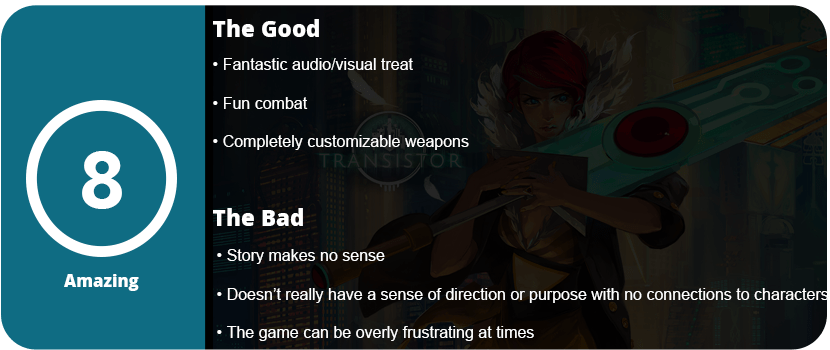
Bastion was a fantastic game with a memorable narrative and fast-paced combat. Transistor slows it down a bit with more strategic combat and a slightly less memorable story. The story is about love. The whole story never really makes sense; you’re just thrown in the middle of some battle between a woman named Red, a man named Grant, and a sect called the Camerada. I had no idea who this rebellious sect was, who Red was, or who Grant was. I guess that’s kind of the point. You’re in some sort of computer world, and the transistor is your weapon. A horde called the Process is trying to kill you.
The combat can be done in real-time, or you can stop time and plan out your moves. These moves eat away at a meter, so you need to plan carefully. Each enemy has a different play style, so you really need to adjust and learn each one. Your combat moves are completely customizable, which is a nice touch. At access points, you can load a main type of weapon onto each face button. There are two add-ons for each button, and these will add characteristics to that weapon. Of course, you can make any weapon you have the main weapon. This is great because it allows for many combinations of weapon types. However, you have a limited number of add-ons you can use until you upgrade your maxed-out stats. I found a very frustrating feature of your weapons to be your health. Once you lose health, a weapon will break until you get two access points again. If all four weapons break, it’s game over.
I honestly felt the game never really came together in any way except for the art and audio. The music is fantastic, and the game is wonderful to look at. There are some boss fights thrown in, but they’re extremely tough and will frustrate most players. I also found the game to be way too short, coming in at about 5 hours. With that said, the main focus is combat here. The game is intense, and the added element of strategy and the combination of weapons are all up to you. There’s a small test area you can access to hone your skills (kind of like Bastion), but in the end, this game isn’t something I’m going to remember a year from now. It’s a nice attempt at a spiritual successor but doesn’t really come close.
The game also lacks replay value. It felt so frustrating that the last thing I wanted to do was play again. For serious masochists, there are limiters you can add to make the game even harder. Once you kill an enemy, a cell will burst out. You get so many seconds before that enemy respawns unless you absorb the cell. A limiter can put a shield around this, requiring you to break it before absorbing it to gain more XP. But remember, once you have used your time to stop the ability to plan out your combat, you can’t fight in real-time until it recharges. You can literally lose a whole health bar in those 5 seconds.
With that said, if you loved Bastion, you’re not really missing much here except some eye and ear candy. The story makes no sense despite having a touching ending, and I never really connected with any characters. It’s a fun weekend to play through, not much more than that.
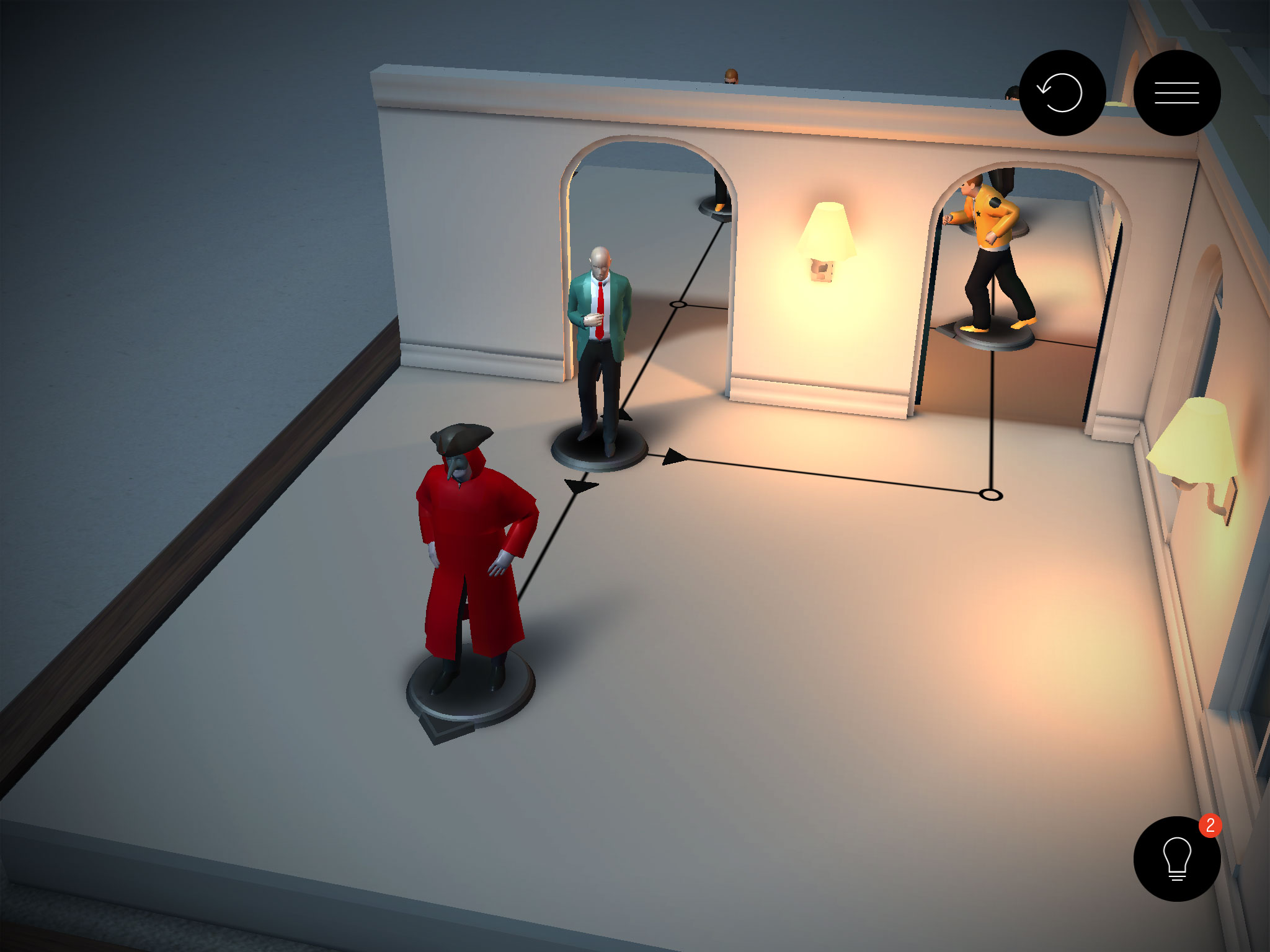
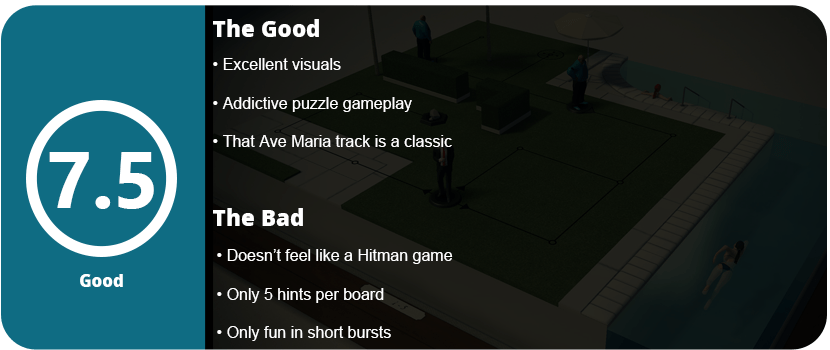
When you think of Hitman, you don’t exactly think of a board game. Hitman GO has Agent 47 sliding around various levels, trying to find the best way to the end, or his target, without getting caught. The enemies vary, with some who follow a path and will move one space when you do; other enemies will catch you if you land on the space they are facing (but they don’t move). The game is more of a puzzle than anything else. Some levels have briefcases you need to get to, while others want you to finish in a certain number of moves. There are other elements introduced later on, such as trap doors, items you can throw to distract enemies, and so on.
The game is highly addictive since levels have that (I get it now!) appeal where you just want to do one more level. I especially love when you have an assassination level and the Ave Maria theme plays from Hitman: Blood Money (composed by the oh-so-excellent Jasper Kyd of Assassin’s Creed II soundtrack fame). I also love the graphics, which look very good for a simple puzzle game.
However, this game just doesn’t feel like Hitman, and that’s the issue. Sure, you’re sneaking around, but there’s no violence, no gruesome death scenes, and no nudity. There’s zero plot (which is really fine for this kind of game), but many Hitman fans will scratch their heads wondering why this game even exists.
That’s not to say the game is bad. But even with faceless woodblocks, the game would have been just as good. At least non-Hitman fans can enjoy this game. Anyone who loves puzzles or board games, in fact.
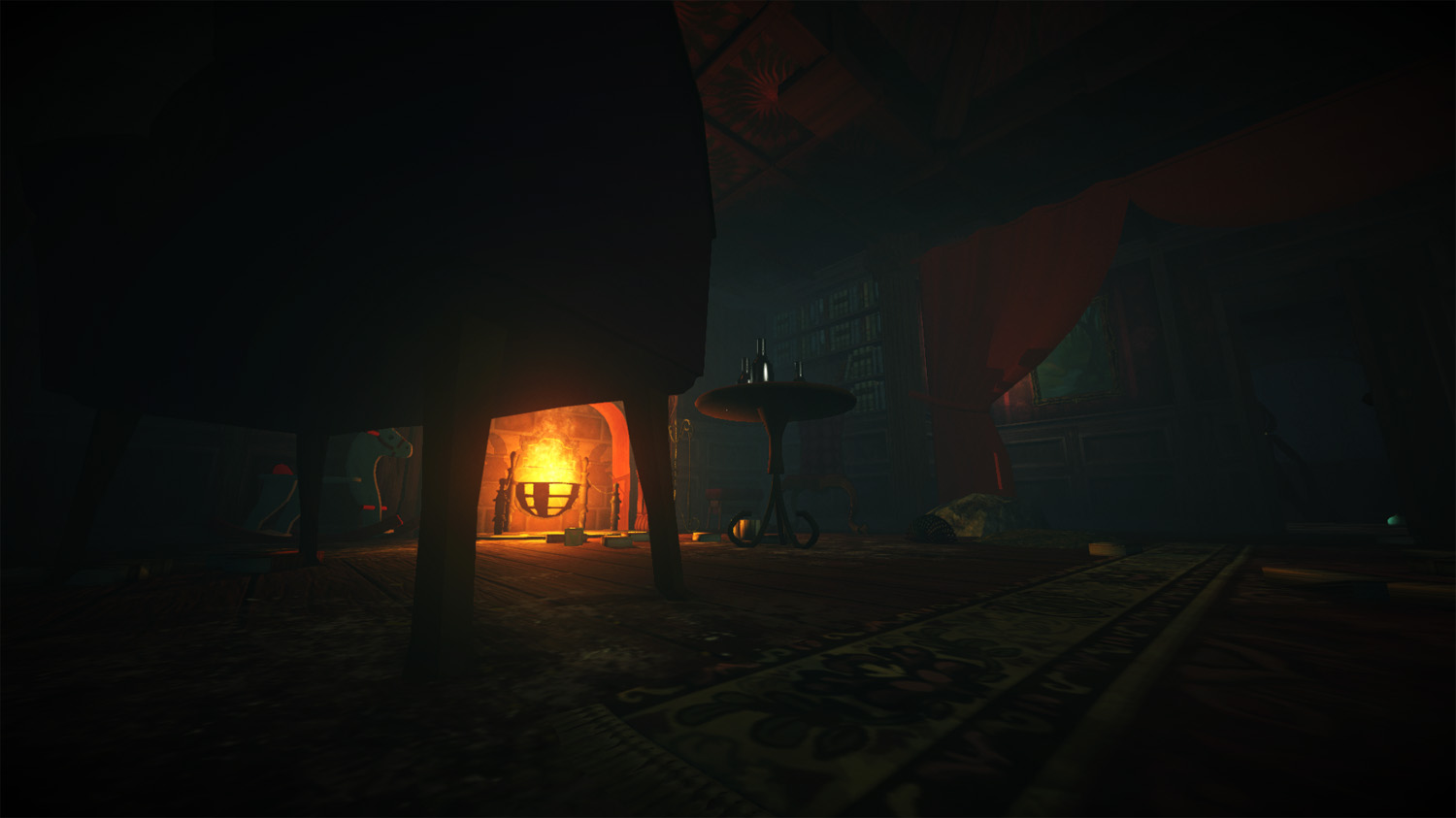
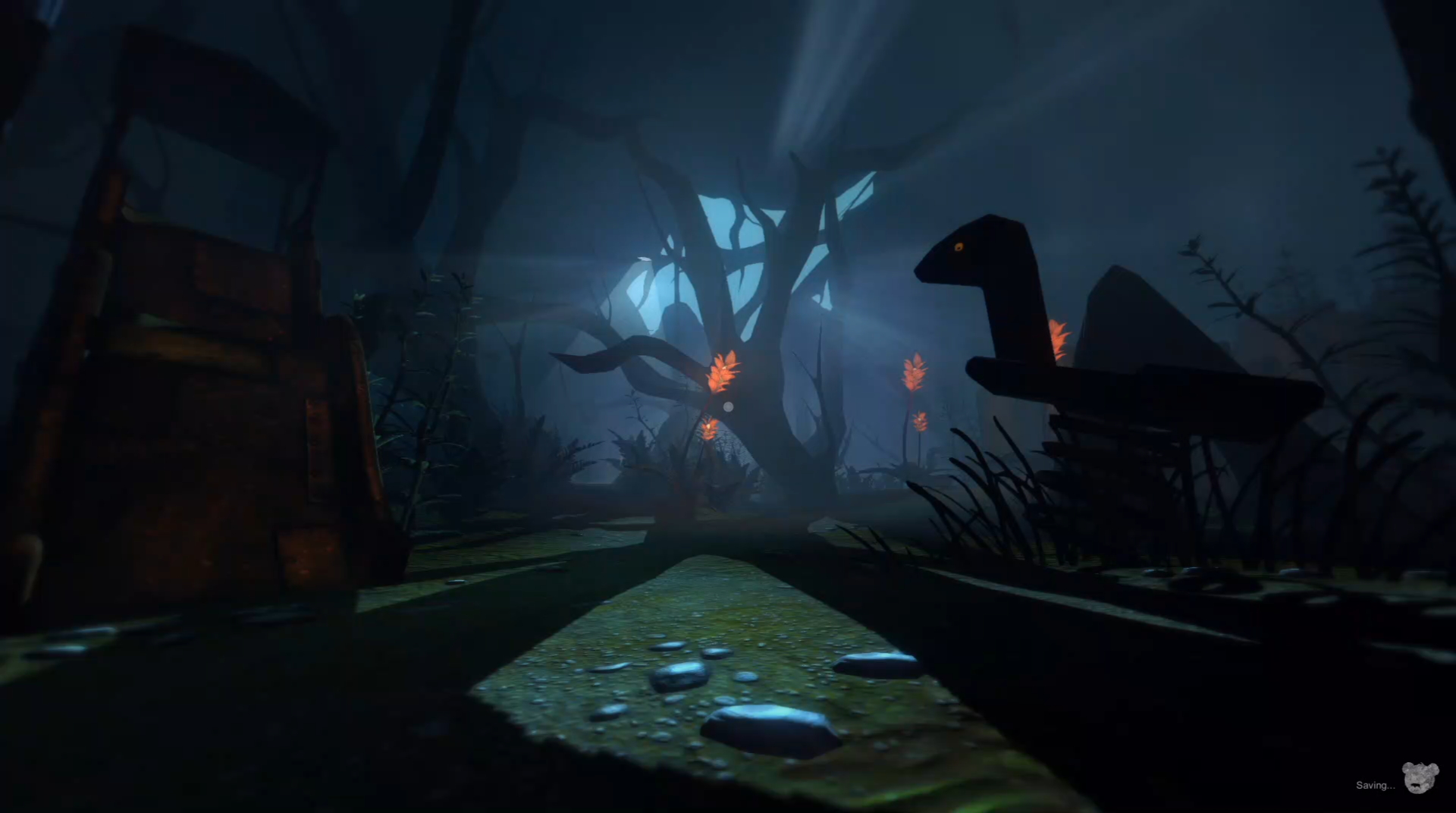
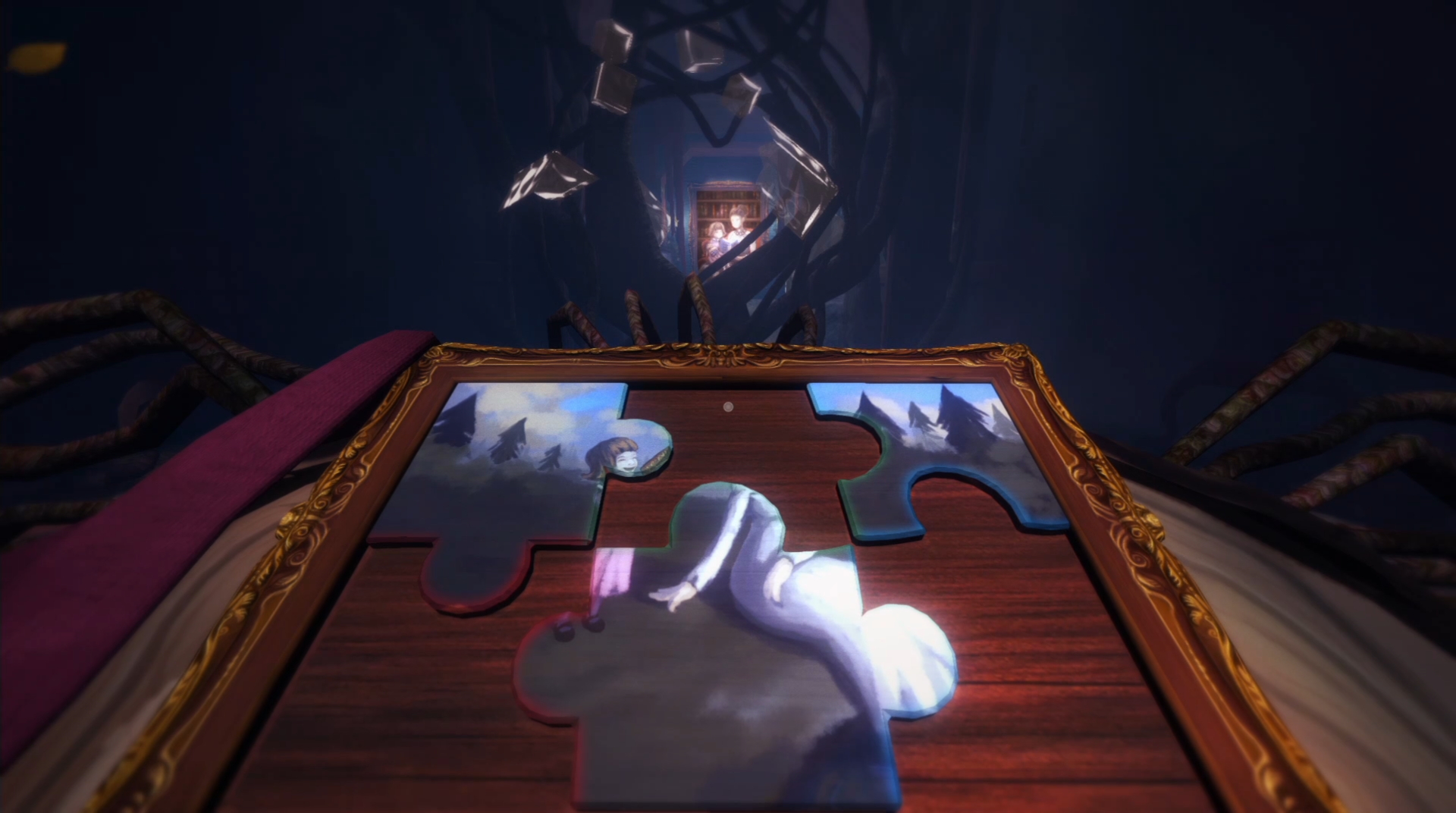
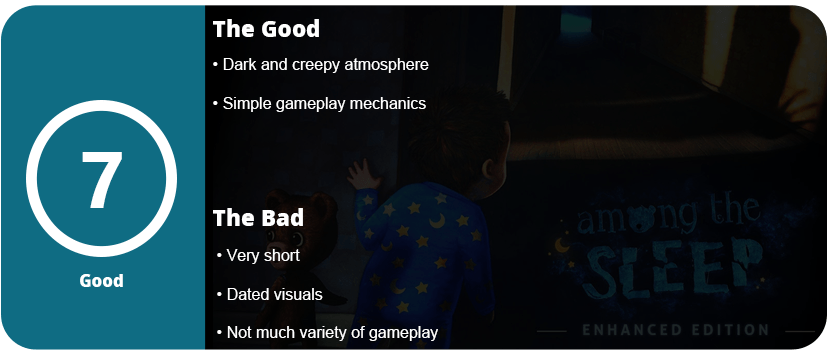
Ever since Amnesia: The Dark Descent was released, atmospheric horror adventure games have been popping up, but none are as good. Among the Sleep is probably the only one that has come close (even more so than Amnesia’s own mediocre sequel). You play as an infant (gasp, a baby in a horror game!) and you just wander around a very strange land-out horror adventure trying to figure out who this mysterious dark creature is that is trying to find you.
The game starts out pretty cheery. It’s your second birthday, and you get a gift from a mysterious person. As your mom puts you in your playpen, you learn the controls and get out to open this gift. Lo and behold, it’s a creepy talking teddy bear that you can hug and use as a flashlight. As you go deeper and deeper into this crazy world, the game gets tenser. You go from simple climbing puzzles to finding and hunting for items and keys and running and hiding from this scary creature. A lot of elements feel similar to amnesia, such as not being able to fight at all but only running.
Due to the claustrophobic and nearly haphazard way everything is laid out, no particular moment is really memorable, save for the first 30 minutes. You end up going through random doors; hallways appear out of nowhere in the dark; strange sounds will clatter away in the background; and things will flash in front of you. All of this is to make you tense, but there’s no real scary moment where you jump. It’s all about a tense atmosphere that keeps you on the edge of your seat.
The main goal, you could say, is to find four relics to unlock a mysterious door. This is your hub that you always come back to. The game actually has a pretty crazy finale, and things finally start clicking as to who this creature is and what it represents. It’s pretty sad in the end. The whole game can be beaten in less than 4 hours, which is a real shame. I would have liked to see the actual story unfold and some more cutscenes. The graphics are fairly decent, but the textures are flat and muddy, so you won’t be seeing much in the pitch dark 90% of the time. The game supports Oculus Rift if you are lucky enough to own one, so that is a bonus.
Overall, Among the Sleep is a short but sweet horror ride for any fan of amnesia or adventure games. There’s no combat, just you as a vulnerable baby trying to run away from your fears and keeping your teddy by your side.
Whether you like it or not, I have to start out by saying Lords of Shadow 1 was a masterpiece. The game was finely crafted from all angles that make up a great video game. It was the best Castlevania reboot ever done, and it was a fantastic action-adventure genre. It was challenging, beautiful, and memorable. Lords of Shadow 2 is not so much. In fact, I don’t know what happened. They took everything that made Lords of Shadow 1 great and threw it out the window.
The story picks up after Mirror of Fate. Gabriel wants to die and have eternal peace. He already has to deal with the death of Maria. Zobek (voiced by Patrick Stewart) will give him the vampire killer in exchange for killing Satan. In order to do this, you must help out various other people and find three of Satan’s acolytes. You see, even the story got screwed up. The first game’s story flowed and was touching. Lords of Shadow 2 takes forever to get interesting and has very few cutscenes until the very end. The setting also really throws the game off; being set in modern times just ruins the whole thing. The level design is terrible and confusing, with a poorly implemented “open world” design that just makes you want to tear your hair out.
The game starts off with a nice pace, but once you step out into the present, all that magic from the first game just disappears. Secondly, the combat hasn’t changed much, and the upgrade system feels meaningless. While the combat is still responsive and quite good, the enemies that defined the use of the combat system have been simplified and cut down to a mere half-dozen. Yes, the same half-dozen enemies through the entire game. It’s repetitive and irritating, and you will end up just running past most of them if you can. Not to mention the increased amount of collectibles in the game that require going back through these labyrinthine levels and remembering where these spots are.
If that isn’t disappointing enough, the ending is just terrible. Unlike the sad, tearful ending of the first game, we just get a “what the hell is this?” ending, leading into another Lords of Shadow game we know will never happen. At least the boss fights are fun and, honestly, the best part of the whole game. They are super challenging, and the designs are pretty cool. Satan is a very challenging boss and worthy of being an end boss. Chipping away at health and scrounging your items is fun, but it should be through the entire game, not just the boss fights.
It also doesn’t help that the only store is in one part of the entire game. You have to go all the way back just to buy something. I honestly wanted this game to have a more linear path, so it feels more unique. But here’s the worst part about the game: the stealth sections. Yes, why the hell are there stealth sections in a Castlevania game? They are broken, just boring, and completely slow the game down. Some are confusing, most are boring, and they are all completely unnecessary. Instead of the clever puzzles of the first game, the developers lazy through stealth sections to replace them. Lords of Shadow 2 is just a lazy excuse for a game that never should have been.
At least the graphics are fantastic, and the voice acting is superb. None of that matters if everything around it is a sub-part of a masterpiece. As it is, Lords of Shadow 2 won’t please fans of the first game and definitely won’t draw in haters of the first game to give it a chance. If you never play this game, you won’t miss out on anything, even if you played the first. Do yourself a favor and just forget it even exists.
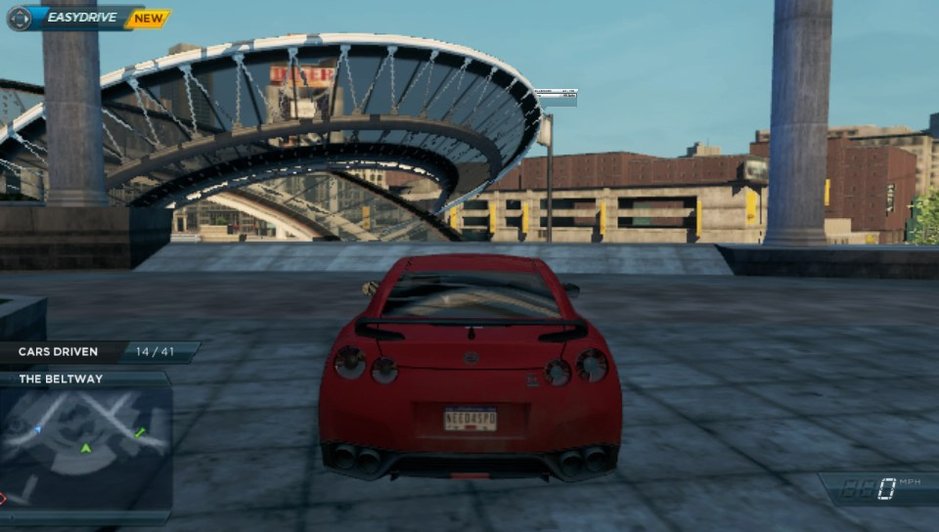
Need for Speed has had a great comeback over the last few years, and Most Wanted seems to have topped it. Being a remake of 2005’s excellent Most Wanted, this version is a whole new beast. The streamlined menus, AutoLog, the massive amount of real-world cars, and the huge world to drive in are something to get excited about.
My favorite feature has to be the new navigation menu. Being able to select races, customize your car, and jump to various cards with just the D-pad is great. There’s not even a need for a map. Select the race you want, and it will put the GPS line on your mini-map. Want to drive a different car? 3 D-pad clicks, and you’re there. This just seems nearly revolutionary for the racing genre, as they have been plagued with nasty menus for years. Outside of the menu are excellent racing moments and various types of races to do.
Sprints, circuits, fastest speed, and losing the cops the fastest are just a few types of races in Most Wanted. The whole goal is to find all the jump areas where cars are hidden throughout the entire world. Win first in each race for each car, and you will win part upgrades to make your car faster and better to drive. Some parts are better for certain areas, like offroad, but will slow you down on the asphalt. There are also various parts to help the cops, like re-inflating tires if you hit a spike strip or a stronger chassis for ramming through roadblocks. Like previous Need for Speed games (and any criterion racer), you can take down vehicles for more points to work your way to the number one most wanted.
A fun feature here (and it threw me for a loop) was having to take down a most wanted car to win their car. Sure, you can beat them in a race, but what about taking them down? It adds a greater challenge, but if you miss them, you can always summon the car back via the navigation menu. It’s not hard to work your way up to the top if you try to get first in every race. Even after you beat the most wanted vehicle, you can earn parts and find every hidden vehicle in the city.
If that’s not enough, try the AutoLog recommended objectives or try to find and hit every billboard in the game. There’s a lot to do in this game, and even though it can feel repetitive after a while, there’s just a great sense of accomplishment from getting first in every race. Let’s talk about graphics. Most Wanted is one of the best-looking games on the Vita. The sense of speed is great, and the controls are amazing. It doesn’t look like the game took much of a hit from being downgraded graphically, but it was hand-tailored to the system. The game even sounds great, and I spent hours just racing around, completing races without ever getting bored. Is there anything bad about Most Wanted? Mainly how repetitive the races can get overall, but the variety of cars keeps this played down a bit. Crashing every 5 seconds can get annoying, but that’s expected. Most Wanted is a must-have racer for any system you can own it on.
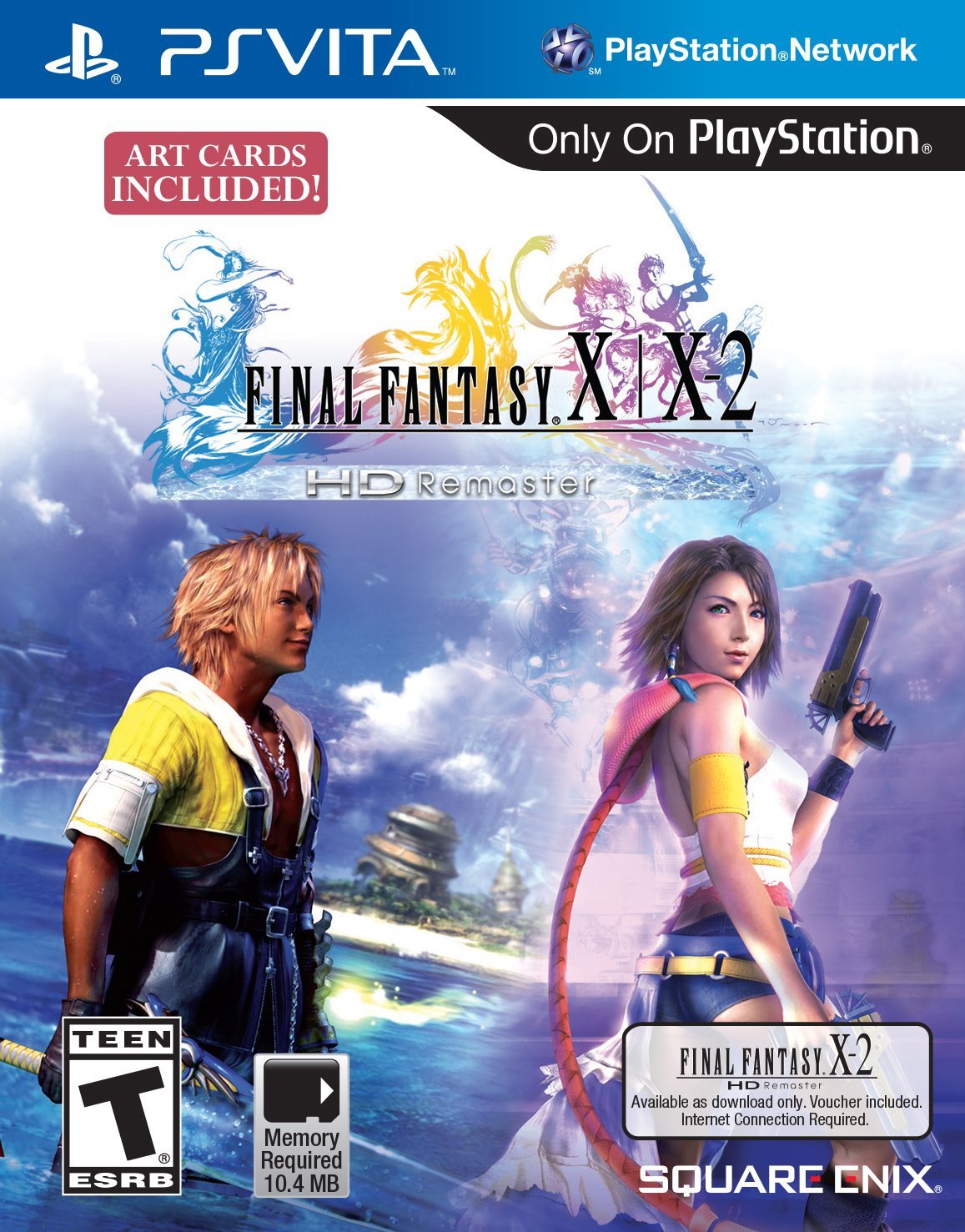
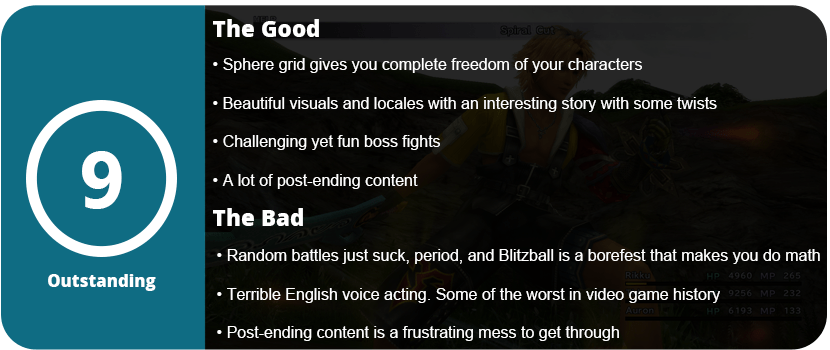
Final Fantasy X was a game in the series that really shifted things around. It broke some common JRPG rules and was a bit all over the place. This was the first JRPG I had ever beaten as a kid, and it was the first Final Fantasy I ever finished. I have a lot of fond memories of this game, and the HD Remaster brought a lot of those back.
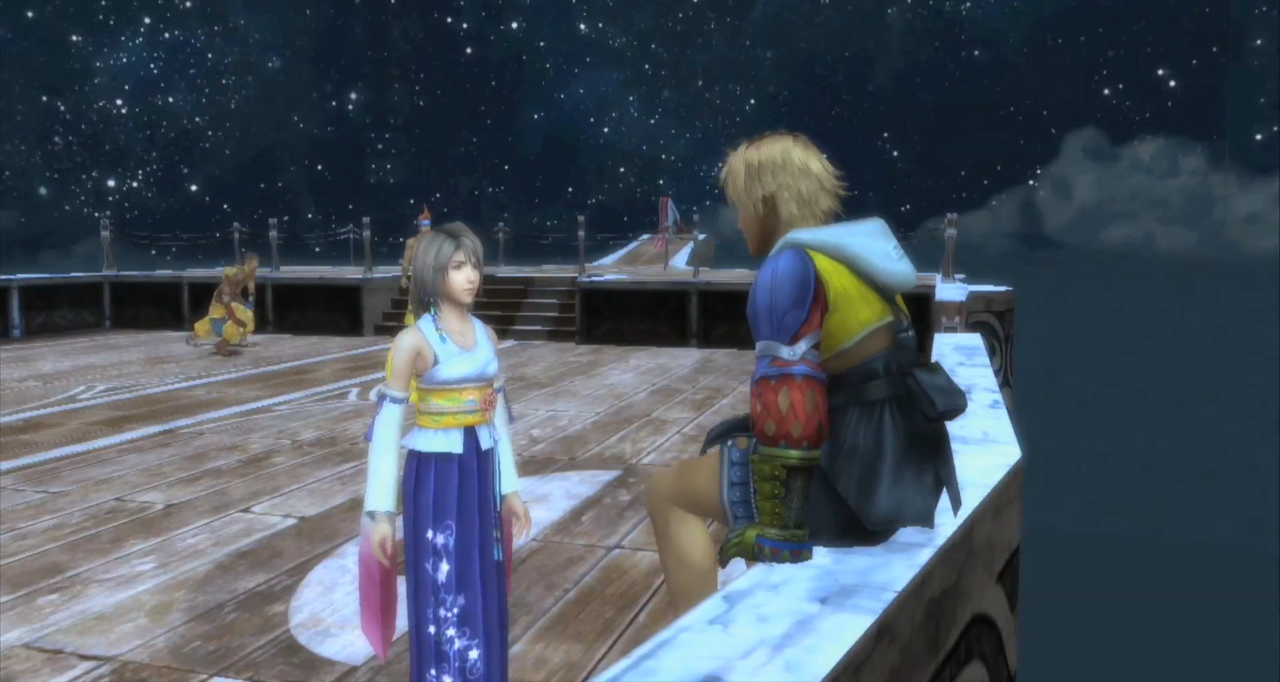
The core game hasn’t really been touched, but US gamers will finally get a taste of the tougher international version, which adds an expert sphere grid and Dark Aeons, which are the toughest enemies in the game (some have millions of HP). Outside of the game, the game is still the same, with great characters that are memorable and beautiful locales. The story is a bit confusing at first, but very original, if not very deep. You play as Tidus, who is a young man sent forward in time hundreds of years into the future. His original home is now a sacred ruin, and a giant being called Sin is destroying humanity. Every 10 years, this sin comes back, and the calm ends. Another summoner must go on a pilgrimage to gather all the Aeons and take down Sin for another 10-year Calm. Your goal is to put a stop to this cycle. You gather your crew along the way to level up and put an end to all this nonsense.
Before you jump into this game, you must have a mindset from when the PS2 first launched. This game was fantastic back in the day and still holds up well. Most JRPG gamers will be thrown off by the Sphere Grid. There is no traditional leveling up where you gain levels. Instead, you acquire AP and get sphere points, which allow you to freely upgrade various attributes and skills for each character. The expert sphere grid allows you to use keys to go off your path and learn other abilities from other characters. This is a lot of fun and gives you total freedom over your character.
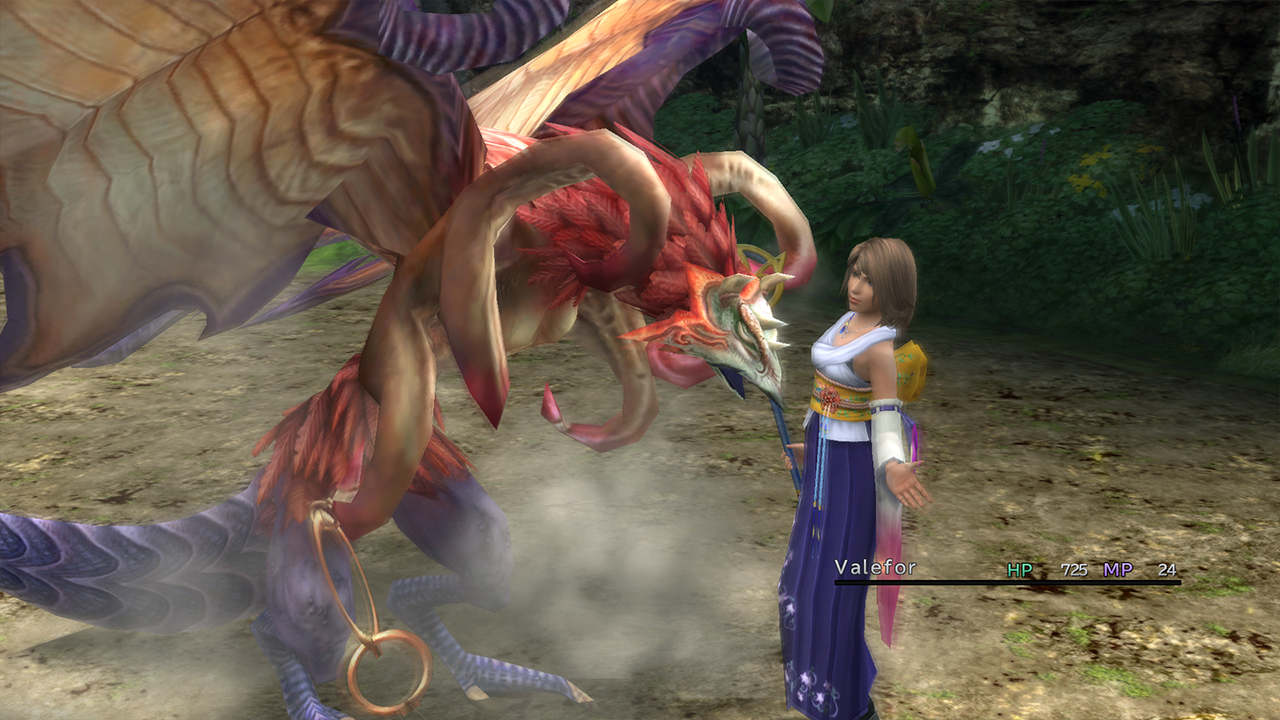
Outside of the sphere grid is the obvious combat. Yes, there are random battles, and some areas are so bad that you hit one every 2–3 seconds—literally. A maximum of three characters can battle at once with the freedom to swap out. It’s the usual JRPG turn-based battle system, but there are overdrives that are crucial to winning boss fights. Characters learn new drives as they battle. Aeons are also essential, but only Yuna can send them in. They are large, heavy hitters that will take away massive damage and can also be overdriven, which is probably the #1 technique for winning tougher boss fights. Like any other JRPG, learning enemies’ weaknesses and battling with magic is a must. Some bosses nearly turn into puzzles where you must cast Reflect on them so their healing spell bounces off of them onto you. Some bosses will cast status ailments that can cripple your entire party. If you don’t grind a bit and stay ahead of the game, you will struggle.
Outside of battle, there are the Cloister of Trials, which are a huge pain and aren’t fun at all. These are puzzles in which you place various spheres to unlock doors. Another huge pain is the Blitzball mini-game. This isn’t fun at all and requires math to actually play. It’s stiff, shallow, and just plain boring. I hated it as a kid, and I hate it even now that I know math better. It’s all nearly luck-based and a roll of the dice. You have almost no control over characters.
FFX is also full of pre-final boss content, but there are a lot of requirements to get this stuff. Ultimate weapons are a must-have to do more than the 9,999 HP damage limit. However, they require you to be in certain areas, acquire certain other items, or even get through harder areas that require getting through other areas just to get to that area. Sounds confusing? It is. I spent a good 15 hours just trying to figure all this out and could get only one optional Aeon (Yojimbo). Anima is another optional Aeon but requires getting through a tough boss with the three weakest characters (Tidus, Rikku, and Wakka) and then getting all the destruction spheres in every trial. It’s a huge pain, requires a lot of running around and backtracking, and can make you frustrated. You can also monster hunt, but this requires training a Chocobo (which is tough as nails to get through), and then capturing the toughest monsters in the game easily requires ultimate weapons, which require more backtracking. It’s a frustrating mess but also somehow extremely satisfying once you do it.
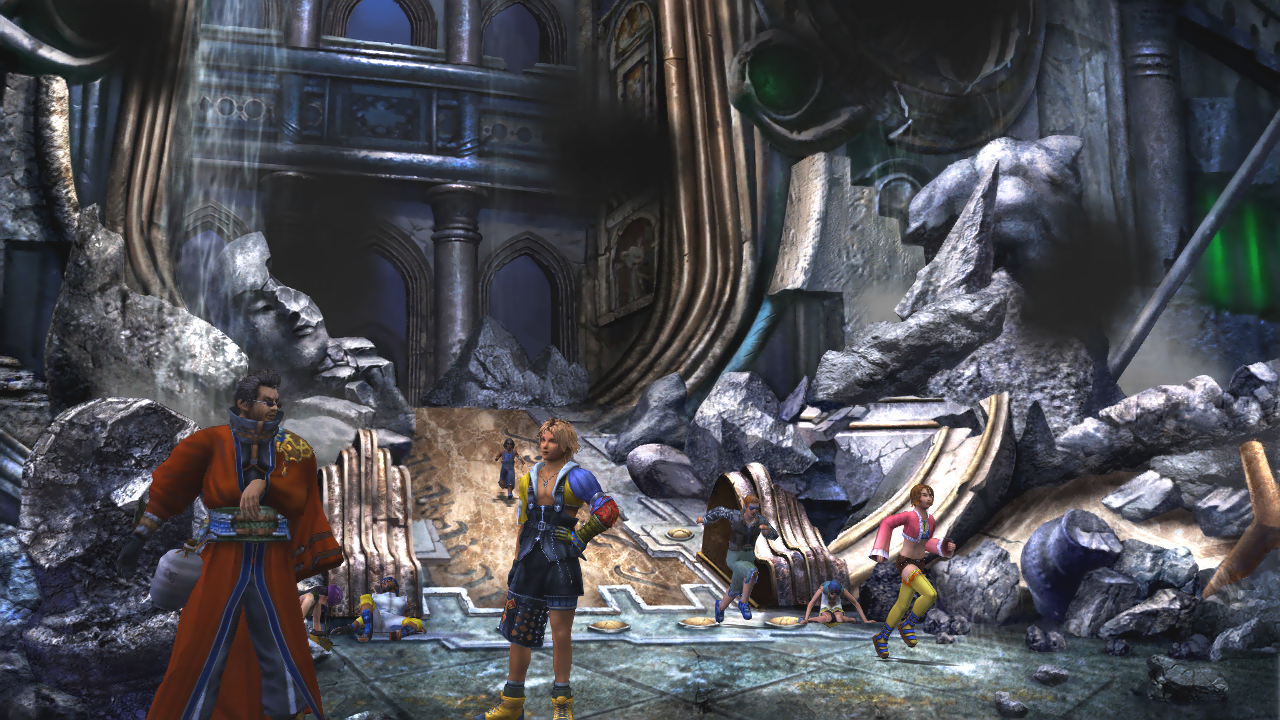
With the main game out of the way, let’s talk about visuals. The HD upgrade isn’t exactly what you think. Most of the game has been remodeled, and all the main characters are completely redone; however, many monsters and NPCs just had a few passes of texture filtering, and that’s it. It really looks ugly in spots, but it’s not so bad if you’ve played the game before. I just wish the Japanese voice track was on here since the English voice acting is so terrible and embarrassing to listen to.
Note: Shame on you, James Arnold Taylor, for your terrible voice acting in Tidus. You’ve done better! Like Ratchet from Ratchet & Clank, Gabriel Logan from the PSP Syphon Filters, and even Marty McFly from the Back to the Future adventure games!
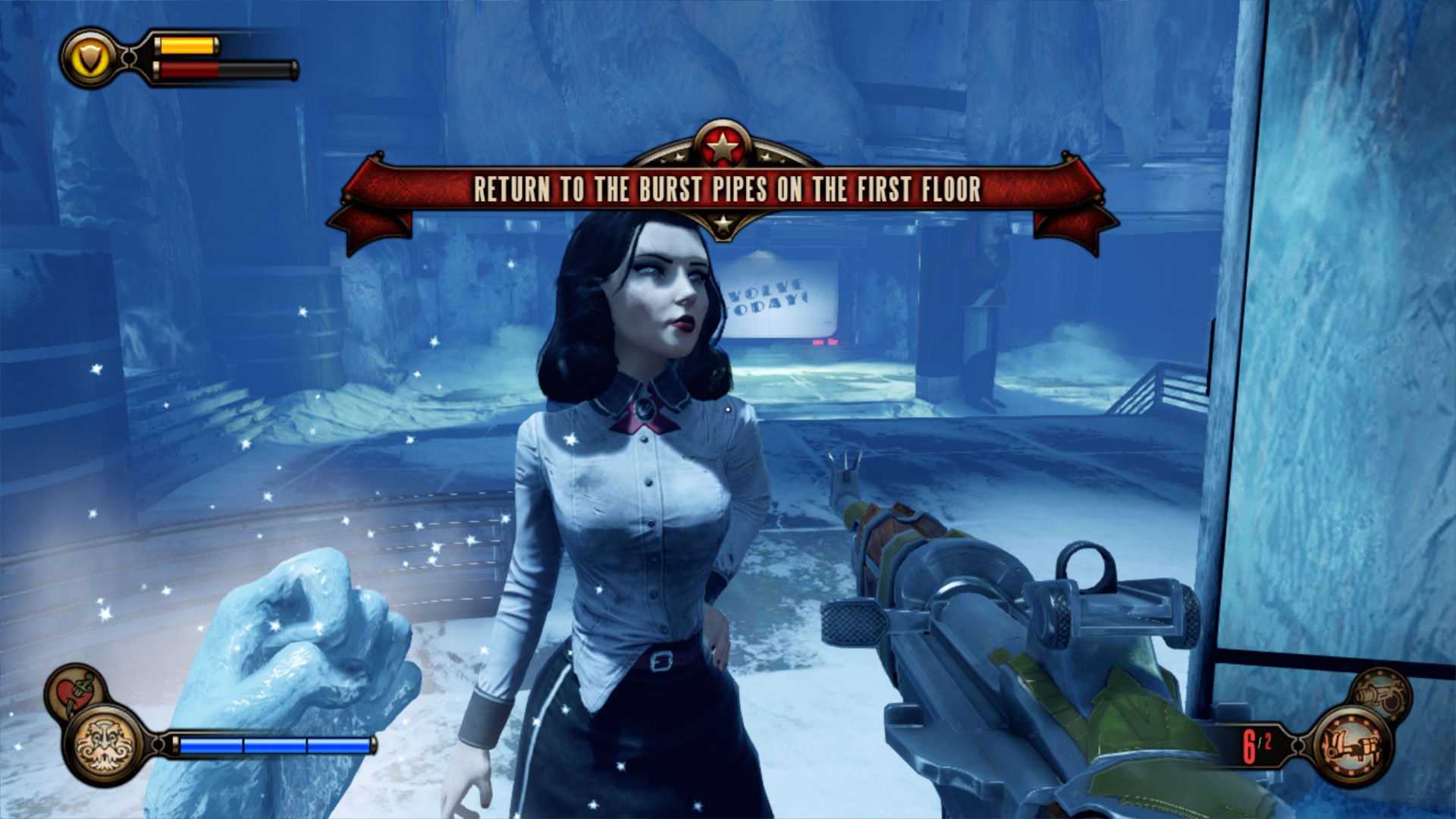
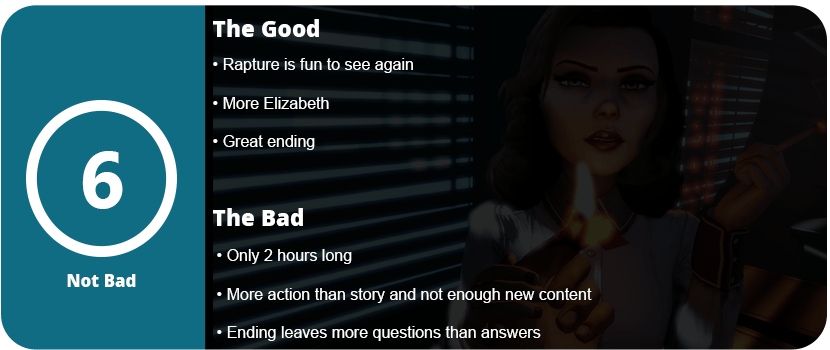
The long-awaited Infinite expansion set in Rapture is out and about. I honestly didn’t know what to really expect from this other than more questions and fan service from Rapture. The story started out very similarly to BioShock 1, where you are riding down the bathysphere into Rapture. It brought back a lot of great memories, and I was happy to see the beautiful Elizabeth throughout the whole chapter. What I wasn’t happy about was the length, the gameplay, and the lack of anything memorable.
You feel more like one level from a full game. The one level that is really just action is more than the story. It doesn’t pick up at all until the last 2 minutes of the ending, which is both shocking and expected and gives us more questions than answers. The same infinite guns are back, but with only one new power, and that is Old Man Winter. It is not much different from the freeze power in BioShock 1. It can freeze running water to make a bridge, and that’s about it. I ran around closing vents to draw Sally out (the girl who Booker must get back) and not much else. The ammo is extremely scarce, so you will be scrounging for it more than at any other moment in previous BioShock games. You also don’t get the full arsenal in Infinite, and nothing much else has changed gameplay-wise.
The setting is fantastic, however. The underwater city is memorable, and it’s great to be back before it went to crap from the previous games. We are seeing the calm before the storm here. The Little Sister program is starting, and so are the new Plasmids. It’s very interesting to see how things are happening when everything is prosperous and fun in the underwater utopia. Another great addition is the return of Sander Cohen, who is probably the most insane person in Rapture. This section is memorable but dies out quickly with more boring shooting and getting lost in hallways.
Outside of the interesting ending, there’s not much else. This was a real disappointment because of how long everyone waited. The gamer who just played Infinite and moved on shouldn’t even bother. This DLC is mainly for hardcore fans who actually want the ending in Episode Three rather than the tidbits from each episode.
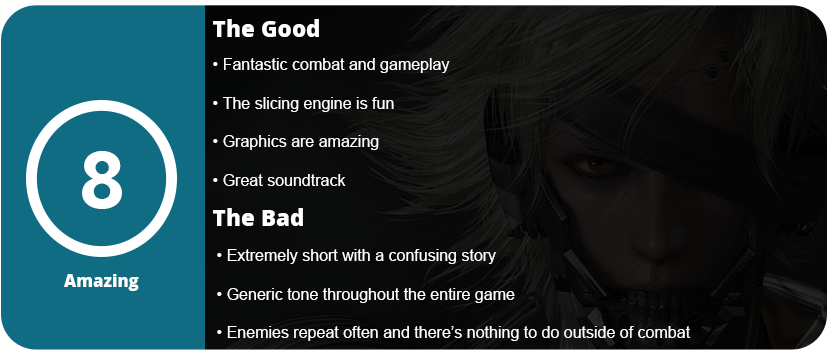
The Metal Gear franchise hasn’t seen too many spin-offs. Acid is the last one. Revengeance puts you in the shoes of Raiden, a cyborg fighting against other cyborgs for the greater good. The plot is supposed to hover around MGS4, but it’s boiled down to a confusing and ultimately uninteresting mess. There’s something going on about children’s brains being harvested for implants and people making money off of war. Raiden is the good guy trying to stop all this, but the game is so short and broken up so much that it’s hard to follow.
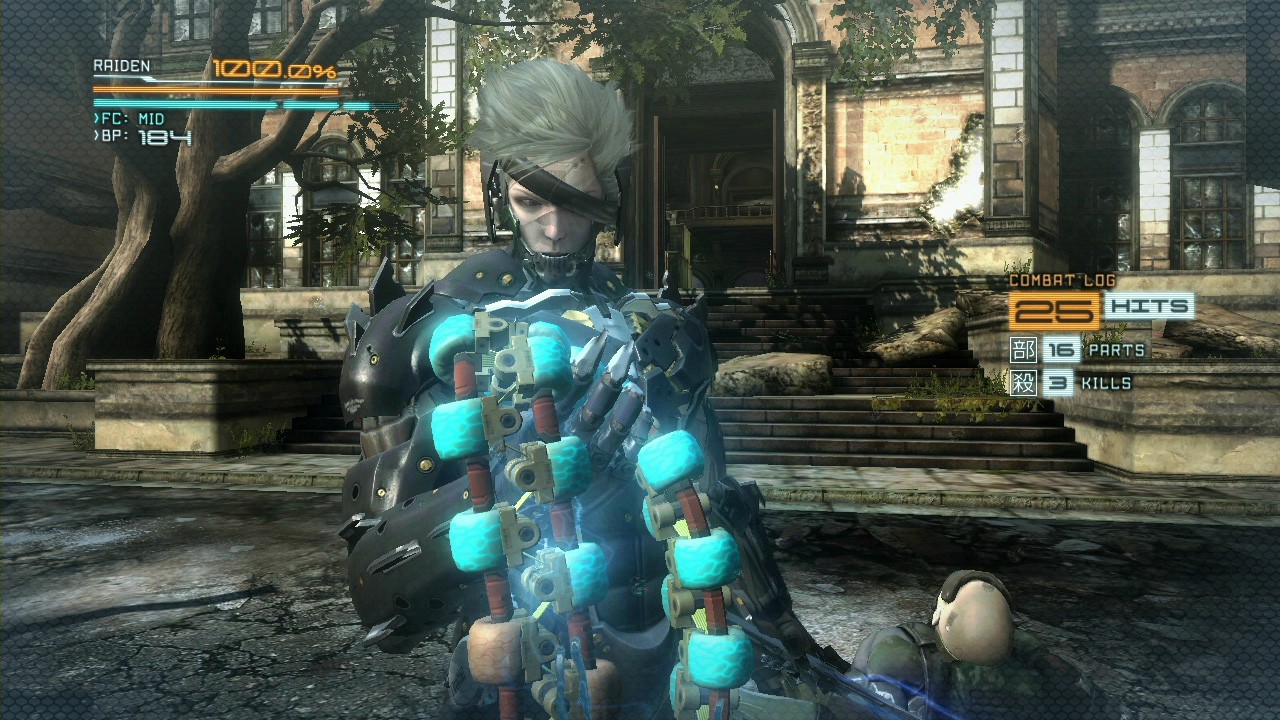
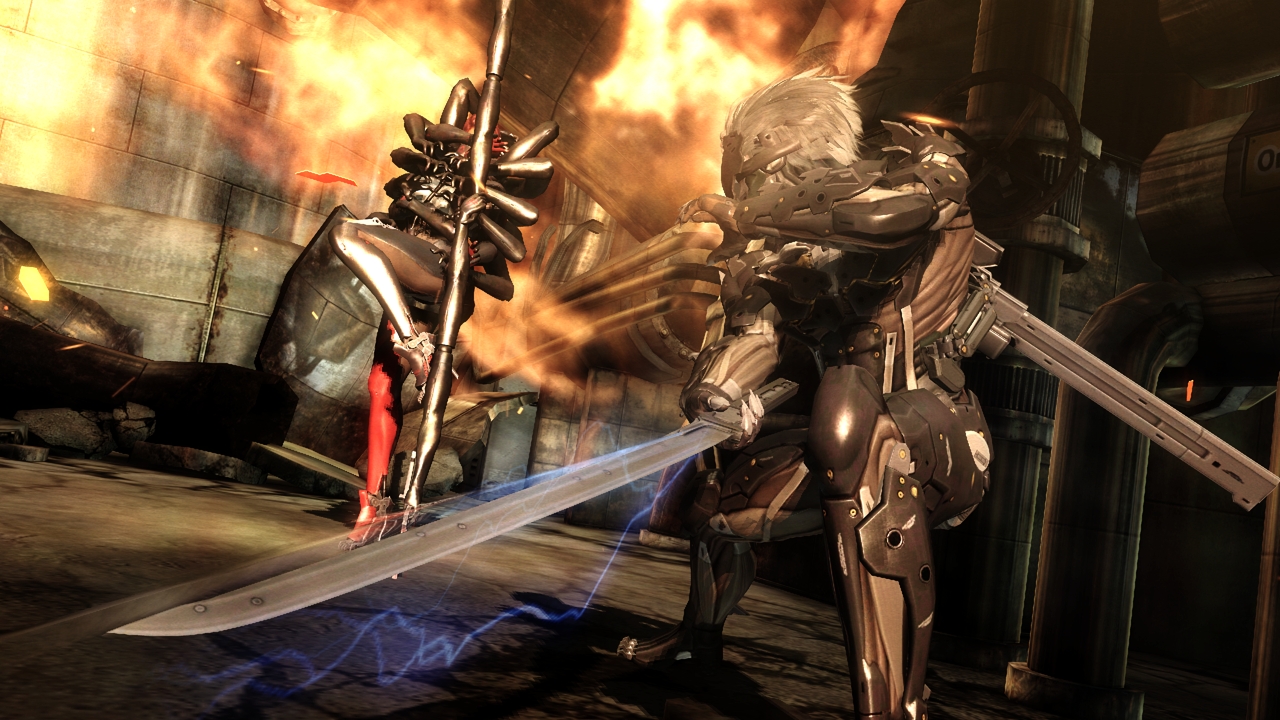
What is great is all the action. Raiden responds wonderfully and has an array of flashy moves that would put most action-adventure games to shame. As you progress through the game, you can upgrade your life, fuel cells, weapons, and moves. The whole game pretty much revolves around a slicing engine. When you defeat an enemy enough, you can slow down time and use the right analog stick to slice enemies up into ribbons. It’s pretty fun and never really gets old, but it’s sensitive and sometimes finicky. Boss fights will rely on this, and line-up squares can cost you the entire battle if you aren’t quick enough.
I honestly wish Platinum never put stealth sections in the game. This isn’t Solid Snake; I want to run around slicing things up. The enemy placement isn’t smart and laid out like in a typical Metal Gear game. You get seen most of the time, even if you try hard not to. One problem lies in the fact that there’s not much else to do. It’s just wave after wave of enemies and then a boss fight. It also doesn’t help that the game is ridiculously hard outside of easy mode. Even though it took me less than 6.5 hours to finish the game, it was broken up throughout a year of playing. I would spend hours in some areas just because of how hard the game can be. There’s no block button. Let me throw that out there right now. Instead, you can dodge and parry, which is extremely difficult to do. You can die in just a few hits, and healing relies on slicing enemies at the right moment and getting their nanostrands to fully heal. You must slice them before they hit the ground; this can be really tricky to master.
The enemies also repeat often, and the game is overly generic in tone. Sure, the graphics are fantastic, the music is great, and the action is fast-paced and looks amazing. However, the enemies are just generic soldiers and geckos. The environments nearly all look the same, and some boss fights even repeat. I appreciate the difficulty that forces you to master the combat system, but a larger variety of gameplay would have been nice.
So the final question is this: Is revenge the be-all-end-all of the action-adventure genre? Not likely. Sure, it’s up there with some of the better games combat-wise, but everything else just falls a bit flat.
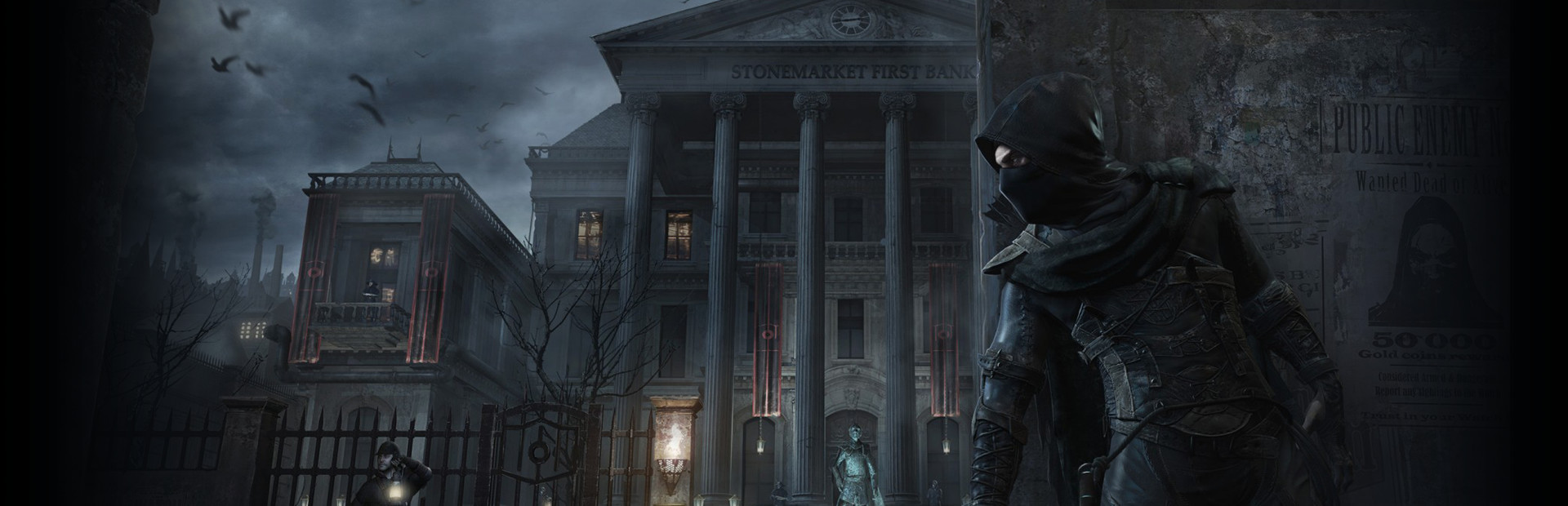
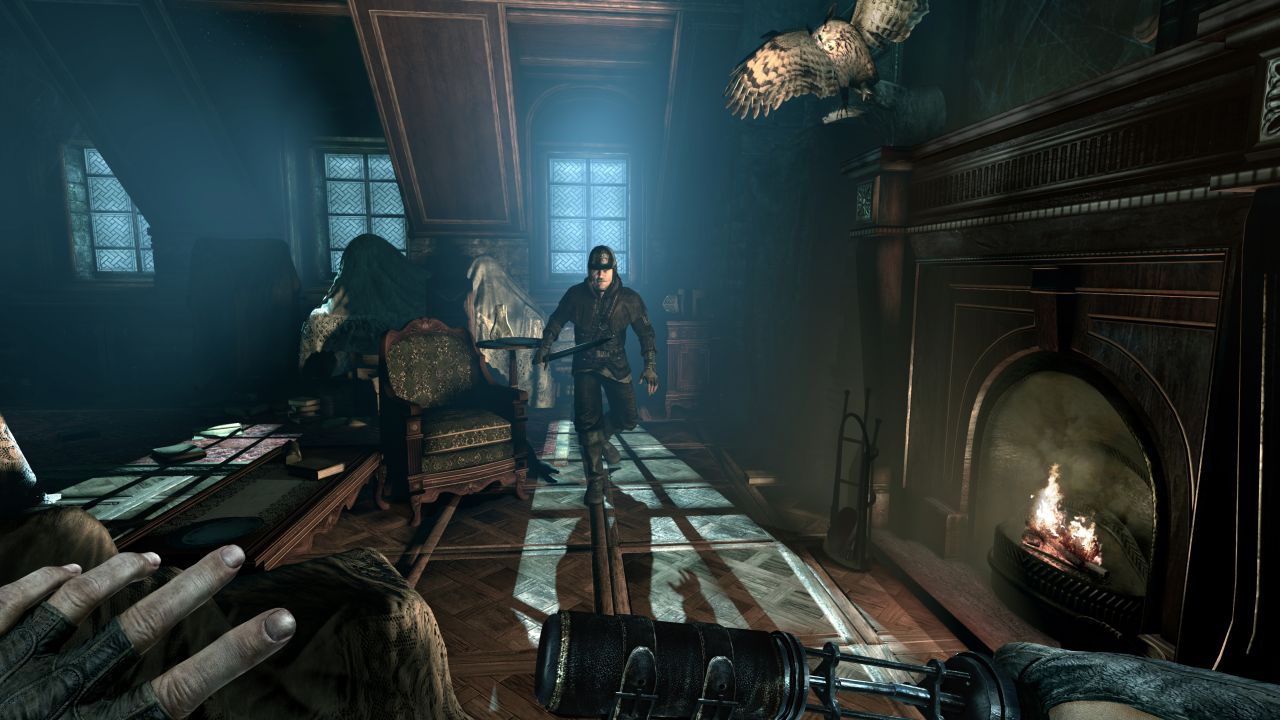
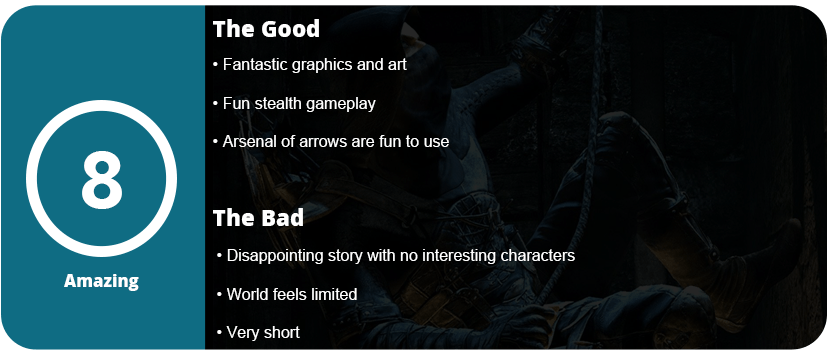
Thief has been one of those franchises that has been on the back burner of gamers’ minds for over a decade. Like Deus Ex, Duke Nukem, and various other decade-long franchises, Thief went through its own development hell. The end product isn’t exactly something that’s worth waiting ten years for, but it’s a fun game with fantastic visuals and some great stealth gameplay.
I will come right out and say this: the story is almost complete garbage. It’s a discombobulated mess of disjointed segments strewn together in eight chapters of gameplay. You play as a master thief, Garret, who is trying to get his friend Erin back, whom he let down during a big heist. You need to get a hold of some powerful people to answer some questions and find a mysterious stone. There is some anarchy and revolution thrown in, as well as some sort of plague called The Gloom. I honestly don’t know why any of this is happening or why Erin has a power called the Primal. It’s a huge mess, and nothing is ever explained. That’s too bad for a game, as cinematic as it is, that can’t tell a decent story. At least the gameplay is fun, and that’s why most people are here.
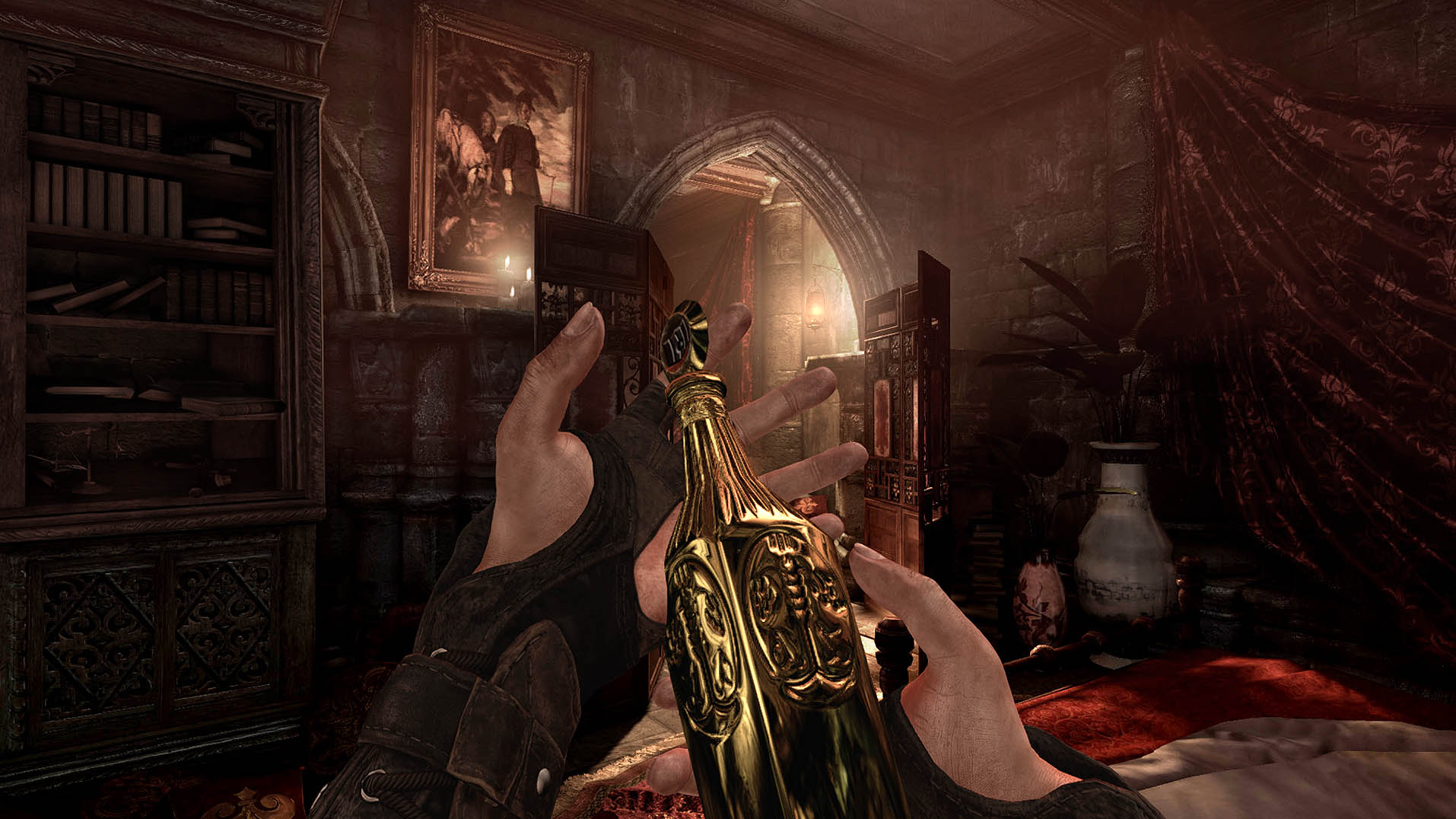
The stealth gameplay consists of sneaking and hiding in the shadows, like in previous Thief games. Garret isn’t really about killing enemies, so you just knock them out with your famous Blackjack. You can kill enemies by using arrows, but it takes away from your level score. Like in past Thief games, arrows are your whole arsenal. Water arrows can put out fires, giving off light; rope arrows can help you swing to a new area to get around guards; poppy arrows can stun enemies; and blast arrows can take out a group of people or cause a distraction. Your arrows are a playground for anything you want them to be to your heart’s content.
Like in previous Thief games, you can take multiple paths to get around guards completely undetected or by taking them out one at a time. Some of the paths are hard to find, and some just lead to the treasure. Picking locks and finding loot to gain gold are very important if you want to stay stocked up on arrows. Sometimes it’s not worth getting caught just for a piece that’s worth 10 gold. Sometimes animals are guarding a piece, or there are too many guards or lights to get around. Thankfully, vertical play is quick thanks to your claw, which lets you climb taller areas.
An odd addition to the series is weird creepy horror segments straight out of Amnesia. You can’t kill these things; you can only sneak around them. Sure, they were creepy, but why? It felt out of place. Also out of place are the awkward boss “fights” that just feel loose and sloppy—maybe even shoehorned in. The flow of the game is also off quite a bit, with side missions taking you to weird areas of town and not really being worth anything. I honestly felt the whole world was limited to just side missions when it could have been a whole larger open world.
Outside of all that, there’s not much else to the game. It doesn’t feel like the ultimate revolutionary stealth game like the first two games felt. The AI is dumb most of the time, and the game can be beaten in less than 8 hours, even if you try to gather all the loot. With side missions, you may extend to 20 hours, but just barely. The graphics are just fantastic, with advanced DirectX 11 effects and a great art style that feels like Thief; there aren’t even any memorable characters in the game—Garret included. What we have is a fun weekend rental and nothing more.










































 thebinarymessiah.com
Try multiplayer. A lot of fun !